A state of international health emergency (PHEIC) has been declared since early 2020 due to a sharp increase in coronavirus (COVID-19) infections. The virus has changed the way people approach every issue in their lives. In particular, the pandemic ushered in a new era in education. The purpose of the study is to analyze the steps taken in the field of education in Azerbaijan in response to the requirements of the pandemic period, the transition to online education, and the difficulties encountered in online learning. This article will be useful for future generations, reflecting on the transition to e-learning and the experiences gained during this transition.
Introduction
The COVID-19 virus, which started in December 2019 in China’s Wohan province and spread around the world, has made an extraordinary difference in most areas of life. The quarantine days announced within the countries, public catering facilities, cultural centers, as well as elite trade facilities, whose activities were temporarily restricted, created a different routine in people’s lives. However, the difficulties caused by the COVID-19 virus did not end there. Education, which plays an invaluable role in the development of generations, has also undergone a form change in this process. This serious virus, which spread around the world, arrived in Azerbaijan, albeit a little late.
Despite the implementation of numerous preventive measures (restriction of entry and exit to the country, strict inspections at customs checkpoints, quarantine of foreign citizens without exception), Azerbaijan has also joined the processes taking place in the world. The accession was prompted by the World Health Organization’s official declaration of COVID-19 as a pandemic. It was decided about the organizations and enterprises where the risk of spreading the virus is high. Thus, on March 2, in order to prevent the spread of COVID-19 infection, increase the effectiveness of measures taken in this area, and strengthen medical prevention, from March 3–9, 2020, all educational institutions of the country suspended teaching and other related activities. According to the relevant order of the cabinet of ministers, to prevent infections and continue medical-prophylactic, disinfectant, and other preventive measures in all educational institutions located in the country, from March 10 to 20, 2020 (the first training day was March 27), the process of teaching and learning in all educational institutions was suspended, and all measures in this regard have been postponed. The main objective of this study was to analyze the process of transition from traditional to online education in institutions, especially universities, based on observations and surveys in connection with the spread of COVID-19 infection in Azerbaijan since March 2020.
Azerbaijan state oil and industry university
Being the pioneer oil and gas educational school across Europe and Asia, the Azerbaijan State Oil Academy [now Azerbaijan State Oil and Industry University (ASOIU)] was founded in November 1920. Covering several scientific institutes and 18 scientific research labs, ASOIU provides education to both local students and international students. ASOIU is one of the first higher education institutions in Azerbaijan, as well as one of the top five higher education institutions in terms of the number of students. I am lecturer of BA programs, which is one of main departments of ASOIU. The goals of the core program are to provide students with the opportunity to develop their communication, social interaction, leadership, and teamwork skills. The core program will also provide students with a basic understanding of the business environment in support of the learning objectives of each specific major concentration (http://mba.edu.az/). It should be noted that online classes for bachelors in ASOIU’s BA programs started March 29, and for masters on April 3. Since March 31, classes are 100% online. ASOIU has launched an online university system that meets high standards—Unibook, so online learning has started easily. Attendance at online classes was not mandatory due to the weakness of the internet in the regions and limited student access.
An overview of the role of instructional technology prior to the first impact of the pandemic
Despite the relevant decision of the cabinet of ministers to suspend the teaching and learning process in all educational institutions from March 10 to 20, 2020 (the first day of study is set for March 27), the Azerbaijani educational space (whether secondary, as well as in higher education institutions) were not ready for this process. Because until our time, the diplomas of distance learning students were not recognized in the country, admission to part-time education was kept to a minimum, and most importantly, a certain generation preferred to use only traditional methods in the educational process. On the other hand, many pupils, teachers, and students lacked personal electronic equipment, and most had limited access to the internet. Especially in the cities and districts outside the center, in remote villages, there are problems with access to the internet. Another issue is that teachers who are accustomed to teaching with traditional teaching methods were less aware of innovative teaching methods. For this reason, the teaching process in the second half of the 2019–2020 academic year was unsatisfactory.
Transition to online education in azerbaijan
The introduction of the Microsoft Teams platform by the Ministry of Education also showed that although domains have been created for all higher education institutions, some universities are not fully prepared for distance education. Since online education is distance learning, it is essential that this form of education be of high quality. To do this, universities must be fully prepared in terms of information and communication technology, as well as provided with electronic textbooks. It should be noted that currently a number of higher education institutions of our country (ADA University, ASOIU BA programs, Azerbaijan-French University, Azerbaijan State Economic University, etc.) have provided distance learning (https://mektebgushesi.az/2020/06/22/ilqar-orucov-az%C9%99rbaycan-t%C9%99hsili-t%C9%99kc%C9%99-pandemiya-dovrund%C9%99-deyil-post-pandemiya-dovrund%C9%99-d%C9%99-cagirislara-aciq-olmalidir/).
Taking into account the fact that students and teachers in secondary schools in the country are not fully prepared for this process, it was decided to start the program “Lesson Time” in TV programs. All shown TV lessons are then posted for free use on the electronic portal of the Ministry of Education www.video.edu.az and on the official Facebook page, as well as on the YouTube channel, which creates additional opportunities for students. In addition to TV lessons, there are 2 hours of interactive homework assignments each week, which provides feedback to students (https://edu.gov.az/az/page/9/18449). However, although the organization of teaching here was one-sided, students watched the TV program as a listener, and there was no feedback from the program’s lead teacher.
Although higher education institutions have switched to the online process due to the above-mentioned problems, students have been granted one-semester discounts. Under these discounts, students were given the privilege of not joining classes if they did not have internet access and taking exams with simpler questions at the end of the semester. For example, some higher education institutions (Azerbaijan State Economic University) have accepted certificates obtained from online courses for students (such as Coursera) as test results (https://apa.az/az/blog/Koronavirus-pandemiyasi-Azrbaycanda-thsil-v-onun-glcyi-69).
March 2020
The process of suspending the teaching and learning process in all educational institutions operating in the territory of the Republic of Azerbaijan was carried out in several stages. As a first step, as mentioned above, on the basis of the relevant decision of the Cabinet of Ministers of the Republic of Azerbaijan, the process of suspending the teaching and learning process in all educational institutions in connection with the COVID-19 virus was extended from March 3–9 (https://nk.gov.az/az/document/4308/), and then from March 10 to 20 (https://nk.gov.az/az/document/4320/).
As March 20–28 is a national holiday in Azerbaijan, the next decision was made on March 29. Thus, by the relevant decision of the Republic of Azerbaijan’s Cabinet of Ministers, the process of suspending the teaching and learning process in all educational institutions of the country was extended from March 29 to April 18 (https://nk.gov.az/az/document/4339/). Despite the suspension of the educational process in all educational institutions in Azerbaijan from March 3, 2020, the online education system in the country was officially launched only on March 29 because the universities, hoping that this period would end soon, could not decide on the form of education.
At the same time, during this period, the guidelines for preventive measures to prevent the spread of coronavirus (COVID-19) infection in educational institutions” were developed and implemented. Systematic disinfection work began in all educational institutions.
April 2020
March 29–April 18, 2020, was the first stage of online education in all educational institutions of the Republic of Azerbaijan. During this period, the lack of experience in online teaching methods of universities, the fact that lessons are still based on traditional teaching methods, and the lack or weakness of teachers’ ability to work on online platforms created many difficulties at the initial stage. In this context, many teachers need to be trained in the use of online platforms.
To help in this regard, many universities have developed guidelines for the use of these platforms and sent them to all teachers. Although the ministry of education has recommended the Microsoft Teams platform for online teaching, some higher education institutions have begun to use other platforms (platforms of choice for teachers). With online classes I taught at ASOIU, I started to make a difference in the adaptation of students to the online learning environment using platforms such as Gotomeeting, Edsoft, Zoom, and Click meeting.
Furthermore, the use of innovative tools in addition to the teaching method has increased the interest in online learning in the groups I teach. However, the number of teachers with previous online teaching experience in the teaching process was very small. At the same time, there are serious difficulties in determining the hours of online classes by many universities, which have always had experience in organizing classes on a traditional basis. Thus, some universities have defined online classes as 90 minutes per hour, as in the traditional form, and began to organize it according to the traditional schedule. This allowed these platforms to freeze and did not meet the online teaching time standards applied at various foreign universities. However, in some universities, including the BA programs of the Azerbaijan State University of Oil and Industry, where I teach, teachers were assigned to organize the lesson on a semester basis, and each teacher reported weekly to the BA department on the subject he taught. The report was presented in written and video recording format.
Students living in different regions of Azerbaijan, but without access to the internet (video screen platforms), were sent lesson recordings, and it was planned to organize the exam for them at the beginning of the next academic year (September). However, the persistence of the virus to date has made it difficult for those students to take the exam.
Due to the increase in the COVID-19 virus, the next relevant decision of the cabinet of ministers allowed people to go outside for 2–3 hours a day, and at the same time, suspend the teaching and learning process in all educational institutions of the country from April 20 to May 2, 2020 (the first school day was set for May 4) (https://nk.gov.az/az/document/4385/). During this period, in parallel with the online classes, the students were informed of the time of the midterm exam, which will be held on the first 15 days of May, and the rules of its organization. A 2–3 hours’ time frame for the mid-term exam was determined. The choice of platform to be applied was determined by the teacher.
May 2020
Due to the current situation, the next relevant decision of the cabinet of ministers extended the process of suspending the teaching and learning process in all educational institutions of the country from May 4 to May 31, 2020 (the first day of study is set for June 1) (https://nk.gov.az/az/document/4402/). During this period, midterm exams were organized on the first 15 days of May. At the same time, based on the recommendations of the BA department, the supervising teachers began to hold online meetings with both master’s and bachelor’s students to improve their dissertations. According to the relevant decision of the BA department, students had until May 31, 2020, to submit the final version of the thesis.
It should be noted that in previous years, the school year ended on May 31, but was extended until June 15, 2020 due to a pandemic in Azerbaijan.
June 2020
The steady increase in COVID-19 forced the cabinet of ministers to make another decision, according to which by the end of the 2019–2020 academic year (until June 15, 2020) in all educational institutions operating in the territory of the Republic of Azerbaijan the process was stopped (https://nk.gov.az/az/document/4475/). The online learning process continued until June 15. During this period, along with the online teaching process, the students’ final assignments were listened to and the rules of the online final exam were explained to them. The online organization of the final exam process was planned for 3–4 hours.
The dates of the exams were set by the BA department in consultation with the teacher and were held from 16 to 30 June. At the same time, the defense process of undergraduate and graduate students in June was simplified, and the defense of their dissertations was assessed online.
End of the academic year (2019–2020) to the next academic year (2020–2021)
The end of the pandemic caused by the COVID-19 virus has already posed great challenges for educational institutions. Thus, appropriate preparations had to be made in the summer months. These preparations included e-learning trainings for teachers, opening official emails for students through the university website and submitting them to the program, as well as instructing administrative staff. The virus has also affected the preparation of students who graduate from high school and are admitted to higher education. This is because the low or no internet access of secondary school students in different regions of Azerbaijan created serious difficulties in their university preparation process and led to the failure to achieve the high results required for university admission.
Survey results: evaluation of students’ approaches about online learning
In order to get accurate results in the research, an online survey was conducted among the students and academic staff of the higher education institution where I am teaching. A total number of 63 people took part in the survey: 20% of respondents were between the ages of 18–22, 31% between the ages of 23–25, and 36% between the ages of 26–35. The number of respondents over the age of 36 was only 11%. This means that the younger generation is more interested in this type of research.
If we look at the gender composition of the respondents, we see that 57% of the number are men and 43% are women. One of the most interesting points is the level of education of those who participated in the survey. Thus, it is clear from the results obtained that most of those studying at the master’s level were interested in the survey and made up 46% of respondents. After that, the next advantage belongs to the bachelor’s degree students. They made up 25% of respondents. Doctoral and college students each accounted for approximately 14%.
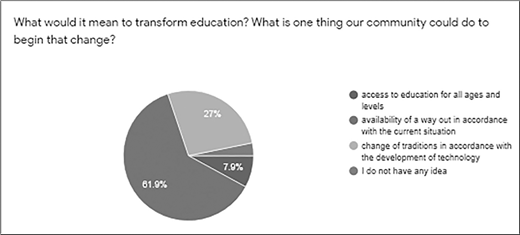
When respondents were asked what the transformation in education meant to them, they gave different answers. Although the answers in Figure 1 are very diverse, 62 participants attributed this transformation to the current situation, while 27% of participants noted that learning traditions change with the development of technology.
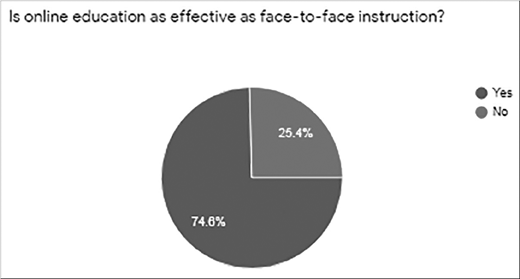
The most questionable part of the online lessons in the transition from the COVID-19 pandemic is how effective it is compared to traditional education. With this in mind, respondents were asked about the comparative effectiveness of online education with face-to-face education, and as a result, 75% of respondents answered in the affirmative (Figure 2). On the one hand, this can be considered satisfactory for the current period. Thus, if society accepts the effectiveness of online education, the steps taken during the COVID-19 pandemic will not be ineffective.
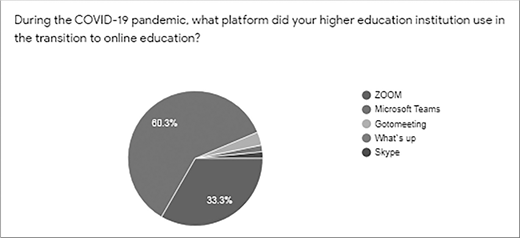
To date, the lack of emphasis on online education in the country or its limited application to individual educational institutions has not allowed the introduction of online learning platforms. Therefore, in the early days of the pandemic, teachers used various means (Zoom, Microsoft Teams, Skype, among others) to prevent incomplete education. However, two of them (Zoom and Microsoft Teams) were more effective. The answers obtained during the survey also showed this. As shown in Figure 3, 60% of participants reported using Microsoft Teams, and 33% using ZOOM during learning process.
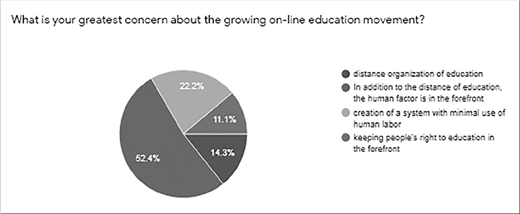
As shown in Figure 4, in response to the question of what is your greatest expectation in the transition to online education, a larger majority (52.4%) noted that the human factor is important regardless of the form of education. As can be seen from the chart, even 11% of the participants mentioned that the most important aspect of online education is access to lifelong learning.
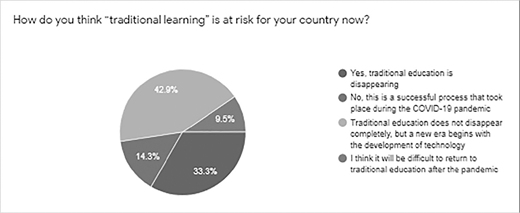
One of the concerns of experts, as well as the public, is that online education is overturning traditional education over time. People think that if this continues, interest in traditional education may decline over time. When asked about this in the survey, respondents (43%) said that traditional education should be promoted with the development of technology. It was interesting that 33% of participants noted the possibility of the disappearance of traditional education with the expansion of online education (Figure 5).
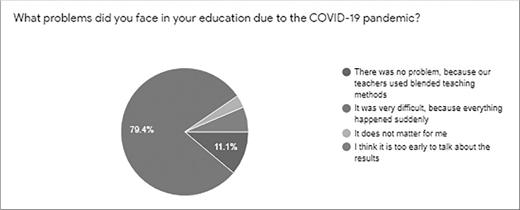
The COVID-19 virus, which has been spreading around the world since December 2019, has caused a shock effect among people in the field of education as well. This can be clearly seen from the chart above. Because when asked what problems they face in the transition to online education, 79% of respondents said that everything happened suddenly and caused serious difficulties (Figure 6).
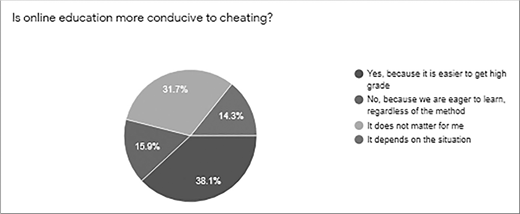
The transition to online education is also difficult for the country’s population because it was thought to lead to irresponsible behavior on the part of students. In this regard, during the survey the question on “Is online education more conducive to cheating?” was asked and the answers received were retail approaches. Thus, 38% of students said that it is easier to get a grade in online education; 14% of students said that this situation was related to the situation (Figure 7).
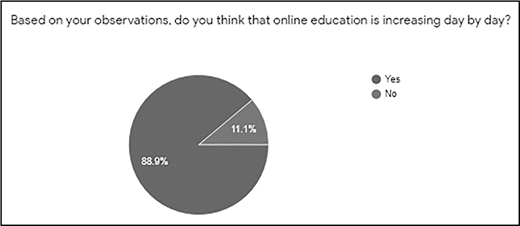
In addition to boosting online education, the COVID-19 pandemic has expanded its application at all levels (primary school, secondary education, higher education, various training courses, etc.). As can be seen from the figure, 89% of the participants observed that online education was expanding day by day (Figure 8).
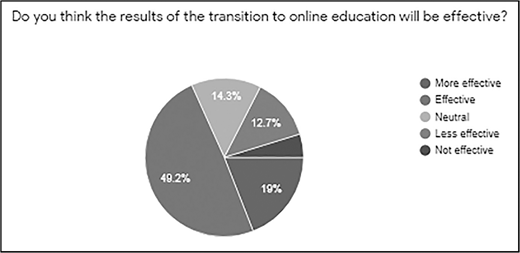
As the respondents were mainly students, they were asked whether the transition to online education would be effective or not. It is gratifying that in the ongoing processes, 49% of respondents said that the results were effective and 19% were even more effective (Figure 9).
Current status of study process in azerbaijan universities
Starting from September 15, full online education has been introduced in higher education institutions. The Zoom platform was introduced in secondary schools, and the Microsoft Teams platform was introduced in higher education institutions on the basis of the relevant recommendation of the Ministry of Education. The hours of online classes have also been shortened, unlike traditional classes. Thus, it was recommended to reduce it from 45 minutes to 30–35 minutes in secondary schools, and from 80–90 minutes to 45–60 minutes in higher education institutions. Only in some dual degree programs and depending on the nature of the specialty, the 80-minute lesson mode was maintained.
Conclusion
Admittedly, during the coronavirus pandemic, online education saved the education system from a critical situation not only in Azerbaijan but around the world. This crisis has given us an opportunity to rethink how education is organized. Undoubtedly, online education cannot replace traditional education. Many people still do not understand the essence of online education because they approach it as an alternative to distance learning. However, online education is more successful than traditional part-time education. In fact, online education, which is a modern form of education, is in support of traditional education. At the same time, it can act as a basic form of education in critical situations. The coronavirus pandemic has shown that it is important to ensure the future development of online education.
Surveys also showed that respondents emphasized the effectiveness of online education, that online education is not a serious risk to traditional education, and that it is evolving day by day, no matter how chaotic it may be.