Although previous research has identified undergraduate student motivations for selecting online courses over face-to-face courses, this work tended to examine students as a single group. The current research presents survey results of business school students demonstrating that these motivations differ significantly by classification. Freshman select online courses primarily due to a belief that they are easier than face-to-face courses. Sophomores and juniors select online courses primarily because of available seating. Seniors select online courses largely because of their availability and their convenience.
Introduction
Online courses are an increasingly important part of undergraduate education. Both the number of courses offered online and enrollment in them is growing, and they form a key part of strategy for many higher education institutions (Allen & Seaman, 2014). Their importance was solidified by COVID-19. The widespread shift online seems to have paved a path for online courses in the postpandemic future (Lockee, 2021). Many institutions complement traditional face-to-face courses with online modes, giving students the choice between modality for many of their courses. Therefore, administrators and instructors must have a solid understanding of the reasons why students select online courses. Previous research investigating these reasons has identified key themes, including convenience provided by online courses, the availability of seating, and the perceived simplicity of online coursework (Kuzma et al., 2015; McPartlan et al., 2021; O’Neill et al., 2021).
However, the previous literature viewed undergraduate students as a group. Yet, over the course of their degree, students’ preferences can change. The current research compares students’ reasons for enrolling in online courses by their classification and finds key differences. Freshman select online courses largely due to a belief that online courses are easier than face-to-face courses. Sophomores and juniors select online courses primarily due to seating and course availability issues. And compared to their peers, seniors prioritize online course convenience.
Because courses are targeted to students based on their classifications, it is important to understand how student classification impacts their preferences. The next sections cover students’ key motivations for selecting online courses and outlines rationales for why these motivations vary by classification.
Conceptual Development
To examine students’ selection of course modality, the current research focuses on degree programs where both online and traditional face-to-face courses are offered, which excludes distance education and other exclusively online programs. It also excludes hybrid courses and course management systems that supplement face-to-face delivery with online aspects (Allen & Seaman, 2014). Perceptions of course modality can vary by classification.
Four-year degree programs typically recognize four levels of student classification based on credit hours completed: freshman (fewer than 30 hours), sophomore (30–59 hours), junior (60–89 hours) and senior (90+ hours) (Knepper, 1990). These correspond with classification systems based on the year of enrollment (first year, second year, and so forth). The next section reviews motivations for selecting online courses organized into three categories: their convenience, availability, and perceived simplicity. Finally this section predicts how student classification can affect these motivations.
Convenience
Perhaps the most widely discussed reason why students prefer online courses is their convenience. Previous literature typically distinguishes two types of convenience. First, online course formats can offer convenience by helping to accommodate students with different abilities (Van Wart et al., 2020). Second, because online courses often do not have a scheduled meeting time and location, they provide a flexible option for students dealing with other obligations (Harris & Martin, 2012; Jaggars, 2014).
Convenience to Help Accommodate Different Abilities
Several students face challenges with mental or physical health that can make attending face-to-face classes difficult. Among undergraduates in the U.S., 40% reported mental illness and 19% reported some type of disability (National Center for Education Statistics, 2019). Mental health issues, especially anxiety, frequently disrupt academic progress (Van Amerigan et al., 2001), and students struggling with these issues often find that online courses can help them avoid stigma and overcome these constraints (Kotera et al., 2010). Furthermore, online courses can serve as a type of assistive technology. Although most students believe that they will learn more in face-to- face courses (O’Neill & Sai, 2014), others find the self-pacing and video presentation typically found in online courses more effective (Clayton et al., 2010). Other students prefer online formats for comprehending the subject matter and interacting with instructors and classmates (Van Wart et al., 2020).
Convenience to Deal With Obligations
In addition to their coursework, many students have careers, family, and other obligations. More than half of U.S. undergraduates are employed, with 36% working part time and 26% working full time (National Center for Education Statistics, 2015). Many students also care for dependents. Twenty-two percent of U.S. undergraduates are parents (Cruse et al., 2019). In the U.K., estimates indicate 8% of full-time and one third of part-time students are parents (Moreau & Kerner, 2012). These obligations make the convenience of online courses particularly attractive (Harris & Martin, 2012; Mann & Henneberry, 2012). Students who are employed are significantly more likely to take online courses than nonemployed students (National Center for Education Statistics, 2015). Likewise, students caring for dependents were more likely to take courses online (National Center for Education Statistics, 2015).
The importance of convenience-related factors likely depends on student classification. It often takes time for students to recognize their disability and how online courses can benefit them (Dickey, 2022). Moreover, students may be more likely to begin careers as they near the completion of their degree, and older students may be more likely to have family obligations (Mann & Henneberry, 2012). Therefore, the convenience of online courses should be a more important reason as student classification increases.
Availability
During enrollment, students often face hurdles finding courses with open seats that fit their schedule. Increases in the number of students and reduced budgets have crowded classrooms, creating competition for available seats, and courses are often offered during the same time slot (Gurantz, 2015). Online courses can help overcome these space and scheduling constraints (Harris & Martin, 2012). Unlike face-to-face courses, online courses are free from the constraints of classroom size. And many online courses have no set meeting time, thereby avoiding scheduling conflicts (Lei & Gupta, 2010).
Course availability becomes increasingly important to students of higher classifications. While lower level courses tend to be large, introductory classes with many available seats, upper level courses tend to be more specialized with smaller capacity. Moreover, students must complete required courses to fulfill their degree, creating less flexibility as they approach the end. Therefore, the availability of online courses should be rated as a more important motivator as student classification increases.
Perceived Simplicity
Course difficulty plays an important role in student course selections (Yu et al., 2021). Although students value intellectually challenging courses, they avoid difficult ones, particularly on topics where they feel inexperienced (Martin et al., 2008). All else equal, students prefer simpler courses with lighter workloads (Babad & Tayeb, 2003; Yu et al., 2021).
Some students prefer to take easy courses online but difficult ones in person to take advantage of face-to-face support (Jaggars, 2014). Other students believe that online courses have lighter workloads than face-to- face courses (O’Neill et al., 2021). And this belief seems to be more prevalent among less experienced students. Dobbs et al. (2009) collected opinions from students who had taken an online course in the past and those who had not. They found that those who had never taken an online course believed that online courses were easier, requiring less effort and time than traditional courses. Moreover, freshmen are particularly stressed and feel low selfefficacy about difficult courses and may be more motivated to select courses that they perceive are simpler (Zajacova et al., 2005). Therefore, beliefs about the simplicity of online courses should be rated as a less important reason as student classification increases.
Methodology
These predictions can be tested using the results of a survey of undergraduate business school students at Oklahoma State University in the spring of 2022. Students were asked about their experiences with online courses, and those who had chosen to take one were asked to rate their reasons for doing so.
Method
The survey was administered via email to a census of undergraduate business school students at Oklahoma State University, a total of 4,536 undergraduates. Participants were asked if they had enrolled in at least one online course for credit at Oklahoma State University (No; Yes, but I don’t intend to enroll in any additional online courses; Yes, and I hope to enroll in additional online courses) for the purposes of the current analyses the two yes responses were combined). An online course was defined as completely online, excluding hybrid courses that mix online with face-to- face delivery or one that transitioned online due to COVID-19.
Next, participants who had indicated that they enrolled in an online course were asked why they chose to take their most recent online course, reflecting the reasons identified in prior literature. They answered 14 items describing reasons for taking an online course on a 5-point scale (1 = strongly disagree, 5 = strongly agree; see Table 3). Finally, participants provided their student and demographic information. The final sample included 200 students (10.5% freshman, 26.0% sophomore, 30.5% junior, 33.0% senior). Table 1 provides an overview of their demographics and other characteristics.
Results
One hundred and eighty students had taken an online course. See Table 2. As expected, the likelihood of having taken an online course increased with classification (?2 (3, N = 200) = 26.71, p < .001).
Reasons for Taking Online Courses
The next analysis examines students’ reasons for selecting online courses. The 14 items were classified using exploratory factor analysis. Loadings were rotated using oblimin rotation and factors were extracted using principal axis factoring due to several items with skewed distributions (Costello & Osborne, 2005); six of the items had skewness greater than 1 or less than -1. This particular extraction method does not affect the conclusion; other methods—maximum likelihood and unweighted least squares—produced the same results.
The appropriate factor structure was determined based on the cleanliness of the structure matrix loadings as well as theoretical issues (Costello & Osborne, 2005). Five versions of the model were considered, varying the number of factors from two to six. The six-factor solution was discarded because one factor yielded no dominant items (all less than 0.3) and five items crossloaded on multiple factors (greater than 0.3). The five-factor and four- factor solutions were discarded for multiple crossloading items. Both the three-factor and two-factor structures had no crossloading items. However, the two-factor solution was discarded based on theoretical grounds, because it did not distinguish between availability and convenience, which prior research treats as distinct issues (Kuzma et al., 2015). Therefore, three factors were adopted.
The three factors correspond with primary motivations: convenience provided by online courses, the availability of online courses, and the perception that online courses are simpler than face-to-face courses. See Table 3. The corresponding items were averaged to create scales for convenience (a = 0.80), availability (a = 0.65), and perceived simplicity (a = 0.87). As shown in the next section, the importance of these reasons depended on student classification.
Reasons for Selecting Online Courses by Student Classification
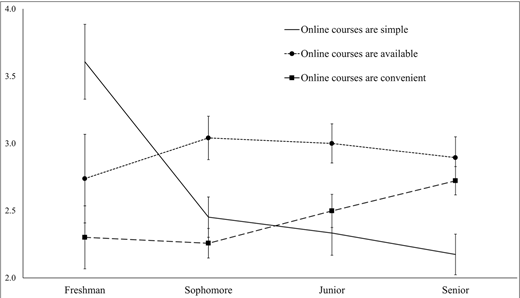
Students varied in their reasons for taking online courses (see Figure 1). For freshman, the highest rated reason for taking an online course is their belief that it would be easier than a face-to-face course. Perceived simplicity (M = 3.61) was rated significantly higher than convenience (M = 2.30; t(13) = 3.26, p = .006) and marginally higher than availability (M = 2.74; t(13) = 2.10, p = .056). Convenience and availability did not differ (t(13) = 1.15, p = .272).
On the other hand, sophomores primarily chose online courses because of registration concerns. Sophomores rated availability (M = 3.04) significantly higher than perceived simplicity (M = 2.45; t(40) = 3.24, p = .002) and convenience (M = 2.26; t(40) = 4.71, p < .001). Perceived simplicity (M = 2.45) and convenience (M = 2.26) did not differ (t(40) = 1.13, p = .264).
Juniors showed the same pattern as sophomores. Availability (M = 3.00) was the highest rated reason, significantly greater than perceived simplicity (M = 2.33; t(56) = 3.80, p < .001) and convenience (M = 2.50; t(56) = 2.30, p = .025). Perceived simplicity (M = 2.33) and convenience (M = 2.50) did not differ significantly (t(56) = 0.75, p = .459).
Seniors indicated two primary motivators for selecting online courses: availability (M = 2.89) and convenience (M = 2.72), which were rated equally highly (t(65) = 0.88, p = .385). Perceived simplicity (M = 2.17) was significantly less motivating than availability (M = 2.89; t(65) = 3.32, p = .002) and convenience (M = 2.72; t(65) = 2.94, p = .005).
Next, a trend analysis provides a different perspective on these findings. The ratings were regressed on year of classification, coded as 1 to 4. First, as predicted, the belief that online courses are simpler than face-to-face courses as a motivating factor shows a significant decline as classification increases (b = -0.31, se = 0.09, p < .001). In contrast, the importance of convenience shows the opposite trend. The convenience provided by online courses becomes increasingly more important with student classification (b = 0.19, se = 0.07, p < .01). Finally, online course availability shows a different pattern, with no significant trend across student classification, (b = -0.01, se = 0.09, p = .920), contradicting the prediction.
Discussion
Building on previous research examining motivations for taking online courses, the current research indicates noteworthy heterogeneity. Freshmen, sophomores, juniors, and seniors systematically differ in their motivations. Freshmen select online courses largely because they are perceived as easier than face- to-face courses. Sophomores and juniors select online courses because of the availability of open seats and avoiding conflicts with other courses. Seniors also rated availability as a main reason, as well as the convenience of online courses.
A key takeaway from these findings is the generally low overall ratings given to the convenience of online courses. At first glance, this seems to contradict previous work indicating that the primary benefit of online courses is their convenience (Harris & Martin, 2012; Jaggars 2014; Kuzma et al., 2015; McPartlan et al., 2021). Although all students seem to recognize the convenience of online courses, it only seems to be a key driver of course selection for more senior students.
Additionally, the findings for course availability did not match the predictions. The trend in availability as a reason why students selected online courses was not significant. Nevertheless, course availability was the primary motivator for sophomores and juniors, due to trends in the other reasons. In short, course availability is concern common to all undergraduates, yet is relatively more motivating for students with higher classifications.
It is also noteworthy that freshmen differed so dramatically from other students regarding online course simplicity. Although there are many possible interpretations of this finding, a plausible conclusion is that freshmen enter the program with an unfounded expectation that online courses will be easier, and by their sophomore year they realize that they are mistaken. Because freshman academic expectations impact retention (Campbell & Mislevy, 2013), these findings suggest the importance of guiding the expectations of incoming students.
Some limitations of these results must be kept in mind. These results reflect a cross-sectional survey of the opinions of undergraduate business school students pursuing bachelor’s degrees at a large, public university, and it is unclear if the findings generalize to other disciplines or other university settings. Second, some of the findings may reflect influences of COVID-19 where many students switched to online coursework. It may account for differences seen for freshmen, as their COVID-19 experiences with online coursework in high school may have differed from students with higher classifications.
As online courses increasingly complement face-to-face courses in higher education, administrators and faculty must understand students’ motivations for course selection. The current research highlights how these motivations can vary for students of different classifications. Effectively designed courses should reflect these differences. Hopefully these results can help universities improve their educational outcomes.