Published taxonomies for classifying distance learning interactions give educators valuable insights into the nature and range of potential interactions that may be used to facilitate eLearning. However, existing taxonomies neither depict the relationship between, nor provide practical guidelines for planning or managing a comprehensive set of interactions necessary to achieve a specified set of objectives. This article posits a three-level framework for classifying eLearning interactions. It illustrates how the framework may be used to design and sequence eLearning interactions, analyze planned interactions to reduce the need for costly revisions, and organize research on interactivity and eLearning to help interpret findings and guide future studies.
In traditional face-to-face classrooms, key interactions that affect learners’ attitudes and performance often occur spontaneously in real-time. Good instructors interpret students’ body language, answer questions, clarify expectations, facilitate activities, promote discussions, elaborate concepts, render guidance, and provide timely and appropriate feedback as they present content in a clear and engaging manner. It is the ability to initiate and facilitate such interactions that often distinguishes a good instructor from a bad one. During eLearning, communications are predominately asynchronous and mediated by technology.
Opportunities to individualize instruction and help learners’ interpret content information based on spontaneous verbal and non-verbal cues are confined. Key interactions that occur in real-time face-to-face environments must be carefully planned and sequenced as an integral part of eLearning.
Various frameworks have been published for identifying and classifying distance learning interactions that may be grouped into four basic categories, including communication, purpose, activity, and tool-based taxonomies. Moore (1989) posited what may be the most widely known communications-based frame work, defining the sender and receiver of three basic interactions: student-student, studentteacher and student-content. Student-student interactions occur “between one learner and another learner, alone or in group settings, with or without the real-time presence of an instructor” (Moore, 1989, p. 4). Studentteacher interactions attempt to motivate and stimulate the learner and allow for the clarification of misunderstanding by the learner in regard to the content. Student-content interactions are defined as a process of “intellectually interacting with content to bring about changes in the learner’s understanding, perspective, or cognitive structures” (Moore, 1989, p. 2).
With the increasing use of computer-based delivery systems, Hillman, Willis, and Gunawardena (1994) argued convincingly for a fourth class of communication-based interaction (student-interface). The interface acts as the point or means of interaction between the learner and the content, instructor, fellow learners, or others. It includes learners’ use of electronic tools and navigational aids as well as the layout of text and graphical elements.
Several authors posit additional classes of communication-based interactions. For example, Carlson and Repman (1999) defined learner-instructional interactions as those between the learner and the content that traditionally utilize strategies such as questioning, feedback and clarification, and control of lesson pace and sequence to facilitate learning. They further delineate social interactions as personal attempts to modify or enhance the quality of the instructional interaction by interpreting body language, promoting a sense of comfort, and developing class management routines. Northrup and Rasmussen (2000) stressed the importance of closing communication loops and distinguishing feedback from interactions with instructional materials, defining a total of four classes including student-to-student, student-to-instructor, student-to-instructional materials, and student-to-management (feedback) interactions. Mortera-Gutierrez and Murphy (2000) reminded us that we must also consider interactions from the instructor’s perspective, extending the basic communication categories to include instructor-facilitator, instructor-peers, instructor-support staff and technical personnel, and instructor-organization interactions.
Alternative approaches codify interactions by purpose. For example, Hannafin (1989) posited five basic functions for computerbased interactions: confirmation, pacing, inquiry, navigation, and elaboration. With the emerging use of telecommunication technologies, Breakthebarriers.com (2001) identified nine basic purposes, including synchronous communication, asynchronous communication, browsing and clicking, branching, tracking, help, practice, feedback, and coaching. To guide the selection of online instructional strategies and tactics, Northrup (2001) proposes five interaction attributes (or purposes): to interact with content, to collaborate, to converse, to help monitor and regulate learning (intrapersonal interaction), and to support performance.
“Activity-based” interactions or interactivities are designed to stimulate active learning and the development of learning communities. For example, Bonk and Reynolds (1997) delimit three categories of interactivities based on a wide range of literature on learning and instruction, including critical thinking, creative thinking, and cooperative learning interactivities. Similarly, Harris (1994a, 1994b, 1994c) posits three classes, describing a variety of interactivities associated with information searching, information sharing, and collaborative problem solving.
Still others, such as Bonk and King (1998) take a “tools-based” approach, focusing on the capabilities afforded by various telecommunication technologies to facilitate eLearning interactions. They delimit five levels: electronic mail and delayed-messaging tools, remote access and delayed collaboration tools, real-time brainstorming and conversation tools, real-time text collaboration tools, and real-time multimedia and/or hypermedia collaboration tools.
The current frameworks provide valuable insights into the nature and range of interactions that may be used to facilitate eLearning. However, they neither illustrate the relationship between, nor provide practical guidelines for sequencing eLearning interactions to facilitate achievement of specified objectives. Within a lesson, when is it important for the instructor to contact the student? When should students interact with other students, with content information or with external resources? When should students be given the opportunity branch, or to receive help, practice, or feedback? How should each of these interactions be designed? What tools should be used to facilitate each interaction? This article seeks to help distance educators answer these questions by proposing a framework that delineates the relationship between fundamental communication-based interactions and by illustrating how the framework may be used to analyze, design, and sequence planned eLearning interactions.
PROPOSED FRAMEWORK
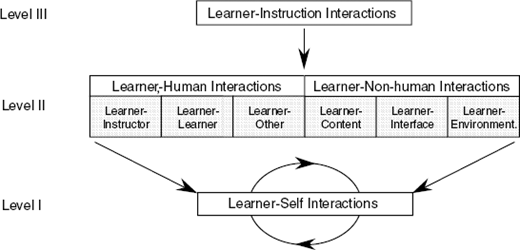
The framework posits three basic, interrelated levels of interactions that may be planned as an integral part of eLearning (Figure 1).
Level I interactions occur within each individual learner. Level II interactions occur between the learner and human and nonhuman resources. Level III interactions delineate an eLearning strategy; a set of Level II interactions that are designed and sequenced to stimulate Level I interactions.
The description of each level is given from the learner’s viewpoint. This is not to say that the instructor’s perspective (Montera-Gutierrez & Murphy, 2000) and other views are inconsequential. Rather, attention is placed here on the learners and their requirements in accordance with learner-centered approaches to instructional design, as discussed by Berge (in this issue) and others (e.g., APA, 1993; Dillion & Zhu, 1997).
Level I: Learner-Self Interactions
Learner-self interactions occur within each individual learner. They include both the cognitive operations that constitute learning as well as metacognitive processes that help individuals monitor and regulate their learning.
The specific cognitive operations that occur within an individual depend on the instructional designer’s epistemological beliefs. A behaviorist may recognize that some learnerself interactions occur, but chooses not to pay particular attention to them (e.g., Skinner, 1969). A behaviorist would concentrate solely on Level II and Level III interactions and how they reinforce or weaken particular behaviors. For someone who believes in information-processing theories of learning, key learner-self interaction may include sensory memory, selective attention, pattern recognition, short term memory, rehearsal and chunking, encoding, long-term memory, and retrieval (Atkinson and Shiffrin, 1968). Development constructivists (e.g., Piaget, 1971; Bruner, 1974) would key on learner-self interactions that result from adaptations to the environment which are characterized by increasingly sophisticated methods of representing and organizing information. In contrast, social constructivists would focus on learner-self interactions that occur when individuals interact with their social and cultural environment (Vygotsky, 1978). The proposed framework does not adhere to any particular learning theory or epistemology. However, the type of Level I (learner-self) interactions the designer ascribes to are important because they affect the selection of Level III interaction and the design and sequencing of Level II interactions as detailed latter in this article.
Studies identifying the characteristics of self-regulated learners underscore the importance of distinguishing learner-self as a primary level of eLearning interactions. Learners are self-regulated to the degree that they actively participate metacognitively, motivationally, and behaviorally in their learning (Zimmerman & Martinez-Pons, 1986). Selfregulated learners take responsibility for their own learning, initiate efforts to acquire desired skills and knowledge (Zimmerman & Martinez-Pons, 1988), access metacognitive strategies and take steps to correct learning deficiencies (Zimmerman & Martinez-Pons, 1995), activate, alter and sustain learning (Zimmerman & Martinez-Pons, 1986) and to plan, organize, monitor, and evaluate their learning processes (Corno, 1994; Hagen & Weinstein, 1995; Zimmerman & Paulsen, 1995).
Due to the relatively constrained nature of learner-instructor and learner-learner interactions in an online environment, self-regulation may be particularly important for distance learners. Self-regulated learners may have a substantially greater potential for success in distance education than those who have relatively poor self-regulatory skills because they may not need as much prompting from an instructor or help from other learners to monitor, regulate, and otherwise facilitate their learning. Fortunately, self-regulation may be learned and instruction may be designed to compensate for possible deficiencies (c.f. Ley and Young, 2001; Northrup, 2001; Corno & Randi, 1999; Butler & Winne, 1995; Iran-Nejad, 1990).
Level II: Learner-Human and NonHuman Interactions
Level II interactions occur between the learner and other human and non-human eLearning resources and are designed to stimulate Level I interactions. Six classes of Level II interactions are presented based on a framework for comparing instructional strategies posited by Reigeluth and Moore (1999). For this paper, brief descriptions of Level II interactions are given to delimit each category. References to related literature are provided if further details are desired.
Learner-Instructor Interactions
Learner-instructor interactions are defined as student- or instructor-initiated communications that occur before, during, and immediately after instruction. Moore (1989) characterized learner-instructor interactions as attempts to motivate and stimulate the learner and allow for the clarification of misunderstanding by the learner in regard to the content. A recent study of distance educator competencies revealed seven key learner-instructor interactions: to establish learning outcomes/ objectives; to provide timely and appropriate feedback; to facilitate information presentation; to monitor and evaluate student performance; to provide (facilitate) learning activities; to initiate, maintain and facilitate discussions; and to determine learning needs and preferences (Thach & Murphy, 1995). Literature on feedback is further examined because it is vital to learner-instructor interactions (Northrup, in this issue; Northrup & Rasmussen, 2000) and elemental to both behavioral and cognitive theories of learning.
Bangert-Drowns, Kulik, Kulik, and Morgan (1991) asserted that:
...any theory that depicts learning as a process of mutual influence between learners and their environments must involve feedback implicitly or explicitly because, without feedback, mutual influence is by definition impossible (p. 214).
Feedback compares actual performance to set standards (Johnson & Johnson, 1994). It informs learners of the accuracy of their responses to instructional questions (Cohen, 1985; Kulhavy, 1977) and may be used to increase response rate or accuracy, reinforce correct responses to prior stimuli, or change erroneous responses (Kulhavy & Wager, 1993). In networked environments, telecommunication technologies are expanding feedback options. Immediate and delayed feedback may provide learning guidance, lesson sequence advisement, motivational messages, critical comparisons and information about answer correctness and timeliness (Hoska, 1993). At minimum, feedback is essential during eLearning for closing message loops (Yacci, 2000;Northrup & Rasmussen, 2000), informing learners that communications are complete (Berge, 1999; Liaw & Huang, 2000; and Weller, 1988, as cited by Northrup, 2001). An extensive review of feedback research (Mory, 1996) and a textbook on instructional feedback methods (Dempsey & Sales, 1993) yield further insights into the design of this essential learner-instructor interaction.
Learner-Learner Interactions
Learner-learner interactions occur “between one learner and another learner, alone or in group settings, with or without the real-time presence of an instructor” (Moore, 1989, p. 4). Typically, such interactions ask learners to work together to analyze and interpret data, solve problems and share information, opinions, and insights. They are designed to help groups and individuals construct and apply targeted skills and knowledge.
Assigning individuals to groups does not mean that they will work collaboratively (Johnson & Johnson, 1994). Considerations for effective learner-learner interactions are similar in traditional classroom environments and eLearning environments (e.g., group size, group goals, individual roles and responsibilities, group and individual accountability, contact information, communications, grading). The challenge lies in planning and coordinating such interactions during eLearning.
Much has been written about learnerlearner interactions, including, but not limited to, literature on cooperative learning (Slavin, 1987) and social constructivism (e.g., Jonassen, 1995, 1994, 1991; Piaget, 1971; Vygotsky, 1978; Bruner, 1974; von Glasersfeld, 1989a, 1989b; Rorty, 1991). A meaningful analysis that includes implications of such work for the design of learner-learner interactions goes beyond the purposes of this paper. Those interested in additional information on the planning, management and facilitation of learner-learner interactions are referred to the works of Chih and Corry and Berge (in this issue) among others (e.g., Bonk and Reynolds, 1997; Harris, 1994a; 1994b; 1994c).
Learner-Other Human Interactions
Learner-other human interactions utilize the potential for telecommunication technologies to break down the barrier of classroom walls and enable learners to search for, access, acquire, and apply a wealth of information from a variety of external resources. Increasing numbers of online courses ask learners to review external websites, as well as to communicate with others outside of class to promote knowledge construction and social discourse (e.g., Bonk & King, 1998). Such interactions include exchanges with teaching assistants, mentors, and subject matter experts, as well as student and academic support staff.
Some argue that certain attitudes and behaviors must be modeled during face-to-face interactions with real people in real-time and thus, eLearning is not appropriate. In such cases, it is essential to keep in mind that just because a course or training program is put online, not all interactions must occur online. Distance learners may be asked to visit a designated facility and work with subjects and certified personnel. Thinking that face-to-face interactions must occur between students and the instructor of record can be somewhat egocentric. Suitable interactions may be arranged between learners and other experts as a required component of counseling, humanities, and education programs, for example. The key lies in distilling the nature of and designing such experiences.
Accrediting agencies, such as the Southern Association of Colleges and Schools (SACS), also remind us that distance learners must be afforded the same services provided to local students. During the design of eLearning programs, educators must consider how distance learners will be able to contact and garner support and services from staff, such as librarians, advisors, and counselors. The pervasive use of computer technology also makes ready, if not immediate, access to technical support staff essential during eLearning.
Learner-other human interactions may occur online or face-to-face depending on the location and configuration of the learners and the other human resources. They may be planned as an integral part of a lesson or learners may be given random access from within or outside of the eLearning program. The key is to provide ready access to the expertise, supports, and services necessary to enter, navigate, and complete the educational or training system in a user-friendly fashion.
Learner-Content Interactions
Learners-content interactions occur when learners access audio, video, text, and graphic representations of the subject matter under study. While it seems only logical to assume that media matters (e.g., what I hear, I forget; what I see, I remember; what I do, I understand), research suggests otherwise. Media selection guides, such as those proposed by Reiser and Gagné (1983) indicate that video and graphics (or more specifically, interactions with simulations or real objects) are critical when teaching psychomotor skills and may have a significant impact when trying to affect learner attitudes (e.g., modeling). Furthermore, if sensory discriminations (visual, tactile, auditory) are a required part of learning (e.g., music education), a specific medium or a combination of media is required during instruction. However, comprehensive reviews of media comparison research conclude that use of media, in general, has minimal effects on student learning (Clark, 1994a, 1094b). Research reviews, focusing on distance learners, yield similar results (Russell, 1993, 1999). It appears that instructional design has a greater impact on student achievement than the media used to deliver the content.
There are some practical criteria to consider when designing learner-content interactions. First, are the plug-ins and other software applications necessary to read various multimedia file formats readily available to learners? The use of Flash, Java, RealAudio, RealVideo and other specialized multimedia programs require updated Web browsers that may be difficult for novice computer users to configure. Second, is the expertise necessary to generate the desired multimedia resources available on staff or are funds available to outsource such development requirements? Third, how durable are the multimedia resources? If multimedia is used to communicate content information that is highly volatile, it may not be practical to continuously update and revise the files. Finally, what is the return on investment for creating such files? Creating and maintaining multimedia content costs a lot more than text. Is the resulting effect on student attitudes, learning or performance worth the price?
Learner-Interface Interactions
When a computer acts as the primary delivery mechanism, its interface serves as the principal point or means of interaction with the content, instructor, learners, and the larger community. Attention must be placed on how the interface enables learners to manipulate electronic tools, access information, interpret visual elements, and complete goal-oriented tasks. Hillman, Willis and Gunawardena (1994) suggested that the extent to which a learner is proficient with a specific medium correlates positively with the success the learner has in extracting information from the medium. Metros and Hedberg (in this issue) also point out that poor interface design can place high cognitive demands upon the learner that may take his or her attention away from the subject matter at hand. Learners cannot deal with content information if they are unable to use the interface. Learners must possess the skills necessary to operate the delivery system before they can be expected to successfully interact with human and non-human resources.
Norman (1988) suggested that mental models form as users interpret the interface’s perceived action and its visible structure. Then, as the model develops, it serves as the basis for understanding the interface, predicting its future behavior, and controlling its actions. The development of an effective mental model may be facilitated by instructional activities or tools that help the learner become familiar with the interface (e.g., in-class exercises, orientation sessions, technology credit courses, help screens or job aids).
The design of engaging learner-interface interactions is discussed in detail by Metros and Hedberg (in this issue). In short, key factors include learners’ mental model that enable them to become proficient in interacting with the mediating technology, learners’ understanding of specific communication protocol associated with the delivery system to transmit and receive information, and learners’ potential fear of (or anxiety with) working with the technology. Gillani and Relan (1997), Jones and Farquhar (1997) among others (c.f., Neilsen, 1993) have posited additional guidelines for Web interface design.
Learner-Environment Interactions
Learner-environment interactions occur when learners manipulate tools, equipment, or other objects outside of the computer interface during eLearning. As noted earlier, not all eLearning interactions have to occur online. Learners may be sent a package of manipulatives, field equipment, or laboratory instruments and asked to use them as an integral part of eLearning. Learners may also be required to seek or travel to specific locations to gather, observe, and otherwise inspect materials, complete activities, or participate in planned events to achieve specified learning objectives.
For example, gaining technical or problemsolving skills by interacting with highly specialized and sophisticated equipment may be necessary aspects of science, aerospace, and engineering courses or training programs. In such instances, distance learners may be asked to go to a remote facility and work with an experienced scientist or engineer. Such interactions may be difficult to manage at a distance but, when necessary, they can be arranged.
Like planning complex learner-other human interactions, the keys are to: clearly define the required learning outcomes and identify when such experiences are essential for the achievement of those outcomes; carefully plan and coordinate the interactions so that learners readily understand what is expected of them and why it is important for them to interact with their environment; and integrate the event with other interactions and embed them within a sound instructional strategy to optimize the experience and ensure that learners reach the specified objectives and achieve the greatest return from time and effort invested on arranging such learner-environment interactions.
Level III: Learner-Instruction Interactions
Learner-instruction interactions consist of a series of events (or eLearning strategy) that are necessary to achieve a defined set of objectives. Level III interactions are considered a meta-level that transcend and serve to organize Level II interactions. Like Driscoll’s (1994) definition for instruction, Level III interactions involve a deliberate arrangement of events to promote learning and facilitate goal achievement. Learner-instruction interactions are differentiated from Level II and Level I interactions to illustrate how theoretically grounded instructional strategies may be used to help distance educators design and sequence planned eLearning interactions.
Educators often fail to ground their designs in research and theory (Bonk & King, 1998; Bonk & Cunningham, 1998; Bednar, Cunningham, Duffy, and Perry, 1995). While there is no substitute for practical experience, difficulties occur when eLearning strategies are based solely on past practices. Without sufficient time, training, or support, educators have little choice but to rely on what they know best (i.e., teacher-directed methods). The problem is that key interactions are not often planned as an integral part of traditional classroom teaching materials because instructors typically facilitate such interactions in real time based on their expertise and intuition. As a result, key interactions necessary to stimulate eLearning are frequently missing when traditional classroom materials are posted online to promote eLearning.
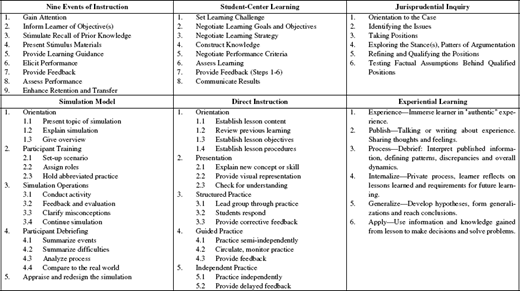
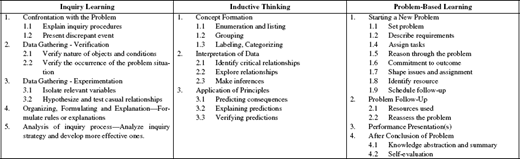
So, how do learner-instruction interactions help guide the design and sequencing of Level II interactions? A cursory review of literature on teaching methods reveals a number of research-based, theoretically grounded instructional strategies (Figure 2).
Each of the events associated with an instructional strategy may be considered an interaction-a transaction that occurs between the learner and other human or non-human resources. Educators can select an instructional strategy, based on the learning objectives, learner characteristics, context and their epistemological beliefs and use the events to design key interactions and the strategy to sequence the interactions. The application of a grounded instructional strategy gives educators a foundation for planning and managing a comprehensive series of eLearning interactions necessary to achieve a set of objectives based on a combination of research, theory, and practical experience.
APPLYING THE FRAMEWORK
Three specific applications illustrate the utility of the proposed framework for designing and sequencing eLearning interactions, analyzing the frequency and quality of the planned interactions; and analyzing and organizing research on interactivity and eLearning.
Designing and Sequencing eLearning Interactions
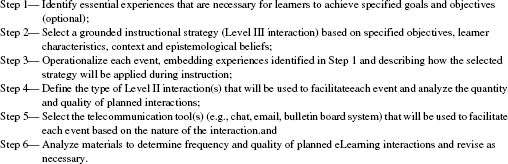
Figure 3 lists six steps for designing and sequencing eLearning interactions based on the proposed framework.
The steps result in an instructional treatment plan that is then used as a foundation for generating flowcharts, storyboards, and vertical and horizontal prototypes. Specific guidelines for applying the initial five steps within the context of an overall systematic design process are detailed in Hirumi (in press). An example is provided here to illustrate how the framework may be used to design and sequence eLearning interactions, as well as to analyze the planned interactions (Step 6).
Table 1 depicts an instructional treatment plan created by a professor during a two-day workshop on designing and sequencing eLearning interactions. The lesson is designed for undergraduate engineering students. The terminal objective is to write and present a feasibility report. The professor selected a WebQuest as the Level III interaction (or eLearning strategy) because one of the goals of the module is to engage students in searching the Web for scholarly articles in their field. Students are to synthesize the information from at least five sources into their feasibility report. A WebQuest seemed to be the most appropriate instructional strategy for integrating such an assignment.
Column 1 lists the key events associated with the WebQuest model (Dodge and Bober, in this issue). Column 2 provides a short description of how the professor plans to operationalize each of the events online. Italicized words represent the actual text that is to go online, plain text provides basic descriptions,
and underlined words indicate links to additional information or resources. Column 3 identifies the type of interaction associated with each event, based on the classes of Level II interactions posited by the proposed framework. Column 4 denotes the specific telecommunication tools that were selected to facilitate each interaction. At this stage, an analysis of the planned interactions prior to flowcharting, storyboarding, or prototyping may reduce potential time wasted developing and programming instructional materials that may not be well designed.
Analyzing Planned eLearning Interactions
After generating a preliminary draft of an instructional treatment plan, an analysis can help determine the appropriateness of the planned interactions for learners and the instructor. A planned interaction analysis is particularly important during the design phase of the systematic process to reduce or eliminate the need for costly revisions after program development or implementation.
Web-based courses with greater interactions can be more complicated to use (Gilbert and Moore, 1998). For novice distance learners or anxious computer users, such complexity may lead to confusion, frustration, inadequate performance, and eventual drop out. Berge (1999) also noted that the overuse or misuse of interactions can lead to frustration, boredom, and overload. Students may become dissatisfied if they perceive online interactions as meaningless busy work. Too many interactions can also make it difficult for learners to discern the relative importance of content information and each interaction. Too many interactions may also overwhelm the instructor. A common concern expressed by educators is that it takes far more time and effort to manage the communications that occur during eLearning than during traditional classes. Two potential causes for such overload are: too many planned learner-instructor interactions, and poorly designed interactions that require considerable clarification, explanation and elaboration.
Table 2 represents a planned interaction analysis completed during the workshop of the sample treatment plan.
Column 1 lists each type of interactions specified in the treatment plan. Column 2 denotes the frequency of each type of interaction. Column 3 provides a brief description of the quality or nature of the interaction, and column 4 specifies any required revisions in design or factors to consider during development.
An analysis of each class of planned interactions contained in the sample treatment plan reveals several key factors that warrant further deliberation. To begin with, the frequency of learner-content interactions emphasizes the importance of the user interface, suggesting that resources spent conducting usability tests, such as heuristic and scenario-based evaluations (Neilson, 1993) during development may be worthwhile.
Moving to the second category of planned interactions listed in the analysis, eight learner-instructor interactions may be far too many for the instructor to manage. For each interaction, the instructor must acknowledge receipt of the initial communication, save and track relevant documents and messages, review each learner’s work, and then generate and provide timely and meaningful feedback. If one takes into account the total amount of effort required to manage each interaction, multiply that by the total number of students registered for the course, and consider that the treatment plan represents just one unit in an entire course, it becomes readily apparent that eight learner-instructor interactions are far too many for the instructor to manage. In such cases, it may be helpful to group two or more interactions together to reduce the total number of interactions that must be handled by the instructor. Other options include grouping students to reduce the total number of assignments that must be reviewed by the instructor, eliminating some interactions or further automating the interaction so that preprogrammed responses are provided based on users’ input.
The third category of planned interactions includes five learner-learner interactions that may be too much for learners, particularly in light of the number of planned learner-instructor interactions. During the workshop, the professor noted that students completed similar learner-learner interactions in her face-to-face course as defined in her treatment plan. However, bear in mind that in traditional classroom settings, such interactions occur through speaking and listening, two modes of synchronous communications that take far less time and effort than reading and writing, which are the predominate forms of communication during eLearning. Similar tactics for reducing the investment necessary to complete learnerinstructor interactions are recommended here with one exception-grouping students. Because communications are predominately asynchronous, group work can take considerably more time and energy than individual assignments. Messages must be posted or sent directly to team members who must then access, organize, interpret and respond to the communications. If there are differences in opinion, an additional series of asynchronous communications may be required to reach group consensus prior to formulating a group response. Group processes may be facilitated through synchronous communications (e.g., chat), but such meetings may be difficult to schedule, particularly if team members live in different time zones. Therefore, to reduce learner-learner interaction requirements, it was suggested that the professor consider either grouping the interactions (e.g., requiring learners to share and discuss problem and purpose statements as two parts of one online activity) or eliminating one or more interaction.
An analysis of the third class of interactions specified in the treatment plan denotes two learner-other human interactions, potential interactions with a librarian and planned interactions with other professors. Such interactions are important to keep in mind during development and implementation. Librarians must be informed of such potential interactions with enough lead time to allocate sufficient resources so that they can respond in a timely fashion. The participation of other professors must also be solicited far enough in advance to ensure sufficient numbers and so they can properly plan for and address learner inquiries.
Analysis of the fourth class of interactions contained in the treatment plan identifies resources that must be made readily accessible to learners. In this case, the professor must make sure that all learners have ready access to a library and can obtain the course textbook and related journal articles in a suitable manner. Such considerations are also required in traditional on-campus classes. However, making sure that distance learners can readily access required resources may take additional time and noting such requirements during the design phase of the systematic process may help facilitate implementation.
Too few, too many, or poorly designed interactions can result in both learner and instructor dissatisfaction, inadequate learning, and insufficient performance, requiring additional time, effort, and expertise to revise instruction-resources that could have been spent on other projects. Improved interface design (Metros and Hedberg, in this issue) and the evolution of better Web course authoring and delivery tools may eventually make the technical aspects of online interactions transparent to learners. However, until such improvements are realized, educators must keep in mind that frequency does not equal quality (Northrup, 2001). Analysis of planned eLearning interactions specified in initial drafts of instructional treatment plans can help educators correct potential problems prior to programming as well as identify key factors to consider during development and implementation. Planned interaction analysis of prototypes and existing coursework may also be conducted to increase the overall effectiveness of eLearning materials.
Analyzing and Organizing Research
In addition to guiding the design and sequencing of eLearning interactions, the proposed framework may be used to analyze and organize research on interactivity and eLearning.
Several articles contained in this issue are examined to demonstrate how the framework may be used to analyze related research. For instance, Berge stresses the importance of aligning objectives, instruction, and assessment and the significance of evaluation and feedback (essential elements of Level III design). Berge also discusses how learnerlearner, learner-instructor, and learner-content interactions (three Level II interactions) may be applied to facilitate active, interactive, and reflective eLearning and promote knowledge construction (Level I interactions). In comparison, Metros and Hedberg focus on interactions between the learner and the interface (Level II) and discuss how graphical interfaces may be designed to support constructivist views of learning (Level I). Chih and Corry discuss how social presence (Level II human interactions), technology (Level II non-human interactions), and instruction (Level III interactions) influence the development of eLearning communities. Their refined model also highlights the importance of community learning and suggests that it may be useful to add considerations for community-self interactions as a new form of Level I interaction.
Further analysis of the articles contained in this issue reveals several trends:
As noted by Bannon-Ritland (in this issue), studies typically do not focus on one type of interaction. Investigators usually concentrate on one category and discuss its effect on others.
Few studies address Level III interactions. Of the eight articles included in this issue, Berge and Chih and Corry allude to certain aspects of learner-instruction interactions, a comprehensive set of interactions (or eLearning strategy) that comprise an instructional unit designed to achieve a specified set of objectives.
None of the articles contained in this issue directly address learner-other or learnerenvironment interactions as defined by the framework.
Bannan-Ritland uses the proposed framework to analyze trends in research in her comprehensive review of literature, further illustrating the utility of the framework for analyzing, organizing, and guiding research on interactivity and eLearning.
SUMMARY
Key interactions that can affect student attitudes and performance must be carefully designed and delivered as an integral part of eLearning. While various taxonomies reveal a plethora of interactions that may be used to facilitate eLearning, relatively little has been done to synthesize related literature on, delimit the relationships between, and provide practical guidelines for planning and managing eLearning interactions.
This article presents a three-level framework for analyzing, designing, and sequencing eLearning interactions. Level I interactions consist of cognitive and metacognitive operations that occur within each learner’s mind and is distinguished to further emphasize the importance of self-regulation. Level II includes six classes that are divided into human and non-human interactions (i.e., learner-instructor, learner-learner, learner-other human, learner-content, learner-interface and learner-environment). Level III (learnerinstruction) interactions are viewed as a metalevel. Learner-instruction interactions provide educators with a set of events (an eLearning strategy) that may be based on research and theory to provide a grounded approach to designing and sequencing Level II and stimulating Level I interactions.
A higher education example illustrated how the framework may be used to analyze planned eLearning interactions. Additional guidelines for applying the framework to design and sequence eLearning interactions are described by Hirumi (in press). This article focused on how the framework may be used to analyze the frequency and quality of planned interactions during design and development to reduce the need for costly revisions after programming and to enhance the overall eLearning experience. Similar analysis may be conducted to optimize the design and sequencing of planned interactions in existing eLearning materials. Finally, several articles contained in this issue were analyzed to illustrate how the proposed framework may be used to analyze, organize, and guide research on planned eLearning interactions.
The creation of modern eLearning programs requires research and the development of new design methods that fully utilize the capabilities of telecommunication technologies and the potential they afford collaborative and independent learning (Bates, 1990; Mason & Kaye, 1990; Soby, 1990). While the effectiveness of the proposed framework has been demonstrated in several practical situations (e.g., workshops and in the design of secondary, undergraduate, and graduate eLearning coursework), much work is left. Further study is required to provide empirical evidence for its utility and to optimize the design and sequencing of planned eLearning interactions.