This paper describes a model of online learning communities characterized by online mentors (OLCOM), which has been implemented at a large southeastern state university. The OLCOM is a virtual online learning community, which incorporates online mentors to assist online teaching and facilitate online learning along with other members in the OLCOM. The goal of the OLCOM is to ensure that course completion rates and GPAs in OLCOM are as high as those in face-to-face learning communities. The role of each member in OLCOM was described and the effectiveness of OLCOM was assessed by student satisfaction on mentor performance and student performance. This paper concludes that the OLCOM is an effective model for online learning programs.
Introduction
Online learning programs have expanded dramatically in the higher education community, as reported by the National Center for Education Statistics (NCES, 1999). An increasing number of courses has being developed and offered via the World Wide Web; however, the quality of online courses has become a major concern to both online learners and educators (NCES). The most commonly asked question is whether these online courses are as effective as face-to-face courses in terms of achieving course completion rates and learning achievement. Thus far, the answer to this question is still inconclusive.
The Department of Distance Learning (DDL) at a large southeastern state university was assigned the mission of facilitating the faculty and academic departments at the university to establish undergraduate online degree programs in 1995. The online degree programs are to provide continuous education for people who have earned an Associate of Art degree at a community college to continue their study and earn a bachelor’s degree in two years.
With the common concern of online learning and teaching effectiveness, the goal for the undergraduate online degree programs was set to achieve the same course completion rates and same grade point averages (GPAs) as those of face-to-face degree programs at the same university. In achieving this goal, a model of online learning communities with online mentors (OLCOM) was created to ensure the effectiveness of online learning and teaching. The OLCOM expanded its members to include online mentors, mentor support team, and academic coordinators, in addition to online students and faculty that are commonly included in online learning communities. An online mentor, trained and supported by the mentor support team, was assigned to each online course of the undergraduate online degree programs to assist the faculty and students in the course.
In 1999–2000 academic year, OLCOM was implemented in four undergraduate online degree programs at the university. These programs were: Computer Science, Information Studies, Interdisciplinary Social Science, and Nursing. There were 8 different courses offered with a total of 26 sections, which had approximately 570 online students supported by 26 mentors. The maximum ratio of student to mentor was set at 20 to 1, which had been kept in most courses.
Online Learning Communities
In general, an online learning community (OLC) in higher education refers to a community that is formed by online students and the faculty to achieve certain learning goals in a course website in which the students and the faculty interact synchronously or asynchronously through online learning activities. Based on the theory of collaborative learning (Dewey, 1933) and social interaction (Vygotsky, 1978), many researchers advocate building OLCs for online learning as an effective instructional strategy to achieve learning outcomes (Bauman, 1997; Brown, 2001; Haythornthwaite, 1998; Hill & Raven, 2000; Kim, 2000; Kowch & Schwier, 1997; Lally & Barrett, 1999b; Misanchuk & Anderson, 2001; Palloff & Pratt, 1999; Rose, Ding, Marchionini, Beale, & Nolet, 1998; Tu & Corry, 2002).
Developing learning communities may be more challenging in online environments than in face-to-face learning environments, although the notion of OLCs is viewed as an expansion of the concept of a face-to-face learning community (Caverly & MacDonald, 2002). Students enrolling in online courses have expressed psychological distance and experienced technical problems (Ryan, Carlton, & Ali, 1999; Wolcott, 1996). The psychological distance has arisen from the space and time separation between the faculty and peer students. The technical problems have existed due to online students’ unfamiliarity with the Internet technology in the online learning environment. These psychological distance and technical problems seem to be the major barriers toward online learning. Fortunately, OLCs may reduce the psychological distance by mediating the dialogues of understanding and communication among OLC members and may facilitate technical problem-solving by providing a virtual space for exchanging experiences among OLC members (Lally & Barrett, 1999a). OLCs can also be a powerful conceptual framework for analyzing learning interactions and explaining learning performance in online learning environments (Caverly & MacDonald, 2002; Lally & Barrett, 1999b; Russell, 1999; Tu & Corry, 2002). Thus, building OLCs has been proposed for removing the major barriers in online learning environments.
Different approaches have been proposed for building OLCs to ensure the effectiveness of online learning. Among them, Misanchuk and Anderson (2001) emphasize the importance of interactions and suggest interactions could be encouraged at different levels, such as communication and cooperation levels. Hill (2001) presents several instructional strategies that emphasize structural design and online assistance, such as fail-less, learner structural-dependent, and interaction-conducive strategies. Another strategy is to provide online students with assistance and encouragement to explore in the learning space, manage their time and priorities, and resolve technical problems.
Overall, OLCs possess characteristics that are different than those in face-to-face learning communities. First, a virtual learning environment constituted by online students and faculty is the learning environment for online learning, while a physical classroom in which students and faculty reside is the learning environment for traditional learning. Second, telecommunications (e.g. course website messages and emails) are the major communications in OLCs, as face-to-face communication is the main communication in traditional learning communities. Third, the identity of a community becomes more essential and the development of the sense of social connectedness seems more challenging via telecommunications in OLCs, compared to face-to-face communication in a traditional learning community.
Online Learning Communities with Online Mentors (OLCOM)
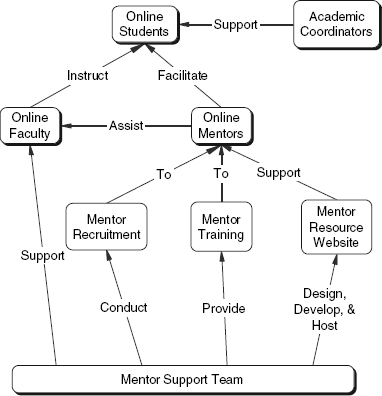
Online learning communities with online mentors (OLCOM) at the University encompasses the unique characteristics of OLCs. The OLCOM is a virtual online learning community in which members communicate with each other via telecommunications and the identity of an online learning community is essential to achieving learning goals. However, the OLCOM distinguishes itself from typical OLCs by expanding its members to include online mentors, the mentor support team, and academic coordinators, in addition to online students and faculty. Online mentors are incorporated to facilitate students’ online learning and to assist faculty’s online teaching. The mentor support team is integrated to train and support online mentors. Academic coordinators from associated academic departments are included to assist online students concerning admissions, registrations, and meeting graduation requirements. Thus, the members of an OLCOM include the online students, the faculty, online mentors, the mentor support team, and academic coordinators from associated academic departments. The following describes the roles of each member of OLCOM and the relationships among the members of OLCOM. Figure 1, Online Learning Community with Online Mentors (OLCOM), illustrates the relationships among the members of OLCOM.
Online Students
Online students are students taking online courses in the undergraduate online degree programs. The admission criteria (e.g. grade point average in high school and Scholastic Aptitude Test) for the undergraduate online degree programs are the same as those for undergraduate face-to-face degree programs at the university. In OLCOM, online students are supported by online mentors for additional feedback on course content and for online technical support, besides receiving instruction from faculty via course Websites. Online students are also assisted by the academic coordinators of the associated academic departments in the processes of admission, course enrollment, and, finally, graduation. The majority of the online students are located outside the campus vicinity and all over the state. There were approximately 570 online students in the 1999–2000 academic year.
Faculty
Faculty are the professors who teach online courses in the undergraduate online degree programs. Online faculty teach the online courses, which are designed and developed either by themselves (in most cases), or by other faculty members. Online faculty are expected to play roles as subject matter experts, online course managers, and computer technology consultants. The role of online course managers is different than that of classroom managers in face-to-face classrooms; and the role of computer technology consultants is new to most faculty. To play these roles effectively, most online faculty need not only to learn additional knowledge and skills for online course management and technical problem-solving, but also every online faculty member needs to allocate extra time for assisting students in solving technical problems. The expectation of playing so many roles becomes a heavy burden to online faculty and may impacts online course effectiveness. In OLCOM, online faculty are assisted by online mentors, who remove some burden from online faculty by providing supplementary feedback on course content and technical support to online students. Online faculty are also supported by the mentor support team for online course management to reduce online faculty’s burden. With assistance from online mentors and support from the mentor support team, online faculty can focus more on delivering course content and managing online courses to enhance teaching and learning effectiveness, without being overwhelmed by learning online management or solving technical problems.
There were eight professors teaching eight different online courses with a total of 26 sections in the departments of Computer Science, Information Studies, Interdisciplinary Social Science, and Nursing during the 1999–2000 academic year.
Online Mentors
Online mentors are employed by the Department of Distance Learning to assist online teaching and to facilitate online learning. They are required to possess either a master’s degree related to the course contents or the knowledge of the subjects associated with the course contents to be mentored. Computer literacy is preferred but not required. The recruitment of new online mentors is conducted by the mentor support team, who advertise vacancies of online mentors through various media and visit the campuses of community colleges in the state. New online mentors are also required to complete the Mentor Training provided by the mentor support team before hiring to ensure their ability to perform online mentoring. Most online mentors are faculty members of community colleges and graduate students at the university who previously completed related online courses. There were 26 online mentors who were assigned to 26 online courses to assist online faculty in online teaching and learning during the 1999-2000 academic year. The following describes the reasons why online mentors are needed in online learning communities and the three dimensions of the online mentor’s role.
The Need for Online Mentors
Many online learning communities implicitly rely solely upon the faculty to provide online students with a large amount of online interactions and assistance in solving technical problems that are critical for effective online teaching. For example, interactions between faculty and students have motivated learners to engage in tasks (Bauman, 1997), and have facilitated socio-cultural and socio-cognitive environmental development (Tu & Corry, 2002). Students’ participation in faculty-mediated interactions has built the sense of community connectedness to the online learning community (OLC). Faculty-mediated interactions have strengthened the sense of learning community for online students (Gilbert & Driscoll, 2002; Hill, 2001; Jin, 2002) and lead to improved learning outcomes (Ragan, 1998).
However, when online faculty have already been loaded with heavy responsibilities, playing multiple roles such as subject matter experts, online course managers, and computer technology consultants, and when the class size becomes large, 30 or more students in a class, the interactions that faculty can provide to each online student become very constrained. In the 1999–2000 academic year, there were eight professors teaching eight different online courses, which were divided into 26 sections, with a total of approximate 570 online students of the undergraduate online degree programs at the university. The student-faculty ratio was about 70 to 1, which was more than the double the size of a normal large class. In this case, it would be impractical to expect that the faculty would provide students enough interactions and assistance, which were critical to effective online learning. Therefore, online mentors were incorporated into the online learning community to assist faculty in teaching in online virtual classrooms and, at the same time, to facilitate students in online learning. One online mentor was assigned to each section, and the student-mentor ratio was kept at a maximum of 20 to 1.
Dimensions of the Online Mentor’s Role
Online mentors serve instructional, social, and technical purposes. These three purposes define a tri-dimensional role for online members:
Subject matter facilitation—providing extra help to students in clarifying and comprehending course contents, which serves the instructional purpose;
Learning community initiation—helping students develop an online learning community, which serves the social purpose; and
Online technical support—helping students solve technical problems (ODDL, 2002a), which serves the technical purpose.
On one hand, assisted by mentors with these three dimensions, online faculty’s burden can be decreased greatly so that faculty can focus more on the effectiveness of online teaching. On the other hand, facilitated by mentors, online students’ psychological disconnectedness and technical difficulty, the two key barriers in building online learning communities, can be diminished to a great extent, so that students can concentrate more on comprehending course contents for more effective learning. Thus, the effectiveness of online teaching and learning can be enhanced considerably. The following describes the three dimensions that constitute the role of online mentors.
Subject Matter Facilitation: Providing Extra Help to Students in Clarifying and Comprehending Course Contents
Online mentors serve as supplementary subject matter experts, in addition to the faculty, to assist online students in learning course content. For example, online mentors can provide extra information and feedback that is consistent with the faculty’s comments. Online mentors can guide online students to access university resources (e.g. online university libraries) to enhance learning effectiveness. Online mentors can monitor online discussion to clarify and elaborate concepts, to draw attention to the focus of the discussion subject, to provide additional examples or demonstrations, to point out relationships among concepts, to answer questions, and even to stimulate students’ curiosity to inquire and explore new knowledge. Online mentors can also provide tailored coaching activities to direct students’ individual learning processes so students may become independent learners and knowledge explorers, which may increase students’ ability to learn across different disciplines. Thus, with online mentors’ assistance in providing additional feedback, online students can comprehend course content more clearly and deeply.
Learning Community Initiation: Helping Students Develop an Online Learning Community
Online mentors also serve as learning community initiators by interacting with students. Because online students are separated from faculty and coursemates by time and physical space (Wolcott, 1996), psychological distance between faculty and students exists and may decrease students’ sense of connectedness to the learning community. Students may also experience barriers to participate in online activities, to express their own ideas, or to ask for assistance. Although students enrolling in online courses tend to have higher motivation and commitment to learn, psychological barriers may hinder the sustaining of students’ motivation. A study suggests that, due to pervasive low learner motivation and lack of community connectedness, low course completion rates (as low as 20%) have been associated with distance learning programs (Schlosser & Anderson, 1994). To enhance learning motivation that builds the sense of learning communities, which then sustains online course completion, more interactions are suggested (Brown & Brown, 1994; Chen, 1997; Wolcott, 1996). Online mentors can initiate interactions with students by encouraging students to overcome psychological barriers by participating in activities, playing a part in students’ discussions, assisting in group activities, guiding students to their learning goals, providing just-in-time help to students, promoting collaboration to develop team spirit, and contributing their own learning experiences or insights to facilitate interactions in the learning community. These interactions initiated by online mentors, in addition to those by faculty, are helpful in building a sense of connectedness among online students. Thus, with online mentors’ initialization that emphasizes social rapport, a sense of coherent learning communities for online students can be formed easily.
Online Technical Support: Helping Students Solve Technical Problems
Online mentors also help students with accessing or navigating course Websites, uploading or downloading course materials, posting messages onto online discussion boards, and by coaching other basic skills for online learning. Students’ ability of accessing the necessary materials is very critical to the success of online learning. Some, or many, students have little or no online learning experiences; their ability to access course materials may be low and they often experience difficulties in completing course requirements. Such students need technical assistance. Online mentors can help students to overcoming technical difficulties or psychological barriers arising from technical incompetence and to develop the ability to access course materials on the Website. Thus, online students can obtain the necessary ability for online learning and obtain learning objectives without being held back by technical problems.
Mentor Support Team
The mentor support team includes the mentor coordinator, who is the person in addition to the faculty who can help online mentors solve problems, and mentor support team members who assist the mentor coordinator to support online mentors all year ’round. The mentor support team recruits online mentors, coordinates mentor training, and manages the Mentor Resources Website to prepare and assist mentors in mentoring students in online learning environments.
Mentor Recruitment
The mentor support team recruits people who possess the needed subject expertise for the online courses by marketing the vacancies via multiple media to the campuses of community colleges in the state and on the university Website. The mentor coordinator visits community college campuses once or twice a year to recruit new mentors. The mentor coordinator also selects best candidates among the applicants and assists faculty to select the online mentors among the candidates for their courses. Then, the selected online mentors is hired by the Department of Distance Learning and trained by the mentor support team. The majority of online mentors are faculty at community colleges, lecturers at universities, and graduate students who previously completed related online courses at the university.
Mentor Training
All new mentors are required to participate in the mentor training conducted by the support team in order to ensure that mentors have acquired the necessary knowledge, skills, and attitudes for online mentoring. The scheduled Mentor Training session has been conducted every summer since 2001. Additional training sessions are also provided at different times when needed.
The Mentor Training consists of two phases: Phase I, face-to-face workshop; and Phase II, online training on the online course management system employed for delivering online courses at the university. The training takes 40 hours: 32 hours in Phase I, and 16 hours in Phase II.
Phase I Training
Phase I training is a 3-day face-to-face workshop at the university campus. The purposes of Phase I training are: 1) discussing the mentor’s role and responsibilities; 2) meeting with other members in the online learning community; and 3) participating in the orientation on the online course management system. New and experienced mentors meet together to discuss the history, roles, and responsibilities of online mentors in order to thoroughly understand the expectations of mentors from the students’, faculty’s, and university’s perspectives. Also, mentors initiate the networking and the formation of the online learning community by meeting face-to-face with other members in the online learning community, such as online student representatives, faculty, the mentor coordinator, mentor support team members, academic coordinators from associated academic departments, and senior mentors. Finally, mentors participate in an orientation on the online course management system to become familiar with the online learning environment that delivers the online courses they will be mentoring.
Phase II Training
Phase II training is online training. Its purpose is to learn and practice the basic functions of Blackboard, the online course management system. Each mentor is assigned to two mirror training websites with two different status levels: a teaching assistant in one training Website and a student in the other training Website. Training activities are designed for mentors to use functions within Blackboard and to experience the results of those functions as a teaching assistant as well as a student at the same time. Mentors who have successfully completed both phases of training are awarded Mentor Certificates honored by the university. Since the establishment of mentor training in Summer 2001, 113 mentors have been certified.
Mentor Resources Website
The Mentor Resources Website is for mentors to construct co-mentoring partnerships or collaborative mentorship for professionally developing online mentoring knowledge and skills. This Website is designed, developed, and managed by the mentor support team to support online mentors. It is suggested that the collaboration of mentors can establish a partnership support group (Head, Reiman, & Thies-Sprinthall, 1992; Kealy & Mullen, 1999) and, as a result, form a powerful force for professional development in mentoring (Mullen, 2000a, 2000b). It is also believed that the successful professional development of online mentors is one of the important elements that lead to the success of the online degree programs. Thus, the Mentor Resources Website provides a virtual space for mentors to build up a powerful force for professional development in mentoring.
The most significant feature of the Mentor Resources Website is the online discussion sessions. Either the Mentor Coordinator or any mentor may initiate a discussion forum to discuss issues of concern, exchange experiences they partake of, express opinions they possess, send out early warnings of potential problems they may have to deal with, and suggest solutions to problems they encounter. Mentors’ participation in the online discussion on the Mentor Resources Website has been very active. There were 178 messages generated by 33 mentors during the 1999–2000 academic year. Most mentors commented that participating in the discussion on this Website was extremely valuable to their professional development.
In addition to discussion sessions, the Mentor Resources Website is also used as a major communication tool between the Mentor Coordinator and mentors. The Mentor Coordinator frequently posts announcements on the Mentor Resources Website to all mentors regarding new resources for mentoring, new mentors joining the learning community, recommendations for problem solving, and explanation of mentoring models, mentor conference calls, opportunities for mentoring, etc.
Academic Coordinators
An academic coordinator from each associated academic department is assigned to assist online students who take online courses in the undergraduate online degree programs in the department. Four academic coordinators from departments of Computer Science, Information Studies, Interdisciplinary Social Science, and Nursing. Academic coordinators assist online students by teaming up with the Office of Admissions to help students in the process of obtaining admissions, by collaborating with Registrar’s Office to track online students’ progress, and by cooperating with the Graduation Office to process graduation paperwork for students who have met graduation requirements. Like the face-to-face students, all online students are admitted to the online degree programs at the same time each semester before the admission deadlines of the university. Unlike online mentors, academic coordinators communicate with online students via telephone, email, and fax, but not via online messages on Web course sites that online mentors use.
In summary, the model of online learning communities with online mentors (OLCOM) is characterized by expanding its membership to incorporate online mentors, the mentor support team, and academic coordinators, in addition to online students and faculty, who are included in typical online learning communities. Special emphasis is placed on the online mentors, who are trained and supported by the mentor support team to ensure that mentors have acquired the necessary knowledge, skills, and attitudes for online mentoring. Figure 1 illustrates the members of OLCOM with their relationships.
The Effectiveness of OLCOM
The effectiveness of OLCOM was assessed by student satisfaction with mentor performance and by student performance. Student satisfaction with mentor performance was measured from five dimensions: reasonable response time, valuable help, consistent feedback, comfortable relationship, and recommendable work. Student performance was assessed by comparing the course completion rates and average GPAs between undergraduate online degree programs and the cohort of all the undergraduate degree programs at the same university.
Mentor Performance
Student satisfaction with mentor performance was assessed via an online survey. There were five questions capturing the five dimensions of student satisfaction:
Reasonable response time: My mentor’s response time was reasonable.
Valuable help: My mentor’s help in course content was valuable.
Consistent feedback: I received consistent feedback from my mentor and my instructor.
Comfortable relationship: I would be comfortable having the same mentor in a future course.
Recommendable work: I would recommend my mentor to other students who would be taking online courses.
Validity and Reliability
The validity of the five-dimension construct to measure student satisfaction on mentor performance was established in previous studies that examined online learning satisfaction. The first dimension, reasonable response time, was reported by students as the top attribute of the supportiveness of online learning environments (Northrup, 2002), and a related supportiveness indicator, instructor’s availability to answering students’ questions, was noted as a key factor related to student satisfaction in online learning environments (Maushak & Ellis, 2003). Also, immediate feedback to provide needed information was viewed as an important component of student satisfaction toward effective online learning (Moore & Kearsley, 1996). The second dimension, valuable online help, was suggested for effective online instruction (Hill, 2001), as sufficient online supports would motivate and enhance learning achievement (Althaus, 1997; Hmelo, Guzdial, & Turns, 1998). The third dimension, consistent feedback, was to constantly confirm right answers and correct errors concerning course contents and to provide key information to learning achievement (Anderson, Kulhavy, & Andre, 1971; Gilman, 1969; Kulhavy, 1977). The fourth dimension, comfortable relationship, was a self-report related to students’ relationships with mentors. The relationship between students and instructors was implemented to measure student satisfaction in online learning environments (Maushak & Ellis, 2003). The logic underpinning this dimension related to student with learning satisfaction preferred to have the same mentor in a future course if a comfortable relationship has been previously established with the mentor. In particular, a positive collaborative relationship was reported as a major factor influencing student satisfaction in online learning environments (Jung, Choi, Lim, & Leem, 2002). The fifth dimension, recommendable work, also captured student satisfaction from a different but related aspect. A comfortable relationship with the mentor motivated a satisfied student to recommend his or her mentor to other students. Referring colleagues to take an online course was incorporated into the measurement to assess student satisfaction in online learning environments (Maushak & Ellis, 2003).
While the validity of the student satisfaction on mentor performance was based upon the construct validity of the survey questions, the reliability tests of this survey were not feasible due to the nature of the aggregate data, as individual case-level data were not available to the author.
Results of Mentor Performance
The responses to the Student satisfaction on mentor performance survey were on a 5-point Likert scale: strongly agree, agree, neutral, disagree, and strongly disagree. This survey was distributed at the end of each semester and students were encouraged to participate. Students’ participation in this survey was voluntary. Survey data yielded 632 responses from 1,750 students during the Summer semester of 2001 to the Fall semester of 2002.
The result of student satisfaction on mentor performance was very positive. The percentages of positive ratings (strongly agree and agree) ranged from 69% to 80%. It showed that approximately 3/4 of total students were either very satisfied or satisfied with the help provided by their mentors. Such results of mentor performance are considered very successful. See Table 1 for the overall and positive rating of each dimension of student satisfaction on mentor performance (ODDL, 2002b).
Student Performance
Course completion rates and average GPAs in the 1999–2000 academic year were collected to assess student performance, which was facilitated by online mentors. The results suggested that both course completion rate and average GPA of students in undergraduate online degree programs were higher than those of the cohort of all (face-to-face and online) students in undergraduate degree programs at the same university in 1999-2000 academic year. Such results suggested that online mentoring might have contributed to student performance to a great extent. See Table 2 for the comparison of the course completion rates and average GPAs between the undergraduate online degree programs and the cohort of all the undergraduate degree programs at the same university.
Discussion
The primary results of the effectiveness of online learning communities with online mentors (OLCOM) suggested that OLCOM is a powerful model for online learning programs. The experience of OLCOM clearly showed the advantages of incorporating online mentors within the mentor support team in online learning environments. The following discuss the results of mentor performance, student performance, the importance of online mentors, and further research concerning the effectiveness of the OLCOM.
Mentor Performance
The results indicated that student satisfaction on online mentor performance was positive. This positive satisfaction suggests that online mentors have contributed to online learning in the OLCOM to a large extent and such contribution validates three successful aspects of the OLCOM. First, it verifies that the three dimensions of the mentor’s role have been well defined in terms of facilitating online learning and assisting online teaching. Second, it confirms that mentor training has effectively prepared online mentors to obtain the critical knowledge, skills, and attitudes for online mentoring. Third, it endorses that the mentor support team has selected suitable candidates for online mentors and supported online mentors on the Mentor Resources Website for online mentoring.
Student Performance
The results showed that online students in online degree programs achieved higher course completion rates and higher average GPAs than those in face-to-face degree programs. Because this was not a controlled comparison, the results do not necessary demonstrate the advantage of online learning over traditional face-to-face learning. However, it implies that online students seem to sustain higher learning motivation in completing online courses and perform higher comprehension in achieving course grades in OLCOM, as compared to students in face-to-face classrooms.
The Importance of Online Mentors
Concerning the effectiveness of learning, online mentors seem more important to the effectiveness of online learning, in contrast to teaching assistants to the effectiveness of face-to-face learning. On one hand, online mentors in OLCOM facilitate online students to overcome two major barriers for making online learning possible. These two barriers to online learning environments are psychological disconnectedness and technical problems, which are unique in online learning environments and need online mentors’ special attention in order to ensure the effectiveness of online teaching and learning. In face-to-face learning environments, these barriers do not exist and teaching assistants do not need to deal with these barriers. These barriers can be eliminated or largely decreased with the help from online mentors in online learning environments. Online mentors assume the three dimensions of the online mentor’s role: subject matter facilitation, learning community initiation, and online technical support to maintain learner motivation and to develop OLCOM for decreasing the impacts of psychological disconnectedness and technical problems of online learning.
On the other hand, online mentors supplement the faculty member to deliver effective instruction. Existing online course design seems to place much demand on the online faculty to deal with online learning barriers. An online faculty member is often expected to be a subject matter expert, an online course manager, and a computer technology consultant, which require additional time and effort to manage online course systems, host online discussions, communicate via telecommunications, and solve technical problems, as compared to faculty in face-to-face learning environments. Such extra demand may impact the effectiveness of online teaching. Also, when the class size becomes large, the expected interactions between faculty and students may be greatly limited. Online students tend to expect timely feedback from online faculty within a short time period (Northrup, 2002). These demands and expectations may become extra burdens to online faculty. With online mentors’ assistance, many of the burdens on online faculty may be significantly alleviated and online faculty can increase the frequency of advice and support to students with respect to content-specific issues. In addition, the added interactions generated by online mentors may increase learner motivation and may strengthen the socio-cultural relationships among students, which then may pave the way for building the OLCOM.
Further Research
The effectiveness of the OLCOM was assessed partially by subjective measures, student self-report. In order to objectively examine the effectiveness of the OLCOM, instruments that measure online learning motivation and social connectedness to the OLCOM have yet to be developed. Also, the relationships among learning motivation, connectedness, course completion rates, and GPAs need to be further explored.
In order to further understand how interaction enhances the effectiveness of OLCOM, the interaction between online mentors and online students needs to be investigated. Also, commonly asked questions concerning interaction in OLCOM are: How much or what types of interaction can enhance online learning achievement? Are there any patterns of interaction that may maximize the effectiveness of OLCOM? The answers to these questions may help online faculty and mentors to better implement online teaching and better facilitate online learning in OLCOM.
Summary
A model of the online learning communities with online mentors (OLCOM) implemented in undergraduate online degree programs at a large southeastern state university was described. Theoretical underpinnings of OLCOM were discussed. The purposes of incorporate online mentoring and other supporting groups were reported. The roles of OLCOM member were also described. The contribution of online mentors in both online learning and teaching has been recognized greatly by both students and faculty at the university. Finally, the higher course completion rates and higher average GPAs of the undergraduate online degree programs using OLCOM signified the higher effectiveness of online courses, as compared to those of the cohort of all the undergraduate degree programs at the same university. In conclusion, the findings suggested that OLCOM was an effective model for online learning programs.
Acknowledgment:
The author would like to thanks Drs. Kathryn Ley and Caroline Crawford for providing valuable comments for improving this paper.