This article provides guidance for meeting the educational needs of “learners on the periphery”—those learners who traditionally have been disenfranchised by formal education because of the structure and nature of face-to-face courses but who now may be returning to higher education due to the promises of the online classroom. The guidance comes in the form of heuristics that can be used as a supplement to online course design models. Specifically, the heuristics provide a means for analyzing learners on the periphery, developing strategies that will meet their needs, and implementing those strategies in useful ways. The article also includes an application of the heuristics and their supporting infrastructure. After the presentation of the heuristics and their application, implications for continued development and applications are discussed.
INTRODUCTION
With the advent of online learning, traditional higher education has become a more attractive option for a variety of learners, not all of whom have even relatively homogenous needs or goals and not all of whom have traditionally been well served by higher education. Certainly, groups of such students may be those from minority cultures who find cultural differences—such as language barriers and differences in normative academic practices—to be less pronounced in online classrooms than in face-to-face ones (cf. Freedman & Liu, 1996). Other examples, however, may be more obscure. Consider, for example, high school students from private schools or home schools who are eligible to enroll in college online classes. Furthermore, students from strong religious backgrounds may tend to be more attracted to online courses than to face-to-face courses, which may be less student centered and thus less accommodating of faith-based ontologies and epistemologies (cf. Knowlton, Thorne, & Harriss, 2002).
Because of their extreme heterogeneous needs and goals, we label these nontraditional learners as “learners on the periphery”—those groups of learners who once were beyond the reach of formal higher education because of the structure and nature of face-to-face courses but who now legitimately may be on the potential periphery of learning within online contexts. (See Lave & Wenger, 1991, for a discussion of legitimate peripheral participation.) As the field of instructional technology, in general, moves further into postmodernism (cf. Solomon, 2000), designers of online courses must concern themselves with creating online courses that allow these learners to move from the periphery to the center of the online classroom. As Speck (2000) has noted, we should design online courses only if they are educationally useful to students. This article offers guiding heuristics that, when used in conjunction with design models and development approaches, can result in instructional strategies that will be useful to learners on the periphery. We first provide an overview of the heuristics. In the remaining sections of this article, we elaborate on each heuristic and provide an illustrative application.
OVERVIEW OF THE HEURISTICS
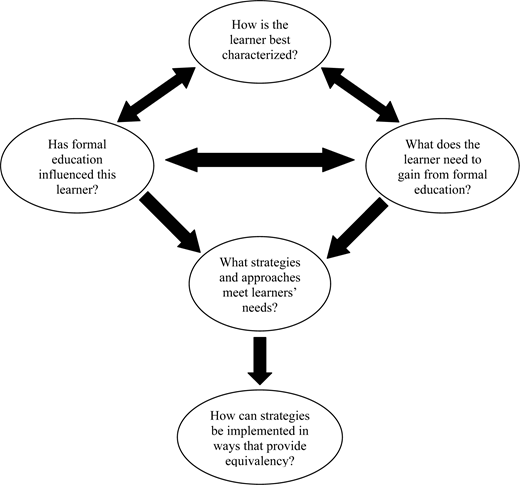
Historically in academia, both content and instructional strategies have been established without a true consideration of learners’ needs. Sometimes, for example, content was determined based on that with which professors were most familiar. In such a case, the professor’s familiarity naturally led to lecture as the primary instructional strategy (Knowlton, 2003a). With online learning attracting what we have described as learners on the periphery, a stronger consideration of learners as a variable that dictates instructional strategies is needed. Said differently, no longer is it sufficient simply to require learners to shape themselves to accommodate the professors’ strategies of choice; designers of online courses must develop an understanding of learners and their educational needs and, through that understanding, develop instructional strategies that will be useful to learners. Heuristics—guiding “rules of thumb”—are well used within instructional design and development processes (e.g., Morrison, Ross, & Kemp, 2004; Weiss, Knowlton, & Morrison, 2002). Heuristics provide an advantage over rules or steps because heuristics allow the designer to tailor and adjust decisions in light of contextual barriers and opportunities; rules, on the other hand, obligate designers to execute a sequence of steps regardless of context. That is, heuristics guide the designer but allow the designer to recognize that no design guidance can consider all unique and idiosyncratic variables (Abel, 2003). As can be seen from Figure 1, the heuristics that form the basis of this article come in the form of analysis questions that might provide more subtle consideration of learners on the periphery that would not come to light using only a traditional design model.
The remainder of this article provides guidance toward the sound application of the heuristical questions shown in Figure 1. We accomplish this in two ways. First, analysis questions and prescriptions to promote effective design decisions are explicated for each heuristical question shown in Figure 1. We offer a generalized discussion of these questions and prescriptions. Second, we offer an example of how the heuristics can be used to consider the needs of one specific learner on the periphery—the household production matriarch. Both the discussion and example provide guidance to other designers who must consider learners on the periphery. We present the heuristics linearly, yet we remind readers of the non-linear nature of heuristical reasoning. In fact, readers should be aware that when used linearly the heuristical questions may seem redundant, yet this redundancy might be able to serve as a point of triangulation to support iterative and cyclical decision making. The flexibility of the heuristics has the further advantage of allowing Figure 1 to be used as support to any design model or approach.
HOW IS THE LEARNER BEST CHARACTERIZED?
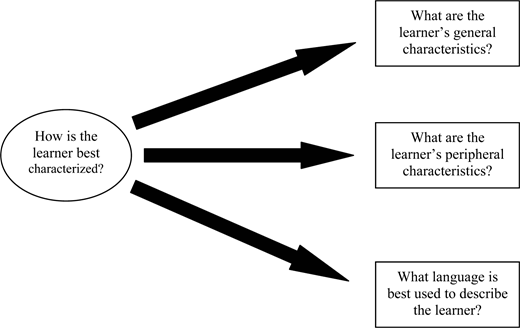
The first heuristical question dealt with in Figure 1 focuses on learner characteristics. In this section, we first offer guiding questions for characterizing the learner (see Figure 2). As will be discussed, characterizing learners is essential toward the goal of productively using subsequent heuristical questions shown in Figure 1. After discussing the advocated approach to characterizing learners, we characterize the learner on the periphery that will serve as the example within this article.
Guiding Questions to Support Learner Characterization
Designers must first determine the general characteristics of the learner. Morrison, Ross, and Kemp (2004) note the importance of considering learners’ general characteristics in terms of race, gender, and age. General characteristics also might include characterizations of culture and socioeconomics. Delineating general characteristics of the learner will be useful in considering the degree to which formal education (or more specifically online learning) has benefited learners of the same general category, even if it has not benefited the learner on the periphery, per se. As will be seen, a consideration of the learner’s past experiences with formal education is an important part of the heuristical process presented in this article. Because the learner is on the periphery, the exact learner being characterized has not had formal educational experiences that can be analyzed. It is necessary, then, to delineate the general characteristics of the learner.
Furthermore, delineating the general characteristics of the learner will better help designers understand to what extent the learner is on the periphery. That is, once characteristics that can be generalized have been extracted, remaining are likely to be the unique characteristics that make the learner peripheral in relation to traditional college students. The general characteristics offer insights into what makes the learner being analyzed similar to other learners; the peripheral characteristics address the question of what makes the learner unique and one who is on the periphery. As will be seen later in this article, describing the specific peripheral characteristics of the learner also can support instructional strategy selection.
Through considering both the general and peripheral characteristics of a learner, designers must determine the language that they will use to describe the learner and the learner’s needs. The issue of language is important, particularly in light of the notion of learners being on the periphery. Such learners are sometimes hard to label, and not labeling them appropriately and carefully might lead to designer biases and assumptions that create poor design (Power, 1997; Solomon, 2000). Designers should find language that casts learners in a powerful light and rhetorically exploits their potential strengths as learners who come to the online classroom with unique needs and goals. Appropriate language can help set the tone for this task.
Example of Learner Definition: The Household Production Matriarch
The example used in this article is based on the household production martriarch (HPM)— the female who has a major responsibility in the realm of running the household and managing its day-to-day requirements (e.g., cooking, cleaning, child care, paying bills, and supervising home repairs). We chose the HPM as the example within this article because she is a clear example of a peripheral learner and one that will provide an intellectual challenge within the application of our various heuristics, thus highlighting for readers the flexibility of heuristics.
For the purposes of this analysis, we narrow to the ages of the HPM between 30 and 60. Women younger than 30 are more appropriately considered to be learners in the “traditional” college range; women above the age of 60 might more appropriately be analyzed in light of gerontological educational literature. In establishing the age range and gender of the HPM, we have established relevant general characteristics. Her peripheral characteristic— the characteristic that puts her on the periphery of learning within higher education—is simply that she operates within the context of the home, not within the context of business and industry. On the surface, this peripheral characteristic suggests the appropriateness of online learning, as women who operate within the home are likely to have less flexibility in terms of completing formal education since running a household is not confined to the hours of a traditional work day. More directly related to the design of an online course, the peripheral characteristic of operating within the context of home production, not market production, has implications for her entire purpose for getting a formal education. Should a formal education simply improve her skills in doing housework? Or, is there a different outcome that an HPM may seek through formal education? Such questions must be considered—and will be addressed later in this article—if the online course is to be designed to meet her needs.
We acknowledge the unusual language inherent to the collective phrasing of “household production” and “matriarch.” As we have noted, though, particularly when dealing with learners who are on the periphery of benefiting from online learning, the language in which designers frame the learner may inadvertently shape the design. The words that traditionally describe these women (e.g., “housewife” and “homemaker”) and their tasks (e.g., “cleaning up”) may carry negative connotations that lead to inferences of servitude and powerlessness. To the extent that formal education is meant to empower, learners must be considered in light of their potential to be empowered; thus, the language used to describe the HPM is important.
HAS FORMAL EDUCATION HISTORICALLY INFLUENCED THE LEARNER?
As Figure 1 indicates, two heuristical considerations follow a characterization of the learner: designers should (a) consider how (or whether) formal education has influenced the learner being analyzed, and (b) determine what the learner needs to gain from an education. Taken together, these two considerations provide a type of needs analysis where a designer can define “need” as the gap between actual influence of formal education and the desired gain for the learner. Either of these two heuristical questions can be addressed first. We begin by considering a learner’s experiences with formal education in order to gain insights into the potential of designing an online course that will benefit the learner. After an examination of this heuristical question, literature surrounding the formal education of the HPM will be considered as an example.
Formal Education’s Influence on Learners
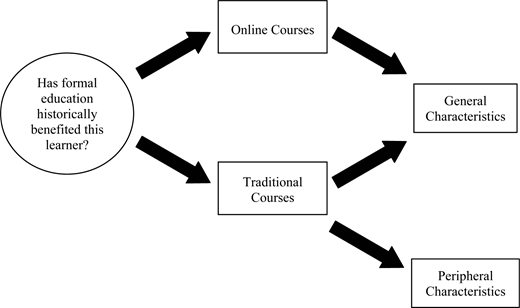
In considering formal education’s influence, designers must examine the influence of both online courses and traditional educational experiences (see Figure 3). Most likely, little literature will exist in both areas. After all, the learner is on the “periphery” of education, so if much literature surfaces particularly in regards to the influence of online courses on the learner being analyzed, designers might do well to consider whether they have correctly defined the learner as being on the periphery. However, when a literature search is removed one level—from the peripheral to the general characteristics—literature might provide insights worthy of consideration.
As designers consider the influence of formal education on learners, there may be a tendency to associate “influence” with “benefit.” The most “beneficial” education for the learner on the periphery will be addressed in the next section of this article; and, as will be discussed, an actual influence of formal education may not match the intended, or needed, benefit. If formal education has positively affected the learner on the periphery in the past, then a question is begged: How has formal education benefited the learner on the periphery that is being analyzed? Can online learning capitalize on the “how”? To the extent that it can, examining the impact of formal education on the learner in question can help designers begin to understand the types of instructional strategies that might be most useful in an online course. But formal education often has not influenced the learner in question—one of the very reasons that the learner is only on the periphery of formal education. Or, if the learner is just entering the periphery, examining the impact on the learner may not be particularly useful because literature might not exist. Where literature does exist, we urge designers to carefully document the literature, even if it initially seems to be unhelpful. As the analysis process described in this article progresses, some literature that initially seemed irrelevant may take on a new significance.
Formal Education and the HPM
Not surprisingly, a review of the literature revealed no discussion of the HPM and online learning. When generalized from the HPM in particular, to women as a group, though, some literature did offer relevant insights about the influence of online education. Because home computers provide women with any-time-anyplace access to the Internet, for example, online courses have helped minimize the impact of barriers facing women as they consider the feasibility of engaging in formal education (Furst-Bowe & Dittman, 2001). More specifically, online courses have provided new opportunities for women from rural environments (L. C. Morris, 1996), women who are victims of domestic abuse (Campbell, Sy, & Anderson, 2000), and adult women (Furst-Bowe & Dittman, 2001). For some of these women, online learning resulted in improved computer skills and more awareness of course content (Campbell et al., 2000). While only mentioned tangentially, both L. C. Morris (1996) and Campbell et al. (2000) point to the need for instructional strategies to be aligned with women’s ways of knowing (cf. Belenky, Clinchy, Goldberger, & Tarule, 1986). This point about alignment supports the need for this article, in general: Strategies must be created in light of an understanding of the learner. This point will be considered further as the HPM serves as an example.
Some literature does exist that examines the influence of traditional formal education on the HPM’s proficiency in completing house-hold tasks. Economists, for example, have tended to assume that the relationship between formal education and household productivity is positive—as formal education increases, so does household production: “A distinguishing characteristic of human capital [such as “investments in … formal schooling”] is that it is embedded in an individual [and thus] accompanies [her] wherever [she] goes, not only into the labor market, but also into … the kitchen” (Michael, 1973, p. 306). Michael’s empirical results substantiate his hypothesis: formal education increases a woman’s productivity in doing housework. Notably, though, Michael’s analysis was based on a very broad definition of “nonmarket productivity,” and thus considers other nonmarket activities, such as entertainment, reading, and even grooming (Gronau, 1980).
Other researchers have tried more meticulously to address the relationship between housework and formal education. These results offer mixed conclusions. J. Morris’ (1976) empirical analysis rejects the hypothesis that education has nonmarket productivity effects. Conversely, Gronau (1980) offers an analysis of housework productivity for Caucasian wives who were not employed outside the home. The results of this analysis indicate that the effect of education on home productivity is 70% of the effect that education has on workforce productivity. Using an adjustment of Gronau’s technique, though, Graham and Green (1984) suggest the need for “caution in drawing definitive conclusions” about the influence of formal education on household productivity (p. 281). Others have more recently empirically examined the relationship between formal education and household production (cf. Sharp, Heath, Smith, & Knowlton, 2004; Sharp & Knowlton, 2002). These investigations suggest that the relationship between productivity in the home and formal education cannot be ruled as positive.
WHAT DOES A LEARNER NEED TO GAIN FROM FORMAL EDUCATION?
As noted earlier in this article and as shown in Figure 1, both (a) the influence of and (b) the needed benefit from a formal education to the learner on the periphery should be considered in light of learner definition. In this article, we discussed the influence of formal education in the previous section; in this section, we consider the heuristical question that will help designers determine the learner’s needed benefit from an education. We first discuss a scheme for considering the potential benefits of formal education to learners on the periphery. Then, we offer an analysis of which benefit within that scheme might be most appropriate for the HPM.
Defining Learner Needs
A variety of perspectives can influence the purposes of a formal education and an understanding of what the educational needs of learners on the periphery may be. Most obviously, if a sample of the learners is convenient, designers might survey them to determine their felt and anticipated needs. In higher education, this is often impractical, thus designers might revert to less direct ways for determining the needed benefit that should come to learners on the periphery from formal education. We point to four types of potential benefits that higher education might be able to provide to learners on the periphery. The four types are performance improvement, occupational preparedness, critical analysis skills, and personal transformation. In considering these various types of education in relationship to learners on the periphery, designers should neither assume that they fall along a continuum from inherently “good” to “bad” or “simple” to “complex” nor that aiming toward one need necessitates the exclusion of other needs; still, designers must determine which type of benefit is most appropriate—as opposed to solely “correct”—for the intended learners.
First, as the name implies “performance improvement” deals with increased or enhanced skills on the part of the learner. While often useful in corporate training situations, it is not often listed as a primary goal within higher education. Performance improvement downplays the importance of cognitive growth—a hallmark of a college or university education—as an explicit learning outcome and focuses solely on performance. In spite of the lack of the cognitive component, we urge designers not to overlook performance improvement as one possible purpose of an online course that might benefit a learner on the periphery.
Second, education for occupational preparedness focuses on the learners’ intended career. Certainly, there is an element of performance improvement inherent to an education geared toward occupational preparation. But, there are larger aspects of such an education, as well. For example, occupational preparation involves understanding the structure and nature of organizations and problem solving within real world contexts (cf., Beckett & Grant, 2003).
Third, critical analysis skills (such as critical and creative thinking, problem-solving abilities, and improved communications skills) are indicative of a liberal arts education. The content of such a curriculum may tend to be canonical and based on content that is revered. For example, within a study of literature in western culture, one assumes the prominence of Shakespeare as a topic for analysis; within a study of music, Bach, Beethoven, and Brahms are names that traditionally have been included as part of the cannon. Emphasis here, though, properly should be on the analysis of the cannon, not the rote memorization of canonical facts (e.g., the year that Beethoven wrote a given symphony). Through analysis, learners will develop their abilities in critical thinking. Fourth, a transformative education focuses on personal change through education (Palloff & Pratt, 1999). Transformative education is consistent with notions of “learning about the self” (cf. Knowlton, 2003a, p. 8); in the context of online learning, transformative education “embodies a self-reflective process that occurs on several levels” (Palloff & Pratt, 1999, p. 129). Transformative education addresses the central question of “what will all this [education] do to me” (Holmes, 1996, p. 24). This notion of an education for transformation, when considered in absence of the other three potential benefits of a formal education, may seem a bit abstract and esoteric. Therefore, education for transformation is a benefit that is often combined with one or more of the other benefits described in this section.
The Educational Needs of the HPM
Most literature reviewed in the previous section of this article that examined the influence of formal education on the HPM focused on both performance improvement and occupational preparedness, at least to the extent that household production is an “occupation.” Are these the best types of “benefit” to the HPM? Our analysis suggests that they are not. Literature suggests that as women acquire more education, they become less satisfied with performing home labor (e.g., Baxter & Western, 1998; Oakley, 1974; Robinson & Milkie, 1998). It seems reasonable to conclude that less satisfaction will result in less productivity. If true, then “more” education toward occupational preparedness will result in less proficiency in the occupation of housework. Furthermore, to claim that performance improvement and occupational preparedness are the appropriate benefits of a formal education through online learning is to suggest that all online courses should take on a “home economics” and “consumer education” approach, where coursework is geared directly toward the daily tasks of the HPM. Such an approach probably does not seem very practical for courses across disciplines.
A shift toward critical analysis skills and personal transformation as the intended benefit of online learning for the HPM seems more viable. Part of our rationale justifying this shift is a matter of default (i.e., the inappropriateness of performance improvement and occupational preparedness leaves critical analysis and transformation). In addition, though, considering the characteristics of the HPM that make her peripheral suggests the appropriateness of a transformative education, which requires an examination of her own thinking and learning processes, beliefs, biases, and hidden assumptions—both her ontological and epistemological stances. Through such an examination of her own thinking processes, the HPM can move toward better opportunities for self-enlightenment. Women need to learn that they are “capable of intelligent thought; and they need to know it right away” (Belenky et al., 1986, p. 193). This is the case for more specifically the HPM. This need describes the importance of a shift from cognition (thinking about course content) to metacognition (thinking about one’s own thinking as she considers course content). Obviously, a metacognitive approach to education is not immediate, but it does move students toward an understanding of their own thinking and perhaps even the unique intelligence that underlies their own thinking.
Because of modern biases against the notion of a woman working within the home (cf. MacKinnon, 1987; Nelson, Palonsky, & Carlson, 2000), a tendency may exist to shape the transformation toward an intended outcome (e.g., transformation toward understanding her proper place outside of the home as a productive member of the labor market). As the focus of this article is learners on the periphery, we caution against such tendencies. Certainly, if the HPM determines through transformative learning that she should enter the labor market, that is an acceptable conclusion; but choosing to stay in the home—while perhaps not politically correct—is also acceptable to the extent that her “choosing” comes as a result of a transformative education. Therefore, designers of online courses would do well to recognize notions of transformation as value-free. It is the learner—not the designer—who should determine the value system toward which transformation should occur.
WHAT TYPES OF STRATEGIES SUPPORT THE NEEDED EDUCATION?
This heuristical question provides a means for matching the intended benefit of education described in the previous section of this article with specific instructional strategies. After this scheme is provided, we apply the scheme to the HPM as learner on the periphery.
Matching Strategies to Need
As can be seen from Figure 1, the heuristic questions discussed in the two previous parts of this article each inform strategy selection. It is possible, for example, that determining strategies appropriate for the learner being analyzed is a function of considering the learner’s past educational experiences and the strategies that were used in those experiences. That is, if literature suggests that the learner—as defined either through general or peripheral characteristics—has benefited from formal education and that benefit is appropriate in light of the needed type of education, then simply implementing the instructional strategies that have previously been used may be useful. The topic of implementing strategies is discussed later in this article.
More than likely, though, because the learner is on the periphery, examining the past formal education experiences of the learner will not be useful. Therefore, designers should make new connections between the benefit of education that the learner needs and instructional strategies. To optimize the new connections, designers should categorize instructional strategies in ways that are congruent with the benefits of education described in the previous section of this article. One way to accomplish this goal is to adopt four categories of instructional strategies: behaviorist, cognitivist, constructivist, and metacognitive or reflective (see Table 1).
As Table 1 shows, behaviorist strategies—a simple pairing of stimulus and response—are likely to be most useful when there is an emphasis on performance improvement. In practical terms, such an approach would require small cycles of student action with immediate feedback. Cognitivist strategies— such as generative learning strategies (cf. Grabowski, 1996)—can support stronger critical analysis skills. In short, generative learning strategies suggest that students who organize and represent content in unique and personal ways and then elaborate on that content will likely come to think about course content in more diverse and complex ways (Knowlton, Eschmann, Fish, Heffren, & Voss, 2004). Because constructivist strategies focus on collaboration and real-world problem solving that are based in specific contexts (Jonassen, 1991), there is some congruence with the educational goal of occupational preparedness. For a transformative education, metacognitive and reflective strategies can be useful. Meta-cognitive strategies are based on the view that engaging in educational activities is not “enough” to constitute true learning. Learners must reflect on their activities to learn more about themselves. Therefore, metacognitive strategies often are used in conjunction with other strategies because the learner must engage in activity to reflect on and think meta-cognitively about.
Certainly the connections between the needed educational benefit and strategies that we offer here are not foolproof. For example, cognitive behavior modification (cf. Stipek, 1996), though a cognitive strategy, can lead to an improvement in performance. Furthermore, constructivist strategies can lead to a transformative education in some settings (cf. Knowlton, 2004). Nevertheless, the general alignment that we offer between these purposes of education and strategies can serve as a starting point for the heuristical reasoning process.
Strategies and the HPM
In the previous section of this article, we suggested that a transformative education was appropriate for the HPM. Earlier in this section, we suggested that metacognitive strategies are most salient toward creating transformation. The type of transformative education through metacognition that we advocate requires the HPM to examine her own production activities in a new light. The new light is the result of a combination of examining course content and her own thinking and learning of course content. Within the context of online learning, Palloff and Pratt (1999) deem this as a “constant process of looking back and taking stock” (p. 139). While the first level of transformative learning requires the HPM to take stock of herself as a learner, the second level requires her to “[use] a prior interpretation to revise or create a new interpretation of one’s experience as a means by which to guide future action” (p. 139). It is this notion of guiding future action that serves as the second level of transformative education.
Strategically, we conceptualize this process as cyclical and iterative. Her change in thinking results in an enlightened understanding of her own choices and behaviors, which leads to additional changes in thinking. Through such iteration, an HPM might come to understand her own role in a new way and be able to conceptualize and articulate that role in more meaningful and constructive ways—coming to see her own role and its potential value. There is a reciprocal relationship, then, between thinking and the real-world implications of that thinking. Said more plainly, to offer the HPM opportunities for reflection, we must give the HPM something on which to reflect. Therefore, perhaps cognitivist activities where the HPM develops connections between course content and her own life provides her an opportunity to see herself through a new lens. This new lens may be a portal that allows for transformation through metacognitive reflection. Even content that may seem to be far removed from her life—say, a foreign language course, can provide opportunities for activities that allow for transformation. As she works with classmates even on the most traditional of academic task, such as collaboratively analyzing the structure of sentences or translating a passage from one language to another, she is being provided with collaborative activities on which she can reflect. As she is asked to consider her collaborative activities, she has the possibility of learning more about herself and her own experiences.
HOW CAN STRATEGIES BE DEVELOPED AND IMPLEMENTED IN WAYS THAT PROVIDE EQUIVALENCY?
This last heuristical question is represented as the end point in Figure 1; functionally, though, it serves as a type of culminating question through which the analysis emerging from the previous heuristical questions are synthesized in ways that operationalize and support the integrity of the entire heuristical process. More directly said: designers must synthesize their understanding of the learner with their understanding of both educational purpose and the strategies to provide learning experiences that allow for equivalency. We develop these ideas in the abstract, then we apply them to the HPM.
Equivalency for Learners on the Periphery
The notion of equivalency in distance education was first suggested as a means for comparison between distance and face-to-face courses (Simonson, Schlosser, & Hanson, 1999). Simonson (2000) has applied equivalency theory specifically to the online classroom, noting that an educational experience might not be equal for both online and face-to-face learners. Rather, students should be able to get a “different but equivalent learning experience” (p. 29). We extend this notion of equivalency to consider different learners in the same online course. That is, a learner on the periphery should have an educational experience that is equivalent to more traditional learners, even if the two types of learners are in the same course. Such an extension has two implications for those who are charged with designing online courses. First, designers must consider the relationship between the media-based tools that constitute the online classroom and the analysis of the learner on the periphery. Second, learning experiences may need to be individualized in order to help the learner on the periphery achieve equivalency.
Equivalency Through Media
Simonson (2000) suggests that part of the process for achieving equivalency is to match learning experiences with the appropriate media; furthermore, he suggests that a “smorgasbord” of media should be used (p. 29). Our point here is not to focus on media for its own sake, but rather to point out that some instructional strategies can only be made practical through the use of certain media. Some media may be biased against specific learners on the periphery, and we suggest that this bias can often be seen by considering the uniqueness of social interaction patterns and norms among learners on the periphery. To support this point, we briefly contrast video- and text-based media.
Media supporting video (e.g., Web-enabled two-way video using a webcam and micro-phone) allow communication to be based on audible and visual cues. As Weiss (2000) notes, gestures, facial expressions, and other physical elements can “contribute subtle (and sometimes not so subtle) meanings or attitudes” (p. 48). Conversely, media that support only text-based communication remove any chance for meaning to be derived based on visual and audible cues; communication occurs solely through the written word. For some learners on the periphery, the lack of visual connection might impede communication and thus hinder the potential for learning; for other learners on the periphery, though, the lack of sights and sounds might serve as a point for liberation because it removes idiosyncrasies, such as a lack of eloquence or even speech impediments.
We recognize that the analysis that we present here is a bit simplistic and exceptions exist. MUDs and MOOs, for example, are text-based communication tools, but they can be used to manipulate sights and sounds to enhance communication (Purnday, 2000). Such a view is supported elsewhere in the literature, where it is noted that some text-based communication tools can “liberate participants from the limitations that roles in a physical setting often prescribe for them” (Anderson, Benjamin, Busiel, & Parades-Holt, 1998, p. 77).
Equivalency Through Individualized Learning Experiences
Learners on the periphery probably will not need to consider content in many courses from the same perspective as more traditional learners, and except in the most extreme of circumstances, the learner on the periphery is probably but one learner in a class with both other peripheral learners—albeit ones very different from the learner on the periphery being targeted in a single analysis—and with traditional learners. Thus equivalency can only be achieved through the creation of individualized learning experiences, whereby a strategy is created based on the type of interaction that will be most useful to the peripheral learner.
There are several different types of interaction, and to accommodate a variety of different types of learners—both traditional and learners on the periphery—a strategy may need to include multiple types of interaction. The first type of interaction is between a learner and course content. In the truest sense, because content cannot “interact,” perhaps this first type is better characterized as learners interacting with themselves and their own thoughts about course content. The second type is between a learner and course activities. The third type is between the learner and a professor. The fourth type is interaction among students. These four types of interaction are described by Berge (2000), and they serve the point that different learners may need different types of interaction, given their needs.
Creating Equivalency for the HPM
We have suggested that this final heuristical question allows for a cumulative consideration of the learner. Table 2, then, shows a summation of the analysis of the HPM as presented in this article. In considering this summation, equivalency through both media and individualized learning experiences are considered.
In terms of media, we cannot offer definitive answers; on the one hand, the past educational experiences of the HPM likely were face-to-face and thus based on body language, other visual cues, and tone of voice. Thus, consider the HPM’s comfort level with being able to see and hear—through video media—classmates and the instructor. On the other hand, such media tend to replicate the traditional classroom more so than the absence of these media, and traditional classrooms have tended to silence women and support communication that is more indicative of male-based discourse (Belenky, Clinchy, Goldberger, & Tarule, 1986). From a media-based perspective, then, perhaps equivalency can best be created through simplicity. For simplicity, the use of Web pages and text-based communication tools that allow for both one-to-one and one-to-many communication would be useful. Simplistic media may be an advantage for the HPM who may not be media savvy and likely will have little technical support.
In terms of individualized learning experiences, a socially constructed understanding of course material is more useful than a transmission model of coming to understand content. Why? A hierarchical view whereby formal authorities hand down a final version of truth is contrary to the ways that women tend to learn—by socially constructing knowledge through relationships. To allow socially-constructed knowledge to occur, designers will need to create opportunities for careful scaffolding and reinforcements for a style of interaction with which the HPM is comfortable. Furthermore, as we pointed out in the previous section of this article, a transformative learning experience might be based on having the HPM reflect on social interaction. Because social interaction allows for additional meta-cognitive—and thus transformative—activity, we advocate lots of social interaction for the HPM.
Unlike women who work in the market-place, the HPM has not experienced formal social inductions through being mentored by others who understand the social structures of organizations and implicit protocols for working within those social structures (Oakley, 1974). Therefore, individualized strategies should help the HPM become inducted into social negotiation. Simple initial “introduction” exercises can help, and such exercises may be useful in supporting more formal interaction that deals directly with course content. One activity might be to require students to create a “personal” Web page that introduces themselves to their classmates. This assignment might allow students to share their excitement and concerns about the course. Once the Web pages are built, students might be asked to read each other’s Web pages and post a greeting to several classmates that acknowledges common interests and experiences. This approach will cause the HPM to interact with both the content and with each other.
Socialization can be enhanced by matching the guidelines supporting the use of these tools with traditional female communication styles. A full discussion of gender differences in written discourse is beyond the scope of this article, as the involved issues could fill numerous books (e.g., Gannett, 1991; Gilligan, 1982; Tannen, 1994). Here, though, we focus on the need for individualized learning experiences to emphasize informal writing as a means of interaction. Fortunately, informality not only matches a female style of writing (cf. Gannett, 1991; Gilligan, 1982), but also it matches the types of writing that are often produced within online discourse (cf., Knowlton, 2003b). Online discussion can create a self-contained rhetorical context (Anderson et al., 1998) in which students are writing to an authentic audience (Fabos & Young, 1999) that can provide feedback in ways not typical in more formal writing contexts (Kemp, 1998).
The emphasis on an informality that is consistent with female approaches to discourse implies more of a narrative approach to discussion than a traditional academic approach. Without the emphasis on narrative approaches, the “fondness for abstract claims” and “freedom from … real-life entanglements” and even freedom from “the body” that are often inherent to computer-mediated discourse might tend to privilege and reinforce a male-dominated style of written interaction (Punday, 2000, p. 198). A narrative approach implies more of a story-telling connection with course content, as opposed to a writing style that privileges academic citations and rigorous adherence to style manuals. The HPM will benefit more from being asked to connect course content to her life beyond her cybereducation. To help students see the importance of a narrative approach, the introduction of strategies might include example stories of how students have changed their ideas and behaviors by connecting course content with their own lives. Slightly more abstract, we sometimes even share illustrative quotations from literature about the benefits of narrative writing as an educational tool. These quotations might note that informal narratives can serve as “powerful vehicles of the intellect, as engines that warm and drive the mind, capable of doubling back or going great distances, carrying with them the maps and memories of all previous trips along with plans for the next” (Gannett, 1991, p. 99). Depending on the point of the course, longer excerpts or even entire articles (e.g., Sommers, 1993; Tompkins, 1987; Welch, 1993) can help students come to see the virtue in a narrative and discourse-based approach.
IMPLICATIONS
In this article, we have presented heuristical questions for considering the types of strategies that will be most useful to peripheral learners. We recognize that these questions represent a trial and are in need of refinement through formative evaluation or a form of design-based research, like intervention design (cf. Barab & Squire, 2004). Thus, we raise some issues of practice that can refine and thus improve the utility of our approach.
First, the infrastructure of our heuristical approach is in need of revision through formative evaluation or lessons learned through design-based research. For example, we recognize that our discussion of strategies as behaviorist, cognitivist, constructivist, and transformative is a bit trite and overly generalized. Designers should consider other infra-structures for this heuristical question. For example, perhaps Morrison et al.’s (2004) approach to strategies emerging from a consideration of objective classifications might be useful in some situations. Still, we think that broader approaches for designing instruction could be equally as useful, particularly where designers are trying to create online learning environments, as opposed to designing traditional instruction to be delivered online.
Second, every learner on the periphery is defined by uniqueness, and we obviously have not reasoned through our heuristics with all possible peripheral learners. Our use of the HPM as an example was designed to serve as simply one illustrative example. What issues arise when applying these heuristics to other learners on the periphery? Designers should build on the heuristical reasoning that we have initiated here by applying our heuristical questions to other learners on the periphery. Obviously entire programs of studies or even individual classes cannot be designed for the learner on the periphery. But, as this article inherently asserts, we cannot ignore learners on the periphery, either. The needs of learners on the periphery must be met but these learners are—by definition—heterogeneous; when the needs of “mainstream online learners” (whoever exactly they are) are factored in, the entire pool of students becomes even more heterogeneous. Considering the needs of learners on the periphery allows learners to pursue their own interests within a course, without infringing on the learning opportunities of those who may be more traditional learners. Because design-based research and its variants directly involve learners in the research and refinement process (Wang & Hannafin, 2005), perhaps it is an appropriate approach for more directly gaining insights into the needs of learners on the periphery.
Third, there are issues here of formative evaluation and refinement through implementation. What hallmarks does a designer “look for” during implementation that will evaluate both the quality of the heuristical questions and any given application of those questions? The application of the heuristics offered in this article is not science as much as it is giving practical approaches for a design technology. We recognize that even a different application of these heuristics using the HPM as an example learner on the periphery could have resulted in quite a different analysis from the one that we have presented here. In our view, this does not belittle the need for (and usefulness of) the heuristical questions shown in Figure 1. Rather, the flexibility of Figure 1 is its strength. Collectively, the heuristical questions provide a structure to scaffold and support designers’ thinking about their own design in light of learner needs. A variety of directions for that thinking might be appropriate, even when two different designers consider the same types of learners.