This scoping review maps mobile social network–supported microlearning (MSNSM) in higher education, identifying research trends and applications and how MSNSM enhances cognitive, social and teaching presence within the community of inquiry (CoI) framework.
Following Arksey and O'Malley's framework, 787 records from Web of Science and Scopus were screened, yielding 16 empirical studies (2010–2024). Data were analyzed using bibliometric mapping, content analysis and the CoI framework.
Three trends emerged: (1) increasing use of mixed-methods, (2) reliance on platforms (YouTube, TikTok, Twitter, Instagram and WhatsApp) and (3) broad disciplinary reach. Cognitive and social presences were strongly supported, with improvements in performance, engagement and motivation. Teaching presence remained limited, often manifesting as instructor “micro-celebrity” rather than structured design.
The review includes only SSCI/SCI-EXPANDED/Scopus Q1 English studies, excluding some relevant work. The small corpus reflects the field's emerging status. Future research needs stronger pedagogical grounding for MSNSM and more cross-context, longitudinal studies.
MSNSM enhances engagement and performance via familiar social media. Educators should use micro-video and interactive content but integrate intentional scaffolding and clear objectives, avoiding personality-driven practices.
MSNSM fosters supportive learning communities through connection and collaborative sharing in informal digital spaces, reducing participation barriers and expanding access to higher education.
This review synthesizes MSNSM research in higher education through the CoI framework. It highlights an imbalance where cognitive and social presences thrive while teaching presence remains underdeveloped, offering a foundation for theory-informed pedagogical design.
1. Introduction
Microlearning, characterized by its multimodal (Reynolds & Dolasinski, 2023) and video-based nature (Alias & Razak, 2025), has been widely adopted for online learning. Recent studies showed that microlearning not only improved academic performance (Mohammed, Wakil, & Nawroly, 2018; Polasek & Javorcik, 2019) but also fostered motivation and engagement (Fidan, 2023; McKee & Ntokos, 2022) in informal learning. However, microlearning is not monolithic. In educational contexts, it is defined by brevity and modularity (Jahnke, Lee, Pham, He, & Austin, 2020; Lee, 2023), whereas professional training emphasizes workflow-integrated models (Torgerson, 2021). This review adopts the educational framing while acknowledging these broader debates.
Social networks have gained considerable research attention for supporting microlearning due to their accessibility (Greenhow, 2011; Kohnke, 2023), mobility, and sociability (Ooi, Hew, & Lee, 2018). Platforms such as Facebook and WeChat have been used to not only improve communication and collaboration (Roblyer, McDaniel, Webb, Herman, & Witty, 2010; Yu, Wang, & Spector, 2020), but also foster self-directed learning and self-monitoring skills (Hamid, Waycott, Kurnia, & Chang, 2015). Moreover, mutual connection and support within social networks enhance microlearning (Kohnke, 2021; Torgerson, 2021), self-regulated learning (Tower, Latimer, & Hewitt, 2014; Yu, Tian, Vogel, & Kwok, 2010), and professional development (Lee & Kwon, 2023; Rodriguez-Gomez, Muñoz-Moreno, & Ion, 2024). In EFL learning, the integration of mobile social networks has been proposed to optimize microlearning (Kohnke, 2023). Consequently, mobile social network-supported microlearning (MSNSM) has emerged as a strategic approach to enhancing learning outcomes in higher education.
Although prior reviews have examined microlearning broadly (e.g. Lee, 2023; Moore, Hwang, & Moses, 2024; Pham, Nguyen, Dinh Hai, Nguyen, & Nguyen, 2024; Wang, Bakhet, Roberts, Gnani, & El-Osta, 2020) or narrowly (e.g. K-12 education) (Sankaranarayanan, Yang, & Kwon, 2024), the growing use of MSNSM mainly appears in medical fields (e.g. Osaigbovo & Iwegim, 2018; Palmon et al., 2021). Few studies have synthesized MSNSM research in higher education (Taylor & Hung, 2022). Hence, this study seeks to explore the pedagogical landscape of MSNSM in higher education by analyzing its bibliometric trends and applications.
2. Method
To identify key trends within an emerging field (Levac, Colquhoun, & O’brien, 2010; Munn et al., 2018), a scoping review method was employed to examine MSNSM research. The review followed Arksey and O'Malley's (2005) five-step framework: (1) identifying research questions; (2) identifying relevant studies; (3) selecting studies; (4) charting data; and (5) summarizing results. A content analysis approach (Lee, 2023) drawing on the Community of Inquiry (CoI) framework (Garrison, Anderson, & Archer, 1999) was added to qualitatively code MSNSM themes.
The CoI framework posits that effective online learning arises from teaching, social, and cognitive presence. It is particularly suited for MSNSM: teaching presence aligns with microlearning's structured design, social presence with social media's interactive affordances, and cognitive presence with mobile, just-in-time independent learning. Thus, CoI provides an integrated lens to examine MSNSM.
While CoI has been applied to social media environments (e.g. Kazanidis, Pellas, Fotaris, & Tsinakos, 2018), most applications remain limited to formal online courses. Our study extends CoI specifically to MSNSM. Beyond formal education, social media enables informal workplace learning (Marsick and Watkins, 2001) through just-in-time learning, peer problem-solving, and knowledge sharing – processes aligned with microlearning (Sharma, Bhatnagar, Jaiswal, & Thite, 2023). Although our review focuses on higher education, these workplace perspectives offer insights for designing self-directed, informal MSNSM.
2.1 Identifying research questions
Three research questions were formulated.
What are the current trends of MSNSM in higher education, including prevalent keywords, citation rankings, publication distributions, and geographic reach?
How is MSNSM mainly applied in higher education in terms of research methods, platforms of mobile social networks, subjects, and fields of application?
How does MSNSM in higher education foster cognitive, social, and teaching presence?
2.2 Identifying relevant studies
2.2.1 Search terms and databases
Three search term sets were used. The first targeted mobile social network concepts (general terms: social media, social networking sites, mobile applications, messaging apps, and multimedia sharing; platform-specific: YouTube, Facebook, Twitter, WhatsApp, WeChat, LinkedIn, and Instagram). The second concerned microlearning (microlearning, micro learning, micro-learning, bite size learning, and bite-sized learning). The third included higher education terms (college students, undergraduate, and postgraduate) and application contexts (learning performance, medical, surgical, foreign languages, skill, English, EFL, motivation, confidence). Boolean operators (AND/OR) combined the sets. Two databases, Web of Science (SSCI/SCI-EXPANDED) and Scopus (Q1), were searched for peer-reviewed English articles (2010–2024).
2.2.2 Inclusion criteria
Four inclusion criteria were applied:
Indexed in the Web of Science (SSCI/SCI-EXPANDED) or Scopus Q1.
Published in English from 2010 to 2024.
Empirical studies on MSNSM (qualitative or quantitative).
Application of social media platforms in higher education.
2.3 Selection of studies
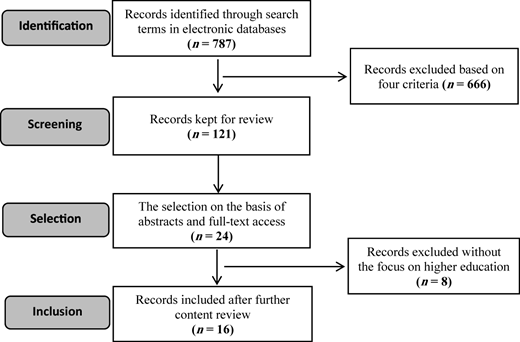
Following the PRISMA statement (e.g. Liberati et al., 2009; Moore et al., 2024), article selection involved four stages: identification, screening, selection, and inclusion (Figure 1). A keyword search yielded 787 articles, narrowed to 121 based on four inclusion criteria. After title/abstract screening, 24 articles remained relevant to MSNSM. Full-text review excluded eight that did not focus on higher education contexts, resulting in a final sample of 16 studies.
2.4 Charting the data
Sixteen journal articles were selected for the study (Table 1).
2.5 Data extraction and coding
Two independent reviewers coded the included studies. Interrater agreement was substantial to excellent (Cohen's κ = 0.79–0.85; McHugh, 2012). Disagreements were resolved through consensus.
3. Results
These studies were analyzed through Microsoft Excel, NVivo 14, and Tableau and further coded by employing the matrix methodology concept (e.g. Webster & Watson, 2002). The initial concept matrix was first constructed and iteratively refined during the classification process (e.g. Radianti, Majchrzak, Fromm, & Wohlgenannt, 2020).
3.1 Bibliometric results
3.1.1 Citation rankings
According to the Web of Science Core Collection (Table 2), the citation counts indicate that Stephansen and Couldry (2014) is the most cited work, with 48 citations, followed by Vizcaíno-Verdú and Abidin (2023) with 41 citations, and Lee, Jahnke, and Austin (2021) with 36 citations. Both Blooma, Kurian, Chua, Goh, and Lien (2013) and Fidan (2023) share the same citation count, with 29 citations each.
3.1.2 Publication distributions
Table 3 shows the ranking of the number of publications across the 16 articles, revealing that Education and Information Technologies and Educational Technology & Society were the two most prominent journals, with 3 and 2 articles published, respectively.
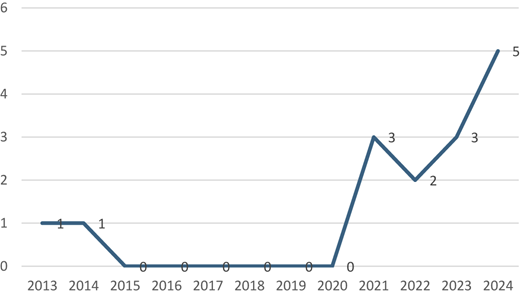
Figure 2 depicts the annual publication trend of the scoped articles. While the dataset reveals an overall increase from one publication in 2013 to five in 2024, a notable absence of publications occurred between 2015 and 2020.
3.1.3 Geographical reach
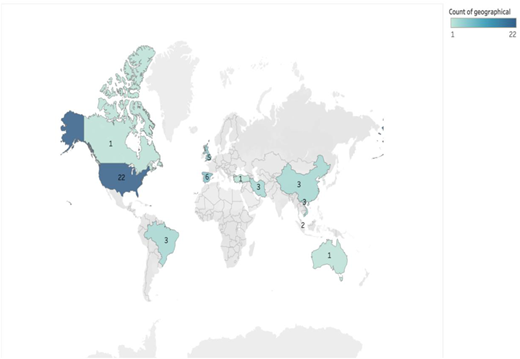
The regional locations of authors' institutions, extracted from each article, were analyzed using Tableau. Figure 3 illustrates the geographic distribution of affiliations across 11 countries. The USA led with 22 authors, followed by Spain (6), the UK (5), Brazil (3), China (3), Iran (3), Vietnam (3), Singapore (2), Canada (1), and Australia (1). Additionally, we calculated the number of publications by country, identifying the USA, the UK, and Spain as the top three contributors, with 4, 3, and 2 articles, respectively.
3.2 Primary themes of MSNSM applications
The review revealed some primary themes addressing RQ2.
3.2.1 Increasing use of mixed-methods designs
Of the 16 studies, four employed quantitative methods (Cai et al., 2023; Conde-Caballero, Castillo-Sarmiento, Ballesteros-Yánez, Rivero-Jiménez, & Mariano-Juárez, 2024; McKee & Ntokos, 2022; Rahbar, Zarifsanaiey, & Mehrabi, 2024), four used qualitative approaches (Aslan, 2024; Blooma et al., 2013; Kohnke, Foung, Zou, & Jiang, 2024; Vizcaíno-Verdú & Abidin, 2023), and eight adopted mixed-methods designs (Fidan, 2023; Gerbaudo, Gaspar, & Gonçalves Lins, 2021; Lee et al., 2021; Lohman, 2024; Sankaranarayanan et al., 2024; Stephansen & Couldry, 2014; Tennyson & Smallheer, 2021; Wakam et al., 2022). Quantitative studies employed diverse designs, including longitudinal quasi-experimental (Conde-Caballero et al., 2024) and single-group pre-test and post-test with surveys (Cai et al., 2023). Qualitative studies predominantly used content analysis, ethnography, and walkthrough methods (e.g. Aslan, 2024; Blooma et al., 2013; Kohnke et al., 2024; Vizcaíno-Verdú & Abidin, 2023). Mixed-methods studies commonly integrated observation (e.g. Stephansen & Couldry, 2014), surveys, semi-structured interviews (Gerbaudo et al., 2021; Fidan, 2023; Stephansen & Couldry, 2014), and self-reflections (Kohnke et al., 2024).
3.2.2 Widespread reliance on mobile social networking applications
Of the 16 studies, ten used mobile social networking applications as learning platforms. The most frequently used platforms were YouTube, Instagram, TikTok, Twitter, and WhatsApp, each appearing in two studies, with Wakam et al. (2022) combining both YouTube and Twitter. One additional study employed the EdApp mobile LMS (Lee et al., 2021). The remaining six studies used LMS platforms with social functionalities, including Moodle (Kohnke et al., 2024; McKee & Ntokos, 2022), Canvas (Lohman, 2024; Sankaranarayanan et al., 2024), Piazza (Blooma et al., 2013), and Edmodo integrated with EdPuzzle (Fidan, 2023).
3.2.3 A broad disciplinary reach across education, healthcare, and technology
Academic professionals were the most common target users (seven studies: Aslan, 2024; Gerbaudo et al., 2021; Kohnke et al., 2024; Lohman, 2024; Sankaranarayanan et al., 2024; Vizcaíno-Verdú & Abidin, 2023; Wakam et al., 2022), followed by undergraduate students (six studies: Blooma et al., 2013; Cai et al., 2023; Conde-Caballero et al., 2024; Fidan, 2023; Tennyson & Smallheer, 2021; McKee & Ntokos, 2022) and mixed cohorts (three studies: Stephansen & Couldry, 2014; Lee et al., 2021; Rahbar et al., 2024).
Regarding fields of application, Medical and Healthcare was the most represented (five studies), followed by Technology and Computer Science, and Education and Pedagogy (four studies each). Communication and Humanities comprised two studies, and Social and Professional Development one study. Specific topics included medical curricula (Cai et al., 2023), nursing education (Conde-Caballero et al., 2024), surgical training (Rahbar et al., 2024; Tennyson & Smallheer, 2021; Wakam et al., 2022), Java programming (Blooma et al., 2013), IT professional development (Gerbaudo et al., 2021; McKee & Ntokos, 2022; Sankaranarayanan et al., 2024). Other topics included teacher training and digital competence (Aslan, 2024; Fidan, 2023; Kohnke et al., 2024), and inclusive teaching (Lohman, 2024), journalism education (Lee et al., 2021), foreign language learning (Vizcaíno-Verdú & Abidin, 2023), and community building (Stephansen & Couldry, 2014).
3.3 Imbalances in the community of inquiry presences
Applying the CoI framework identified three dynamic themes.
3.3.1 Fostering and measuring social presence
Affective expression and engagement. The literature consistently highlights positive emotional responses. MSNSM enhances student engagement (McKee & Ntokos, 2022), satisfaction (Conde-Caballero et al., 2024), learner confidence (Kohnke et al., 2024; Lee et al., 2021; Tennyson & Smallheer, 2021), motivation (Fidan, 2023), and social support (Lohman, 2024). Community and collaboration. MSNSM platforms enable “micro-processes of recognition and mutual learning” (Stephansen & Couldry, 2014) and “social dimensions of micro-collaborations” (Blooma et al., 2013). Collectively, these studies conceptualize social presence as learners' capacity to connect as “real people” (Garrison & Arbaugh, 2007) within the microlearning community.
3.3.2 Assessing and reinforcing cognitive presence
Learning performance and knowledge acquisition. Most studies report positive correlations between MSNSM and cognitive outcomes. For example, learners scored “significantly higher” on quizzes (Sankaranarayanan et al., 2024), a finding consistent across surgical training (Cai et al., 2023; Rahbar et al., 2024; Wakam et al., 2022), IT problem-solving (Gerbaudo et al., 2021), and teacher training (Fidan, 2023; Kohnke et al., 2024; Lohman, 2024). Application of theoretical models. Several studies ground their analysis in established cognitive models, including Bloom's Taxonomy (Blooma et al., 2013) and cognitive load theory (Sankaranarayanan et al., 2024).
3.3.3 Limited and reconceptualized teaching presence
Under-representation of formal pedagogy. Only a few studies addressed the pedagogical design or facilitation of microlearning (e.g. Fidan, 2023); comprehensive focus on the intentional design of teaching presence is largely absent. Emergence of “micro-celebrity” and “influencer” roles. In the absence of formal design, teaching presence manifests through instructors' social media personas. On platforms like TikTok and Instagram, teachers engage in “micro-celebrification” and “relational pedagogy” to build communities and facilitate learning (Aslan, 2024; Vizcaíno-Verdú & Abidin, 2023). This suggests that teaching presence in MSNSM tends to be informal and personality-driven, indicating that its full potential, as defined by the CoI framework, has yet to be realized (Kohnke et al., 2024).
4. Discussion
This study explored trends and applications of emerging MSNSM in higher education. Beyond bibliometric results, three key themes emerged: increasing use of mixed-methods designs, widespread reliance on mobile social networking applications, and a broad disciplinary reach across education, healthcare, and technology. The lens of the Community of Inquiry (CoI) framework revealed a predominant focus on social and cognitive presences, alongside an underrepresentation of teaching presence evolving toward more personality-driven instructional roles.
4.1 Methodological and disciplinary trends
The findings reflect growing recognition of MSNSM's multifaceted nature. Mixed-methods designs offer robust understanding of research phenomena (Mekheimer, 2025), capturing learning outcomes that purely quantitative or qualitative methods cannot adequately address (Denojean-Mairet, López-Pernas, Agbo, & Tedre, 2024). Social networking applications dominate MSNSM platforms, facilitating participatory learning and peer feedback within everyday communication routines (Tang & Hew, 2022; Urena-Rodriguez, Lowell, & Yan, 2025), signaling a shift toward decentralized, learner-driven peer support (Rayland & Andrews, 2023).
MSNSM's broad disciplinary application highlights its interdisciplinary nature and adaptability. In medicine, it supports health communication, patient support, and professional networking (e.g. Conde-Caballero et al., 2024; Rahbar et al., 2024). In information technology, research focuses on learner engagement and cognitive assessment (e.g. McKee & Ntokos, 2022; Sankaranarayanan et al., 2024). In education, MSNSM facilitates microlearning and collaborative learning in professional development among educators and learners (e.g. Kohnke et al., 2024; Lohman, 2024). The cross-disciplinary engagement suggests a strong potential for MSNSM to foster interdisciplinary collaboration.
4.2 Imbalances in CoI presences
This study also found that MSNSM facilitates knowledge acquisition and cognitive improvement across domains, aligning with prior microlearning studies (Wang et al., 2020; Huang & Janakiraman, 2024). In light of the Community of Inquiry (CoI) framework, cognitive presence was the most systematically measured element, focusing on such fields as database programming (Sankaranarayanan et al., 2024) to surgical training (Wakam et al., 2022). However, the concept operationalization of cognitive presence remains relatively narrow. As Garrison et al. (1999) emphasized, cognitive presence involves not only information acquisition but also sustains critical inquiry and problem resolution. Critically, the study showed that social presence emerged as the most robustly developed dimension in MSNSM environments. Learners frequently reported heightened motivation, community support, and confidence when using MSNSM (e.g. Fidan, 2023; Kohnke et al., 2024). This positive outcome may be due to the informal and affectively rich learning experience created by social media for learners to interact and build supportive networks (Vizcaíno-Verdú & Abidin, 2023; Aslan, 2024).
In contrast, teaching presence was often implicit, fragmented, or reconceptualized through online social networking, frequently manifesting in educators' influencer-like performative identities (e.g. Vizcaíno-Verdú & Abidin, 2023). This digital personality-driven adaptation reflects social media's fleeting attention spans and dependence on instructors' affective appeal. The displacement of learning metrics may compromise the depth, rigor, and equity of learning experiences. In other words, there is a risk that using MSNSM without structured scaffolding privileges entertainment over education. The reconfiguration of teaching presence thus represents a conceptual upgrade for the CoI framework within online social media-supported learning environments.
4.3 Reconceptualizing teaching presence in platformized environments.
Our findings do not advocate abandoning intentional instructional design. CoI positions teaching presence as instructional design, discourse facilitation, and direct instruction (Garrison et al., 1999) – functions that remain essential in MSNSM, even when platforms encourage informal, persona-driven engagement. Intentional design can strengthen peer-to-peer and instructor-student connections. For example, instructors can design structured microlearning videos that scaffold from simple to complex inquiry (Fidan, 2023; Lee et al., 2021) and facilitate skill development through guided prompts and peer feedback (Kohnke et al., 2024; Lohman, 2024).
These patterns echo earlier research on novel delivery systems (e.g. CBT, WBT and telecourses), where technology similarly disrupted traditional teaching presence. Despite platform evolution, the tension between affordances and design persists. A balanced perspective aligns with CoI: teaching presence is not about instructor persona, but about pedagogical design that enables meaningful learning. Future MSNSM interventions should integrate relational authenticity with structured design – for example, combining structured microlearning videos (teaching presence), platform-facilitated peer discussion (social presence), and scaffolded inquiry tasks (cognitive presence).
Synthesizing across findings, three patterns emerge: (1) MSNSM supports social and basic cognitive presence, but deeper critical inquiry is underdeveloped; (2) teaching presence is often reconfigured as relational, influencer-led engagement; and (3) the field remains nascent. To strengthen pedagogical design, educators should integrate structured microlearning sequences, platform-facilitated peer feedback, and timely direct instruction. Future research should examine longitudinal outcomes, cross-cultural differences, and AI-augmented MSNSM that balances authenticity with educational depth.
5. Limitations
This review has two primary limitations: the small sample size and the absence of identified MSNSM articles between 2015 and 2020. This gap likely reflects the nascent stage of the field, as mobile microlearning research gained momentum only after 2015 (Lee, 2023; Moore et al., 2024). Two publications from this period (Khachan & Özmen, 2019; So, 2016) illustrated implicit microlearning principles but were excluded due to search term constraints. Future research should investigate whether this gap reflects genuine inactivity or search term limitations.
6. Conclusion
This review reveals that MSNSM enhances social and cognitive presence, but teaching presence remains marginalized or reconfigured as relational engagement. Educators should design structured microlearning sequences, facilitate peer feedback via platform features, and provide timely direct instruction. Research should prioritize longitudinal studies, design frameworks integrating all three CoI presences, and AI-augmented MSNSM that balances authenticity with pedagogical rigor. Illustrative examples include flipped microlearning with peer feedback (Fidan, 2023) and TikTok challenges with reflective questioning (Vizcaíno-Verdú & Abidin, 2023). Future case studies should document such integrated designs, tracking theory-driven interventions that operationalize all three CoI presences, prioritize learning theory over platform metrics, and move beyond affordance-led design.