


There is a need for higher education to produce graduates who are motivated to transfer learning into the workplace. Motivated graduates are work-ready and associated with increased performance. Presently, the research field around motivation to transfer learning by students in higher education is not clear and is inconsistent.
This scoping review provides an overview of the characteristics of the literature, including key concepts, recommendations and gaps based on eight published articles on the motivation of students in higher education to transfer learning.
The results reflected a research field, which focused primarily on the influence of specific factors, namely student characteristics, educational design, the workplace environment, and on higher education students' motivation to transfer learning. The lack of a shared conceptual definition of motivation to transfer learning in higher education appears to influence the description of the results from the included studies. Most of the previous studies applied rigorous research designs.
This seemingly stunted research field related to higher education students' motivation to transfer learning needs to be amplified to influence the development of work-ready graduates from higher education. Approaches towards including all elements of motivation, expanding to other fields in higher education, including low-income countries, may be a proximal step in enhancing the trajectory of this research field.
1. Background
Graduates from higher education institutions (HEIs) are continuously labelled as unemployable and not work-ready. Being work-ready implies that graduates are able to transfer their learning from HEIs into the workplace. Castillo et al. (2018) define transfer of learning as applying competence (knowledge, skills and attitude) acquired in one context to solve a problem in another context. This can be linked to improved performance in the workplace. In addition to various contextual factors that may influence transfer of learning, motivation is described as a critical factor influencing whether a person transfers learning or not (Celestin and Yufen, 2018; Chang and Chiang, 2013). Motivation is a person's inner drive to apply knowledge to accomplish personal and organisational goals (Grohmann et al., 2014; Khan et al., 2015; Kirwan and Birchall, 2006; Tohidi and Jabbari, 2012). Raza and Shah (2017) refer to the detrimental effects of a person without motivation for the organisation, as such a person will not be able to transfer learning, even if he or she had the skills, clear objectives, and a supportive work environment. Conversely, the performance of highly motivated people improves the quality of work to meet the organisational goals. Consequently, the organisation may experience increased productivity, decreased staff turnover, and positive employee morale (Celestin and Yufen, 2018; Kontoghiorghes, 2002; Waiyaki, 2017).
Higher education is expected to produce graduates that are motivated to transfer learning within their workplace. However, McDonald (2012) notes that the concept of motivation to transfer learning has not been given considerable attention in higher education, thus contributing to graduates from higher education not being work-ready. An increasing number of HEIs are creating opportunities for their students to transfer learning within authentic platforms. These opportunities are exemplified in laboratories, work-integrated learning (WIL), apprenticeship and internship programmes (Rowe and Zegwaard, 2017). Positive experiences within these learning environments, as designed by educators, may contribute to increased motivation for students to transfer learning.
In enhancing motivation to transfer learning, educators within higher education should actively pay attention to the development of learning tasks that promote deep engagement, and which are autotelic (Darling-Hammond et al., 2020). Course material must have value, meaningfulness and utility and should develop graduate attributes associated with competences that transcend all higher education (HE) courses (McDonald, 2012). According to Barkley (2010) – motivation is the product of expectancy and value. Expectancy is inextricably linked with self-perceptions, such as confidence to succeed with reasonable effort. Students should value the learning task itself and not only the consequences of task completion. The inference is that a student who expects to succeed and values the task will engage deeply with the learning task to discover meanings and construct new insights and integrative interpretations. This experience is a necessary foundation for students to be motivated to transfer their learning.
The literature reports developments related to motivation to transfer learning within professional development (Foley and Kaiser, 2013; Hajian, 2019). Studies investigating motivation to transfer learning in higher education are limited and inconsistent (see Colquitt and LePine, 2000; Gegenfurtner et al., 2009; Jacot et al., 2015; Nafukho et al., 2017; Tonhäuser and Büker, 2016). At the time of this study, the authors could not find a comprehensive review related to motivation of students in higher education to transfer learning. Therefore, this article reports on a scoping review that aimed to summarise existing literature on HE students' motivation to transfer learning. We argue that insights into HE students' motivation to transfer learning will enhance expansion into this research field.
2. Methods
A systematic review of the literature on motivation to transfer learning by higher education students was conducted. Findings are discussed below.
2.1 Design
A scoping review as per the prescribed steps of Peters et al. (2020) was conducted as it allowed for a broad overview of the literature in the field. The characteristics of the literature, including key concepts, recommendations and any gaps within an area were thus described (see Pham et al., 2014). Peters et al. (2020) expanded on the work by Arksey and O'Malley (2005), and described a nine-step process when executing a scoping review, namely:
defining and aligning the objectives and review question;
developing and aligning the inclusion criteria;
describing the planned approaches;
searching for evidence;
selecting the evidence;
extracting the data;
analysing the evidence;
presenting the results; and
summarising the evidence.
The Preferred Reporting Items for Systematic Reviews and Meta-Analysis Protocols (PRISMA-P) guided the development of an a priori protocol, which was approved by the Health Sciences Research Ethics Committee of the University of the Free State (HSD 2020/0421/2605) and registered at the Open Science Framework (see https://osf.io/8k56v) (open registration).
2.2 The search string
This scoping review was guided by the following review question: “What is the existing state of evidence regarding the motivation of students in higher education to transfer learning?” Boolean operators and modifiers were integrated with keywords generated from the population concept and context (PCC) elements of the review question to create a search string to search for potential literature to include in this study. A discussion with a subject matter librarian enhanced by trial searches refined the final search string to:
(classroom* or student* or undergrad* or “higher educat*”) AND motivat* and (transfer* n2 (train* or learn*)) and (motivat* n3 transfer*) AND “Higher educat*”
2.2.1 Information source
The librarian searched the following databases: ERIC, APA PsycInfo, Academic Search Ultimate, MEDLINE with Full Text, CINAHL with Full Text, Africa-Wide Information, Applied Health Source: Nursing/Academic Edition Science and Technology Source Ultimate, Communication and Mass Media Complete, APA PsycArticles.
2.2.2 Inclusion and exclusion criteria
Inclusion and exclusion criteria aligned to the review question guided the selection of articles for this study. In this review, we included literature reporting on motivation to transfer learning, specifically in higher education, from 1 January 1986 to 31 July 2020. Raymond Noe coined the concept “motivation to transfer learning” in 1986; hence, the timeframe of this review (Noe, 1986). The authors eliminated articles reporting on pre-primary, primary or high school education, and studies where English versions could not be accessed or retrieved.
2.2.3 Selection of evidence sources
Using the final search string to search through the included databases, the librarian recovered 114 records reflecting titles and abstracts. Forty records were eliminated through physical and automatic de-duplication. In the initial phase, authors independently applied the inclusion criteria in selecting titles and abstracts to include in the review. The selection outcomes of each individual author were then compared and tallied. Disagreements were rectified through discussion and consensus. The authors eliminated 64 titles and abstracts through the described process, as they did not meet the inclusion criteria. A total of 20 full-text articles were independently screened by the authors using the same inclusion and exclusion criteria. Of these, 12 articles were eliminated for not meeting the inclusion criteria. The reference lists of the included articles were examined for potential titles to include in the review, and this examination yielded no additional articles. Eventually, only eight full-text articles were included in this review (see Figure 1).
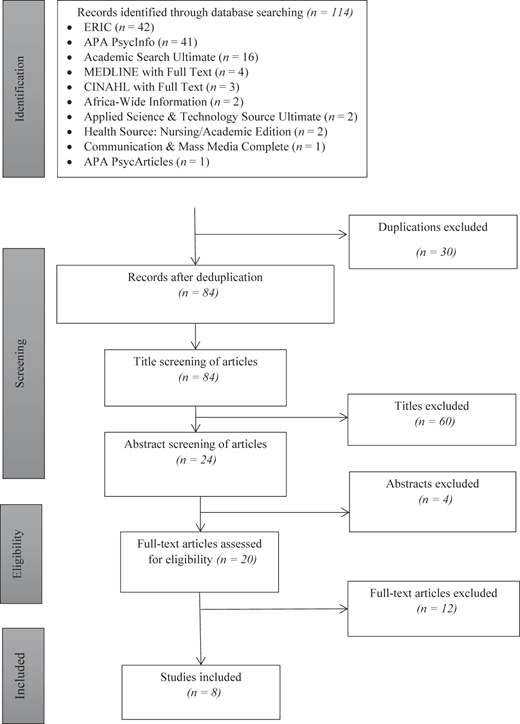
2.2.4 Charting the data
Data from the included articles were extracted into a custom-made Excel spreadsheet by the first author. Elements of the data extraction form were generated from the review question informed by recommendations from Peters et al. (2020). The extracted data were captured in the data extraction sheet (see Table 1). The other two authors checked and confirmed the extracted data against the included articles to enhance transparency and consistency of the data extraction process (Arksey and O'Malley, 2005; Armstrong et al., 2011; Mohajan, 2017).
Charted data
| Author | Definition of motivation to transfer learning | Aim/Purpose of the study | Design | Models/Theory used | Instruments used to measure motivation to transfer learning | Factors influencing motivation to transfer | Results |
|---|---|---|---|---|---|---|---|
| Belenky and Nokes-Malach (2012) | None described | Explore the role of motivation in knowledge transfer, specifically focussing on how students' achievement goals impact transfer | Quantitative 2 × 2 pre- and post-test study design | Model of achievement goal | Achievement goal questionnaire | Invention activities facilitate mastery-approach goal adoption |
|
| Belenky and Nokes-Malach (2013) | None described | To examine the effect of individual differences in student motivation operationalised as achievement goal on knowledge transfer | Quantitative 2 × 2 pre- and post-test study design | Achievement Goal theory | Achievement Goal questionnaire | Classroom grading structure |
|
| Gonzalez (2012) | None described | To identify and validate a model that describes the role motivational constructs play in promoting transfer of learning | Quantitative, correlational, descriptive and explanatory approach design | Bandura self-efficacy theory | Motivation instrument Prior knowledge instrument Self-regulated learning instrument Transfer of learning tasks | The types of learning activities used, and the among of authority given to students. Individual difference |
|
| James (2012) | Transfer motivation is a combination of effort, desire and attitude that influence whether an individual will apply L2 learning from one context in a different context | To investigate motivation to transfer second language learning (L2) or L2 transfer motivation | A qualitative research descriptive study design | None described | None | Self-efficacy, goal-orientation, and interest prior knowledge, Self-regulation learning |
|
| Joo et al. (2014) | As the trainee's desire to apply the knowledge and skills that they have learned from the training programme | To investigate the effect of internal values as a personal characteristic of learners | Quantitative, descriptive study design | Integrative model | Author developed | Perception of resource availability; Perceptions of opportunity for transfer; Personal beliefs about transfer; Expected impact of transfer; Perceptions of competence; Attitudes toward learning outcome; Attitudes toward learning and transfer context/task |
|
| Khorshidi and Nimchahi (2013) | None described | to investigate the impact of integrative and instrumental motivation on the development of interlanguage pragmatics in Iranian English language learners | Quantitative, descriptive study design | None described | Attitude/Motivation test battery (AMTB) Additional author developed | Learner characteristics, training design and external environment |
|
| Peters et al. (2012) | Motivation to transfer predicts the effort with which the trainee will try to apply to his job what he learned during training | To determine the mediating role of satisfaction between motivation to train | Quantitative, pre- and post-test design | Flawed four-level evaluation model | Author generated | Learner motivation |
|
| Yurtseven and Altun (2016) | None described | To investigate students' foreign language learning motivation and views about integration of Understanding by design (UbD) into their lessons | Mixed Method design | None described | Attitude/Motivation test battery (AMTB) | Motivation to take advantage of these opportunities |
|
2.2.5 Analysis of results
A collaborative inductive approach was used to analyse the data generated from the extraction. Study characteristics were enumerated and clustered. The clusters of the data are presented as part of the characteristics of the research. The extracted research results, recommendations and conclusions were then themed to reflect the current scientific knowledge of research in this field. Themes are presented as findings of the review.
2.2.6 Rigor of the review
Various strategies were engaged to enhance the rigour of this review. The Johanna Briggs Institute (JBI) guidelines influenced the design and execution of this scoping review (see Peters et al., 2020). An a priori protocol was developed based on the PRISMA-P guidelines. This protocol was shared on the Open Science Framework for public comment. The authors independently reviewed articles for inclusion, and discussions resolved differences. Standards for reporting scoping reviews were applied in presenting this review.
3. Results
Based on the analysis of the eight articles that met the inclusion criteria, results of this review are presented according to the characteristics of the included studies, purpose of the included studies, models and theories, methods, and factors influencing the motivation to transfer learning.
3.1 Characteristics of the included studies
The year of publication, the discipline and the country where the research was conducted were identified as characteristics of the included studies. Seven studies were conducted between 2012 and 2015, while only one study was conducted between 2016 and 2019. The majority of the included studies (n = 6) were conducted in the education discipline, while computers in human behaviour and development had one study each. As expected, the majority of the studies were conducted in high-income countries, mainly from the United States of America (n = 4), the Republic of Korea (n = 1) and Belgium (n = 1). Only two studies were from high middle income countries, namely Iran (n = 1) and Turkey (n = 1).
3.2 Purpose of the included studies
The purpose of the research included in this review was expressed in the form of study questions and/or hypotheses, aims and objectives that were synthesised into five main collective elements. Three studies reported on the influence of learner satisfaction, motivation types and internal values on motivation to transfer, while two studies reported on the influence of mastery approaches and the effect of mastery goal on motivation to transfer learning. One study focused on the relationship among variables to validate a measurement model (see Gonzalez, 2012), another study reported on the pragmatic interlanguage development concerning the type of motivation (Khorshidi and Nimchahi, 2013), and lastly, Yurtseven and Altun (2016) focused on the contribution of understanding by design (UbD) on students' foreign language motivation.
3.3 Models and theories
Four articles used theories and models to position their description and relevance of variables to motivation broadly to transfer learning. The study by Belenky and Nokes-Malach (2012) used the model of goal achievement by Elliot and McGregor (2001), while Peters et al. (2012) used the flawed four-level evaluation model by Holton (1996). The self-efficacy theory by Bandura (1993) was applied by Gonzalez (2012), while Joo et al. (2014) applied the integrative model to confirm the structural relationships among variables in a hypothetical research model. However, four of the included articles did not state any applied model or theory. It is important to note that none of the included studies presented a conscious conceptualisation of the concept “motivation to transfer learning”.
3.4 Methods applied in the included studies
Three articles applied quasi-experimental research designs, including pre-test and post-test approaches (see Belenky and Nokes-Malach, 2012, 2013; Peters et al., 2012). These quasi-experimental studies applied a two-by-two design, randomly assigning their subjects to interventions and standard practice. The other studies applied a correlation approach (see Gonzalez, 2012), a mixed-method design (see Yurtseven and Altun, 2016), descriptive quantitative research (see Joo et al., 2014; Khorshidi and Nimchahi, 2013) and a qualitative descriptive design (see James, 2012).
All eight included studies reported on sample size. The reported sample sizes varied from 40 participants in one qualitative study (see James, 2012) to 589 respondents in a quantitative study (see Belenky and Nokes-Malach, 2012). All the studies reported a balanced gender distribution between males and females, although some participants in two studies preferred not to report their gender. Three studies reported on the age range of their participants, namely Belenky and Nokes-Malach (2012), Peters et al. (2012) and Joo et al. (2014), while the other five articles did not consider age. In the three included studies, the ages of participants ranged from 18 to 62 years.
Questionnaires were used to collect data in most of the included studies. Two studies used different measuring instruments to measure attitude/motivation (see Khorshidi and Nimchahi, 2013; Yurtseven and Altun, 2016). Yurtseven and Altun (2016) used the attitude/motivation test battery (AMTB) developed by Dornyei (1998) and adapted to Turkish by Mendi (2009) in a mixed-method study. Khorshidi and Nimchahi (2013) used the attitude/motivation test battery (AMTB) as designed. Furthermore, two studies used the same instrument to measure motivation to transfer learning, namely the Achievement Goal Questionnaire (Belenky and Nokes-Malach, 2012, 2013). Gonzalez (2012) used four questionnaires to collect data of which two were validated through an online survey with experts. The other two questionnaires used in the study by Gonzalez (2012) were the motivational instrument that was validated by Elliot and Church (1997), Church et al., (2001), and Linnenbrink-Garcia et al. (2010). Appropriate data analysis methods appear to have been applied across all studies aligned with the research designs.
4. Factors influencing motivation to transfer learning
Three broad elements appear to contribute to the factors influencing motivation to transfer learning. These three broad elements are student characteristics (see Belenky and Nokes-Malach, 2012, 2013; Gonzalez, 2012; Joo et al., 2014; Peters et al., 2012), training design (see James, 2012; Joo et al., 2014; Khorshidi and Nimchahi, 2013; Yurtseven and Altun, 2016), and workplace environment (see Joo et al., 2014).
4.1 Student characteristics
Studies that reflect a high motivation to transfer learning mention that students with high mastery-approach goal orientation at the beginning of a course were more motivated to transfer from instruction to a target problem than students without a mastery approach goal orientation (see Belenky and Nokes-Malach, 2012, 2013). In addition, a model describing the role of motivational constructs, namely prior knowledge, knowledge transfer, self-regulated learning, and the effect of goal orientations on motivation to transfer learning, mentions that the higher the relationship between motivation and self-regulated learning, the higher the level of transfer of learning (Gonzalez, 2012). The study by James (2012) mentions three components where students are motivated to transfer learning, namely the desire to transfer learning; a favourable attitude towards transfer of learning and an effort made to transfer learning.
The relationship between internal value, satisfaction and transfer motivation was confirmed as significant (Joo et al., 2014) in motivation to transfer learning. Therefore, the higher the internal value, the higher the satisfaction; the higher the satisfaction, the higher the motivation to transfer learning. Students who perceive training as useful and valuable are likely to be motivated to apply the new knowledge to the workplace, whereas students who are not assured of the importance of training will lack the motivation to learn and apply targeted skills (Joo et al., 2014). As students' integrative motivation increases, the positive feeling and attitude of the student to learn successfully also increase, further increasing the motivation of the student to the pragmatic application (Khorshidi and Nimchahi, 2013). Motivation to transfer learning will increase with utility type satisfaction, namely to transfer what was learned in one context to a professional working context. However, Yurtseven and Altun (2016) found no relationship between enjoyment satisfaction and motivation to transfer learning.
Regarding low motivation to transfer, students believed learning and transfer were unrelated, because they thought transfer should be automatic rather than intentional (James, 2012). In addition, students did not make an effort to transfer learning, as they did not think they had sufficient chances and time to transfer learning (James, 2012). Motivation to transfer was influenced negatively by students' perception of the difficulty of the instruction. Therefore, the more difficult the perceived learning content, the less motivated the student would be to transfer the learning (Peters et al., 2012).
4.2 Educational design
Increased motivation to transfer learning was associated with existing achievement goal orientation, invention activities, and tell-and-practice activities as education design. Therefore, students' motivation to transfer learning increased when they had high achievement goal orientation (Belenky and Nokes-Malach, 2012). However, increased motivation to transfer learning from instruction to target problem related to existing mastery approach goal orientation, invention activities and structure and performance framing as education design (Belenky and Nokes-Malach, 2013). The implementation of an UbD programme, which included educational activities and audio-visual material, was reported to have increased motivation, achievement and transfer of learning (Yurtseven and Altun, 2016).
4.3 Workplace environment
As opposed to the learning environment, the workplace environment predicts motivation, and affects motivation to transfer learning as reported by Joo et al. (2014). Peters et al. (2012) assert that students need personal interaction, which includes instructor support and colleagues' support to be motivated to transfer learning to another context. The included studies also mention that, due to less personal interaction in some workplace environments, training is perceived as difficult and enjoyment decreases, affecting the motivation of students and the transfer of knowledge. Therefore, there is a need to pay specific attention to opportunities for interaction with students, as these indirectly affect motivation to transfer. Joo et al. (2014) agree with Peters et al. (2012) that the quality, support and motivation from the instructor prior to the training will affect learning achievement, and learning achievement affects motivation to transfer learning.
4.4 Limitations of the studies included
The limitations of the included studies were grouped as either theoretical or methodological. Regarding methodological limitations, three studies reported using a single setting (see Belenky and Nokes-Malach, 2012, 2013; James, 2012), while three studies reported a limitation related to insufficient sample size (see Gonzalez, 2012; James, 2012; Joo et al., 2014). James (2012) mentions that the semi-structured interview perspective may not have been able to describe all the reasons influencing their transfer motivation. The study by Belenky and Nokes-Malach (2013) reports a methodological limitation, as the study was conducted in a laboratory setting with classroom-like material. The researchers mention the need to replicate their study in a more authentic setting, for example, a controlled classroom setting, as some of the findings were inconsistent (Belenky and Nokes-Malach, 2013). Gonzalez (2012) reports the generalisability of the results as a methodological limitation. As a theoretical limitation, Peters et al. (2012) report that the outcome motivation to transfer was only tested at the end of the study to predict transfer. Khorshidi and Nimchahi (2013) and Yurtseven and Altun (2016) do not discuss any limitations of their research.
4.5 Recommendations from the studies
James (2012) recommends the need to examine the link between motivation to transfer learning and performance, and Gonzalez (2012) mentions that future research needs to model, in unison, cognitive and motivational mechanisms that predict HE students' positive effect on transfer of learning. Other researchers recommend the need to explore the role of motivational construct perspectives on learning and transfer (see Belenky and Nokes-Malach, 2012), and measurement of effective transfer (see Peters et al., 2012). Khorshidi and Nimchahi (2013) recommend that the investigation of the relationship between motivation and interlanguage pragmatics learning transfer needs consideration in future research. Additional recommendations from the included studies are:
understanding student motivation in an academic setting by addressing the achievement goal theory (Belenky and Nokes-Malach, 2013);
controlling different positions and job environments (Joo et al., 2014); and
focussing on the aspect of authentic usage of foreign language motivation and views (Yurtseven and Altun, 2016).
5. Discussion
This review described studies reflecting the motivation of students in higher education to transfer learning. Eight studies that met the inclusion criteria informed this scoping review with the majority of the reported studies being within the education discipline. The United States of America dominated the number of publications in this field with a limited number from other countries, namely Belgium, Korea and Iran. Possible explanations include that research requires investment in terms of resources and expertise, resulting in research from high-income countries. Low-resource settings, such as those in Africa, Asia and South America, may not prioritise research, especially in higher education, as they face more exigent challenges. However, the need for work-ready graduates from higher education is a universal phenomenon across all settings, creating an argument for more geographically diverse research in this field. Additionally, studies included in this review were reported in the English language, eliminating any relevant information from non-English-speaking countries. The research focus of the included studies was heterogeneous. Broadly, the studies reported the influence of specific factors, namely student characteristics and the educational design and work environment, on student motivation to transfer learning. However, a conceptual understanding of the antecedents, attributes and consequences of the concept “motivation to transfer learning” in higher education is missing, resulting in diverse interpretations of student outcomes and limited linking of results across the studies included in this review. As much as this scoping review did not aim to synthesise research results, building upon prior research could develop a research field (Hindle and Moroz, 2010). A shared conceptual understanding of the concept “motivation to transfer learning” in higher education would be an essential piece in developing this research field, potentially contributing to developing a homogenous focus within the field.
The majority of the studies included in this review comprised quantitative research. The research approaches were influenced largely by the purposes of the studies. Remarkably, quasi-experimental designs, which were perceived from a positivistic lens as of high quality, appeared to be popular across studies that applied quantitative research methods. The post-test results from the quantitative studies revealed improved outcomes of interventions associated with motivation to transfer learning among students. The obvious lack of research applying qualitative designs in this field may explain the limited description of results that expound on the “how” and “why” of the factors reported to be associated with motivation of students in higher education to transfer learning. A possible consideration of applying qualitative research methods that engage students in higher education in describing their own perspectives related to motivation to transfer learning within their educational contexts would be essential in advancing this research field.
Student characteristics, educational design and the workplace environment were reported as factors influencing motivation to transfer learning among students in higher education. The influence of intrinsic motivation has been reported in health sciences education literature as a fundamental factor towards learning (see Taylor and Hamdy, 2013) and subsequent transfer of learning. The studies included in this review reflected student characteristics, such as high mastery goals at the beginning of the study, interval value and satisfaction, and general motivation as positively influencing students' motivation to transfer learning. HE students who are often classified as ‘adult’ or ‘mature’ learners have been described by Knowles et al. (1998) as having a reason, high expectancy, and greater purpose of engaging in the educational process. Exploiting this expected trait in the development of educational interventions may enhance students' motivation to transfer learning. However, the included studies were also clear on the capacity of a negative perception of the learning event to influence students' motivation to transfer learning adversely. Joo et al. (2014) report that negative perceptions increase students' cognitive overload, which influences learning unfavourably, and directly influences any motivation to transfer learning.
Studies that focused on the influence of educational design on the motivation to transfer learning concluded that intentional, engaging educational material that is fun and interesting enhanced students' motivation to transfer learning (Joo et al., 2014). A call towards focussing on a quality educational design that engages students in their learning has been re-emphasised as a consequence of the COVID-19 pandemic, where HEIs have adopted online education approaches (Tigaa and Swapnil, 2020; World Economic Forum [WEF], 2021; Zalat et al., 2021). Well-designed educational spaces contribute to student engagement, learning, and motivation to transfer learning. It is essential for educators within the HE space to be aware of the influences and consequences of educational design on the development of work-ready graduates.
The workplace environment, where students are expected to transfer their learning, is an essential factor in influencing motivation to transfer learning by students in higher education. HEIs deliberately engage students in WIL opportunities, where students learn and transfer their learning within authentic environments (see Berndtsson et al., 2020). Several included studies reflect the influence of authentic work-environment spaces in enhancing students' motivation to transfer learning (Griffin et al., 2013; Wu et al., 2020). Specifically, the quality of the interaction of students and their instructors within this setting is fundamental to motivation to transfer learning. Similarly, a study by Kantar (2021) described the role of the clinical preceptor, including their approaches of interaction and relationship with nursing students, as fundamental in enhancing students' learning within workspaces. The acknowledgement of the workplace environment, including the role of stakeholders in the same environment, may need further research within this field taking advantage of the WIL space popular within HE programmes.
While the intent of this review was aimed at an international perspective, the research studies included in this review were only limited to English-speaking countries in the Northern Hemisphere. Insights into motivation to transfer learning by students in higher education from other settings were excluded, partially due to the language limitations. In addition, we are conscious of the limited research in this field – which ultimately skewed the discussion of findings to a predominantly Western perspective.
6. Conclusion
This scoping review reported on studies that focused on the motivation of students in higher education to transfer learning. Eight studies were included in this review, which is an indication of the limited research within the field of higher education. These studies appeared to focus on the influence of specific factors, such as student characteristics, educational design, and the work environment on students' motivation to transfer learning in higher education. The lack of a conceptual or a theoretical definition of the concept ‘motivation to transfer learning’ in higher education in all of the included studies may have contributed to the heterogeneous approaches in interpreting results and the lack of focused recommendations.
6.1 From this review, we recommend
the development of a shared conceptual definition of the concept “motivation to transfer learning” within the HE context;
engagement of research that integrates various elements of motivation in definition and engagement of motivation to transfer learning within HE contexts;
adoption of qualitative research methodologies to explain “how” and “why” motivation to transfer learning applies among students in higher education; and
an investigation on the motivation to transfer learning among HE students from low-income countries.
Motivation to transfer learning by students in higher education is essential to enhance their development of competence and work readiness. Higher education is expected to produce graduates who can contribute to organisations through performance. Research on motivation to transfer learning by students in higher education may potentially influence strategies to enhance graduates' work readiness. However, this research field appears dormant with sporadic heterogeneous outcomes.

