


This study examined the effects that online asynchronous dilemma discussions have on moral reasoning scores of pharmacy students. In contrast to face-to-face group discussions, asynchronous threaded discussions afford all participants time to reflect and respond during discussions. Anonymity features may lessen inhibitions in responding critically to others and engaging in sensitive discussions. Moral reasoning scores of participants in the online and online with anonymity discussion groups significantly increased over time; however, those gains were not significantly different from the traditional discussion and control groups. Asynchronous online discussion strategies may be useful for increasing moral reasoning skills in distance education settings.
Moral reasoning skill, also known as moral judgment, is one major component of morality (Rest, 1984) and is linked with moral and ethical behavior (Blasi, 1980). While no single direct definition of moral reasoning can be found in the literature, an amalgam of Kohlberg's (1976) and Rest's (1979) accounts explains moral reasoning as the cognitive processes one uses to think about issues of justice and social fairness. Rest (1979) notes that moral as used in this sense does not refer to individual values, but is restricted to concepts of justice and fairness in social interactions. He suggests that the term “fairness” reasoning would be more accurate.
According to cognitive moral development theory (Colby & Kohlberg, 1984), from which the construct of moral reasoning originated, individuals progress serially through stages of moral judgment or reasoning ability. Although individuals progress naturally to some higher stage from early childhood through adulthood, instructional interventions may also play a role in increasing moral reasoning skills. Numerous studies have been conducted on the effectiveness of educational interventions, and the research clearly supports that moral rea soning skills can be increased through educational intervention (Cifuentes, Murphy, Segur, & Kodali, 1997; Rest & Thoma, 1986; Schlaefli, Rest, & Thoma, 1985).
One major criticism of cognitive moral development theory stems from its research roots of measurement on American males, making it both cultural and gender biased (Baumrind, 1986; Gilligan, 1982). Universal applicability of Kohlberg's approach has, however, been supported by research. Walker (1984) concluded and then defended (Walker, 1986, 1989) his position that there is no consistent evidence of gender differences in moral development and reasoning.
Increasing Moral Reasoning Through Education
The most effective means of increasing moral reasoning skills has involved the use of socio-moral group dilemma discussions (Schlaefli et al., 1985). These moderated face-to-face group discussions revolve around specific moral dilemmas in which individuals discuss and provide their reasoning for what should be done in the particular situation. The dilemmas are designed such that there is no universal or culturally accepted answer and, therefore, group members will probably have different solutions and/or different reasons for the solution (Galbraith & Jones, 1976). According to Piaget (1985), as members discuss the different reasons for their solution, individuals may begin to experience cognitive disequilibrium in that they may hear reasoning that is better than their own and therefore seek to accommodate that reasoning into their own cognitive structure. This cognitive disequilibrium is the stimulus for moral reasoning development (Kohlberg, 1976).
In addition to socio-moral group discussions, courses in ethics and logic, as well as deliberate psychological interventions such as empathy training, personality training, and a host of other psychological interventions, have been attempted in order to increase moral reasoning skills. Socio-moral group discussions have been most successful with some deliberate psychological interventions showing moderate success (Blatt & Kohlberg, 1975; Schlaefli et al., 1985). Researchers still need to search and develop new instructional design strategies that could be more successful in promoting the development of moral reasoning (Binfet, 2004). One potential strategy for increasing moral development is the use of asynchronous threaded discussions.
Asynchronous Discussion
Asynchronous threaded discussions offer learners the ability to participate in discussions with others, yet not be tied to a particular place and location. Asynchronous threaded discussions allow people to access discussion from a computer, read the “postings” of other members of the group, and contribute to the discussion in a time and place that is convenient.
One of the affordances of asynchronous communication may be the ability to examine closely one's own thoughts and ideas with a measure of reflection before composing comments or replies. Researchers (Davidson-Shivers, Muilenburg, & Tanner, 2001; Killian & Willhite, 2003; Romiszowski & Mason, 2003) have reported that time to reflect during conversation is an advantage of computer-mediated communication CMC and asynchronous discussions. The time delay that is necessary for such reflection is often difficult in traditional face-to-face conversation. In asynchronous discussion, rather than answering a question impromptu, one can take the adequate time to develop, compose, and revise thoughts and articulate a well-reasoned response (Kirk & Orr, 2003).
Two other closely related potential benefits of using online asynchronous discussion are the ability to participate in an anonymous fashion and the reduction of social restraint. Social restraint, as operationalized in this study, refers to the constraints that individuals place upon their spoken or written statements because of fear of mental or emotional discomfort resulting from the reactions of other individuals in the social group. According to Hughes and Hewson (2001), name/identity anonymity is one possible component of an online instructional strategy that can be used to enrich classroom communication. The lack of physical presence and name anonymity in online discussions can serve to lessen social restraint for participants. Participants can optimize their “self-presentation” free from physical appearance and voice attributes (Kang, 1998). The removal of physical presence can reduce inhibitions to speak openly and critically in discussion (Connolly, Jessup, & Valacich, 1990; Sullivan, 2002; Vonderwell, 2003) and creates an environment devoid of cues such as facial expressions, tones of voice and body language that can reduce the intimidation for participants who fear embarrassment from reprisal in the classroom (Bordia, 1997; Cheng, Lehman, & Reynolds, 1991; Hartman et al., 1991; Jaffee, 1997; Tiene, 2000). Also, when social context cues are absent, status hierarchy cannot regulate group behavior, which results in more participation by the less-dominant members (Dubrovsky, Kiesler, & Sethna, 1991; Kiesler, Siegel, & McGuire, 1984).
Other consistently reported advantages of CMC and asynchronous discussion are flexibility in access and participation (Hartman et al., 1991; Williams, Watkins, & Daley, 2001), potential for equal and increased participation in discussion among participants (Bober & Dennen, 2001; Chong, 1998; Kirk & Orr, 2003; Larson, 2003; Smith, Ferguson, & Caris, 2001-2002) and the ability to support collaboration and conversation (Jonassen, Davidson, Collins, Campbell, & Haag, 1995; Rohfeld & Hiemstra, 1995). Lapadat (2002) suggests that the written aspect of online asynchronous discussions fosters higher order thinking because of the relationship between writing and cognition. Garrison, Anderson, and Archer (2001) suggest that the use of appropriate discussion strategies can enhance cognitive presence and critical thinking in online discourse. Despite the growing body of evidence on the benefits of asynchronous discussion, there has been little in terms of the impact the design of discussion strategies have on meaningful discourse (Gilbert & Dabbagh, 2005).
Applicability of Asynchronous Discussion Strategies to Moral Reasoning Development
Research on instructional interventions to increase moral reasoning skills has been focused primarily on face-to-face courses or instructional modules, particularly as it applies to socio-moral group discussion (Rest & Thoma, 1986; Schlaefli et al., 1985). The potential advantage of asynchronous dilemma group discussions for increasing moral reasoning skills is an untapped area of research. Exposure to and critical analysis of others’ arguments toward a dilemma appear to be the major means of creating the cognitive disequilibrium that is theorized to be the factor in moving one along the stages of cognitive moral development (Schlaefli et al., 1985; Turiel, 1974, 1977; Walker, 1983). This requires not only the composition of reasoning, but also its full elaboration to others in the group. One or more individuals in a group may possess sophisticated reasoning but may be hesitant to offer it to the group because of shyness or a general reserved personality. Furthermore, some individuals may prefer time to examine their own thoughts before offering them out to discussion. Hathorn and Ingram (2002) suggest that the relative anonymity due to physical separation provides participants with a less-threatening way to contradict or challenge other discussion posts, which could ultimately lead to more engaging discussion. This transactional distance reduces the restraints (negative facial expressions, verbal indication of disapproval, and other physical cues) that we feel others may impose when we are visually present (Postmes & Spears, 2002).
Asynchronous threaded discussion offers a means to avoid those potential pitfalls of face-to-face discussion. The capability to promote conversation and collaboration is one of the primary strengths of online discussion (Jonassen et al., 1995). The time-delay aspect of asynchronous discussion allows all members of a group to participate and reduces the possibility that a few members dominate the discussion (Siegel, Dubrovsky, Kiesler, & McGuire, 1986; Smith et al., 2001-2002). It also allows learners sufficient time to think about and compose articulate contributions or replies to the discussion (Im & Lee, 2003). This may partially eliminate fear of saying something that one may regret later simply because the thoughts were not completely formed.
A second major advantage of asynchronous discussion is ability to contribute to the discussions anonymously. Discussions of a sensitive nature may benefit from the anonymity feature. This feature removes the inhibition to post thoughts and ideas even if they are somewhat radical or socially unacceptable (Siegel et al., 1986). Freeing one from social restraint such as evaluation apprehension increases the probability that he/she might more freely engage in discussion (Dubrovsky et al., 1991). Furthermore, hidden identity of the group members allows for critical analysis of all postings without the criticisms being tied back directly to one another (Kiesler et al., 1984; Siegel et al., 1986). Research shows that normative pressure to conform to group opinions is reduced in an online setting, with less agreement among members in the group versus a face-to-face setting (Bordia, 1997; Hiltz, Johnson, & Turoff, 1986). Other studies (Connolly et al., 1990; Vonderwell, 2003) have shown that the anonymity feature in online discussions was instrumental in increased participation and removal of learners’ inhibitions to provide open and honest comments and critiques to the discussion.
Methodology
This section presents the methodology used in the study. It contains the purpose of the study, research questions, description of the participants, experimental design, instructional treatment design, criterion measures, instruments, and data-collection procedures.
Purpose of the Study
The purpose of this study is threefold. First, through the investigation of four instructional strategies, this study evaluates the effectiveness of different approaches to increasing moral reasoning skills. Second, the results of this study add to the knowledge base on effectiveness of online asynchronous discussion strategies on participant outcomes. Finally, further insight is possible about the strategy of using anonymity in asynchronous group discussions.
Research Questions
According to the research literature, the features of online asynchronous discussions lend themselves favorably to socio-moral group discussions designed to increase moral reasoning. From this, the research questions addressed are:
Can a strategy of socio-moral group dilemma discussions via online asynchronous threaded discussions increase moral reasoning?
Are socio-moral online asynchronous threaded discussion strategies as or more effective than traditional, face-to-face discussions in increasing moral reasoning?
Does the added functionality of name anonymity, such as freeing from social restraint that online discussions can offer, provide an even more effective means of increasing moral reasoning skills than asynchronous threaded discussion without name anonymity?
Participants
The sample (N = 124) consisted of 48 male and 76 female students in their second professional year of a southeastern United States pharmacy school. The average age of participants was 23.92 with a standard deviation 4.08. The youngest participant was 21 and the oldest participant was 46. Most participants were in their low to mid 20s. The participants were enrolled in a required pharmacy law and ethics course. All participants had computer and online experience and had utilized Blackboard course management system in previous courses.
The baseline mean Defining Issues Test (DIT) p scores, defined later in the instrument and criterion measures section, were 38.60 (SD = 12.65) for males and 40.26 (SD = 12.73) for females. The mean DIT p score for all participants (N = 124) was 39.62, with a standard deviation of 12.67, which was similar to DIT p scores of pharmacy students in previous studies (Latif, 2002; Latif & Berger, 1997; Lindon & Draugalis, 1992; Rest, 1994).
Research Design
Participants were preassigned by college staff to cohort groups as part of the curriculum through stratified randomization based upon day of the week for labs, gender, and GPA. These 12 groups of 9 to 12 members each were then randomly assigned into four treatment groups. Therefore, each treatment group was composed of 3 cohort groups of approximately 31 participants. The treatment groups were as follows: G1 = face-to-face dilemma discussion, G2 = online threaded dilemma discussion without anonymity, G3 = online threaded dilemma discussion with anonymity, G4 = online dilemma analysis (no discussion). The independent variable was the type of strategy used (face-to-face dilemma discussion, online dilemma discussion without anonymity, online dilemma discussion with anonymity, dilemma reasoning—no discussion) within the moral dilemma treatment. The dependent variable was moral reasoning score as measured by the Defining Issues Test (DIT). The unit of measurement was the DIT p (principled reasoning) score, which is the percentage of principled reasoning statements chosen when answering the DIT questions. Participants initially completed the DIT to obtain a baseline measure of moral reasoning. At the conclusion of the instructional treatment, participants repeated the DIT to provide a summative measurement to compare against the baseline. Participants also completed a demographics instrument designed to collect age, gender, and knowledge/exposure to Kohlberg's moral development theory.
Procedures
Initial meetings took place in which participants completed two tasks related to the research. They also received participant materials appropriate to their group, which included dilemma discussion and analysis directions.
The class was divided into four lab sections; therefore, the initial meeting with all participants was repeated over four different class periods. An independent person administered the DIT. Each DIT instrument contained a five-digit code that identified the participant, the experimental group, and whether it was the pretest or posttest. The independent person maintained the codes; therefore, participant anonymity was protected and researchers could not identify individual participant scores.
All participants participated in the treatment respective of their group. Treatments occurred on a weekly basis and lasted for five weeks total, which included an allowance of one week off due to course exams. The same researcher moderated all discussions across all treatment groups. Course lectures during the weeks of this experiment consisted solely of review of legal statutes so as to not confound the results. Ethics lectures occurred after the experiment was completed. With the exception of the face-to-face discussion group, all treatment materials were delivered via Blackboard. One week after completing all dilemma discussions and individual analyses, all participants repeated the DIT as a posttreatment measurement. All participants also completed a demographic instrument at that time.
Description of Treatment Groups
G1: Face-to-Face Dilemma Discussion. Participants in this traditional group attended and contributed to face-to-face dilemma discussions that were moderated by one of the researchers. Participants received guidelines on how to contribute to the discussions and expectations for contributions. Dilemma discussions were held once weekly in a classroom with one unique dilemma discussion per week. A total of four dilemmas were discussed over a five-week period, which included an allowance for no discussions during the week of exams.
G2: Online Dilemma Discussion without Anonymity. Participants in this group contributed to dilemma discussions through threaded discussion boards on Blackboard, which were moderated by one of the researchers. The participants received guidelines on how to contribute to the discussions, expectations for posting, as well as technical training on how to use Blackboard discussion boards. Discussions lasted one calendar week per dilemma.
G3: Online Dilemma Discussion with Anonymity. Participants in this group contributed to dilemma discussions through threaded discussion boards on Blackboard, which were also moderated by one of the researchers. With the exception that participants in this group posted anonymously to the discussion board, the topics, instructions, guidelines, etc. were identical to G2: Online Dilemma Discussion without Anonymity.
G4: Online Dilemma Analysis—No Discussion. Participants in this group served as an experimental control and did not engage in dilemma discussions. Rather, they received the same dilemmas as those in the previous groups and responded individually to a set of questions that were designed to provoke cognitive conflict in the individual. Participants in this group received one unique dilemma and corresponding set of questions per week. A total of four dilemmas were given over a 5-week period, which included an allowance for no dilemma assignment during the week of exams.
Instructional Design Elements
Moral dilemmas and design. The moral dilemmas, around which the group discussions and individual analysis centered, were one of the major components of the instructional design. The dilemmas were designed around issues relevant to pharmacy students. In addition to verifying that dilemmas met the validation criteria prescribed by Galbraith and Jones (1976), a four-person pharmacist faculty panel also checked for content accuracy and verified that the dilemma was a realistic situation for a pharmacist or pharmacy student.
Discussion strategy. Facilitation of the discussions was vital to the success of the design. The discussion leader ensured that critical analysis of the dilemmas occurred through promoting the discussion and interaction. The discussion strategy for the moral dilemmas generally followed the guidelines of Galbraith and Jones (1976). This discussion format was as follows: (a) confront the dilemma, (b) state tentative decisions, (c) examine reasoning, and (d) reflect on individual positions. Each student participated in the discussions. Once judgments had been made concerning a particular dilemma, the dilemma was changed in a way that required further analysis by the participants. These revised dilemmas were designed to further challenge judgments elaborated on in the prior discussion. All participants in each of the discussion groups received the revised dilemmas and follow-up questions. The appendix contains a sample dilemma along with follow-up questions for the revised dilemma.
Instruments and Criterion Measures
The instruments used in this study were the DIT and a demographic form collecting age and gender. The DIT was developed and evaluated by Rest (1979) and was designed to measure moral reasoning skills. The DIT consists of six dilemmas, each accompanied by 12 items for a total of 72 items for the entire test. The test is structured such that a participant is presented with a moral dilemma and then asked to rank from a series of issues the ones most important to consider when solving that dilemma. The items were designed to correspond with considerations used with the different schemes of moral judgment (Rest, 1986). The four highest ranked items chosen by the participants produce a “p” index score which is the weighted percentage of items chosen that corresponds with principled moral judgment (stages 5 & 6) (Rest, 1990). Scores can range from 0 to 95.
Findings
Homogeneity of Variance
To satisfy the assumption of homogeneity of variance among the groups for the analysis of variance test, a Levene statistic was calculated. The results, F(3, 120) = .23, p = .88, showed that the variance for baseline DIT p scores of the treatment groups was not significantly different. A Box's test for equality of covariance was also run, and there was no significant difference in the covariance of DIT p scores among the treatment groups, F(9, 160575) = 0.98, p = 0.45.
Baseline DIT Scores
An analysis of variance on the baseline DIT p scores among the treatment groups showed no significant difference in the group means, F(3, 120) = .57, p = .63. Also, an analysis of variance on the baseline DIT p scores among the cohort groups showed no significant difference in the group means, F(11, 112) = .59, p > .05.
Correlation Within Groups
A mixed model with treatment effect and compound symmetry correlation procedure was used to estimate correlation between participants within cohort groups. This test ensures that there were no intragroup effects on the DIT scores. The estimated correlation was negligible across both DIT tests and the gains between the tests. There was no significant correlation on the baseline DIT p scores within cohort groups, r = −.042, z = −1.3, p = .19. There was significant correlation on the postintervention DIT p scores, r = −.058, z = −2.50, p = .012, within cohort groups, but the correlation was very small. Finally, there was no significant correlation on the individual differences between the two scores within cohort groups, r = .063, z = .84, p = .40. The results of this test indicate that the participants’ DIT scores within each group were not correlated.
Results
A paired-samples t-test was used to determine if there were significant differences between pre-DIT and post-DIT p scores for each individual treatment group. Treatment groups G2 (online dilemma discussion without anonymity), t(31) = 2.2, p = .038, and G3 (online dilemma discussion with anonymity), t(31) = 2.6, p = .015, experienced significant increases in moral reasoning scores after the instructional intervention. Mean DIT p scores for both the baseline measurement and postintervention measurement of moral reasoning, and the differences between the two scores are contained in Table 1.
Mean DIT p Scores by Treatment Group
| Treatment Group | Pretest | Posttest | Difference (Gains) | P value (2-Tailed) | |||
|---|---|---|---|---|---|---|---|
| Mean | SD | Mean | SD | N | |||
| G1-Face to Face | 42.15 | 10.6 | 41.56 | 13.32 | −.59 | 0.69* | 31 |
| G2-Online | 38.75 | 13.29 | 42.40 | 12.18 | 3.65 | .038* | 32 |
| G3-Anonymous | 38.33 | 13.58 | 43.70 | 13.51 | 5.37 | .015* | 32 |
| G4-Analysis | 39.29 | 13.24 | 42.18 | 13.47 | 2.89 | .095* | 29 |
Note: *p < .05.
The treatment groups were then tested for differences among the group mean scores across time with an analysis of variance, Table 1. There were no significant differences among the group mean DIT p scores across time, F(3, 120) = 2.07, p = .11.
Research Question 1
The first research question asked “Can a strategy of socio-moral group dilemma discussions via online asynchronous threaded discussions increase moral reasoning?” The mean gain scores of the 2 online treatment groups: G2 (online dilemma discussion without anonymity) and G3 (online dilemma discussion with anonymity) significantly increased over time.
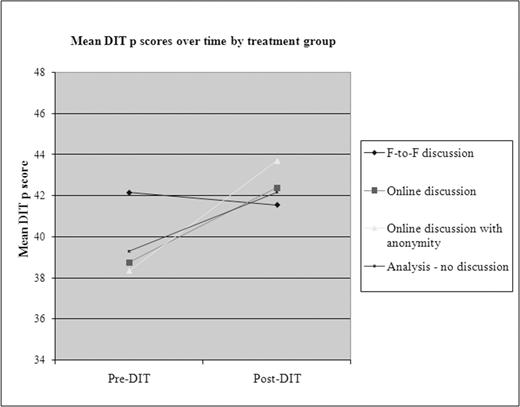
Mean DIT p Scores Over Time by Treatment Group
Mean DIT p Scores Over Time by Treatment Group
Research Question 2
The second research question asked “Can an instructional design of socio-moral group discussions in an online asynchronous threaded discussion format be as much or more effective than traditional, face-to-face discussions in increasing moral reasoning?” Although the mean gain scores of the online treatment groups: G2 (online dilemma discussion without anonymity) and G3 (online dilemma discussion with anonymity) significantly increased over time, a Repeated Measures ANOVA, F(3, 120) = 2.072, p = .11, did not reveal a significant difference from the other treatment groups.
Research Question 3
The third research question asked if asynchronous threaded discussions with the added functionality of name anonymity is more effective at increasing moral reasoning skills than asynchronous threaded discussion without name anonymity. Although mean gain scores of treatment group G3 (online dilemma discussion with anonymity) was greater than treatment group G2 (online dilemma discussion without anonymity), the scores were not significantly different, as indicated in Table 1.
Analysis of DIT p Scores by Gender and Age
An analysis of covariance on gender's effect on baseline DIT scores revealed that no significant relationship, F(1, 118) = 2.01, p = .16, existed between gender and DIT scores as illustrated in Table 2.
While females scored higher than males on the DIT, as shown in Table 2, the scores were not significantly different. This is consistent with Walker's (1984, 1986) and Rest and colleagues’ (1986) findings that there are no significant differences of DIT p scores between males and females.
Older participants scored significantly higher on the DIT than younger participants. This is also consistent with prior findings (Armon & Dawson, 1997; Perez-Delgado & Oliver, 1995; Rest, Davison, & Robbins, 1978).
Discussion
The results of this study, in terms of contribution to the literature, are discussed below.
Face-to-Face Dilemma Discussion
Although face-to-face dilemma discussions have traditionally been the most effective strategy for increasing moral reasoning skills (Schlaefli et al., 1985), they have not been universally successful. This study is another example in which face-to-face discussions have not improved participant moral reasoning skills. Interestingly, the mean DIT p scores decreased slightly from baseline to posttreatment. The decrease was statistically insignificant and does not indicate that the strategy negatively affected moral reasoning skills. However, the decrease evokes the question of why that strategy was unsuccessful. As discussed previously, a cognitive dissonance of one's own reasoning is necessary for moral reasoning skills to increase (Kohlberg, 1976). For this to occur, individuals must be exposed to the downsides of their own reasoning, as well as hear reasoning that is better than their own. During dilemma discussions, considerable analysis and criticism is crucial among participants. In a face-to-face setting, social restraint and dominance of dialogue by only a few participants may hinder these types of discussions. The face-to-face group discussions in this study tended to be dominated by only 2 or 3 individuals, which reduced the opportunity for others to hear reasoning different and possibly better than their own.
Although statistically insignificant, the baseline DIT scores of participants in the traditional face-to-face group was higher than that of the other three groups. This could indicate a sampling bias in which participants with higher baseline moral reasoning skills were grouped together. Therefore generalizations from this discussion should only be made with caution.
Asynchronous Dilemma Discussion Strategy for Improving Moral Reasoning
The results of this study showed that asynchronous dilemma discussions can be effective at increasing moral reasoning as evidenced by the statistically significant increase in mean DIT scores from baseline to posttreatment. Face-to-face contact among the discussants and the moderator are not necessary for the strategy to be effective. This is especially important for classes conducted in an online distance education environment where face-to-face meetings are not feasible. The Galbraith and Jones (1976) dilemma discussion strategy, along with requisite strategies for promoting and maintaining discussion proved to be effective in an online environment.
Anecdotally, the asynchronous discussions consisted of more organized and reasoned responses than the traditional face-to-face discussions. Furthermore, 1 to 3 individuals dominated the traditional discussions by responding and reacting to every statement. Participants in the asynchronous group were able to contribute in equal amounts, thereby allowing multiple and diverse viewpoints and responses to different discussion points. This is consistent with the theoretical basis for how cognitive moral development is likely to occur. Although outside the scope of this study, qualitative research methods analyzing the discourse could be helpful in determining the value of the online format and provide further information on the different strategies.
Can Asynchronous Dilemma Discussions be More Effective Than Traditional Discussions?
As mentioned previously, an alternative strategy using asynchronous discussions offers several advantages to critical elements of dilemma discussions including: opportunity for equal participation; time to compose and critically examine comments; and a reduction in social restraint for providing contradictory or challenging statements to others.
The asynchronous discussion groups in this experiment participated in the same dilemma discussions as the traditional face-to-face groups. However, anecdotal observations revealed that individuals did not dominate the discussion and comments overall tended to be more reasoned and oftentimes critical of others. Facilitation of the online discussion was much easier with regard to engaging students in active and critical dialogue. Participants in the online discussions had the opportunity to read others’ comments, think about the reasoning, and construct a clear response. Participants in the traditional face-to-face discussions had little time to compose their thoughts on the difficult philosophical arguments. The majority of students in the online groups provided critical thought and analysis to the topic at hand, whereas only a minority of students in the face-to-face groups added meaningful comments to the overall debate.
The results of this study showed no significant differences between asynchronous threaded dilemma discussions and traditional face-to-face dilemma discussions. However, the DIT scores of the two online discussion groups significantly increased from baseline to posttreatment. This may be important when distance education is being considered. Although the environment for face-to-face and online discussions may be different, from an instructional design standpoint, it is necessary to provide equivalent (Simonson, Schlosser, & Hanson, 1999) learning experiences to participants in the respective settings. If students at a distance are given equivalent learning opportunities, then they should be able to achieve equivalent outcomes to the face-to-face students.
One issue that might have affected the outcome is that it seemed to take participants at least two dilemma discussions before they became comfortable with the format. These exercises were designed to make students cognitively process and explain their reasoning. During the first two discussions, participants persisted in trying to “solve” the dilemma, when in actuality there was not a perfect solution. Because of their difficulty in adjusting to this type of thinking process, the treatment effects may have been weakened.
Name Anonymity in Dilemma Discussions
The third research question asked if asynchronous threaded discussions with the added functionality of name anonymity is more effective at increasing moral reasoning skills than asynchronous threaded discussion without name anonymity. The addition of name anonymity to the online discussions was hypothesized to promote further critical analysis of participants’ posts because the identity of the discussants would be unreachable (Nissenbaum, 1999). Theoretically, discussions in that environment would revolve more around the issues themselves, without interference from friendships and personalities.
During the anonymous group discussions, posts appeared with “anonymous” listed as the discussants’ names, therefore there was no way to link posts back to any individual. Anecdotally, the discussions among the anonymous groups were more spirit-filled than either the face-to-face and online groups without anonymity. Discussants frequently criticized the reasons that others gave when making a judgment and in many cases elaborated on why their own reasoning was better. As expected, discussants were more straightforward with their posts and some comments, although not derogatory, directly addressed poor reasoning. Because of the complete anonymity, it appeared as if participants stated their true thoughts and opinions without concern of offending others in the group. Participants protected by name anonymity tended to contribute to “better” philosophical discussions. Statements appeared more challenging and there was no clear consensus on what constituted the best judgment on the dilemmas. Theoretically, this type of discussion should challenge participants’ own cognitive schemas for moral reasoning and promote higher reasoning skills. Not surprisingly, this group's DIT scores significantly increased over the course of the treatment and those differences were the highest among the treatment groups. However, the differences were not significantly different from the other groups. As mentioned previously, possible sampling bias and participant adjustment time for this type of instruction may have affected the overall outcome of the treatment.
Limitations
This study had a few limitations, which will be briefly discussed in this section. First, the study contained a convenience sample of students from one course within a single college course and the study's population consisted of pharmacy students only. A second limitation was that participants were not randomly assigned to treatment groups in the true sense of the term. Due to the structure of the curriculum in this school, students were preassigned to cohort groups before this study began. This preassignment resulted in a stratified random sample based upon the day of the week in which they were assigned to lab, grade point average, and gender. Those preassigned cohort groups were then randomly assigned to treatment groups; however, the slight chance exists that some sampling bias could have occurred. In particular, the face-to-face group had higher baseline scores than the other three groups and the two online groups started with the lowest baseline scores. Finally, the DIT does not detect fine differences in moral reasoning skills (Schlaefli et al., 1985). Therefore, it is possible that significant differences in moral reasoning skills may have occurred among the treatment groups, but were unable to be recognized.
Further Research
One area for research outside the scope of this study would be to analyze the discourse in conversation. Although the DIT is commonly accepted as the primary instrument for measuring moral reasoning skills, it only provides data concerning stages and or schemas of individuals. Qualitative methods that examine differences in participation levels and types and amounts of critical comments among face-to-face, online, and online with name anonymity discussions, could aid us in understanding the nature of these different discussion strategies. Qualitative research methods could also be used to determine if different discussion strategies affect participant thought processes on how ethical dilemmas are initially analyzed. In addition to quantitative measurements on cognitive development, qualitative research could potentially yield information that helps designers comprehend the effects of different instructional strategies.
Although prior research (Schlaefli et al., 1985) suggests that dilemma discussions over a period of three weeks appears to be sufficient in increasing moral reasoning scores, that research did not include online discussions. Perhaps, because of the lack of visual social cues, it takes longer to establish enough rapport in the online setting to engage in these challenging discussions and hence significantly increase moral reasoning skills.
This study did not address participant perceptions or preferences for the medium used for dilemma discussions. However, this could be important for instructional designers when determining the strategy used for moral reasoning instruction. Students may prefer to discuss controversial or sensitive discussions in an online asynchronous environment with the affordances of time for reflection, analysis, and equal participation by all. Gathering student feedback on whether removal of social restraint opens the discussion to more honest comments and criticisms will also help in determining if these online discussion strategies have value over traditional face-to-face discussions.
Appendix: Sample Revised Dilemma and Follow-up Questions
Dilemma 1: Pharmacy Student Drug Use
Dwayne Smith is a second year pharmacy student at a highly regarded pharmacy school in the western United States. Several of his classmates were celebrating the end of the fall semester with a postfinals party at one of his classmate's house. Dwayne accidentally discovered Lily and Travis, two of his fellow classmates, smoking crack in the back bedroom. Startled by what he saw, he questioned Lily and Travis about what they were doing and they told him they were just trying to “relieve a little stress.” Upon further questioning, he found out that they had been doing this for over a year. They pleaded with him not to tell anyone because according to the school's honor policy, they could be expelled from school. Still shaken by what he witnessed, he assured them that he wouldn't, but after leaving the party his conscience began to bother him. If he did not inform the college's dean of student affairs of what he saw, then he would be violating the honor policy and he could ultimately face disciplinary action himself. On the other hand, he knew he would feel horrible for reporting his friends. On reflection, Dwayne realized that Travis and Lily, had at times throughout the semester, appeared to be disoriented during some of the classes. He began to contemplate the seriousness of the issue, particularly if Lily and Travis had an addiction problem. They were his friends and he did not want to jeopardize their education and career, but he also feared the potential risks they might pose to others and themselves in a pharmacy practice. Should Dwayne inform the dean of student affairs that Travis and Lily were using an illegal narcotic?
Alternative Follow-up Questions/ Scenarios to Dilemma 1:
One student has already been expelled for illicit substance abuse.
To complicate matters, Lily's parents had been killed over the summer in a tragic car accident and she struggled emotionally to make it through the demands of the fall schedule. She still finished with a 3.75 GPA for the semester and was admired by both classmates and faculty alike as being a model student and future leader.
Travis is the son of his mother's boss and his mom asked him not to tell.
Last semester, Dwayne had an indiscretion with one of Lily's friends at a party, and Lily promised Dwayne that she would not tell his fiancé and Lily had kept her promise.
One of the students has repeatedly joked that he wants to be a pharmacist to have access to drugs.
Where does Dwayne's obligation lie: students/friends, school, or profession?

