


There is growing potential for the development of practitioner-based doctor of education (EdD) programs as potential students in the field recognize that they do not need to leave their current work positions to obtain a doctorate particularly if it enhances their work. This article chronicles 1 university’s process in developing an innovative online practitioner-based EdD in educational technology leadership. Also addressed are the achievements and pitfalls of developing an online practitioner EdD in educational technology leadership.
Introduction
Is there a need for an innovative doctorate in educational technology for people who do not want to be a professor? What about an innovative doctorate in educational technology leadership? What about an online practitionerbased program? These are questions that were raised by Morehead State University, a Midwestern regional university, 6 years ago when development began on its first institutional doctoral program, the doctor of education (EdD) in educational leadership, with a track in educational technology leadership. There are several institutions throughout the United States that offer online doctoral programs in educational technology and some institutions are offering practitioner-based EdD programs, but few are combining both of these types of programs. This article describes the development of an innovative online doctoral program in educational technology leadership. It is designed to tell the story of how Morehead State University went through the process of developing its first doctoral program.
Originally, this story was presented by Miller and Curry (2013) at the Association for Educational Communications and Technology (AECT) Annual Convention, but there was still a need to move the story toward a wider audience to detail the development process and to provide insights to those considering the development of similar programs in the future. The telling of MSU’s story of developing its first doctoral program was a specific recommendation made by Southern Association of Colleges and Schools (SACS) reviewers during the accreditation site visit after MSU received initial approval for substantive change to become a Level 5 institution (a Southern Association of Colleges and Schools designation for institutions offering three or fewer doctorate degrees). This article will focus upon the initial development of the program and how it was structured with a specific focus on being a practitioner doctorate, rather than being a university faculty preparation program. Additionally, the article will address issues the program has faced such as geographic issues, rigor, policies and procedures, faculty resistance, and the management of expectations. While there have been several issues experienced along the way, there have also been achievements made, particularly in relation to student engagement within the field.
Program Description
In 2008 Morehead State University (MSU), a Midwestern regional university located in eastern Kentucky, was given the opportunity to develop its first doctoral program. Previously only the research-based doctoral institutions in Kentucky such as the University of Kentucky and the University of Louisville were authorized as public institutions to provide doctoral programs. The caveat by the Kentucky Council on Postsecondary Education for allowing regional universities such as MSU was that it must be an advanced practice educational doctorate (EdD) (Programs of State and Comprehensive Universities, 2012). There was a need for the advanced practice EdD as there had been little difference between the PhD and EdD programs in education within Kentucky previously. This was not a surprising discovery, as this lack of difference has been found in prior research occurring throughout the United States (e.g., Anderson, 1983). This new direction was in direct alignment with the ideals presented by Shulman, Golde, Bueschel, and Garabedian (2006) in discussing a need for reclaiming the EdD for the original intent of preparing advanced practitioners.
The EdD in educational leadership program was developed initially with two tracks that included P–12 administrative leadership and educational technology leadership. The purpose was to create a doctoral program for individuals who wanted to be educational leaders within their current work positions. As the program was being developed it was focused around a “north star” of providing all students an opportunity to learn within a culture of high expectations (Barnett, Miller, & Abell, 2009). This was an important focus because, prior to MSU having a doctoral program, there were limited regional opportunities for students to obtain a terminal degree, particularly in the area of education.
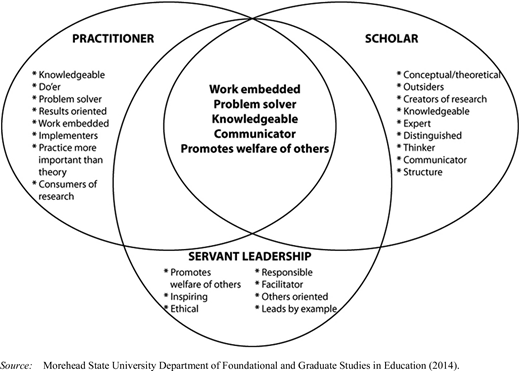
As the program moved forward, a guiding focus of MSU’s educational leadership doctoral program was developed out of an EdD faculty retreat (Morehead State University Department of Foundational and Graduate Studies in Education, 2014). The guiding focus was based on three areas including practitioner, scholar, and servant leader. The areas of practitioner and scholar were directly related to the ideals established by the Kentucky Council on Postsecondary Education when they approved the offerings of advanced practitioner doctoral programs for Kentucky regional universities. The focus area of servant leader, as described by Greenleaf (1970), developed as the doctoral core courses were being designed to support the program. There are several components to the idea of servant leadership. The first is that servant leadership is focused on an individual being a servant first and a leader second. The servant leader focuses on making sure to support the individuals within the organization to be successful and help them meet their fullest potential as they meet the needs of the organization. The servant leader is also someone with initiative that steps out in front and is willing to show the way (Greenleaf, 1970).
Five ideals of the type of desired doctoral graduates emerged during a discussion of concepts related to the three guiding focus areas of practitioner, scholar, and servant leadership. Those ideals were that a doctoral graduate student from MSU would be a problem solver, knowledgeable (in terms of the practice of educational technology and instructional design or P–12 administration, for those in the P–12 administrative leadership track), a communicator, promote the welfare of others, and their doctoral capstone was work embedded or focused on a specific organizational need. Figure 1 provides a graphic of the core ideals within these areas of practitioner, scholar, and servant leadership that have guided the focus of the MSU doctoral program (see Figure 1).
The educational technology leadership track occupies a unique niche within the educational technology field. There are many doctoral programs currently available in the field, but few with a practitioner focus and even fewer with a focus on educational technology leadership. A recent article by Kung and Logan (2014) provided an example of the uniqueness of this program through an analysis of 12 different online doctoral programs in the field of educational technology. Through the learning opportunities of the doctoral program, the students would become practitioner scholars. The doctorate of education in educational leadership program was designed to provide students with several opportunities for leadership development such as:
develop an understanding of leadership models;
synthesize learning in a real-life context of job-embedded activities;
learn how to collect data and analyze relevant research to translate findings into action; and
create opportunities for all learners to learn at a high level (Morehead State University, 2010).
While there were several opportunities to develop a stronger understanding of leadership, there was also a specific focus on developing the doctoral students into practitionerscholars within their organizations, rather than developing them into future university faculty. There were several reasons for this focus. One of the primary reasons was the need to provide more opportunities for educators in eastern Kentucky to obtain a terminal degree with a focus on leadership. Additionally, this program was designed to embody ideals of advanced preparation of educational leaders to use existing knowledge to solve educational problems as described by Shulman et al. (2006). Finally, there was an interest by practitioners for an alternative doctoral degree to one that prepared individuals for the professoriate.
Design And Development Of Program
When the EdD in educational technology leadership was developed, there were five primary areas of program development that had to be considered. These areas included delivery method, program structure, cohort method of admission, course load, and the final capstone project.
Program Delivery Method
The first area of program development was offering the educational technology leadership program as a fully online program with a face-to-face doctoral seminar each year. The decision to go with an online program was made based on the need to provide flexibility in taking courses for students that are also full-time educational technology practitioners. A second reason for an online program was to ensure that the doctoral program was not limited to only students restricted to the institution’s geographic location thus attempting to meet the locational needs of practitioners across the world interested in obtaining a doctoral degree.
Program Structure
The second area was program structure. The 60-hour doctoral program was broken up into four sections that included doctoral program core courses, applied and capstone courses, track core courses, and alternate areas of emphasis courses (see Table 1).
MSU Educational Leadership Doctorate Educational Technology Track Curriculum
|
|
|
|
|
|
| Courses will be selected for emphasis area in consultation with the doctoral committee. The courses should align with the candidate’s long-term, professional goals and augment other courses required for the EdD program. |
The doctoral program core was made up of 18 hours of doctoral level courses that focus on topics related to leadership, change theory, problem solving, legal and ethical issues, and research. The applied and capstone courses section was made up of 12 hours that include a 1-hour doctoral seminar taken three times for a total of three credit hours, a directed doctoral study course, and 12 hours of doctoral capstone. The educational technology track core included 12 hours of graduate level advanced coursework in the area of instructional design. Finally, the alternative areas of emphasis was made up of 12 hours of graduate coursework that was selected by the student in consultation with the student’s doctoral committee to help support them in their area of work and their capstone project.
Admission Process
The third area of development was the admission process. Admissions occurred once a year with approximately 12 students accepted into each program cohort. The admission process was designed as a three-stage process that included submission of an admission packet, submission of an on-demand writing sample, and an interview. Each stage was evaluated using a holistic rubric (see Table 2) developed by the program faculty.
Admissions Criteria for EdD - Educational Technology Leadership Track
| Admission Criteria | Minimal (1 Point) | Average (2 Points) | Outstanding (3 Points) |
|---|---|---|---|
| Master’s degree in education or related field from accredited institution: REQUIRED | Yes/No | ||
| Graduate degree grade point average | 3.0 GPA | 3.2 GPA | 3.5 GPA |
| Years of related professional/leadership or educational technology, instructional design | No experience | 3 years experience | 5 years experience |
| GRE or MAT test scores (GRE: Quantitative Reasoning and Verbal Reasoning) | GRE V + Q below 1000 | GRE V + Q below 1000-1200 | GRE V + Q below above 1200 |
| GRE Writing Score or on-demand writing | GRE analytical writing score of 2.0 or below | GRE analytical writing score of 2.5-3.0 | GRE analytical writing score of 3.5 or higher |
| Letter of introduction/ interest stating professional goals, leadership style, and educational philosophy | A “minimal” score reflects evaluator concerns about the person’s dispositions, stated beliefs, record of behaviors or potential for success in the program. | An “average” score is an indication that the evaluator believes the person’s dispositions, stated beliefs, and record of behaviors indicate significant potential for success in the program. | An “outstanding” indicates the evaluator belief that the person’s dispositions, stated beliefs, and record of behavior indicates a very high probability for success in the program. |
| Recommendation forms | A “minimal” score indicates that at least one of the recommendations reflects concerns about the person’s dispositions, stated beliefs, record of behaviors or potential for success in the program. | An “average” score is an indication that none of the recommendations reflect any significant concerns about the person’s dispositions, stated beliefs, and/or record of behaviors. Further, the recommendations should indicate significant potential for success in the program. | An “outstanding” score is an indication that the recommendation forms suggest the person’s dispositions, stated beliefs, and record of behaviors point toward a very high probability for success in the program. |
| Resume/vita | A “minimal” score indicates concerns about the person’s past educational and work experiences as reflections of potential for success in the program. | An “average” score is an indication that the person’s past educational and work experiences reflect significant potential for success in the program. | An “outstanding” score is an indication that the person’s past educational and work experiences point toward a very high probability for success in the program. |
| Individual Interview | A “minimal” score reflects faculty concerns about the applicant’s dispositions, stated beliefs, record of behaviors or potential for success in the program. | An “average” score is an indication that faculty believe the applicant’s dispositions, stated beliefs, and record of behaviors indicate significant potential for success in the program. | An “outstanding” score is an indication that evaluators believe the applicant’s dispositions, stated beliefs, and record of behaviors indicate a very high probability for success in the program. |
The initial admission packet that applicants submitted included transcripts with student GPA, GRE/MAT scores, three recommendations submitted online, resume, and a description of the applicant’s educational technology leadership experiences. After the program faculty evaluated the application packet a group of applicants were invited to participate in face-to-face interviews. The day of the interview the applicants participated in an on-demand writing sample and a group interview. Rather than the applicants answering questions from the screening committee all of the applicants were given a topic question to focus upon and were asked to engage in discussion with each other about the topic while the faculty observed the interactions of the group-based interview.
Approximately 12 applicants were selected to receive invitations to join the incoming cohort after a final review of the applications and interviews. As part of their acceptance of admission to the new cohort, students were required to attend a face-to-face one-credit hour doctoral seminar in June. If they were not able to participate in the seminar, they were recommended to wait until the following year to begin the program. The faculty placed great importance on the face-to-face seminars, particularly the first one, because it helped to begin establishing the community of scholarship and support among the new cohort of students. The cohort method allowed for the students to establish a cohort of learners that take courses together and move through the program at the same pace. This also allowed for the development of extensive collaborative projects to be developed.
Course Load
The fourth area of development was course load. The program was designed to allow students to typically take two online courses a semester during the regular academic year. While a 9-hour or three-course load per semester is typical of many doctoral programs, it may not be practical for full-time educational technology practitioners. The program was also designed to offer courses during the summer, so students could complete their primary coursework during the first 2 years in the program. This allowed the third year of the program to focus on students developing and implementing their doctoral capstone project.
Final Capstone Project
The fifth area of development of the program—and most important component—was the capstone. The doctoral capstone requirement, rather than a traditional doctoral dissertation, was the cornerstone of this advanced practitioner EdD program. There has been discussion regarding the rigor of a capstone requirement as opposed to that of a dissertation for a doctorate (Shulman et al., 2006), but others describe the work-based or practitioner doctorates acting as vehicles for real-world development and high-level professional capability (Lester, 2004). The key component of these capstones is addressing a real problem within an organization.
Issues And Achievements
The development of an institution’s first doctoral program, particularly an online practitioner program has presented the faculty with several issues. Some of the issues that have been identified are geography, rigor, program policies and procedures, faculty resistance, and managing expectations.
Geography
There is great promise in an online doctoral program because the institution is not limited to a geographic area for student recruitment. While geographic location can help increase potential enrollment for an online program, it can also be a limiting factor, as students are required to attend the one week EDD 800 seminar course each year. Currently, there are students enrolled in the program from Florida, North Carolina, Kentucky, Tennessee, Ohio, Indiana, West Virginia, and Oklahoma. Scheduling a seminar course in the summer for students from eight different states becomes difficult when students also need to schedule vacation time. In the case of K–12 teachers, their school years may end at different times. One example of the difficulty in scheduling the face-to-face seminar for students in these various geographic locations occurred during the 2014 summer. This particular year was especially difficult because of the harsh winter in eastern Kentucky. Initially, the seminar was scheduled for the first week of June and students had been told to plan on that time period earlier in the year. However, most counties in the MSU region had experienced over 20 snow days, and therefore, many of the school districts didn’t dismiss for the summer until the end of the first or second week in June. Fortunately, the seminar was rescheduled without anyone from out of state having their travel plans negatively impacted.
Additionally, while it would appear that an online program would potentially attract international students, the travel difficulties for the 1-week seminar each year are increased due to the overall cost for international travel. But more importantly the Department of Homeland Security regulations related to international students (that at least 6 hours of coursework each semester be in a face-to-face environment) becomes prohibitive to international students participating in a completely online program.
Rigor
As with any academic program, but perhaps particularly with online programs, rigor can be an issue. How does one ensure that the courses are being taught fairly, consistently, and at a level equal to the degree being offered? How does one ensure a quality educational experience and still allow for faculty academic freedom? One method to ensure rigor and allow faculty the freedom to teach in their preferred style is by engaging in careful strategic program planning. The faculty met once an academic year to review agreed upon course objectives and outcomes. Reviewing and revising (if necessary) each course’s agreed upon strategic outcome together ensures that all program faculty are on the same page as to the intent of each course and how it relates to overall program and degree goals and student learning outcomes (SLO). The faculty then concurred that as long as those agreed upon outcomes are being met and addressed using assessments or critical performances tied to the SLO, it does not matter how the person teaching the course addresses them—thus protecting faculty academic freedom to do as they choose in their own courses. An example of this is from the course EDD 811 Action Research and Grant Writing taught by John Curry (2013). The SLO was that students would write and submit a professional presentation proposal. The assessment for that particular SLO was the Research Presentation Proposal, which requires students write and submit a proposal for the AECT International Convention. The AECT call for proposals occurs during the spring semester when the course is taught. SLOs and critical performances such as the example can then be used for any required data reporting to the Kentucky Council on Postsecondary Education.
Program Policies and Procedures
Finally, one of the biggest issues of a new online doctoral program, particularly the first offered by the university, was navigating the new waters of managing a program. With established programs or even new programs within a previously established structure, university policies and procedures would already be in place and would not generally have to be created. However, it was found in the creation of the first doctoral program on MSU’s campus that policies and procedures unique to a doctoral program were not in place or had not been formulated. Moreover, who would make the policies? Was it the program faculty or should the policies have come from the graduate school or university committees? In this program, it was a combination of both. While the graduate school had specific criteria for some issues, it was quickly discovered that not all issues were covered.
One such issue was academic probation. What happened when a student received a grade below a B for a required course? Or worse yet, what happened when a student failed multiple courses in the doctoral program? Situations have arisen where students have experienced problems and failed multiple courses. This alerted the faculty to a looming potential problem. Would students be dismissed from the program if they failed courses within the program? Would a student go on probation and what would probation entail? It was the first time this issue had been considered, so policies and procedures were ambiguous. The first step to resolving the issue was consulting the Doctoral Handbook. Unfortunately, a policy was not put in place for such a situation. The next step was consulting the graduate school. The only published graduate school policy was that a student had to have a cumulative graduate grade point average of at least a 3.0. At first glance that would make sense, but what if a student had completed other graduate programs at the institution? That would mean that the cumulative grade point average would potentially not go below the 3.0 grade point average threshold, even with multiple doctoral classes having grades below a B average. Subsequently the doctoral faculty met and amended the Doctoral Handbook to include a doctoral program policy on academic probation, which stated that after the first grade below a “B” on a required course, the student would be given a remediation plan that would need to be completed to remain in the program and that any further grades below a “B” would result in immediate dismissal from the program (Morehead State University Department of Foundational and Graduate Studies in Education, 2014).
Another issue that was not anticipated was tenure and promotion. When the program was designed, developed, and approved, no one thought to check how any of the policies and procedures specific to the doctoral program would affect faculty with the tenure and promotion process. Initially, the program was designed so faculty would generally teach one course and direct capstones for the rest of their teaching load once the third anniversary of the program was reached and when the first cohort began their capstones, as faculty would have a full course of students in their 6 hours of capstone each semester. In addition, when students were working on their capstone and taking their capstone credits, some instructors taught the capstone course but didn’t administer student evaluations (due to the largely independent nature of the capstone process). While these policies made sense when the program was designed, they ended up in direct conflict with university policy. MSU’s tenure policy required all junior faculty to evaluate two courses a semester, and it didn’t take the junior faculty teaching in the doctoral program long to realize that the program policies were going to keep them from being able to meet the University requirements for teaching in the tenure process. Fortunately, this affected only one faculty member before it was caught, and letters were provided for this faculty member’s portfolio. Program faculty worked with the MSU administration to calculate capstone course load differently and began working with the Faculty Senate on revising the University requirements to allow for some of the special situations that arise for the faculty in the doctoral program.
Faculty Resistance
Perhaps one of the most unexpected issues related to the program was that of faculty resistance. As stated, MSU is a regional university, and this is the first (and currently only) doctorate on campus. Not all faculty were excited about the addition of the program to the University’s offerings. Some faculty felt that having a doctoral program, particularly in MSU’s role as a regional institution, went against the institutional mission. Another group of faculty believed that having an online doctorate would simply become a diploma mill. Yet another group contended that having a doctorate on campus gave an unfair advantage to doctoral faculty in the promotion, tenure, and merit pay processes.
To address these issues, program faculty have aggressively engaged in outreach to other faculty—not only in the College of Education, but across the University. The educational technology program faculty discussed openly with resistant faculty their concerns and tried to address them. The program faculty made it known that if faculty outside of the program had an interest to work with doctoral students, they would help to find ways for them to participate on doctoral committees. The program faculty actively sought faculty outside of the program to fill seats on doctoral committees. There have been six doctoral committees that had nonprogram faculty members on them, and those included faculty from every college on campus. As long as the interested faculty had associate or full graduate faculty status in the university, they could serve on committees. Anyone outside the institution was required to submit a vita to be reviewed to determine if they met the criteria of associate graduate faculty to serve on the committee. An individual who wanted to chair a doctoral committee would have to obtain full graduate faculty status at MSU, which is limited to tenure and tenure-track faculty. Typically, the doctoral committee chairs have been selected from the educational technology faculty, who are all required to hold terminal degrees.
In addition, the program faculty have been transparent in what they do programmatically. They have provided concerned faculty the opportunity to meet, interact with, and see the work conducted by MSU doctoral students. The faculty have also encouraged the students to participate (as much as they can via distance) in campus events such as the Celebration of Student Scholarship and the College of Education Honors Banquet. Participation in these events had a dual purpose. First, it provided the students with opportunities to present their work in juried and peer review events, but it also provided opportunities for faculty across campus to see the level of work that the doctoral students were creating, which helped address faculty concerns about the quality of student work. A recent opportunity for doctoral students to present and engage in discussions with campus faculty was at the Educational Technology Doctoral Student Research Symposium held during the 2014 summer. For the first time, all three active cohorts were on campus at the same time and participated in a mini research symposium. Over those 2 days, every student stood and presented his or her current research. First-year students (newly admitted to the program) were given ten minutes to present on what they would like to research in their degree program. Second-year students were given 15 minutes to present on what they were preparing to work on for their literature reviews and possible capstone topics. Third-year students were given twenty minutes to give their capstone proposal presentations. Each presentation also included a question-and-answer period in which students and others were able to ask questions about the presentation and provide feedback to enhance the presentation and research. University upper administration, college of education administration, and most importantly, college and university faculty were invited to attend. Some of the most concerned faculty attended (for some of the previously listed reasons), and after hearing the students not only present research but defend it, perceptions began to change. One particularly exciting outcome was that some of the faculty who attended saw research they were interested in and subsequently agreed to serve on doctoral committees.
Managing Expectations
While the online nature of the program can be an attractor, the focus of a practitioner doctorate in educational technology leadership is also an attractor, particularly when offered primarily online. While there are a number of individuals who seek traditional doctoral programs that prepare for the professoriate, the practitioner focus of MSU’s program has attracted a variety of educational technology leaders such as high level institutional administrators, educational technology designers and developers, military and medical personnel, as well as P–12 faculty and administrators seeking the degree to enhance their practitioner work. However, one issue that has occurred was a misunderstanding of the program and expectations of the students. There were times when faculty heard students talk about a desire to become a university faculty member once their degree was completed. It was interesting that this occurred as the students were informed of the nature of the program when they participated in the interview process of applying for the program and even reminded of the focus of the program during their first doctoral seminar taken immediately after program admission. The program faculty have been united in the vision of this practitioner doctorate. When they would hear a student mention something like this, they acted quickly to remind the student that this degree program was a practitioner program and was not designed to prepare them for the professoriate. In addition, if a student asked for a letter of recommendation for a university teaching position, the faculty have been very clear that if they wrote the letter the first thing they would do was explain that the program was a practitioner program. So while students have sometimes held expectations beyond the scope of this advanced practitioner doctoral program, the faculty took seriously the need to stay true to the program focus and helped students remember as well.
Some faculty have also held differing expectations for the program as well. The difficulty for some teaching faculty was shifting from the traditional programs they completed to a practitioner doctoral program model. As mentioned previously, other nonprogram faculty expressed concerns about the program being a diploma mill. Both points of view help program faculty remain faithful to the designs of the practitioner doctorate, because they frequently have had to address questions about it. Additionally, the Kentucky Council on Postsecondary Education has regularly requested reports on the progress of the practitioner programs to monitor what was occurring in the various advanced practitioner doctoral programs offered throughout Kentucky.
While several issues have been experienced over the past few years as the program has become established and has grown, it should be understood that these were growth pains. New faculty have sometimes expressed amazement about some of the issues that have arisen because they were not experienced at their previous institutions, but what was often forgotten was that many of the institutions that faculty previously associated with had doctoral programs that were established many years previously. It would not be surprising if those same institutions experienced similar growth pains when their first doctoral programs were being established.
Achievements
While MSU’s first doctoral program has experienced some issues along the way, there have also been many achievements. Some of these achievements included students presenting at conferences of all levels, publishing articles in peer-reviewed journals, obtaining international internships, and being recognized with major organizational awards. The faculty have known that while the students are practitioners they also needed to be consumers of scholarship as well and to share what they were doing in their own particular research. To facilitate and encourage this process, two of the program courses embedded projects requiring the development of conference proposal submissions. This was to encourage the students to participate in the academic conversation and to help them to overcome the initial fear of presenting. This attitude of “participating in the conversation” has taken on a life of its own. Students have engaged in actively sharing publication and presentation opportunities on the program’s Facebook page, and students have sought out opportunities to share what they are doing. This culture of participation has permeated the program. Over the last 3 years, the educational technology leadership doctoral students have given over 40 presentations at the state, national, and international levels. They have published proceedings submissions, journal articles, book chapters, and white papers. One was recently asked to participate in coediting a book. Two were selected as Bath Spa University Virtual Interns. Three have been elected to division officer positions in AECT and one student was selected as the AECT Strohbehn Intern in the AECT Leadership Intern program.
Conclusions
The potential need for more practitioner EdD programs will grow based on two beliefs. The first is that more institutions will, as Shulman et al. (2006) say, “reclaim” the EdD as practitioner-focused doctoral programs. The second belief is based on the practitioners. As practitioners recognize they can participate in a program not intended to prepare people for the professoriate they will seek these types of programs. One example of this occurred after a presentation at the AECT convention in Anaheim that this article was based upon. Multiple people approached the presenters wanting information about the program describing that this was the type of program they had been seeking or that they wanted a doctorate with a focus on becoming a stronger practitioner, but did not want to become a professor (Miller & Curry, 2013).
As new practitioner EdD programs appear and complete the design, development, and implementation phases, there are going to be several things that will need to occur. First, it will be important for those existing programs to share their stories. Sharing their stories will not only help to inspire new program development, but also will assist other new programs in avoiding the issues those programs faced. Sharing the stories will also help to spread the word to those seeking a practitioner-based doctoral program that they are available. The second is that the programs need to regularly reflect on where they started and where they are currently at in terms of their focus. It is very easy to slide back into the focus and format of a program that prepares people for the professoriate as most of the faculty will have come out of traditional professoriate focused programs. The third is that MSU and other practitioner-based doctoral programs need to examine, after a period of time, the types of products that are produced out of the doctoral capstones to review the quality of the products as well as the potential impact the capstones may have to better address the various needs of the organizations the program completers worked with in their research.

