


This article examines Twitter as an innovation to enhance student learning within an online graduate-level course. Specifically, this article includes 3 narratives from students who were charged with using Twitter as a medium for sharing photographs and accompanying analysis. Within each narrative, students’ experiences and opinions are explicated. This article concludes that professors should consider the strains of new mediabased interactions and the relationship between media and method.
Introduction
Twitter has become the social medium du jour. This is particularly true among an increasingly mobile generation of social media users who have large appetites to connect with each other in real time. But, Twitter as a productivity tool in higher education? The use of Twitter in a distance education course is not something to discount. In a review of the literature about Twitter’s use in the higher education classroom, Knowlton and Nygard (in press) note that Twitter has been an effective educational tool, allowing students to communicate easily with each other outside of class. Like any medium, though, Twitter has both advantages and disadvantages as an educational tool. For instance, its mobility means that it can be used flexibly (Junco, Heibergert, & Loken, 2010), yet its mobility also can be a limitation when students do not have up-to-date equipment for running the Twitter platform (see, for instance, Rinaldo, Tapp, & Laverie, 2011) or when students are not in a context where using the medium is practical (see, for instance, Wright, 2010). Similarly, depending on perspective, Twitter can either enhance students’ abilities to communicate well in writing (Crews & Stitt-Gohdes, 2012; Hosterman, 2011; Lowe & Laffey, 2011) or destroy those abilities (Grosseck & Holotescu, 2008,Kassens-Noor, 2012; Lin, Hoffman, & Borengasser, 2013).
While the above-listed advantages and disadvantages of Twitter have been debated, “student voices are not prominent in the empirical literature; this lack of prominence creates deficiencies in understanding of the ways that students encounter learning through Twitterbased assignments” (Knowlton & Nygard, in press). This article is meant to prominently display student voices in the literature. This article does so by sharing three students’ narratives about their experiences using Twitter in a graduate-level instructional technology course. The next section of this article provides an overview of the assignment along with the process of how the professor and the students proceeded throughout the semester. This will be followed by three students’ narratives. Following the three narratives, we offer a discussion of implications.
The Context and Assignment
The context for the Twitter-based assignment was an online graduate-level instructional technology course at a Midwestern university in the United States. The course was called “Computer-Based Publishing and Instruction.” A large goal of the course—and the focus of the Twitter-based assignment—involved recognizing visual design elements (e.g., line, shape, space, negative space, texture, color, and shading) and principles (e.g., gravity, alignment, figure/ground, rhythm, unity, emphasis, and balance and symmetry). To this end, the Twitter-based assignment required students to take photographs of content that illustrated effective (or ineffective) use of the elements and principles of visual design. The assignment focused not on the quality of the photograph (i.e., the student’s photography skills). Rather, the assignment focused on the analysis of the content within the photo. To summarize the assignment, students were instructed to use their cell phone camera and the Twitter app to photograph things that they saw throughout their day that illustrate (or not) the various content of this course. Suggestions included political posters in a neighbor’s yard, advertising billboards along a highway, graphics in newspapers and magazines, or even their own artwork or views found in nature. With the photograph, students were to tweet an analysis or interpretation of the photo. As the syllabus noted, the point was for students to “eavesdrop on the city and find course content all around us.”
The notion of “eavesdropping on the city” deserves some explanation. Within the full assignment description, students were told of an approach used by David Byrne, lead singer of the rock band Talking Heads: Byrne is notorious for his bicycling in urban areas, which allows him to “listen to the city.” Byrne “describes cycling as a form of urban eavesdropping, a way to overhear the hum of the streets.” As Byrne notes, “In a vibrant city, you can get just as much from … walking down a crowded street, as you can from going to a museum. It’s about paying attention … to everything that’s happening. It’s about letting all that stuff in, so the city can change you” (Lehrer, 2012, p. 179).
In an effort to emphasize the need for an informal writing style, the assignment guidelines were written based on a term paper assignment that famed author Kurt Vonnegut had once given to his students. This assignment is documented in Kurt Vonnegut: Letters (Vonnegut & Wakefield, 2012), and it provided a nice way to cue students in to the “vibe” of this photographic analysis assignment. The following section of the assignment guidelines was paraphrased and recontextualized from Vonnegut:
You have 140 characters to share your analysis of each photo with us. What should the nature of your analysis be? Certainly, you will refer to the … elements [and] principles of visual design [and to] your own “just-in-time” readings about graphic design and related topics. Do not analyze those things that you photograph as a person who is drunk on art for its own sake. Neither should you analyze things as a barbarian who has no hunches of what is artistically pleasing to the eye and functional for guiding human activity. (This course isn’t just about “art”; it’s about “functional art”). I want you to be both cynical and easily delighted in your tweeted analyses. Praise or damn the content of your photographs as you please, but do so clearly, with cunning attention to annoying or gratifying details of the images that you capture on your camera. Be yourself. Be unique. Be innovative enough to share what you see in ways that might surprise and enlighten your followers. The purpose isn’t to be “right” in your analysis; rather, the purpose is to help us all see in more interesting and meaningful ways.
Methods
The first three authors of this article were students in the course. We decided to undertake a self-study as we completed the photograph analysis assignment during the semester. Selfstudy is acknowledged as a viable framework for making meaning of one’s activities (Drevdahl, Stackman, Purdy, & Louie, 2002). Specifically, throughout the semester, the three of us kept notes and journal-style writings of our experiences within this assignment. Those notes and writings became the basis of narratives that we share within this article.
The fourth author of this article was the professor of the computer-based publishing course. In terms of methods, the professor served the role of raising questions for our consideration as we completed the self-study and constructed our narratives. Because Feldman (2003) notes that determining quality in selfstudy is difficult, having the professor serve as a consultant and counselor throughout the selfstudy was useful. For instance, the professor kept questions in front of us:
Is the photographic analysis assignment helping you learn? Is it helping you “see differently” the world around you in terms of visual communication and design?
What are your biggest a-ha moments that are coming from this assignment?
What are your frustrations about this assignment or difficulties completing it?
To what extent at any point in the semester do you have to search for visual images worthy of tweeting versus happening upon those images?
The point of the above questions—and others that the professor asked—was not to limit the topics under consideration throughout our self-study. Instead, the point was to provide suggestions, scaffolding, and jumping-off points for our ideas. The looseness of these items as research questions is appropriate. After all, the goal of the self-study was not to aim for close-ended empirical rigor but rather to offer a type of naturalistic analysis of ourselves as students charged with completing the assignment. Our efforts here are exploratory in that our goal is “to investigate a little understood phenomenon” (Marshall & Rossman, 1995, p. 41). Specifically, how might students “encounter” the photographic analysis assignment within this course?
Students’ Narratives
In what follows, we offer individual, first person narratives from each of the first three authors of this article. Each narrative is a compilation and analysis of our individual notes that we kept throughout the semester while engaging in the self-study.
Micah’s Narrative
The photographic analysis assignment gave me an extra incentive to become familiar with the medium known as Twitter—either get used to navigating through Twitter or take a blow to my grade. The incentive of needing a good grade did not make the technical aspects of Twitter any less frustrating, initially. I did learn how to create groups and follow my classmates, but other technical difficulties frustrated me.
My phone did allow me to send tweets, but it was incompatible with sending images. I had to take additional steps to post photographs on Twitter, then. Once I took a photo, I e-mailed it to myself, saved it within a folder on my computer, and then posted on Twitter from the computer. This process wasn’t difficult, but it was more time consuming. I wondered if this process would be frustrating for students who were more compulsive and eager to share their images immediately after taking them.
Another technical issue was the 140-character limitation for posting tweets. In actuality though, the 140-character limitation was compressed to 120 characters when adding images. I felt compelled to elaborate thoroughly on the images that I posted, but it was difficult to explain multiple principles or elements of visual design within a 120-character limitation. For instance, when I took the picture shown in Figure 1, I wanted to elaborate on how the sunlight beaming in the background added to the warm emotional tone. I wanted to explain in details the two visual rhythms that I saw in the picture, as well as the texture of both the bricks and the fire logs. The 120 characters limited me to a watered down version of the commentary: “At my family reunion, the fireplace adds a warm emotional tone from the light colored bricks. 2 rhythms exist.”
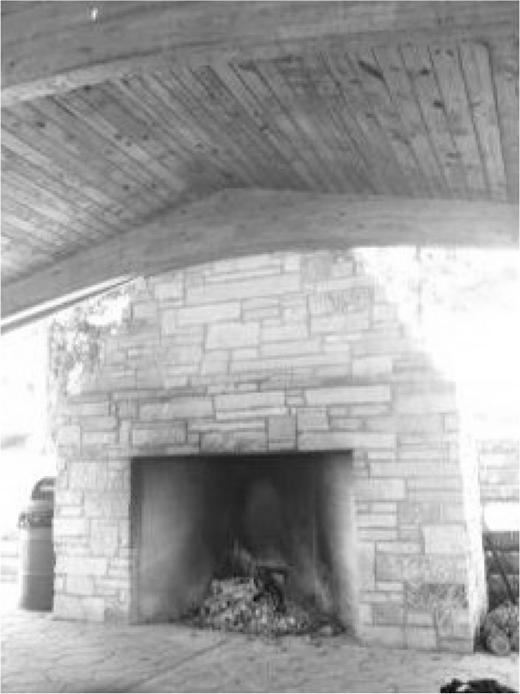
Instead of mentioning multiple principles and elements of visual design, then, I found myself tending toward one specific principle or element within each image that I tweeted. This limitation created in me a strong feeling of aloofness. Would my classmates think that I did not perceive other elements or principles of design that could have been discussed? How could I use Twitter to connect with others when the medium did not even allow me to say all that I wanted to say? This seeming limitation did have the benefit of allowing my classmates to address remaining aspects of my tweeted images. In some photos that I tweeted, classmates would reply and offer other analyses. So, the limitation that I felt as a Tweeter actually might have served to spur ideas from others. If there was disagreement about the analysis of an image, though, it was nearly impossible to have a meaningful rebuttal and dialogue, due to the character limitations.
A second example reinforces some of the points that I just made above and provides opportunity for an additional point. Consider Figure 2, which depicts a boxing bag lying in the middle of the floor. My tweet with this photograph read, “Bright light beaming down where bag was hanging gives a sense that the bag was knocked off the clamp.” Certainly, beaming light is a reference to visual design, but the tweet did not give me room to write about the negative space surrounding the bag and leading the eye to the bag. This would have been another visual element worthy of consideration. Also, just the color contrast among the bag, the floor, and the walls would have been worthy of mentioning. The limitations of Twitter hindered me from offering full analysis.
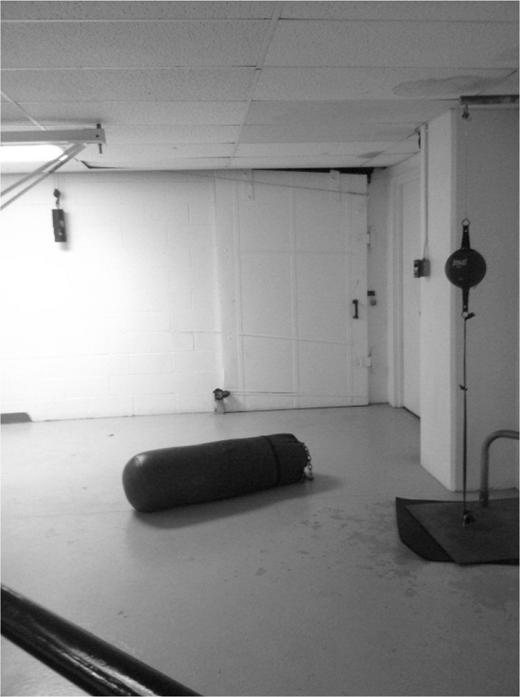
To extend the point, though, sometimes, the visual dimensions of an image can be enhanced through a consideration of context. The 120-character limit often prevented me from sharing that context. This tweet could not have set the tone or given background to the situation—namely, that the bag ending up on the floor was the result of a triumphant boxing “accident,” as I was the one who knocked the bag off the clamp and onto the floor. Somehow, without the context, the tweet felt detached; the light—the very visual element that I was tweeting about—did not seem as dramatic apart from that context. My tweet only resulted in a simple statement about light.
I wondered if the example was less useful to my classmates because of the missing contextual information. I wondered if my followers even understood that the context was a punching bag. An earlier version of my tweet that was too long to post read as follows: “My boxing accident ended with a triumphant pic. Bright light beaming down where boxing bag was hanging gives a sense that the bag was knocked off the clamp. It was. I have powerful punches.” As a viewer of other tweets, I certainly felt a sense of detachment at times. I regularly read tweets without contextual explanation. There sometimes seemed to me to be no significance to the elements and principles of visual design within an image because of the lack of context.
Part of my point extends beyond the tweets as communication of information about visual design and addresses tweets as a form of writing. The tweets within this assignment created a shift away from the type of elaborative, specific, and detailed writing that often is required in graduate school and toward a more condensed and generalized type of writing that fits within 120 characters. Is this shift in writing more harmful than useful? Twitter’s form implored me to get to the point. But, was the point so narrow that substance was diluted? These are all thoughts that regularly occurred to me as I reached for the “tweet” button.
I personally felt the instruction fostering the assignment was good. In spite of the 120-character limitation, I learned from others as they tweeted out photographs and analyses. The assignment did help me learn the principles and elements of visual design. But the medium of Twitter was not as efficient or effective as I would have preferred.
Gretchen’s Narrative
When this assignment was introduced, I was looking forward to it, as I wanted to learn more about Twitter. I consider myself fairly adept at learning new media, so I was surprised that it took me longer than I anticipated to get used to Twitter. One thing I struggled with early on was simply finding my classmates’ tweets. When I initially signed up for Twitter, I was prompted to select five accounts to follow from “well-known” Tweeters and five more from my contact list. This created a full Twitter feed. I sought out my classmates and followed them so they would appear in my feed, but I found that their tweets were often buried among others who I followed. A classmate suggested creating a list of everyone in the class, and that helped organize my news feed. That tip did help me feel more proficient in using Twitter. When I logged on, I could more easily focus on class-related tweets apart from all the other tweets.
Once I solved this basic problem of finding content, I struggled to interact easily with my classmates. I am a Facebook fan and like the ability to see entire threads of conversations easily. Those threads help me actively engage with my friends and groups. I found that engagement to be different in Twitter. It was harder to see conversations and threads. In Twitter, I felt much more like a voyeuristic observer than I did a part of a conversation. I did find technical tips to make communication in Twitter easier. For instance, initially, when I wanted to reply to a tweet, I would open the attached picture and then go back to the original tweet to post my response. It was clunky and required a lot of clicks of the mouse or finger taps on my phone. I eventually learned that I could simply hit “reply” and see the picture and the content of the tweet while I typed my reply.
As I started tweeting myself, I was hesitant to publicly criticize other people’s designs— even people that I did not know personally. Because we were learning about visual design in this class simultaneously with completing the assignment, I felt inadequate to criticize designs until I had acquired more knowledge about the elements and principles of design. I felt a lack of confidence in my design-recognition abilities, so I was worried I might criticize the wrong things. It was very uncomfortable to me.
My first tweets were all focused on things found in nature; nature tweets seemed more comfortable to criticize. One of my early photographs was from my garden. I saw the tendrils of a sweet pea plant intertwined with the fernlike shoot of an asparagus plant. I loved the contrast of the two different textures of the plants and how each created a different sense of line, one curly and the other straight. Unfortunately, my iPhone’s camera could not focus on fine textural details. The very characteristic that I wanted to react to and analyze was not observable through a phone camera photo.
Even as I ventured beyond nature and into consideration of artificial designs, I sometimes experienced logistical frustrations. I saw great examples of things to tweet, but it was often not convenient or safe to capture the picture that I wanted. For example, I saw an incorrectly painted road sign with an arrow pointing the wrong way. Because of road construction and no convenient place to park my car, I would have put myself in danger to get a photo of that sign. It became a missed opportunity for expressing my knowledge of course content.
The character limitation of Twitter sometimes interfered with my ability to say what I wanted to say about one of my images. This was frustrating on one level; on another level, though, it forced me to take the fluff out of my words and choose my words very carefully. I would often rewrite a tweet several times to fit the character limitations and convey my message. For example, on a bike ride with friends, I stopped to take a picture and decided to take several using the “rule of thirds.” I selected the one I liked best and tried to convey what I’d done: “Bike ride with friends today. Decided to play with rule of thirds to see how it impacted the look of a picture. This one shows my friends in the bottom right third. I liked this one the best.” That first attempt was 194 characters, leading me to a revision: “Decided to play with rule of thirds to see how it impacted the look of a picture. This one shows my friends in the bottom right third. I liked this one the best.” Even this revision was too long, though. My final version read as follows: “Played with rule of 1/3. Friends are in bottom right 1/3. Like best of all 1/3 options for this shot.”
Another source of frustration came from not being able to “turn off” class. In addition to being a student, I have family responsibilities and a full-time job. In past classes, I would schedule specific times for homework. Once homework was complete, I “turned off’ school and focused on other aspects of my life. In this assignment, I felt I was always “on” and thinking about the need for content to tweet. If I relied on scheduled time and my standard studying location, I would have missed out on most of the things I tweeted. This assignment took up more space in my day-to-day life and forced me to think about school outside of my standard-scheduled homework time.
Partially because of the difficulty of adjusting to always being “on,” I did experience periods of stagnation in this assignment. During my homework time, I would often force myself to take a picture of something, anything, just to force myself to notice the details and to make sure I was tweeting to fulfill the assignment requirements. At one point during my allotted homework time, I went through some graphics and pictures that just happened to be within arm’s reach. The resulting tweets were probably ridiculous, but I tried to analyze something in each picture. In one graphic, the color purple served as the “white space,” and it created a nice visual effect. A logo had two fonts, one sans serif and one serif, with the color and white space reversed in two separate words. I found that initially forcing myself to analyze images and tweet them helped me refine my design sense and become more attuned to how the elements and principles of visual design were applied.
At one point, I sat down with my favorite magazine to relax. I was surprised at how much I noticed and was willing to tweet! It was not even scheduled homework time! I didn’t feel like I was searching for material to tweet; I felt like examples really jumped out at me. This was a nice experience given my frustrations earlier in the semester of feeling stagnant and worrying about criticizing the designs of others. And even though it was not my scheduled homework time, I really did not mind the extra few seconds it took to snap a picture, comment on what I saw, and tweet it.
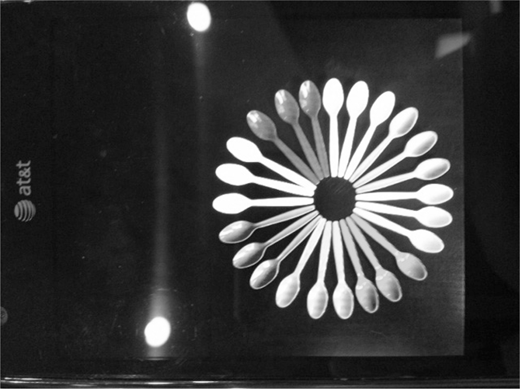
One approach that became common for me was to not tweet out an image as soon as I captured it. For instance, in a frozen yogurt store, I noticed a designed display containing colorful spoons. They had a nice visual impact, so I snapped a picture. See Figure 3. But I did not take the time to tweet it right away. This delay between taking a photo and tweeting it did help me balance my time a bit more with this assignment. Sometimes that gap in time allowed me to reflect on a picture and notice additional elements deserving analysis. For example, I took a picture of a box of Girl Scout cookies because I was drawn to the colors and shapes on the box. See Figure 4. When I got around to tweeting that picture, though, I realized the message was broader than the cookies, as the box included a picture of young girls dancing and a quote about experiencing other cultures. The graphic qualities inherent to the girls added levels of richness to the visual design. If I had tweeted right away, I might have overlooked these additional layers of design.

Even while on vacation, during the time period of this class, I found myself snapping pictures of various designs. I took one picture of the FedEx logo on the side of a truck. I previously had never noticed that the negative space between the “E” and the “x” created an arrow. Since FedEx is known for their speedy delivery, that subtle arrow was interesting symbolism in their logo. While on vacation, my family wandered through some old cemeteries where my grandparents are buried. The font choices used on gravestones stood out to me. I think of serif fonts as being old, so I was surprised to see a gravestone from the 1800s with a sans serif font. I’m not sure that this would have stood out to me prior to this class. I did snap a picture of the font, but did not tweet, as it seemed disrespectful to tweet in a cemetery.
The assignment has enhanced my ability to better notice design elements and more succinctly articulate my thoughts on design. With my method of snapping pictures as I saw them and tweeting later, I found it less of an issue to find useful examples. While I have not been an avid tweeter since the class ended, I do appreciate the exposure to this medium, and more recently—approximately 7 months after the course ended—I’ve found myself checking Twitter more often.
Shanda’s Narrative
Before this assignment, I had never used Twitter; and, truthfully, I never gave it much thought as a medium. I really did not think that I had a need for it. My impression was that Twitter was for celebrities, people who had an inflated sense of self-importance, or others who think anything they do during the day is interesting—I do not care you tried a new sandwich, and it was the best thing you ever tasted. This is not to say I am against the use of social media. I use Facebook, and I am probably on that site more than I should be. But, isn’t one social medium enough? I didn’t need another account to keep track of and a password to remember. I also did not think you could say anything meaningful in 140 characters. My thoughts are more than 140 characters even on a bad day.
Nevertheless, Twitter was the medium chosen for this assignment, so I signed up for a Twitter account as required. I began following my classmates; but, not wanting to be accused of not fully embracing something new, I started to follow others as suggested by Twitter: Matthew Gray Gubler from Criminal Minds, Mayim Bialik from The Big Bang Theory, and my father who is tweeting all the time.
In the beginning of this assignment I found myself extremely frustrated and discouraged by my lack of knowledge of how Twitter worked. My unfamiliarity of Twitter in the first couple of weeks of this assignment kept me from tweeting much and getting much out of the assignment at all. At one point in my frustration, I was ready to unfollow everyone except my classmates just to ensure that I could find their tweets. Then, a classmate suggested that I create a “student list” to easily find classmates’ tweets without scrolling through all tweets of everyone who I was following. I was glad to accept that suggestion.
Even after solving this initial problem of finding my classmates’ tweets, I must admit that I really was unimpressed by Twitter. It did not work the way I thought it should, at least not on my mobile phone. I assumed that I was going to be notified when someone I followed tweeted something, and this was not the case. I can see why notifications would not be very good for a person who followed hundreds of tweeters. But, because I followed only a few people, I really would have liked notifications. Perhaps there was a setting in Twitter to adjust the types of notifications that I could have received, but I could not find it.
I did become more comfortable with the medium, but I found myself getting discouraged by the character limitation of each tweet. It was more than difficult for me to express any meaningful analysis of the photos in so few characters. For example, while at a zoo on a very hot day, I saw an advertisement for ice cream, shown in Figure 5. I originally wanted to say something about the irony of a penguin eating ice cream in a jungle, and how clever the ad was because I did think that I would be cooler if I had an ice cream cone. However, I could not say all of that because of the character limitations of Twitter. I ended up tweeting the picture of the ad with a caption of “creating an illusion with greenery.” I don’t feel I expressed exactly what I wanted to with that tweet.

Over time, it did become easier to tweet. I was on public transportation going to work, and I tweeted; I was following instructions on how to put together a trampoline for my son, and I tweeted; I was walking down my neighborhood street, and I tweeted; I was at the park, and I tweeted; I was at the store, and I tweeted. At one point during the summer, my mother asked if I could go anywhere without tweeting something.
As the assignment continued throughout the summer, I quickly started seeing textbook graphics, in-store displays, magazine advertisements, and road signs all around me that I thought were, at the very least, visually interesting. But more importantly, I began seeing materials that could have been much more effective if they used a larger font, brighter color, more evocative pictures, or simply less white space. Because of the assignment, I became less casual in seeing; everything became a visual design. I am bombarded with new layers of sight all around me. I cannot look at my surroundings and just take them at face value anymore.
This new way of seeing did not just occur when it was convenient. For instance, while traveling on public transportation during my daily commute, I saw an advertising billboard that intrigued me in its use of negative space. But, from the metro train, I could not get an ideal look at the billboard, much less a clear picture of it. One day, I decided to leave for work just 15 minutes earlier than normal so I could get off the train, take the picture of the billboard, and hop onto the next train to continue my commute. It worked. See Figure 6. The picture is a bit blurry; my phone camera is just not that great. But I tweeted the picture anyway with a reference to what I found so intriguing: “Great use of white or neg space. Simple but powerful message with few words and image.”
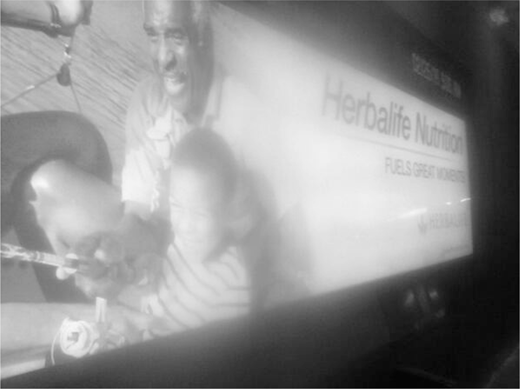
I wondered if my professor and classmates knew the steps I took to get photographs like this one. It was not convenient or easy to get the photo, and I showed commitment to the assignment by going the extra steps to get it. I worried, though, that the blurriness of the picture overshadowed the larger point, and I wondered if the effort had been worth it. I still look at that billboard every day on my way to work, and it is a reminder of some of the content that we studied in the course.
Throughout much of this assignment, I was discouraged by the medium of Twitter and did not get the point of this assignment. However, now that I have successfully completed the assignment, I see that the medium helped change my view of my surroundings. The mobility of Twitter allowed for many tweets of analyzed pictures, and more analysis proved useful. Because of the mobility of Twitter, I was able to take a picture of a graphic, analyze the picture, and tweet it out immediately. Without having the mobility of Twitter, I would have taken a picture to analyze later and most likely may have forgotten exactly what I wanted to say. I may still not be the biggest fan of Twitter, but I am glad I embraced the medium during this assignment.
Implications
In this section, we discuss two broad implications that seem to emerge from both our narratives and our experiences. First, it must be considered that new interactions do strain students in various ways. Second, questions about the appropriateness of Twitter as a medium for this assignment are discussed.
The Strain of New Interactions
Schlossberg (1998) notes that new interactions place “a strain” on users. That strain is a result of not understanding how to interact and concern over being “embarrassed for not doing it right” (p. 17). From Schlossberg’s brief note, three points are important. First, as we each indicated in our narratives, we struggled to figure out technical aspects of the interactions. These struggles did interfere with our ability to interact both with content and with each other. In terms of content, for instance, we have noted that the limitations of our cameras hindered some of us at times from clearly capturing details worthy of analysis. And, even when we captured those details, the character limitations of Twitter hindered our ability to offer cogent analysis.
A second point from Schlossberg (1998) is related to the phrase of “not doing it right” (p. 17). The photograph analysis assignment was decisively postmodern. There really was not a “right.” As the assignment guidelines noted, the purpose was not correct analysis as much as the purpose was for us to offer interesting interpretations that might “enlighten and surprise” our followers. We see this postmodern bent now, in retrospect, as we write this article and consider implications. But, what our narratives should show is that in the act of completing the assignment, we did worry about being “right.” Our concern for being right felt constraining.
Third, we felt another type of interaction strain. We strained to use Twitter to interact with others. In considering our narratives after they were written, it struck us that we all recognized that an audience of followers was “out there.” But, our recognition emphasized worries about how we would be viewed by that audience. Would we be seen as aloof for limited analysis, banal choices, or blurry photographs? Far less prominent in our narratives were discussions of the social aspects of learning—learning with (and from) each other. We all agree that this type of learning occurred throughout the photograph analysis assignment, but the fact that we did not see it as important within our narratives might serve to contradict Wright’s (2010) findings that students felt that using Twitter “reduced isolation and supported a sense of community” (p. 263). Instead, our view was more in line with Lin et al.’s (2013) point that collaboration “was not sustained” and in fact, sometimes “did not occur when [Twitter] usage was left to the students” (p. 43). The experience felt more insular than social, though certainly a social component existed.
Media Versus Method
Given that we struggled with (a) the technical aspects of Twitter, (b) the postmodern intentions of the assignment, and (c) consistently interacting meaningfully with classmates, we discussed among ourselves the question of whether or not Twitter was the best medium for this assignment. Could we have done this assignment in a different medium, such as in Facebook; through Instagram; or using Blackboard, our university’s learning management system? Certainly, Clark (1994) has famously asserted that any medium is replaceable by any other medium, while Kozma (1994) asserts that unique media attributes better enable some instructional strategies to be carried out. Knowlton and Nygard (in press) have addressed the Clark and Kozma debates as they relate to Twitter’s use in higher education. In fact, pointing to numerous publications about Twitter’s use (e.g., Hosterman, 2011; Junco, Heiberger, & Loken, 2010; Kassens-Norr, 2012), Knowlton and Nygard conclude that many who have published about Twitter’s use in the higher education classroom have seemed unaware of the tension between media use and method as driving factors to ensure learning within assignments. Professors who implement assignments that use social media should consider the media/method debates carefully.
As for us, we are mixed on our conclusions as to whether or not Twitter was the best medium. We believe that this assignment could have been completed successfully in a variety of media, though some of us are not willing to dismiss the importance of the mobility of Twitter as impetus for immersion in this assignment. To the extent that creativity is relevant to this assignment, some evidence suggests that immersion into the environment is important if creative seeing is the goal (Arnheim, 2004; Lehrer, 2012; Sims, 2011). Certainly, one of the reasons the professor chose a mobile medium is to force the synthesis of this assignment with students’ nonhomework time. The assignment intruded on students’ lives— workouts at the gym, family trips to the zoo, and vacations. That is a good thing, so the fourth author of this article argues, to the extent that it helped us come to terms with the reality that a graduate-level education should impact (and intrude upon) all parts of our lives, not just our homework time. Professors who integrate mobile media into their courses should consider their own beliefs about coursework infringing on students’ everyday lives. Graduate students who are in courses where social media is used should consider the virtues of allowing their learning opportunities to extend beyond preestablished parameters of time and place. After all, application of content is not always limited by time and place.
Our final conclusion here is that students’ perceptions of the medium may be more important than a Clark (1994) and Kozma (2001) analysis of the medium. That we found it difficult to navigate, even initially, might raise questions in professors’ minds about the wisdom of using Twitter—or any other tool— as the medium. If students are using their powers of consciousness to use the medium, then the course content might push students into cognitive overload. Professors in distance education courses might consider multiple job aids at the start of a Twitter-based assignment. Topics might include forming groups in Twitter, following other tweeters, setting notifications from group members, and so forth. To students, we say “play early and play often.” While job aids might help, media is best learned through play.
Conclusions
This article has provided a novel use of Twitter—a use that does not seem to currently exist in the literature. Furthermore, this article has brought students’ voices to the forefront; and, as we have noted, students’ voices were not previously emphasized in the literature. While this article provides a good start for considering students’ voices, additional research is needed. For instance, we wondered if students from other disciplines would have had radically different experiences than ours. To offer an illustration, wouldn’t it be natural to expect literature majors to have a different experience in using Twitter than engineering majors?
We also wondered if a different context would sway students’ opinions and focus as Twitter users within a higher education classroom. The course discussed in this article, for instance, occurred during an abbreviated 6 week summer semester. Would more (or less) time for students to get accustomed to both the assignment and the medium change their experience? Similarly in terms of context, did the small class size—there were approximately 15 students in the course—shape our experiences? Elavsky (2013), for instance, has addressed Twitter use in large courses. Students’ perceptions of Twitter use in large courses would be a useful addition to the literature.

