


Synchronous distance education through Internet technologies is emerging as an option for involving experts in training events for dispersed audiences. This article reports on the design and formative assessment of a synchronous distance education demonstration project designed to bring experts to participants at their work locations through Internet technologies. The first of three collaboratory demonstration projects used a minimalist approach to involve participants and an expert in a training event. Formative evaluation results indicated that the participants’ experiences were successful and convenient, but more engaging activities would provide additional benefits. A more robust model was designed to increase interactivity before, during, and after the live-broadcast training event.
Over the last five years we have synthesized and demonstrated a new paradigm for distributed education, which makes delivery via Internet technology to home or office both economically viable and educationally attractive.”(Pullen & Benson, 1999p. 14.)
Introduction
Distance education, previously only sustaining a marginal role in the total scope of education, is now becoming mainstream in lifelong learning. An emerging line of literature describes the advantages of synchronous distance educational strategies to support real-time learning among distributed audiences. A key instructional strategy used in synchronous distance education environments is real-time distributed social interactions. Research literature supports the premise that learning was more successful when peers actively collaborated and interacted socially during learning (Duin, 1996; Riel, 1990). This research found that learning was not based solely on the establishment of new knowledge; rather it began with the needs and interest of individual learners and grew out of discourse and shaping of understanding through social interactions with others in the learning environment. However, differences were noted in the nature of dialogue between synchronous and asynchronous models of distance education (Shotsberger, 2000) demonstrating that synchronous discussions were more informal and spontaneous. Synchronous social exchanges were in fact found to be valuable in facilitating the group learning process (Becker & Dwyer, 1998). Thus, integrating real-time discussions into distance education courses can enhance the learning process.
However, little has been written about designing synchronous distance education programs that integrate opportunities for distributed audiences to interact with true experts in real-time. Such events would be in line with situated learning principles suggesting that effective learning of a practice requires interactions with the information, tools, and people of a practice (Lave and Wenger, 1998). Therefore, adding a live-broadcast component using acknowledged experts could be a differentiating distance education event lending credibility to learning new and complex content through interactions with, and immediate feedback from, one who is a practicing expert. This article describes such a design, the initial formative evaluation results, and the emergence of a more robust model.
Designing Easily Accessible Synchronous Distance Education to Promote Learning
Whereas previous literature on synchronous distance education technologies described expensive technology solutions that connected multiple classrooms to a single instructor, this article describes the design and formative evaluation of a synchronous distance education model that incorporated new internet technologies offering a low cost option for delivering instruction to distributed audiences at their work or home location. This model provided real-time delivery of expertise to widely distributed groups and individuals. In addition to providing a presentation of content, the synchronous distance education technologies encouraged interactive participation among the participants and experts during the live training event. Such an event connects learners with practicing experts who normally would not have the time to participate in multiple training sessions. Although the stakeholders are not in the same place during synchronous distance education the experience has proven to be just as successful as classroom experiences even in the absence of two-way video teleconferencing (Pullen & Benson, 1999, Pullen, 1998). However, designing such events as meaningful learning experiences is not without its challenges (Koszalka & Budenbender, 2001).
Collis (1999) emphasized the need for distance education models to meet the needs of individual participants on several levels. She suggested that distance education must be designed to improve the flexibility of location—where the learner carries out learning. In the synchronous distance education model described here, the Internet technology allows learners to participate from their own home or office. Collis also suggested that distance education needed to provide flexibility in the types of interactions used. In this initial demonstration project, participants were provided with a variety of pre-work and live-broadcast activities that encouraged them to read and reflect on new concepts, develop their own definitions of key concepts, and practice applying new concepts to familiar situations as well as their own unique work-related activities. The pre-work and live-broadcast were designed to establish an environment where the participants played the key role learning new content and applying new content into their work-related practices. Interaction, practice and reflection exercises were therefore designed to provide participants with opportunities to work with and manipulate new concepts to help them develop understanding in the context of their own work environment (Duffy & Cunningham, 1998; Wittrock, 1990). The expert played a peripheral role, scaffolding learning by presenting and advising on content application (Lave & Wenger, 1998). Collis also advocated the need for multiple forms of communication among instructors, students, and others beyond what might normally occur in a classroom and multiple types resources that meet the needs of a variety of individual learners. The design for this training session incorporated sharing of information and feedback through automated assessment surveys and several forms of interactions during the synchronous live-broadcast. The participants were also provided with text and internet-based pre-reading, links to relevant reference materials, graphic intensive presentations on content concepts and applications, and access to a leading content expert. Each design feature was provided to benefit multiple individual learning preferences.
Sachs (1999) suggested that distance education should emphasize the instruction not the material, incorporate the collection and reporting of assessment data to enhance instruction, support stakeholders in learning the new technologies that connect them to experts, and incorporate a variety of technologies that allow ample interaction and practice. In this model the focus of all of the materials were to prepare the participants and facilitator for the culminating event, the live-broadcast. During the live-broadcast the participants would be provided with interactions to help shape their knowledge about the content. Assessment data were used to inform the facilitator about participant needs and adapt instructional strategies adapted to support learning during the live-broadcast.
In these two contexts, flexibility and design factors for distance education, designing live- broadcast experiences that were interactive and engaging to participants required more than just making the event available to listeners; it meant motivating and preparing the participants and instructor to effectively engage in learning. Thus, design strategies for synchronous distance education need to integrate a variety of technologies, information and human resources, and instructional strategies to support teaching and learning.
Components of Synchronous Distance Education
Synchronous distance education courses tend to incorporate the multiple technologies and strategies seen in traditional correspondence and asynchronous courses with a live-broadcast (Pullen & Benson, 1999; McIsaac, 1998). See Table 1.
Traditional correspondence courses today generally provide participants access to instructional content and directions through digital technology. Course materials are selfstudy in nature and instructor support is generally provided through assignment feedback or on an as-requested basis, as in the traditional paper-based correspondence course. Asynchronous distance education provides participants with access to information and people on their own time, allowing participants to interact with course content and people during specific types of activities or when they are seeking guidance. During asynchronous instruction, participants do not generally have formal meeting times; rather they hold discussions using communication technologies such as listservs (mail groups) or bulletin boards. Often, interactions with others are planned and scheduled instructional events encouraging discussions on course content, sharing ideas and solutions, creating group projects and representations, thus engaging in social learning (Koszalka & Bianco, 2001). Integrating such components into synchronous instruction accommodates information sharing, learner and facilitator preparation, social interaction, and the opportunity for focused face-to-face interactions and feedback required to facilitate learning and skills development (Pallesen et al., 1999; Koszalka & Bianco, 2001).
This article reports on the development and formative evaluation of a minimalist synchronous distance education model that was designed as the first version of a synchronous distance education project created to demonstrate the use of emerging Internet technologies as a means for delivering real-time educational experiences to government employees dispersed throughout the country (Koszalka & Budenbender, 2001). The remainder of this article will describe the context and content for the project, the instructional design and strategies used in the initial demonstration project, the assessment strategy, the results of the first test, and recommendations for the second demonstration project.
Distance Education Delivery Strategies
| Pure Traditional (digital) correspondence course | PureAsynchronous | Pure Synchronous | |
|---|---|---|---|
| Formal “class” time | None specified | None specified | Formal specified time for instruction |
| Technology applications | Deliver information and instruction, provide interactive learning activities, support asynchronous communication | Deliver information and instruction, provide interactive learning activities, support asynchronous communication | Deliver presentation, support synchronous communication |
| Course materials | Instructions, text- and graphic-based resources, assignment submission information | Instructions, text- and graphic-based content resources, assignment submission information communication vehicles | Announcements, supporting handouts |
| Types of instructional activities | Self-study, reading, research, individual develops and submits projects | Self-study, group projects using shared workspaces and communication vehicles | Presentation, discussion, and live-interactive events, i.e., polling/voting, etc. |
| Access to Instructor | Feedback after assignment submission or as requested | Discussions, feedback asynchronously | During live-broadcast |
| Access to other learners | Generally, none provided | Discussions, group work, peer review, feedback | During live-broadcast |
| Types of communications | Email, listservs, bulletin boards | Audio-, text-, and video conferencing, |
Project Context and Content
In additional to playing a major role in the development of aircraft, space technology, food preservation, technology commercialization, and weather forecasting, NASA has also broken new ground and pioneered the use of Internet and distance education technologies in support of lifelong learning. Much of the acknowledged and published work on NASA education endeavors has been reported in K-12 literature. However, NASA also supports adult education efforts and expends a great deal of effort in supporting the knowledge and skill development of government employees.
NASA Ames Research Center (ARC) has been exploring ways to use technology to reach large numbers of people in different locations at one time by leveraging existing resources and pioneering new technology-enhanced learning approaches and strategies to ensure project management and technical competence across the NASA agency. The NASA Academy of Program and Project Leadership (APPL) and ARC undertook a joint effort to explore the advantages of using distance education technologies to conduct project management training for federal employees. This effort was named the NASA APPL Collaboratory.
The NASA APPL Collaboratory was proposed as an agency demonstration project that would integrate existing project management instructional resources and leading edge learning technologies to train government employees. The purpose of the collaboratory was to conduct a series of educational experiences using synchronous distance education techniques applied by resident experts in NASA’s way of doing business and employing the latest in digital communication tools to enhance educational experiences.
This proposal was accepted for funding based on initial instructional design and technology integration ideas and incorporation of collaborations among experts from government, university, and private sectors. The team planned to develop internet-delivered distance education materials and events for project management training on Probabilistic Risk Assessment (PRA), e.g., identifying, analyzing, and addressing risks inherent in any project. The purpose of the training was to provide an overview of PRA in the context of risk management and practice and expert feedback applying PRA to one’s own projects. At the end of this training, participants were expected to be able to define key terms and models and apply PRA principles in the context of their own work.
The proposal included an extensive commitment to formative assessment, initially evaluating the instructional design of the total event, usefulness of the training components in preparing participants for the live-session, and value of the experience for the instructor and participants. The formative data from the initial test were used to help the facilitator prepare for the live-broadcast and to enhance subsequent demonstration projects that would incorporate additional technological and instructional features. Once all three of the demonstration projects were completed, additional research would be conducted to investigate learning gains and stakeholder interactivity for the different synchronous distance education models.
Instructional Design of the Appl Collaboratory
“The questions that need to be asked are not which medium works best, but rather how best to incorporate media attributes into the design of effective [distance] education for learning … to help designers create distance learning courses that assist students who are not active learners become more independent.” (McIsaac, 1998, p. 25)
The APPL Collaboratory team developed the first of three demonstration projects using a minimalist approach, e.g., designing a simple event that required little preparation time and both prepared the participants for and engaged them in a live-broadcast with a leading expert in PRA. The live-broadcast would be disseminated from NASA headquarters in Washington, DC and viewed on the participants’ desktops across the country through Internet connected personal computers. The instructional design approach consisted of two major components, (1) web- and text-based pre-work materials and (2) live-broadcast. See Figure 1.
Registration and Pre-Work
Participants for the first demonstration project were identified through training administrators at several government offices across the country. Announcements were sent through email and included information on the course, the URL for the APPL Collaboratory preparation website, and a prompt to complete the pre-work prior to the live-broadcast. The APPL Collaboratory website provided access to the on-line registration form, desktop system testing instructions, technical support, prework, and pre- and post live-broadcast formative evaluation surveys. Those who registered for the session were sent several reminders to complete the pre-work, test their desktop computer technology prior to the scheduled live- broadcast, complete the pre live-broadcast formative evaluation form assessing the prework, supporting website, and their readiness to participate in the live-broadcast, and log-in to the live-broadcast at the appropriate time.
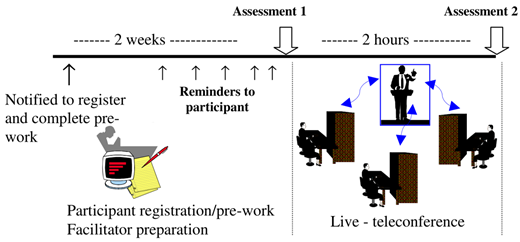
The pre-work activities were designed using an inquiry-based strategy to introduce basic PRA concepts, prompt fact and concept recall, and encourage participants to apply PRA concepts to simple examples. Participants were also prompted to reflect on, and record notes about, the application of PRA to their own job-related projects. These pre-work activities were designed to prepare participants for planned live-broadcast discussion and sharing sessions.
Synchronous Live-Broadcast
The live-broadcast session also was designed to be inquiry-based. The facilitator would review major concepts presented in the pre-work, regularly elicit responses to recall basic content and apply content to simple examples, describe scenarios that demonstrated application of PRA concepts, respond to participant questions, and prompt participants to share their responses to the reflection pre-work activities. The broadcast was designed to begin with a quick technical check of those who logged-in and included a 15- minute break in the middle of the session. Although not included as an official component of the first APPL Collaboratory, streaming video was tested during the session break to gather data on its use for subsequent projects.
During the two-hour live-broadcast the facilitator, a leading expert in PRA, interacted with the participants using an Internet technologies interface that supported one-way audio, video, and graphic presentation and enabled synchronous sharing of examples and discussion of specific PRA tools through a text interface. See Figure 2.
The interface features allowed the facilitator to elicit participant interactions and responses to questions using real-time textbased chats and simple response (yes/no) online polling. Participation during questioning and polling was automatically registered on the participant list in the lower right of the screen. Presentation slides were displayed in a window at the top of the screen, a picture of the facilitator (still and video capability) was displayed in the lower right, and a text-entry-text- display box was at the bottom of the screen. On a horizontal bar below the main presentation window there were buttons for the participants to send yes/no responses to facilitator questions and volume controls. A tally box for yes/ no responses was located on the bottom of the screen.
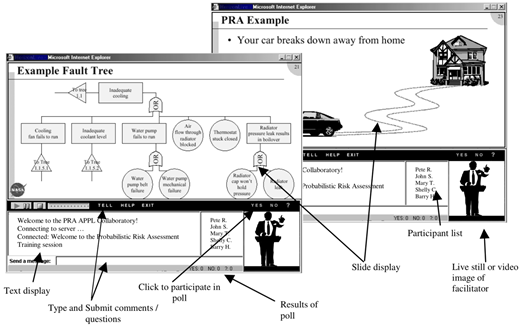
Although the interface was designed to be easy for the facilitator to lead the training and handle the technical aspects of the presentation, chats, and polling, a technical support person was present during the first test to help monitor the questions and conversation throughout the presentation. The technical support person summarized participant questions and thoughts and periodically identified times when the facilitator should respond to content and application questions.
Assessment of the Demonstration Project
Data were collected from the participants at two points during the testing cycle using pre- and post live-broadcast on-line surveys as well as comments made by the stakeholder during the live broadcast. The formative assessment provided feedback on the training material, technical setup procedures, and facilitator-participant experiences.
The primary goals of the pre-live-broadcast data were to:
provide the facilitator with a list of the issues to address during the live-broadcast as raised by participants during pre-work,
provide the design team with feedback on the pre-work materials including the website, pre-work packet, and technical setup procedures,
provide demographic data on the participants, and
provide data on the participants’ perceptions of their level of readiness to participate in the live-broadcast.
The primary goals of the post-live-broadcast session were to:
gather formative feedback to enhance the pre-work based on participation in the live-broadcast,
gather formative feedback on the design of the live-broadcast, e.g. content covered, use of technological features, level of interactivity and participation, and
gather feedback on the participants’ overall experience and their perception of the value of synchronous distance education.
The net result of the data analysis prepared the facilitator to support participant needs during the live-broadcast and provided recommendations on how to enhance the quality of materials and instructional strategies to support the development of subsequent demonstration projects.
Summary of Results of the First Appl Collaboratory
Forty-three participants from around the country registered for the first APPL Collaboratory. Thirty completed the on-line surveys. See Table 2. Eighty-three percent had six or more years of management experience. Fifty-eight percent had reported having a moderate amount of experience in risk management and forty-two percent claimed to have a low amount to no experience in risk management. Forty-two percent of the respondents reported a moderate level of knowledge about PRA and fifty-eight percent claimed to have little or no knowledge of PRA principles. Eighty-three percent had indicated a need for training in PRA and risk management. Fifty percent had never taken a distance education course, ten percent had taken one or two distance education courses, and twenty-five percent had taken more than three distance education courses.
When asked about completing the pre-work readings and activities, seventy-five percent indicated that they had completed a majority of the reading and activities prior to the live-broadcast and twenty-five percent indicated that they had skimmed the materials. Several written comments indicated that participants were interested in the content, but more curious about the application of distance education techniques.
Pre Live-Broadcast Survey
In general, participants agreed that the PRA website and pre-work materials helped them set up and test their technical configuration,provided a clear introduction to the components of the PRA Collaboratory, gave clear instructions for completing the pre-work activities, and helped them understand risk assessment. Neutral assessments were given with regard to the value of the pre-work references (on-line links to PRA and official government risk assessment documents) and the helpfulness of the short answer pre-work activities in developing an understanding of PRA. The participants indicated that they felt ready to participate in the live-broadcast. See Table 3.
Participant Profile
| Questions/Options | Percent responses |
|---|---|
| Management Experience | |
| 83% |
| 17% |
| Risk Management Experience | |
| 0% |
| 58% |
| 42% |
| PRA Knowledge | |
| 0% |
| 42% |
| 58% |
| Need for PRA Training | |
| 83% |
| 17% |
| Distance Education Experience | |
| 60% |
| 10% |
| 30% |
| Pre-Work | |
| 75% |
| 25% |
Note: N=30
The data collected about participant backgrounds and specific PRA issues were immediately shared with the live-broadcast facilitator so that his presentation and discussion could be tailored to meet the needs of the participants. Data on technical issues were forwarded to technology support personnel who follow-up with registered participants to make sure that they were able to successfully participate in the live-broadcast. Feedback on the website and materials were summarized for use in designing subsequent demonstration projects.
Post Live-Broadcast Survey
On average, participants agreed or strongly agreed that the environment (their location) was conducive to learning, the pre-work prepared them to participate, they were successful in participating, they felt comfortable with the technology, and their questions and comments were addressed during the live-broadcast session. They also agreed that during the live- broadcast the pre-work facilitated their participation and that the live-broadcast was a valuable component to the overall training experience. On average the responses were neutral in regard to feeling engaged during the live-broadcast, however, several noted that they disagreed that they felt engaged during the live-broadcast. See Table 4. In another series of questions 36 percent of the participants indicated that they would, and 63 percent said that they would not, be able to apply PRA concepts to their work.
Participants agreed that the course objectives and their expectations for the training were met. Participants were neutral in regard to their perceptions about getting ample practice during the PRA Collaboratory training, although several disagreed that they had ample practice, and were neutral as to whether they learned the content while participating in the training.
As expected, the first live-broadcast pilot test had its technical challenges. Overall, the audio, graphic, and video transmissions worked well on all of the platforms tested (Windows and Macintosh, high speed and low speed transmission lines) and participants experienced only slight transmission delays, if any, during the entire two-hour live-broadcast including tests of the streaming video. The few technical problems that did occur were attributed to Internet transmission congestion at the receiving sites. The congestion blocked or slightly delayed audio for a few seconds or in one case forced a participant to logout and relogin to the broadcast. This caused minimal disruption from the participants’ perspective. There were also some minor difficulties reported by participants setting-up and testing their workstations, however, issues were resolved with the help of the technical staff on the development team or from technical personnel at local sites prior to the live-broadcast.
Level of Agreement on Pre-Work Material and Activities
| Participant Response Scale strongly agree (2), agree (1), neutral (0), disagree (-1), strongly disagree (-1) | Average* |
|---|---|
| 0.8 |
| 1.3 |
| 0.9 |
| 0.3** |
| 0.8 |
| 0.5** |
| 0.7 |
* Score based on a scale of strongly agree (+2) to strongly disagree (-2)
** Areas for focused improvements (n=30)
Level of Agreement on Live-Broadcast Experience
| Participant Response Scale Strongly agree (2), agree (1), neutral (0), disagree (-1), strongly disagree (-1) | Average* |
|---|---|
| PARTICIPATING IN THE LIVE BROADCAST | |
| 1.2 |
| 1.0 |
| 0.9 |
| 1.0 |
| 0.9 |
| LIVE-BROADCAST / ACTIVITIES | |
| 1.0 |
| 0.5** |
| 1.1 |
| OVERALL QUESTIONS ABOUT THE TRAINING | |
| 1.0 |
| 1.5 |
| 1.2 |
| 1.1 |
| 1.0 |
| 0.5** |
| 0.3** |
Notes:* Score based on a scale of strongly agree (+2) to strongly disagree (-2)
** Areas for focused improvements (n=30)
The analysis of the final evaluation comments indicated that the participants felt the objectives of the training were met and their expectations for this type of training were met or exceeded. One person did comment that “this medium was inadequate to explore the uncertainties in the material or reach consensus on answers … it was difficult to explore questions. ” Although others had commented that the technology inhibited personal face-to- face communications, on average, participants indicated that they liked the interactive aspects of the conversations during the live-broadcast, not having to travel, sharing information among colleagues, and getting training from an expert.
In summary, the participants felt that the pre-work prepared them for the live-session both from a technical and basic content perspective, the live-broadcast provided them with access to an acknowledged expert who provided valuable information and feedback on PRA, and the use of such technologies to support their professional development added convenience without compromising training quality. On the down side, the participants did not know exactly what to expect during the live session—either technically or in terms of interaction with the facilitator or peers, they did not feel as engaged in the educational event as much as they would have liked, and many did not feel that they would be able to easily apply PRA concepts to their own work after this one session.
Discussion of the Formative Evaluation Results from the First Appl Collaboratory
The first APPL Collaboratory demonstration project proved to be a valuable experience to the participants, facilitator, and development team. Telling data were collected on the value of a minimalist approach, e.g., simple paperbased pre-work followed by a live-broadcast, for designing synchronous distance education events. A majority of the feedback indicated that the overall experience was valuable to the participants; perhaps because of the training’s accessibility and the minimum amount of required preparation time (between 2 and 4 hours) prior to engaging in the interactive live- broadcast session. However, it was questionable whether this experience significantly contributed to learning the PRA content. Specifically, participants indicated that they felt that they understood the concepts and examples, but questioned their own ability to apply the concepts to their everyday projects. They expressed a desire for additional interactive experiences where they could learn new concepts, apply them, and discuss issues with true experts. In this minimal model, no “social” vehicles were established to prompt interactions prior to the live-broadcast, or after. Given this approach, it was difficult to assess how engaged the participants were with the content and activities provided in the prework material and how they addressed their issues after the live-broadcast.
During the live-broadcast the facilitator purposely made use of the yes/no polling feature to prompt participants to indicate whether they had completed specific pre-work activities and if they understood concepts presented in the pre-work, but there was little sharing of actual responses to the pre-work questions. More encouragement to share responses to the pre-work short-answer questions may have helped assess the value of the recall and reflection questions and provided specific data on the level of interaction with the materials prior to the live-broadcast.
In contrary to initial strategy of using the live-broadcast to focus on application of concepts, the facilitator spent a great deal of time reviewing concepts previously presented in the pre-work. He did pause periodically to answer posted questions from participants; however, he did not elicit examples from the participants of projects that they were managing that could benefit from PRA. Such conversations before, during, and after the live-broadcast could have provided the participants with a better understanding of how to incorporate PRA into their work.
Recommendations for Future Distance Education Experiences
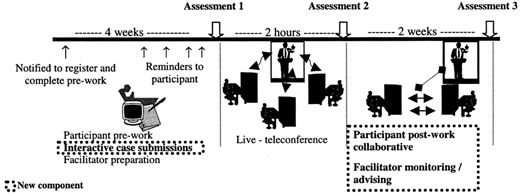
Based on the data collected and sound instructional design, distance education, and learning principles, future designs of the APPL Collaboratory distance education demonstration projects should incorporate more interactive and social activities, including:
Pre-work that contains interactive webbased learning activities that prompt participants to apply concepts to work-related scenarios. The activities should actively engage cognitive processing in the learner and prompt learners to demonstrate their understanding of the basic concepts while preparing them for active participation during the live-broadcast. Assignments should be submitted to the facilitator prior to the live-broadcast to prepare him/ her to cover gaps in understanding rather than repeat content covered in the pre-work.
Live-broadcasts that focus on filling the gaps in understanding of basic concepts and further exploring the application of concepts to authentic case scenarios.
Follow-up activities that encourage collaboration among participants and the facilitator in real work-related application-based activities applying new content. See Figure 3.
Recommendations for Future Synchronous Distance Education Events and Research
Overall, participants felt the APPL Collaboratory distance education training was effective. They indicated that using the web for delivery of training to their desktops was “time and cost effective,” “promoted learning of information in a short time and sharing of references among peers,” and “brought experts to remote locations with small group or single individual in need of support and training.” Participants indicated that during the live-broadcast the “use of examples during walkthroughs [of concepts] was helpful in understanding the concepts ” and the “stories told by the facilitator were helpful in understanding PRA application principles.”
As predicted, many ideas for improving the learning experience and capitalizing on the use of technology were identified. Many participants stated that they would have liked to have had “a better overview of the live-broadcast process … possibly an on-line tutorial to describe the screen features and participation process” and “more time or a more efficient process for asking questions and discussing application of concepts … perhaps a follow-up session for further discussion. ” There was agreement from participants that they “ needed more hands-on application-type activities” and “more opportunities to discuss how to apply and practice applying concepts to their own work environment. ”
As models for synchronous distance education become more fully developed and tested, research needs to be conducted to investigate learning gains, types of synchronous communication interactions and activities that promote or inhibit learning, the relationship between length of time in live-broadcast and engagement in training activities, and effect of integrating different types of electronic resources into pre-, live-, and post-broadcast sessions. Additional research is also needed to understand if, how, and when Internet technologies are effective tools to replace or enhance face-to-face training from learning, convenience, and economic perspectives.
The first APPL Collaboratory proved to be a valuable experience to both the participants and the development team. Many of the learnings will be valuable in developing more effective and advanced techniques to promote learning at a distance, including the incorporation of hands-on interactive activities to better prepare participants for live-broadcasts and follow-up activities that enhance application of concepts and development of social support structures across the agency.
It is often difficult to take a true expert out of his or her job to support training; thus using synchronous distance education is an effective and efficient way for an expert to directly share his/ her knowledge with a distributed audience. Designing synchronous distance education programs, however, is not as simple as coordinating a live-broadcast of the expert giving a speech. The preparation of the participants and providing opportunities for interaction with content and others was critical in supporting knowledge and skill development of the learners.
As technology continues to become more accessible to workers, and time spent away from the workplace in training less convenient, the use of synchronous distance education opportunities that bring experts and learners together will become more important to productivity in the workplace. This first demonstration project supported the argument that a minimal synchronous distance education design model could successfully prepare participants to actively participate in a live-broadcast and gain new understanding and knowledge of complex concepts. However, several enhancements to the interactivity of the events leading up to, including, and after the live-broadcast were identified that could enhance the learning experience. Additional research is needed to investigate more robust designs and the effectiveness of synchronous distance education.
This work was supported in part by funding through NASA Ames Research Center and NASA Headquarters in response to Executive Order #13111. Special thanks to Valerie Dudley, a graduate student in the Instructional Systems Program at The Pennsylvania State University, for contributing to the literature review of this manuscript.

