


Current technologies for qualitative data analysis treat all types of data analysis as a homogeneous category, and for this reason, the value of other technologies for a discourse analysis of transcripts is not well examined. Therefore, the current study addresses how qualitative data can be analyzed by a learning analytic tool, such as Knowledge Building Discourse eXplorer (KBDeX), demonstrating how this software can serve as an alternative tool for analyzing qualitative data. Therefore, this study makes recommendations on how a leaning analytic tool can be beneficial for analyzing knowledge building discourse.
Introduction
The presence of international students in American higher education is essential, as they contribute to the diversity of the student body at postsecondary institutions (Bound et al., 2021; Lee & Rice, 2007; Wu et al., 2015). International students bring different perspectives to American classrooms, foster appreciation of cultural differences, and prepare domestic students to work with people from different national and cultural backgrounds (Lee & Rice, 2007; Wu et al., 2015). Studies(e.g., Özturgut & Murphy, 2009; Wu et al., 2015) that focus on international students' academic experiences in the United States note the lack of knowledge about their challenges, demonstrating how critically they need academic services. Since academic challenges are primarily attributable to proficiency in English, appropriate support services are essential for international students to have positive academic experiences (Sherry et al., 2010). Investigations into international students' academic experiences reveal several challenges due to writing requirements at American colleges (Wang & Yang, 2012). The lack of academic writing skills is mainly because many international students come from cultures where they are not taught to write critically (Okuda & Anderson, 2018). Writing centers can be of outstanding academic support for international students at U.S. higher education institutions by contributing information about how to support improving the students' writing skills (Liu & Brown, 2015; Moussu & David, 2015). To be more specific, collaborative learning with writing coaches/tutors is essential for international students to improve their academic writing skills.
KNOWLEDGE BUILDING PROCESS AND POTENTIAL OF TECHNOLOGIES FOR DISCOURSE ANALYSIS
In the 21st century, the contemporary education system aspires to provide knowledge through learner-centered teaching to equip students with skills essential for this century (Griffin et al., 2012; Gürsoy, 2021; Scardamalia & Bereiter, 2005; Terenzini et al., 2001). Collaborative learning is one of the skills that can prepare students for the current century's ongoing knowledge-creating culture (Scardamalia & Bereiter, 2005; Terenzini et al., 2001). Collaborative learning can be best observed in tutoring because a tutor and a tutee are engaged in a dialogue that entails a knowledge-building process (Ito & Umemoto, 2022).
In a broader sense, knowledge building is defined as a discourse for collaborative learning that aims to improve skills and knowledge through interactions (Scardamalia & Bereiter, 2005). Knowledge-building discourse is different from other types of discourse because it advances knowledge and helps examine how critical thinking is developed through interactions (Bereiter, 2002). Therefore, technologies that help explore how knowledge building occurs through discourse are much needed (Scardamalia & Bereiter, 2005). To date, the potential of current communication technologies to analyze discourse has not been well examined (Mercer, 2001). Treating qualitative data as a “homogeneous category," current computer-assisted analysis tools do not have adequate features for in-depth discourse analysis (MacMillan, 2005, p. 1). Therefore, discourse analysis is a less often mentioned method in contemporary qualitative studies that use technologies for data analysis. In conducting discourse analysis, it is recommended that technologies have built-in features based on some psychological methods, such as discursive psychology (Potter, 2012; Wetherell et al., 2001). Unlike other psychological paradigms, discursive psychology views discourse as an essential medium for human action, where knowledge is displayed in conversations (Potter, 2012). Therefore, it is recommended to rely on principles of discursive psychology when designing discourse analysis software because only then can the software features help investigators focus on learners' talk as an action (MacMillan, 2005). In other words, an approach combining discursive psychology with discourse analysis can help researchers understand how discourse contributes to the knowledge-building process. Furthermore, this approach can be further enhanced by employing the constructivist framework to explore the theoretical underpinning of discourse, as constructivist theory is concerned with “discursive or social constructionist research" (Edley, 2001, p. 433).
THEORETICAL FRAMEWORK
The theoretical tenets of constructivism help examine the knowledge-building process through interactions between students. Lev Vygotsky is one of the strongest proponents of learning as a social act, and constructivism emerged from his work (Mazen, 2018). When viewed through the lens of constructivism, knowledge development takes place due to a scaffolded dialogue in a zone of proximal development (ZPD; De Guerrero & Villamil,2000; Mazen, 2018; Vygotsky, 1978). From the constructivist view, the experienced expert should promote dialogue that facilitates knowledge development and encourages students to develop problem-solving skills to enhance their knowledge and reflect on what they have learned (Mazen, 2018). Vygotsky's ZPD principle is beneficial for examining the knowledge-building process in depth by exploring which words international graduate students use to describe the knowledge they gain during tutoring sessions at the writing center.
As the current study focuses on how international graduate students describe their interactions when working collaboratively with the tutors at the writing center, Vygotsky's (1978) constructivist concept of ZPD can explain the nature of collaboration in tutoring sessions. In the writing center context, the ZPD concept refers to those supportive behaviors of tutors as experts to assist novice learners in developing knowledge about writing (De Guerrero & Villamil, 2000). Since this study focused on discourse that led to the knowledge-building process, constructivism and its associated ZPD concept provided the framework to analyze the discourse using a tool known as knowledgebuilding discourse (KBDeX).
PURPOSE OF THE STUDY
This study aimed to explore international doctoral students’ reflections on their academic discourse with the tutors at their university’s writing center by utilizing KBDeX. The following research question guided this study: How does KBDeX reveal the knowledgebuilding process through international students’ reflections on their interactions with the writing center tutors?
METHODOLOGY
This research used a qualitative case study to explore how the writing center at a public university in the Midwest (PUM) shaped international students’ academic experiences, focusing on doctoral students. A case study is defined as an in-depth examination of a phenomenon (Yin, 2009). The writing center that operates at PUM was used in this study because it is an information-rich case. Specifically, this writing center supports many international students, particularly doctoral students, through a peer-tutoring approach. When it comes to graduate-specific writing, peer tutors are essential as they are more effective in interacting with international graduate students (Okuda & Anderson, 2018; Vorhies, 2015).
DATA COLLECTION
The study was conducted as part of my doctoral dissertation. I interviewed 17 students from the PUM through purposeful sampling after getting approval from the institutional review board in December 2019. Merriam (2009) notes that purposeful sampling aims to maximize information to reach saturation. Participants who met the following criteria were eligible: (a) they were international doctoral students; (b) they had been an international doctoral student for at least 1 year; and (c) they were students who had scheduled appointments at the writing center at least three times during the fall 2019 semester. The interviews started in January 2020. I communicated via email with each participant to set the date, time, and location for the interview. Creswell (2013) notes the importance of selecting a location where participants are most at ease, as it contributes to a more natural interview process and creates a trustful atmosphere. Thus, interviews were conducted at the places chosen by the participants. Due to the situation with the COVID-19 pandemic in March 2020, six interviews were done virtually. Each interview took approximately 45-60 minutes. Semistructured interview questions sought answers to questions related to the participant’s interactions with the tutors at the writing center. The interviews were audio-recorded and later transcribed for further analysis.
DATA ANALYSIS USING KNOWLEDGE BUILDING DISCOURSE EXPLORER
If the discourse becomes an object of interest, it can be best analyzed by Knowledge Building Discourse eXplorer (KBDeX; Matsuzawa et al., 2011). Through the lens of the constructivist perspective of learning, the quality of academic discourse is vital as it contributes to students’ learning (Mercer, 2007). Oshima et al. (2012) note that contemporary analytical techniques are inadequate to analyze knowledge that occurs through learners’ discourse. Unlike other technologies, KBDeX is more effective for discourse analysis as it helps focus on each participant’s speech because it is built on knowledge-building pedagogy (Matsuzawa et al., 2011; Oshima et al., 2012). The KBDeX platform creates network structures of discourse based on the bipartite graph of words � discourse units. KBDeX can help categorize those structures into three types: students, discourse units, and selected words. KBDeX provides visualizations of the characteristics of interaction levels between keywords within discourses (Oshima et al., 2012).
DATA ANALYSIS PROCESS
Matsuzawa et al. (2011) underscore the importance of extracting the text discourse through recorded sources to analyze the discourse better. Since it was my dissertation study, I already had transcripts of interviews, and I focused on students and word networks to render the data analysis results when analyzing data. Before proceeding with the data analysis, I entered the text into the Excel file for the interview responses. Then, I added the students’ names to the agenda file, which is built into the structure of the software as a text document.
After entering all the required data for discourse analysis, the set of appropriate words was selected so that the tool could analyze the social networks of learners, a network of discourse units, and network words. KBDeX tool went through each discourse unit to check cooccurrence of terms and created networks of discourse units and words based on co-occurrences of the preselected list of words, which served as domain vocabulary for ZPD.
Specifically, the software detected the keywords that reflected the participants’ perceptions of the feedback provided during tutoring sessions, showing the characteristics of interaction levels between keywords. For example, in the analysis process, if two similar words co-occurred in the discourse structure, KBDeX drew a stronger connection between them; simultaneously, the same connection (a visible bold link) was drawn between two students who used those words. In other words, the stronger the connection between students, units, and words, the thicker the lines drawn between them (Figure 1).
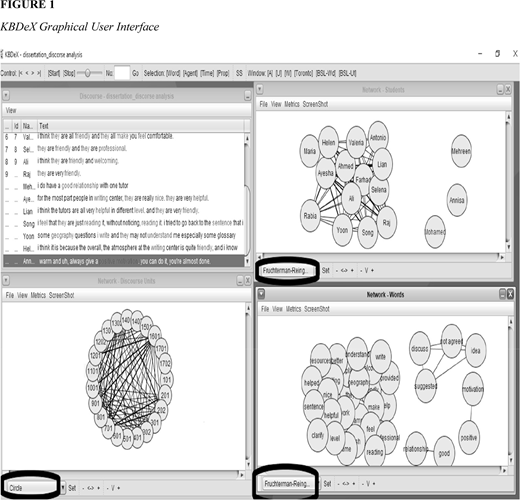
As seen in Figure 1, the main view of the KBDeX graphical user interface has four windows: (1) a discourse viewer showing the selected words marked in red on the screen (top left), (2) the network structure of learners (top right), (3) the network structure of discourse.
Units (bottom left), and (4) the network structure of selected words (bottom right). The circular layout algorithm was selected as a structure for the networks of discourse units (Figure 2) because this algorithm was set in the software by default. For the network of learners and words (see top right and bottom right windows of Figure 1), the Fruchterman-Rein- gold layout algorithm was selected to show learners’ network structure and illustrate the links between words. Steel rings represented pivotal nodes in this layout algorithm, and the edges were represented by springs. In this structure (see Figure 1), one can see that some learners were pulled together in the structure, while three learners (Annisa, Mehreen, and Mohamed) were pushed further apart from the main structure. Similarly, the phrases/words of these three learners were pushed far from the main structure of the network (see Figure 1). To clearly see which words/phrases those students used, two other windows on the screen were closed, and the structures of a network of learners (students) and network of words were enlarged (Figures 2 and 3).
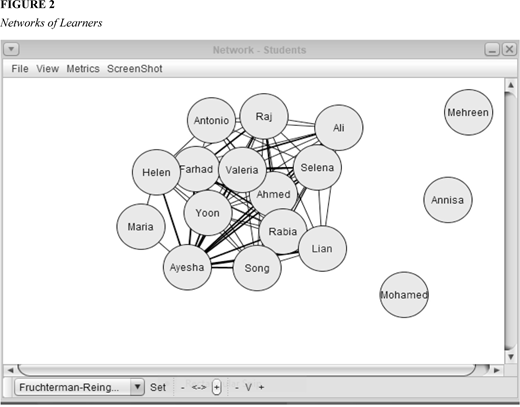
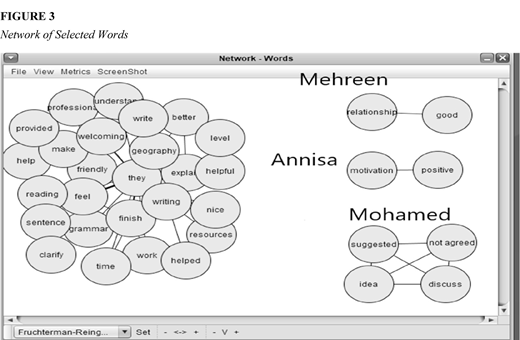
By visually and interactively exploring these two types of networks, one can see the relationships among students from very specific angles. For instance, by looking at the student network, one can easily see which students were using terms or phrases like other students and which ones were more isolated in conversation content. The codes connected in the primary structure yielded significant insights into the discourse content by checking the network of tracked words. To be more specific, the identified words and phrases demonstrated the scaffolded feedback concepts in a proximal development zone. For example, almost all students used words such as suggested, recommended, provided, and discussed, all of which attest that students perceived their interactions with their tutors as knowledge-building processes. Moreover, although two out of the three students who were pushed out of the main structure (see Figure 3) had made positive comments about their interactions with tutors, their reflections were analyzed differently by the software and, therefore, were isolated from the structure. The third student’s (Mohamed) network had its own structure within the platform because he said somewhat negative comments on the academic discourse between him and the tutor; therefore, the structure related to him was pushed even further (see Figure 3).
In summary, this analysis helped me see how students described the construction of knowledge through their interactions with their tutors during sessions. Students exchanged their ideas through collaborative processes by engaging in a knowledge-building discourse.
DISCUSSION
In this study, qualitative data was analyzed through KBDeX. The finding yielded through structures built by the KBDeX platform helped evaluate students’ knowledge-building discourse, providing visualizations of the characteristics of interaction levels between keywords within discourses (Oshima et al., 2012). The constructivist lens was beneficial in focusing on how students constructed knowledge out of their interactions with their tutors during tutoring sessions. The findings attest that the constructivist learning models can explain how students construct knowledge through their interactions with tutors. To be more specific, the ZPD concept was represented through the discourse about tutors as experts to assist novice learners in developing knowledge about writing, supporting previous research (e.g., De Guerrero & Villamil, 2000; Mazen, 2018). Based on the present research findings, it is recommended to conduct studies that involve analysis of discourse analytic tools in-depth because they help detect the critical elements of the knowledge-building process through interactions in a collaborative learning environment.

