


Organic Architecture
In architecture, “organic” refers to a philosophical approach that promotes structures for living that are harmonious to the external environment with an emphasis on spontaneity (Satler, 1999). The goal of organic architecture, according to architect Frank Lloyd Wright, was to “create a building that did more than enclose or close off possibilities.” As Satler (1999) has noted, Wright “hoped to create works that sheltered but also encouraged movement, beyond what apparently existed” (p. 54). Wright’s works were based on the destruction of the “box” that separated the individual from the world. Organic buildings attempted to create a harmonious and seamless environment where people were protected yet not isolated from life outside the walls. By moving people from structures that created a sense of isolation to structures that blended into the environment, a different type of relationship could develop between an individual and the larger whole. No longer would an individual (structure) remain in the background (subordinate to a larger whole)” (Satler, 1999 p. 54). Referring to Wright, Satler wrote, “Psychologically, this paved the way towards a view of architecture, and more fundamentally, a view of interaction, that respected and responded to both individual and collective needs (p. 52).”
This article suggests that instructional designers should consider Wright’s organic philosophy as they design and build asynchronous distributed learning environments so that a more natural learning space is created that fosters knowledge-building. In designing such environments, the goal is to foster the building of knowledge by removing the barriers that separate people from their environment. Traditional instruction, much like traditional architecture, imposes a structure on its environment. While some may argue this is necessary to control the learning process, it has resulted in obstacles that close the individual off from its human nature to learn. Constructivists assert that while most traditional instruction does well to control and manage the educational experience, it does little to maximize, and may even inhibit, natural human learning abilities (Marshall, 1997). Learners need an environment that promotes the types of transformative or generative processes needed to handle ill-structured situations, including thinking, creativity, collaboration, dialogue, and argumentation directed at solving those problems and providing continuous learning (Preskill & Torres, 2000).
Too often, traditional instruction and virtual classroom forms of distance learning do much the same: create barriers to the individual’s natural learning inclinations. What is needed are models, which like Wright’s architectural designs, that break from tradition to work with, rather than against, the natural learning instincts and abilities of human beings. One potential conceptual model is organic knowledge-building. This model leverages the technological capacity of asynchronous distributed learning (ADL) by potentially creating environments that allow for instructional models that are impractical or inefficient in a traditional classroom.
Defining Organic Knowledgebuilding
This article argues that learning environments should be designed and constructed using an organic approach, so that learning is not viewed as a distinct human activity but incorporated into everyday performance. Learning environments developed from an organic perspective help individuals construct knowledge by making available to them a wide variety of resources, experiences, and interactions to explore. As such, to make knowledge-building organic, learning is defined as a constant dynamic and purposive process in which cognitive capabilities are used to create new knowledge, as applications or solutions to problems, by first reexamining current knowledge in terms of a deeper understanding of the complexity of the information; second, by identifying novel relationships between previously-believed distinct knowledge; and, finally, by identifying unknown but required new information. Note, knowledge and information are not interchangeable terms. Information refers to facts, concepts, rules, etc., that are somewhat objective and easily transferable. Information becomes knowledge when an individual takes ownership and makes it meaningful by applying or using the information in conjunction with other established knowledge.
Organic Learning Environments
To support the previously mentioned definition, organic knowledge-building substitutes a highly asynchronous, learner-centered, technology-rich, competency-based environment for a bureaucratic or highly structured classroom model. This conceptual learning model strives to place the learner within a “space” in which learning, context, and application can co-exist (Barab & Duffy, 2000). Land and Hannafin (2000) suggest that such spaces are more learner-centered than traditional computer-based instruction. Computer or webbased ADLs can provide such spaces since they have mechanisms for easing and thus increasing the communication among learners, including reconceptualizing learning from one-shot fixed term to an on-going process that is intermingled with the actual work processes.
Learning occurs naturally and embodies many forms, sometimes taking place subconsciously and serendipitously, while at other times planned and deliberate. We can learn from reading a newspaper, speaking to a colleague, experiencing something new, or even by overhearing a conversation on the bus. At work or everyday life, individuals leverage a wide variety of resources and experiences to learn, outside the boundaries of formal education or training, about the things that matter to them. They commonly experiment with ideas, share their own knowledge with others, collect feedback, and assimilate or reject the knowledge of others. Similarly, learning environments developed from an organic perspective help individuals construct knowledge by making available to them a wide variety of resources, experiences, and interactions to explore.
In recommending an organic philosophical approach, we are promoting the concept that instruction should adapt to how people naturally learn, with the individual, rather than the group, at the center. Taking the organic concept further, we support a situated cognitive approach and argue that learning is not isolated from doing and that instruction should serve to encourage exploration, experimentation, communication, and growth. Proponents of situated cognition argue that learning takes place during the individual’s struggle to solve a contextually meaningful problem (Brown, Collins, & Duguid, 1996; Lave & Wenger, 1991). We are also mindful that social constructivists, on the other hand, suggest that learning takes place in the process of communicating ideas and negotiating group meaning (Jonassen, 1999; Scardamalia & Bereiter, 1993).
To the question of whether learning takes place individually or in groups, the Organic Knowledge-Building model answers “yes.” We believe that learning takes place within the individual as he or she engages in a process of solving meaningful problems and is further encouraged and supported by the group as it moves closer to a shared meaning (Brown, 2000). This edges close to what Torraco (1999) describes as skill. “Skill is not defined exclusively in terms of human capabilities; it retains features of both the performer and the work environment in which it is expressed” (p. 256). However, Torraco (1999) also states that “Skilled performance in many work environments is a function of expertise that is distributed among group members. …and that learning is a group activity” (p. 254). Clearly, the individual who is allowed to develop to the maximum extent is a greater contributor to a larger collective learning which in turn nurtures the individual.
Components of the Organic Knowledge-Building Model
In organic knowledge-building, an instructional environment is created that utilizes the naturalistic, spontaneous, and regenerative nature of humans as it relates to learning. Although this is not a new concept, per se, we believe this model describes a design structure that can aid implementation.
There are four components in an organic knowledge-building environment: information objects, scaffolds, discourse action communities, and facilitation. The components are neither sequential nor discrete; their relationship can be characterized as inter-related, dynamic, idiosyncratic, often overlapping. In short, what makes the instruction organic is not any particular component, but rather the idea that these components are used in concert with the individual’s context to create a rich and open environment that is alive with opportunities for exploration and meaning-making. Furthermore, this model is not bound by traditional theoretical constraints but adheres to a pragmatic orientation that suggests incorporating any “tool” or idea that helps the learner to accomplish the goal.
Figure 1 depicts the major characteristics of the organic knowledge-building model. The individual is central to the process and, simultaneously, both a learner and practitioner. The learner is driven by a meaningful problem within a workplace or other real-life context. The learning environment is what we traditionally think of as the conceptual boundaries of a course, curriculum, training program, etc. Note that the boundaries within this model are not solid. In an organic learning environment, there should indeed be significant overlap between the learning environment, context, problem, and learner. In organic architecture, structures are designed to blend in with the natural setting, blurring the lines between the home and its natural surroundings. Similarly, organic learning environments blur the distinction between the individual as a learner and the individual as a practitioner; between the learning context (e.g., the classroom) and the performance context (e.g., the workplace).
Another aspect of this model is the availability of resources that encourage and support the individual in exploring, experimenting, and knowledge-building. There are four general categories of resources: information objects (IOs), scaffolds, discourse action communities (DACs), and facilitation. Information objects are essentially building blocks of content. They can stand alone or they can be strung together to form larger molecules. In a traditional sense, IOs replace the lectures, handouts, and slides given to students; they are basically, the declarative (what) and procedural (how) knowledge components of instruction. Within an organic learning environment, individuals have access to a wide variety of IOs, representing not only the scope of one expert’s knowledge and experience, but also the entire available breadth and depth of multiple knowledge domains. Discourse action communities do not differentiate between learning communities or communities of practice. Learners, in their quest, communicate with other learners and practitioners sharing their experiences as well as the information objects they have encountered during their exploration. These interactions in turn lead to the discovery of other information objects within the learning environment as well as outside of the learning environment. From this ongoing exploration and discourse, the individuals form ideas, what we may call hypotheses, regarding the ill-structured problems they are trying to solve. Scaffolds, some in the form of simulators, enable the learners to experiment with their ideas within a safe environment that is closely related to their context. These experimental or virtual workspaces allow us to eliminate the traditional concept of practice. Other types of scaffolds include subject-matter experts, exemplars/non-exemplars, cases, and job aids. Together, scaffolds, information objects, and discourse action communities create a rich environment in which the learner/practitioner can explore, interact, and construct meaning. In fact, this environment is so rich and the possible paths through it so limitless that learners/practitioners may be overwhelmed by the possibilities. For this reason, facilitation is critical within an organic learning environment and should be the instructor’s primary role in the learning process.
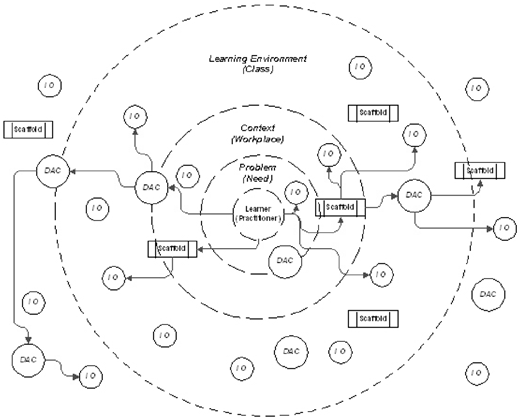
Visual Depiction of the Organic Knowledge-Building Model
Visual Depiction of the Organic Knowledge-Building Model
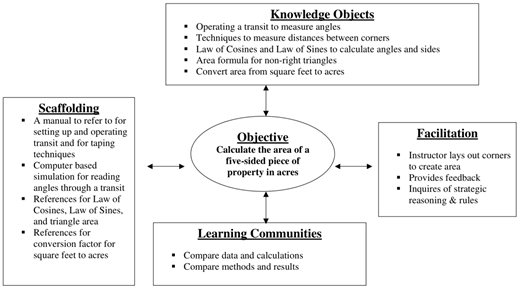
Information Objects
Information objects utilize web or computerbased tutorials or information packets to convey topics or small modules of the key portions of the content. Rather than a regularly scheduled and managed class of determined hours where learners accumulate information to be used or examined at a later time, learners directly engage the declarative and procedural knowledge in smaller chunks at a time and place the learner(s) recognize it as needed information, which in itself is a learning activity.
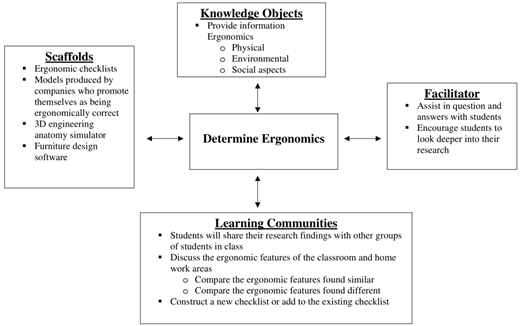
Information objects, or “molecules” of information, are identified and categorized, placed in a system where the information can be quickly extrapolated and applied within a new frame of reference. When placed into a generic categorized framework, learners may access these objects by using key words to retrieve the pertinent information. Picture these “info nuggets” as pamphlets or chunks of information that contain specific components of a complete procedure or process. Learners access only the “info nugget” they need to review, rather than spending the time reviewing the full procedure.
For example, if someone wanted to learn how to change an oil filter, he or she could access the information object base for that particular chunk of information and it might show a short video demonstrating the procedure, step-by-step. But, if the objective were, instead, to understand car systems and the rules associated with them, the learner would need more structure, organization, and content. The chunks of information gathered would be more detailed. However, when the learner reached the part about learning to change the oil filter, the same video clip would be part of the program (Gordon, 1997).
Using information objects supports an organic knowledge-building environment by requiring the learner to navigate the learning process through drawing on previously formed schemata, incorporating new information into them as needed to solve a given problem or enhance dialogue within their communities.
The learning object format is supported by the belief that instructional designers can create independent chunks of learning content that provide a learning experience for pedagogical purposes. The chunks are self-contained, though they also may contain references to other objects; they may be combined or sequenced to form longer learning interactions (Quinn, 2000).
This supports meaningful and useful learning by allowing the learners to actively create meaning by exploring, experimenting, testing, and applying knowledge in self-directed and collaborative ways, rather than following a predetermined format. A problem is presented to learners and they are given tools, such as case studies, information resources, or collaboration tools, with which to manipulate the information. The learner then approaches the problem at his or her own pace and from his or her chosen direction, attempting to solve the problem with the tools given (Jonassen, 1999).
The use of information objects allows the learner to explore the content in unconventional ways, following a unique path to discovering the targeted learning objective. In this particular application, context is not just provided to the learner, but rather provides cues to the learner so that he or she may explore the content in linked contexts and draw individual conclusions and meanings. The use of the Web to explore the content can be enhanced by the use of knowledge object databases to focus the search more directly, using the terminology and clues that the learner uncovers during the search process.
Developing the information objects involves choosing keywords for easy and broad retrieval, and the avoidance of an editorial voice in the information packets, which might include introductions or conclusions about the content. Additionally, they should be freestanding or modular, non-sequential, and able to satisfy a single learning object. To assist in that process, the system should use “context wrappers.” Context wrappers consist of information that is associated with a learning object. One object may have multiple wrappers, providing different ways to contextualize it. In this way, the keywords would allow multiple uses and frameworks to capture the same information nuggets.
Algorithms can be used to guide the manipulation of knowledge objects into different categories and permutations, somewhat like a formula manipulates numbers in different sequences to arrive at different answers. Merrill’s theory supports our knowledge-building approach by allowing the learner to control the path for his or her own learning, through choices in the program (Merrill, 1999).
The advantages of using knowledge objects as a tool for creating just-in-time training are numerous, but the need for a consistent and regulated information structure is necessary before this approach can be used globally. Gordon (1997) quotes Matlack, senior developer for Multimedia Pathways, Inc., regarding one of the concerns about chunking bits of information:
Taking pieces of information, bit-by-bit, and pasting it together is not what training is all about. Training is about taking raw information, integrating it, and helping you develop a mental model of it. In the end, you should be synthesizing all this information and coming out with a transfer of know-how rather than a transfer of facts. (p. 32)
Scaffolding
Technology-based scaffolding involves helping learners by providing support for performance when they encounter a task or concept they have yet to perform (Jonassen, 1996). In this manner, learners are able to find help when they encounter something for the first time. This approach allows learners to ask questions, see examples or models of the process, or get expert advice on what to do next. As with other parts of our model, learners could use these tools while they are performing a new task.
An excellent example of the power of this type of computer-based scaffolding can be seen in several products developed by Schank (Schank & Cleary, 1995). Schank has developed a number of systems he dubs “ASK” systems. These ASK systems allow learners to ask questions using the program and have their questions answered in the form of video clips of experts in the field speaking about the topic at hand. For example, one such system is TransASK, developed for use by the United States military in training officers in materials management during a military crisis (Schank & Cleary, 1995). In TransASK, a trainee can input questions as he or she works through either a training scenario or an actual crisis, and the system will provide a video clip from among a database of clips containing 25 experienced officers telling their stories of how they handled a similar situation. While ASK systems are highly advanced CBT programs, even simple tutorials could provide the information and modeling a learner needs, at the time when the learner/practitioner needs to perform a specific skill. Furthermore, learning new things at the time they are needed helps learners make the knowledge more meaningful and stable in the learner’s cognitive processes. This also allows for the learning process to continue unabated.
Scaffolding also should incorporate the use of virtual workspaces and simulators. Unlike a predetermined scenario, as typically found in simulations, this virtual laboratory would allow the learners to practice, experiment, or test various hypotheses, actions, and models in relative safety while still maintaining the realistic outcomes necessary in evaluating and revising knowledge. Examples of these types of scaffolding tools range from the Electronic Workbench designed to allow budding chemists to try out electronic circuits (Sadik & Cheung, 2001) to a multimedia simulation of an actual work environment (Montgomery, Campbell, & Moffett, 1994).
For example, the multimedia simulation is a goal based scenario (GBS) system, a term conceived by Schank (Schank & Cleary, 1995) and similar to the previously described ASK systems. GBS systems allow learners to simulate the work environment and receive immediate feedback on their performance. Successful implementations of these GBS systems can allow for scaffolding strategies such as coaching and feedback to be used within a simulated environment (Acovelli & Gamble, 1997).
Discourse Action Communities
One of the key principles of organic environments is that the learner should neither be isolated from nor become subsumed by the larger group. In an asynchronous organic community, a group of people are electronically linked for the purpose of learning specific materials through collaboration via computer-mediated communication (CMC). These groups of learners are typically comprised of computer-literate adults who are seeking to gain knowledge in a particular area of interest and are highly motivated to participate in all the learning requirements (Downs & Moller, 1999; Garrison 1989; Moore & Kearsley 1996).
Viewing learning as primarily a knowledge-building process requires the learner to be actively engaged in cognitive manipulation of the instructional content or information. As Moore and Kearsley (1996) point out, “learner to learner interaction is desirable for pedagogical reasons” (p. 153). Gay and Lentini (1995) confirm this assumption by writing “ learning is fundamentally built up through conversations between persons or groups, involving the creation and interpretation of communication” (p. 2). Furthermore, they argue, “conversations are the means by which people collaboratively construct beliefs and meanings as well as state their differences” (p. 2). Thus, we are more able to enlarge our own beliefs and more likely to take risks when supported by a community of other learners (Grabinger, 1996).
In other words, an organic knowledgebuilding community is designed to facilitate learner-centered communication and increase peer interaction by first engaging the learner in tasks that require high-level thinking and reflection. These higher-order cognitive processes are prompted through the use of communication for collaborative idea generation, critical analysis, and argument construction. This organic knowledge-building discourse and action community provides the necessary intellectual and emotional support to the learner for growth of intellectual risk-taking behaviors.
Online learning is potentially a powerful tool when a community encourages learners to deeper cognitive experiences through: collaboration, debate/argument, and conflict/resolution. Collaboration is the most noted of these interactions. In 1988, Douglas Englebart at the Augmented Human Intellect Research Center of Stanford Research Institute developed Augment . This online learning system provides tools, like chat rooms, to support collaborative knowledge work and places “the greatest emphasis on collaboration among people doing their work in an asynchronous, geographically distributed manner” (Palloff & Pratt, 1999, p. 245). Traditional distance learning models emphasize the independence of the learner (Downs & Moller, 1999; Moore, 1986) and the privatization of learning (Keegan, 1996). Organic learning, on the other hand, is distinguished by the social nature of the learning environment that is created through community and collaborative learning (Harasim, 1990). The process of collaborating through learning communities increases engagement in the learning process. When promoted, “collaborative work forms the basis for the student’s ability to engage in a transformative learning process” (Palloff & Pratt, 1999, p. 127). These transformative learning processes should include online conflicts among participants.
Controversy and conflict within a group can lead members to question their own concepts as well as seek new information and perspectives (Harasim, 1990). Conflict can facilitate learning and personal growth when it is used with the goal of reaching a deeper level of understanding (Palloff & Pratt, 1999). Additionally, Johnson and Johnson (1979) propose that conceptual conflict resolution has cognitive benefits: “Students who experience conceptual conflict resulting from controversy are better able to generalize the principles they learn to a wider variety of situations than are students who do not experience such conceptual conflict” (p. 67).
One of the concerns about conflict and resolving conflict in online learning is that, without the physical and verbal cues of face-to-face contact, many people feel less socially constrained when debating an argument. When communicating face-to-face, conflicts are resolved with what we consider to be socially appropriate behavior. (Palloff & Pratt, 1999). With a defined norm for how to deal with online conflict, a deeper and meaningful type of learning can take place (Harasim, 1990; Moller, Harvey, Downs, & Godshalk, 2000). Considering the many ways in which the Internet and online learning touch people’s lives, these issues deserve further discussion.
Given that communities are formed around issues of identity and shared values rather than the traditional place- and time-based development of community, online learning provides a platform for a new, redefined sense of community (Palloff, 1996). An organic knowledgebuilding community, via online learning, facilitates learner-centered communication and increases peer interaction by first engaging the learner in a manner that is more active than is likely to be found in traditional learning; promotes an opportunity for meaningful learning that requires and allows for thinking and reflection; increases cognitive development through argument construction, communication of those ideas, and critical analysis of new ideas; expands the range of ideas and capitalizes on the possibilities of brainstorming or collaborative idea generation; and provides emotional support for growth or intellectual risk-taking behaviors.
Community begins to shape as the learners communicate, negotiate, and work with one another toward a common goal. In a traditional classroom, this sense of working toward a common goal and building a sense of community identity often does not occur. Bielaczyc and Collins (1998) support learning communities by stating that
… in learning communities, both the content learned and the processes of learning from outside resources are shared more among members of the community and become part of the collective understanding. A further distinction between learning communities and most classrooms is that in learning communities, both the members themselves and the collective knowledge and skills of the community are viewed as important resources (p. 4).
One significant implication of the organic knowledge-building model is that individuals will bring their challenges, experiences, and ideas, which can be the product of individual problem-centered learning activities, to a discourse and action community and then extract ideas from their discussions (and vice versa). These ideas can be used back in their workspaces and/or discussed in other learning communities. This is a natural process that people use already when they transfer knowledge to and from workplace settings, school, hobbies, and other so-called compartments of their lives. In fact, compartmentalizing one’s knowledge or avoiding discussion of ideas about which one is passionate is an unnatural and self-defeating enterprise. Knowledge is not something that grows by hoarding; rather, it can flourish only in environments that enable and encourage movement of ideas. This concept is the essence of organic architecture and is at the heart of the organic knowledge-building model.
Facilitation
Given its dynamic nature, a learning environment without a facilitator is little more than a rudderless ship adrift on an ever-expanding sea of information. To support the achievement orientation of organic knowledge-building, five roles associated with facilitators have been identified (Prestera & Moller, 2001). These are the facilitator as a guide, mentor, catalyst, coach, assessment-giver, and resource-provider. Each of these roles is a form of feedback that the facilitator provides in the context of an organic knowledge-building environment.
As guides, facilitators help individuals form strategies for navigating the rich, and sometimes complex, learning environment. After all, individuals who are new to asynchronous learning environments are on multiple learning curves as they acclimate to new technology, communication, socio-cultural, and learning process issues. As mentors, facilitators model the values of the learning community. As catalysts, facilitators challenge and stimulate individuals to explore and interact.
As coaches, facilitators provide formative feedback and encouragement. As assessmentgivers, facilitators create opportunities for individuals and groups to showcase their newfound skills and knowledge. Facilitators will also evaluate the individual less in terms of the substance of the individual’s output and more in terms of the individual’s learning process. Values often manifest themselves in evaluation rubrics. These rubrics can be written to focus on process skills as well as content skills. For example, a rubric might include an evaluation of the reflection, analysis, and collaboration activities in which the individual engaged. If one goal of education is to produce lifelong knowledge-builders, then learners must demonstrate the ability to process information and solve problems, not simply the ability to accumulate information.
As resource-providers, facilitators actively support learners by making available a wide range of information objects, scaffolds, and interaction opportunities. For example, it sometimes may be appropriate to capture the experiences of expert practitioners in a variety of situations and make them available as information objects in the form of video clips. Or, one could capture the reflections of one student who struggled through a learning process and make that available as a scaffold to help other learners who will go through a similar process. Similarly, a facilitator may find it valuable to connect learners with an online community of subject matter experts who work in a contextually relevant field. In fact, an important aspect of building a community should be building links with other communities. As Brown and Duguid (2000) point out, “Isolated communities can get stuck in ruts, turning core competencies into core rigidities” (p. 6).
Facilitation plays a vital role within the organic knowledge-building model. While information objects, scaffolds, and discourse action communities give substance to the learning environment, facilitation gives it shape and form. Without facilitation, a learning community is merely the architectural equivalent of a pile of bricks.
Conclusion
Technology breakthroughs have always held the potential to improve life. However, it is only as we truly seek to understand the vast realm of possibilities available in these breakthroughs, and as we have the courage and inventiveness to utilize that technology in creative, heretofore unexplored, perhaps controversial but always challenging ways, that we can even begin to realize technology’s potential to improve the quality of learning and life. Simply recreating the present in a more efficient manner seems wasteful, especially when the status quo is so ineffective. By itself, technology in learning is a benign force. However, when tools and learning strategies are combined and constructed in ways that expand our potential to learn, we give meaning to that technology.
Accessibility to technology is only half the equation. Technology has great abilities to carry and present information; however, learning is more than receiving and storing information. Information only becomes knowledge when people convert it through application. Human beings are social creatures who traditionally encourage, communicate, and share amongst themselves.

