


Employing best practices for teaching mathematics like math manipulatives, children's literature picture books, and GeoGebra can all be connected and better help to prepare students for a STEM world to develop confident young individuals in doing mathematics in a world of AI, distance learning, and online with emerg ing technologies. This paper will highlight all the above best practices and share how they can be connected and taught to make math meaningful and help learners be confident with technology and mathematics in a way that helps them see math in a hands-on, visual, and abstract way. Students can digitally engage with GeoGebra, Virtual and actual math manipulatives, and children's math literature/picture books. This paper will give a synopsis of the theory of these best practices, discuss manipulatives, the use of GeoGebra software in learning mathematics, and show the connections between picture books and everyday life math skills. Using such best practices in mathematics aims to develop confident young learners for a STEM and AI world where so much of the technology now focuses on AI and emerging techno
INTRODUCTION
I never teach my pupils, I only provide the conditions in which they can learn.
—Albert Einstein
Math is stimulating, challenging, enjoyable, simple, effective, and expansive, and the more we can use hands-on tools to show this to kids, the more we can share this love of the mathematical universe with them.
—Esther White
Apprehension with mathematics is an actual phenomenon, and many young learners are confronted with this when learning math at various grade levels, from kindergarten through college today. Many people often go through such math anxiety throughout their whole lives, and it can often affect decisions in life as well as the career selections one will make. It is imperative that all people feel confident in their ability to do math in an era that depends so profoundly on STEM areas and problem-solving. A school really must see that their students value and feel confident in their ability to do math and use technology to learn because, ultimately, all choices individuals make and choices of careers may be resolute in part by their dispositions toward mathematics. Math anxiety is a real phenomenon that has been researched for many years now (Alday & Panaligan, 2013; Beilock & Willingham, 2014; Boaler, 2008; Quander, 2013; Richardson & Suinn, 1972; Scieszka & Smith, 1995; Williams, 1988). Mathematics educators must take it seriously and use research to address the problem in an age of STEM. Resources and websites for addressing math anxiety, improving attitudes, and incorporating technology like GeoGebra, math manipulatives, photography, and children's literature books will be shared and included in the paper. Today, it is critical that we help create mathematically confident young people in the STEM/AI world in which we now live.
Anxiety with Math is a Real Phenomenon, and Many People Suffer from It
Apprehension of math continues to devastate our society and distress our young people's success and achievement within this subject area of mathematics (Finlayson, 2014; Quander, 2013). Quander (2013) found that elementary teachers need to help make students be lifetime learners and advance a productive mathematical temperament to prepare them for advanced schooling and eventual careers, many of which may be STEM-related. Math anxiety can impede mathematical performance, interest, career choice, and many decisions in life. The awareness as educators to exam math anxiety levels, enthusiasm to learn mathematics, and using advanced technologies like GeoGebra to instruct and motivate learners is critical today in a global society of STEM and also can impact achievement areas of learners (Furner, 2019, 2022; Gonzalez-De-Hass et al., 2017 and 2023; Furner & Marinas, 2016; Furner & Marinas, 2020).
Many educational organizations like the National Council of Teachers of Mathematics (NCTM, 1989) believe that mathematics teachers need to assess students' mathematical disposition regularly regarding:
Checking for confidence in using math to solve math problems, communicate thoughts, and reason.
Being adaptable in exploring mathematical concepts and employing various approaches when solving problems.
Preparedness to persist in mathematical problems.
Interests, inquisitiveness, and ingenuity in doing math.
Students can reflect and monitor their thinking and performance while doing math.
Value and appreciate math for its real-life application, connections to other subjects and norms, and as an instrument and idiom.
Young learners often say: “I like the math class because of the teacher” since the math teacher knows how to present developmentally the subject matter, creates a learning atmosphere advantageous to learning with empathy, has high expectations for all students without regard to gender, race, or language barriers, and uses a variety of assessment methods and teaching styles to reach all students better to address math anxiety and better ways to teach and reach students (Chernoff & Stone, 2014; Dowker et al., 2016; Schoenfeld, 2022).
Today, it is critical to know that there are two distinctions to math anxiety handling: prevention and reduction, and there are distinct strategies and methods to address each in different ways. Furner (1996) synthesized three steps to prevent math anxiety: (a) Engaging in using Best Practices in teaching math like using math manipulatives, cooperative learning, dialogue of math, enquiring and conjecturing, justifying one's thinking, math journaling, using a problem-solving approach to teaching, interdisciplinary instruction of content, emerging technology, assessment as an integral part of instruction, etc.; (b) Incorporating the NCTM and State/Common Core Math Standards into the curriculum and instruction and discussing feelings, attitudes, and appreciation of mathematics with students.
Research by Furner (1996) also found that there are three approaches to reducing/lower- ing math anxiety: (a) Psychological procedures such as math anxiety management, desensitization, therapy, group support, bibliotherapy, and deliberations/conversations about experiences; (b) As a math-anxious learner feels less fear and dread toward math, he/she might build self-confidence by taking more math classes and exposure to higher-level math concepts; and (c) Most research on math anxiety reduction has shown that until a person with math anxiety has confronted this math anxiety by some form of discussion/counseling, no best practices for teaching mathematics will help to overcome this fear of the subject.
Math teachers during the school year while teaching mathematics should use some advantageous instructional methods which are advocated now for teaching mathematics using the Concrete-Representational-Abstract (CRA) Model teaching mathematics as follows: First, educators need to start with the Concrete using hands-on manipulatives like Geoboards; then secondly, they must move to Representational models in diagrams (or use Virtual Manipula- tives like NLVM at: http://nlvm.usu.edu/), and lastly, connect to the Abstract symbolism where student understand and function at an abstract level completely (GeoGebra software works well at: http://www.geogebra.org/cms/en/). The CRA Model is the basis for the best practices pedagogy for teaching mathematics, starting with young people, but it should also be used at all levels of math instruction. See Figure 1.
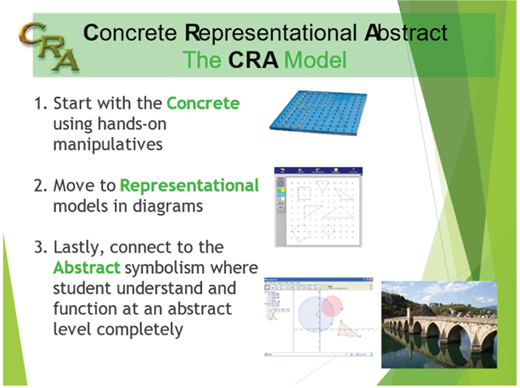
The book author Jones (2012) found, as discussed in her book Visualizing Mathematics, that it is essential that math teachers help students envision and create images of their mathematics comprehension so young people view math everywhere and as a large part of their being. In their research, Beilock and Willingham (2014) found that math teachers can help address and reduce math anxiety. The author believes that by using technology like GeoGebra, photography, and children's books, teachers can make better connections, and students will be more highly motivated to learn math (Furner & Marinas, 2014; Marinas et al., 2016)
Defining Math Anxiety in a STEM/AI World
Mathematics anxiety can be defined as a dread of math that interferes with working with numbers and solving math problems or daily life experiences that involve numbers or mathematics. The NCTM recognizes math anxiety as a problem and specifically includes it in its assessment practices. Standard #10 from the NCTM prompts teachers to assess their students' mathematical dispositions, for example, self-confidence in employing math to solve word problems, communicate concepts, and reason mathematically.
Math anxiety is often caused by an amalgamation of internal and external influences; nevertheless, educators cannot modify internal factors within the learner, so as teachers, it makes sense to concentrate on what teachers can control (Chernoff & Stone, 2014). Math anxiety has been researched for almost 50 years and is a universal phenomenon. Unfortunately, not enough is being done today in schools to address how we approach teaching mathematics (Beilock & Willingham, 2014; Dowker et al., 2016; Geist, 2010). Poor dispositions toward math and carrying math anxiety around with you in life are grave impediments for students at all levels of schooling nowadays (Geist, 2010). Beilock and Willingham (2014) summarized: “Because math anxiety is widespread and tied to poor math skills, we must understand what we can do to alleviate it” (p. 29).
Poor teaching approaches are not the only cause of math anxiety. Because math anxiety can be seen in daily living activities and inclass work or assignments, the need to have a multi-pronged approach is crucial to addressing it. Applying anxiety-reducing techniques in a multitude of activities and recurrently through instructional activities aids to address a variety of learner needs. This is like applying different management and organizational skills suited to the situation. Research from Skagerlund et al. (2019) discovered that math anxiety can weaken math ability; they propose that learners need to acquire approaches to bring about this so that it does not affect their working memory and number processing when doing math.
Using different approaches before teaching a math activity allows the teacher to set a more focused and less anxious tone for math learning using a variety of approaches to teaching. Employing procedures that lower anxiety and provide support just before the math activity and during the activity helps signal the anxious learner to a more positive approach to math schoolwork and the subject.
Stopping Math Anxiety in Students
Today, there are several approaches schools can follow to help thwart math apprehension. In cooperation, educators and parents play an essential part in nurturing positive attitudes toward mathematics. In many intervention programs, early intervention and action aid to foster positive mathematics dispositions. Today, the math education field has pushed to increase and reassure math literacy in schools. Laterally, that drive has established valuable resources to boost math capability. Research by Mammarella et al. (2018) shows how important it is for instructors to detach math from anxiety levels. Their investigational results showed that children with severe math anxiety, nonetheless through no changing dyscalculia, were explicitly impaired in the hands-on interference task, while learners with developing dyscalcu- lia (with or deprived of mathematics anxiety) botched in the working remembrance duties. The above research findings contend how critical it is to distinguish between the cognitive processes underlying the profiles of a child, which can have factors as teachers report preventative and lessening strategies as it correlates to math anxiety levels. A successful program established by the Southeastern Consortium for Minorities in Engineering (SECME) is in schools today for high minority populations to stimulate and grow students interested in math, science, and engineering fields. SECME was initially an acronym for the Southeastern Consortium for Minorities in Engineering. The organization is based in Atlanta, Georgia, at the Georgia Institute of Technology.
SECME is a deliberate coalition to recommence and fortify the professional expertise of K-12 educators, to motivate and counsel students, and to invest in parents so that all their children can learn and achieve at higher echelons. (SECME, n.d.) Many teachers find this program helpful in turning young people onto math and motivating them to like the subject more. The grades K-8 school years are critical to instilling confidence and powerful attitudes toward math in young people. Deterrence of math anxiety in students is about instructor planning and employing the best possible teaching strategies in mathematics instruction (dos Santos Carmo et al. (2019). The way math anxiety is fixed in our schools, to put it simply, is better teaching to reach all students. Research by Finlayson contends using a constructivist style of instruction that emphasizes the following practices:
Using whole group instruction first, then
Quest for student queries and interests.
Key resources should be manipulative materials.
Learning should be interactive, constructing and building on what learners already know.
Instructor interacts/negotiates with students.
Evaluating students through observations, interviews, tests, etc. The process is as critical as the result.
Knowledge is dynamic/change with experiences.
Students work in groups (Finlayson, 2014)
Lessening/Overcoming Math Anxiety and Building Confidence is Key
Math anxiety reduction is much different from the prevention of such anxiety. While every educator would like to prevent a student from experiencing math anxiety, some come to school afraid and worried about learning math.
Many math educators contend that a person who suffers from math anxiety needs to first lay the groundwork by coming to terms with their feelings, challenge their present views, and comprehend they are not unaccompanied; secondly, a person has to change their views and negative thought and use intervention approaches to progress one is discerning that they may be efficacious with math; thirdly, a person needs to know themself, it is critical that a person knows his/her learning style/approach and that he/she apply such methods to doing math by successful people. Lastly, when students have increased confidence and approaches to undertaking math, they must apply what they learned and how they do the mathematics. Additionally, the problem for those who suffer from math anxiety is the condition of anxiety itself. Research by Rubinstein et al. (2015) found that apprehensive learners often focus on negative impetuses more than positive stimuli, making themselves more uneasy.
The equivalent is true of individuals with math anxiety; the one difference is that for individuals with math anxiety, math is the negative stimulus (Rubinstein et al., 2015). From this, it is suggested that math anxiety may be remedied through treatments designed to lower anxiety, such as cognitive and social therapies and exposure therapy (by exposing someone incrementally to that which they are fearful, like doing math) (Rubinstein et al., 2015).
Educators need to realize that there are critical supportive techniques in a counseling setting when working with math anxiety. For example, some researchers (Ramirez et al., 2018) propose systematic desensitization as a practical approach to helping people reduce their math anxiety. Systematic desensitization in the framework of math anxiety can be a distinct and measured gradual exposure to math ideas that cause students to develop anxiety and teach learners how to manage such distress. When using systematic desensitization, a mutual practice in counseling today, learners understand that their math anxiety is a learned conditioned behavior they were not born with, and they can be trained to overcome it by constantly applying their self-monitoring strategies to become less math anxious. Some researchers advocate using relaxation with repeated positive messages and visualizations to reduce math anxiety.
Operating from the academic perspective, Zemelman et al. (2012) summarize many evidence-based practices for teaching math, which include:
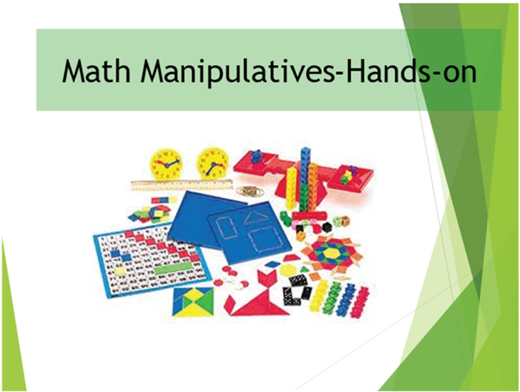
use of manipulatives (make learning math concrete) [See Figure 2],
use cooperative group work,
use discussion when teaching math,
make questioning and making conjectures a part of math,
use the justification of thinking,
use writing in math for thinking, feelings, and problem-solving,
using a problem-solving approach to instruction; making content integration a part of instruction,
using calculators, computers, and all technology,
being a facilitator of learning,
and assessing learning as a part of instruction.
Connecting Manipulatives to Picture Books and GeoGebra
I think that children's literature offers a wonderful vehicle for helping teachers teach math well.
—Marilyn Burns.
If you want your children to be intelligent, read them fairy tales. If you want them to be more intelligent, read them more fairy tales.
—Albert Einstein
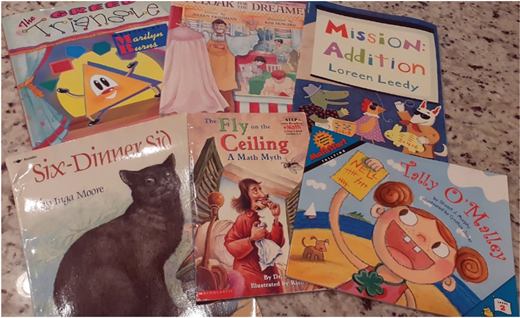
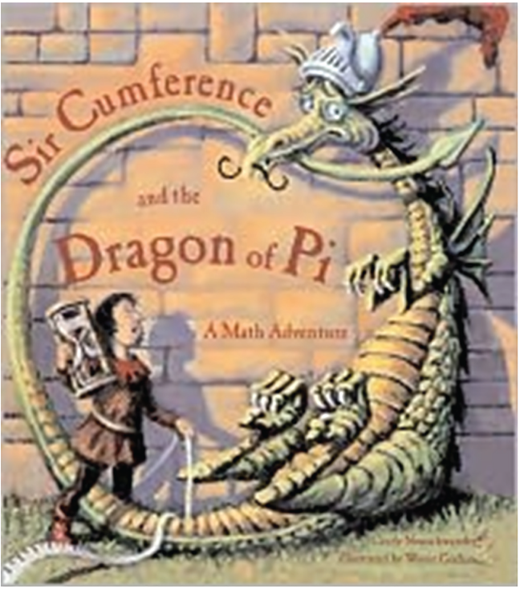
As stated above, it is essential that math teachers read children's books and fairy tales like Sir Cumference and the Dragon of Pi, a Math Adventure by Neuschwander (See Figure 3–Figure 4), the son whose name is Radius (his title is referred to but not labeled in math terms) protects his father Sir Cumference from dying after unintentionally turning him into a fire breathing dragon. A math formula/equation is the solution to the problem here in this book. Sir Cumference names Pi in this story. The story in the book tells how the math formula n was uncovered. The book offers a fictional story; nevertheless, the author's purpose is achieved when young people reading this book recall this math lesson and what Pi means.
Assisting Young People to Gain Math Confidence for a STEM World
We are living in an age of advancing technologies that are constantly changing. Today,many students learn math online or through distance learning using many digital means. We have online virtual math manipulatives for our learners. GeoGebra is free math software that all can use online to do math, draw, explore, and create so much in many meaningful ways. Even students can access YouTube and have children's picture books related to math learning read to them excitingly and animatedly. Young people must be literate and good at mathematics and problem-solving to compete in a global society.
A youngster's lack of confidence and ability to do mathematics may impact his/her entire life continually in all choices they decide on a regular basis and forthcoming vocational choices. Educators in an age of STEM should be prepared to reach all learners and develop their confidence and ability to do mathematics so they can compete globally.
Teachers today should check to see that all their students have positive attitudes and dispositions toward math (NCTM, 1989). It is essential to ensure our young learners are confident and well-equipped in math in a STEM world if they will vie for such high-tech jobs now and in the future. Today, the United States and other countries are working to lead more young people into the fields of Science, Technology, Engineering, and Mathematics (STEM) so that countries can better compete globally. Today, it is critical that teachers build math confidence in our students; educators need to address the matter of math anxiety directly as it manifests the issue as uncertainty or learned helplessness in observed math achievement. Many adults do not like mathematics. Sparks (2011) contends that as the STEM fields become more significant for our young people to study, our schools and teachers need to do more to address math anxiety levels in learners. Hence, our young people are confident in their ability to study fields associated with STEM areas.
Children's picture books like Math Curse by Scieszka and Smith address the issue of math anxiety. The book is an excellent resource for educators to help anxious learners realize that not all individuals feel self-confident in their capability to do mathematics. The book commences with the teacher, Mrs. Fibonacci, who tells her students that they can think of almost everything as a math problem. One student starts thinking and worrying and becomes overcome by the breath of math. His math anxiety becomes a real curse, hence the book's title, Math Curse.
Nevertheless, the character in the book ultimately comprehends that math is all around us and that there is no way of avoiding it in daily life; therefore, the math-anxious youngster recognizes math as a means of making one's life easier. Math Curse may be used as a form of bibliotherapy to prompt discussion on math anxiety and allow other students to discuss their feelings on the theme to compare to the character in the story. Isdell (2017) wrote another great book, A Gebra Named Al, about a young girl who struggles with her feelings toward math at the middle school level. This is also an excellent book to incorporate in a bibliotherapy lesson to address math anxiety with students. Hebert and Furner (1997) feel that teachers need to take the time in their math instruction to address such affective aspects of learning mathematics so that students can come to terms with their feelings toward mathematics. Sripatmi et al. (2023) conclude that using pictures/children's books and such media helps reach students better in mathematics teaching.
State Math Standards as They Relate to Using GeoGebra
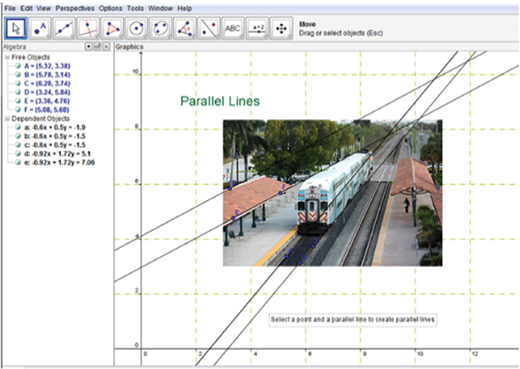
Most schools and states in the USA today are adhering to the new Common Core Math Standards (Council of Chief State School Officers and the National Governors Association Center for Best Practices (NGA Center), which can be found at: http://www.corestandards.org/ When math teachers relate real-world problems through the use of dynamic technology like GeoGebra and connecting them to photography to make significant correlations in mathematics, students can recognize that geometry/shapes and mathematics surround us. GeoGebra is an ideal piece of math software to teach many Common Core or State Standards today. Furner and Marinas (2016) offer many premade GeoGebra activities that match the Common Core Math Standards and with many more resources at www.matharoundus.com. There are also many GeoGebra resources for teachers at geogebra.org. GeoGebra is excellent software that can even involve programming, and as a computer technology like gaming, it can be a powerful aid to motivate learners.
Technological tools used as part of instruction are critical in today's world of STEM. Young people need to learn to succeed in math at much higher levels of generality, represent and solve multifaceted problems, and emphasize decision-making and reasoning more (National Council of Teachers of Mathematics. NCTM believes that mathematical power can arise from technology, which includes increased opportunities for learning, opportunities for real-life social contexts, and orientation to the future; this also connects with gam- ification aspects by employing technologies to motivate learners. As part of the President's Council of Advisors on Science and Technology (PCAST) by Holdren et al. (2010), they issued a policymaking report with explicit commendations to government leaders given to ensure that the United States is a frontrunner in Science, Technology, Engineering, and Mathematics (STEM) education in the upcoming decades. One primary recommendation is to recruit and train upwards of 100,000 new STEM middle and high school mathematics teachers over the next decade who can prepare and inspire students to have strong majors in STEM fields and vital STEM content-specific pedagogical preparation for such fields. PCAST believes that teachers are the most critical factor in ensuring excellence in STEM education for our nation's future young people, despite the ongoing efforts to promote the use of technology in education (e.g., National Council of Teachers of Mathematics [NCTM], National Educational Technology Standards for Teachers [NETS*T], educators' ineffective usage of technology skills has been cited in the research.
Software like GeoGebra is a multi-platform dynamic mathematics software for all levels of education from elementary through university that joins dynamic geometry, algebra, tables, graphing, spreadsheets, statistics, and calculus into a streamlined and integrated software package. This dynamic mathematics software can be downloaded for free and accessed immediately at http://www.geogebra. org. GeoGebra allows students and teachers to use it both in the classroom and at home or on the go. GeoGebra has a large international user and developer community with users from 190+ countries. It has been translated into 55 different languages.
GeoGebra can demonstrate how mathematical formulas/equations can be used in commonplace ways to model math. Research by Aydin and Monaghan (2011) uncovered that math teachers must explore the potential for learners to view mathematics in the real world through coding mathematical features of digital pictures using a dynamic geometry program like GeoGebra software. Mathematics teachers may find the following videos (Mathematics & Multimedia, n.d.) of basic training for GeoGebra at http://mathandmultimedia.com/2011/01/01/geogebra-essentials-series/ helpful as they provide excellent resources for how to use GeoGebra in their math classrooms quickly.
Math Manipulatives, Children's Picture Books, and GeoGebra Clarified Practice
Using a hands-on approach and math ma- nipulatives (physical didactics or virtual) is common in most math lessons today in schools in the USA and around the world. Concrete manipulatives are critical for students to develop an understanding of math concepts (Furner & Worrell, 2017). Moore and Rimbey (2021) found that math manipulatives help students better connect math ideas for better understanding. Iqbal et al. (2021) found that usingmath manipulatives positively impacted student achievement in learning mathematics.
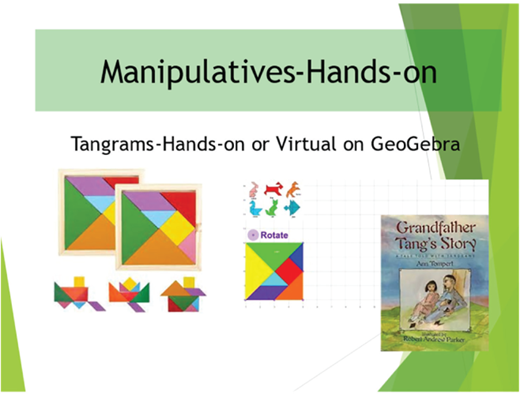
Larson and Rumsey (2018) contend that children's literature in mathematics brings stories to life when teachers integrate literature and math manipulatives to make math lessons meaningful, as shown in Figure 8, Figure 9, and Figure 12. Figure 8 shows concrete Tangrams, Tangrams on GeoGebra, and a children's book using Tangrams. Figure 9 provides Color Tile manipulatives to model a math problem. The book Spaghetti and Meatballs for All, written by Marilyn Burns, also shows a GeoGebra model of the problem. Furner (2018) found that using children's literature to teach mathematics was an effective vehicle for better reaching all students. Washington (2023), in her review of teaching mathematics creatively, discusses the importance of using technology like GeoGebra, manipulatives and virtual forms, storytelling, and children's literature in the teaching of mathematics as some of the best pedagogy for creatively teaching the subject to better reach students.
Mathematics teachers may ask why it is essential to make connections and motivate students to learn math while using GeoGebra.
Teachers will find that when using GeoGebra; educators will be able to demonstrate a purpose for mathematics develop relations between math ideas and shapes and; the software will show practical applications to math in life; it employs innovative teaching in the classroom; it stimulates through photography/modeling; it employs emerging technologies in math with many actual world application; GeoGebra can aid in addressing math anxiety as a motivating form of technology so that students feel confident for all STEM fields when they complete high school.
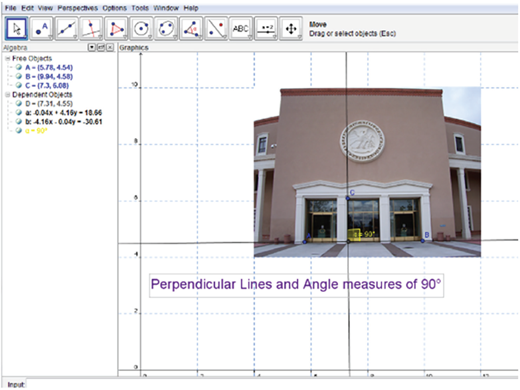
Perpendicular lines create right angles and 90-degree angles. Like in the GeoGebra file photo above [See Figure 6], right angles and perpendicular lines are drawn on the photo with the GeoGebra software, all allowing students to identify vocabulary and math ideas (Furner & Yahya, 2020)..
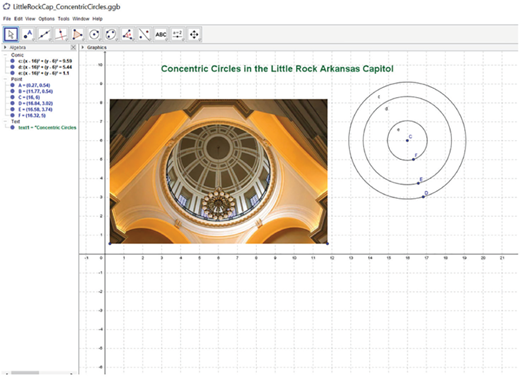
The photo in Figure 7 was imported into GeoGebra, and then students were asked to draw circles and concentric circles, as seen in the Little Rock Capitol building photo.
Reflections can often show up when taking photos of water, glass, or any other reflective surface. The photo above in Figure 10 shows a photo of a reflection of a bird in water with a line of reflection drawn in GeoGebra.
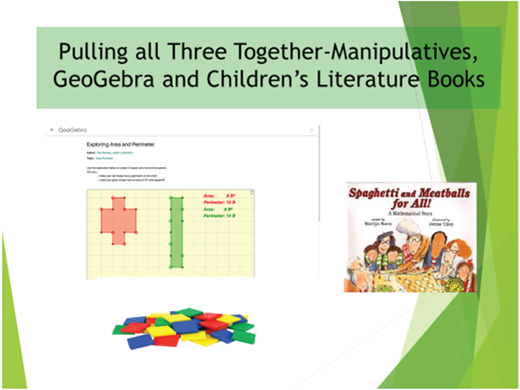
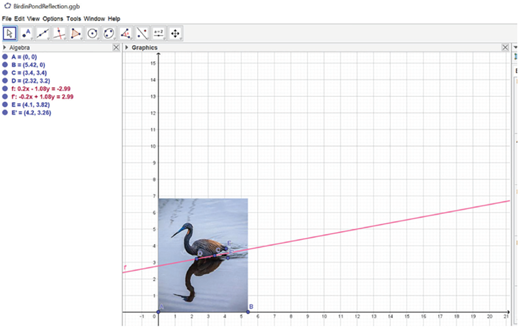
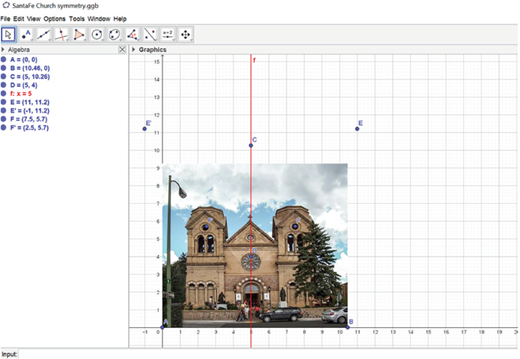
Figure 11 shows a photo inserted into the GeoGebra software. A line was drawn through the center of the photo, and then a point was selected and reflected along the line to show them as symmetrical to each other.
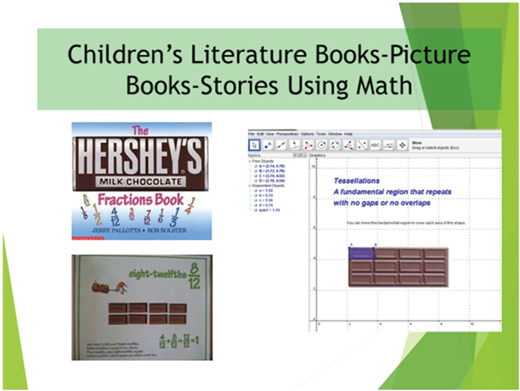
Tessellating patterns repeat with the same fundamental region covering a space, with no gaps or overlaps, as seen in the chocolate bar rectangular pieces in Figure 12. Students can use the GeoGebra and move the pieces to test their hypothesis of the same shape repeating. Byusing GeoGebra and inserting photos into the software, students can use the tools in GeoGebra to do the math, learn the vocabulary, and start better understanding mathematics concepts.
CONCLUDING REMARKS
Mathematics educators need to look deeper at their students' needs and address the math-anxious students in their classrooms today to better prepare them for the high-tech world we live in. As educators, we need to prepare our young people for STEM better, using technology and having a strong and curious interest in mathematics. Math is best learned, especially at the elementary levels, when teachers use the CRA model, starting with concrete and manipulates first. They need to connect to the representational through computer and GeoGebra with representational models and then get to the abstract. Young learners will enjoy using technology like GeoGebra and virtual math manipulative websites today while learning mathematics meaningfully and motivating. Reading children's literature math books helps students see the value and understanding of many math concepts in the real world with actual-world applications. Math manipulatives, in-person or virtually, children's literature, and technology like GeoGebra are the keys to success for students when learning mathematics, and it also better prepares them for a STEM world where they are confident in their ability to do mathematics. Manipulatives can provide concrete experiences for students, children's books offer great representational models of the math used in everyday life, and GeoGebra allows students to use math at abstract levels while employing emerging technology. These practices mentioned in this paper are considered best practices for teaching mathematics today. Math educators can also do all this withtechnology and through distance learning using virtual math manipulatives, YouTube picture books, and stories, as well as GeoGebra online, if they teach entirely online.
Math teachers today, whether in person or online, have the great responsibility to ensure that their students feel confident in their ability to do math and see a purpose for it in life. Ultimately, a child's life and all life decisions and vocations may be determined based on their temperament toward mathematics.
As math teachers, we must make a difference in our children's feelings toward math while preparing them for a future with a greater STEM emphasis. In the STEM world, we live in now, it would be wonderful to see more young people when inquired on how they feel about mathematics, say, “Math is my preferred course at school,” or “I am great at geometry!” or “I can solve almost any word problem!” Math teachers today, when employing all the “best pedagogical practices” and engaging math confidence-building techniques in our schoolrooms today, educators and schools can produce more mathematically self-confident young people for the 21st-century STEM world we now live in. Math manipulatives, children's math literature, and technology like GeoGebra are a large part of learning today. They are used to help cover math content as well as to be a motivating factor in learningand preparing our young people for a STEM world. These are some of the best pedagogical practices today for teaching mathematics to prepare young people for STEM; all can be done using distance learning, online instruction, and digital means to motivate and aid students in math instruction while employing such best practices.

