


As an emerging educational technology tool, ChatGPT has gained tremendous attention in diverse fields because of its capability to generate novel content. This study used ChatGPT to support a leadership course for graduate-level students in the field of Educational Technology. This study explores the possibilities and implications of Artificial Intelligence (AI) in Educational Technology through the lens of Design Thinking (DT) theoretical framework. DT guides this study through five processes: emphasize, define, ideate, prototype, and test. This research presents the process of developing a lesson plan with ChatGPT, an AI chatbot that uses natural language processing to respond to a user’s prompts and produce humanlike conversational dialogue. An Empathy Map and Persona were used to analyze case scenarios addressing problems of practice. Canva.com was also utilized to visually construct and represent the Persona, facilitating a clearer understanding of the contextual dynamics and educational leaders’ perspectives. The researchers used various prompts on ChatGPT to create multiple lesson plans, which were refined into a single lesson plan. The final lesson plan was utilized for the graduate-level leadership course. The study’s limitations, suggestions for future studies, and implications are included.
Introduction
In a world where change is constant, it is crucial to adopt innovative approaches to improve leadership skills. One such approach is the Design Thinking (DT) theoretical framework, which emphasizes a human-centered approach to innovation. This framework can be used to develop an academic course (Ward et al., 2009; Zupan et al., 2023). By using the DT framework, educators can design courses tailored to meet students’ needs and facilitate their personal and professional growth. This framework leverages the potential for developing and tailoring lesson plans with the integration of ChatGPT, a cutting-edge Artificial Intelligence tool. ChatGPT can provide dynamic content from available online data to enhance instructional design for leadership courses using the Design Thinking framework. Thus, this study presents the process of developing a lesson plan through the DT process aided by ChatGPT.
Educational Leaders
The influence of educational leaders on their subordinates makes it crucial for them to apply digital technological skills to bring about positive changes in their organizations (Lussier & Achua, 2010; Sun et al., 2023). With the rapidly changing educational field, leaders must familiarize themselves with technology and learn to use it effectively (Keengwe et al., 2009). The importance of educational leaders in integrating educational technology for the benefit of their teachers and students cannot be overstated. If educational leaders lack the necessary understanding and skills in educational technology, they will be unable to effectively implement its use in their settings to support their teachers and students (Keengwe et al., 2009).
Similarly, Sterrett and Richardson (2019) argue that educational leaders who have strong digital leadership can foster clear visions about educational technology to support and improve their student’s academic success (Consortium for School Networking, 2014). Additionally, Educational leaders must possess proficiency and a deep understanding of the benefits and drawbacks of various technologies, including highly controversial ones, like Artificial Intelligence (AI). To remain at the forefront of innovation, educational leaders should step out of their comfort zones and participate in professional development opportunities, such as graduate courses or training programs. By understanding the value and risks of emerging technology tools, educational leaders can offer practical strategies, such as instructional guidance and safety protocols, to ensure their proper use in an educational setting.
Leadership Courses
Leadership courses provide integral components of academic and professional development for educational leaders or educational leaders-to-be (Sogunro, 1997). The components taught in the courses could equip each leader with essential skills such as communication (Men, 2014), collaboration (Waugh Jr. & Streib, 2006), and decision-making (Saaty, 2001) skills that are required for school leaders. Mosley et al. (2014) propose providing school leaders with suitable challenges and support to effectively implement the most current techniques. In addition, educational leaders can expand their horizons and learn from each other by exploring practical applications and engaging with peers (Robertson, 2016).
Educational leaders could enhance their understanding of deep learning by collaborating and building relationships with other leaders. It is crucial for them to have access to plausible educational scenarios or dilemmas that they may encounter in their organizations or schools. By taking relevant courses and being prepared for any challenges, they would be equipped to solve any problems that may arise. To support educational leaders, comprehensive instructional design for leadership courses is required; integrating technological tools into the course could enhance leadership skills. However, there are few courses available that incorporate cutting-edge tools. This needs to be addressed because students often adopt new educational technology, such as ChatGPT, faster than educational leaders can keep up with it.
ChatGPT
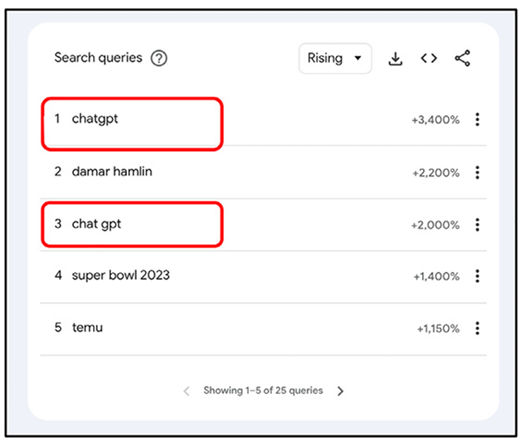
ChatGPT is a natural language processing model developed by OpenAI that can be accessed from the website: chat.openai.com (Rahman & Watanobe, 2023). GPT-3 is a highly popular version of the generative pre-trained transformer. It uses a large language model to generate text like human writing and performs various language-related tasks with exceptional precision. The remarkable proficiency of GPT-3 in executing language-related duties has made it a preferred choice among many. ChatGPT has received tremendous attention around the world. Google Trends presents ChatGPT as the highest searched word as shown in Figure 1.
While technology is advancing, educators have not had enough time to prepare to utilize ChatGPT for their classrooms and schools. Crawford et al. (2023) claim “the need for good leadership in teaching ChaptGPT” (p. 6) as many potential problems could arise, such as cheating. As ChatGPT is an emerging and powerful technology, it is required that educational leaders fully have a fundamental understanding of ChatGPT applications for education. Since this situation is new, research is needed to produce a fresh and creative approach to address emerging issues. Furthermore, the argument regarding Artificial Intelligence has a significant effect on students’ learning performance which is an essential segment that educational leaders should consider for the benefit of their students (Wang et al., 2023).
Therefore, this study aims to develop an innovative educational leadership course by integrating Design Thinking and ChatGPT to address problems of practice, contemporary challenges in educational settings, and provide practical showcases.
Method: Design Thinking
Design Thinking (Figure 2) as a human-centered approach to innovation is one of the teaching methods as well as a course design methodology in academia (Ward et al., 2009; Zupan et al., 2023). The primary reason for using Design Thinking is because it is the process of seeking to understand the points of view of others such as students. Design Thinking has a total of five steps that flow as a cyclical process: empathize, define, ideate, prototype, and test. From empathy to testing, “re-iterating and re-thinking” is extensively used to improve prototypes and create a quality outcome (Zupan et al., 2023, p. 470).

Brown and Katz (2011) suggest that educational leaders should learn how to think like designers to get benefits into their organization. Meinel and Leifer (2011) also emphasize the value of collaboration among diverse roles of people such as educators, instructional designers, and subject matter experts when using Design Thinking to design a course. Thus, this study employs Design Thinking to develop a lesson for educational leaders to learn essential skills, including communication, collaboration, and decision-making.
Empathize
Empathize is a first step as a user-centered approach to understanding the needs and perspectives of potential learners who would be in the course. Kelley and Kelley (2013) highlight Design Thinking in that students are considered to design a course in an educational setting. In this process, instructors could understand the needs and wants of their students and use them in a course design. Empathy map is one of the tools used for this process to engage with the target audience (Tschimmel, 2012). All information is gathered during this first process.
Define
All information gathered during the first process is organized. The problems and challenges would be found and then used in designing educational leadership courses. This approach is one of the core concepts of Design Thinking as it emphasizes the voice of students. According to Brown and Katz (2011), defining problems should be elaborated in a human-centered manner. Define process aims to create “meaningful and actionable problem statements” (Platter, 2016, p. 3). The methods used in this process include 5-Whys and Persona (Tonkinwise, 2011). 5-Whys uses why questions repeatedly to go deeper into the situation and problems; Perona began using human-computer interactions to invent a person by naming and creating their personality including their situation in the Design Thinking process (Brenner et al., 2016; Cooper, 2004).
Ideate
Ideate, also known as a brainstorming stage, is the phase dedicated to generating ideas throughout the process. Tschimmel (2012) suggests that making creative ideas is a key element in Design Thinking for innovation. Tschimmel (2012) also recommends that group work and visual tools be employed in this brainstorming process to help group members understand the ideas generated. This brainstorming stage could facilitate the creation of innovative ideas for course design (Tschimmel, 2012). In the ideation phase, a highlight is on the quantity of ideas created rather than the quality of individual ideas.
Prototype
Prototype serves as a way of “visualizing and testing new solutions” (Tschimmel, 2012, p. 4), demonstrating its significance in the development process. In this process, an interactive design is a fundamental element as it allows products to be refined: prototyping and redesigning processes are actively on, meaning that solutions and outcomes are tested iteratively (Sato & Adler, 2013). A rapid prototype is recommended as a tangible outcome because it engages users, incorporates their feedback, and iteratively refines the design to enhance its functionality and user experience.
Test
Test and evaluation are essential to finding any parts that help improve the outcomes of the prototype. In this process, potential or final users are highly recommended to evaluate the prototype made in the previous stage and the outcomes (Tschimmel, 2012). Feedback from them provides an opportunity to understand the final users, in this case, potential and real students of the course. Design Thinking emphasizes reflective processes as this process improves the final product (Cross, 2006; Plattner, 2016). Additionally, tests are essential to refine and improve the outcomes, including prototypes, and build empathy through the observation of users or students (Plattner, 2016).
Results: Implementation
This section provides practical ways to use the five Design Thinking processes, along with visual images and tools.
Empathize
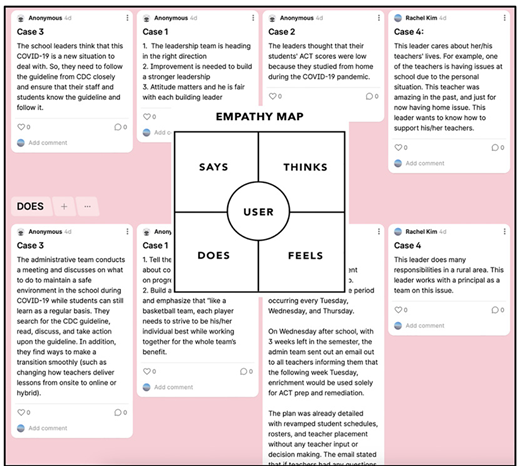
Four real-based cases were used to Empathize educational leaders. These cases were from educational leaders who are mostly in leadership positions at his/her educational institutions as well as graduate students in an educational leadership program. With four different cases, the Empathy map was used to understand educational leaders and their problems. According to this map, Says, Thinks, Does, and Feels were categorized to emphasize the target audience; instructional designers wrote four parts of Says, Thinks, Does, and Feels based on the scenarios (Figure 3).
In this process, Padlet.com, an online bulletin board, was used. Meanwhile, a physical board is also helpful to visualize the ideas among many participants in personal meetings; sticky notes can be used; any ideas can be shared by posting more than two per person on the board. All participants can read and even share their thoughts. In this meeting, all four authors shared what they think about educational leaders and their situations by trying to understand the situations and themselves. Sharing what each found is helpful to understanding the big picture; post-its or maps help make connections between participants (Plattner, 2016).
Define
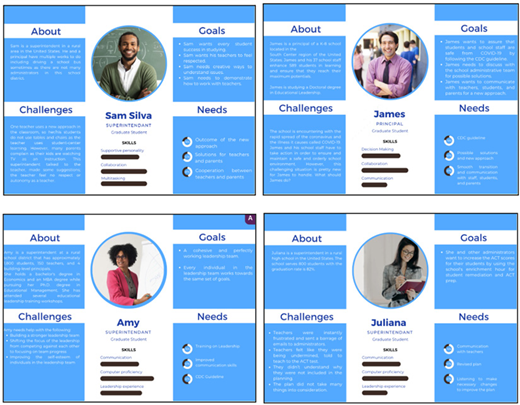
Define aims to create a meaningful and practical problem statement based on the information collected during the first stage. Each author used persona to understand each educational leader from a real-based scenario. In creating Perona, a random figure was picked and added from a free image at Canva.com, and categories including About, Goals, Challenges, Needs, Roles, and Skills began to be filled by each author (Figure 4). To visualize Personas, Canva.com was used as a tool. The main challenges found in the Define process included that educational leaders must improve their communication skills, find creative ways to collaborate with teachers, build decision-making competence, and build strong teamwork. The primary needs for educational leaders include creativity for solving problems, communication skills, and improving leadership.
Ideate
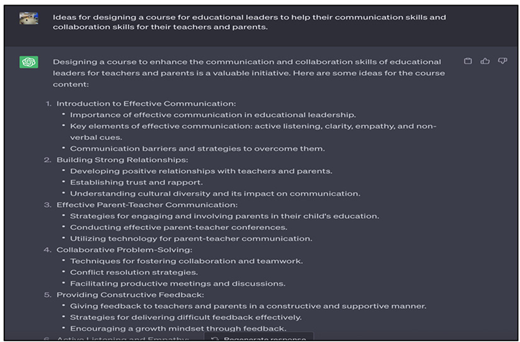
Brainstorming matters at this stage; quantity matters more than quality when generating ideas among diverse stakeholders (Tschimmel, 2012). At this stage, ChatGPT was used (Figure 5), using four similar but different prompts.
Prompt 1. Design a graduate-level course to help a school superintendent improve communication skills.
Prompt 2. Build a graduate-level course for a school superintendent to develop her leadership skills and improve communication skills.
Prompt 3. Create a course for preservice educational leaders that can assist them in developing decision-making skills.
Prompt 4. Ideas for designing a course for educational leaders to help their communication skills and collaboration skills for their teachers and parents.
Each author made four different prompts, all of which were typed on June 27 around 9:00 p.m. (CDT). ChatGPT’s suggestions can be found in Appendix A. Leadership skills, encompassing three key components—communication, decision-making, and collaboration—were identified as the primary focus areas in the course design, based on one of the scenarios.
Prototype
Prototyping provides visual solutions in an iterative process (Tschimmel, 2012). As rapid prototype was one of the main characteristics of the Prototype process in the Design Thinking method, diverse prompts were used in ChatGPT to create a prototype. Additionally, a lesson plan was chosen instead of a syllabus to see the details and quality of the output. In this way, specific activities, tools, or methods could be evaluated as a repetitive design process. A total of four different prompts were used in ChatGPT, and the prompts have been revised according to the suggestions from ChatGPT. After reviewing four different lesson plans, the authors redesigned the lesson plan and made it a final one, which was planned to be used in a real leadership course. The final prompt and its response can be found in Appendix A.
Test
The test is the outcome of the Design Thinking process. Potential or final users of the lesson plan were invited to use the lesson. In this study, either course instructors or students are the proper audience to test the outcome (Tschimmel, 2012). In this study, instructors used the lesson plan to teach an educational leadership course for graduate students. Design Thinking emphasizes reflective processes (Cross, 2006; Plattner, 2016). Therefore, after this lesson plan was used, instructors used reflective notes.
If any, what were your favorite lesson activities and why?
If any, what were your favorite educational tools used and why?
If any, what challenges did you face in teaching leadership skills through this lesson plan?
If any, what advantage did you have in teaching leadership skills through this lesson plan?
Any other thoughts?
Both instructors agreed that a flipped learning method was excellent in this lesson, as students were able to be prepared for the class. In addition, ChatGPT played a role as a brainstorming tool to generate class content, allowing the main instructor to save some time for brainstorming, and making presentation slides. However, ChatGPT still required an instructor to revise the lesson plan five times to fully prepare the lesson. For example, the lesson plan by ChatGPT did not present examples of leadership for communication, collaboration, and decision-making. The instructors need to find proper examples to share with the students.
Also, the wordings used in ChatGPT needed to be trimmed as a “right command” so that ChatGPT could provide the outcomes that the instructors expected to have. Besides this revising challenge, ChatGPT did not suggest an evaluation process of measuring student success from learning this lesson. Therefore, instructors may consider incorporating ChatGPT as a teaching assistant into their instructional methodologies; however, a thoughtful and discerning approach is imperative. This approach entails the deliberate integration of critical thinking processes to facilitate the delivery of accurate and tailed content and the implementation of highly effective pedagogical strategies. With consideration, instructors can better use this AI tool for their students.
Discussion
This study suggests innovative practices by utilizing features of AI related to ChatGPT in supporting a leadership course. The study extensively used ChatGPT in the DT process: empathize, define, ideate, prototype, and test. This study suggests possibilities of using AI so that practitioners could generate their ideas by leveraging ChatGPT for their benefit. For example, they can use ChatGPT as an aid to their communication and decision-making tools. Similarly, teachers and professors could use ChatGPT for designing their teaching courses in the way this study used it to develop a lesson plan for multiple subject matters including a leadership course. Furthermore, educators across different subjects could benefit from using ChatGPT by following the process presented in this study.
While there are considerable possibilities for integrating ChatGPT into various applications, there has been limited comprehensive discussion regarding the quality of the outcomes or any emerging issues or challenges that may arise, especially in the course design, including a leadership course. More studies are required to thoroughly understand and address any potential issues and to establish a clear understanding of the quality of outcomes that ChatGPT and other AI tools can produce. This would be critical in understanding the effectiveness and reliability of the technology tools in an educational context.
The research explores a novel approach to designing a graduate course using various educational technology tools such as Empathy Map, Persona, a virtual bulletin board, and visual software as a showcase. In addition, Design Thinking is extensively used for educational leadership courses with AI. The study suggests the potential for adopting emerging technology to support educational leaders. Future studies can include creating a guideline for using AI in different educational leadership courses such as ethical decision-making and data-based decision-making while using Design Thinking. Increased data from more participants such as educational leaders and faculty members would bring a deeper understanding of the impacts of AI in educational leadership areas.
One limitation of this study is that the feedback was received only by instructors. Instructors’ feedback was extensively utilized to create the final version, but according to DT, any final product can always be improved by inviting current users and in this study they can be both instructors and students. Since the final users of the lesson included both instructors and students, it would be beneficial for future research to invite students who have learned through this lesson plan to provide their feedback. This would allow to bring more diverse perspectives, leading to a better outcome (Junt et al., 2019). Nevertheless, this study is still significant as the design that emerged from the design thinking process was implemented in a real-life scenario that educational leaders may encounter in their organization.
Conclusions
This study employed Design Thinking as a framework to explore a course designed for educational leaders by utilizing ChatGPT. As an interactive iterative process, empathize, define, ideate, prototype, and test were the five processes that this study followed. To empathize with educational leaders, an empathy map was used based on the categories: Says, Thinks, Does, and Feels in the real life-based scenarios that educational leaders shared. Accordingly, four real case scenarios having genuine issues that came from educational leaders were analyzed by authors based on what they say, what they think, what they do, and how they feel. The process facilitated a deeper understanding of the situations that educational leaders may encounter.
Another strategy used in this study, Persona, was used to define meaningful problems that educational leaders may face (Platter, 2016). The discussion about educational leaders, their challenges, needs, and potential profiles provided valuable insights into analyzing prospective students by fostering a deeper understanding of the qualities and requirements of effective educational leaders. To generate multiple ideas within a brief time, ChatGPT was used, and it generated many ideas for course design. In ChatGPT, four different prompts were used to bring diverse ideas; the authors compared and analyzed the outcomes from ChatGPT and selected one topic to make a lesson plan.
To prototype the design of the courses, one topic was selected to create a lesson plan by ChatGPT. A total of four different lesson plans were suggested by different prompts in ChatGPT. For the final version of the prototype circle, the authors revised and synthesized the four lesson plans to create a fifth version. Finally, this fifth version was tested according to DT to receive feedback from the final users. After using the lesson plan, instructors generated reflective notes which could be used to create a last version of the lesson plan for graduate students taking educational leadership courses.
This study advances the literature on AI in educational leadership by offering practical implications and insights to equip leaders with the skills to effectively leverage AI for their professional growth and student success.
References
Appendix A. Lesson Plan by ChatGPT (Lesson Plan by ChatGPT— 4th version)
Prompts
Make a lesson plan for two hours for the educational leadership course where graduate students (master’s level) learn leadership skills including communication, collaboration, and decision-making skills; make suggestions of educational technology tools that can be used in this lesson and the modes of the courses such as a lecture or flipped learning.
Suggestions by ChatGPT
Lesson Plan: Leadership Skills - Communication, Collaboration, and Decision-Making Skills in Educational Leadership
Duration: 2 hours
Objective:
By the end of this lesson, graduate students will be able to:
Understand the importance of communication, collaboration, and decision-making skills in educational leadership.
Identify key strategies and techniques for enhancing these skills in an educational leadership context.
Explore and utilize relevant educational technology tools to support effective communication, collaboration, and decision-making.
Lesson Procedure:
Introduction (10 minutes)
Welcome the students and provide an overview of the lesson’s objectives and outcomes.
Highlight the importance of communication, collaboration, and decision-making skills in educational leadership roles.
Explain the role of educational technology in supporting and enhancing these skills.
Part 1: Communication Skills (40 minutes)
Lecture: Importance of Effective Communication in Educational Leadership (10 minutes)
Present a brief lecture on the significance of effective communication skills for educational leaders.
Discuss the impact of communication on building relationships, fostering a positive school culture, and promoting student success.
Flipped Learning Activity: Educational Technology Tools for Communication (30 minutes)
Prior to the class, assign students readings or video resources on various educational technology tools for communication, such as:
Video conferencing tools: Zoom, Google Meet
Collaborative document editing tools: Google Docs, Microsoft Office 365
Instant messaging tools: Slack, Microsoft Teams
Instruct students to explore and familiarize themselves with one or more of these tools.
During the class, facilitate a discussion where students share their experiences, advantages, and challenges of using the assigned technology tools for communication in educational leadership.
Break (10 minutes)
Part 2: Collaboration Skills (40 minutes)
Lecture: Importance of Collaboration in Educational Leadership (10 minutes)
Present a brief lecture on the significance of collaboration skills for educational leaders.
Discuss the benefits of collaboration in fostering teamwork, professional development, and innovative practices in educational settings.
Flipped Learning Activity: Educational Technology Tools for Collaboration (30 minutes)
Prior to the class, assign students readings or video resources on various educational technology tools for collaboration, such as:
Project management tools: Trello, Asana
Virtual whiteboarding tools: Miro, Jamboard
File sharing and collaboration tools: Dropbox, OneDrive
Instruct students to explore and familiarize themselves with one or more of these tools.
During the class, facilitate a discussion where students share their experiences, advantages, and challenges of using the assigned technology tools for collaboration in educational leadership.
Break (10 minutes)
Part 3: Decision-Making Skills (40 minutes)
Lecture: Importance of Effective Decision-Making in Educational Leadership (10 minutes)
Present a brief lecture on the significance of effective decision-making skills for educational leaders.
Discuss the impact of decision-making on strategic planning, resource allocation, and student outcomes in educational settings.
Flipped Learning Activity: Educational Technology Tools for Decision-Making (30 minutes)
Prior to the class, assign students readings or video resources on various educational technology tools for decision-making, such as:
Data analysis and visualization tools: Tableau, Excel
Survey and feedback tools: Google Forms, SurveyMonkey
Virtual meeting and collaboration tools: Zoom, Microsoft Teams
Instruct students to explore and familiarize themselves with one or more of these tools.
During the class, facilitate a discussion where students share their experiences, advantages, and challenges of using the assigned technology tools for decision-making in educational leadership.
Wrap-up and Reflection (10 minutes)
Summarize the key points discussed during the lesson.
Ask students to reflect on their learning experiences with educational technology tools for communication, collaboration, and decision-making.
Encourage students to identify opportunities for applying these skills and tools in their future educational leadership roles.
Conclusion (5 minutes)
Recap the main takeaways from the lesson.
Thank the students for their active participation.
Emphasize the importance of continuous development of communication, collaboration, and decision-making skills in educational leadership.
Provide resources for further exploration of educational technology tools in leadership contexts.
Note: The lesson plan incorporates the flipped learning approach, where students engage with the assigned materials before the class, enabling in-class discussion and application. The suggested educational technology tools can be adjusted based on the availability and suitability for the educational leadership context.
Appendix B. Lesson Plan by ChatGPT (Prototype (5th version) by us and ChatGPT)
Suggestions by ChatGPT and revised by authors
Lesson Plan: Leadership Skills
Communication
Collaboration and
Decision-Making Skills in Educational Leadership
Duration: 2 hours
Presentation Link
Place: Hybrid: In person classroom/online classroom
Students: Graduate students in a Master’s degree level
Objectives:
By the end of this lesson, graduate students will be able to:
Understand the importance of communication, collaboration, and decision-making skills in educational leadership.
Identify key strategies and techniques for enhancing these skills in an educational leadership context.
Explore and utilize relevant educational technology tools such as ChatGPT to support effective communication, collaboration, and decision-making.
Lesson Procedure:
Introduction (10 minutes)
Welcome the students and provide an overview of the objectives and outcomes of the lesson.
Highlight the importance of communication, collaboration, and decision-making skills in educational leadership roles.
Explain the role of educational technology in supporting and enhancing these skills.
Part 1: Communication Skills (30 minutes)
Lecture: Importance of Effective Communication in Educational Leadership (10 minutes)
Present a brief lecture on the significance of effective communication skills for educational leaders.
Discuss the impact of communication on building relationships, fostering a positive school/organization culture, and promoting student success.
Flipped Learning Activity: Educational Technology Tools for Communication (20 minutes)
Prior to the class, assign students readings or video resources on various educational technology tools for communication, such as:
Video conferencing tools: Zoom, Microsoft Teams, and Google Meet
Collaborative document editing tools: Google Docs and Microsoft Office 365
Instant messaging tools: Slack, Microsoft Teams, GroupMe, and Line
Instruct students to explore and familiarize themselves with one or more of these tools.
During the class, facilitate a discussion where students share their experiences, advantages, and challenges of using the assigned technology tools for communication in educational leadership.
Break (5 minutes) Q&A
Part 2: Collaboration Skills (30 minutes)
Lecture: Importance of Collaboration in Educational Leadership (10 minutes)
- Present a brief lecture on the significance of collaboration skills for educational leaders.
- Discuss the benefits of collaboration in fostering teamwork, professional development, and innovative practices in educational or organizational settings.
Flipped Learning Activity: Educational Technology Tools for Collaboration (20 minutes)
Prior to the class, assign students readings or video resources on various educational technology tools for collaboration, such as:
Project management tools: Trello, Asana, ClickUp, and Monday.com
Virtual whiteboarding tools: Miro, Padlet, and Jamboard
File sharing and collaboration tools: Dropbox, OneDrive, and Google Drive
Instruct students to explore and familiarize themselves with one or more of these tools.
During the class, facilitate a discussion where students share their experiences, advantages, and challenges of using the assigned technology tools for collaboration in educational leadership in schools or organizations.
Break (5 minutes) Q&A
Part 3: Decision-Making Skills (30 minutes)
Lecture: Importance of Effective Decision-Making in Educational Leadership (10 minutes)
Present a brief lecture on the significance of effective decision-making skills for educational or organizational leaders.
Discuss the impact of decision-making on strategic planning, resource allocation, and student/staff outcomes in educational or organizational settings.
Flipped Learning Activity: Educational Technology Tools for Decision-Making (20 minutes)
Prior to the class, assign students readings or video resources on various educational technology tools for decision-making, such as:
Data analysis and visualization tools: Tableau, Excel, and ChatGPT
Survey and feedback tools: Google Forms, Qualtrics, and SurveyMonkey
Virtual meeting and collaboration tools: Zoom, Microsoft Teams, and Google Meet
Instruct students to explore and familiarize themselves with one or more of these tools.
During the class, facilitate a discussion where students share their experiences, advantages, and challenges of using the assigned technology tools for decision-making in educational leadership.
Wrap-up and Reflection (5 minutes)
Summarize the key points discussed during the lesson.
Ask students to reflect on their learning experiences with educational technology tools for communication, collaboration, and decision-making.
Encourage students to identify opportunities for applying these skills and tools in their future educational leadership roles.
Conclusion (5 minutes)
Recap the main takeaways from the lesson.
Thank the students for their active participation.
Emphasize the importance of continuous development of communication, collaboration, and decision-making skills in educational or organizational leadership.
Provide resources for further exploration of educational technology tools in leadership contexts.
Note: The lesson plan incorporates the flipped learning approach, where students engage with the assigned materials before the class, enabling in-class discussion and application. The suggested educational technology tools can be adjusted based on the availability and suitability for the educational leadership context.
Acknowledgments
We would like to express our gratitude to TeleED for providing an accessible platform that utilizes real-world cases. These practical challenges have enhanced our understanding of the issues and practices in educational leadership. Incorporating the cases into our learning journey has been instrumental in bridging the gap between theory and practice. We sincerely thank the organizers and participants for their dedication to fostering leadership excellence in this exceptional educational initiative.

