


The purpose of this study was to explore best practices for community building in Web-based learning environments (WBLEs). The study took place in two Web-based courses at two universities. An embedded case study design was used, and multiple sources of evidence (e.g., chat and bulletin board transcripts, interviews, and surveys) were gathered to inform the results. Overall, participants in both courses indicated some sense of community, albeit limited in scope. Learners indicated a stronger connection with their team members than with the larger class group. While more research is needed, our study indicates that incorporating community building strategies during course design, and encouraging interactions between participants during the course, can contribute to the long-term viability and use of WBLEs in institutions of higher education.
Introduction
The use of electronic technologies for the delivery of instruction has grown at an exponential rate over the last five years. Institutions of higher education, corporations and K-12 environments continue to seek ways to use on-line tools to deliver instruction. Concurrently, the technological infrastructure is expanding in terms of its capabilities and power (Daniel, 1998; Katz, 1999), increasing learner access to the technologies needed to acquire and share information with other participants. This convergence in interest by educators and learners in learning via distance technologies has enabled an exponential increase in the quantity of distance courses and programs across disciplines (e.g., art, history, information systems, education, science) and contexts (Otchet, 1998).
While the increased interest and need is an exciting development, several challenges associated with the successful implementation of instruction in Web-based learning environments (WBLEs) remain unresolved, including retention and high dropout rates (see Barley, 1999; and Hill (2002), for an overview of several issues). Retention has historically presented challenges for distance educators. According to Moore & Kearsley (1996), dropout rates have ranged from 30-50%. While this figure is inclusive of a variety of distance learning technologies (video, print, etc.) and the authors point out that the dropout rate would now be at the lower end, 30% is still a considerable percentage to lose in a learning experience. WBLEs, with their high demands psychologically and technically, makes this challenge even more significant.
Several factors may contribute to retention challenges in distance education. Factors mentioned in the literature include: lack of prior experience with distance learning, external demands, and conflicts with motivation demands (external vs. internal) (see, for example, Carr, 2000). Another explanation for high dropout rates and dissatisfaction with distance delivered courses may relate to a lack of a perception of community in courses that are not face-to-face. Learners may feel like they are isolated, creating an experience of lack of presence from others involved in the course.
Perception of a community may assist learners with feeling connected or belonging (Halaby, 2000; Joyce & Weil, 1996). Research in on-line environments indicates that community building can occur in distance-delivered courses (Hill, 1999a; Palloff & Pratt, 1999), much like community building can occur in virtual teams in the business sector (Lave & Wenger, 1991; Raven, 1999). Given that a sense of a community has been demonstrated to contribute to group performance within a corporate context (Lave & Wenger, 1991), it may prove to be a benefit in a learning context. Discovering the best strategies and techniques for community building may lead to enhanced course outcomes (e.g., retention, satisfaction, learning outcomes) by participants in WBLEs.
Purpose
The purpose of this study was to explore best practices for community building in WBLEs. In doing so, the study sought to examine specific strategies and techniques designed to facilitate the establishment of an on-line community. The study was guided by the following general research question: What are the best techniques/strategies to enable community building in WBLEs?
This question was addressed through a number of sub-questions, two of which will be focused upon in this paper:
What can we do, as designers of, and instructors in, a WBLE to assist the learner in the effective building of community while learning in a Web-based environment?
What strategies can learners use to assist themselves (individually and with each other) in community building while engaged in learning in Web-based environments?
Significance of the Study
While considerable research has been conducted in the general area of distance learning, research specific to Web-based environments for learning has only recently been published (see, for example, Dehoney & Reeves, 1999; Khan, 1997; Hill, 1997a; Hill, 1999a; Owston, 1997; Pritchard, 1998), and most is being presented at a theoretical rather than an empirical level. As the Web and Internet-based technologies (e.g., bulletin boards, e-mail, streaming video, instant messaging) continue to grow in popularity and use in higher education, we felt that institutions would benefit greatly from investigation of best practices related to WBLEs, in our case, specifically examining best practices for community building.
Interest in building community is certainly not new, nor is it something isolated to study in the context of higher education. Lave and Wenger (1991) have spent considerable time examining the issues related to forming community in a business and industry setting. Joyce and Weil (1996) called for the creation of communities of professional educators within a school setting. Halaby (2000) brings the notion of belonging into the classroom setting, emphasizing a need to help learners belong. More recently, Palloff and Pratt (2001) extended their work on community building within higher education settings, focusing on providing hints and tips for the online teacher.
Certainly, this work is useful and adds to our literature base. However, much of the work completed to date is primarily theoretical, and while based in experience, is not primarily driven by empirical research. Further, the current work does not define specific models for how to enable community building in a Web-based environment—both from the teacher and student perspective. We need data-driven strategies and models, presenting techniques on both sides of the desk, so that others can test the robustness of the models in a variety of environments.
Research Plan
Research Design
An embedded case study design was used for this study, involving the use of multiple cases, or embedded units, within a larger context. The unit of study in the case was the individual faculty member or student involved in the WBLE. Multiple sources of evidence (e.g., mid-term focus groups, end-of-term surveys, transcripts of online discussions (chat rooms and bulletin boards)) were used to triangulate the data, thus addressing possible concerns with internal validity (Yin, 1994). This approach has been used by one of the researchers in previous research (Hill & Hannafin, 1997; Hill, 1997b), and has proven successful when looking to describe rich contexts and for model development (Hill, 1999b).
Selection and Description of the Participants
Two groups of participants were engaged in this study. One consisted of a an instructor and learners involved in the Master's level course “Information Technology Infrastructures” in a college of business at a university in a large metropolitan area. The other consisted of an instructor and Master's level learners involved in the course “Instructional Design” in a college of education at a university in a rural area. The population included university instructors, instructional design experts, and working professionals returning to school from various sectors of business and industry (e.g., information technology management, technical support, Web development) and education (K-12 and higher education).
The courses were selected for two primary reasons:
Involvement in the courses was voluntary. Although for many learners the courses were required for completion of the degrees, they decided when and how to take the course. Most learners enter with a high level of interest and motivation.
Learners begin the course with a variety of backgrounds, as well as differences in their technology experience. This variety is essential for examining strategies and techniques across potential learners.
Two groups comprised the sample of this study: university faculty as subject matter experts to help inform the design, development, and implementation of the courses; and learners enrolled in the courses during summer term.
WBLE Development
A systematic approach for the design of instruction was used to guide the design and development of the courses “Information Infrastructures” and “Instructional Design.” The process was both in-depth and comprehensive, covering a 3-4 month period and involving a team of designers and subject-matter experts in both instances. Instructional design experts helped inform the design, development and implementation of the courses while the subject matter experts informed the content used within the courses.
A variety of technologies were used in the development and implementation of both courses. These included: Dreamweaver® for the development of Web pages, Active Server Pages® with VisualBasicScript® to enable high-end capabilities in the Website, database technologies to support the overall site infrastructure, and Blackboard® and WebCT® for the integration of e-mail, bulletin board, and chat systems.
Measures and Instrumentation
A combination of positivistic and interpretivist techniques were used in gathering evidence for the study. Various instruments were used to facilitate data collection for the study: surveys, interviews, observations, and content analysis of discussion transcripts. Positivistic techniques were used to generate individual difference measures for each case. Interpretivist techniques were used to monitor the use of community building strategies and techniques.
Settings and Procedures
Implementation of the courses took place over a 7-8 week period during the summer of 2000. An initial face-to-face meeting was held for both courses, as was a mid-term face-to-face meeting for debrief of the experience to date. The classes met for synchronous discussions in the chat room. For chat room discussions, the classes were divided into two groups of 10-15 learners to better facilitate synchronous discussions. The chat sessions for each group were held two times during the week and lasted, on average, one hour. Follow-up bulletin board discussions were also held each week to extend the conversations occurring during chat sessions.
Data were collected in a variety of environments. Pilot testing with learners in the spring and data gathering with learners in the summer took place in the context in which the WBLE was used, including campus computer labs and the learners’ homes/places of employment (depending on where they have access to the Web). A combination of questionnaires, focus groups, and content analysis of transcripts from on-line discussions were used to gather data from learners. The facilities and necessary equipment for data gathering were fully established at each institution.
Analysis
To the extent possible, the collection, organization, and initial analysis of data occurred concurrently. Previous research indicates that this assists with indicating gaps in data as they are gathered and allow for adaptations in the process (e.g., need for additional information) (Glaser & Strauss, 1967; Hert, 1992; Hill & Hannafin, 1997). One “gap” that did occur related to the number of participants. We did experience a small reduction in participants in both courses, with the final number of participants being 21 in the Information Technology Infrastructures course (reduced from 23) and 22 participants in the Instructional Design course (reduced from 24).
In-depth data analysis took place throughout the academic year following the offering of the courses. One level of in-depth analysis involved reading through and coding the transcripts from the online chat and bulletin board discussions. As the researchers read the data, pre-established codes were used to mark-up the data (Ericsson & Simon, 1984; Hill & Hannafin, 1997). Additional codes were established as themes and patterns not readily applicable to the established categories emerged.
Codes for Infrastructure Strategies
| Codes | Constructs | Definitions Used in the Study |
|---|---|---|
| AI | Active Interaction | Interactions involving both course content and personal communication; interactions that are purposeful, engaged, energetic. |
| SCM | Socially Constructed Meaning | Arguing with or questioning each other with the intent to achieve agreement on issues of meaning. |
| ESE | Expressions of Support and Encouragement | Validating other's ideas/sentiments by showing agreement or understanding. |
| CL | Collaborative Learning | Sharing ideas and knowledge among and between learners. Comments directed primarily student to student rather than student to instructor |
| SI | Sharing Information/Resource | Reference by learners to people, ideas, resources, etc. |
| ACK | Acknowledgement of others | Noting the presence of a person in the chat room or bulletin board space. |
| CC | Chit Chat | Social interactions among participants that are not related to class. |
Another level of in-depth analysis involved chunking sections of the data related to specific research questions according to pre-established strategies and techniques for community building (Hill, 1999b). These coding and analysis techniques have been documented in the literature (Bogdan & Biklen, 1992; Krathwohl, 1998; Yin, 1994) and were used by the researchers in previous studies (Hill, 1997b; Hill & Hannafin, 1997). Pattern matching was used to inform the generation of an overall list of strategies and techniques—instructor and student—for community building in WBLEs. The overall list was then analyzed for themes and patterns, enabling the creation of a theoretical model for community building in WBLEs.
Data Presentation
The content of each student's and instructor's postings in the chat room and on the bulletin boards was analyzed to determine the number and type of constructs was examined. In total, more than 400 pages of transcripts from the chat rooms and bulletin boards were analyzed and coded. Overall, 13 constructs in participants’ posting were identified: active interaction, socially constructed meaning, expressions of support and encouragement, collaborative learning, sharing information/resources, acknowledgement of others, chitchat, teacher initiative, student initiative, teacher response, student response, student evaluation, and teacher evaluation. To help inform the results, the data were first divided into two main categories: infrastructure strategies and interaction strategies. To refine our analysis, we further divided the codes in the interaction strategies category into two other categories: instructor strategies and student strategies. Codes and definitions for strategies included in these categories are displayed in Tables 1-3.
The coding and analysis of the transcripts revealed patterns of behavior in the WBLEs. Other sources of data were then used as points of triangulation for the findings: focus group interview notes were reviewed and end-of-term surveys were analyzed. Trends in these data were then compared to the trends and patterns established from the discussion transcripts. Overall, strategies and techniques were adjusted as needed based on the analysis of the additional data points.
Codes for Interaction Strategies—Instructor Strategies
| Code s | Constructs | Definitions Used in the Study |
|---|---|---|
| TI | Teacher Initiative | Asking question(s) to lead and/or facilitate the discussion. |
| TR | Teacher Response | Responding to student contributions. |
| TE | Teacher Evaluation | Evaluation of student contributions. |
Codes for Interaction Strategies—Student Strategies
| Code s | Constructs | Definitions Used in the Study |
|---|---|---|
| SI | Student Initiative | Asking question to lead and/or facilitate the discussion. |
| SR | Student Response | Responding to the teacher or student contributions. |
| SE | Student Evaluation | Evaluation of student or teacher contributions. |
Findings and Results
Analysis of the data was an intensive task, cognitively and logistically. Many hours were devoted to reviewing the data and refining the findings, individually and as a team. The results of our efforts are presented below, organized according to our research questions.
What can we do, as designers of, and instructors in, a WBLE to assist the learner in the effective building of community while learning in a Web-based environment?
Based on feedback from the learners during implementation, as well as expert review of the course, there are several things that designers and instructors can do during the design, development and implementation stages to help with community building in WBLEs.
One strategy that proved very effective was ensuring that learners have sufficient opportunities to interact with each other as well as with the instructor. Our research indicates that learners want a variety of ways to interact with each other. In the end-of-term surveys, learners in the Information Infrastructures course and the Instructional Design course indicated that all of the communication technologies (e.g., chat, bulletin boards, email, phone).were working well and were important for facilitating interactions. They also mentioned the importance of having face-to-face (f2f) meetings. As one respondent put it: “I liked having the 2nd f2f because I think it helped connect with others and do real sharing of information, thoughts and ideas.”
Another strategy used in the “Instructional Design” course that proved effective was the use of CSM messages. CSM messages indicated to learners what they Could be doing, what they Should be doing, and what they Must be doing. These messages were sent out by the instructor once or twice a week to remind learners of tasks for the week.
During the mid-term evaluation, learners indicated that the CSM messages were important not only for keeping them on track, but also for letting them know that the instructor was there. Asked what they would keep in future classes, students noted: “The CSMs gave helpful information every week” and “CSM—great for organizing and planning.”
Yet another strategy that proved effective for community building was the use of teams for completing course work. Because of the nature of the courses, team configurations differed. In the Information Infrastructures course, teams of 2-4 worked together; in the Instructional Design course, teams of 2 worked together (i.e., Design Buddies). During mid-term focus groups in both courses, the learners indicated that the team members contributed very positively to their sense of belonging and a sense of connection with others in the course. This was also confirmed in the end-of-term surveys where learners reported that their teammates or “buddies” were the greatest contributor to their sense of belonging. The following two quotes illustrate this:
“It was difficult at first to experience any such ‘group’ feeling with the on-line format. But interestingly enough, this grew exponentially as the course progressed, particularly with the project team.”
“Having a design buddy and the interactions with instructor helped me feeling part of the class.”
Additional comments, from Successful Strategies included:
“I found that talking to my design buddy helped a lot.”
“I emailed my design buddy with questions.”
“I have constantly asked questions to facilitator and to my buddy in order to be able to keep up with class work.”
“Communication with Buddy, regular review of WebPages, questions to instructor when appropriate.”
What strategies can learners use to assist themselves (individually and with each other) in community building while engaged in learning in Web-based environments?
Analysis of surveys, as well as transcripts from various interactions in the courses, indicate that several strategies were used by learners to assist themselves with community building and learning in a Web-based environment. Learners were asked in the mid-term focus groups and end-of-term survey what they were doing to assist themselves with feeling connected in the WBLE. Several learners reported that a daily visit to the Web site to check for new messages on the bulletin boards was useful. While many learners indicated that this was frustrating (“takes too much time”), others stated that the frequent visits helped them with establishing a sense of belonging to the course. A large number of respondents also mentioned that asking their buddy questions helped them a lot as a strategy:
“I looked at the website almost everyday. I also did a lot of research outside of the class site on the Internet for coding questions. I used my team members to bounce some questions off as well.”
“I tried to stay in touch by going to the web site daily. I emailed my design buddy with questions and also I emailed [Instructor] with specific questions. I read everything, probably too much. It was a lot of work to keep up with everything.”
Two other closely related community building strategies used by learners are providing encouragement and support to their peers. Evidence of this was seen throughout bulletin board postings and chat room interactions. Learners engaged in expressing encouragement and supporting each other on a regular basis throughout the term.
Several learners indicated that the experience was somewhat overwhelming. This comment related mainly to the number of messages learners had to read on bulletin boards, in chat sessions and in e-mail. One strategy mentioned by several learners during mid-term focus groups and the end-of-term surveys was that of scanning; that is, reading for content not for detail, in order to keep the information exchange manageable.
Community-Building: A Process-Based Model
It would appear that various community building strategies and techniques were used during the Information Infrastructures and the Instructional Design courses. To address the overall research question, “What are the best techniques/strategies to enhance community building in WBI?”, the strategies and techniques have been divided into two main areas: infrastructure strategies and interaction strategies (see Table 4).
We have also represented the strategies in terms of those most relevant to different participants, i.e., instructor or learner (see Table 5).
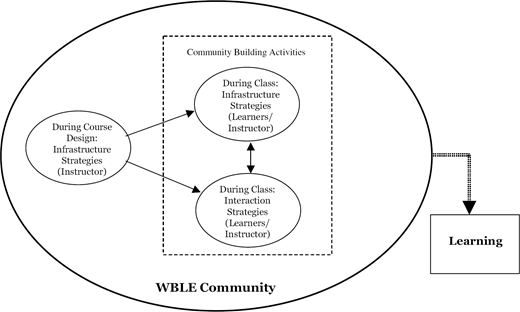
The analysis completed to date has enabled the creation of the beginnings of a theoretical model for community building and its potential relationship to the creation of a learning community (see Figure 1). While the model is not complete, it does exemplify a significant step toward identification of strategies and techniques that can enable community building in WBLEs.
Strategies and Techniques for Community Building in On-Line Environments.
| Infrastructure Strategies | Interaction Strategies |
|---|---|
Access to multiple communication technologies. Posting of announcements and “what's new” updates. Personal Web pages for each learner. | Read for content not for detail. Encourage and support fellow learners in their efforts. Use CSM messages to indicate to learners what they Could be doing, what they Should be doing, and what they Must be doing in terms of the course. |
| Learners have sufficient opportunities to interact with each other as well as with the instructor. | Use of teams for completing work in the course. |
| A daily visit to the Web site to check for new messages on the bulletin boards. |
The model in Figure 1 illustrates how community building strategies may lead to community building activities that take place during a class. As discussed earlier, during course design, the instructor can implement a number of infrastructure strategies that provide a basic framework for community building (e.g., access to multiple communication technologies, posting of announcements and “what's new” updates, and personal Web pages for each learner that included a picture and biographical information). During the class, both instructor and learners can use interaction strategies (e.g., initiating, responding) for community building.
The two sets of strategies (infrastructure and interaction) can lead to enhanced communication during the class, creating opportunities for connections by and between learners and instructor. These connections, in turn, can lead to the emergence of a community that can support a learning outcome. Future research is needed to explore the extent to which the strategies and techniques enable learning to occur.
Discussion and Suggested Next Steps
This study investigated strategies and techniques for community building in WBLEs. Overall, participants in both courses indicated the use of some community building strategies, leading to some awareness of community, albeit limited in scope. Based on the data we gathered, the impact of the community building strategies seems to occur faster and more readily in teams or small groups. The learners indicated a stronger connection with their team members than with the larger class group. While further investigation needs to be completed to verify this finding, we do feel comfortable in proposing a preliminary implication: focus community building strategies in small groups within the Web-based course, then look to extend those efforts to the larger class over the duration of the course.
Instructor and Learner Strategies for Community Building In On-Line Environments.
| Instructor Strategies | Learner Strategies |
|---|---|
| Provide multiple opportunities for interaction. | Visit the course Web site daily (or every other day at a minimum). |
| Send out management related messages (e.g., CSMs) on a regular basis. | Provide encouragement and support. |
| Establish teams so that learners work together to complete tasks | Scan material posted on the Web site - do not read for detail |
| Keep the Web site up-to-date and add in new information on a regular basis to keep things “fresh.” |
Our recommendation of developing community across and between groups, and over time, mirrors research on learner engagement in online environments completed by Conrad & Donaldson (2001). In their research, Conrad and Donaldson recommended the implementation of strategies for engaged learning in phases, where phase one focuses on the individual and phase four (the last phase) focuses on the overall community. We believe that a similar approach would prove effective for building community in a Web-based environment—first focusing on the individual and, over the duration of the course, moving to teams and finally the overall community. Further research is needed to discover if moving from the individual to the team to the collective is an effective way to enable community building.
As we continue work in this area, we are also beginning to consider different questions and issues to explore. One issue we offer as an area for additional study is that of adjustments to change. As compared to face-to-face classes, WBLEs place more demands on both instructor and learners in terms of amount of time worked, and number of student-instructor and student-student interactions. As with regular face-to-face classes, it is better to wait with the evaluation of a Web-based course until it has been taught at least twice. The first time around is typically a learning experience for the instructor and the learner; better to use this as a vehicle to determine what works and what does not work, and then make additional judgments the second—or third—time around.
We also recognize the need for assisting others in the implementation of community building strategies in their own WBLEs. Models and tools to assist with this effort would go a long way toward helping others interesting in building community in their own WBLE. We have proposed a preliminary model for community building in WBLEs. We encourage others to also explore this area and test the viability of the model.
Conclusion
By delivering engaging and meaningful instruction in WBLEs, universities can increase their visibility and viability in the 21st century educational arena. Further, results from this study can be used to guide and facilitate the design, development, and implementation of WBI to increase interaction and engagement. This, in turn, can lead to higher retention (our experience: 94%) and satisfaction (our experience: high) in on-line courses at institutions of higher education.
Authors note: The authors would like to recognize the work of Joan Davis and Michael Grant, Ph.D. students in the Instructional Technology program at UGA at the time this research was completed. Without their assistance with building and maintaining the course sites, as well as assistance with data collection and analysis, this research would not have been possible.

