


This paper explores the nature of psychological distance in distance learning and identifies some vital student support issues. Initial findings from a pilot study comparing the experiences of remote and local students (N = 30) are presented. Significant variance between genders was observed in expected support, with females generally requiring more than males. Individual differences in approaches to study also indicated a significant variance in expectations. No significant differences were observed between the expectations of remote and local learners. Although the sample size is small, and may lack statistical power, several key issues are raised which point the way for future research. A full study (N = 300), currently underway will be reported in a future article.
Introduction
The rise in popularity of distance education has prompted a great deal of research into the effects on students. The effect of being separated from both peers and instructors is arguably the most important feature of distance education research. Considering this, Moore (1991) and Moore and Kearsley (1996) proposed the theory of transactional distance as an explanatory framework for distance education. Moore (1983) and later Saba (1988) argued that transactional distance is a function of the variance of dialogue and structure. The extent of closeness or remoteness reported by students indicates the responsiveness of a given program to an individual learner's needs. This perceptual chasm (or “psychological gap”) becomes apparent when teachers and students interact at a distance. It is a variable phenomenon, with close transactional distance resulting from an increase in dialogue and structure. Conversely, remote transactional distance is evident when dialogue and course structure are decreased.
Distance education in emerging as a mainstream activity for many institutions and organizations throughout the world (Simonson, et al., 2000). As distance education assumes greater importance in the general scheme of education and training, it becomes increasingly important that more should be learned about the effects of distance learning on students. Many areas have already been extensively studied, including student attrition rates (Belawati, 1998) the differences between studying in traditional settings and at a distance (Barry & Runyan, 1995; Eiserman & Williams, 1993) the effects of multimedia materials on learning and memory (Tuovinen & Sweller, 1999; Tuovinen 2000) and the use of dialogue to unite distributed student groups and connect learner and instructor (Katz, 2000; Brown, et al., 1999). It is evident, however, that not enough research has been undertaken to investigate the true nature of the perceived distance and its effects on remote students. The aim of this paper is to highlight some of the fundamental issues, outline some of the problems experienced by distance learners, and propose some potential solutions.
The Nature of the Distance
The very nature of distance education separates students from instructors (Boondao & Rowley, 1991) and this separation is likely to be temporal as well as spatial in nature (Marsden, 1996). Moore & Kearsley (1996) argued that the “transactional distance” between learners and instructors becomes evident in their interactions (dialogue), the structure of instructional programs and also the level of autonomy each learner demonstrates (Moore, 1993).
Other commentators elaborate, suggesting that the psychological gap between teacher and student may amplify the potential for misunderstanding (see for example Willis, 1993). This instructional gap may also result in mismatches between what the course author desires to communicate and the students’ interpretations (Marsden, 1996), and between the intentions of instructors and the expectations of students (Moore, 1991). Moreover, there is evidence to suggest that anxiety or psychological discomfort resulting from learning at a distance may increase rather than decrease as time goes by (Jegede & Kirkwood, 1994).
Moore identified three kinds of interaction: learner-content, learner-instructor, and learner-learner (Moore, 1989). Interaction between instructor and learner is possibly the most important function of distance learning support. Lack of interaction between teachers and students, along with the perception of lack of instructor input into the learning process, have been shown to have detrimental effects on some distance learners (Teven & McCroskey, 1996) while students who interact regularly are more likely to learn more effectively (Willis, 1993). This “guided didactic conversation” between student and teacher promotes pleasure in learning and motivates learners (Holmberg, 1989). Brown, et al. (1999) demonstrated that the most effective distance lectures occur when a high level of interaction is promoted and where, for example, students are addressed by name. Educators often fail to take these communication factors into consideration when designing courses to deliver to remote students (Jenkins, 1988). Although distance learners may be using the same technologies, they will invariably experience learning differently, and there is therefore a case, argues Bates (1997) for instructors to meet these diverse needs by offering a range of tutorial services.
Although geographical distance can be bridged by information and communication technology (ICT) the research already quoted shows that it is the interaction between the teacher and the student that somehow holds the key to success for the distance learner. Technology therefore has an important role to play in this process. It is generally agreed, for example, that text is a useful mediating factor between instructors and remote students (Marsden, 1996). However, a psychological dimension to the separation exists, and the author argues that this gap can only be bridged effectively by sensitive and appropriate facilitative support skills on the part of the instructor.
Support for distance learners is, as we have seen, a sensitive and important issue, and as a component of dialogue between instructor and learner, it requires careful consideration. One study by Visser and Visser (2000) highlighted the need for further investigation in this area, suggesting that there is a divergence between what distance learners perceive and what they actually receive in terms of learning support. Another study by Carnwell (2000) argues that support offered to distance learners must be flexible in order to cope with the vast diversity of needs and perceptions of students.
Pilot Study
A pilot study was carried out to investigate the nature and extent of the psychological distance apparent in technology supported distance learning environments, by establishing the differential between perceived and actual support in a distance education environment. A comparison was made between two learner populations, local and remote, studying on two courses, business computer applications, and computer-aided design (CAD). This pilot study sets the scene for a full research program already underway where over 300 distance learners will participate over a period of one year.
Method
Participants
Two groups of students studying on identical courses participated in the study. There were a total of 30 learners (15 males and 15 females), with a mean age of 38 years and standard deviation of 14.4. One group (n = 20) was studying at a local college of further education with access to an instructor at all times. This group was designated as local group (L). A second group of learners (n = 10), was a population of distributed learners studying at seven rural tele-centers across the region. These were designated as remote group (R) (See Figure 1).
The groups were enrolled on the same two courses, namely a basic computer literacy and information technology course (CLAIT), and a course in computer aided design (CAD). They were labelled as levels 1 and 2 respectively, reflecting the increased level of academic demand required by the latter. All of the students had been enrolled in their respective courses for at least one month, and were studying on a flexible basis.
Procedure
Each learner completed a questionnaire that was designed to measure several items, including demographic details, learner expectations, perceptions of instructor support, and satisfaction levels ( Appendix 1). Participants also completed the Approaches to Study Inventory (ASI) (Entwistle, 1981) to provide a further dependent measure.
The ASI was originally designed to measure preferences and approaches to study and is presented as a series of 40 statements with a 5 point Likert measurement scale. Participants score on 8 sub-scales, including surface, deep and strategic approaches to study, and a predictor score of success in learning.
Responses are sub-grouped into indicators of each student's bias toward surface approaches to learning, such as “reproducing” behavior and deep approaches such as comprehension and meaning. These are contrasted by strategic approaches to learning that are represented by an optimum mix of deep and surface approaches. Entwistle argued that a high strategic approach indicates a high prediction of academic success. The predictor variable is an indicator of how well students can be expected to cope with the program of study, and in particular, their potential for self-sufficiency and autonomy. Although there is no correlational evidence to link predictor scores with student autonomy, there is an implied relationship.
Principal Components Analysis of Perception Responses
| Factor P | Factor A | Factor S | |
|---|---|---|---|
| Encouragement | .883 | ||
| Direction | .643 | ||
| Information | .588 | ||
| Feed Back | .634 | ||
| Explanation | .775 | ||
| Motivational | .776 | ||
| Practical Help | .738 | ||
| Emotional Support | .901 | ||
| Technical Support | .861 | ||
| Discipline | .552 | ||
| Helpful “Tips” | .673 | ||
| Total Variance % | 46.325 | 14.296 | 9.485 |
Factor Analysis
Carnwell (2000) identified three categories of support for distance learners. These are academic, emotional, and practical. She suggested that some students require all three, while others require some or none at all. Academic support is defined as specific advice about the course itself, including direction or “signposts,” explanation and general “housekeeping” details. Practical support (called “administrative” support by Visser & Visser, 2000) represents practical help and advice such as where to find learning resources and technical support. Emotional support (called “affective” support by Visser & Visser, 2000) is concerned with social support, motivation, reassurance, cajoling, and a general sense of discipline. Carnwell's categories were loosely applied to the data gathered in this study and a three factor solution was therefore sought. Principal component analysis was used to reduce data to determine which categories of perception responses could be grouped. As expected, responses fell naturally into three discrete areas of support, and these were designated as Practical support (Factor P), Academic support (Factor A), and Social and Emotional support (Factor S). The three factors accounted for more than 70% of the total variance. Table 1 presents the full factor matrix, with variance accounted for, shown using a varimax rotational correction.
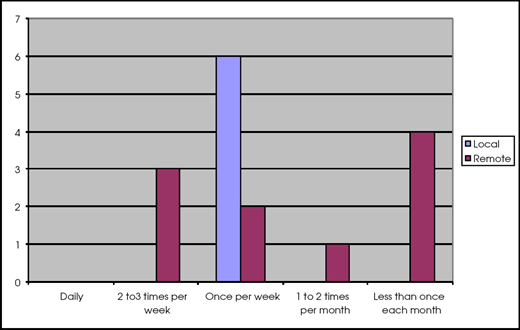
Figure 1 shows a comparison of the frequency of tutorial contact for local and remote students. Local students regularly met with their instructor once a week, whereas remote students contacted their instructor using the telephone, e-mail or videoconference on a more random, ad hoc basis.
Mean Scores for 3 Categories of Tutorial Support (with standard deviations) for Local and Remote students
| Support category | Practical | Academic | Social |
|---|---|---|---|
| Local Support Expected | 15.40 | 6.70 | 1.90 |
| (6.45) | (3.56) | (1.96) | |
| Local Support Received | 16.10 | 7.10 | 3.70 |
| (6.36) | (3.31) | (2.79) | |
| Remote SupportExpected | 16.16 | 6.35 | 2.26 |
| (2.16) | (3.53) | (1.94) | |
| Remote Support Received | 14.26 | 5.30 | 3.26 |
| (6.47) | (3.66) | (2.44) |
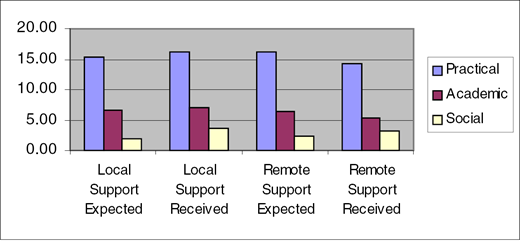
Expected and Received Support (local and remote students)
Expected and Received Support (local and remote students)
A difference was observed between the total tutorial contact times of local and remote students, with remote students generally having less dialogue with their instructors. Lack of contact can be explained by the difficulty in communication between people at a distance, but may also contribute to the learner feeling isolated from expert help and learning support.
There was a marked difference between the perceptions and reality of support between local and remote students. Table 2 shows mean scores (and standard deviations) across all categories of support offered by tutorial staff. Higher scores indicate higher expectations.
Gender Differences
One way analysis of variance revealed statistically significant differences between the males and females in expected practical support (F [1,27] = 4.965, p < .034), with females expecting substantially more support in this area. Females also received more practical support, but not as much as they generally expected. In the social support category, both males and females generally received more than they expected. No other significant between group differences were observed for expected or received support (F [1,27] < 1, n.s.).
A gender difference was consistently observed in both expected and received support, with females generally receiving more practical and academic support than males, and males receiving more social support than 20 females. Table 4 presents these results and Figure 3 represents the differences.
Mean Scores for the 3 Categories of Tutorial Support (with standard deviations) for Females and Males
| Support category | Practical | Academic | Social |
|---|---|---|---|
| Expected Support (Females) | 15.40 | 6.70 | 1.90 |
| (6.45) | (3.56) | (1.96) | |
| Received Support (Females) | 16.10 | 7.10 | 3.70 |
| (6.36) | (3.31) | (2.79) | |
| Expected Support (Males) | 16.16 | 6.55 | 6.27 |
| (2.16) | (1.75) | (2.10) | |
| Received Support (Males) | 15.18 | 4.91 | 5.55 |
| (2.48) | (2.51) | (2.54) |
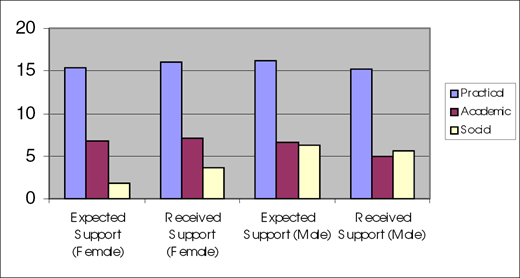
Expected and Received Support (Female and Male Students)
Expected and Received Support (Female and Male Students)
One way analysis of variance revealed significant differences between males and females in expected Direction at F (1,27) = 2.93, p < .09, expected Explanation, F (1,27) = 3.20, p < .084, including expected technical support at F (1,27) = 4.302, p < .04. Significant variance was also observed in received Feedback, F (1,28) = 3.073, p < . 09, received Motivation (social support), F (1, 27) = 4.184, p < .05, received Explanation (technical support), at F (1,27) = 3.004, p < .094, and useful ‘tips’ at F (1,28) = 5.016, p < .033.
Individual Differences
A Pearson Product Moment Correlation procedure was used to analyse relationships between student preferences and their perceptions of support. Significant positive correlation was found between the overall expected totals and the ASI Achieving dimension (r = .401, p < .028), between expected Information and Achieving (r = .386, p < .035), and between Direction (Practical) and Achieving (r = .479, p < .007). Positive correlation was also observed between Received Direction and the ASI Reproducing dimension (r = .367, p < .04), Received Information (Practical) and Reproducing (r = .543, p < .002), and between Received Feedback (Academic) and the ASI Versatility dimension (r = .437, p < .01). All results were represented as 2 tailed predictions.
Discussion
A comparison between local and remote students’ perceived and actual support revealed that little difference existed between what students expected and received. However, there was a marked differential between local student and remote student expectations. There was also a significant increase in the support offered to remote students, but interestingly, where explanation was concerned, this fell substantially short of what remote students expected.
Correlation Matrix for All Categories of Responses (and standard deviations)
| Mean | Female Mean | SD | Male Mean | SD | |
|---|---|---|---|---|---|
| Expected Encouragement | 2.17 | 2.33 | (1.63) | 2.00 | (1.31) |
| Expected Direction | 2.33 | 2.73 | (1.33) | 1.93 | (1.22) |
| Expected Information | 2.60 | 2.93 | (1.28) | 2.27 | (1.03) |
| Expected Feedback | 2.20 | 2.40 | (1.55) | 2.00 | (1.31) |
| Expected Explanation | 2.80 | 3.20 | (1.21) | 2.40 | (1.24) |
| Expected Motivation | 1.43 | 1.73 | (1.44) | 1.13 | (1.13) |
| Expected Help | 3.20 | 3.33 | (1.23) | 3.07 | (1.16) |
| Expected “Listening Ear” | 1.03 | 1.00 | (0.68) | 1.07 | (1.10) |
| Expected Tech Support | 2.69 | 3.21 | (1.25) | 2.20 | (1.37) |
| Expected Discipline | 1.10 | 1.14 | (1.29) | 1.07 | (1.28) |
| Expected Tips | 2.17 | 2.53 | (1.36) | 1.80 | (1.21) |
| Expected Total | 23.57 | 26.20 | (9.75) | 20.93 | (9.05) |
| Received Encouragement | 2.17 | 2.33 | (1.50) | 2.20 | (1.37) |
| Received Direction | 2.47 | 2.67 | (1.29) | 2.27 | (1.28) |
| Received Information | 2.37 | 2.53 | (1.51) | 2.20 | (1.15) |
| Received Feedback | 2.03 | 2.47 | (1.46) | 1.60 | (1.24) |
| Received Explanation | 2.33 | 2.47 | (1.30) | 2.20 | (1.37) |
| Received Motivation | 1.60 | 1.73 | (1.44) | 1.47 | (1.36) |
| Received Help | 3.07 | 3.27 | (1.03) | 2.87 | (1.25) |
| Received “Listening Ear” | 1.86 | 2.36 | (1.28) | 1.40 | (1.24) |
| Received Tech Support | 2.34 | 2.79 | (1.42) | 1.93 | (1.22) |
| Received Discipline | 1.55 | 1.57 | (1.50) | 1.53 | (1.36) |
| Received Tips | 2.23 | 2.73 | (1.16) | 1.73 | (1.28) |
| Received Total | 23.90 | 26.40 | (11.13) | 21.40 | (11.42) |
There were other disparities in experience between local and remote students. First, the means by which learners communicated with their instructors moderated the frequency of communication. Remote students averaged fewer conversations each month with their instructors than local students, but they enjoyed more flexible access through video links, e-mail and telephone contact.
Generally, males expected and received less support than females, both in the remote and local contexts. Further research into the reasons behind this is highly recommended, but variables to consider may include the influence of the instructor in terms of gender and experience, the nature and quality of the learning environment, and student activities linked to learning outcomes. Overall, learners with high levels of Achieving scores on the ASI were significantly less needy of direction from their instructor. Conversely, those with high Reproducing scores (the antithesis of Achieving) required more information and direction from their instructors. These results suggest that distance learners who study with the aim of merely reproducing knowledge through a surface approach perceive a greater need for direction, whereas those who practice a deeper, meaning-centered approach require less of this kind of support.
It is evident from the results of this study that remote students expect a great deal more from their instructors than their local peers in terms of social and practical support, most probably due to the psychological (transactional) distance they perceive. However, they expected less in terms of academic support which may indicate that they perceive less need due to their independent learner status. A new hypothesis to test might be that distance learners who experience more remote transactional distance will tend to demand more social and practical support from their instructors. Local students, however, may demand and receive less social and practical support because they experience a closer transactional distance with their instructor, richer in dialogue and structure, and they also benefit from peer group support. All of the remote students in this study were studying in isolation from their peers, and regardless of their independent status, they may have perceived they had less control over the learning process and experienced a greater level of transactional distance as a result.
Conclusion
Transactional distance may not only be an artefact of the interplay between instructional program structure and level of dialogue, but may also be an effect brought about by the disposition of each individual student. Distance educators may need to concentrate in particular on providing pedagogical support in the areas of explanation, direction, and information-giving. Females may require more support than males, and those who approach study in a generally shallow manner may require more help than those who possess skills for deeper and more “meaning” oriented learning. Although student support can sometimes be seen as didactic in nature, some forms of support offer a great deal of interaction that encourage students to apprehend the material more effectively.
With only 30 participants, this pilot study lacks the statistical power to provide concrete recommendations and serves merely to indicate the direction of future research. It is expected that the results from further study using a larger participant sample will offer more generalizable findings.
References
Appendix 1 Computers and Learning Questionnaire
The University of Plymouth is studying the way people learn with the help of computers. We are particularly interested in the way instructors, family, and other students support this kind of learning. We would be grateful if you would spend a short time completing this questionnaire. All answers will be treated in strict confidence.
Male □Female □
Age:________________ Course:__________________
Where is your normal place of study?___________________________
PLEASE TICK ONLY ONE BOX FOR EACH QUESTION
How do you normally communicate with your college instructor?
Face to face □ By video link □
By e-mail □By phone □
How often do you communicate with your instructor(s)?
Every day □2-3 times a week □
Once a week □1-2 times a month □
Less than once a month □Never □
How much support/help do you get from other students?
A lot □A little □
None □Unsure/Not applicable □
How much support/help do you get from friends or family?
A lot □A little □
None □Unsure/Not applicable □
How important is it for you to get support/help on this course?
Vital □Very Important □
Fairly Important □Not at all Important □
Unsure □
What kind of support do you expect from your college instructor(s)?
(Tick ONE BOX ONLY for each item) Very much Much Some None Not sure Encouragement Direction/Guidance Information and Facts Feedback on my progress Explanation Motivation/Inspiration Help when I need it A friendly ear/Someone to talk to Technical support/Troubleshooting Discipline and Structure Useful tips/Practical help Other :______________________ What kind of support do you receive from your college instructors?
(Tick ONE BOX ONLY for each item) Very much Much Some None Not sure Encouragement Direction/Guidance Information and Facts Feedback on my progress Explanation Motivation/Inspiration Help when I need it A friendly ear/Someone to talk to Technical support/Troubleshooting Discipline and Structure Useful tips/Practical help Other______________________

