


Distance learning has significantly changed over the years from a social, pedagogical, and technological perspective. The compatible bonding of telecommunications technologies and social constructivist learning principles premised a pedagogical ecology that has challenged traditional teaching practices, faculty and student roles, institutional roles, and academic infrastructures, prompting a reconceptualization of distance learning and a rethinking of the broader practice of education and training. Pedagogical ecology emphasizes the nonneutrality of the learning space and consideration of the expectations and potentials that each learning medium brings forth to the teaching and learning process. This paper discusses the evolution of the pedagogical ecology of distance learning and presents a model for the design of online learning environments that emphasizes a transformative interaction between learning technologies, pedagogical models, and instructional strategies.
Affordances and abilities are relative to each other: a situation can afford an activity for an agent who has appropriate abilities, and an agent can have an ability for an activity in a situation that has appropriate affordances. (Greeno, Smith, & Moore, 1993, p. 114)
Gibson’s theory of affordances is an ecological approach to psychology that emphasizes perception and action rather than memory and retrieval. According to Gibson, action and perception are linked through real-world objects that afford certain forms of action possibilities (affordances) for particular individuals or organisms (Albrechtsen, Andersen, Bodker, & Pejtersen, 2001). Gibson’s theory of affordances has direct implications on how we may understand the evolution of distance learning. Distance learning has significantly changed over the years from a social, pedagogical, and technological perspective. These changes seem to coincide with the changes and advances in learning technologies, making it difficult to separate the impact of technology on the teaching and learning process and supporting the argument that technology is not neutral but rather that it brings with it its own affordances (possibilities for action) and implications on learning designs. The compatible bonding of telecommunications technologies and social constructivist learning principles premised a pedagogical ecology (Jaffee, 2002) that has challenged traditional teaching practices, faculty and student roles, institutional roles, and academic infrastructures. Pedagogical ecology emphasizes the non-neutrality of the learning space and consideration of the expectations and potentials that each learning medium brings forth to the teaching and learning process. Supporters of this view argue that each medium has a unique set of characteristics and that understanding the ways in which students use the capabilities of the medium is essential to understanding the influence of the medium on learning and on building media theory (Kozma, 1994). The focus of this paper is on Internet- and Web-based technologies and the affordances they bring forth to the teaching and learning process. In order to better understand the influence of these technologies on the evolution of distance learning, a discussion of the pedagogical ecology of traditional learning environments and classic distance learning is in order.
The Pedagogical Ecology of Traditional Learning Environments
Traditional face-to-face learning environments have long been associated with classroom instruction in which the teacher is the expert, the main deliverer of knowledge, and the sole assessor of student learning. The setting is that of an authoritative and knowledgeable figure who has been entrusted with the task of imparting reliable knowledge to the students and assessing students’ mastery of knowledge through tests and other observable and measurable behaviors. Each classroom is a self-contained and isolated curricular unit and interaction is limited in scope to this unit (Kearsley, 2000). Content is generally sequenced in a linear order from the instructor’s point of view and each student receives the same instruction at the same pace using the same context (Dabbagh, 1996). Instruction, therefore, takes the form of a directed approach, in which the teacher is teaching an “identifiable body of knowledge” to students using methods that are grounded in behavioral and early cognitive learning theory (Hannafin, Hill, & Land, 1997; Kearsley, 2000). This directed pedagogical approach is also descriptive of traditional or classic distance learning. Traditional distance education began with print-based correspondence courses more than 100 years ago (Galusha, 1997; Picciano, 2001; Schrum, 1999). The practice was known as “correspondence study” or “extension courses” and was established initially in Europe, crossing the Atlantic in 1873 (Schlosser & Simonson, 2003). Correspondence study courses were delivered primarily through print media, with the content segmented into manageable units providing sufficient structure to ensure success. Correspondence study courses benefited from the planning, guidance, and pedagogical practices of an educational organization without being under the continuous and immediate supervision of tutors present with their students in lecture rooms or on the premises. Moore (1994) referred to this type of correspondence study as non-autonomous or teacher-determined, and gauged the degree of learner autonomy by determining how much guidance a learner needs in formulating objectives, identifying sources of information, and measuring objectives. Moore noted that, in most conventional educational programs, resident or distance, the learner is very dependent on the teacher for guidance, and the teacher is active while the student is passive. Guided readings, frequent tests, and free pacing of progress through the program by the student were key elements of traditional or classic settings of distance education. Additionally, in traditional distance education settings, the “quasi-permanent absence of the learning group” was evident (Keegan, 1990, p. 44) (meaning that people are usually taught as individuals and not in groups, with the possibility of occasional meetings for didactic and socialization purposes), and the learning need was primarily based on a geographical distance that prohibited the individual from enrolling as a resident student in an academic institution.
With the move to Internet- and Web-based technologies, there was a growing realization that traditional teaching techniques will not work in Internet-supported distance education settings (Thach & Murphy, 1995). Internet-based telecommunications technology began to increase the potential for interaction and collaborative work, which was difficult to achieve with previous delivery formats of distance education (Riel & Harasim, 1994). Interaction took on a new meaning extending beyond learner-teacher, learner-content, and learner-program modes to learner-learner and learner-group modes, eliminating the quasi-permanent absence of the learning group. As LeCourt (1999) suggested, “technology became a cultural artifact that changed the educational dynamic from focus on the individual to focus on a group if we look at the current trends in educational uses of technology where the focus is on collaborative and multicultural pedagogies” (p. 52). Additionally, the concept of distance became relatively unimportant or blurred (i.e. not limited to the physical separation of the learner and the instructor), challenging the traditional pedagogical ecology of distance education. Pedagogical constructs and models such as distributed learning, open/flexible learning, asynchronous learning networks, knowledge networks, knowledge-building communities, virtual learning communities, electronic classrooms, and communities of practice, began emerging, prompting the reconceptualization of distance learning. Two underlying concepts played an important role in the emergence of these models: globalization and learning as a social process.
Globalization and its Impact on Distance Learning
Globalization is described as a psychological phenomenon that can be applied to many contexts to imply that most people are connected simultaneously with distant events, directly or indirectly, intentionally or unintentionally, promoting a perception or an awareness of the globe as a single environment (Evans, 1995). Terms such as the “information revolution” and the “end of geography” underlie this somewhat ambiguous concept and give rise to two distinct dimensions of the concept: increasing or stretching the scope of an activity; and deepening the interconnectedness of an activity (Walker & Fox, 2000). For example, in multinational corporations, economic activities are stretched across the world as geographical constraints recede and economic relationships intensify in the sense of increased interconnectedness, making the distinction between domestic economic activity and worldwide economic activity difficult to sustain. In brief, globalization can be thought of as “the widening, intensifying, speeding up, and growing impact of world-wide interconnectedness” (Held & McGrew, 2002). The cultural and technological preconditions for globalization were not in place until the late 1970s and early 1980s. Evans (1995) argued that “globalization is not a technical outcome of the development and implementation of communications and transport technologies; rather it is a social, economic, political, and cultural outcome” (p. 258). Therefore, both the technological and socio-cultural structures and practices of our society had to evolve in order for globalization to take on its new meaning in the Information Age. With these preconditions now firmly in place, the modern meaning of globalization implies a global perspective of the particular area of study, a perspective that arises from the increased interdependence of technological advances and socio-cultural changes. Telecommunications technology has played a significant role in realizing this modern meaning of the concept. This is particularly evident in financial markets. According to Lowell and Farrell (1996), the most important factor in the globalization of financial markets is technological change.
The same can be argued for distance learning. Recent advances in telecommunications technology have redefined the boundaries and interactional pedagogies of traditional or classic distance learning environments by stretching their scope and deepening their interconnectedness. New learning interactions that were not perceived possible before can now be facilitated, such as the coupling of experts from all around the world with novices, the accessibility of global resources, the opportunity to publish to a world audience, the opportunity to take virtual field trips, the opportunity to communicate with a wider range of people, and the ability to share and compare information, negotiate meaning, and co-construct knowledge. These activities emphasize learning as a function of interactions with others and with the shared tools of the community. This brings us to the second principle prompting the reconceptualization of distance learning: learning as a social process.
Learning as a Social Process and its Impact on Distance Learning
Learning can be viewed as a social process in which social interaction plays an integral part and the emphasis is on acquiring useful knowledge through enculturation. In other words, there is a social framework or “culture of practice” surrounding a learning context whose constituents are the learners, the interactions that these learners engage in, and the tools that enable those interactions. The socialization of knowledge is based on the idea that knowledge is always under construction (fluid, dynamic) taking on new meanings relative to the activity and situations in which it is being explored (Brown, Collins, & Duguid, 1989). The concept of the social framework within which knowledge is constructed is rooted in the epistemological perspective of social constructivism. Social constructivism is largely attributed to Vygotsky’s approach to developmental psychology (Maddux, Johnson, & Willis, 2001) in which Vygotsky argues that children develop in social or group settings and, therefore, learning is a socially mediated activity. Knowledge in the context of social constructivism is perceived as belonging to, and distributed in, communities of practice or “environments of participation” in which the learner practices the patterns of inquiry, learning, and the use of shared resources as part of the preparation for membership in a particular community (Firdyiwek, 1999). This view of knowledge is known as distributed or situated cognition. It is also known as cultural knowledge, social knowledge, and social cognition. Rather than thinking of cognition as an isolated event that takes place inside one’s head, cognition is looked at as a distributed phenomenon—one that goes beyond the boundaries of a person to include environment, artifacts, social interactions, and culture (Rogers, 1997; Hutchins & Hollan, 1999).
For example, the navigational system goal of a U.S. Navy amphibious transport helicopter would be to successfully steer the ship into a harbor. Since this system is not relative to a single person but to a distributed collection of interacting people and artifacts (tools) that form a single cognitive system, it can only be understood when one understands “as a unity, the contributions of the individual agents in the system and the coordination among the agents to enact the goal,” which in this case is to achieve a successful and safe entry into the harbor (Nardi, 1996, p. 77). A main principle of distributed or situated cognition, therefore, is to understand the coordination among individuals and artifacts (how individuals align and interact within a distributed process) in a system or community. As Young (1993) contended, “it is only the interaction between an agent and an environment that can truly be said to be intelligent” (p. 44). This interpretation of situated cognition is consistent with Gibson’s theory of affordances. Action and perception are linked through the affordances present in a given situation, and the abilities of an agent to act upon these affordances. In technologyenabled distance education settings, distributed cognition is manifested through distributed forms of interaction or what is known as distributed learning.
Distributed Learning
Distributed forms of interaction (or distributed learning) made possible by learning technologies can take place in knowledge networks, virtual classrooms or communities, and asynchronous learning networks where groups of learners or professionals with a common goal congregate to share information and resources, ask questions, solve problems, and achieve goals, and in doing so, collectively build new knowledge and evolve the practices of their community. These forms of interaction can also be applied to supplement face-to-face instructional activities, bringing to the forefront an important distinction between a course as a whole that subscribes to these interactions, and the notion of “distributed course events” that hold complex challenges for the distributed course designer (Dede, 1996). A distributed course can be defined as a course in which one or more of the instructional events that traditionally have occurred in the physical classroom are distributed to learners so that they may occur while learners are separated by either time or space from one another and the course instructor (Locatis & Weisberg, 1997, p. 41). Learning can therefore occur at the same time in different places (e.g., through scheduled videoconferencing events), at different times in the same place (e.g., meeting face-to-face in the classroom to attend guest lectures), or at different times in different places (e.g., using email to communicate with the instructor and with each other). Learning is perceived as distributed across space, time, and various media. Unlike classic distance education settings, distributed courses are not designed solely to deliver instruction to geographically distant learners, which is why the term “distance” in distance learning or distance education has become blurred and no longer necessarily implies the physical separation of the learner and the instructor. To better capture this conceptual change, terms such as distributed learning or blended learning have become more current.
Revisiting Distance Learning
Based on the above discussion, distance learning can be reconceptualized as the deliberate organization and coordination of distributed forms of interaction and learning activities to achieve a shared goal. The following attributes apply to this definition:
Globalization and learning as a social process are inherent and enabled through telecommunications technology:
The concept of a learning group is fundamental in achieving and sustaining learning;
The concept of distance is relatively unimportant or blurred, and does not necessarily imply the “long distance” physical separation of the learner and the instructor;
Teaching and learning events (or course events) are distributed over time and place, occurring synchronously and/or asynchronously;
Learners are engaged in multiple forms of interaction: learner-learner, learner-group, learner-content, and learner-instructor.
Distance Learning and Telecommunications Technologies
Distance learning, as defined above, can be enacted through a variety of telecommunications technologies, including audio, video, and computer or digital technologies. Of particular interest in this pedagogical analysis are the technologies within each of those categories that foster interaction. For example, in the audio category, audioconferencing and audiographics provide interactive capabilities between instructor and student, and between student and student (Picciano, 2001). Audioconferencing technology connects various sites or parties simultaneously using telephone message handling equipment. Audiographics can supplement this communication with graphics through electronic blackboards or document cameras that transmit images or drawings via the audio connection. In the video category, videoconferencing or teleconferencing “provides all the benefits of [educational] television and also allows the audience or students to interact in real time with the instructor and other students,” closely approximating the interaction in a traditional classroom environment (Picciano, 2001, p. 56). Videoconferencing is now also available on desktop computers, extending interaction to include audiences at multiple locations. Additionally, computer or digital technologies include several interactive technologies such as CD-ROM software, networked software that can run on a local area network (LAN), a wide area network (WAN), or on the Internet, and Internet- or Web-based technologies that include a variety of tools and applications to support the teaching and learning process.
Examples of Internet- and/or Web-based technologies that promote learner-content, learner-learner, learner-group, and learner-instructor interaction include hypertext and hypermedia; asynchronous and synchronous communication tools such as email, listservs, bulletin boards, groupware (multi-user software that enables synchronous and asynchronous communication and document sharing and production), and virtual chat; digital audio and video and other rich media; file transfer protocols; search engines; Web development tools, authoring systems, and course management systems, to name a few. When Internet or Web-based technologies are utilized to facilitate the design, development, and delivery of distributed forms of interaction or distributed course events, e-learning, online learning, or Web-based learning become more appropriate and current pedagogical constructs that describe such learning settings. More specifically, online learning can be considered a derivative or subset of distance learning defined as: “an open and distributed learning environment that utilizes pedagogical tools enabled by Internet- and Web-based technologies to facilitate learning and knowledge building through meaningful action and interaction” (Dabbagh & Bannan-Ritland, in press).
This definition emphasizes the link or interaction between perception and action as it pertains to the affordances that Internet and Web-based technologies present in a learning situation and the abilities a learner has to harness these affordances and engage in meaningful activity. To maximize the potential of this interaction when designing online learning environments, a three-component model that emphasizes the recursive and transformative interaction between pedagogical models, learning technologies, and instructional strategies is presented in Figure 1.
The three-component model for online learning is different than other learning design models in that it allows the instructional designer, developer, or online instructor the flexibility to begin thinking about designing distributed course events with any of the three components depicted by the three vertices of the triangle in Figure 1, and proceed clockwise or counterclockwise to integrate the other two components. The decision as to which component to consider first will be largely based on the particular instructional context and the expertise of the instructional designer, developer, or online instructor. For example, if a learning technology such as a course management system has already been selected for the implementation of distributed course events at a particular institution, the instructional designer or course developer may begin by exploring the instructional potential of this learning technology and proceed to integrate appropriate instructional strategies and pedagogical models to ensure overall instructional effectiveness and compatibility of the learning design. Alternatively, a college professor who may be more experienced in pedagogical approaches can choose to begin with a familiar pedagogical model and proceed to explore corresponding instructional strategies and learning technologies to create an integrated learning design. Another unique feature of this model is its emphasis on media (referred to as learning technologies in the model) as a key component in the overall design process. Rather than treating media as a delivery vehicle or a transmissive educational technology (Jonassen, 2000), media is placed on an equal footing as the other two components to ensure that the affordances that media bring forth to a learning situation are given appropriate consideration.
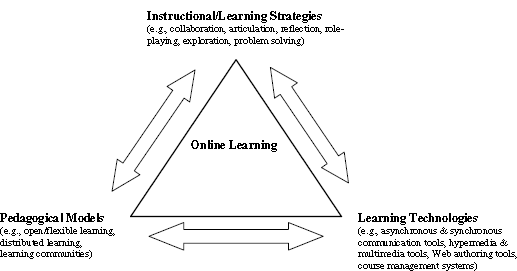
A three-component model for online learning
A three-component model for online learning
Additionally, the model suggests a recursive interaction among the three components, resulting in a transformative or self-organizing learning design system. Self-organizing systems are systems that evolve as a result of critical interactions among components that are internal to the system to form potentially evolving structures and emergent system properties (Self Organizing Systems FAQ, 2002). Online learning environments can be perceived as self-organizing systems due to the transformative nature of their pedagogical ecology. As described earlier in this article, both the technological and socio-cultural structures of our society had to evolve in order to transform the nature of distance education. As a result, pedagogical models and constructs such as distributed learning, open/flexible learning, knowledge networks, asynchronous learning networks, and virtual communities began emerging. As learning technologies continue to evolve, setting forth new affordances, new pedagogical models and instructional strategies will emerge, transforming learning designs.
Key Components of Online Learning
The three-component model for online learning suggests that there are three key components working collectively to inform the design of online learning environments that foster meaningful action and interaction: pedagogical models and constructs; instructional and learning strategies; and pedagogical tools or learning technologies. Pedagogical models can be described as views of teaching and learning. Pedagogical models are essentially cognitive models (knowledge acquisition models) or theoretical constructs derived from learning theory and enabling the implementation of specific instructional and learning strategies. In other words, they are the mechanism by which we link theory to practice. For example, information processing theory in which “the human learner is conceived to be a processor of information in much the same way a computer is” (Driscoll, 1994, p. 68) has led to a knowledge acquisition model known as CIP (Cognitive Information Processing) that portrays the mind possessing a structure consisting of components for processing information (e.g. sensory registers, short term memory, long term memory) and procedures for using these components (e.g. storing, retrieving, transforming, using). Implicit in this model is the principle that information undergoes a series of transformations in the mind in a serial manner until it can be permanently stored in long-term memory in packets of knowledge that have a fixed structure. Resulting from this view of CIP is the specification of instructional and learning strategies that assist the learner in processing information in discrete and linear events that align with internal cognitive processes such as selective attention, encoding, retention, and retrieval. Examples of such instructional and learning strategies include gaining the attention of the learner, helping the learner recall prerequisite knowledge, informing the learner of the lesson objectives, arranging information in sequential order, providing guidance, and providing practice.
By contrast, situated cognition theory, discussed earlier in this article, emphasizes pedagogical models and instructional strategies that allocate control of the sequence of instruction to learners (Coleman, Perry, & Schwen, 1997) and task the learner with creating, elaborating, constructing, and co-constructing representations of individual meaning (Hannafin, 1992). Examples of pedagogical models that are rooted in situated cognition include: situated learning (also known as anchored instruction), cognitive apprenticeships, problem-based learning (PBL), communities of practice (CoP), and cognitive flexibility hypertexts (CFH). These pedagogical models lead to the specification of instructional strategies that promote authentic learning activities, exploration, collaboration, and self-directed learning, among others. Instructional strategies are therefore derived from pedagogical models. Jonassen, Grabinger, and Harris (1991) described instructional strategies as “the plans and techniques that the instructor/instructional designer uses to engage the learner and facilitate learning” (p. 34). In technology-mediated learning environments, instructional strategies are supported or facilitated through the use of learning technologies, which is the third component of the model in Figure 1. Learning technologies act as “situated potentials” providing an authentic environment for active application and supportive interaction (Barab, Hay, & Duffy, 1998). Hence, learning technologies bring with them their own affordances or possibilities for action. Examples of learning technologies, specifically Internet-and Web-based technologies, were presented earlier. As learning technologies become more ubiquitous and new technologies continue to emerge, bringing forth new affordances, pedagogical practices and social structures are transformed.
Putting the Model into Practice
In the remainder of this paper, an educational example is provided that enacts the design process depicted in Figure 1. Although this example begins with the consideration of a pedagogical model and moves clockwise to integrate the two other components of the model in Figure 1, it is important to emphasize that the enactment of the three-component model for online learning may begin with any of its three components. In this particular example, it was more meaningful to begin by selecting an appropriate pedagogical model. Let’s see why.
Engaging in Cultural Inquiry. A national professional teaching society estimates that over half the public schools in America are wrestling with cultural diversity issues and learning needs stemming from differences in students’ educational and ethnic backgrounds. Some diversity issues come from the fact that the families of many schoolaged children emigrated from foreign countries and do not speak English. Other issues arise because American families are more mobile than they were 25 years ago. Many students spend only one or two years in the same school system. When they arrive at a new school, they have differing academic backgrounds and expectations. Teachers need to be able to analyze student problems and identify whether they are developmental issues, cultural differences, or learning disabilities. Perhaps the “difficulties” are the result of the teacher’s own overly narrow expectations. Educators must be capable of locating resources and using those resources to flexibly solve problems that interfere with their students’ learning. This year’s public school educational conference will address this issue. The theme is “Cultural Inquiry and Effective Education (CIEE).” The goal of the CIEE conference is “to support teachers working in culturally diverse classrooms so that they might provide effective educational opportunities for all students.” The conference will be divided into tracks geared to four different audiences: teachers in K-7, teachers in 8-12, school administrators, and technology support professionals. Presenters and participants will be encouraged to collaborate and share their experiences, and to recommend resources and methods for supporting culturally diverse classrooms. As the conference organizer and an instructional designer, you want this event to lay the groundwork for a teacher support base for cultural issues. You want to enable the teachers to continue the process of knowledge building and sharing beyond the conference. You want to help the teachers build a community of practice. Your hopes are that this community of practice will enable teachers to identify appropriate cultural approaches, knowledge domains, and intervention strategies to solve culturally based educational problems, envision alternative ways of viewing educational processes, and improve educational practice.
The conference organizer and instructional designer in this example began by selecting the pedagogical model, Communities of Practice (CoP), to enact a learning design. The designer was familiar with the concept of a CoP and the instructional challenge and context of the scenario called for the adoption of this model. Communities of practice are “groups of people informally bound together by shared expertise and passion for a joint enterprise” (Wenger & Snyder, 1999, p. 139). Over time, the activity and actions of the individuals engaged in the enterprise give rise to new and specific practices and processes that are shared by all members of the community. CoPs have become popular in the business community and in organizations that focus on knowledge as an intellectual capital. When the common purpose is learning, CoPs are known as learning communities and can be described as “shared environments that permit sustained exploration by students and teachers enabling them to understand the kinds of problems and opportunities that experts in various areas encounter and the knowledge that these experts use as tools” (CTGV, 1992, p. 79). In online learning environments, communities of practice include learners and instructors who interact with one another and other experts via online learning technologies to build a reciprocal interchange of ideas, data, and opinions. The following is a list of instructional attributes of a CoP:
Control of learning is distributed among the participants in the community and is not in the hands of a single instructor or expert
Participants are committed to the generation and sharing of new knowledge
Learning activities are flexible and negotiated
High levels of dialogue, interaction, collaboration, and social negotiation are exhibited by the participants
A shared goal, problem, or project binds the participants and provides a common focus and an incentive to work together as a community
Appreciation of diversity, multiple perspectives, and epistemic issues
Crossing of traditional disciplinary and conceptual boundaries
Innovation and creativity are encouraged and supported
Equipped with this understanding of a CoP, the instructional designer proceeded to explore instructional and learning strategies that support this model. Promoting collaboration and social negotiation, promoting exploration and problem solving, and promoting articulation and reflection emerged as primary instructional and learning strategies. The instructional designer then proceeded to examine the learning technologies that support the enactment of these strategies. Examples of mapping these strategies to learning technologies are presented below.
Promoting Collaboration and Social Negotiation
In its simplest form, a collaborative strategy can be defined as an instructional strategy that encourages interaction between and among two or more learners to maximize their own and each other’s learning. Social negotiation is an integral component of collaboration. In online learning environments, collaboration and social negotiation are largely supported through the use of asynchronous and synchronous communication technologies as well as document sharing tools and groupware. For example, the online developer can design activities that allow members of a CoP to share documents. Sharing documents online is a collaborative activity and can range from displaying the document in a designated Web posting area to having participants work simultaneously on a document using groupware. In the scenario above, teachers can generate intervention strategies to solve culturally-based educational problems collaboratively using groupware technologies.
Promoting Exploration and Problem Solving
Exploration encourages “students to try out different strategies and hypotheses and observe their effects” (Collins, 1991, p. 135). In exploratory learning, there is limited instruction and guidance from an instructor and more student-generated learning through exploring and discovering information. As Collins (1991) noted, “this puts students in control of problem solving” (p. 135). Therefore, exploration and problem solving are interdependent. Problem solving can be defined as a heuristic search process in a problem space (Newell & Simon, 1972) or as “any goal-directed sequence of cognitive operations” (Anderson, 1980, p. 257). Learning technologies that support exploratory and problem-solving activities include asynchronous and synchronous communication technologies, hypertext/hypermedia, search engines, online databases, and knowledge repositories. In the scenario example, the online developer can promote exploration and problem solving by presenting the participants with a Web-based case or problem in which elements of the case are linked to resources, online databases, and knowledge repositories using hypermedia links and search engines.
Promoting Articulation and Reflection
Articulation involves “having students think about their actions and give reasons for their decisions and strategies, thus making their tacit knowledge more explicit or overt” (Wilson & Cole, 1996, p. 606). Reflection is a process of analyzing and making judgment about what has happened to give a situation new meaning. Reflection is similar to articulation, except that it is pointed backwards to previous tasks. In online learning environments, articulation and reflection can be largely supported through the use of asynchronous and synchronous communication tools and Web publishing tools. In the scenario example, the online developer can design activities that engage participants in online discussions using bulletin boards or discussion forums. Facilitators (moderators) can be assigned to post engaging questions, prompt meaningful responses, keep the discussion focused on the topic, and provide a synthesis of the discussion at the end. Participants engaged in online discussions are articulating their understanding of the issues by answering questions and explaining to others what they know. In addition to promoting articulation, these discussion areas can later be revisited, enabling reflection on one’s postings and an analysis of one’s learning performance.
Mapping Instructional Strategies to Pedagogical Models and Learning Technologies
| Instructional Strategy | Supporting Pedagogical Model | Associated Learning Technologies |
|---|---|---|
| Promoting authentic learning activities | Problem-based learning (PBL), anchored instruction, cognitive apprenticeships | Graphics, digital audio & video, Web-based animation, Web-based authoring tools, hyperlinks |
| Promoting problem solving | Problem-based learning, anchored instruction | Hyperlinks, asynchronous & synchronous discussion forums, document sharing technologies, groupware, online databases, knowledge repositories |
| Promoting exploration | Simulations, microworlds, anchored instruction, CFH | Hyperlinks, search engines, online databases, scripting languages, web-based authoring tools, selfcontained instructional modules |
| Promoting hypotheses generation | Simulations, microworlds, PBL, anchored instruction | Plugins, Web-based authoring tools, Web-based animation, digital audio and video, dynamic Web pages (database driven websites) |
| Promoting role playing activities | Cognitive apprenticeships, CoP, simulations, PBL | MOOs, MUDs, Internet chat, video conferencing, groupware |
| Promoting articulation | Cognitive apprenticeships, PBL, CoP | Bulletin boards, discussion forums, virtual chat sessions, document sharing technologies, groupware, email, Web posting areas |
| Promoting reflection | Cognitive apprenticeships, anchored instruction, PBL | Web posting areas, bulletin boards, discussion forums, email, note-taking tools |
| Promoting collaboration and social negotiation | PBL, anchored instruction, CoP | Asynchronous and synchronous discussion forums, bulletin boards, groupware, document sharing technologies, video conferencing technologies, chat, shared databases |
| Promoting multiple perspectives | Cognitive flexibility hypertexts, CoP | Hyperlinks, graphics, digital video & audio, listserves, asynchronous discussion forums, search engines |
| Promoting modeling and explaining | Cognitive apprenticeships, simulations, CoP | Asynchronous & synchronous discussion forums, graphics, animation, video conferencing, digital audio & video, Web posting areas, email |
| Promoting coaching | Microworlds, simulations, cognitive apprenticeships, anchored instruction, problem-based learning | Email, hyperlinks, asynchronous & synchronous discussion areas, self-contained instructional modules, Web-based authoring tools |
| Promoting scaffolding | Cognitive apprenticeships, microworlds, CoP | Hyperlinks, email, search engines, asynchronous & synchronous discussion areas, online databases |
The above is a sample of instructional strategies and enabling learning technologies that support the enactment of a CoP. Different pedagogical models may emphasize different instructional strategies. Table 1 provides additional examples of the process of mapping pedagogical models to instructional strategies and learning technologies. In the second column, the pedagogical model that highly emphasizes the particular instructional strategy is listed.
Conclusion
This article discussed the evolution of the pedagogical ecology of distance learning and the social, pedagogical, and technological changes that led to a reconceptualization of distance learning based on two underlying concepts: globalization and learning as a social process. It was argued that the compatible bonding of telecommunications technology and social constructivist learning principles premised a pedagogical ecology that is self-organizing and transformative in nature. Based on this concept, a three-component model emphasizing the recursive and transformative interaction between pedagogical models, instructional strategies, and learning technologies was presented to scaffold the design of online learning environments. Examples of how to implement this model were also provided. It is the author’s hope that this article has provided a synergistic perspective on pedagogical issues and learning designs as they relate to distance and online learning.

