The aim of this study is to advance the understanding of the visual in arts-based participatory research, by using the concept of theorizing processes as an analytical lens.
A secondary data analysis was conducted, using data collected in a qualitative study exploring sustainable living environments for people with mental ill-health.
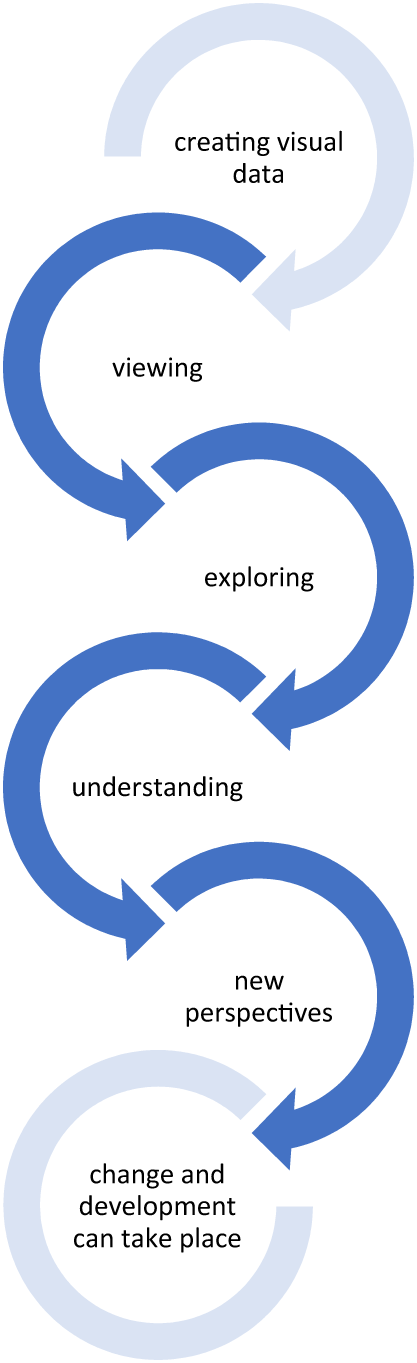
The visual allowed for new perspectives to be gained by the process including (1) viewing the visual data, (2) exploring the visual data with words and (3) explaining, recognizing and understanding the insights acquired from the initial visuality.
This study suggests how the use of the visual in participatory art-based qualitative research methods could contribute to the gain of new perspectives. This finding is the contribution of this study to the field of arts and health.
Background
Visual research is not new. Understanding how and what we see is among the most ancient forms of scientific investigation. As Margolis and Zunjarwad (2018) claim “[e]very scientific discipline was built on a core of visual inquiry, from the stone megaliths revealing the seasons when a sunbeam struck a stone, through Galileo’s observation of the phases of the moons of Jupiter, to the central Western figure of Descartes” (p. 600). However, the introduction of the camera as a research tool has contributed to the distinction between “visual research” and “fundamental observations of science”. A contraposition has emerged between a positivistic understanding of photographs as so-called “appearances” and an interpretivist understanding where images connote socially established ideological and aesthetic beliefs. Because of the interpretivist and symbolic elements of photographs, social scientists are skeptical of using them (Margolis and Zunjarwad, 2018). However, over time, several methods of doing research with visual sources have been developed within the social sciences. Visual data, such as photographs and images, are often collected and analyzed from a hermeneutical point of view, where multiple theoretical techniques are applied with the goal of understanding and interpreting images within a larger social context. The contemporary use of portable cameras and video recorders also implies a shift of control; researchers are not the only producers of knowledge. A growing popularity of visual methods across social sciences during the last decades has been referred to as “the visual turn” (Bäckman, 2025; Vassenden and Jonvik, 2022). It is this methodological evolution which this study takes as its point of departure.
Art-based qualitative research methods, including visuality, are frequently used in health, mental health and well-being research (de-Graft Aikins et al., 2024; Fraser and al Sayah, 2011; Martin-Wylie et al., 2022; Padilla et al., 2019; Witkowski et al., 2020.) This study combines two of them: photovoice (Wang and Burris, 1997) and collage (Leavy, 2009). Photovoice is a research method which focuses on visuality and seeks to integrate the visual into the entire research process. The research method was developed during the 1990s by Caroline Wang and Ann Burris with inspiration from the critical pedagogy, developed by Paulo Freires and used in Latin America. This participatory arts-based research method starts with individuals’ experiences. The first photovoice study was conducted in a rural part of China and focused on women’s perspectives of health. In a photovoice study (Wang and Burris, 1997) participants document and reflect on their living environment by photographing places in their everyday life and then have conversations about their photographs in smaller groups. Critical power perspectives are embedded in this methodology. The knowledge and experience that participants have related to situations where they have been positioned – situations characterized by a lack of power – is collected. This knowledge and experience is then explored and shared with individuals in positions of power, such as policymakers, within the domain or area focused on in the study. A study using a photovoice methodology has three stages: (1) participants document their everyday environment with cameras, (2) using the resulting images as a starting point participants share their thoughts and experiences in small groups. They look at the photos together and discuss what they see. In subsequent dialog with the researchers, they begin to engage in a process of critical reflection. (3) The knowledge that is generated is then voiced to policymakers in an attempt to achieve social change. Users’ knowledge is then brought into the decision-making process and put to use. Photovoice studies have been shown to be suitable for facilitating conversations around well-being and mental health. With help of gathered material showing places and sometimes objects, insights of individuals' perspectives and experiences of well-being and mental health is gained, see for example Keating’s (2021) study on black men’s experiences of talking about mental health issues and Souza et al.’s (2018) study on well-being and mental health among older adults experiencing homelessness.
Collage making (Butler-Kisber and Poldma, 2010; Leavy, 2009) is a particular art-based research method that involves the gathering, selecting, analysis, synthesis and presentation of images on paper. One point of departure when using art-based research methods is that visual data allows for new perspectives to emerge. The visual arts, such as collages, can open up new dialogs, provide new insights and enhance reflections (Leavy, 2009).
The aim of this study is to advance the understanding of the visual in arts-based participatory research methods (in this case photovoice combined with collage making), by applying the process of theorizing (Swedberg, 2016) as analytical lens. The research question posed is how could the use of the visual in participatory art-based qualitative research methods contribute to the gain of new perspectives?
In the present study, visuality is understood as “how we see, how we are able, allowed, or made to see, and how we see this seeing and the unseeing therein” (Foster, 1988: ix, in Rose, 2012 p. 2). The empirical evidence on which this study is based was generated by a qualitative study exploring sustainable living environments for people with mental ill-health. Photovoice (Wang and Burris, 1997) combined with collage making (Leavy, 2009) was used to explore participants’ lived experience of socio-spatial contexts in light of the post-deinstitutional paradigm (Högström et al., forthcoming).
One critique of visuality as a qualitative research method concerns the risk of reproducing dominant paradigms of power and privilege (Farrales et al., 2022). This reproduction could cause a retention of individuals in non-power positions or members of stigmatized or vulnerable groups. Thus, dominant narratives need to be problematized and working with arts-based methods across sectors must acknowledge and account for gradations of power. Another critique concerns the potential for visuality to become propaganda. Finley (2015) agrees that even though visuality can be used for both positive and negative social transformation, most researchers applying art-based research methodologies from a critical perspective are seeking to promote positive social engagement and social change.
The theorizing process
The debate on the relationship between theory and practice has given rise to the concept of theorizing. Zundel and Kokkalis (2010) view theorizing as an engaged practice and take, as their point of departure, the notion of theoria. Theoria begins with the process of “looking at” a spectacle or theater performance and brings together, etymologically, the Greek words thea (sight) and theoros (spectator). Theoria is described as an act where an individual places themselves to one side while remaining curious and paying attention to what is presented, without letting themselves be interrupted in their observations by their own aspirations or goals. Zundel and Kokkalis (2010) shift the understanding of “theory” and “practice” from separate distinct realms to an appreciation of “a myriad” of overlaps between academic and empirical practices.
According to Swedberg (2016) theorizing is the process that precedes the final formulation of a theory. Swedberg describes it as a three-step process. In an attempt to acquire a solid empirical foundation on the topic before formulating any theory, the first step is to observe. According to Swedberg (2016) the researcher should draw on all of their senses at this initial stage. The process of theorizing thus begins with the visual, in the observation and experience of a phenomenon so that the best possible empirical understanding of it can be achieved. In the second step of theorizing, the phenomenon is elaborated on and identified. It could be an entirely new concept that requires a new name or one already in use, which suggests that the phenomenon can be managed through the application of a concept already in use. Swedberg (2016) suggests that in this step it is also possible to use analogies, metaphors or perhaps a typology, in an attempt to both give body to the theory and to invest it with some process. The third and final step in theorizing is to come up with an explanation. The explanation is the centerpiece of the theory and is the final result of the theorizing process. To advance an understanding of the visual as an arts-based participatory research method, the theorizing process according to Swedberg (2016) has been used in this study as an analytical lens.
Research design and methodology
A research project exploring sustainable living environments for people with mental ill-health was carried out between 2019 and 2024. The research project included, among other qualitative studies, the three stages in a photovoice study: (1) participants documented their everyday environment with cameras, (2) using the resulting images and collages including them as a starting point, participants shared their thoughts and experiences in small groups. They looked at the photos and collages together and discussed what they saw. In subsequent dialog with the researchers, they began to engage in a process of critical reflection. (3) The knowledge that was generated was then voiced to policymakers in a future workshop including local and national stakeholders in the field of mental health and urban planning, an attempt to achieve social change. The empirical data used in this study is a synthesis of three different sets of qualitative data that emerged during this part of the research project (for an overview, see Table 1).
Data set 1, the users’ perspective: Data were collected from twelve people between the ages of 26 and 66 living with mental ill-health. The self-reported primary mental health complexities were bipolarity, PTSD, depression and autism. Data included photos, collages and transcripts from focus group interviews. Participants photographed their living environment and made collages with photographs and art material. The study was conducted by researchers in social work and urban planning and architecture. The three steps in the photovoice methodology were carried out. At the first meeting between researchers and participants, the participants were given cameras, instructions on how to use them and guidance on what they should use them for. Participants were asked to photograph their everyday places over a period of two weeks. They documented their favorite places, the places they avoided, the places where they felt at home and the places where they felt left out. In a second session participants and researchers met in small groups. The participants’ pictures were put up on the walls and, while participants and researchers viewed the pictures, the participants described them. Participants and researchers talked about different topics related to the photographs, based on what they were seeing. In a third session participants made individual collages, to allow for combining their everyday reality in terms of bits of photographs and newspapers, with paint or ink. When carrying out this act of creativity, the illusionary was merged with the actual, art with society and aesthetics with their everyday and everynight life. During this session collages were put up on the wall, participants and researchers looked at them and then discussed their appearance and content together. During the sessions, the participants talked one at a time about their pictures and about their collage. Other people in the room were given the opportunity to reflect on and speak about these pictures and collages and how they related to their own experiences. All of the group talks were recorded and transcribed verbatim. Participants’ experiences of their living environment, as expressed by the visual data of their pictures and collages were crucial pieces central to a future workshop with policy makers (see dataset 3). Participants supported the idea that their photos and collages should be used to shed light on their living environment experiences in open structured dialogs between national and local stakeholders within field of mental health and urban planning.
Data set 2, the researchers’ perspective: Data was collected from four researchers, including two social work researchers and two urban planning and architecture researchers. Data included research notes and documentary photographs. The data, including photographs, collages and transcribed group discussions with people with mental ill-health, were put up on the wall. The researchers viewed the visual data and read the transcribed group discussions from their different areas of scientific expertise and theoretical understandings. The collected data took the form of research notes.
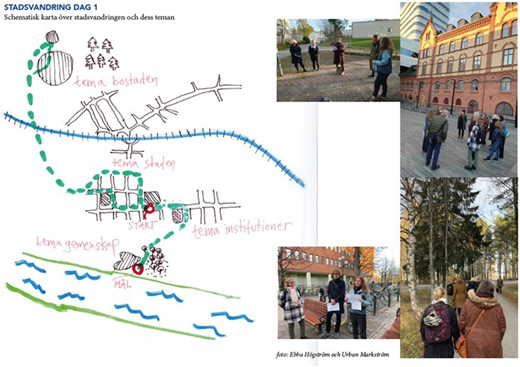
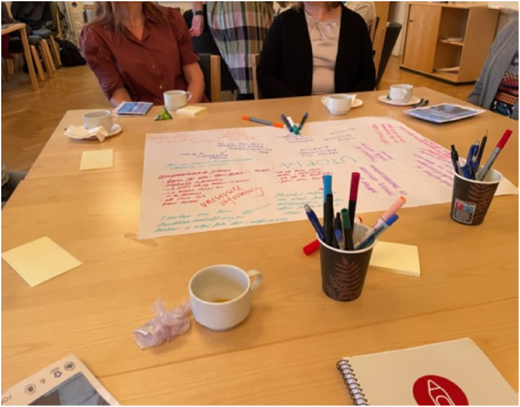
Data set 3, the policymakers’ perspective: Data were collected from a so-called “future workshop’ (Högström et al., 2022) conducted with representatives from social services and city planning in one Swedish larger city and representatives from user organizations and authorities on a national level, including focus group interviews. They all worked with mental health issues on a national or municipal level and were involved in some way with the decision-making that affected people with mental ill-health. In total 12 representatives on a local and national level participated. It was a two-day future workshop. In day one, it began with a city walk based on the participants’ experiences of their living environment, as expressed by the visual data of their pictures and collages. On the second day, the participants were divided into small groups comprised of four participants and one researcher. In their groups participants compared Utopia, the dream scenario for people with mental ill-health living in the community, Realia, the present situation for people with mental ill-health and Futura, how a likely outcome for mental health treatment in the community could be changed so that it resembled Utopia more than Realia. The themes utopia, realia and futura were developed by the interdisciplinary research group planning and carrying out the future workshop, based on their previous experiences of applying the methodology. During the group discussions during the second day data were collected. The collected data took the form of research notes and visual documentation, including photographs of participant notes and a list of bullet point suggestions for change.
This article is based on empirical data generated when similarities involving the three different stakeholder groups appearing in the three data sets inductively were identified. To advance the understanding of the visual in arts-based participatory research methods (in this case photovoice combined with collage making), by applying the process of theorizing (Swedberg, 2016) as analytical lens, a qualitative secondary data analysis (Ruggiano and Perry, 2019) was conducted on data sets 1 and 3. Secondary data analysis is suggested when striving to improve methodological understanding (Myers and Lampropoulou, 2016). A conventional content analysis (Hsieh and Shannon, 2005) of data set 2 was added. A directed content analysis approach (Hsieh and Shannon, 2005) was then applied, where the secondary analysis of datasets 1 and 3 and the content analysis of dataset 2, started with the process of theorizing (Swedberg, 2016) as guidance for initial codes. The directed approach to content analysis allowed to further refine, extend and enrich knowledge within this area of interest.
The findings from the primary analysis of the photovoice study and future workshop are reported elsewhere (Högström et al., forthcoming; Högström et al., 2022). Focus for this article are findings from the secondary analysis of dataset 1 and 2, combined with the primary conventional content analysis (Hsieh and Shannon, 2005) of dataset 2, constituting the empirical data to advance the understanding of the visual in arts-based participatory research, by using the concept of theorizing processes (Swedberg, 2016) as an analytical lens.
To pursue quality in research, being self-reflexive and transparent about procedures are important (Tracy, 2010). In this case, it is relevant to describe the author’s prior knowledge and experience. The author is a social work researcher and a trained and experienced art-therapist. On one hand, knowledge on arts-based interventions and art-based research methods could allow for a deeper and more nuanced understanding of the phenomenon studied. On the other hand, the inside perspective poses a risk for biased interpretation of data. To address this risk, transparency of procedures has been a guiding principle. The manuscript has been reviewed from a critical perspective by research colleagues in other disciplines, to see what in the text needed further transparency and clarification.
Ethical and methodological considerations
The photovoice study and the associated future workshop were parts of the research project “LEX - sustainable Living Environments for people with psychiatric disabilities. Aligning housing planning and social services through eXperimental collaborative practices”. The project and its various parts were approved by the Swedish Ethical Review Authority (Dnr: 2019-02812 and 2020-04764). Participants with mental ill-health had access to professional mental health support before, during and after participating in the photovoice study. Oral and written informed consent was collected from all participants in dataset 1, 2 and 3. The possibility of withdrawing consent to participate was communicated to all participants. Participants contributing to dataset 1 by collecting visual data were explicitly asked not to photograph other people so as to avoid any risk of personal data being exposed in the context of the study.
Although conducting a secondary analysis of qualitative data is a common methodological approach, it is one that has attracted some discussion (Ruggiano and Perry, 2019). According to Ruggiano and Perry (2019), a secondary analysis is an endeavor to generate new knowledge that may benefit society while minimizing the burden that research participants bear to share sensitive and detailed information about themselves. They advise researchers to take upon themselves the responsibility of recognizing when it is appropriate and safe to conduct a secondary analysis of collected qualitative data. As Ruggiano and Perry (2019) recommend, this study has considered its related ethical issues and implemented the appropriate ethical safeguards (Ruggiano and Perry, 2019). No harm or distress was caused to the participants in this study. All of them received information about the study and willingly gave their consent to participate in it. All participants were aware that the research project had several parts and that the knowledge developed in each of the parts would, when taken together, allow deepened understandings to emerge about different aspects of the study, of which this methodological aspect is one.
Results
This section aims to show how, in this study, the visual became a starting point for a process of gaining new perspectives. It begins with a presentation of the data collected from each data set: first, from the participants with mental ill-health (data set 1) and then from the researchers (data set 2) and policymakers (data set 3).
Participants gaining new perspectives: data set 1
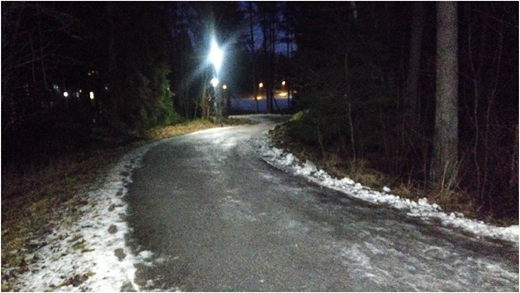
As an example of the new perspectives that the visual offered to the participants with mental ill-health, one participant, Lena, describes how her thoughts about a specific place in her living environment changed after participating in the photovoice study. She had documented her living environment by taking a photograph of a place she avoided: the dark road leading from the bus stop to her house (see Figure 1). Later on, when the participants with mental ill-health, together with the researchers in small groups, discussed their pictures together, Lena said:
Lena: This picture, I took this one only because I find that place really scary.
(…) Often the lights are turned off, so it's completely dark there, so I feel like I’ve got no control. (…) I always think that I might be molested when I get off the bus and come along here towards (…) If I take a night bus or something and it (the bus) stops at that stop, it’ll take maybe fifteen minutes to get home. Instead of me taking my own bus, directly to my place.
Researcher: Does having to take the night bus make you avoid being out so late?
Lena: Yeah, I do avoid it. It's a pretty horrible feeling to be there, actually.
Researcher: Isn’t there any alternative, like taking the main road or something ?
Lena: Yes, there is, it’s just that it takes such a long time, it takes maybe more than half an hour to walk from there. But like I said, I only go there (the dark road) when I have to. And I feel the same discomfort every time.
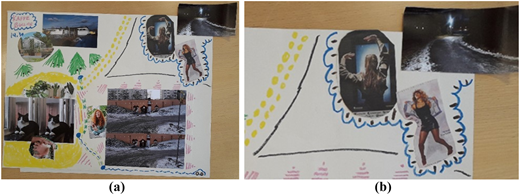
During the next session, after collages had been made (see Figure 2), Lena showed hers and talked about this dark road in slightly different words:
Lena: But that horrible place, it’s not so horrible anymore. (…) So I feel that I will, that I’ll go there again and see how it feels, now that I’ve talked about all this.
In Lena’s collage, the picture of the road extended partially beyond the edge the paper and a thick black line separated this part from the rest of the collage.
This data suggests that by documenting her living environment – by taking these photographs, making a collage and reflecting on a place together with others – Lena came to view this place in another way. The dark road home did not seem as scary as before. Although she initially said that she tried to avoid this place, the acts of photographing and collage making in combination with personal and joint reflections and discussions meant that Lena changed her understanding of it.
A process had been undergone. Lena created and interacted with visual material. She then viewed this visual data together with other participants and researchers. After that she put those reflections, experiences and thoughts into words in a conversation with others. In a final stage, she expresses her understanding of this place from a new perspective. Based on the visual data of photographs and collages, personal reflection and understanding developed, a new perspective became possible that allowed future personal everyday actions to be changed.
This example shows how (1) viewing visual data and (2) putting reflections and experiences into words made it possible for participants with mental ill-health to think new thoughts and to, therefore, (3) develop new understandings of a place.
Researchers gaining new perspectives: data set 2
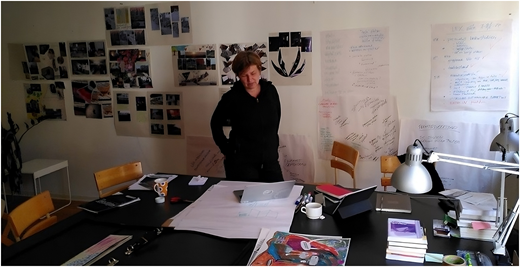
When the research group engaged with the evidence collected in data set 1, they started with the visual as their way to generate, collectively, new knowledge in their field. In this process, the four researchers drew on the theoretical and practical knowledge they had within their respective research fields (social work, urban planning and architecture). The participants' photographs, collages and discussions (now transcribed into text), were put up on the wall (see Figure 3.). The researchers then started to analyze the visual and verbal data. The city could be better understood if it was viewed through two “filters”, poverty and loneliness.
Poverty was expressed in various ways in the photographs and collages, for example, in the experiences of exclusion from places where other people might feel involved and included, like a restaurant or shopping center. To be involved in the community that these places created, it was expected that you would have money to spend. Other examples of poverty were that people with mental ill-health could not afford to own a car or get a driver’s license. Without the alternative transport solutions these provided, participants had to take collective transport and had to handle places that they would rather avoid. If they had the money, a participant could have taken a car instead of the bus and thus avoided the dark walk home from the bus stop. Through their photographs and collages, the participants stressed the importance of non-commercial, free entry public places where anyone was welcome despite their personal financial situation.
The other “filter” that was expressed in the pictures, collages and stories was a sense of loneliness. This feeling was described in various ways but always stressed the importance of community. Loneliness was also connected to the poverty filter, because communities are often created and sustained through money and spending. To be part of the community surrounding a riding stable, for example, a person needs to have the money to pay for riding lessons. If a person has owned a dog and become part of a community of dog walkers, they need to have enough money to buy a new dog when their old dog passes away. A stable financial situation is something that many people with mental ill-health lack. The experiences that the participants with mental ill-health expressed challenged some of the ideas that the researchers had about city planning. As a result, common planning understandings, such as commercialization, were turned on their heads and the concept of ‘the inverted city’ was coined. This phrase is meant to explain how people with mental ill-health could be part of a community or city but still feel excluded from them.
This example shows how (1) viewing visual data and (2) putting reflections and experiences into words made it possible for researchers to think new thoughts and to, therefore, (3) develop new understandings of a place.
Policymakers gaining new perspectives: data set 3
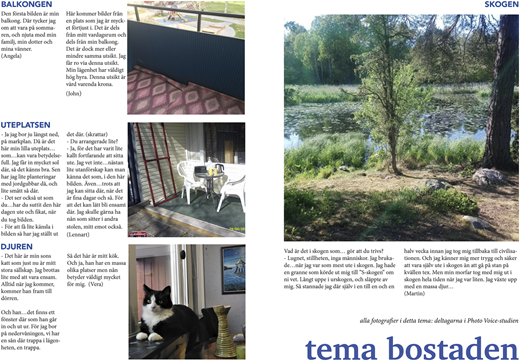
The data showed that the visual – the photographs and collages and the stories about them – allowed policymakers to gain new perspectives and constituted a potential starting point for a changed practice. Data was collected from a two-day future workshop with the twelve policymakers taking part in the photovoice study. During the first day of the workshop, the policymakers went on a city walk that was based on the photographs, collages and stories generated by the participants with mental ill-health (data set 1) and the knowledge and concepts developed by the researchers (data set 2). During the city walk, policymakers were given a booklet containing the participants’ visual data (Högström et al., 2022) (see Figure 4), the researchers’ theoretical concepts and their own (policymakers’) physical experiences of the city. Figure 5 describes the city walk in more detail.
During the second day of the future workshop structured group discussions were conducted. Across three different sessions and in small groups of four, each with a researcher as co-ordinator, participants discussed Utopia, the dream scenario for people with mental ill-health living in the community, Realia, their present situation and Futura, what could be changed to achieve a situation closer to Utopia than Realia. Data were collected during all three sessions, in the form of research notes and visual documentation (photographs of policymakers’ notes and bullet points written down by each small group (see Figure 6).
During the second day of the future workshop, policymakers came up with their ideas for the future. Some examples of these included introducing a “town square (Sw. torg) for everyone” where it was possible to get help and support. At the time the future workshop was taking place, a public “senior square” had been organized in the city’s former tourist office, where the elderly could get everyday support, have a cup of coffee and feel part of a community. This was an easily accessible place with low thresholds and was non-stigmatizing to visit. The new idea in this workshop was to open up the square to other citizens, such as people with mental ill-health, and rename it to “the square”.
This example shows how (1) viewing visual data and (2) putting reflections and experiences into words made it possible for policymakers to think new thoughts and to, therefore, (3) develop new understandings of a place.
The process of gaining new perspectives: viewing, exploring and understanding
When analyzing the data collected from data sets 1–3 through the lens of a theorizing process (Swedberg, 2016), the following pattern emerged:
To see and observe the visual data. In the first stage stakeholders viewed visual data with the aspiration to gain as good an understanding as possible of the phenomenon concerned. Participants, researchers and policymakers on separate occasions viewed photographs and collages.
To name, describe and explore the visual data with words. In the second stage words were articulated and associated with the phenomenon concerned. The phenomenon could be named or given a name formulated elsewhere and related to this phenomenon. In this stage metaphors, analogies and typologies could be used to give a form to the conceptual description of the phenomenon. A participant described her experiences of a dark road. The researchers described the visual data as moving them along from their previous knowledge and understanding of theories and models. Policymakers started their discussion of the living environment for people with mental ill-health in the present, but used the visual data to adjust their view of the future.
To explain, recognize and understand, when letting insights emerge. In the final stage, an explanation is sought. In a theorizing process this concerns an explanation that a theory could offer. In the present manuscript, this phase concerns explanations being drawn from the empirical insights taking place on a personal, scientific or policymaking level. Insights constitute a foundation for potential change. However, the data in this study do not convey whether any change took place or not.
The process taking the visual data made by participants with mental ill-health as its starting point made it possible for individuals, researchers and policymakers to (1) view, (2) explore and (3) understand a particular issue. This process allowed new perspectives to be gained, from where potential development and change could take place. This is the contribution which the visual in qualitative participatory art-based research methods can potentially make: art-based methods offer the potential to gain new perspectives and provide a basis for conceptualizing change and development among relevant stakeholders in a particular scientific field. This process is illustrated by Figure 7.
Discussion
The findings show that the processes taking place during this study were similar on the individual level (among participants with mental ill-health), the scientific level (among the researchers analyzing the data) and the policy-making level (among policymakers participating in a future workshop). By examining the process in detail, knowledge was developed to explain how participatory art-based research methods can facilitate knowledge development on a personal, scientific and policy-making level. The use of the visual as a research method (Rose, 2012) provided participants, scientists and policymakers with a tool to explore the experiences of living conditions for people with mental ill-health in a nuanced and in-depth way.
When analyzing empirical data produced from the understandings acquired from art-based participatory research methods through the analytical lens of theorizing (Swedberg, 2016), new knowledge was generated. This knowledge increases the understanding of specific processes that use the visual as their starting point and new perspectives as their final outcomes. These new perspectives constitute a basis from where considered and informed personal, scientific and social changes can potentially take place. The improved knowledge of how participatory art-based research method processes can be explained and understood also deepens the knowledge of how critical art-based research methodologies can be used to take responsibility for social engagement and social change (Finley, 2015). The process described in this article shows how participatory art-based research methods can enable science and scientific knowledge to be applied to a process of social change. The data suggests that the specific process which begins in the visual can be understood as a process of stages where certain elements of the end results can lead to the emergence of new perspectives. By using a qualitative participatory art-based research method new perspectives on prevailing social structures can be examined when different groups in society visualize and describe their living conditions and living environments.
Conclusions
This study suggests how the use of the visual in participatory art-based qualitative research methods can contribute to the emergence of new perspectives among different stakeholders, though the processes of (1) viewing, (2) exploring and (3) understanding. This finding is the contribution of this study to the field of arts and health.
The author would like to thank Professor Urban Markström, Professor Ebba Högström and Associate Professor Lina Berglund Snodgrass.