The challenge of recruiting participants from hidden and hard-to-reach groups to sensitive qualitative interviews is well-established. This article brings together recent thinking on trauma-informed research and research relationalities to consider methods of reaching diverse populations effectively and ethically.
The article draws from a research study on gender-based violence (GBV) in higher education in Ireland, which recruited 18 participants to in-depth interviews about experiences of disclosing, reporting and not disclosing GBV in their higher education institutions. All participants were self-identified survivors of GBV, and interviews were potentially emotionally sensitive and ethically complex. Recruitment used social media, community networking and ongoing relational engagements.
The small sample recruited was highly diverse, including participants who were socially minoritised and who might have reason not to trust professional researchers. Analysis of the recruitment approach identifies four aspects that draw on trauma-informed practice, particularly relationality. Specific to recruitment, we outline how trauma-informed and relational principles apply before fieldwork begins, and extend beyond study participants to take in multiple agents. We propose this as a unifying theme that can be ethical and effective for reaching those who are often excluded from sensitive or challenging qualitative research studies.
We bring recent thinking on trauma-informed research practice and relationality to bear specifically on recruitment methods for sensitive qualitative research. This contributes practical insight to ongoing considerations on ethical and effective inclusion of hidden and hard-to-reach populations in qualitative research.
1. Introduction
For qualitative researchers conducting interviews on sensitive topics, accessing hard-to-reach or hidden populations can be especially challenging (Fahie and McGillicuddy, 2018; Fahie, 2025). In some cases, the topic of interest of the study – such as power relations with service providers or institutions – is also the factor that might cause target populations to “hide” from researchers. Emerging methodological guidance in trauma-informed research approaches is helpful for understanding how trauma can impede research recruitment, and provides valuable principles and, increasingly, examples and guidelines, for conducting trauma-informed research (Jefferson et al., 2021). This understands that a central aspect of quality in qualitative research is research relationalities (Timonen et al., 2024). This article draws on Campbell et al.’s (2019) ten-principle framework for trauma-informed research on sexual violence, with particular emphasis on principle 5: framing the researcher-participant relationship as a relational collaboration. It breaks recruitment into phases of sample access and sample recruitment (Fahie and McGillicuddy, 2018), and emphasises relationality prior to the conduct of interviews and among multiple agents (Young and Browne, 2025). Drawing on one specific study, we suggest that this relational trauma-informed thinking provides a useful basis for effective recruitment from hard-to-reach and hidden samples.
This article relates to a research study that conducted qualitative interviews to explore the disclosure and reporting experiences of victim-survivors of gender-based violence (GBV) in higher education in Ireland (Ballantine et al., 2026a). Participants in the study were all self-identified victim-survivors, and the study set out to be, as much as possible, trauma-informed [1]. The study sought interviews with victim-survivors who had attempted to report or complain about GBV in their higher educational institution (HEI), as well as those who had been more reticent about their experiences, up to and including telling nobody. Using GBV in higher education as a case study, the article intervenes in a gap in the literature by offering detailed practical considerations for sensitive interview recruitment.
The article opens with a discussion of hidden and hard-to-reach populations in qualitative research, drawing across literature on sensitive research topics. It then introduces thinking on trauma-informed research methods and relationality, connecting these to the recruitment of hard-to-reach participants. The literature review concludes with an introduction to research on GBV in higher education.
The methods section of the article introduces our study and situates it briefly in the literature on recruitment methods for GBV in higher education. We outline four key elements that constituted the relational and trauma-informed approach taken, which resulted in high internal sample diversity, including hard-to-reach participants. The approaches are: varied recruitment outreach; transparent and accessible provision of study information; reducing barriers to expression of interest; and structured and responsive engagement with prospective study participants. We do not suggest these as a blueprint; rather, we argue that the combination of these approaches responds to a conceptualisation of research recruitment as relational and trauma-informed. We conclude with implications for research practice and reflections on avenues for further consideration and exploration.
2. Challenges of recruitment to sensitive qualitative interviews
2.1 Hidden and hard-to-reach populations
Qualitative research on sensitive topics presents challenges for research recruitment, particularly in the case of participants who are hidden/hard-to-reach/unheard/seldom heard and/or vulnerable (Fahie and McGillicuddy, 2018; Freeman et al., 2021; O'Brien et al., 2022). We bring these overlapping descriptions together under the umbrella term of hidden and hard-to-reach as most relevant to our interests. Hard-to-reach participants are often difficult to find or engage for researchers, while hidden participants may not want to be found, and indeed may conceal their identities (Freeman et al., 2021). We understand vulnerability to refer to characteristics or circumstances that may render individuals vulnerable to being mistreated or suffering additional harm (O'Brien et al., 2022), and to be highly relevant to sensitive research practice (Downes et al., 2014). Participation in research on sensitive and trauma-related topics including GBV can be impeded by concerns about stigma, retraumatisation and distrust of the research community (Freeman et al., 2021; Iribarren et al., 2018). This creates a paradox: for some research studies into sensitive topics, the individuals most likely to “hide” from researchers may be those with the most relevant data to contribute. For researchers, reaching these individuals raises challenges and also implies an ethical responsibility, since non-participation may reflect a trauma-related pursuit of psychological safety, which research must not endanger (Campbell et al., 2019).
2.2 Trauma-informed research
Methodological writing on sensitive research with hidden and hard-to-reach populations increasingly recognises the relevance of trauma to research approaches; however, there is a lack of scholarship applying trauma-informed theory to research design (Jefferson et al., 2021). For this article, and in line with the emerging literature and guidance on research practice (e.g. Di Santis and Towl, 2025; Campbell et al., 2019; Struzinska et al., 2024), we refer to the concept of trauma established in the 2014 SAMHSA guidelines. Trauma is understood to result from specific events which are experienced as harmful or life-threatening, and having lasting adverse effects on functioning and well-being (SAMHSA, 2014, p. 7). Such events and experiences can be both individual and/or collective (SAMHSA, 2014; Pain, 2022): GBV can thus be understood for some and not all in contexts of overlapping individual and collective traumas (Pain, 2022). Trauma is widespread and unevenly distributed in contemporary society; it impacts on individuals' emotions, cognition, physiology and behaviours; and it often goes unrecognised and unsupported (SAMHSA, 2014).
Trauma-informed research clearly overlaps with hidden and hard-to-reach people and groups. For those who are trauma-experienced, safety and recovery are of central importance, and need to be prioritised by researchers (Campbell et al., 2019).
The study of violence against women has led the field in respect of victim-centred, collaborative and empowering research methods (e.g. Ellsberg and Heise, 2005; Downes et al., 2014); and lessons can be effectively drawn from this area into others. A ten-point framework setting out a trauma-informed approach to sexual violence research (Campbell et al., 2019) has proven foundational for the implementation of research practice. Point five advises framing research “as a relational collaboration” with the participant (Campbell et al., 2019, p. 4769); a topic to which we return below.
Critiques of trauma-informed approaches note that trauma can be operationalised as a lens that is pathologising, deficit-based and reinscribing of pre-existing structural exclusions (Chudzik et al., 2025). Research that engages with trauma as a subject or component of participant experiences should therefore steer away from narrow biological understandings of the phenomenon, rather approaching it with a holistic understanding that incorporates individual, interpersonal and socio-cultural dimensions (Zoromba et al., 2024). Researchers in feminist victim studies have drawn attention to a narrow tendency by research ethics committees to understand all victim-survivors as traumatised and uniquely “vulnerable”: this tendency is critiqued as paternalistic and undermining of the agency of victim-survivors (Downes et al., 2014). Rather, meaningful trauma-informed practice respects the agency and autonomy of the individual; it does not seek only to identify and “fix” deficits; it understands trauma as embedded within a socio-cultural framework which is saturated with inequalities and distributes harm unevenly; and it seeks to empower victim-survivors, and remove structural barriers to equality and justice (Campbell et al., 2019; Chudzik et al., 2025; Zoromba et al., 2024, Pain, 2022). For researchers, this means not treating participants as risks to be managed/minimised, but as collaborators wherever relevant and possible (Campbell et al., 2019). At the same time, trauma-informed research is respectful of trauma survivors' need for safety, choice, control and recovery (Campbell et al., 2019).
2.3 Research relationalities
While Campbell et al.’s (2019) 10-point framework for research practice is valuable in its entirety, here we draw particular attention to point 5: framing research as a relational collaboration. In talking about relationalities, we build on feminist, indigenous and broader sociological thinking that resists individualist or isolationist representations of research practitioners and subjects, highlighting instead inter-connectedness and inter-dependencies among and between humans, and the more-than-human (Cruz, 2024; Timonen et al., 2024). While relationality is currently receiving attention in qualitative research methods (Cruz, 2024; Timonen et al., 2024), it is relatively rare for methodological literature to focus on the relationalities of the recruitment phase (but see Fahie and McGillicuddy, 2018; Young and Browne, 2025).
Relationality is particularly relevant for considering the power relations between researchers and the target population, with a view to employing an empowerment model that respects the agency of potential participants: point 3 on Campbell et al.’s 10-point framework. Empowerment, agency and choice are key dimensions of trauma-informed research which, we argue, should be incorporated into research relationships well before direct engagement in qualitative interviewing begins.
2.4 Recruitment strategies for qualitative research interviews
Research recruitment can be understood as incorporating two inter-connected phases: identifying and communicating with a target population (sample access); and gaining individuals' consent to take part (sample recruitment) [2] (Fahie and McGillicuddy, 2018). It is established that qualitative research involves a negotiated relationship between researcher and participant, and more recent reflections on recruitment strategies note the emergent relationalities between multiple actors or agents including researchers, target populations, communities and other online agents (Young and Browne, 2025).
Reaching hard-to-reach populations requires careful approaches to sample access (Fahie and McGillicuddy, 2018). Researchers can access populations via services; often a robust and ethical approach for victim-only samples in sexual violence research (Campbell et al., 2019; Anderson et al., 2023). While this enables guaranteed access to victim-survivors, it limits the sample to only those who accessed services – frequently over-represented in research (O'Brien et al., 2022). For this reason, researchers additionally access hard-to-reach potential participants through community settings, for instance through embeddedness in ethnic minority communities; LGBTQI + organisations; youth groups or similar spaces (Fahie and McGillicuddy, 2018; Freeman et al., 2021). Such approaches can allow an entry point to populations that might otherwise resist engaging with researchers for reasons connected to past experiences, cultural knowledge and general suspicion or mistrust (O'Brien et al., 2022, Freeman et al., 2021). Researchers in such contexts need to attend carefully to their demeanour, as every interaction builds their reputation and influences the trust that is placed in them by the community (O'Brien et al., 2022) – it is relational. When information about research is conveyed through community-based networks to facilitate onward snowball sampling, prospective participants can take responsibility for assessing their own safety based on existing connections of trust (O'Brien et al., 2022, Newman et al., 2022).
The processes for sample access outlined above meet the needs of trauma-informed practice because they emphasise cultural awareness and humility; and they respect survivors' need for safety, respect and acceptance (Campbell et al., 2019). However, participants may still “hide” from both service providers and community organisations owing to stigma, social exclusion and negative past experiences (Freeman et al., 2021). Network recruitment strategies, such as those using grassroots communities and social networks, can over-represent specific groupings and under-represent others (Newman et al., 2022), resulting in qualitative research data that under-represents excluded groups and sub-groups, including racial, migrant and other minority populations (Jones, 2025). For this reason, Struzińska et al. (2024) recommend prioritising passive strategies, whereby material is disseminated with the aim of attracting participants to contact the research team, rather than approaching them directly, hence not centring gatekeepers or community organisations. Passive recruitment is increasingly conducted online through social media, email lists and digital information sheets (Struzińska et al., 2024).
It is increasingly recognised that social media-based strategies are valuable for accessing historically less-well-represented groups in research, because they allow for a high degree of confidentiality (Iribarren et al., 2018), thus respecting the safety needs of trauma survivors (Campbell et al., 2019). However, some researchers suggest that online recruitment is impersonal and does not allow for trust-building (e.g. Iribarren et al., 2018). The ethics and trauma-relevance of these strategies are under-examined in the methodological literature. Given the many barriers to research participation, a flexible and context-specific combination of strategies to sample access is often recommended (Downes et al., 2014; Struzińska et al., 2024).
Moving from sample access to sample recruitment is a relational process, seeking to build confidence that researchers and the study can be trusted (Young and Browne, 2025). Trauma-informed methodological guidance emphasises transparency before people agree to sign up, and the implementation and communication of detailed procedures for gathering and withdrawing consent (Jefferson et al., 2021; O'Brien et al., 2022); all key to respecting survivor choice, control and need for safety (Campbell et al., 2019). Facilitating early access to study protocols can allow trauma-affected people to assess the safety of participation (O'Brien et al., 2022). Researchers also emphasise the deliberate and informed use of inclusive language in recruitment materials (Anderson et al., 2023, p. 2249). This can involve culturally-sensitive terms adapted for excluded or stereotyped groups; using different languages to reach migrant participants; and creating space for victims and survivors to use their own words to define their experience, rather than presumptively labelling them as, say, “rape victims” (Anderson et al., 2023). Engaging potential participants via an online lead form can provide them with time and space to consider their participation (Campbell et al., 2019); similarly, practical decisions such as time and location for interviews are best viewed as collaborative, with the participant empowered to make choices whenever possible (Campbell et al., 2019).
2.5 Gender-based violence in higher education research
This final section introduces the specific research interest of our study: GBV in higher education. We conceptualise GBV as encompassing a wide range of gendered and sexualised harms including physical, sexual, emotional, financial, technology-enabled and collective violence and harassment, interconnected on a continuum which recognises types of violence as distinct yet overlapping and mutually reinforcing (Hearn et al., 2025; O'Connor et al., 2021). Research on GBV in higher education emphasises local specificities (Hearn et al., 2025) and gendered power relations, in particular the hierarchical, individualistic and competitive nature of higher educational settings (O'Connor et al., 2021; Hearn et al., 2025). There is a growing literature that draws from the experiences of victim-survivors themselves (Bull, 2024), and it is recruitment to such research that concerns this article.
For qualitative research in this area, targeted participants are likely to be trauma-experienced, leading to a need for trauma-informed research practices (Bedera, 2023). Research should also respond to intersectional vulnerability to GBV and its impacts: for instance, on people marginalised by race, class, dis/ability, migration status, ethnicity and other aspects (Hearn et al., 2025; Jones, 2025). Strikingly, the majority of research on GBV in higher education to date has focused on students from relatively privileged backgrounds (Jones, 2025).
3. Methods
This article discusses the recruitment strategy used for a qualitative study into experiences of disclosing or reporting GBV in Irish HEIs (Ballantine et al., 2026a). The study was commissioned and funded by the Higher Education Authority in Ireland. The project was overseen by a research consortium comprised of academic researchers based in three Irish universities, and ethical approval was granted by the ethics committee in the lead university. The entire research team took part in training on trauma-informed research before the project began, and the research interviewer was supported through weekly debriefs with the Principal Investigators, and private therapy [3].
Inclusion criteria were that participants should be staff or students [4] who had experienced or disclosed GBV in their HEIs in the preceding 4 years [5]. Although a low target was set of 15–20 interviews, the study aimed to include significant diversity, further outlined below. Rates of disclosure of GBV in HEIs are generally agreed to be low (Jones, 2025), and the same factors that inhibit disclosure may also inhibit victim-survivors from participating in research: they may not consider the experience to meet a threshold of seriousness to act; they may fear negative consequences for complaining; they may be inhibited by shame, guilt, and self-blame (Burke et al., 2025; Kirkner et al., 2022). Lack of trust in institutions and past experiences of institutional betrayal/institutional silence could also play a role in choosing not to take part in this government-funded, HEI-led research study (Pilinkaite Sotirovic et al., 2024). A research interview about violence and harassment, conducted by professional academics, might be felt to mirror the harmful or traumatic format of a formal investigation process. This provokes the paradoxical concern that people who had been traumatised in such processes – central to the interests of the study – might avoid the study for precisely the reason that made them eligible for inclusion. Thus, the population we sought to recruit from was potentially hidden by definition. There were multiple different factors behind the hard-to-reachness of the diverse target groups (i.e. minoritised by race/class/disability/precarity etc; those who did not disclose; those who took part in formal reports), demanding a broad and targeted recruitment strategy.
In this methods section, we summarise the relational and trauma-informed research recruitment approach adopted for this study, which was deemed to have met the original sampling objectives of an internally diverse set of 15–20 interviews. Here, the approach is outlined, not as a blueprint for replication, but rather as an example of relational principles in action. We argue that this approach might be augmented, adapted and critiqued by other studies that explore sensitive topics with hidden and/or trauma-affected populations [6].
3.1 Diverse approaches to sample access including, but not limited to, gatekeepers
The study used a mix of active and passive sample access strategies (Struzińska et al., 2024), building relationships with communities and gatekeepers and looking beyond these actors. Active approaches were principally implemented via a network of sexual violence and harassment practitioners working across the 16 HEIs in Ireland. This network targeted information about the study to volunteers, past service users and interested parties via email lists, newsletters and social media [7]. Additionally, sample access to entire HEI populations (students and staff) was achieved by sending “all staff” and “all student” emails to the three universities in the research consortium; and targeted emails and social media posts were shared by student and staff unions, and NGOs working on youth and/or violence issues.
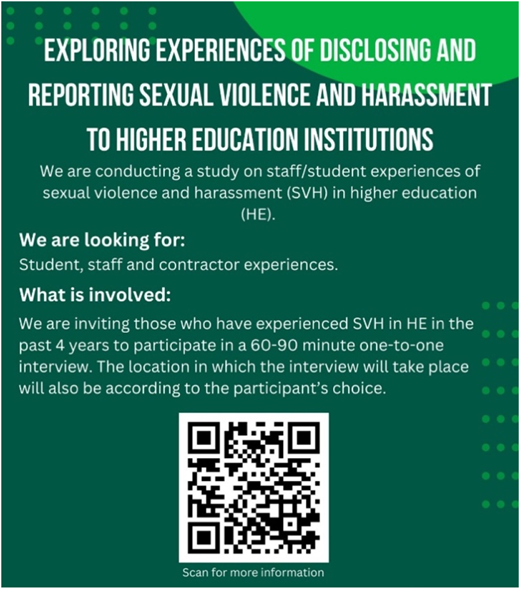
Dissemination used a recruitment “advert”, sent via email and social media, and designed to be shared onwards (Figure 1). Emphasising social media channels and onward sharing was intended to enable passive recruitment of people who might be observing online topics and spaces without engaging with them – that is, “hidden” victim-survivors.
3.2 Information transparency and accessibility
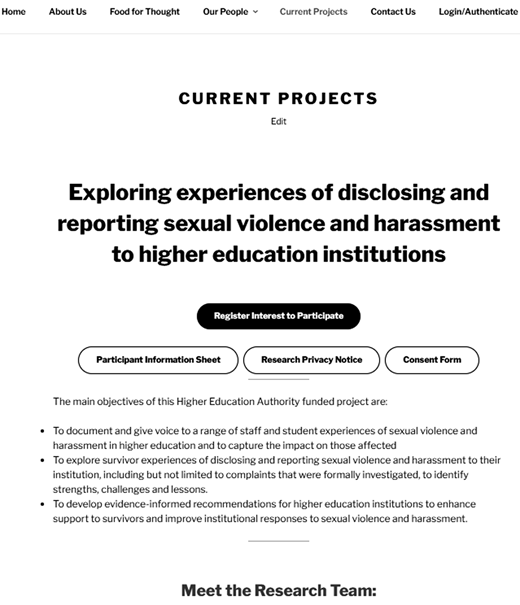
The shareable recruitment ad (Figure 1) and emails included a QR code/weblink that led interested parties to a website with further information, and a sign-up link (Figure 2). Specifically, the webpage included a plain English section called FAQs (Frequently Asked Questions) ( Appendix) that anticipated, articulated and responded to questions and concerns people might have about taking part in the research. The webpage also included brief biographies of all members of the research team, as well as three key study protocols: the participant information sheet, the consent form and the research privacy statement.
3.3 Low barriers to engagement in the research
Prominently displayed on both the recruitment information emails and the webpage was a link for participants to express interest in the study, leading directly to a form hosted on Microsoft Forms [8]. This explained the purpose of the study once more, in plain English and included just one field for an email address for further contact. This is distinct from a common practice in academic research to provide an email address and invite prospective participants to make contact with the researcher, and in line with trauma-informed research guidance (Campbell et al., 2019).
3.4 Structured and responsive relational correspondence with every lead
Once somebody entered their address in the lead form, the research interviewer and lead author of this article initiated communication. This followed a structured but highly adaptable approach. On receiving a lead, the research interviewer contacted the individual, inviting them to take part, and linking again to the website with study information. In the event of no reply, the initial email was followed up on a total of two occasions, at an interval of three working days each time, before the lead was allowed to “drop”. Once a lead responded, the interviewer engaged in active dialogue with the potential participant, focused on trust-building, empowerment and collaboration (Campbell et al., 2019). Participants were encouraged to ask questions as required, and offered a choice of date, time and location (online or off) for an interview.
Different levels of correspondence ensued across 58 expressions of interest, with some leads going dead almost immediately, some engaging in discussion before withdrawing and others (n = 18) resulting in successful “conversion” to research interviews.
3.5 Hard-to-reach participants in the sample
Between 15th May and 31st July 2025, the study conducted 18 interviews, with 12 students and 6 staff across 7 different HEIs in Ireland. These included different, potentially hidden experiences (reporting/not reporting/not disclosing) and roles (staff and students, at different career stages and disciplines). Of the sample of 18 participants, only two said they had no relevant identity or minority status apart from their gender (Ballantine et al., 2026b): others mentioned race, ethnicity, international status, and disability and neurodiversity. In what follows, we consider the relationalities of this recruitment strategy, in order to advance methodological thinking on trauma-informed recruitment of hard-to-reach populations.
4. Discussion: relationalities of trauma-informed recruitment
4.1 Diverse approaches to sample access, including but not limited to gatekeepers
The study relied on outreach across: institutional mechanisms, community and civil society organisations and onward sharing on social media – a mixture of active and passive methods, primarily online. Networking to establish trusting relationships with stakeholders underpinned online recruitment, enabling respect for safety needs and cultural sensitivity, key aspects of trauma-informed approaches (Campbell et al., 2019; O'Brien et al., 2022). By embedding the recruitment in existing supports and referrals, relationalities were established that sustained through the research cycle (Campbell et al., 2019).
Passive recruitment via social media allowed study information to reach targeted HEI-only/survivor-only groups, including individuals who may not engage with formal communications from institutions or support services. This targeted people who might have a negative view of institutions owing to their own personal experience, and others who were excluded from “mainstream” higher educational spaces, for instance those on short study visits or temporary contracts (Tran et al., 2025). Such groups had specific and valuable experiences to share with the research, and were especially vulnerable to impacts of trauma. Using social media anticipated high confidentiality needs of “hidden” or marginalised participants (Campbell et al., 2019; Iribarren et al., 2018) including people who did not openly disclose their past experiences of GBV.
Accessing this hard-to-reach sample was a first step, which required further action to develop confidence and trust to participate in the research study. Taking the principle of informed consent seriously means that researchers need to anticipate and accept non-participation and withdrawal of leads – indeed, such withdrawals can be read as evidence of commitment to consent as active and meaningful. In practice, this means researchers must ensure broad and diverse dissemination of recruitment materials. High exposure is required to generate even a relatively small number of leads, which in turn result in a smaller number of conversions to interviews.
4.2 Information transparency and accessibility
The study did not offer relational reassurances or guarantees, but rather empowered individuals to make their own safety assessments and choices (Campbell et al., 2019; Downes et al., 2014). Both dissemination emails and the easily-shared recruitment advert (Figure 1) linked to detailed participant-facing information, in a relatively easy-to-access format (Figure 2). A suite of study protocols was available on the website, including brief profiles of the research team in addition to material more directly addressed to potential participants, acknowledging and addressing the impact of vulnerability and trauma (O'Brien et al., 2022). The study materials used the somewhat unwieldy term gender-based and sexual violence and harassment, inviting participants to interpret their own experience, rather than imposing reductive labels (Anderson et al., 2023; Tran et al., 2025).
The FAQ was written in plain English, and prominently displayed on the website. It differed in tone and purpose from the participant information sheet (also linked on the website) in that it addressed potential participants well before the stage when they would typically receive such information [9]. It was structured around anticipated concerns specific to the hard-to-reach populations being targeted and the interests of the study. Examples of these concerns were whether the violence or harassment experienced would “count” in the eyes of researchers; whether they could trust the researchers to represent them accurately; and what level of confidentiality would be applied to their data (see Appendix). The FAQ directly addressed concerns about the possible negative impacts on a person's career from taking part, and concerns about being identifiable because of protected characteristics such as race, ethnicity or disability. It emphasised that participants were free to change their minds and withdraw at any stage. While this is standard practice in qualitative research (Karmakar and Duggal, 2024), by emphasising the freedom to withdraw in the FAQ and in the process of setting up an interview (see point 4, below), the project aimed to enact informed consent as meaningful and ongoing.
Confidentiality, transparency and the centring of free and informed consent thus created a respectful research relationality in conditions where trust may be lacking (Browne and Nash, 2023; Bull and Shannon, 2025). This relationality aligns with trauma-informed principals of “empowerment, voice and choice” and “trustworthiness and transparency” (SAMHSA, 2014). Such participant-oriented transparency is still relatively uncommon in academic research, although it is recognised as relevant to recruitment for vulnerable groups and in GBV research in higher education (O'Brien et al., 2022; Struzińska et al., 2024).
4.3 Passive expression of interest via email address
The use of lead forms for indicating expressions of interest is recommended for research on GBV in HEIs (Struzińska et al., 2024). By not having to write an email, individuals did not have to share any information, once again respecting survivors' need for safety and confidentiality [10]. The burden of communication and explanation fell instead on the interview researcher, who was responsible for making contact with the victim-survivor. This approach simplified decision-making for the prospective participant and gave them control over the timing of their decision (Campbell et al., 2019). We argue that this favours potential participants who may feel especially wary about engagement – those who might be the hardest to reach using traditional methods.
4.4 Trauma-informed, relational correspondence
Correspondence between the researcher and prospective participant is understood as a continuation of the relationship which began the first time an individual encountered the study material on social media or by email, and which sustains through the research cycle, based on principles of empowerment and cultural competence (Campbell et al., 2019; Jefferson et al., 2021). The initial correspondence followed a structured process, ensuring that every lead received repeated opportunities to engage; was invited to ask questions, but was not overwhelmed with demands or requests from the research team (Struzińska et al., 2024).
Once an individual moved to the active recruitment phase, engagement was individualised and personalised. The study anticipated interest from people with previous (re)traumatic experiences of recounting sexual violence to HEIs (Pilinkaite Sotirovic et al., 2024), and sought to create the conditions for them to speak, this time, in a way that felt safe and under their control; offering choices related to location, timing and safety (Downes et al., 2014; Struzińska et al., 2024). When a lead confirmed that they were interested, they were once again directed to the FAQs on the website, resulting in more detailed engagements and ultimately some withdrawals. Potential participants emailed to say that they did not meet the eligibility criteria, and in one case that they were not emotionally prepared to share their experience. Each of these exchanges required a carefully judged response from the research interviewer, enabling the participant to make their own decisions about their readiness and eligibility. Outcomes varied: a participant who said they were not ready was accepted without question and forwarded referral details for support services; a participant who doubted their eligibility was invited to a short call to discuss it, and ultimately went on to take part in an interview.
Relational correspondence thus modelled consent as negotiated, situational and ongoing (Karmakar and Duggal, 2024), refraining from any pressure to participate, including over-correspondence. This contrasts with concerns that are raised about risks of internet-mediated research recruitment (Iribarren et al., 2018), particularly in this age of AI, and demonstrates the relationality of online settings (Young and Browne, 2025).
5. Conclusion
In this article, we have outlined the relational approach taken to participant recruitment for a study on GBV in higher education, a topic that is trauma-relevant, sensitive, and often hidden. This approach yielded a small but diverse sample, including a range of participants who might have reason to “hide” from academic researchers. Like most studies in this area, recruitment was carried out principally online using a mix of active and passive sampling, supported by networking with services and communities. This article has considered specific ways in which online and passive recruitment strategies for a particularly sensitive research topic can be conceptualised relationally to be trauma-informed and reach hidden and hard-to-reach individuals. We aim to advance the methodological literature, which is limited when it comes to trauma-informed recruitment methods, and hence, we invite further critical reflections in this area.
Four key elements of the overall recruitment strategy have been identified. Rather than offering potential participants reassurances or guarantees of their safety, which are outside of the control of research teams, we propose that principles of relationality can be used to guide decisions on the recruitment process. This involves, first, both immersion in networks and also creating opportunities for passive recruitment to identify individuals who are excluded from networks. Second, transparent, accessible and clear communication of study details can empower potential participants to conduct their own risk assessments and engage cautiously. Third, by making it easy to express interest and placing the burden of communication on the researcher rather than the potential participant, researchers can signal an intention to develop a respectful, trust-based relationship. Finally, structured and responsive interpersonal interactions can begin to model a relational collaboration in which survivors are offered choice and control, and their need for safety was respected. We unite these four key elements through the principle of collaborative research relationality, a key component of trauma-informed research practice (Campbell et al., 2019).
We extend this concept to the beginning of the research design, and acknowledge the relationalities of multiple agents, such as community stakeholders, service providers, volunteers and commenters on social media (Timonen et al., 2024; Young and Browne, 2025). Research recruitment thus becomes an ongoing process between the researcher and agents across a range of communities, rather than a series of one-off engagements or encounters.
This article is not a blueprint for conducting research recruitment, rather an engagement with the relationship between researchers and potential participants, when trauma and complex power relations are at play. Thus, we do not suggest replication, but invite others to consider relationality as a useful organising concept for reaching a hidden sample in a trauma-informed way. Beyond well-understood issues of interpersonal behaviours in one-to-one settings like an interview, it has implications for how researchers think about: identifying and accessing a sample; what and how to communicate about the research study; ways of enacting informed consent; and ways of interacting with the entire research field. We note that this insistence on the power and agency of potential research participants is at odds with narrow, individualised and legalistic conceptualisations of vulnerability that often dominate the framing of institutional ethics committees (Downes et al., 2014). However, GBV researchers have long held that such narrow understandings of vulnerability are in fact harmful to the field of knowledge, and ultimately to survivors themselves (Downes et al., 2014). Respect for the agency of victims and survivors is fundamental to ethical research practice, not least in order to diversify the types of people who feel able to take part in sensitive research interviews (Jones, 2025).
This article has deliberately zoned in on recruitment methods, a vital and under-examined aspect of literature on trauma-informed and sensitive qualitative research methods. Methodological guidance in this vein could also be developed for other stages of the research cycle, particularly under-explored areas such as analysis and dissemination. Within recruitment, there is also scope for considerably more engagement with these topics. Participants in this study were not specifically asked about how they were recruited; thus, the analysis herein draws mainly on the study design and methodological literature. Future research might ask participants about their experience of recruitment, to more clearly identify the specific impact of elements of the approach. Research might also consider whether and how these principles could be adapted to larger studies with teams of interviewers, or to low literacy settings or ones with low Internet use. Further reflection would also be welcome on the implications of a relational trauma-informed approach to recruitment for ethical review boards, who are often focused on protecting participants from “harm” rather than empowerment and agency (see, e.g. Downes et al., 2014). Finally, neither Campbell et al.’s (2019) ten principles for trauma-informed research nor this article offer a detailed reflection on the impact of this work on the researcher(s) themselves, an area that deserves far more extensive consideration (see Young and Browne, 2025; Fenge et al., 2019; Skinner et al., 2025). Relational, trauma-informed research practice offers important insights which can promote in-depth understanding of especially complex and sensitive topics, and it merits ongoing methodological development.
The authors wish to thank the 18 participants in this study for their generosity and courage. We are grateful to the many people who facilitated recruitment to this study, most especially members of the network of practitioners working on sexual violence and harassment prevention and response. Finally, we are grateful to the editor and peer reviewers at Qualitative Research Journal for engaging with this article thoughtfully and perceptively: your comments strengthened it.
Appendix Frequently asked questions
Exploring experiences of disclosing and reporting sexual violence and harassment to higher education institutions
Frequently Asked Questions.
I experienced gender-based harassment but I don't think it was sexual violence, can I take part in the study?
Yes. The study is interested in all forms of sexual or gender-based misconduct, harassment and violence. If you feel that your experience meets this description, we would like to interview you.
I didn't make a formal report or take part in any investigation, can I take part in the study?
Yes. We are interested in experiences that resulted in formal investigations, and also experiences that did not.
I didn't tell anybody about my experience, can I still take part?
Yes. We are interested in all experiences of disclosure, including decisions not to disclose.
My experience was a long time ago, can I still take part?
For this study, we are collecting data about experiences of reporting, disclosing, or not disclosing in the past 4 years. If your experience of sexual violence or harassment was in 2021 or since then, OR if you tried to report or disclose in 2021 or since then, we would like to hear from you.
I didn't experience sexual violence or harassment, but I helped somebody who did. Can I take part?
No. This study is focused on the experiences of victims-survivors. It responds to action 12 of the ESVH Implementation Plan: Undertake a study following the victim's journey from disclosure to outcome. Action 13, which will build on this research, involves a study to analyse the views and experiences of those to whom disclosures were made.
I would like to share my story, but I'm worried that it will damage my career or my personal life
The purpose of this study is to collect information that is often kept hidden or silent because of such worries. The research team will do everything it can to ensure your confidentiality. This includes:
Only allowing two people access to your identifying information: the interview researcher and the Principal Investigator. Nobody else will see your name, your email address, or the institution that your experience relates to.
Conducting the interview at a time and in a place of your choosing, so that you can ensure that you have the privacy you need.
Providing you with a copy of your interview transcript so that you can remove any information that might identify you to others (we will automatically remove names; geographic locations; workplaces and institutions; and anything else that is identifying. You can choose the name that we use to talk about you in research outputs.
Enabling you to withdraw from the process if you change your mind, and to withdraw your data up until the time when you have returned the transcript to us. Once we have deidentified your transcript, it won't be possible for us to find it in the complete dataset.
I am worried that if I tell my story it will be easy to find out who I am because of my unique characteristics or circumstances.
We are aware that some of the people who are most vulnerable to sexual violence and harassment are members of very small minority groups, including members of the Traveller community or racial minorities; transgender and non-binary people; people with disabilities and others. It is vitally important that these experiences are captured. We will record such details (identities, characteristics, circumstances) to improve the evidence base, but we be very careful not to report in a way that could identify you.
For instance, if you were a third year student at the time of your experience, and a member of the Traveller community, we might describe you as a racially minoritised undergraduate student, and never name your institution. We will make our recommendations as specific as possible, so the recommendations might name membership of the Traveller community, but without any connection to your story.
How will I find out what happens with my interview data?
We will place the main research outputs on our website Link to the website.
The study will produce a clear and succinct research report for the Higher Education Authority, including recommendations to improve institutional responses to sexual violence and harassment.
We will also work on generating accessible and creative survivor stories based on the research data, to be communicated widely.
Further research outputs are likely to include articles in peer-reviewed journals; conference presentations; and short blogs or news stories.
We will be careful with all research outputs to maintain the confidentiality of individuals, while presenting data that clearly and effectively represents the experiences that we hear in the study.
Notes
It is generally agreed that institutionally, trauma-related practice exists on a continuum, with trauma-aware as a basic level of awareness that operates across all staff in a setting, and trauma-informed meaning a whole-organisation response that fully incorporates trauma into all staff members, situations and settings. As researchers working in institutions, we strive individually for our work to be trauma-informed, recognising that at present, our institutions are at best trauma-aware (SAMHSA, 2014). We use trauma-informed in this article in accordance with most literature on research practice.
Fahie and McGillicuddy note a third phase: sample retention. As this is most often considered in the context of longitudinal studies where participants are sampled on more than one occasion and attrition is a significant problem, we do not discuss it here.
The impact of research relationalities on the individual researcher is a topic of emerging interest in methodological literature (see, for instance, Fenge et al. 2019; Young and Browne, 2025). In the context of a brief article, we are unable to do this topic justice but note its significance.
The study was also open to interviewing other members of HEI communities including visiting academics or students, past staff and students, and contract staff. While this was made clear in recruitment materials, targeted outreach to these groups would have required additional strategies (e.g. preparation of different recruitment materials, translation, additional networking) which were not feasible within the budget and timeframe.
The study data comprises semi-structured interviews with victim-survivors of violence. Informed consent was gathered via a consent form, signed before the interview began and confidentially stored according to ethical procedures. Consent was understood to be situational, provisional and ongoing, as outlined in this article, and opportunities to withdraw consent were clearly signalled.
The elements outlined here were implemented by the research interviewer and lead author drawing on learning from a previous research project – see Young and Browne (2025).
It is beyond the scope of the current article, but worth noting that this network of SVH practitioners played a crucial role throughout the life of the study in supporting the research to be trauma-aware.
Using Microsoft Forms allowed this collection of personal data to be conducted in line with ethical guidelines and GDPR: the lead university has a contract with Microsoft for provision of software services, and the data is stored within the European Union and in line with GDPR rules. All email addresses collected were deleted once their purpose had been served and none were stored or used for any other purpose.
Participant information sheets are more usually shared once somebody has decided to make contact and is actively considering participation; they are also more formal in style than the FAQ, which was deliberately written in accessible plain English, and are required to include detailed procedural information (e.g. related to GDPR).
Undoubtedly, as with active recruitment, some of the study participants would have made their way into the sample in the “traditional” way, by emailing the research interviewer or the PI – indeed, some did.