The purpose of this study is to insvestigate the characteristics of theoretical-empirical models described in the scientific literature concerning the relationships among ESG aspects, innovation, and financial performance.
Following the PRISMA protocol and the Methodi Ordinatio, and using a structured framework applied to 52 scientific journal articles. The authors map the main relationships across these constructs and show how institutional, sectoral and methodological factors shape their interactions.
The authors find that innovation frequently strengthens the positive influence of ESG practices on financial performance, whereas country-level institutional factors moderate these effects.
The theoretical-empirical model was developed based on a reality that may differ significantly from those in other regions. Considering the importance of institutional context in empirical outcomes, future studies should aim to construct article portfolios for SLRs focused on specific contexts. This would enable exploration of ESG-INNOV-FP relationships while accounting for country-specific factors.
The findings encourage future research that broadens geographic diversity and adopts more robust analytical techniques.
The authors generate social impact by clarifying how ESG-driven innovation supports the Sustainable Development Goals and by highlighting the underrepresentation of Global South contexts.
The authors advance theory by integrating bidirectional and mediating mechanisms into a theoretical-empirical model informed by the frequency of results, offering a more comprehensive explanation of how ESG and innovation co-evolve.
Introduction
Although scholars have demonstrated long-term relationships between sustainability-related actions and financial returns, company value, investment performances (Chen et al., 2023; Hasnaoui, 2025; Paridhi & Ritika, 2025), environmental issues, political conditions, human rights and armed conflicts in various countries have drawn investors’ attention to nonfinancial criteria (Guimarães & Malaquias, 2023).
Regarding organizational sustainability, the adoption of Environmental, Social and Governance (ESG) factors, first introduced in United Nations discussions (United Nations, 2004), has attained heightened prominence among companies and stakeholders. These factors yield positive outcomes such as increased employee motivation and loyalty (Baek & Lee, 2024; Ge et al., 2022), improved corporate reputation (Buallay, 2022; Chen et al., 2023; Khanchel et al., 2023; Liu et al., 2024) and cost reductions (Chen et al., 2023; Cho, 2022; Liu et al., 2024). ESG practices further contribute to risk mitigation and offer additional advantages (Ed‐Dafali et al., 2024).
Bibliometric research on ESG focuses on determinants of corporate ESG performance – including digital transformation – and underscores the need to examine the interplay between innovation and sustainability. Organizational sustainability can be conceptualized as the integration of nonfinancial (ESG) and financial elements, consistent with Elkington’s sustainability tripod. Prior literature highlights the need to examine these areas together (Cupertino et al., 2021; Doni & Fiameni, 2024; Jin & Lei, 2023; Sandberg et al., 2023).
Accordingly, this research investigates the following question: What are the characteristics of theoretical-empirical models described in the scientific literature concerning the relationships among ESG aspects, innovation and financial performance?
A Systematic Literature Review (SLR) was conducted using the Preferred Reporting Items for Systematic Reviews (PRISMA) framework and the Methodi Ordinatio, evaluating 52 articles published between 2013 and 2024. This analysis is pertinent given the wide array of disciplines contributing to the field and the observed variance in empirical findings, a common trait in social science research and particularly evident in ESG–innovation–financial performance studies (Baek & Lee, 2024; Broadstock et al., 2020; Buallay, 2022; Cho, 2022; Chouaibi et al., 2022; Denyer & Tranfield, 2009; Ed‐Dafali et al., 2024; Fu et al., 2020; Ge et al., 2022; Jung et al., 2023; Li et al., 2021; Martiny et al., 2024; Tranfield et al., 2003).
This article provides a theoretical-empirical foundation to guide future investigations, including quantitative studies, and positions itself as a pioneering effort to consolidate and identify research gaps in discussions on ESG, innovation and financial performance from a multivariate perspective on intrinsically interdisciplinary phenomena.
Methodology
The SLR followed PRISMA 2020 guidelines (Page et al., 2021) and the steps proposed by Sauer and Seuring (2023) and Denyer and Tranfield (2009), as in Ed‐Dafali et al. (2024) and Martiny et al. (2024). Based on the research question, categories and subcategories of analysis were identified, as shown in Table 1.
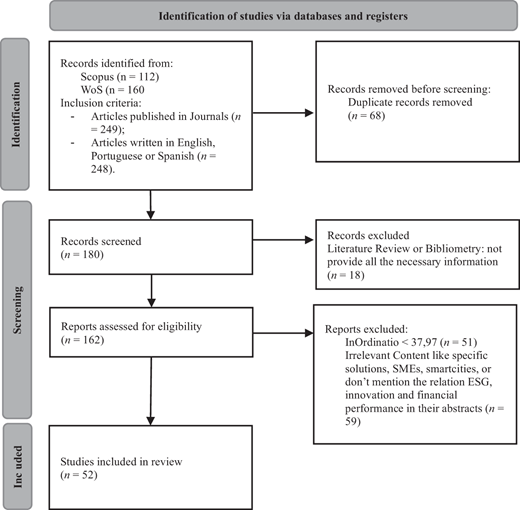
Steps 2, 3 and 4 from Sauer and Seuring (2023) – determining the required characteristics of primary studies, retrieving a sample of potentially relevant literature and selecting the pertinent literature, respectively – were developed in alignment with the PRISMA guidelines (Figure 1). Searches were conducted in the Scopus and Web of Science databases, as in Martiny et al. (2024), and following the recommendations of Paul and Criado (2020).
After preliminary searches, the following search terms were used in titles, abstracts and keywords: (“Environmental, Social and Governance” OR “Environmental, Social, and Governance” OR “ESG” OR “Environmental, Social or Governance” OR “Environmental, Social, or Governance”) AND (“innovat*”) AND (“financial performance” OR “firm value” OR “financial return*” OR “profit*” OR “economic performance”). In the final search, conducted on February 20, 2024, a total of 272 articles were identified.
To ensure a high-quality portfolio for analysis, we applied the Methodi Ordinatio multicriteria approach (Pagani, 2024; Pagani et al., 2015, 2022). This method selects and ranks articles based on their scientific relevance. It incorporates citation counts, the journal’s impact factor, and year of publication. This enables the identification of the most recent advances in the field (Pagani, 2024; Pagani et al., 2022). We calculated the Ordinatio Index (InOrdinatio) for each article using equation (1):
where:
= a weight ranging from 0 to 10 assigned to the importance of the impact factor of the selected journals. It is set to 10 to prioritize the most relevant journals;
IF = the journal impact factor, which uses the most recent Journal Citation Indicator (JCI) available at the time of the search. Clarivate reports this indicator in the 2023 Journal Citation Reports (JCR), which rely on 2022 data;
= this criterion assigns a 0–10 weight to the importance of contemporaneity. It is set to 10 to favor recent discussions;
ResearchYear = the survey year. We use 2024;
PublishYear = article’s publication year;
CitedHalfLife = the median Cited Half-Life reported by Clarivate for each journal in the portfolio, which reflects citation stability among journals with more than 100 citations in 2022;
= this criterion weights the importance of an article’s average annual citations on a 1–10 scale. We use 10 to maximize relevance;
Ci = article’s citation count.
To ensure the inclusion of the most relevant articles in terms of citation volume and contemporaneity, we followed the guideline proposed by Pagani (2024): use the lowest InOrdinatio value of the oldest article in the portfolio as the cutoff. The oldest article, published in 2013, shows an InOrdinatio of 37.97. This value was adopted as the cutoff, ensuring a portfolio composed of recent, academically relevant articles published in high-impact journals. This procedure yielded 52 selected articles.
Following the procedures described by Sauer and Seuring (2023), the process advanced to steps 5 and 6: synthesizing the literature and reporting the results. We used MAXQDA software to code the data. The Coding Book is presented in Appendix 1. An initial full reading of the articles was conducted, and they were coded according to predefined categories and subcategories (see Table 1). After reviewing the Codebook and the Coding Reports generated in MAXQDA, a second round of coding was conducted to further refine the analyses.
The review used the conventional vote-counting strategy described in Canabal and White (2008) and Kahiya (2018): each study functions as one unit of analysis and carries the same weight, in line with discussions by Denyer and Tranfield (2009) and Tranfield et al. (2003) on systematic reviews in organization and management research. These authors discuss that applied social sciences do not rely on a single superior method. Instead, researchers should select the approach that best addresses their specific questions and contributes to solving organizational problems.
We considered article-level importance metrics solely for constructing the portfolio and did not impose epistemological criteria for inclusion, thereby enabling coverage of diverse study designs, data types and samples. The goal was not to count how often a code appeared in each article, but rather to identify which articles contained the code.
Results and discussion
The 52 analyzed articles were authored by 148 researchers. Among them seven were the most prolific: Khalil M. (Khalil et al., 2024; Khalil & Nimmanunta, 2023), Khurram M. (Chen et al., 2023; Zheng et al., 2022), Albitar K. (Alkaraan et al., 2022; Yang et al., 2024a), Chen (Chen et al., 2023; Zheng et al., 2022), Chouaibi J. (Chouaibi et al., 2022; Chouaibi & Chouaibi, 2021) and Chouaibi S. (Chouaibi et al., 2022; Chouaibi & Chouaibi, 2021). Among the five most cited authors with over 150 citations are Eccles R., Serafeim G., Tzeremes N., Matousek R. and Broadstock D. These findings contrast with those of Fatima et al. (2024) and Khaw et al. (2024), who identify different most productive and influential authors.
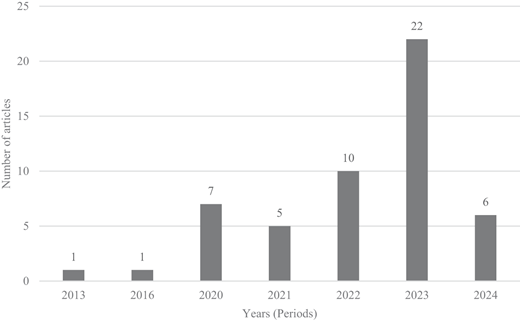
The portfolio includes articles with Ordinatio values ranging from 38.65 to 495.96 and publication years between 2013 and 2024, as shown in Figure 2.
The 52 articles span 29 journals, with 46% of the output concentrated in the top five: Sustainability (11 articles), Business Strategy and the Environment (4), Corporate Social Responsibility and Environmental Management (4), Technological Forecasting and Social Change (3) and Society and Business Review (2). Among these journals, only two appear in the list compiled by Fatima et al. (2024) (Sustainability and Corporate Social Responsibility and Environmental Management). Khaw et al. (2024) list only Corporate Social Responsibility and Environmental Management, and Ed‐Dafali et al. (2024) list only Business Strategy and the Environment. None of the journals overlap with the list presented by Martiny et al. (2024).
These findings show that, although the referenced literature reviews address the ESG theme, their search terms and filtering choices – especially those tied to fields of knowledge – directly shape their results and limit comparability. Consequently, each study offers a snapshot of the ESG topic interpreted through a distinct analytical lens.
Scope and theoretical approaches
Regarding the scope of the 52 articles, the analysis shows that 23 studies (44%) examine the combined relationship among ESG, innovation, and financial performance (ESG–INNOV–FP), while 29 studies investigate bilateral relationships. Among these, 16 articles (31%) address ESG–FP and 13 articles (25%) analyze ESG–INNOV.
The analysis of theoretical frameworks by study scope shows that, consistent with Khaw et al. (2024), Li et al. (2021) and Martiny et al. (2024) – and unlike Ed‐Dafali et al. (2024) – Stakeholder Theory (Freeman, 1984) emerges as the dominant foundation across all three scopes. Additional frameworks include Signaling Theory, applied in Huang (2022); Agency Theory, noted by Ed‐Dafali et al. (2024) and Martiny et al. (2024); and Institutional Theory, emphasized by Li et al. (2021) and Martiny et al. (2024). Despite variation in frequency, all identified theories appear in prior reviews, forming a shared foundation for ESG, innovation and financial performance research, which together shape the core theoretical foundation of the discussions.
Methodological decisions
Most studies analyze the period from 2013 to 2018, reflecting the availability of ESG data. On average, they cover 9–10 years of observations, aligning with the United Nations (2004) recommendation to examine ESG-related outcomes over a decade.
Across scopes, the studies predominantly examine Asian contexts (26), with China accounting for 19 of them. European settings follow with nine studies, and North America with four. A total of 11 articles conduct cross-country comparisons involving multiple continents. Research on Africa and Oceania remains limited, with only one study focusing on Africa and one adopting a cross-country approach that includes Oceania, similar to Fatima et al. (2024).
The portfolio contains no studies on Latin America, a pattern also noted by Ed‐Dafali et al. (2024). This absence does not imply a lack of research on Latin America, Africa or Oceania. Rather, it indicates that such studies have not appeared in leading journals indexed in Scopus or Web of Science, which limits their international visibility.
In Asian countries, the literature emphasizes the ESG–INNOV relationship, whereas studies from Europe and cross-country comparisons highlight the ESG–FP relationship more prominently (Table 2). These patterns differ from those reported by Ed‐Dafali et al. (2024), who find a predominance of studies in North America (18), followed by China (17), and cross-country analyses (10).
Regarding data collection, Eccles and Serafeim (2013), Isaksson and Woodside (2016) and Liu et al. (2024) used primary data obtained through interviews, whereas the remaining relied on secondary data from corporate websites or structured databases. Concerning data analysis, Alkaraan et al. (2022), Kong et al. (2023), Liu et al. (2024), Sun et al. (2023) and Yang et al. (2024b) used textual or content-based approaches. The majority of studies used more than one analytical method, with linear regression and panel-data regression dominating the portfolio, appearing in 82.69% of studies (43).
The variety of variables used by authors as proxies for ESG, innovation and financial performance reflect distinct contexts and rationales. In addition, it helps explain the often-inconclusive results reported in the literature. For ESG proxies, the Bloomberg ESG Score and the ESG London Stock Exchange Group Data and Analytics Indicator (Refinitiv Eikon) were each used in 17 articles. In contrast, specific stock exchange ESG indicators were used in eight articles. CSRHub ESG Rating, ISO14001, ISO26000, ISO9001, ESG KLD Research and Analytics and S&P ESG Score were used less frequently, in four articles. Integrated Reports using international standards, and governance structure for sustainability were each used by three articles. This trend highlights a broader effort among scholars to adopt standardized ESG metrics that allow for meaningful comparability across contexts (De Lucia et al., 2020; Isaksson & Woodside, 2016; Khanchel et al., 2023; Liu & Lyu, 2022).
The literature consistently underscores the need for standardized ESG measures, not only to advance scientific knowledge but also to support managerial, investor and policy decisions in sustainable development (De Lucia et al., 2020; Khanchel et al., 2023; Lee, 2023; Li et al., 2023; Liu et al., 2024; Sun et al., 2023; Yang et al., 2024a; Zheng et al., 2022). Nationally developed standardized metrics are particularly relevant: while aligned with international frameworks, they also capture the localized expression of ESG practices within firms and reflect country-specific institutional conditions, including regulatory, political, market and economic environments.
Regarding innovation proxies, Research & Development (R&D) expenditure appears in 42% of studies (22 articles), whereas patents – including green patents as a proxy for green innovation – occur in 31% of studies (17). Kemp and Pearson (2008) note the difficulties in accessing corporate R&D and patent data, as companies often do not disclose this information or report it only at the country level. These patterns reflect institutional differences across countries, particularly in regulatory environments and companies’ willingness to disclose such data, and they contribute to informational asymmetries between managers and investors (Oliveira et al., 2019). In Oliveira et al. (2019), for example, only 44 of the 1,597 Brazilian companies examined reported R&D expenditures in notes, statements or financial reports.
Most studies examining financial performance use accounting-based return metrics such as Return on Assets (ROA), featured in 35 articles (e.g. Alkaraan et al., 2022; Baek & Lee, 2024; Buallay, 2022; Chen et al., 2023; Cho, 2022; Chouaibi et al., 2022), Return on Equity (ROE) used in 17 articles (e.g. Barros et al., 2023; Doni & Fiameni, 2024; Khanchel et al., 2023; Lee, 2023; Naseem et al., 2020), along with other accounting indicators related to business profitability (14 articles). While accounting-based measures are widely used as proxies for financial performance and reflect historical performance, the literature acknowledges that market-based metrics – such as stock returns or cash flow generation – better capture a firm’s future value creation (Epstein & Roy, 2001).
Regarding the control variables used in the 52 articles analyzed, 73% (38) adopt proxies related to firm size, considering total assets (Barros et al., 2023; Naseem et al., 2020; Yang et al., 2024b), number of employees (Baek & Lee, 2024; Khanchel et al., 2023) or sales (Sandberg et al., 2023; Teplova et al., 2023). In 67% of the articles (35), proxies associated with financial leverage or capital structure are used (Barros et al., 2023; Cho, 2022; Chouaibi et al., 2022). Organizational age and sector are considered in 31% of the studies (16) (e.g. Cho, 2022; Cupertino et al., 2021; Fahad & Nidheesh, 2021), while liquidity or financial slack variables appear in 23% (12) (e.g. Teplova et al., 2023). Risk related to the ESG–INNOV-FP relationship is addressed in 17% (9) of the articles.
As evidenced in the literature, a wide range of proxies is used to measure ESG, innovation and financial performance, as well as to control for variables. Because most studies rely on linear regression models to analyze these phenomena, the selection and calculation of variables are critical decisions that significantly affect the results (Baek & Lee, 2024; Buallay, 2022; Cho, 2022; Jitmaneeroj, 2023; Jung et al., 2023).
Research gaps
Among the research gaps and limitations identified by the authors, 24 out of the 52 analyzed studies (46%) express concerns about the variables used as proxies, emphasizing that such methodological decisions may significantly influence the results, as demonstrated by studies such as Fu et al. (2020), Huang (2022), Jitmaneeroj (2023), Jung et al. (2023), Jung and Yoo (2023), Khalil et al. (2024), Le et al. (2023), Nirino et al. (2021), Pinheiro et al. (2023), Sandberg et al. (2023) and Zheng et al. (2022).
In 23 studies (44%), the authors highlight the need for comparative or generalizable analyses, suggesting the exploration of new contexts or countries, while authors conducting cross-country comparisons stress the relevance of institutional context in shaping the relationship between ESG-INNOV-FP (e.g. Baek & Lee, 2024; Le et al., 2023; Meles et al., 2023; Pinheiro et al., 2023; Sandberg et al., 2023; Sun et al., 2023).
A total of 17 articles (33%) call for exploring new relationships that influence the ESG–INNOV–FP nexus, including analyses of different types of firms and sectors. Nine studies (17%) recommend multivariate techniques to capture long-term ESG returns and clarify the interactions under study.
These findings are corroborated by an analysis of the methodological decisions in the 52 selected articles. Only 18 articles (35%) used second-generation statistical methods (Hair et al., 2017), known to be more powerful and flexible, to simultaneously map the complex relationships studied by applied social sciences, such as General Method of Moments (GMM), Two-stage least squares (2SLS), Multilevel Linear Modeling (MLM), Neural networks, Data Envelopment Analysis (DEA), Nonparametric frontiers, Fuzzy-set Qualitative Comparative Analysis (fsQCA) and Structural Equation Modeling (SEM).
Other research gaps mentioned across the articles include: (a) disaggregated analyses of ESG dimensions; (b) interviews with managers to complement findings; (c) comparative analyses of ESG–INNOV–FP relationships before and after crises; (d) accounting for regulatory differences between countries in modeling; (e) use of alternative databases.
Articles results
Based on the findings of the 52 studies analyzed, there is evidence that ESG aspects positively influence companies’ innovation (11), compared to only one study that found a non-significant relationship (Chen et al., 2023), one study that reported negative relationships (Jung et al., 2023) – when ESG factors hinder companies’ innovative capacity, such as in the case of competition for financial resources – and two studies that identified a nonlinear relationship (Yang et al., 2024a; Yin et al., 2023) between these dimensions. Empirical evidence also shows innovation influencing ESG (10 studies), indicating bidirectional relationships.
The analysis shows that this reciprocity partly reflects the variety of variables used to measure innovation and ESG, as well as the conceptual link researchers establish between these dimensions. When ESG indicators capture the strategic use of ESG principles within organizations – operating as guidelines that shape decision-making – firms that strengthen their ESG engagement tend to achieve stronger innovative performance, which may ultimately materialize in patent registrations (ESG–INNOV).
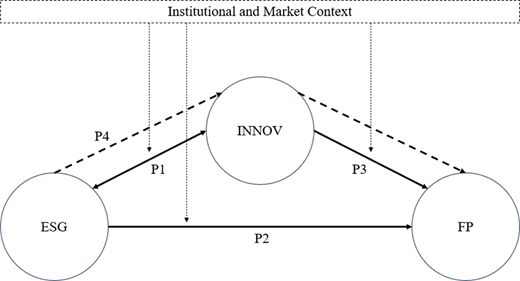
Most studies that report a positive ESG-INNOV relationship use patents as a proxy for organizational innovation (Chen et al., 2023; Jin & Lei, 2023; Le et al., 2023; Li et al., 2023; Liu & Lyu, 2022; Tang, 2022; Zhang et al., 2020). In contrast, when ESG indicators reflect firms’ environmental, social and governance behaviors, these outcomes often arise from firms’ innovative or eco-innovative activities (INNOV–ESG), typically measured through R&D investment, as shown in Baek and Lee (2024), Fu et al. (2020), Ge et al. (2022), Khalil et al. (2024) and Pinheiro et al. (2023). These relationships give rise to proposition 1 (P1): there are reciprocal relationships between ESG and innovation in companies.
Regarding the ESG–FP relationship, 50% of studies (26) report a positive, statistically significant association, leading to proposition 2 (P2): greater ESG engagement is associated with improved financial performance. Nevertheless, six studies identified negative relationships, suggesting that increased ESG efforts may weaken financial outcomes and six studies reported no significant relationship. These findings align with theoretical expectations in the literature, which propose that ESG dimensions shape firms’ long-term financial performance.
A slight tendency toward positive results emerges depending on the financial performance metric used: accounting or market-based. Although most studies rely on accounting metrics, 47% of these report positive ESG-FP results (21 of 45). Among the 25 studies that use market metrics, 52% found positive associations. Despite the widespread use of accounting measures – primarily driven by capital-market transparency requirements – these metrics produce more divergent ESG–FP results than market-based measures.
These patterns suggest that, because firm market value reflects investors’ expectations of future returns, firms’ involvement in ESG tends to be quickly priced by capital markets through reputation gains (Nirino et al., 2021; Pinheiro et al., 2023). In contrast, the accounting effects of ESG-related performance unfold over longer periods, producing different impacts on return metrics (Baek & Lee, 2024; Cupertino et al., 2021; Sandberg et al., 2023).
Regarding the INNOV–FP relationship, 29% of the studies (15) report that innovation positively affects financial performance (proposition 3). This pattern appears to be the most consistent in the reviewed literature: no study reports negative relationships, and only two report insignificant effects. Baek and Lee (2024) identify indirect effects mediated by innovation, while Khanchel et al. (2023) find insignificant relationships in low–R&D–intensity sectors and positive, significant effects in R&D-intensive sectors. The analysis also shows no differences in ESG–INNOV–FP results across the various analytical techniques applied.
Regarding mediation effects, 17 studies show that innovation mediates the relationship between ESG and financial performance, whereas only five identify mediation in the INNOV–ESG–FP pathway. Although many authors describe ESG–INNOV–FP findings as inconclusive, the SRL reveals a higher concentration of specific patterns, leading to proposition 4 (P4): there are mediation effects conducted by innovation between ESG and financial performance. These expected relationships are in the theoretical–empirical model presented in Figure 3.
The theoretical–empirical model can be translated into conditional propositions that clarify how ESG, innovation and financial performance interact under specific configurations. First, when innovation is measured through outputs such as patents, ESG practices tend to appear as antecedents of innovation. Conversely, when innovation is captured through R&D investments, innovation efforts more frequently appear as drivers of ESG improvements. Over time, ESG practices and innovation capabilities tend to co-evolve, mutually reinforcing each other and shaping long-term financial performance trajectories. Second, in contexts characterized by high R&D intensity and technological dynamism (e.g. sectors or countries), innovation more consistently mediates the positive relationship between ESG engagement and financial performance compared to contexts with lower innovation capacity.
The proposed theoretical-empirical model is not conclusive; rather, it is dynamic and should be adapted to the specific realities of the companies analyzed. When addressing ESG-INNOV-FP in a context shaped by digital transformation and ongoing change, it is not advisable to develop a “one-size-fits-all” model. Instead, a model that highlights key relationships and can be adjusted to the demands of the specific institutional context should be considered.
The proposed theoretical–empirical model can incorporate additional control variables or segmentations supported by the literature. Although discrepancies emerged between the dimensions analyzed (ESG, INNOV, FP) and the control variables frequently referenced in prior studies, the review did not reveal consistent empirical patterns. Of the studies, 37 use firm size with different proxies; 40 incorporate financial leverage or indebtedness; 6 consider systemic risk; 26 include liquidity, financial slack or financial constraints; and 16 use firm age. However, few studies provide substantive discussion or empirical results linking these variables to the focal dimensions.
Fahad and Nidheesh (2021) and Meles et al. (2023) highlight the importance of leveraging capital structures to advance innovative and ESG-oriented projects in Asia and Europe. In contrast, Alkaraan et al. (2022), Chen et al. (2023), Tang (2022), Uyar et al. (2023) and Yang et al. (2024b) underscore the role of financial slack and liquidity in strengthening companies’ financial performance and ESG outcomes. For the first group of authors, debt financing enables project development and reduces the cost of capital, consistent with Agency Theory and the reduction of agency costs. For the second group, financial slack supports the pursuit of riskier projects.
These patterns depend strongly on the institutional context in which firms operate and make capital-structure decisions. In environments with substantial state ownership and commitments to international sustainable-development agendas, firms may access equity financing for eco-innovation projects at competitive capital costs. In contrast, in markets with low interest rates and active financial sectors, credit financing may offer a more attractive alternative. Regarding age and size, the literature generally anticipates positive and significant relationships between these control variables and both ESG and financial performance. Appendix 2 details this information and links it to the studies reviewed.
Conclusion
Main conclusion
The SLR shows that the relationships among ESG, innovation and financial performance are predominantly positive, though marked by methodological and contextual heterogeneity. Based on the analysis of 52 articles published between 2013 and 2024, it was found that:
ESG practices tend to stimulate corporate innovation and vice versa, depending on the variables used to measure these dimensions, giving rise to P1;
innovation has direct positive effects on companies’ financial performance, regardless of the metrics used as a proxy (P3); and
the impact of ESG practices on financial performance occurs both directly (P2) and indirectly (P4), mediated primarily by variables associated with innovation.
The SLR revealed the critical influence of institutional contexts on the relationships between ESG-INNOV-FP. Regulatory pressures, data availability, the maturity of organizational and governmental sustainability policies and the performance of financial and capital markets shape corporate behavior and decision-making and can influence the propositions presented. Although many results derive from China, similar relationships appear in studies from other continents; however, these specificities were not captured in the SLR.
The SLR also demonstrates that methodological decisions, such as the proxies used and the time horizon, significantly affect the results, thereby explaining the frequently reported perception of inconclusiveness in the literature. Measurement and methodological configurations also explain divergent results. Studies using patent counts often identify ESG stimulating innovation, while those relying on R&D expenditure frequently capture the reverse pathway, where innovation activities lead to improved ESG outcomes. Similarly, market-based performance indicators more often reveal positive ESG effects compared to accounting-based measures, whose impacts tend to materialize over longer time horizons. However, it was not possible to verify whether the relationships found diverged from the data analysis techniques used.
By analyzing the research gaps identified by the 52 articles, it is possible to construct studies that increasingly capture the complexities of the relationships between ESG-INNOV-FP, considering the characteristics of companies, institutional contexts of emerging countries, organizational culture, level of internationalization of their operations, involvement with innovation and eco-innovation systems, among others.
Theoretical contribution
This study advances the literature on ESG, innovation and financial performance by extending insights from prior systematic and bibliometric reviews and by offering a structured relational synthesis of empirical findings in this research field.
First, the findings demonstrate that the relationships linking ESG engagement, innovation and financial performance are inherently contingent upon institutional and market conditions. Previous literature reviews have emphasized the geographical concentration of ESG research and the importance of institutional environments in shaping sustainability outcomes (e.g. Ed‐Dafali et al., 2024; Martiny et al., 2024), often identifying contextual heterogeneity as a research gap. Building on these insights, this study moves beyond treating context as a descriptive characteristic of research settings and instead positions institutional and market conditions – such as regulatory pressures, ESG data availability, sustainability policy maturity and capital market development – as structural elements that shape how ESG-related initiatives translate into innovation and financial performance. By synthesizing evidence across diverse empirical contexts, the study contributes to institutional and stakeholder-based perspectives by clarifying that sustainability-driven value creation depends on context.
Second, the study clarifies how the relationships among ESG, innovation and financial performance are empirically configured in the literature, depending on how these constructs are operationalized. Rather than consistently reflecting stable directional effects, the synthesis reveals recurring relational configurations associated with measurement choices and research designs. Studies measuring innovation through patent outputs more frequently position ESG engagement as an antecedent of innovation, whereas research relying on R&D investments tends to capture innovation activities as drivers of ESG improvements. In addition, innovation emerges as the most consistent direct predictor of financial performance and frequently operates as a mediating mechanism through which ESG initiatives translate into economic outcomes. By systematizing these empirical regularities, the study advances prior reviews, which have often characterized ESG performance findings as fragmented or inconclusive, by offering a more structured understanding of how analytical strategies and proxy selection influence observed sustainability-performance linkages.
Third, the study advances methodological and theoretical discussions in SLRs by adopting a multivariate relational perspective that simultaneously integrates ESG, innovation and financial performance. While previous reviews have predominantly focused on mapping research streams, determinants of ESG performance or bibliometric trends (e.g. Fatima et al., 2024; Khaw et al., 2024), this research consolidates bilateral and multilateral relationships into a unified theoretical–empirical model informed by the frequency of empirical results. This approach enables the identification of expected relational patterns that can support future model specification and empirical testing. Furthermore, by demonstrating that divergences in findings frequently stem from differences in proxies, time horizons, analytical techniques and contextual conditions rather than from fundamental theoretical disagreements, the study contributes to improving theory development and research design in sustainability and innovation studies.
Taken together, these contributions position ESG, innovation and financial performance as interdependent dimensions embedded in context-sensitive organizational processes of value creation. Therefore, the proposed context-contingent theoretical–empirical model extends prior literature reviews by moving beyond descriptive synthesis toward explanatory integration, providing a foundation for future empirical investigations across diverse institutional environments, particularly in underrepresented emerging and Global South contexts.
Societal contribution
The results presented reinforce that ESG practices and investments in innovation contribute to sustainable business development, with impacts that extend beyond the organizations analyzed. By demonstrating that such practices tend to generate positive financial returns, the study helps legitimize corporate actions aligned with sustainable development, thereby promoting the dissemination of strategies that simultaneously generate economic, social and environmental value, in line with the three pillars of sustainability.
From a practical perspective, the findings provide actionable guidance for managers seeking to integrate ESG practices with innovation and financial performance. Specifically, we clarify how firms can operationalize the ESG–innovation–financial performance relationship by:
aligning ESG initiatives with innovation strategies through sustainability-oriented R&D investments;
adopting ESG metrics that are sensitive to institutional and market conditions;
leveraging innovation as a mediating mechanism to enhance financial performance; and
adjusting financing strategies according to market conditions to support ESG-driven innovation.
These findings directly relate to the Sustainable Development Goals (SDGs), especially those involving work and economic growth (SDG 8), industry, innovation and infrastructure (SDG 9), responsible consumption and production (SDG 12) and climate action (SDG 13). The three dimensions analyzed (ESG, innovation and financial performance) enable us to contextualize companies’ roles and rethink their performance as both consumers and producers of resources, thereby contributing to a review of current patterns of economic development. Recognizing companies’ environmental and social impacts is a relevant step toward ensuring that, driven by innovation, their ESG performance creates long-term value for stakeholders, thereby supporting organizational survival.
At the same time, the SLR highlights the relevant challenges faced by countries in the Global South. The concentration of studies in a few Asian countries contrasts with the absence of research in regions such as Latin America, Africa and Oceania, whose participation in global debates on sustainability is fundamental. The limited availability of standardized data, institutional heterogeneity, lower regulatory requirements and restricted disclosure of corporate information constitute significant barriers to the construction of scientific knowledge in these contexts.
Therefore, this study makes a social contribution by highlighting the urgency of strengthening corporate governance, corporate transparency, data access and the regulatory capacity of developing countries – conditions necessary for formulating public policies and business practices more aligned with global sustainable development.
Limitation
One limitation of this work was the predominance of Asian countries in shaping the body of knowledge on this topic. The theoretical-empirical model was developed based on a reality that may differ significantly from those in other regions. Considering the importance of institutional context in empirical outcomes, future studies should aim to construct article portfolios for SLRs focused on specific contexts. This would enable exploration of ESG-INNOV-FP relationships while accounting for country-specific factors.
Although comprehensive, the systematic review was limited to only two rounds of coding by the same author, which may introduce interpretive biases and compromise the reproducibility of the results. In addition, using only two international databases may be considered a limitation. Although these databases are widely recommended in the literature, they may introduce biases related to the studies’ origins.
The scarcity of qualitative studies and the prevalence of linear models limit the understanding of non-linear relationships and long-term dynamics inherent to the topic. Finally, despite the breadth of the review, the theoretical categories used in the analyzed studies are concentrated within traditional frameworks (e.g. stakeholder theory and institutional theory), highlighting an epistemological limitation of the field and underscoring the need to broaden the theoretical diversity used.
Implication for future research
The identified research gaps provide important recommendations for future research. Methodological gaps include developing and testing new proxies for ESG, innovation and financial performance; using multivariate approaches that can capture the interrelationship between the dimensions studied, considering different time horizons; using other data sources; exploring new relationships, including nonlinear relationships and recursive effects; developing disaggregated analyses of ESG components; and including regulatory variables.
This study highlights the need for research in other developing countries, such as Latin American Nations, key players in the sustainable development discourse but underrepresented in the literature, at least within the criteria used in this review. Research in these contexts can elucidate how differences in institutional, regulatory and market maturity influence ESG-INNOV-FP relationships, thereby contributing to a more balanced global perspective. Furthermore, using databases other than Scopus and Web of Science can yield different results and provide access to work by authors from the Global South, such as Scientific Electronic Library Online (SciELO) and Red de Revistas Científicas de América Latina y el Caribe, España y Portugal (Redalyc).
Thus, by proposing a theoretical-empirical model that synthesizes the scientific literature on the relationships among ESG, innovation and financial performance, this study presents the most up-to-date discussion, advances prior literature reviews and opens avenues for future developments grounded in meticulously mapped insights. Moreover, researchers can use the proposed theoretical–empirical model as a basis for empirical testing of the relationships.
The findings point to several opportunities for future research. In methodological terms, the need to:
develop and test new proxies for ESG, innovation and financial performance;
incorporate more sophisticated multivariate techniques capable of capturing dynamic and mediated relationships over time; and
explore alternative databases, especially in contexts that are underrepresented in the literature, stands out.
Regarding theories, the use of approaches linked to dynamic capabilities, widely used in innovation studies and to financial theories could enrich the current view of the phenomena and make critical theoretical contributions to the revision of existing scientific conceptions.
Finally, it is suggested that new variables be incorporated into the scenarios already studied, such as the moderating effects of public policies and environmental regulations, the impacts of crises and disruptive events and sectoral specificities, particularly sectors intensive in technology and natural resources, whose relevance to the sustainable transition is strategic.
References
Appendix 1
Appendix 2
Data availability
The entire data set supporting the findings of this study is published within the article.