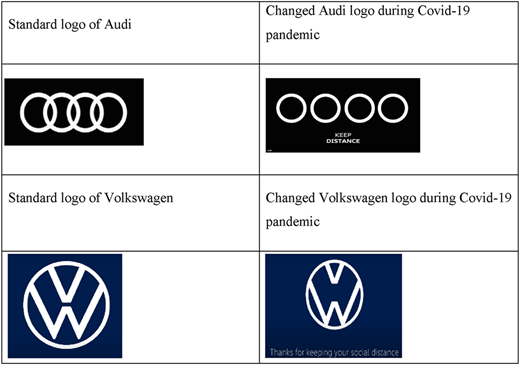
This study aims to examine the influence of Brand Anthropomorphism on Conversational Value and Attitude Towards Communication (relevance) of Gen Y and Gen Z consumers in the context of the COVID-19 pandemic. The study considered interactive marketing strategies used by premium auto brands on social media during this crisis and their impact on consumers. Keeping consumers engaged with brands was a challenge during the pandemic and the premium auto brands in the study ensured that anthropomorphic brand communication, created conversations about the brand.
This primary study used a structured questionnaire to collect data from 102 respondents who witnessed changes in logos by two premium automotive brands on social media platforms during the COVID-19 pandemic. The dataset was analysed using the partial least squares – structural equation modelling methodology and the multi-group analysis (MGA) procedure.
The study reveals that brand anthropomorphism affects consumer’s attitude and encourages consumer conversations. Mass media was employed to raise public awareness and increase the receptivity to learning certain social behaviours during the pandemic. The auto brands in this study also effectively engaged with consumers about such behaviours through their logos which had consumers communicating with the brand as well as amongst themselves.
The study used convenience sampling and an online survey format, which may limit the breadth and representativeness of responses. Future research could adopt probabilistic sampling methods, broaden participant diversity, and extend the analysis to other sectors such as fast-moving consumer goods, hospitality and e-commerce. Expanding the model to include constructs such as brand image and purchase intent, as well as exploring cross-cultural dynamics and the longer-term impact of anthropomorphic branding, would offer a more comprehensive understanding of how such strategies influence consumer perceptions and behaviour during crises.
From a managerial perspective, the results underscore the strategic value of anthropomorphic communication in customer engagement, particularly on digital and social platforms where interaction is frequent and public. The significant and consistent positive effects across brands suggest that brand managers can confidently implement anthropomorphic cues such as conversational tone, human-like avatars, personalised messaging style or emotionally expressive language to cultivate more favourable attitudes toward brand communication and increase the perceived worth of brand consumer exchanges.
The study aims at contributing to the body of knowledge as it investigates a unique the correlation of brand anthropomorphism with conversational value and attitude towards the communication by the brand. This study provides empirical evidence in support of the Stereotype Content Model in the context of premium automotive brands.
Introduction
Consumers buy brands with the purpose of connecting at a personal level and building relationship with not only visual images but also emotions. Traversing the journey of building connections with the consumers has brands focusing not only on the physical well-being of consumers in their communications but also on being sensitive to consumers' overall well-being. An inclusive tone of compassion and care can help brands establish deeper emotional connections with consumers, resulting in a greater number of discussions as well as an optimistic outlook about the brand. While consumers have been hurting amid the global COVID-19 crisis, a few brands have been attempting to reach out and connect with consumers to support them in numerous ways. Steering the relationship with consumers in an empathic and considerate manner has the potential to create authentic connections that could sustain the aftermath of the pandemic. The pandemic has also led to more time being spent viewing videos on streaming services and browsing social media platforms in search of some escapism media, increasing our exposure to commercials (Hart, 2020). Hence, due to this, there is a significant change from traditional to digital media outlets, which will increase the role of digital platforms (Eyada, 2021).
More specifically, while traditional media saw dramatic declines in advertising revenues during the COVID-19 pandemic, digital advertising in India emerged as a major area of resilience and growth. According to GroupM India, overall ad spends in the country fell by 21.5% in 2020 - the highest one-year drop on record, but this impact was disproportionately severe for traditional media, which de-grew by 37%. In contrast, digital media remained stable, buoyed by an accelerated shift of advertisers to online commerce channels and rapid consumer adoption of digital platforms (GroupM India, 2023; IBEF, 2023). Social media and streaming platforms disproportionately benefited, becoming focal points for campaigns as businesses sought to reach consumers and adapt to lockdowns and remote work.
This study examines the Brand Anthropomorphising attempts of two premium automotive brands during the COVID-19 pandemic to demonstrate care for their consumers by creating human-like interactions through the brand logo. The intent was to see if these brand communication efforts impacted consumers enough to develop a positive attitude about the brand and whether it created Conversational Value within the consumer community. For this, we used a structured questionnaire to collect data from 102 study participants who witnessed changes in logos by premium automotive brands on social media platforms during the COVID-19 pandemic. The data were analysed using the partial least squares - structural equation modelling (PLS-SEM) methodology. The results indicate that Brand Anthropomorphism influences consumer attitudes towards the brand and leads to consumer conversations. Brand managers could use the insights from this study to communicate effectively during times of crisis.
The following section presents a brief commentary on the conceptual grounds of this work. Then, we describe the research methodology and follow it with the results of data analyses and discussion. The final section presents concluding remarks and directions for further research.
Literature review
In this section, we present some insights from the extant literature to lay the theoretical foundations. We begin by discussing the idea of brands as beings. Then, we focus on communications around brand logos. Next, we discuss advertising trends during COVID-19 and conclude by presenting some thoughts on brand communications during health crises.
Brands as beings
Anthropomorphisation is about attributing human traits to non-human beings or abstract ideas (Epley et al., 2008). For instance, in the case of automobiles, consumers tend to associate the headlights and grills of cars with a human face with two eyes and a mouth (Windhager et al., 2008; Landwehr et al., 2011). When consumers perceive brands as people or beings, it creates a significant consequence for branding (Puzakova et al., 2013). Consequently, the concept of Brand Anthropomorphism becomes relevant here since it is the degree to which a branded product is seen as a human being (Guido and Peluso, 2015). Brand Anthropomorphism is one of the most widely used marketing strategies and people perceive anthropomorphized brands as close, intimate and friendly objects that can be communicated with (Zhang et al., 2020). Recent studies have demonstrated that imbuing brands with human-like characteristics can significantly enhance emotional brand attachment. As per (Ngoc Dan and Ngo Trong, 2023), Brand Anthropomorphism plays a significant role in consumer engagement. Consumers experiencing social exclusion may exhibit a heightened preference for anthropomorphic brands, as these brands can provide a sense of social connection and belonging (Chen and Lin, 2021).
Communications around brand logos
It requires effort to create a logo so that it accomplishes the objective of representing the company’s image in the perceiver’s mind (Buttle and Westoby, 2006). Consumers find it easy to develop an attachment to the visual presence of a brand's logo. The logo of a brand is considered to be the most prominent visual component when other brand aspects are considered (Mininni, 2005). Besides this, brands come across as being dependable when they have a visual identity or logo. The presence of a brand logo also helps consumers perceive the brand as having a high degree of reliability and it positively affects how consumers evaluate it (Park et al., 2013). It has been seen that logos are a powerful influence on consumers' inclination to purchase the brand and, therefore, augment the brand's net sales (Luffarelli et al., 2019). Interestingly, the effect of the logo change is always more significant for the people who have a stronger bond with the brand. Conversely, for people with weak brand commitment, a change in the logo would not be as meaningful as for people who have a stronger bond with the brand (Walsh et al., 2010).
Brand logos can take on the role of being the integrator of the marketing functions of the brand, a reflector of such an effort and a symbol of what the brand can mean to its consumers. In a nutshell, a good logo can be a synthesiser of a brand that is voluntarily sought by customers for “identification, differentiation and positive associations” (Park et al., 2013).
A logo is a fundamental component of corporate visual identity and the source of the logo becomes a source of positive brand associations over time. Visual and identity-based evaluations play a crucial role in the reception of a logo (Erjansola et al., 2021). Logo evaluations are either targeted towards the logo or the organization behind it.
Digital branding and crisis communication
Recent research in the domain of digital branding and crisis communication highlights the transformative impact of technological advancements and evolving stakeholder expectations on communication strategies. The rise of social media platforms and ICTs has necessitated a shift from reactive to proactive approaches, emphasizing stakeholder-focused, swift and transparent messaging to sustain credibility and public trust in moments of uncertainty (Lee, 2020; Deveney, 2018).
Luxury brand managers can enhance purchase intentions by simultaneously strengthening emotional bonds, offering economic benefits and leveraging social and cultural norms, an approach shown to be particularly effective in markets such as India and China (Singh et al., 2021)
Core pillars such as authenticity, transparency and responsiveness now underpin effective crisis communication, with brands increasingly embracing two-way, humanistic dialogue rather than one-way corporate messaging (Novitasari, 2024; Kara, 2019). This approach is particularly salient for Generation Y and Generation Z, who exhibit heightened sensitivity to brand anthropomorphism, where brands adopt human-like traits and conversational tones, which can enhance conversational value and positively shape communication attitudes. Proactive engagement, rapid response and emotionally intelligent communication not only mitigate reputational risks but also foster deeper loyalty, as evidenced in large-scale analyses during the pandemic era (Dhar and Bose, 2022; Górska-Warsewicz, 2025). These findings underscore that, in the digital age, strategic brand communication must prioritize authenticity, empathy and real-time interaction, harnessing brand anthropomorphism as a lever to build enduring relationships with digitally native cohorts.
Communication during health crises
The role of advertising during health crises needs to be examined better. Brands must not run the risk of appearing to exploit consumers. Social media is one of the important platforms during times of crisis (Yu et al., 2021). The brands should not add to the prevailing fear. Instead, they should come up with communication that is sensitive to the scenario and not entirely profit-oriented. The primary role of the mass media during health crises is to create awareness or heighten public sensitivity to health issues (Bush and Boller, 1991).
A notable study in this regard was by Ali et al. (2021), who looked at brand communications while consumers were still learning behaviours related to social distancing. COVID-19-related commercials can elicit more intense emotional responses and modulate the perception of the ad, potentially acting as a lever to increase consumer appeal (Balconi et al., 2022).
When brands like Uber went ahead and used communication like “No Mask, No Ride”. Threat-to-freedom messages lead to negative ad attitudes, lower intention to engage in socially responsible behaviours and greater psychological reaction (Shoenberger et al., 2021).
Advertising during COVID-19
As the world faced one of the most challenging times in recent history with COVID-19, many industries have been affected by it, with the automobile industry being one of the most hit sectors in terms of sales (Eyada, 2021). The COVID-19 pandemic has forced consumers and brands to make significant changes in the way they function and communicate. Consumers around the world are making changes to the way they work and live, as well as how they interact with the media and shop for their daily needs. Furthermore, most worldwide economies are facing a considerable slowdown. Therefore, companies are cutting back and advertising is experiencing the after-effects. As the world limps back to recovery, a new normal has emerged, and brand managers are adopting diverse methods to connect with their consumers (Jordan, 2021). Using this approach, brands are reaching out to consumers to convey how they care for them and want to see them safe and protected (Eyada, 2021). Consumer behaviour is a major factor when it comes to creating marketing strategies. With a shift in consumer priorities favouring personal health, family safety and public health (Remes et al., 2020), consumers want advertising to assist them in navigating the new normal in a favourable light.
Keeping this in mind, many car brands have altered their marketing plans. Luxury car brands have increasingly leveraged advanced data analysis techniques, especially sentiment analysis and social media monitoring, to interpret emotional responses and customer opinions, enabling them to strengthen brand connections and refine their communication strategies in digital spaces, particularly during periods of heightened social engagement like the pandemic (Barakati et al., 2024).
To adapt to the COVID-19 times, through their social media platforms, brands used advertising methods to offer health information and raise awareness (Eyada, 2021). Along with this, to emphasize the idea of remaining at home, brands such as KIA, AUDI, Land Rover, Mercedes and Fiat have created adverts displaying films of people leaving their cars parked. Land Rover India debuted its “Keep It Parked” campaign, showcasing a car driving backwards from where it started with the motto “Keep it parked for now, not forever.” Numerous firms have altered their logos to advocate social distancing; while logos are frequently viewed as inviolable in the branding world, several brands have adopted this strategy to raise awareness.
Research problem, objectives and hypothesis development
Problem statement
The COVID-19 pandemic transformed brand–consumer interactions, with digitally native audiences expecting empathetic, human-like engagement from brands. While brand anthropomorphism has been identified as a way to enhance consumer connection, its influence on attitudes toward brand communication and conversational value, particularly between different original equipment manufacturers (OEMs) in the Indian premium automotive sector, remains underexplored. This gap limits brand managers’ ability to design effective, consumer-focused crisis communication strategies on social media.
Objectives
To examine the influence of brand anthropomorphism on consumers’ attitudes towards brand communication in the context of premium automotive brands on social media during the COVID-19 pandemic.
To assess the impact of brand anthropomorphism on consumers’ conversational value -their tendency to discuss and share brand communication within their networks - during the pandemic.
To compare the effects of brand anthropomorphism on attitudes towards brand communication and conversational value across different OEM groups, thus identifying whether consumers interacting with distinct premium automotive brands respond differently to anthropomorphic branding strategies during the COVID-19 pandemic.
Hypothesis development
Limited insights could be drawn from extant literature since none of the research done focused on the automotive category, nor performed social media content analysis. Overall, in the context of the premium automobile segment, studies that look at the role of social media advertising during health crises remain scarce.
This study focuses on the effects of brand anthropomorphism in the context of social media branding communications by premium automobile brands during times of COVID-19. For this, we look at consumer's responses to social media posts promoted by the brand and attempt to answer the following research questions:
Does Brand Anthropomorphism influence Attitude Towards Communication?
Does Brand Anthropomorphism influence consumer Conversational Value?
Methodology
We employed a structured methodology involving a primary research design. The methodological pursuit began with developing a questionnaire, followed by collecting sample data through the survey method and culminating with suitable statistical analyses. In thisregard, we had a few overarching considerations. For example, we identified Audi and Volkswagen, two OEMs operating in the Indian automobile market, for this study. Secondly, the logo imagery available on Social Media websites was used to elicit the participants' responses. Lastly, SmartPLS 3.0 software was used to conduct all the reported analyses. The following subsections detail our approach.
Questionnaire development
We developed a new questionnaire with three sections for this study. The first section collected information related to the gender, age and occupation of the study participants. The second section had fourteen questions to collect data for the main study variables (see Table 1) Here, the construct and corresponding items for Brand Anthropomorphism (n = 5) were taken from Epley et al. (2008). Similarly, the construct and corresponding items for Attitude Towards Communication (n = 4) were drawn from Chen et al. (2017) and Smith et al. (2007). Finally, the construct and corresponding items for Conversational Value (n = 5) were taken from Bastos and Brucks (2017). All of the items in the second section were measured on a five-point Likert scale (Strongly Disagree to Strongly Agree) (see Table 1 and Figure 1).
Sample data collection and management
For data collection, we targeted potential respondents belonging to Generation Y and Generation Z situated in four cities of India: Mumbai, Pune, Hyderabad and Bengaluru. This choice of the sample was based on two presumptions: (a) these generations exhibit reasonable levels of social-media content consumption; (b) these cities have historically displayed higher levels of internet penetration and usage. The process spanned approximately 3 months, allowing for a comprehensive data collection process.
The questionnaire was shared as an online survey form with more than 250 potential respondents through Google Forms. Of these, 102 chose to submit the completed questionnaire. Here, we note that the survey form was designed in such a manner that submitting incomplete forms was impossible. Hence, there were no missing entries. After screening all the responses for validity, we decided to proceed with data recoding for further analysis. The finalised sample had 52 men and 50 women respondents belonging to four age groups: (a) 20–35 years: 40 respondents; (b) 36–50 years: 32 respondents; (c) 51–65 years: 28 respondents; (d) 66 years and above: 2 respondents.
Data recoding
The dataset that emerged from the previous step had 102 rows and 20 columns. The first step in the data recording process was to convert the data collected for the first section of the questionnaire into categorical data. Subsequently, the data collected for the second section were recoded as metric-ordinal (1 to 5: 5 being the highest rating) data. Finally, since all the items were direct, there was no consideration or action required for reverse coding.
Data analyses
To continue the conceptual discussion and to avoid information loss, it was decided not to aggregate the constructs as singular variables and not to use a more traditional multivariate data analysis technique like MANCOVA. Instead, we decided to treat the aforementioned constructs as reflectively measured latent variables through the PLS-SEM approach, as suggested by Hair et al. (2017). Other reasons for choosing the PLS-SEM approach were (a) its non-parametric nature and the size of the sample used in this study and (b) the availability of theoretical and empirical work on the constructs (see Section 2). A description of our two-step procedure is given below.
Step 1: Specification and examination of the path model using the PLS algorithm: We used the following settings: “Path” weighting scheme, three hundred as “number of maximum iterations” and “stop criterion” as 10–7.
Step 2: Establishment of the statistical significance of the PLS-SEM results using the bootstrapping routine: We used the following settings: 5,000 subsamples, “Complete Bootstrapping”, “Bias-Corrected and Accelerated (BCa) Bootstrap”, two-tailed test and 0.05 significance level.
These steps led to the computation of statistical metrics like outer loadings, path coefficients, p-values and t-statistics. Furthermore, statistics for internal consistency reliability, like Cronbach’s alpha and composite reliability, were calculated. To examine the convergent and discriminant validity, we used the average variance explained (AVE) and the heterotrait-monotrait (HTMT) ratio statistics (Hair et al., 2017).
Finally, to see whether there was any statistically significant difference between the perceptions of the two groups (Group 1 = Audi, Group 2 = Volkswagen), we conducted a Multi-Group Analysis (MGA). The p-value of the difference between the path coefficients was then examined for inferring (Hair et al., 2017).
Results
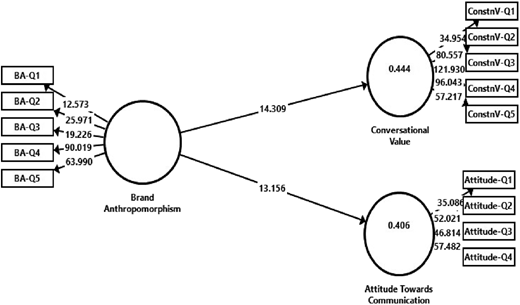
A visual representation of the path model as specified in the SmartPLS software is depicted in Figure 2. Further, the results of the run of the PLS Algorithm and the Bootstrapping routine are presented in Tables 2–4. Table 5 lists the results of the Multi-Group Analysis procedure.
Discussion
The measurement model results indicated that all latent variables, Brand Anthropomorphism, Attitude Towards Communication and Conversational Value, demonstrated strong convergent validity, as evidenced by AVE values exceeding the recommended 0.50 threshold (Hair et al., 2017). Discriminant validity was also established, with HTMT confidence intervals excluding 1 across all constructs. Measures of internal consistency reliability, namely Cronbach’s alpha and composite reliability, were well above the minimum recommended value of 0.70; however, both indices were somewhat higher than the conventional upper boundary of 0.95 for some constructs (e.g. Conversational Value: α = 0.953, CR = 0.964). While this reflects strong measurement consistency, the elevated values could suggest redundancy amongst certain indicators, potentially arising from overly similar item wording or overlapping conceptual coverage.
The structural model results revealed that Brand Anthropomorphism exerted a strong and statistically significant positive influence on both Attitude Towards Communication (β = 0.637, t = 13.156, p < 0.001) and Conversational Value (β = 0.666, t = 14.309, p < 0.001) (see Table 3). These effect sizes are substantial in behavioural research terms, indicating that anthropomorphic brand cues meaningfully shape how consumers appraise both the quality and enjoyment of their interaction with the brand, as well as their overall communicative disposition toward it. Furthermore, the correlation between Attitude Towards Communication and Conversational Value was particularly high (r = 0.841; see Table 4), suggesting that these constructs are closely linked within the brand engagement process.
Multi-Group Analysis (MGA) comparing responses for Audi (Group 1) and Volkswagen (Group 2) revealed no significant differences in path coefficients for either relationship (Brand Anthropomorphism → Attitude Towards Communication: Δβ = −0.007, p = 0.943; Brand Anthropomorphism → Conversational Value: Δβ = −0.103, p = 0.259). This reinforces the robustness of the observed relationships across brands and suggests that the positive effects of brand anthropomorphism on communication-related outcomes may be generalisable, at least within comparable automotive brand contexts.
Theoretical implications
The present study contributes to brand communication theory by providing empirical support for the proposition that anthropomorphic branding significantly enhances both consumer attitudes toward brand communication and the perceived value of conversational exchanges. These findings are consistent with prior assertions that favourable brand-related emotions can be amplified by anthropomorphic cues (Laksmidewi et al., 2017) and align with Epley et al.’s (2008) theoretical model of anthropomorphism, which emphasises human-likeness as a driver of social connection processes. By integrating conceptual insights from Chen et al. (2017), Smith et al. (2007) and Bastos and Brucks (2017), we constructed and tested a structural model that quantified these intangible effects within a digital interaction context.
Importantly, this research situates anthropomorphism within the contemporary digital brand environment, where Gen Y and Gen Z consumers, accustomed to engaging with technology and brands through conversational interfaces, may be particularly responsive to human-like brand personas. The high effect sizes indicate that anthropomorphism acts not merely as a superficial design choice but as a substantive communication strategy influencing relational perceptions in measurable ways. This empirical validation strengthens the argument for considering anthropomorphism as a core variable in models of brand communication effectiveness.
Favourable emotions about the brand trigger intention to purchase products from a particular brand and these are accentuated by the consumer's exposure to anthropomorphic communication by the brand (Laksmidewi et al., 2017). The current study bolstered this understanding through an empirical examination of the belief that Brand Anthropomorphism may influence Attitude Towards Communication and Conversational Value.
Practical implications
From a managerial perspective, the results underscore the strategic value of anthropomorphic communication in customer engagement, particularly on digital and social platforms where interaction is frequent and public. The significant and consistent positive effects across brands suggest that brand managers can confidently implement anthropomorphic cues such as conversational tone, human-like avatars, personalised messaging styles or emotionally expressive language to cultivate more favourable attitudes toward brand communication and increase the perceived worth of brand consumer exchanges.
This strategy is especially relevant in competitive markets or during reputational challenges, where building and maintaining positive consumer attitudes can be decisive. Social media managers, in particular, can leverage anthropomorphism to foster a sense of familiarity, relatability and trust. Given that Attitude Towards Communication and Conversational Value appear highly interlinked, investments in crafting authentic, human-like interactions may deliver a compounding benefit across multiple dimensions of consumer-brand relationship quality, ultimately aiding retention, advocacy and purchase intention.
Conclusion, limitations and future research
This study investigated the role of brand anthropomorphism in the social media communication strategies of premium automotive brands during the COVID-19 pandemic, with a focus on Generation Y and Generation Z consumers. Drawing from the conceptual foundations laid by Epley et al. (2008), Chen et al. (2017), Smith et al. (2007) and Bastos and Brucks (2017), a conceptual model was tested through empirical analysis using data obtained from 102 survey participants. PLS-SEM and MGA were employed to assess the relationships amongst brand anthropomorphism, attitudes towards communication and conversational value.
The findings confirm that anthropomorphic brand communication enhances both consumer attitudes and conversational value, substantiating the relevance of the stereotype content model within a crisis-marketing context. The results highlight the importance of authentic, human-like engagement in brand messaging, particularly during periods of uncertainty such as a global health crisis. For practitioners, these insights suggest that fostering genuine connections and relevance in communication can effectively strengthen consumer engagement.
However, certain limitations should be acknowledged. The study used convenience sampling and an online survey format, which may limit the breadth and representativeness of responses. Future research could adopt probabilistic sampling methods, broaden participant diversity and extend the analysis to other sectors such as fast-moving consumer goods, hospitality and e-commerce. Expanding the model to include constructs such as brand image and purchase intent, as well as exploring cross-cultural dynamics and the longer-term impact of anthropomorphic branding, would offer a more comprehensive understanding of how such strategies influence consumer perceptions and behaviour during crises.