Occupational health and safety (OH&S) in small-sized enterprises has attracted the attention of policymakers and researchers to address the ever-increasing worldwide occupational hazards. This paper makes a modest attempt to highlight research trends in OH&S, especially in the context of small-scale enterprises, and to provide a scientific mapping through bibliometric analysis.
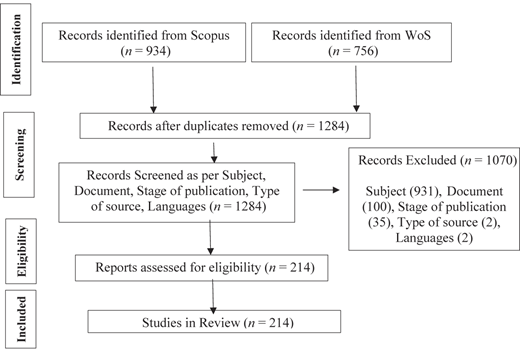
The exploratory study was conducted on both Scopus and Web of Science e-databases during 1990–2023. The collected data were cleaned using several steps following the bibliometrix approach. Using the Preferred Reporting Items for Systematic Reviews and Meta-Analyses model as the extraction criterion, the study sorted 214 studies from 1,690. For merging the Scopus and WoS e-databases, RStudio was used, while network mapping was performed using VoSviewer 1.6.18 and Biblioshiny.
Developed countries were more prominent than developing countries (except China, India, etc.) among the top 20 contributors, as identified by document production and citation counts. All co-occurrence clusters in the knowledge domain (“training and job design”; “ergonomics and health care”; “safety leadership and OH&S”; “employment scheme and occupational health-safety” and “mental health and work stress/distress”) were formed by documents produced by developed countries, except “ergonomics and health care”, where developing countries contributed notably. The study recommends future research avenues related to “ethics,” “corporate social responsibility and “decent work.”
It adds novelty by conducting scientific mappings of OH&S research, primarily in small-scale enterprises that employ semi- or unskilled workers to address occupational pros and cons. This ultimately helps policymakers gather knowledge on safety management.
1. Introduction
In recent times, entrepreneurial “occupational health and safety” (OH&S) has received diligent attention from policymakers to ensure responsive practices that address worldwide occupational hazards and, in turn, strengthen entrepreneurial social commitment (Sharma and Mishra, 2021). According to the International Labor Organization (ILO) [1], 2.78 million work-related deaths, 2.4 million occupational diseases and 370 million injuries are reported globally at enterprises each year (ILO, 2017) [2]. Although occupational hazards are sector-specific (Alli, 2008), on average, four out of five workers in developing countries like ours work in accident-prone environments, with the number exceeding 11 million per year (ILO, 2017). In this context, small-sized enterprises are more prone to occupational hazards than larger enterprises, mainly due to a lack of awareness among unskilled or semi-skilled, low-educated or uneducated employees working in them (DasGupta and Sarkar, 2022). Considering this burning issue, WHO and Burton (2010) recommended that small-sized enterprises can address OH&S issues through (1) acquiring sufficient knowledge regarding the typical occupational health hazards, (2) identifying the special health needs of workers in the workplace, (3) setting requisite health priorities in actions, (4) getting first-aid knowledge, and legislative awareness, (5) identifying the scope for improvement in health promotion at the workplace and (6) maintaining relevant documents on workers' health and working conditions, including accidents and injuries in the workplace. Along the same line, the ILO also recommended legislative provisions to maintain OH&S standards in enterprises through workers' safety and health committees. Consequently, all participants within an enterprise must adhere to concise, clear and communicable provisions to uphold OH&S standards in the workplace (Alli, 2008). Moreover, the evolving demands of OH&S risk management, driven by Industrial Revolution 4.0/5.0 trends, climate change and demographic shifts, compel enterprises, particularly small-sized ones, to move beyond traditional hazard control approaches and consider human factors, ergonomics, resilience and system-level changes (Lindholm et al., 2024). The safety policy is therefore accepted as part of corporate social responsibility (CSR), in which a preventive culture reinforces effective safety management.
These circumstances have generated scholarly interest, emphasizing the physical and psychological occupational hazards and safety measures for entrepreneurial participants, thereby helping achieve sustainability in the competitive arena. The Scopus and Web of Science (WoS) e-databases have recorded significant thematic clusters of OH&S-related studies in enterprises, reflecting a gradual shift from detection to prevention of occupational hazards (physiological and psychological). The theoretical and empirical journey of OH&S-related studies is dispersed across contributions from multiple streams, including Business Management and Accounting, Economics, Finance and Social Science, with scholars from different countries sharing their thoughts. The influx of literature from diverse fields of study has underscored the need to visualize a comprehensive synthesis of the existing body of knowledge that aligns with the specialized themes and disciplines.
Although nominal studies included a literature review in the aforementioned domain of knowledge (Greiner et al., 2022), no study to date has traced the broader views on the content of the relevant research arena. Further, no contribution is found to detect the evolution of the thematic cluster for further trend analysis in the current area of knowledge, i.e. OH&S in small-sized enterprises. No study discloses the intellectual structure of scientific disciplines in the research arena and the connectivity of objects based on the number of references to them.
These evidential gaps motivate the present study to combine quantitative and qualitative analyses to trace the historical trajectory of the current body of knowledge and explore emerging avenues within the domain. In this regard, the study aims to answer the following research questions (RQs):
What is the current publication trend in research on OH&S?
What are the themes of the most prolific articles in OH&S-related research?
What is the intellectual structure of scientific disciplines (co-citation) among the authors in the present study?
What are the themes and thematic clusters in OH&S-related research (co-occurrence)? What are the year-wise thematic trends in OH&S research?
What is the scope of future research?
2. Bibliometric research method
2.1 Defining the appropriate search terms
This study is exploratory and seeks to highlight past and future research trends in OH&S, with particular reference to small-scale enterprises. Hence, it selected papers based on subject areas, document types, publication stages, source types and languages.
2.2 Data collection
Data extraction and cleaning: The study selected two widely recognized databases, Scopus and WoS, owing to their extensive coverage of well-accepted, high-quality journals in adequate numbers in this knowledge domain. Relevant studies published over the 3 decades, from 1990 to 2023, were systematically collected from these sources. Now, data extracted from online databases may be prone to inaccuracies and vague or false bibliometric information about authors (Baker et al., 2022). Therefore, an extraction method was adopted to integrate all raw data without duplicating entries (e.g. multiple entries for the same article), correcting errors (e.g. author names in place of country or institution) or resolving inconsistencies in terminology or spelling (Lim et al., 2024). However, papers with the same title were not removed. Hence, the study followed the following steps: (1) sorted the data, (2) located and removed duplicates, (3) performed a cross-check, (4) saved the duplicate-free bibliometric dataset and (5) updated the review protocol with the application of the bibliometrix approach of the R tool.
To consider an author or a study as productive and influential, the present study emphasized the number of documents published and the corresponding citations. The accepted threshold for the number of documents produced and citations was determined at the researcher's discretion.
Search tool: To search for OH&S-related research in small-scale enterprises, the terms “occupational health and safety” OR “OHS” OR “occupation and health” OR “occupation and safety” AND “small enterprise*” OR “SEs*” OR “small-sized enterprise*” OR “small-scale enterprise*” were used as keywords. These keywords were required to appear in the title and/or the text of the paper. The “*” mark was used as an advanced search tool to search for both “enterprise” and “enterprises” simultaneously. “OR” was used where terms were found interchangeably in papers, and “AND” was used for the combined application of two separate terms in papers.
Subject areas: Focusing on a multidimensional concept spanning entrepreneurship and health security, the study conducted its search across Business, Management and Accounting, Social Science, Economics, Econometrics, Finance and Multidisciplinary.
Document types: Only “articles” and “reviews” published in the aforementioned subject areas were considered to restrict the scope to research-focused studies.
Publication stage: The study preferred to accept the documents at their “final” stage to ensure their publication.
Source type: The study considered only “journal” and “edited volume” for its analysis and rejected “conference volume” and similar sources to maintain a specific quality standard.
Language: Documents published only in English were considered for analysis, given the widespread international acceptance of it in scholarly communication.
Figure-1 illustrates the Preferred Reporting Items for Systematic Reviews and Meta-Analyses (PRISMA) model, the standard for reporting evidence in systematic reviews and meta-analyses.
In bibliometric analysis, methodologies such as co-occurrence and co-citation were used to analyze biographical data (Amiri et al., 2023). Hence, the study used RStudio (Biblioshiny) and VoSviewer 1.6.18 to merge data and perform network mapping.
3. Findings
3.1 Key information on the dataset
Considering the authorship details of 214 studies (194 articles and 20 other documents, e.g. edited volumes) published between 1990 and 2023, it was found that among 693 authors, only 24 were single authors. The average number of co-authors per document was 3.73, and 23.71% of documents involved international collaborations, indicating the domain's broad applicability. With an average of 21.92 citations per document, the studies demonstrated a 5.58% annual growth rate. Overall, the present study covered 704 authors' keywords and included 14,782 references.
3.2 Performance analysis - year-wise publication
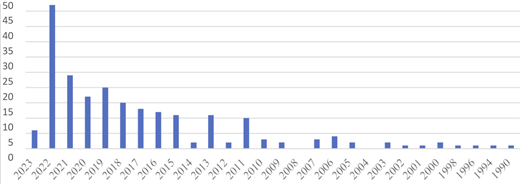
OH&S-related research in small-sized enterprises received attention from the academic fraternity from 1990, with Doyal's (1990) study (“Waged work and women's well-being”) providing a foundation. Before 2015, the domain contained only a handful of publications, and no documents were found in 2004 and 2008, possibly due to international economic and industrial issues. According to the Link to the website, sector-wise investment shifted from manufacturing to services, which discouraged researchers from continuing OH&S-related studies in manufacturing. Likewise, the “World Recession” in 2008 demotivated researchers from publishing in the entrepreneurial domain. The domain accounted for more than 44% of publications after 2020, and in 2022, it recorded its highest number of publications. Figure 2 reflects the year-wise publication trend (in number) since 1990.
3.3 Themes of the most prolific articles in OH&S-related research in small-sized enterprises
“Chinese Guanxi: An integrative review and new directions for future research” by Chen et al. (2013) was identified as the most influential article in this domain, with the highest number of citations (412). The study noted that to prevent occupational hazards in enterprises, the workforce should preferably enjoy “connectivity,” “relationship” and “networking” among themselves. Hence, the entrepreneurial set-up recommended a “bureaucratic relationship among the workers” through which they could exert influence on behalf of others. This, it was argued, could curb occupational hazards, mainly those related to mental stress and tension, and thus could help illuminate the complexity not only in the professional sphere but also in the personal human world. Though the study could make policy implications within the boundaries of all-sized enterprises (including small-sized ones) where vertical and horizontal relationships amongst the workforce would be keenly needed to handle all occupational awkwardness, it did not emphasize safety maintenance. The lacuna in the previous study was rigorously addressed by Clarke (2013) in his study “safety leadership: A meta-analytic review of transformational and transactional leadership styles as antecedents of safety behaviors,” which was identified as the next most influential study in this domain, with 323 citations. The “transformational” safety leadership style emphasized safety climate and safety participation in compliance with rules and regulations, while the “transactional” style emphasized maintaining safety climate, safety participation and safety compliance, considering employees' participation. Two years later, i.e. in 2015, the domain expressed interest in identifying sector-specific occupational diseases, and the study “Prevalence of musculoskeletal disorders for nurses in hospitals, long-term care facilities, and home health care: a comprehensive review” by Davis and Kotowski took the next best position as per the number of citations (200). The domain thus celebrated the emergence of influential studies on networking and safety leadership to curb occupational hazards (physical and psychological) in enterprises, especially small ones, that require prompt and scientific action.
3.4 Knowledge foundation of OH&S research through co-citation analysis
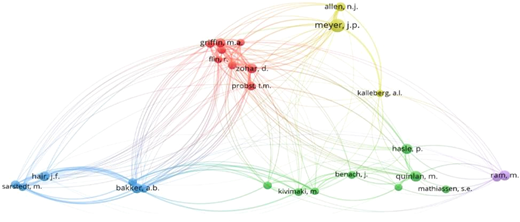
Co-citation analysis reflects the cognitive structure of science by semantically exploring correlations among co-cited references in a specific field of knowledge (Surwase et al., 2011) and thus provides a theoretical foundation for research content (Kim et al., 2016). Figure 3 depicts the co-citation map of authors, with a minimum of 20 citations per author. In the author's co-citation, 27 items were detected to connect with each other in five clusters – red (occupational risk management), green (organizational justice towards occupational health maintenance), blue (organizational role in job design and employees' well-being), yellow (organizational commitment towards safety maintenance) and purple (OH&S policies, procedures and practices). Among the author's co-citation profiles, Meyer and Allen (1991) and Bakker et al. (2022) shared the maximum link strength with other literature under two different clusters, i.e. yellow and blue.
In an organizational environment, “commitment” refers to the willingness of employees to act positively in continuance. Meyer and Allen (1991) explained the concept of organizational commitment as a psychological state that reflects employees' relationship with the organization. The organization should ensure the design of a hazard- and stress-free job. In this regard, organizational commitment is framed within a tri-dimensional concept, i.e. normative or need-based (employees' obligation and intention to remain with the organization), affective or desire-based (emotional attachment of employees to the organization) and continuance or obligation-based (employees' recognition of the costs of turnover). These three dimensions of organizational commitment thus show the strongest relationship with job satisfaction (Meyer and Allen, 1991), tending towards employees' well-being (Bakker et al., 2005) with various job resources. However, the relative strength of an individual's involvement with a particular organization was not detected by the authors, as reflected in an earlier study by Meyer and Allen (1991). Continuing this path, occupational job design (blue cluster) was found to be firmly associated with occupational health maintenance (green cluster), conforming to organizational involvement in framing a hazard-free work environment for employees. In organizations, “justice” goes beyond job control, job demand, social support, etc. It opposes circumstantial effort-reward imbalances, i.e. high effort at work and low rewards in return, and helps support workplace health maintenance with low risk. Substantiating this relationship, a link strength was established between organizational justice towards occupational health maintenance (green cluster) and occupational risk management (red cluster), where Zohar (2003) (red cluster) and Kivimaki et al. (2004a, b) (green cluster) were found to build the maximum link strength. The organizational effort to ensure health maintenance policy would hence be responsible for shaping the overall health prospects of employees, which could be reflected through a higher link strength between the studies under organizational justice towards occupational health maintenance (green cluster) and OH&S policies, procedures and practices (purple cluster). Depressingly enough, the small entrepreneurial periphery was not found to adopt a standardized OH&S policy for the safety and security confirmation of employees and thus was found in an occupational risk-prone arena (Ram et al., 2011).
Hence, the knowledge foundation of OH&S confirmed the research arena's tendency to connect with organizational health-related quality assurance, safety maintenance and occupational risk management.
3.5 Thematic map, clusters and trends of OH&S research in small-sized enterprises
3.5.1 Thematic map of OH&S research in small-sized enterprises
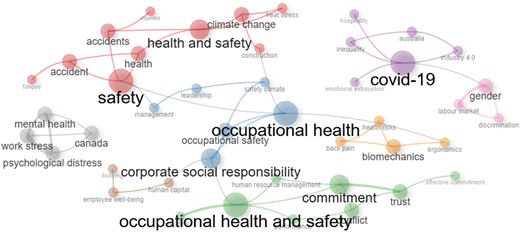
Thematic map is a bibliometric visualization that depicts the organization of research themes within a scientific domain. With a word count threshold of 50 and a minimum cluster frequency (per thousand docs) of 5, the present study detected eight clusters in authors' keywords, namely, “safety” (red node), “occupational health” (blue node), “occupational health and safety” (green node), “COVID-19” (violet node), “ergonomics” (orange node), “employee well-being” (brown node), “gender” (pink node) and “mental health” (gray node), where larger nodes indicate greater significance of the theme within the research domain.
The “safety” cluster studies on occupational accidents and safety provision. This makes a direct connection with the cluster “occupational health,” framed around CSR to maintain a safe climate in the organization. The cluster links with three other clusters, namely, “occupational health and safety” under the themes of commitment, trust and human resource management; “ergonomics” with the studies on “headache,” “backpain,” etc. and “employee well-being” around the studies of human capital. Cluster “COVID-19” stresses issues related to inequality, hospitality, etc. and is linked only to the cluster “gender,” which connects labor market and discrimination-related issues. In this context, except “mental health” cluster, which combines work stress, psychological stress, etc., all other clusters maintain interconnections. In this regard, smaller or isolated nodes are likely to represent niche or emerging themes, whereas dense, interconnected clusters indicate a widely used multidisciplinary domain of knowledge. Figure 4 depicts the thematic map of the authors' keywords.
3.5.2 Thematic clusters of OH&S research in small-sized enterprises
Table 1 presents the thematic cluster of OH&S research in small-sized enterprises, based on co-occurrence analysis, which determines potential relationships between two bibliographic items (Zhou et al., 2022). The present study hence detects five thematic clusters covering studies on OH&S, such as “training and job design” (Cluster: 1); “ergonomics and health care” (Cluster: 2); “safety leadership and OH&S” (Cluster: 3); “employment scheme and occupational health-safety” (Cluster: 4) and “mental health and work stress/distress” (Cluster: 5).
Cluster 1: “training and job design”: An effective job design would clearly outline the overall organization of the job to be performed. Scientific training and a well-designed job, with proper job rotation, enlargement, task and/or machine pacing, good ergonomic posture, work breaks and working hours, could help reduce physical and mental stress and minimize occupational hazards (Sánchez et al., 2003). Consequently, through workers' working time preferences, it would allow them to enjoy life satisfaction (Wooden et al., 2009), positive work attitudes and job and/or organizational performance (Parker et al., 2017) while the absence of this might cause trouble in health-related well-being (Wooden et al., 2009). Literature (Parker et al., 2017) argued for framing work design within a higher-level external (global and/or international, national and occupational factors), organizational, local and individual factorial context, which was detected to have a link with formal decision-making processes and informal and emergent work design processes.
Cluster 2: “Ergonomics and health care”: Interpersonal relationships, proper work design and ergonomic posture would be appreciated to promote health and safety maintenance in the workplace (Chen et al., 2013). Although ergonomic issues were found to be sector-specific (Davis and Kotowski, 2015), productivity would universally depend on a healthy working environment (Flouris et al., 2018).
Cluster 3: “Safety leadership and OH&S”: A collaborative work environment would significantly contribute to the OH&S of the workforce. Organization would be bound to depend on its leadership style to ensure worker safety, using transactional leadership to meet rules and regulations and transformational leadership to encourage employees' participation in safety management (Clarke, 2013). The supervisor's perception was found to be significant in enforcing safety policies in enterprises through proper reporting and recording of occupational accidents (Probst and Estrada, 2010) and was closely related to the enterprise's working environment and climate (Varghese et al., 2018).
Cluster 4: “Employment scheme and occupational health-safety”: Workers' employment tenure (full-time and part-time) would affect their health-safety status at the workplace and also their intention to engage with the OH&S awareness program of the organization. Literature (Rodriguez, 2002; Pirani and Salvini, 2015) confirmed that contractual workers reported more severe occupational health problems than permanent workers. Organizations generally did not show an urge to invest funds to secure health and safety at work for casual and/or marginal workers (Louie et al., 2006). In this context, women workers would suffer more intensely than their male counterparts due to their additional health and safety requirements, which, owing to a lack of awareness, were found to be ignored by the organization (Pirani and Salvini, 2015).
Work conditions were strongly associated with the mental health of employees at the workstation, as indicated by documents grouped under Cluster 5: “Mental health and work stress/distress.” In this regard, while job demand would increase work-related stress, job control would reduce it (Hessels et al., 2017). This was reflected in the job demand-control model, which established a relationship between work stress and occupational risk. However, in some circumstances, mental disorder or psychological distress was not found to be directly associated with occupation but with “pathogenic” work organization conditions, which were correlated with the structure of daily life and job insecurity (Marchand et al., 2005a, b).
Thematic view of the knowledge domain on OH&S, therefore, encompasses organizational job design, employment, training and the health and safety of employees. However, surprisingly, no cluster of studies to date has been found on legislative policies and regulations to protect against occupational hazards and promote workers' health and safety in small organizations.
3.5.3 Thematic trends of OH&S research in small-sized enterprises
The motion of thematic cluster analysis can be extended to thematic trend analysis of OH&S research, where author keywords (from at least two articles) are used to track the evolution of the study chronologically across three specific periods: 2000–2014, 2015–2019 and 2020–2024.
The first 15 years of the study period (2000–2014) may be considered the adolescence of the present research arena, with a nominal contribution (20 papers from 20 sources) from researchers in this topic. The first segmentation identified the primary health-hygiene requirements and reporting in the workplace through five areas of study, represented by five colored nodes: “occupational stress and safety” (green node), “workplace health-care” (lavender node), “organizational citizenship behavior and psychological care” (violet node), “reporting on occupational accident” (yellow node) and “workplace psychometric analysis” (blue node). The “reporting on occupational accident” (yellow node) was found to link with other clusters, denoting the significance of monitoring the health-hygiene and safety status of employees in the organization. Figure 5 depicts the thematic trend at the initial stage of research in this field, i.e. from 2000 to 2014.
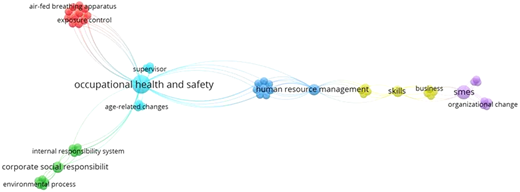
Studies between 2015 and 2019 reflected themes aligned with the principles of the “sustainable development goals, 2015 for small business” Goal-3 (good health and well-being). In this corpus, the need to establish a standard to promote and protect OH&S in small-scale enterprises was strongly emphasized, along with risk management and supervision. The studies in this phase were grouped under areas such as “corporate social responsibility” (green node), “work-place risk management” (lavender node), “commitment and compliance with standard” (navy blue node), “organizational change and interventions” (violate node), “occupational hazard control” (red node) and “supervision and workability” (cyan node). The “supervision and workability” (cyan node) was found to be connected to the maximum cluster, suggesting an association between workplace supervision and work performance. Figure 6 depicts the thematic trend of research on OH&S in small-sized enterprises from 2015 to 2019.
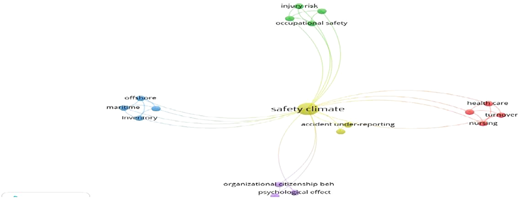
The next phase, from 2020 to 2023, focused on COVID-19 and its subsequent impact on small-scale enterprises. The studies confirmed the scale of the calamity and the resilience of small-scale enterprises in recovering from the hazards. The cluster identified studies under “pandemic” (red node), “leadership and well-being” (green node), “safety climate” (blue node) and “sustainability” (yellow node). “Safety climate” (blue node) established strong links with “leadership and well-being” (green node) and “sustainability” (yellow node), indicating the importance of maintaining health and safety in a sustainable environment. Figure 7 depicts the thematic trend in research on OH&S in small-sized enterprises from 2020 to 2023.
4. Discussion and conclusion: where do we go from here?
4.1 Discussion
OH&S-related research in small-sized enterprises, though, attracted significant scholarly attention mainly after 2020; its notable output dates back to the period 2013–2015, driven by global developments and a growing emphasis on the Sustainable Development Goals (SDGs) (Goal 3: Good health and well-being). Focusing on the themes of the most prolific articles in this domain, it can be argued that occupational hazards in small-sized enterprises can be addressed through the “interconnectedness” among the workforce (Chen et al., 2013; Davis and Kotowski, 2015), which can ensure a safe climate by complying with the concerned rules and regulations (Clarke, 2013; Davis and Kotowski, 2015). The study reflects a knowledge foundation grounded in the “organizational commitment” to fulfilling the needs and requirements of the workforce, thereby encouraging job satisfaction. Effective “job design” is required to ensure a stress-free, healthy working environment and to control occupational risks. This can be substantiated by the thematic map of the present domain knowledge. Thematic cluster, “training and job design,” examines job structures and schedules that enhance individuals' workability. A well-defined job design and an effective training program, though directly related to workers’ productivity and efficiency, may not be sufficient to ensure the workforce's health and safety without proper vertical and horizontal interpersonal relationships. Influential studies in this corpus are based on well-structured premises of developed countries, which may not be applied to developing countries that lack a skilled workforce and have unscientific overtime schedules. Moreover, frequent workforce turnover may not allow an organizational authority to design a job profile permanently. Echoing the flavor of “training and job design,” the significance of the cluster “ergonomics and health care” can be recognized for promoting health and hygiene care among workers who have to perform with extreme physical effort in an organization. The ergonomic impact on the workforce is clearly sector and job specific. Thus, the sitting and standing requirements of a white-collar job worker in the workplace are quite different from those of a worker performing in the boiler or engineering sector. The highly cited articles in this cluster highlight the contextual issues faced by both groups of workers. However, challenges in applying this domain knowledge may arise when an organization has to deal with unskilled and/or illiterate employees without basic knowledge of health and hygiene or when it cannot adopt a proper ergonomic structure due to financial constraints. Moreover, the theoretical overview of a standardized ergonomic structure may be set aside in small-sized enterprises dealing with both men and women workers, where the latter have to carry heavy loads for production under the threat of job security. The next thematic cluster, “safety leadership and OH&S,” emphasizes the different work-related injuries and hazards that occur inadvertently within the enterprise. Supervisor training is also required to raise employees' awareness of potential physical and mental fatigue resulting from improper handling of machinery or other equipment. In this context, the maturity of followers is of special importance, as it determines whether leadership in safety promotion continues in a simple, regular, conventional mode of operation or adopts a more challenging approach in line with environmental requirements. The employability and employment status of the workforce also are found to have a high impact on their health and safety consciousness (Cluster: “Employment scheme and occupational health-safety”). As an obvious outcome, organizational safety concerns for temporary or ad hoc workers are found to be quite reluctant compared with those for permanent staff, as the latter can assure continuous assistance. On the contrary, full-time permanent workers may be found to be more injury-prone due to continuous work-related strain. The prolific studies in this cluster address all the contextual issues associated with it, but OH&S maintenance in a sector that deals only with temporary workers remains under-covered here. Moreover, this thematic view may also face challenges when applied to a small-sized enterprise with seasonal products, where work pressure is uneven throughout the year, and all workers are temporary. Last but not least the thematic cluster under “mental health and work stress/distress” addresses the psychological health of workers at the workplace, which is sometimes underrated in comparison with their physical fatigue. An uneven job structure and strained interpersonal relationships at work may cause distress and affect the mental well-being of individual workers. It is needless to say that the level of consciousness required to safeguard the mental health of workers is very low in any enterprise specially belonging to developing countries. Here, the supervisors of a small segment are primarily focused on meeting market demand through workers' physical efforts; consequently, the psychological health of the workers is often neglected under excessive work pressure.
Hence, a bibliometric analysis of the OH&S domain explores its significance in small-sized enterprises, which can be shaped and reshaped across several time horizons, emphasizing safety and security (2000–2014), sustainability (2015–2019) and pandemic resilience (2020–2023). Despite this, the study identified gaps that suggest future research directions in this domain. The previous literature did not explore organizational ethical practices for handling occupational hazards for employees in the workplace. In addition, studies on organizational social responsibility to address OH&S-related issues may be encouraged. Furthermore, future studies may extend efforts to promote a decent work environment that enhances the workforce's physical and mental health and safety. All these issues can therefore be explored within the scope of small-scale enterprises.
4.2 Avenues for future research
4.2.1 Ethics and OH&S in small-sized enterprises
The spectrum of knowledge thus addresses changes in the concept of OH&S, shaped by the emergence of ethical issues in occupational health. The paradigm for occupational health has shifted from health protection alone to both health protection and promotion in the workplace (Patel and David, 2016). The literature (Patel and David, 2016) in this domain considers the medical aspects of sickness, absence and rehabilitation; the support and management of chronic non-communicable diseases and workplace health promotion. OH&S practice, grounded in ethics, hence needs to be addressed and legitimized by society. In this context, while substantiating ethical practice in OH&S-related issues in the small entrepreneurial arena, literature must address the infrastructural backwardness of enterprises, especially those operating in developing countries and should raise the following questions: (1) What kind of moral consciousness leads individuals or organizations to adopt ethical practices in OH&S-related issues? (2) How can occupational health promotion be grounded for the untrained workforce at the enterprise?
4.2.2 Corporate social responsibility (CSR) and OH&S in small-sized enterprises
CSR represents the moral responsibility of organizations towards society, ecology and the environment (Vallaster et al., 2019). It addresses organizational commitment to all stakeholders and fosters transparency and credibility in society (ibid). CSR endorses an entrepreneurial commitment to establish ethical standards that foster economic development while improving the quality of life of the workforce, their families, the local community and society at large (Bautista-Bernal et al., 2021). Although CSR has been studied separately for a long time, when combined with OH&S, it has emerged as an area of research. In this regard, promotion of a culture of risk prevention to achieve good OH&S for the workforce in organizations is a practice of social responsibility and thus an integral part of CSR (Montero-Simó et al., 2009). CSR practice in OH&S maintenance is also connected to the standard of reporting workplace accidents. It was legitimized by the ILO (2002) in its Geneva Convention (“Link to the website”), which set standards for reporting occupational accidents and injuries after confirming the existence and types of occupational hazards. Hence, not only strategy and structure but also the standardized practice of CSR with respect to OH&S-related issues is found crucial in enterprises. Studies must be conducted to present a clear argument for considering small-sized enterprises under the purview of CSR-related activities. Hence, while substantiating the practice of CSR in small-sized enterprises, some queries may be found: (1) What activity of the enterprise is recognized as socially responsible in maintaining OH&S? (2) What factors do motivate the enterprise to follow CSR activities in maintaining OH&S for workers?
4.2.3 Decent work environment and OH&S in small-sized enterprises
Occupational health and well-being are outcomes of a balanced work-life relationship (Link to the website), which confers decent work conditions in an enterprise. In 1999, the ILO stated that the concept of decent work encompasses conditions such as (1) payment of fair income; (2) assurance of safety and security in employment and working conditions; (3) provision of equal opportunities and treatment for all; (4) inclusion of social protection for workers and their families; (5) prospects for personal development; (6) encouragement of social integration and (7) enabling workers to express their concerns. The decent work concept centers on “Sustainability” and aligns with Goal 8: Decent work and economic growth, as well as Goal 3: Good health and well-Being. A decent work environment generally ensures a healthy and safe environment with minimal occupational hazards, risks and injuries. The study's corpus can therefore be continued by applying the National Political Agenda, integrated with national development policies, in the workplace, which, according to the ILO, poses a challenge. The sustainability aspect in OH&S study can be continued with the goals of the triple bottom line, where (1) cost reduction through proper training to avoid occupational hazards, (2) well-being for workers and their families through the maintenance of OH&S measures and (3) proper use of natural resources through standardized working conditions and policies towards sustainability, may be related to economic, social and environmental aspects (Molamohamadi and Ismail, 2014). Now, while substantiating theoretical knowledge in small-sized enterprises, some questions may arise: (1) What is the reason behind maintaining a decent work environment in an enterprise? (2) What factors of a decent work environment are found crucial for maintaining OH&S for the workforce there?
5. Conclusion
The present study scientifically visualized and mapped the year-wise thematic progression of OH&S-related research in small-sized enterprises. Validating data from Scopus and WoS e-databases, the study traced the evolution of this research domain since 1990 and found that the context of OH&S in small-scale enterprises is a significant means of promoting health and safety for workers who are largely unaware of their regular hygiene practices. The study identified “safety,” “occupational health,” “occupational health and safety,” etc. as the significant clusters of authors' keywords used in the research domain, while the thematic cluster analysis of co-occurrence identified five clusters (“training and job design,” “ergonomics and health care,” “safety leadership and OH&S,” “employment scheme and occupational health-safety” and “mental health and work tress/distress”).
OH&S maintenance in enterprises can enhance workers' interpersonal relationships, their sense of belongingness to the enterprise, job satisfaction and productivity. Efforts to establish an effective OH&S program for small-sized enterprises are therefore seen as an expression of organizational ethical consideration and commitment to the workforce and to society. The present study describes the diversity of the research field, highlighting socio-economic implications and areas where technological applications are lacking. Therefore, it is suggested that artificial intelligence be adopted across contexts, such as the Computer Science Vision Model and the Online Accident Reporting System, to help control occupational accidents and injuries. In the face of today's socio-economic and environmental challenges in the entrepreneurial periphery, workers' health and safety must be maintained and managed to ensure sustainability. In this context, the situation may differ significantly in developing countries, where low literacy levels and workforce awareness remain low. Therefore, priority should be given to workforce training to equip employees with the skills needed to manage workforce challenges effectively. Besides, supporting policies should be implemented to safeguard the workforce's rights and well-being.
The present study demonstrates its policy implications by visualizing the context of OH&S practices in enterprises, including small ones, with co-citation and co-occurrence. Besides, it explores future research trends in this knowledge domain. The findings help confirm the domain's knowledge base and encourage researchers to explore new research areas. The outcomes of the analysis further lay the foundation for limiting occupational hassles in developing countries, where the domain is in its infancy and requires additional scholarly attention. However, like other studies, this study has some limitations. Due to time and resource constraints and the non-availability of relevant data, the study could not include other sources (PubMed and Dimensions) except Scopus and WoS. Moreover, the limited availability of recent, domain-specific studies from developing countries limits deeper, more detailed analysis of emerging economies. Finally, the study considers citation count as the only measure of influence and does not consider the potential negative implications of high citation counts.
Ethical consideration
There are no human participants in this article, and informed consent is not required.
The study acknowledges the contributions of the staff of the Central Library, Burdwan, for assisting with data collection from e-databases. The study also acknowledges professional advice on improving the writing style.