


The purpose of this study was to compare and analyze the job satisfaction, organizational commitment and turnover intention of professors, technical-administrative servants and outsourced workers of the Federal University of the State of Rio de Janeiro (UNIRIO).
The authors conducted analyses of variance, with the multiple comparisons made using Tukey’s post hoc tests, as well as regression analyses. The sample of 297 workers included 115 faculty members, 86 technical-administrative servants and 96 outsourced employees.
The results showed that the job satisfaction of outsourced workers was significantly higher than that of the public servants. On the other hand, professors presented the highest level of affective commitment, significantly higher than technical-administrative employees and outsourced workers. Turnover intention of outsourced workers was lower than that of technical-administrative employees, despite the stability of the latter group.
From a practical standpoint, the results may guide the development human resource management policies and practices aligned with the reality and the needs of public servants and outsourced employees, thus fostering their job satisfaction, commitment and retention.
This study is relevant given the increased use of outsourced labor in the public administration and the relative paucity of empirical studies with this group of workers, as evidenced by the review of the national literature. Moreover, as the theme of outsourcing is quite controversial, the authors hope this new evidence contributes to the debate.
1. Introduction
Productive restructuring and the movement toward the flexibility of labor relations has led to an increased use of outsourced labor, in private as well as in public organizations and institutions. Currently, there are two opposing views about outsourcing. On the one hand, there is a managerial approach, which argues that outsourcing increases the productivity and competitiveness of organizations, and makes them more apt to deal with business environment changes (Girardi, 1999; Matusik and Hill, 1998). From this point of view, outsourcing would be beneficial to organizations, as it allows them to concentrate efforts on their core business and to increase efficiency, as they transfer responsibilities related to peripheral activities – such as cleaning, security and maintenance – to specialized companies (Girardi, 1999).
On the other hand, critics argue that outsourcing results in precarious work conditions and the dehumanization of labor relations (Costa, 2017; Russo and Leitão, 2006; Silveira and Lemos, 2016). They also claim that as workers are employed by smaller organizations, which tend to be less structured, they have fewer rights and access to fewer benefits (Cardoso and Lage, 2007). There is also evidence that outsourced workers face devaluation, discrimination and insecurity (Brito et al., 2012; Costa, 2007).
The importance of this debate and the increased adoption of outsourcing by public organizations and institutions (Costa, 2017; Costa and Santo, 2014) point to an increased need to better understand outsourced workers’ experiences and attitudes, especially compared with public servants. On the one hand, outsourced employees and public servants share the same organizational reality, but on the other hand, these two groups face objective and subjective work conditions that are considerably different (Costa, 2007; Wilkin, 2013).
Given such reality, the purpose of this study is to compare and analyze the job satisfaction, organizational commitment and turnover intention of faculty members, technical-administrative staff and outsourced employees from the Federal University of the State of Rio de Janeiro (UNIRIO). The target population consisted of nearly 2,100 workers, being 905 faculty members, 1,054 technical-administrative staff and 134 outsourced employees. Of this total, 297 participated in the study (approximately 15 per cent of the total), being 115 faculty members, 86 technical-administrative staff and 96 outsourced employees.
This study has both theoretical and practical implications. From a theoretical perspective, its importance lies on the increased use of outsourced labor in public administration (Costa, 2017; Costa and Santo, 2014) and the relative paucity of empirical studies on outsourced workers’ attitudes toward their job and the organization, as evidenced in the literature review. As the topic of outsourcing is quite controversial, we hope this new evidence brings new contribution to the discussion. From a practical standpoint, our results may guide the development of human resource management policies and practices aligned with the reality and the needs of public servants and outsourced workers, thus fostering their job satisfaction, commitment, and retention.
This article is structured in eight parts, including this introduction. Sections 2, 3 and 4 cover the literature on job satisfaction, organizational commitment and turnover intention, respectively. Section 5 includes the research methodology, and Section 6 shows the results of the study. In Sections 7 and 8, we discuss these results and present our final considerations.
2. Job satisfaction
Job satisfaction is an attitudinal variable that measures how individuals feel about their work (Spector, 2010). Siqueira and Gomide (2004, p. 302) point out that job satisfaction involves specific reactions to its different aspects, which “may trigger on the individual different levels of satisfaction/dissatisfaction”. This topic has attracted the attention of researchers from different fields and is an important variable in organizational studies (Spector, 2010; Traldi and Demo, 2012).
Despite the great number of studies, there are still divergences regarding the construct`s dimensionality. Some see it as a single and global feeling towards work, thus partaking what is called a unidimensional view. However, the dominant view is multidimensional, according to which satisfaction involves specific reactions to the various work components (Spector, 2010). Among the most investigated dimensions, we can highlight rewards (salary and promotion opportunities), social relationships (with supervisors and colleagues) and the nature of the work itself (Judge et al., 2012; Shaju and Subhashini, 2017; Siqueira and Gomide, 2004; Spector, 2010).
Spector (2010) defends that the multidimensional approach allows a more complete view of the construct, given that an individual usually shows different satisfaction levels for different dimensions. According to the author, based on studies conducted in different organizations from the USA, people tend to be more satisfied with the work itself, as well as colleagues and supervisors, but tend to be less satisfied with their salaries and promotion opportunities.
The comparison between the job satisfaction of workers who are subject to different work regimes has been an object of study, predominantly in international literature. In a meta-analysis involving 72 studies and approximately 240,000 employees from different countries, Wilkin (2013) found evidence that contingent workers were significantly less satisfied than permanent workers, although the difference was small. In Brazil, we found only one study on the matter, but its results were inconclusive (Oliveira, 2009).
Studies on the antecedents of job satisfaction can be divided into two groups. In the first, evidence shows that it varies among employees who are subject to similar work conditions, suggesting that individual differences, such as personality traits, values and expectations are antecedents of job satisfaction (Gerhart, 2005; Perales and Tomaszewski, 2016). The second group comprises studies that evaluate the impact of situational factors. Their results indicate that work characteristics (Borges, 2013; Hackman and Oldham, 1976), human resource management policies and practices (Garrido et al., 2005), leadership quality (Olaniyan and Hystad, 2016) and organizational justice perceptions (Cohen-Charash and Spector, 2001) are antecedents of job satisfaction.
Regarding its consequences, evidence points to a positive relationship between job satisfaction and work productivity, as well as financial performance (Bryson et al., 2017; Shaju and Subhashini, 2017). Evidence also points to a negative relationship between job satisfaction and both turnover intentions (Campos and Malik, 2008; Tett and Meyer, 1993) and absenteeism (Spector, 2010).
3. Organizational commitment
An employee’s attachment to his/her work is characterized by complexity and multidimensionality, encompassing the individual’s relation to the work itself, his/her job, team, career, occupation, syndicate and organization, the latter being the most studied one (Bastos, 1994; Meyer et al., 1993). According to Meyer et al. (1993), organizational commitment is a psychological state that portrays an individual’s attachment to the organization and affects his/her decision to stay or leave.
Meyer and Allen (1991) defend that organizational commitment is a multidimensional construct, comprised by the affective, normative and continuance dimensions. When an employee is affectively committed, he/she is proud to be part of the organization and sees its objectives as his/her own. A feeling of belonging and involvement with the organization has also been associated to this dimension (Meyer and Herscovitch, 2001). Normative commitment refers to a feeling of obligation toward the organization. In other words, the worker recognizes that the organization has given him/her benefits and advantages and feels morally obliged to reciprocate. Continuance commitment involves the perception of necessity to stay in the organization. In this case, the employee understands that leaving the organization will mean a waste of investments already made (effort, dedication, time) and/or that the labor market does not offer any better alternative (Meyer and Allen, 1991; Meyer and Herscovitch, 2001).
Two national studies compared the organizational commitment of outsourced and permanent employees. Soldi and Zanelli (2006) conducted a study on a private communications company and the results showed greater affective commitment among permanent employees and greater continuance commitment among outsourced workers. Paiva et al. (2013) analyzed a public health research foundation and did not find significant differences for affective and normative commitments. Only continuance commitment was significantly higher among public servants, in comparison to the group of outsourced workers.
In the international literature, researchers point out the relative scarcity of studies on organizational commitment of individuals in non-traditional labor relations, such as temporary and outsourced workers (Biggs and Swailes, 2006; Gallagher and Parks, 2001). Existing evidence, however, indicates that these types of workers tend to be less committed than permanent employees (Biggs and Swailes, 2006; Gilder, 2006).
Regarding the antecedents of organizational commitment, they can be divided into individual differences, work characteristics, work experiences and organization characteristics (Bastos, 1994). Specifically pertaining to affective commitment, researchers have found evidence of a positive relation to different work characteristics, including job challenge, role clarity, goal clarity, equity, management receptiveness and performance feedback (Allen and Meyer, 1990). Bandeira et al. (2000) found a positive correlation between some human resources practices and both affective and normative commitment, while Fernandes et al. (2014) showed that perceived organizational support positively influences affective commitment.
On the consequences of organizational commitment, Brandão and Bastos (1993) note that turnover intention and absenteeism have been most widely studied. The meta-analysis conducted by Meyer et al. (2002) showed that, of the three dimensions, affective commitment showed strong and positive relationship with important variables, including performance and organizational citizenship behavior, the latter being corroborated by Martins et al. (2015) on a sample of Brazilian workers. According to Meyer et al. (2002), the normative dimension showed a positive, though weaker correlation, while the continuance dimension presented weaker or negative correlation with these results.
4. Employee turnover and turnover intention
Employee turnover may be voluntary, by the worker’s own initiative, or involuntary, when the decision is made by the organization (Cascio and Boudreau, 2010). In the public sector, turnover occurs mostly by the servants’ own decision, since employee displacement must obey the rules imposed by Law 8112/90, which are relatively rigid (Silva et al., 2014).
Many factors can influence an individual’s decision to change jobs, including job satisfaction and organizational commitment, which are the focus of this study, as well as the perception of other job opportunities (Clugston, 2000; Ferreira and Siqueira, 2005; Griffeth et al., 2000). Aiming to identify the causes and consequences of collective turnover – related to groups, organizational units or whole organizations – Heavey et al. (2013) conducted a meta-analysis and showed that many factors are predictive of turnover, including human resource management practices, job satisfaction, organizational climate, organizational commitment and perceived organizational justice.
Regarding the consequences of employee turnover, Cascio and Boudreau (2010) highlight that turnover may lead to significant losses to organizations, which are not limited to the costs of dismissal and hiring. There may also be costs related to overtime or temporary aid (necessary to cover the job opening), training (of the substitute) and low productivity (while the new employee learns the work dynamic and due to the remaining employee’s low morale), as well as loss of clients, sales, and connections. In their meta-analysis, Heavey et al. (2013) identified that collective turnover negatively impacts client satisfaction, profitability, and efficiency.
Research on turnover intention in the public sector is relatively scarce in Brazil (Diógenes et al., 2016). Campos and Malik (2008) conducted a study with doctors from the Family Health Program, in the city of São Paulo, and identified a negative relationship between job satisfaction and turnover intention. Diógenes et al. (2016) found higher turnover intention among public servants of a federal agency and a negative relationship between perceived organizational support and turnover intention. Finally, Klein and Mascarenhas (2016, p. 34) studied the relationship between motivation, satisfaction, and turnover in public organizations and their results indicate “the existence of public servants that remain on the job, with high salaries”, despite being dissatisfied and poorly productive, as well as “satisfied and motivated public servants who leave their jobs because of insufficient pay”. According to the authors, such situations are a consequence of several human resource management issues in the public sector.
5. Methodology
Given the proposed objectives, we opted for a quantitative study, based on a sample of public servants and outsourced workers from UNIRIO. Using the SPSS® software, we conducted analyses of variance (ANOVA) – and Tukey’s post hoc tests for the multiple comparison – as well as multiple regression analysis.
5.1 Population and sample
By the end of the 1960s, the Brazilian Government created the Federation of Isolated Schools of the State of Guanabara (Federação das Escolas Isoladas do Estado da Guanabara, FEFIEG), combining isolated federal college education establishments located in the now extinct Guanabara state. This movement integrated traditional institutions such as the Central School of Nutrition, the National Theater Conservatory (currently called School of Theater), the Villa-Lobos Institution, the School of Medicine and Surgery of Rio de Janeiro, the National Library’s Course of Library Science, and the Alfredo Pinto’s School of Nursing, instituted in 1889 (UNIRIO – Universidade Federal do Estado do Rio de Janeiro, 2014).
In 1975, with the union of the States of Guanabara and Rio de Janeiro, the FEFIEG became known as the Federation of Isolated Federal Schools of the State of Rio de Janeiro (Federação das Escolas Federais Isoladas do Estado do Rio de Janeiro, or FEFIERJ), to which were added, two years later, The National Archive’s Permanent Archive Course and the Museums Course offered by the National History Museum. By the end of the 1970s, the government changed FEFIERJ’s name to University of Rio de Janeiro (Universidade do Rio de Janeiro, or UNIRIO) and only in 2003 did UNIRIO began to display its current title of Federal University of the State of Rio de Janeiro, although maintaining its former abbreviation (UNIRIO – Universidade Federal do Estado do Rio de Janeiro, 2014).
Among UNIRIO’s workers, there are faculty members, who are subject to the rulings of the laws 12.772 (Brazil, 2012) and 12.863 (Brazil, 2013), concerning federal teachers’ career plan and positions, and technical-administrative staff, who are subject to the Law 11.091 (Brazil, 2005), concerning the career plan of Technical-Administrative workers in Education. Both groups are subject to the same judicial regime, defined in the Law 8.112 (Brasil, 1990), also known as the Federal Public Servant Statute.
Besides these two groups of public servants, UNIRIO counts on subcontracted workers from outsourcing contracts, which generally involve a service provider that intermediates the relationship between the contractor and the workers. Outsourcing has been used as a mechanism to reduce labor costs and enhance flexibility (Soldi and Zanelli, 2006). In UNIRIO’s case, the only outsourced positions are the ones that either do not exist or have become extinct from the Technical-Administrative in Education’s career plan.
Table I shows data for the population, universe, and sample. We used the Survey Monkey® electronic platform to collect data on public servants. The universe was smaller than the population, as there were missing or incorrect electronic addresses in the database used for the survey. The percentage of returned questionnaires was as expected for a study using an electronic survey. Outsourced workers responded to a written version of the questionnaire because of the absence of their e-mail addresses. As we conducted the survey in person, the percentage of return was higher.
Population, universe, research sample
| Group | Population | Universe | Sample | Return (%) |
|---|---|---|---|---|
| Faculty members | 905 | 664 | 115 | 17.3 |
| TAEs | 1,054 | 721 | 86 | 11.9 |
| Outsourced workers | 134 | 134 | 96 | 71.6 |
| Total | 2,093 | 1,519 | 297 | 19.6 |
Regarding the participants profile, the faculty members were, on average, 46.3 years-old and had 8.8 years of tenure. The technical-administrative in education staff (TAEs) were 40.1 years-old and had 9.1 years of tenure on average. The outsourced workers were 36.5 years-old on average and had 4.4 years of tenure. Most workers were male – 57 per cent of faculty members, and 59 per cent of TAEs and outsourced workers. Of the faculty members, 97 per cent had doctor or master’s degrees, while 48 per cent of the TAEs had graduate degrees. Of the outsourced workers, 71 per cent had high school degrees.
5.2 Measurements
To measure job satisfaction, two scales have been widely used: The Minnesota Satisfaction Questionnaire (MSQ) and the Michigan Organizational Assessment Questionnaire – Job Satisfaction Subscale (MOAQ-JSS). While the former is comprised of various questions and considers satisfaction as a multidimensional construct, the MOAQ-JSS intends to evaluate general satisfaction based on a scale with only three items (Bowling and Hammond, 2008). As our purpose in the present study was to have a more detailed evaluation of job satisfaction, we chose MSQ (University of Minnesota, 1967). Fifteen items were included considering the reality of the organization and its workers.
The three organizational commitment scales (affective, normative and continuance) were obtained from Allen and Meyer (1990), as well as Meyer et al. (1993). We chose this scale given its wide acceptance and validation in the national (Medeiros and Enders, 1998; Soldi and Zanelli, 2006) and international (Meyer et al., 2002; Sharma et al., 2013) literatures.
We evaluated turnover intention using a four-item scale used by Jensen et al. (2013), which was based on a prior study by Tett and Meyer (1993). The items were “I often think about quitting this job at UNIRIO”, “I am always on the lookout for a better job”, “It is likely that I will look for another job during the next year” and “There isn’t much to be gained by staying in this job at UNIRIO”. Differently from what happens with job satisfaction and organizational commitment, there does not seem to be a consolidated and established measure for turnover intention. We opted for this scale because of its trustworthiness and simplicity (Jensen et al., 2013).
We used a five-point Likert scale to measure the five constructs, varying from 1 (strongly disagree) to 5 (strongly agree). All scales presented good reliability levels, measured by Cronbach’s alpha, as presented in Table II.
6. Results
The results are presented in four sections. The first three are job satisfaction, organizational commitment and turnover intention. The fourth contains the regression analysis.
6.1 Job satisfaction
We first compared the average job satisfaction of the 15 items investigated in the study. The ANOVA with Tukey’s post hoc tests, presented in Table III, showed that outsourced workers were significantly more satisfied than faculty members and TAEs. On the other hand, no significant differences were found between faculty members and TAEs.
Subsequently, we analyzed each of the 15 job satisfaction items, as shown in Table IV. The bold values indicate the most satisfied group in each item, which show that outsourced workers were more satisfied than the public servants (faculty and TAEs) on 10 of the 15 items (67 per cent).
Job satisfaction
| Satisfaction items | Faculty | TAE | Outsourced | |
|---|---|---|---|---|
| 1 | The opportunity to do different things | 3.31 | 3.15 | 3.53 |
| 2 | The way in which my superior/manager treats his/her subordinates | 3.90 | 3.83 | 4.27 |
| 3 | My superior/manager’s decision-making ability | 3.78 | 3.62 | 4.27 |
| 4 | Being able to do things that do not go against my conscience | 3.92 | 3.85 | 3.81 |
| 5 | Work stability | 4.10 | 4.44 | 3.63 |
| 6 | The chance to do things (work/help) for other people | 3.87 | 4.15 | 4.11 |
| 7 | The chance to make use of my abilities | 3.63 | 3.42 | 3.88 |
| 8 | The way the organization’s policies are put into practice | 2.30 | 2.38 | 3.45 |
| 9 | The relationship between my salary and the amount of work I do | 2.55 | 2.95 | 3.34 |
| 10 | The chances to make progress/advancing in my career | 3.17 | 2.52 | 3.04 |
| 11 | The opportunity to try my own work methods | 3.78 | 3.40 | 3.60 |
| 12 | The work conditions (infrastructure, materials, equipment, etc.). | 1.98 | 2.32 | 3.41 |
| 13 | The way my colleagues relate to each other | 3.30 | 3.54 | 3.92 |
| 14 | The compliments I receive for doing a good job | 3.35 | 3.71 | 3.96 |
| 15 | The feeling of accomplishment from doing my job | 3.78 | 3.46 | 3.94 |
The ANOVA showed significant differences in practically all satisfaction items, except for numbers 1, 4, and 6. Regarding the other 12 items, Tukey’s post hoc tests showed that in 10 of them outsourced workers were significantly more satisfied than public servants (faculty members, TAEs, or both) – see Table V. These aspects include higher satisfaction with the immediate superior, colleagues, organizational policies, salaries and the work itself. The two items in which public servants were more satisfied than outsourced workers were related to autonomy (item 11) and stability (item 5).
Job satisfaction items: Tukey’s test
| Average | Difference | |||||
|---|---|---|---|---|---|---|
| Item | G1 | G2 | G1 | G2 | (G1-G2) | Sig. |
| 2 | Outsourced | TAE | 4.27 | 3.83 | 0.43 | 0.042 |
| 3 | Outsourced | Faculty | 4.27 | 3.78 | 0.48 | 0.006 |
| TAE | 3.62 | 0.65 | 0.000 | |||
| 5 | Faculty | TAE | 4.10 | 4.44 | −0.34 | 0.031 |
| Faculty | Outsourced | 4.10 | 3.63 | 0.47 | 0.001 | |
| TAE | Outsourced | 4.44 | 3.63 | 0.81 | 0.000 | |
| 7 | Outsourced | TAE | 3.88 | 3.42 | 0.46 | 0.022 |
| 8 | Outsourced | Faculty | 3.45 | 2.30 | 1.16 | 0.000 |
| TAE | 2.38 | 1.07 | 0.000 | |||
| 9 | Faculty | TAE | 2.55 | 2.95 | −0.40 | 0.033 |
| Outsourced | 3.34 | −0.79 | 0.000 | |||
| 10 | TAE | Docente | 2.52 | 3.17 | −0.65 | 0.000 |
| Outsourced | 3.04 | −0.52 | 0.007 | |||
| 11 | Faculty | TAE | 3.78 | 3.40 | 0.38 | 0.025 |
| 12 | Outsourced | Faculty | 3.41 | 1.98 | 1.43 | 0.000 |
| TAE | 2.32 | 1.09 | 0.000 | |||
| 13 | Outsourced | Faculty | 3.92 | 3.30 | 0.61 | 0.000 |
| TAE | 3.54 | 0.38 | 0.036 | |||
| 14 | Faculty | TAE | 3.35 | 3.71 | −0.37 | 0.050 |
| Outsourced | 3.96 | −0.61 | 0.000 | |||
| 15 | Outsourced | TAE | 3.94 | 3.46 | 0.47 | 0.009 |
6.2 Organizational commitment
Regarding organizational commitment, faculty members were the group that demonstrated the highest affective commitment. On the other hand, continuance and normative commitment were higher among outsourced workers, as shown in Figure 1. It is worth highlighting that the affective commitment, among the three dimensions, was higher for the three groups, showing an emotional attachment to the institution.
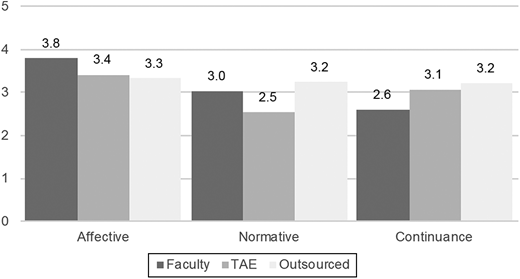
To evaluate the statistical significance of these differences, we conducted an ANOVA with Tukey’s post hoc tests, presented in Table VI. First, we verified that faculty members were significantly more affectively committed than outsourced workers and TAEs. Faculty members also showed significantly lower continuance commitment than TAEs and outsourced workers. In the case of normative commitment, we found that TAEs were significantly less committed than faculty members and outsourced workers. In other words, TAEs are the ones that have a lower sense of obligation towards the organization.
Organizational commitment: Tukey’s test
| G1 | G2 | Average G1 | Average G2 | Difference (G1-G2) | Sig. | |
|---|---|---|---|---|---|---|
| Affective commitment | Faculty | TAE | 3.78 | 3.40 | 0.38* | 0.002 |
| Faculty | Outsourced | 3.78 | 3.33 | 0.46* | 0.000 | |
| TAE | Outsourced | 3.40 | 3.33 | 0.08 | n.s. | |
| Normative commitment | Faculty | TAE | 3.03 | 2.53 | 0.49* | 0.000 |
| Faculty | Outsourced | 3.03 | 3.24 | −0.22 | n.s. | |
| TAE | Outsourced | 2.53 | 3.24 | −0.71* | 0.000 | |
| Continuance commitment | Faculty | TAE | 2.60 | 3.06 | −0.46* | 0.000 |
| Faculty | Outsourced | 2.60 | 3.21 | −0.61* | 0.000 | |
| TAE | Outsourced | 3.06 | 3.21 | −0.14 | n.s. |
Notes:
The average difference is significant at level 0.05; n.s. = not significant
6.3 Turnover intention
Regarding turnover intention, we verified that faculty members were the least likely to leave UNIRIO, while TAEs presented the highest average, as shown in Figure 2.
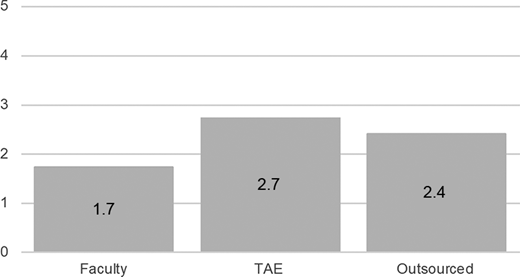
To test for significant differences among the different groups, we also conducted an ANOVA with Tukey’s post hoc tests, as shown in Table VII. Data showed that TAEs and outsourced workers were significantly more likely to leave UNIRIO than faculty members. We also verified that TAEs are more inclined to leave UNIRIO than outsourced workers, with a marginally significant difference (p < 0.10).
6.4 Regression analysis
Finally, we tested the effects of job satisfaction and organizational commitment on turnover intention, as shown in Table VIII.
Regression analysis: turnover intention
| Model | β | t | R2 | ΔR2 |
|---|---|---|---|---|
| Model 1 | ||||
| Gender | 0.022 | 0.18 | 0.158*** | |
| Age | −0.037 | −5.70*** | ||
| Organizational tenure | −0.004 | −0.50 | ||
| Model 2 | ||||
| Gender | 0.099 | 0.86 | 0.304 | 146*** |
| Age | −0.034 | −5.84*** | ||
| Organizational tenure | −0.014 | −1.71 | ||
| Job satisfaction | −0.615 | −7.60*** | ||
| Model 3 | ||||
| Gender | 0.099 | 0.96 | 0.457 | 0.153*** |
| Age | −0.022 | −3.99*** | ||
| Organizational tenure | −0.004 | −0.57 | ||
| Job Satisfaction | −0.198 | −2.29* | ||
| Affective commitment | −0.521 | −6.09*** | ||
| Normative commitment | −0.270 | −3.83*** | ||
| Continuance commitment | 0.080 | 1.14 | ||
Notes:
p < 0.05;
p < 0.01;
p < 0.001
Model 1, with only control variables (gender, age, and organizational tenure), explained 16 per cent of the variance in turnover intention. Only age was significant, indicating that older workers are less likely to leave UNIRIO than younger ones (β= −0.037; p < 0,001). Model 2, which included job satisfaction, amplified by 15 per cent the model’s explanatory power, evidencing the importance of job satisfaction to reduce turnover intention (β = −0.615; p < 0.001).
Lastly, Model 3 included affective, normative, and continuance commitment. This model explained 46 per cent of the variance in turnover intention. The coefficients showed that job satisfaction (β = −0.198; p < 0.05), affective commitment (β = −0.521; p < 0.001) and normative commitment (β = −0.270; p < 0.001) had a significant and negative influence on turnover intention. Continuance commitment, on the other hand, was not significant.
7. Discussion
When analyzing job satisfaction, we found that outsourced workers were significantly more satisfied than public servants – both faculty and TAEs. This result contradicts evidence found in the literature (Wilkin, 2013) and may be interpreted as contradictory with regard to criticisms of outsourcing. In this sense, further considerations are needed.
First, it is necessary to discuss the role of workers’ expectations. Public servants may be less satisfied because of their higher expectations in relation to the university. Outsourced workers, given their condition, could have more modest expectations, thus contributing to this result. Besides that, as faculty members and TAEs have job stability, it is conceivable that they were harsher in their evaluation of the organization and their work conditions than outsourced workers, leading to lower job satisfaction.
Second, since outsourced workers receive similar treatment than public servants – flexible schedules, for example – it is conceivable that these benefits, which are rarely observed in private organizations, contributed to their job satisfaction. In other words, as outsourced workers may have been subject to worse work conditions previously, they may perceive their experience in UNIRIO more positively. This phenomenon has also been pointed out by Costa (2007) in her study on the Public Ministry of Rio Grande do Sul. According to the author, outsourced workers believed they had good working conditions, despite all the problems associated to them being outsourced, including feelings of inferiority and insecurity.
In the literature on job satisfaction, the role of individual differences offers theoretical support to these results. According to Perales and Tomaszewski (2016), job satisfaction reflects on not only objective conditions but also subjective aspects, including aspirations and expectations. In their study, the authors showed that, under equivalent work conditions, low-income workers showed higher levels of satisfaction when compared to workers with better economic situation (Perales and Tomaszewski, 2016). Our results are also supported by the concept of frames of reference, defined as patterns based on previous work experiences against which a worker evaluates his/her job, thus affecting his/her satisfaction (Judge et al., 2012).
It is also important to highlight that, although we did not find significant differences in the averages of job satisfaction with regard to faculty and TAEs (values were practically identical), in some items (SAT5, SAT9, SAT10, SAT11, SAT14) there were significant differences. This result indicates the multidimensionality of job satisfaction as a construct and reinforces the relevance of studies that adopt this theoretical perspective (Spector, 2010).
Regarding organizational commitment, we found out that the affective commitment of faculty members was significantly higher than of TAEs and outsourced workers. A possible explanation for this result may be that the university is a privileged stage for exercising the teaching vocation, an aspect not observed in the other two groups. On the other hand, the continuance commitment of outsourced workers and TAEs was significantly higher than that of faculty members. This evidence is in line with Moscon et al. (2012), according to whom affective and continuance dimensions oppose each other. In this sense, it is important to highlight that critics of the tridimensional commitment model, originally proposed by Allen and Meyer (1990), have brought attention to the low correlation between the affective and continuance dimensions, which brings into question the converging validity of continuance commitment (Solinger et al., 2008).
Finally, TAEs were significantly less normatively committed than the others, suggesting that this is the group that feels less morally obliged to keep on working at UNIRIO. Given that this group has job stability, which may be understood as a long-term commitment to the organization, this result is surprising and goes against evidence found in the literature (Robinson et al., 1994). As will be discussed ahead, this finding indicates challenges in the management of these public servants, given that lower normative commitment is associated with higher turnover intention.
With regard to turnover intention, we verified that technical-administrative employees are significantly more likely to leave UNIRIO than faculty members. This result can be partly explained by the difference in job opportunities, as suggested in the literature (Ferreira and Siqueira, 2005; Griffeth et al., 2000). Considering Rio de Janeiro federal public jobs, while the options for faculty members are limited to the universities in the region (UFF, UFRJ e UFRRJ), TAEs tend to have a wider selection of jobs.
The evidence that TAEs, who have job stability, are more likely to leave UNIRIO than outsourced workers is surprising. However, the outsourced employees’ higher job satisfaction suggests that UNIRIO is a good employer, which tends to reduce turnover intention. Furthermore, the higher turnover intention by stable public servants is in line with the concept of “protean bureaucrat” proposed by Silva et al. (2014). According to the authors, this is a type of public servant that tends to move from one public job to the other in search for better work conditions while keeping his/her stability. This result, also identified by Klein and Mascarenhas (2016), suggests that the protean bureaucrat may be increasingly frequent, especially in public organizations where salaries are relatively lower and career perspectives are more limited.
In this regard, it is worth highlighting that one of the satisfaction items poorly evaluated by TAEs was career progress and advancement, along with work conditions and organization policies. From a practical perspective, this reality may be a problem for UNIRIO and other public institutions since it expresses a difficulty in retaining important servants, despite their job stability. Future studies may look further into this matter, attempting to identify factors that may foster public servants’ retention.
Finally, we investigated the impact of job satisfaction and organizational commitment on turnover intention. The regression analysis results showed that job satisfaction and both affective and normative commitment contribute to reduce turnover intention from UNIRIO, in line with ample evidence found in the literature (Campos and Malik, 2008; Clugston, 2000; Griffeth et al., 2000; Tett and Meyer, 1993). It is also worth highlighting that continuance commitment did not affect turnover intention, indicating that this type of connection in the organization does not foster retention, in line with Moscon et al. (2012).
8. Final considerations
Our study has brought contributions to the debate on outsourcing as a management practice. Firstly, we found that outsourced workers from UNIRIO were significantly more satisfied than faculty members and TAEs, despite their relatively less stable position. In this sense, it is possible to affirm that the outsourced workers that participated in this study possess more modest expectations and/or have less favorable frames of reference, positively affecting their job satisfaction. Considering the results found by Costa (2007), it is conceivable that outsourced employees’ work conditions in the public sector are better than in private organizations. Future studies could further analyze this issue, evaluating outsourced workers’ occupational trajectory while taking into account the concept of frames of reference. According to Judge et al. (2012), in the literature on job satisfaction, this is an issue that could be subject of more in-depth analyses.
Second, our results on organizational commitment only partially corroborate the literature (Paiva et al., 2013; Soldi and Zanelli, 2006), still lacking research on this subject, both nationally and internationally (Gallagher and Parks, 2001). In this sense, more studies are necessary to elucidate the dynamic of organizational commitment of outsourced workers and permanent employees in public and private organizations.
Finally, our study showed that turnover intention is negatively influenced by job satisfaction and both affective and normative commitment. As a practical implication, this evidence indicates that workers’ retention in public organizations may be fostered by management practices that promote job satisfaction – with special emphasis on more structured career plans, clearer organizational policies, and better working conditions – and strengthen both affective and normative links with the organization.
In relation to the study’s limitations, we point out that the list of e-mails for data collection was outdated, leading to a large number of servants without electronic addresses, or with invalid ones. Furthermore, all data were obtained using only one instrument, which may have led to common method variance. However, we used Harman’s test and the principal component analysis showed eleven factors with an eigenvalue number higher than one, and none of them explained more than 25 per cent of total variance, minimizing the risk of such bias (Podsakoff and Organ, 1986). Despite that, we suggest researchers to use more sophisticated data collection and analysis methods.

