


In the backdrop of job demands-resources model, the purpose of this paper is to investigate the effect of selected job resources (job autonomy and rewards and recognition) and job demands (problem with work) on innovative work behaviour through the mediation of employee engagement in the higher education sector of India.
The sample consists of randomly selected 275 teachers from higher education institutions from a city in India. This study used PLS-SEM for data analysis.
The results suggest that employee engagement associates closely with innovative work behaviour. Job autonomy, one of the resources, affects innovative work behaviour directly and its effect does not move via employee engagement. Further, reward and recognition does not impact innovative work behaviour directly, rather, its effect moves through employee engagement. Finally, the work suggests that employee engagement mediates between selected job resources and job demands and innovative work behaviour.
This study can be extended to include more demands and resources which are unique to academic institutions. For example, a transparent career path to all teachers or a high-octane research culture can serve as a boon. Additionally, their interaction effect can also be studied. The present study being a cross-sectional study, at best, offers a snap-shot view of relationship among the variables.
This study shall help organizations to use job resources and job demands to enhance teachers’ engagement and innovative work behaviour. Specifically, results of this study offer a reason to academic institutions to give more autonomy and rewards to their teachers to eke out innovative work behaviour.
Firstly, this study will have a positive outcome for students who will be the prime beneficiaries of innovative work behaviour of teachers. Secondly, broadly the society and its constituents will get benefited by improvement in research outcomes.
The outcome of this study proposes that job autonomy and reward and recognition do not connect with employee engagement and innovative work behaviour in a known way.
1. Introduction
Research contributions suggest innovation as a means to establish and uphold lasting competitive advantage (Drucker, 1985; Kanter, 1988). Innovation is also considered as a basic element of business success and improved organisational performance (Damanpour, Szabat, & Evan, 1989; Visnjic, Wiengarten, & Neely, 2016). Considering the critical role of innovations, organisations regard employees as a key resource and, therefore, expect their creative contribution in all the areas in which they are serving. Employees’ innovativeness in discharging their jobs is broadly known as innovative work behaviour (hereinafter IWB). IWB includes search, generation, promotion and realization of unique ideas in organisational practices (Jong & Hartog, 2010). We lately also observe an attempt to identify factors that promote research, which signifies IWB, at higher education institutions (Fussy, 2018). But such attempts are very few in quantum.
Research plays a primarily role in building reputation of academic institutions. QS World University Ranking gives 40% weightage to academic reputation and 20% weightage to citations (QS World University Rankings – Methodology, 2016). Similarly, Shanghai (Shanghai Ranking Academic Excellence Survey 2018 Methodology |Shanghai Ranking—2018, 2021) and Times Ranking (World University Rankings, 2019) also give a considerable weightage to research in ranking higher education institutions of the world. The referred criteria clearly vindicate the role of teachers in exhibiting innovative work behaviour at higher education institutions. For example, a study by Bakker, Hakanen, Demerouti and Xanthopoulou (2007) of 805 Finish teachers, using job demands-resources (hence forth JD-R) model (Demerouti, Bakker, Nachreiner, & Schaufeli, 2001; Bakker & Demerouti, 2007), demonstrated that innovativeness also helps them in keeping up with dynamic interactions that take place with the students.
JD-R model explicates as to how two components of work environment, namely, demands and resources, contribute towards workers burnout and engagement (Schaufeli & Bakker, 2004). Innovative work behaviour is an extra-role performance of employees which is an outcome of employee engagement (Reijseger, Peeters, Taris, & Schaufeli, 2017; Kim, Kolb, & Kim, 2013). JD-R model is regarded as context neutral (Taris, Leisink, & Schaufeli, 2017); therefore, it has been used in many domains, including academics. There are a very few instances (Lambriex‐Schmitz, van der Klink, Beausaert, Bijker, & Segers, 2020; Messmann, Stoffers, van der Heijden, & Mulder, 2017), where JD-R model has been used to predict IWB among teachers in higher education sector. The present study aims at the identification of drivers of IWB of teachers serving in higher education sector in the backdrop of JD-R model.
Based on the model, and with the help of review of extant literature, we took two resources, i.e. autonomy and reward and recognition, and one demand, i.e. the problem with work, as predictors of employee engagement. Researchers indicate job autonomy and reward and recognition as major predictors of employee engagement (e.g. Janssen, 2000; Saks, 2006). Extending the model, the study also investigates the impact of employee engagement on IWB. Therefore, the major aim of the study is to measure the direct and indirect effect of job resources and job demands on IWB of teachers.
This study is unique in the sense that it is the first, to best of our awareness, to be conducted in the higher education sector in India, towards teachers’ IWB using the JD-R model. The role of “problem with work” as job demand, which has been underestimated by the researchers (Janssen, 2000), has been included in the model.
2. Hypotheses development
In JD-R model two processes operate simultaneously. The first one, the energetical process, helps in predicting health problems via burnout and the second one, the motivation process, assists in predicting via engagement in-role and extra-role behaviours of employees (Hakanen, Perhoniemi, & Toppinen-Tanner, 2008). We, in the present study, are using the motivational route in predicting IWB of teachers in higher education. Review of variables and proposed hypotheses based on extant literature are given below:
2.1 Job demand resource model and employee engagement
The term “engagement” is popularly used to indicate an employee’s involvement, commitment, participation, focussed efforts and state of being geared (Schaufeli, 2012). Kahn’s (1990) theory offers an insight into what leads to personal engagement and disengagement. Traditionally, employee engagement is considered as a “positive-fulfilling, work-related state of mind characterised by vigour, dedication and absorption” (Schaufeli & Bakker, 2004, p. 295).
Being engaged is about enjoying the work, even in off hours, and not taking it as a burdened responsibility (Shuck & Wollard, 2010). It is not about being a hard worker or being workaholic. Such employees are full of energy, performers, committed and better organizational citizens (Saks, 2006). Schaufeli and Bakker's (2004) JD-R model offered a motivational process which argues that job resources contribute towards employee engagement.
JD-R model is an integrative theoretical model that explains what enhances employee engagement and, at the same time, reduces burnout. Every job environment consists of certain job resources and job demands. Demerouti et al. (2001, p. 501) explained job demands as “aspects of the job that require sustained physical or mental effort and are, therefore, associated with certain physiological and psychological costs”. They restrain employees’ performance and reduce energy. On the other hand, job resources are associated with positive psychological and physiological aspects of work offered by an organisation (i.e. job autonomy, rewards, supervisory support and developmental feedback, etc.) that help in achieving goals.
The use of JD-R model is popular in many domains including academics (Han, Yin, Wang, & Zhang, 2020; Messmann et al. 2017). Bakker, Demerouti, & Euwema (2005), in a survey of 1,012 employees of an academic institution, found that job demands and job resources, four each, were predictors of burnout. Bakker and Demerouti (2007), via their study of 805 Finnish teachers, argued that job resources helped in coping with high job demands and boosting engagement. A recent longitudinal study, Dicke et al. (2018) also supported positive association of job resources and teachers’ engagement. Various authors found that the JD-R model also leads to innovative work behaviour of employees (Dediu, Leka, & Jain, 2018; De Spiegelaere, Van Gyes, De Witte, Niesen, & Van Hootegem, 2014).
2.2 Impact of job autonomy on employee engagement and innovative work behaviour of employees
Janssen (2000, p. 288) defines IWB as “the intentional creation, introduction and application of new ideas within a work role, group or organisation, to benefit role performance, the group, or the organisation”. IWB of employees has been linked to positive organisational performance and successful operation in a changing business environment (Hakanen et al. 2008).
Job autonomy has been argued to be a key antecedent in determining IWB based on several theories like job control theory (Karasek, 1979), job characteristics theory (Hackman & Oldham, 1976), job demand resource model (Schaufeli & Bakker, 2004) and others. Further, Krishnan et al. (2013) also used social exchange theory to explain IWB by employees. According to them, employees who are given freedom to perform feel indebted and respond with positive work behaviour, i.e. IWB. Role of job autonomy in positively impacting IWB has received a significant attention from researchers (Chiu, Lun, & Bond, 2018; De Spiegelaere et al. 2014). It has shown a positive role in prediction of engagement, affective commitment and job satisfaction of teachers (Brenninkmeijer, Demerouti, Le Blanc, & van Hetty Emmerik, 2010). The effect of job autonomy in positively impacting teachers’ work engagement has also found support in longitudinal studies (Vera, Salanova, & Lorente, 2012). Therefore, the present enquiry centres around whether a teacher’s ownership of tasks serves as a key determinant of IWB (Martín, Salanova, & Peiró, 2007) and employee engagement. Thus, we hypothesize:
Job autonomy is positively and significantly related to employee engagement.
Job autonomy is positively and significantly related to IWB of employees.
2.3 Effect of reward and recognition on employee engagement and innovative work behaviour
The contribution of Kahn (1990) and Robinson et al. (2004) is synthesized by Moussa (2013, p. 43) as “employees become engaged in their work if they receive socio-emotional and economic value for their work, when they do not receive what they expect, they tend to withdraw from their roles and disengage themselves”. In the backdrop of social exchange theory, Janssen (2000) defined IWB as a deliberate creation effort with new ideas and suggested that it is facilitated by effort-reward fairness. Ramamoorthy, Flood, Slattery, & Sardessai (2005) exhibited that when employees feel that organisations reward their effort and meet their expectations, they may increase their obligation to engage in the discretionary behaviour, i.e. to innovate. Tarry (1996) suggested that inadequate reward and recognition may not prohibit innovation but may reduce its likelihood (Abramson & Littman, 2002). When work is rewarded and recognised, employees believe in meaningfulness of their work and they stay engaged at work (Chirkowska-Smolak, 2012; Scanlan and Still, 2019). Bhatnagar (2013) found reward and recognition as mediator between perceived supervisory support and innovation. Thus, research considers reward and recognition as an important predictor of employee engagement and innovation. Therefore, we hypothesise:
Reward and recognition are positively and significantly related to employee engagement.
Reward and recognition are positively and significantly related to IWB.
2.4 Relationship of the problem with work and employee engagement
One of the assumptions on which JD-R model rests is that every occupation has its set of challenges. These challenges are tagged as job demands (e.g. work pressure, problem with work, emotional pressure). The review suggests that job demands have an inverse relationship with employee engagement (Breevaart, Bakker, Demerouti, & Hetland, 2012; Schaufeli, Bakker, & Van Rhenen, 2009). Though broadly job demands have attained adequate attention of researchers because of their vital role in predicting employee engagement and burnout (Bakker & Demerouti, 2013, 2014; Hakanen et al. 2008) but “problem with work” variable has been left unattended within the ambit of JD-R model. Therefore, we propose:
Problem with work is negatively and significantly related to employee engagement.
2.5 Employee engagement as a mediator of the job demands-resources model and innovative work behaviour
The review of extant research indicates that employee engagement showcases a positive relation with in-role and extra-role performance. Though the research suggests that employee engagement is a predictor of IWB (Chughtai & Buckley, 2011; Kwon & Kim, 2020), the study by Agarwal, Datta, Blake‐Beard and Bhargava (2012) also argued that employee engagement may also plays a role of mediator between IWB and other antecedents. De Spiegelaere et al. (2014) found employee engagement partially mediated between JD-R (job autonomy and insecurity) and IWB. Wang et al. (2015) too found mediation by employee engagement between job insecurity, job autonomy and IWB. Therefore, we propose:
Employee engagement is positively and significantly related to IWB.
Employee engagement mediates the relationship between autonomy and IWB.
Employee engagement mediates the relationship between reward and recognition and IWB.
Employee engagement mediates the relationship between problem with work and IWB.
3. Research methodology
The employee level data was collected with the help of a standardized questionnaire. The sample consisted of teachers of various higher education institutions located in Gwalior, India. The sample of 275 respondents was selected on a random basis from the list of 2500 teachers serving at higher education institutions in Gwalior, India, which comes to around 10.30%. The sample consists of 35% female and 65% of male employees. A total of 49% of employees had a postgraduate degree and the remaining 51% of employees were in possession of a PhD degree.
3.1 Measures
Job autonomy was measured by using the scale by Oldham and Cummings (1996) . It consists of two items. The response ranges from very little to very much on a seven-point scale. Reward and recognition was measured by using the scale by Spector (1985) which consists of four items ranging from very little to very much on a seven-point scale. Problem with work was measured by using the scale by Van Veldhove & Meijman (1994) which consists of four items ranging from never to always on five-point scale. Employee engagement was measured with “UWES–Utrecht Work Engagement Scale (Schaufeli & Bakker, 2004), which consist of nine five-point Likert scale items. IWB was assessed with nine item scale proposed by Janssen (2000) and measured on a five-point Likert scale.
3.2 Data analysis
This study uses PLS-SEM (Hair, Risher, Sarstedt, & Ringle, 2019) in predicting key target constructs. PLS-SEM overcomes the limitation of small sample size and offers a higher statistical power. PLS-SEM does not rely on strict data assumptions as compared to CB-SEM (Hair, Ringle, & Sarstedt, 2011).
At first, we considered outer-path loadings of various constructs and deleted items which were having a value of less than 0.50 (Sarstedt, Ringle, & Hair, 2017). Later, reliability was assessed using Cronbach alpha and composite reliability. Convergent validity was judged with the help of average variance extracted (AVE). Henseler et al. (2016) found better performance of hetrotrait and monotrait ratio (HTMT ratio) for computing discriminant validity compared to other methods (Fornell–Larcker criterion). Therefore, we used HTMT ratio to assess discriminant validity.
The collinearity of the constructs was assessed using variance inflation factor (VIF) and the structural model was assessed using criteria of R2 (explained variance) and Q2 (predictive accuracy). The value of R2 may range from 0 to 1, where higher values suggest a higher explained variance (Hair, Sarstedt, Hopkins, & Kuppelwieser, 2014). Q2, which suggests predictive accuracy, is calculated on the hold out data, using blindfolding, vis-à-vis the data that was used to calculate R2. Later, we applied bootstrapping, to check the direct effect and later, inducted mediating variable to arrive at the indirect effects. Finally, for assessing goodness of fit standardized root mean square residual (SRMR) was used to avoid model misspecification.
4. Results
4.1 Reliability and validity
The outer loading is the absolute contribution of each indicator to the construct. We, based on threshold value of less than 0.50, as indicated by Hair et al. (2019), deleted few items, i.e. 8th item of employee engagement scale, 4th item of problem orientation scale and 9th item of IWB scale. The values in Table 1 suggest internal consistency of the model, as Cronbach alpha values ranged from 0.62 to 0.87 and composite reliability values ranged from of 0.82 to 0.92. Though Cronbach alpha of job autonomy is less than 0.70, based on its composite reliability value, we decided to continue with the variable. The values signify that the measuring instruments were reliable. The validity test measures the fitness of theory of a study. This theory of fitness is tested through discriminant and convergent validity. AVE values reported in Table 1 are above the threshold level (0.50) indicated by Hair et al. (2014). Thus, convergent validity is established. Discriminant validity, assessed using HTMT Ratio (Hair et al. 2014), is reported in Table 2. As the value of HTMT of all the constructs is less than 0.90, it establishes discriminant validity of the variables.
Reliability and validity of measurement scale
| Construct | Items | Convergent validity | Internal consistency reliability | |
|---|---|---|---|---|
| AVE | Cronbach alpha | Composite reliability | ||
| >0.50 | 0.60–0.90 | 0.60–0.90 | ||
| Job autonomy | 2 | 0.546 | 0.626 | 0.827 |
| Reward and recognition | 4 | 0.734 | 0.879 | 0.917 |
| Problem with work | 4 | 0.708 | 0.681 | 0.822 |
| Employee engagement | 9 | 0.505 | 0.859 | 0.890 |
| Innovative work behaviour | 9 | 0.606 | 0.861 | 0.894 |
4.2 Structural model
As calculated values of VIF are less than 5, they indicate lack of collinearity in the present case (Hair et al. 2019). In this model, R2 of employee engagement and IWB is 0.115 and 0.189, respectively. In other words, the model has been able to explain 11.5% variance in employee engagement and 18.9% variance in IWB.
Q2 was calculated using Stone (1974) and Geisser (1974) method. Table 3 exhibits values of R2, adjusted R2 and Q2. and Table 4 exhibits direct effect of paths and their p-value.
Explained variance (R2) and predictive relevance (Q2)
| R square | R square adjusted | Q square | |
|---|---|---|---|
| IWB | 0.189 | 0.180 | 0.091 |
| Employee engagement | 0.115 | 0.106 | 0.049 |
Total effect, t-values and p-value
| Hypotheses | Direct effect | t-value | p-value | Result | |
|---|---|---|---|---|---|
| H1(a) | Job Autonomy→Employee Engagement | 0.130 | 1.834 | 0.067 | Not supported |
| H1(b) | Job Autonomy→ IWB | 0.207 | 4.176 | 0.000 | Supported |
| H2(a) | Reward and recognition→ Employee Engagement | 0.214 | 2.267 | 0.024 | Supported |
| H2(b) | Reward and recognition→ IWB | 0.117 | 1.770 | 0.077 | Not supported |
| H3 | Problemwithwork→Employee Engagement | −0.190 | 3.737 | 0.000 | Supported |
| H4 | Employee Engagement→ IWB | 0.336 | 6.520 | 0.000 | Supported |
4.3 Employee engagement as a mediator
We tested mediation by employee engagement using bootstrapping procedure. Bootstrapping results are exhibited in Table 5 indicating specific indirect effects of latent variables on the outcome.
4.4 Fitting the model in Smart-PLS
SRMR as a goodness of fit matrix helps to avoid model misspecification (Henseler et al., 2016). Fit value of less than 0.08 is considered to be an acceptable fit (Henseler et al. 2016; Hu and Bentler, 1999). In this study, SRMR stands to be 0.068. Therefore, the measurement and structural model criterion has an acceptable fit.
The results support that autonomy shows a significant association with IWB (H1a) rather than employee engagement (H1b). The results suggest that reward and recognition were significantly related to employee engagement (H2a), whereas they were insignificant to IWB (H2b). Further, problem with work was found to be negatively related to employee engagement (H3). Also, employee engagement was positively and significantly related to IWB (H4). The findings reveal significant mediation by employee engagement between two resources of JD-R model (reward and recognition, problem with work) and IWB (H5b) and (H5c). However, employee engagement did not mediate between job autonomy and IWB (H5a). Also, the results suggest that out of all the three variables that were part of the model, only job autonomy directly affected IWB. Thus, except H1(a), H2(b) and H5(a), all other hypotheses found support in the study.
5. Discussion
Innovation plays a major role in sustaining competitive advantage for an organization. IWB by teachers is also one of the key sources of innovation that every organization acknowledges and wishes to tap. The present study used JD-R model to study its effectiveness in explaining IWB of teachers. This study was conducted in the higher education sector of India, which remains one of the unexplored areas as far as application of JD-R model to explore the same is concerned. We regressed employee engagement on two job resources, i.e. reward and recognition and job autonomy and one job demand, i.e. problem with work. Further, we also hypothesised that employee engagement shall positively affect IWB of teachers. In nutshell, the present study investigated relationship between job resources (reward and recognition, autonomy) and job demands (i.e. the problem with work) and IWB, mediated by employee engagement among teachers in higher education sector.
The present study makes three important contributions. Firstly, job demands, especially problem with work, which did not gain adequate attention of the researchers in the area of employee engagement was included among variables that affect IWB. Secondly, JD-R model-based studies primarily include only job resources in their models. The present work accommodates both job resources as well as job demands into a single model to offer a holistic picture. Thirdly, the present study is about teachers serving at higher education sector of India, which, to our best of the information, is the first such attempt. Additionally, the present work challenges the earlier research outcomes where job autonomy is considered as precursor to employee engagement (Nahrgang, Morgeson, & Hofmann, 2011). Rather, this study argues that job autonomy in-fact is an antecedent to IWB of employees.
There are several key findings of the present work. Firstly, reward and recognition affects teachers’ engagement in the hypothesised way, i.e. positively. The outcome is in line with AbuKhalifeh and Som (2013) and Suan Choo, Mat and Al‐Omari (2013) who found reward and recognition as the third highest predictor of employee engagement. Also, it aligns with Maslach and Leiter (2008) and AbuKhalifeh and Som (2013) who proposed reward and recognition as an important area of work-life affecting employee engagement. Secondly, the results suggest that “problem with work”, a job demand, affects employee engagement negatively. Though there are mixed results concerning relationship between job demands and engagement (Xanthopoulou, Bakker, Demerouti, & Schaufeli, 2007), in general, job demands exhibit negative association with employee engagement (Nahrgang et al. 2011). Though there are very few studies available on problem with work and its effect on engagement, it reconciles with the studies that argue work-related problems negatively connect to engagement (Maslach & Leiter 2008).
Thirdly, the results suggest that the job autonomy does affect employee engagement positively, but the same is statistically insignificant. On the contrary, its effect on IWB is positive and significant. The result of the study is in consonance with De Spiegelaere et al. (2014) who confirmed job autonomy relates to IWB but not with employee engagement. Finally, the results show that employee engagement mediates the relationship between reward and recognition, problem with work and IWB. This result is in line with Janssen (2000) and Scanlan and Still (2019) who suggested that fair reward and recognition evoke positive psychology and further an individual’s IWB.
6. Implications
The present study can be extended by including variables such as organisational climate, learning goal orientation and emotional intelligence (Chin et al. 2012; Chughtai & Buckley, 2011) to capture wide spectrum of JD-R model. Additionally, the model can further include job crafting with the help of which employees may make changes in their job demands and job resources (Schuler, Binnewies, & Bürkner, 2019). Additionally, future researcher may also focus on other work-related demands, i.e. emotional and mental demands, along with problem with work.
This study has several managerial implications concerning its findings. Firstly, job demand (problem with work) was found to be negatively related to employee engagement. This suggests that teachers experiencing problems with work will not stay engaged. Hence organisations need to resolve teachers’ problem with work at the earliest to keep them engaged. Otherwise, both students’ satisfaction and research output, are expected to suffer. Further, job autonomy was found to be contributing positively to IWB but its relationship with employee engagement was insignificant, though positive. Translating these results for teachers simply means that a teacher may not be dedicated but can still contribute towards quality research courtesy to job autonomy. Therefore, academic institutions that wish to remain at the top or reach to the top, ought to provide job autonomy to their teachers. Positive relationship of reward and recognition and IWB via teachers’ engagement suggests the importance to monetary and non-monetary incentives that shall enable them to stay engaged and which in turn shall help them to perform innovatively. Thus, academic institutions who wish to stay competitive and do better, need to provide resources to their teachers and help them to contain problems at work.
Despite these contributions and implications, our study is not without limitations and certain caveats need to be exercised while interpreting the results. Firstly, it is a survey-based study and, therefore, should not be used to infer causal relations among variables. Secondly, our results may partly have self-reported error and influenced by a common method variance. Future studies can overcome self-reported error by seeking supervisor’s ratings for assessing innovativeness (Podsakoff, MacKenzie, & Podsakoff, 2012).
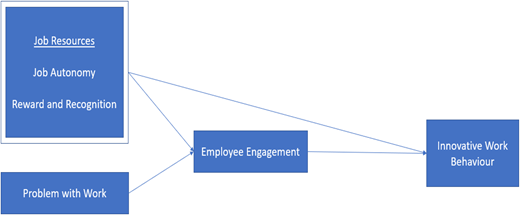
Proposed model (based on a literature review)
Proposed model (based on a literature review)
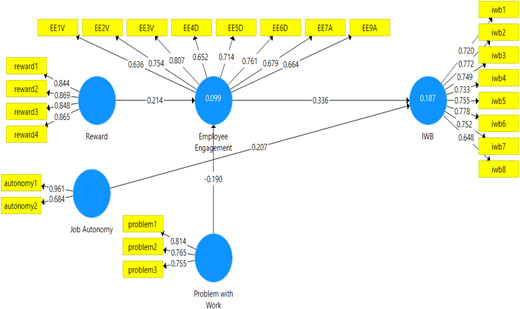
Final model with path coefficient and R-square (after removing insignificant paths) p < 0.05
Final model with path coefficient and R-square (after removing insignificant paths) p < 0.05

