The purpose of this paper is to identify the existing measure instruments for dynamic capabilities (DCs) in order to understand the tendencies of quantitative studies on DCs as well as to evaluate the reliability and validity of these scales.
To accomplish this objective, the authors conducted a systematic review of literature on DCs.
Main findings indicate that quantitative research works on DCs have focused on the relationship between DCs, innovation, organization performance, knowledge management and absorptive capacity. Findings also show that efforts to measure DCs quantitatively are recent and lack reliable methodology.
One limitation of this research is that the authors conducted the systematic review on two databases. However, the authors conducted the research on the two most used databases in management research.
Findings show that academicians have plenty of room to work on quantitative research works on DCs as well as to develop robust scales to measure this construct in diverse business sectors.
This paper is the first to analyze the existing scales that measure DCs.
1. Introduction
In today’s dynamic and highly competitive context, organizations should be “active actors” and capable to adapt to environmental changes “at least to some extent, mainly within the limits of its resources and capabilities” (Makkonen et al., 2014, p. 2707). Sensing and seizing opportunities, as well as taking initiatives to avoid potential threats, is imperative (Teece, 2007). To do so, organizations need to overcome the inertia and to promote the continuous change of their resource base (Makkonen et al., 2014).
Based on the resource-based view (RBV) framework, the perspective of dynamic capabilities (DCs) has emerged to explain how organizations can develop valuable, rare, inimitable and Nonsubstitable attributes (VRIN) resources on dynamic environments (Eisenhardt and Martin, 2000; Teece et al., 1997).
The DCs view focuses on the capacity to survive in dynamic environments by creating new resources and by renewing or changing the resource base (Bowman and Ambrosini, 2003). DCs involve routines and processes that are implemented to reconfigure the resource base in order to adapt to markets as they evolve (Eisenhardt and Martin, 2000). DCs enable organizations to integrate, reconfigure, and recombine their resources in timely manner in order to adjust to environmental changes and demands (Teece et al., 1997).
Despite the increasing relevance of the concept of DCs on strategic management research field and the great amount of theoretical studies on the subject, various authors have criticized this theory for being tautological, difficult to operationalize (Priem and Butler, 2001; Williamson, 1999) and difficult to be measured empirically (Easterby-Smith et al., 2009). As a result, there are few reliable empirical studies regarding dynamic capabilities. Authors plead that empirical studies on DCs are too abstract (Ali et al., 2012).
We defined two research questions:
What is the context in which quantitative studies on dynamic capacities are developed?
Which criteria are considered to ensure the reliability and validity of the scales?
For this reason, this research aims to identify the existing measure instruments for DCs in order to understand the context of quantitative studies on dynamic capabilities as well as to assess the reliability and validity of these scales. To accomplish this objective, we conducted a systematic review of literature on dynamic capabilities.
As literature indicates, DCs is a fundamental asset to get and sustain competitive advantage, as they allow organizations to rearrange their resources and process according to environment changes and demands (Eisenhardt and Martin, 2000; Teece et al., 1997). Based on these arguments, we believe that this research is relevant for strategic management research field, as it identifies and valuate the reliability of measure instruments that have been used to measure DCs.
Main findings indicate that quantitative researches on DCs have focused on the contexts of innovation, knowledge (other related aspects of knowledge such as absorptive capacity and organizational learning), strategic alliance, relationship with stakeholders (partners, customers, suppliers), organizational capacity and brand.
Findings also show that the initiatives to measure DCs are very recent: out of the 42 analyzed instruments, 38 were published in the 2010’s.
Regarding the reliability and validity of the scales, results indicate that quantitative researches on DCs lack more rigorous methodological procedures regarding scale development. As we analyzed the methods of the 42 articles according to the study of Slavec and Drnovesek (2012), we realized that the majority of quantitative studies have not accomplished all recommended steps for scale development.
Even though researchers are aware of the importance of measure reliability and validity, findings show that the majority focused more on the amount of the sampling data than on building an accurate and reliable instrument to measure the object of study.
This research can help researchers as it provides an extensive analysis of existing scales on DCs which can be adopted in future studies. Besides, researchers can make use of research findings by focusing on perspectives of DCs that still lack reliable quantitative studies. Results show that academicians have opportunity to develop rigorous and more accurate empirical studies.
Besides this introduction, this paper presents the theoretical background on DCs, a chapter describing the methodology adopted in this research, the analysis and discussion of research findings and authors’ final considerations.
2. Theoretical basis
DCs can be understood as an extension of the RBV on strategic management (Eisenhardt and Martin, 2000). Teece et al. (1997) apply the influence of the dynamism of markets in the theory of RBV perspective. In their view, resources evolve over time in order to adapt to market changes.
The perspective of DCs has emerged to explain how organizations are able to survive and to keep leadership in unstable environments by rearranging competences, assets and abilities, which was not covered by the RBV perspective. For this reason, the framework of DCs can be considered an extension of RBV as it addresses some of the limitations of its antecessor (Ambrosini and Bowman, 2009; Bowman and Ambrosini, 2003).
For Teece et al. (1997, p. 515), a DC “refers to the capacity to renew competences so as to achieve congruence with the changing business environment.” These authors emphasize that DCs play a fundamental role on strategic management as they enable organizations to adapt, to integrate and to reconfigure their internal and external resources to respond to changes in the environment.
Teece et al. (1997) and Eisenhardt and Martin’s (2000) highlight the impact of environment on organization performance as well as the necessity to adapt to environment in order to sustain competitive advantage. Both papers attest that DCs are related to unstable environments; while other authors, such as Ambrosini and Bowman (2009), point out that DCs can also be developed in stable environments, as they are not about the dynamism of the environment, but about organization’s capacity to adapt to environmental changes.
For Eisenhardt and Martin (2000), DCs are sufficient to achieve sustainable competitive advantage. Teece (2007, p. 1344) corroborates this position as he affirms that “if an enterprise possesses resources/competences but lacks DCs, it has a chance to make a competitive return (and possibly even a supra-competitive return) for a short period; but it cannot sustain supra-competitive returns for the long term except due to chance” (Teece, 2007, p. 1344). To sustain competitive advantage, organizations need to pursue the constant renewal of DC’s as well as to be able to identify valuable resources faster than its competitors (Collis, 1994). This constant renewal of DCs and organization’s resource base can be factors leading to innovation (Teece, 2007).
3. Methodology
This paper follows a qualitative methodological process with the objective to explore scales of DCs. As mentioned above, the objective of this research is to identify the existing measure instruments for DCs in order to understand the context of quantitative studies on DCs as well as to evaluate the reliability and validity of these scales.
To accomplish this objective, we conducted a systematic review of literature regarding DCs. Systematic (literature) review consists of using systematic methods to review studies on a specific theme in order to identify and evaluate the relevant studies on a specific theme (Petticrew and Roberts, 2006).
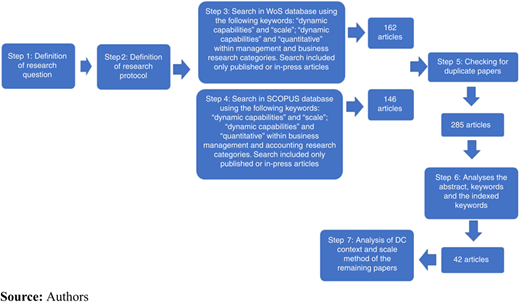
Following Tranfield et al.’s (2003) proposed model of systematic literature review (SLR), we did a set of steps to conduct the SLR in three proposed stages: planning the review; conducting the review; reporting and disseminating. Figure 1 shows the main steps of our protocol.
We defined two research questions to be answered by the SLS:
What is the context in which quantitative studies on dynamic capacities are developed?
Which criteria are considered to ensure the reliability and validity of the scales?
In this SLR, we extracted data from two databases, Web of Science (WoS) and Scopus. To extract articles on DCs from WoS (step 3), we used the keywords “DCs” and “scale.” Then, we filtered the search result using research categories. In this filter, we kept only the articles from management and business research categories. Then, we did another extraction on WoS using keywords “DCs” and “quantitative.” To filter this result, we did the same procedure as we did on the first extraction. After this refinement process, it remained 146 articles on the extraction from WoS. On Scopus (step 4), we performed a similar process as we did on WoS. We did two extractions; one using keywords “DCs” and “scale,” and the other using keywords “DCs” and “quantitative.” To refine the search result on Scopus, we filtered it by selecting articles from “business, management and accounting” research area. In total 162 articles were extracted from Scopus database. It is important to note that both searches included only published or “in-press” articles.
After the extraction, we searched for possible duplicate papers. In this step, 23 papers were excluded from analysis.
Afterwards, we analyzed the abstract, keywords and the indexed keywords of these remaining 285 articles (step 6). In addition, we analyzed their methodology (step 7) to evaluate the methods applied in development of the measure instruments.
To assess the reliability and validity of these scales on DCs, we chose Slavec and Drnovesek’s (2012) paper in which we found a consistent and detailed review of scales published in entrepreneurship journals during the years 2009 and 2010. We, then, used the steps of scale development described by Slavec and Drnovesek (2012) to assess the procedures authors used to develop their measuring instruments.
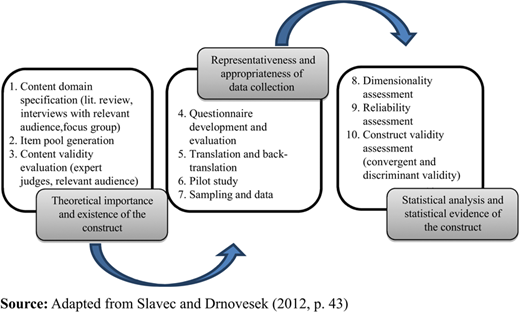
Founded on the classical Churchill (1979) article, Slavec and Drnovesek (2012) propose a ten-step procedure to develop a new scale. These then steps were grouped into three stages: “(1) theoretical importance and existence of the construct, (2) representativeness and appropriateness of data collection, and (3) statistical analysis and statistical evidence of the construct” (Slavec and Drnovesek, 2012, p. 53). Figure 2 illustrates the three-stage procedure for scale development.
In the stage of theoretical importance and existence of the construct, there are three steps: content domain specification (CDS), item pool generation and content validity evaluation (CVE). As you can see in Figure 2, the stage of representativeness and appropriateness of data collection consists of four steps questionnaire development and evaluation, translation and back-translation of the questionnaire, pilot study (PS) performance, and sampling and data collection (Slavec and Drnovesek, 2012). Finally, the stage of statistical analysis and statistical evidence of the construct contains four steps: dimensionality assessment, reliability assessment and construct validity assessment (CVA).
4. Results and discussion
As mentioned above, we analyzed the abstract, keywords, introduction and methodology sections of the selected articles. It is important to mention that in some instances this analysis also included reading the theoretical background and references sections, since occasionally keywords and abstracts did not depict overall content of the papers. For example, even though some articles contained the construct of DC, authors preferred to refer to DCs as the “dynamic perspective on RBV.” In this analysis processes, we found 42 measure instruments for DCs.
We divided our analysis into two parts. The first half is related to the first research objective: to understand the context of quantitative studies on DCs. The second half refers to the assessment the reliability and validity of these scales. Table I presents the 42 selected articles and details regarding their context and research objective.
It is important to mention that even though articles were grouped into one specific context, many of them address more than one context. However, to facilitate readers’ visualization of findings tabulation, we chose the context which got more emphasis in the study. On top of that, there is a strong interrelation within these contexts which implies that the multidimensional role of DCs on rearranging organizations resources (Teece, 2007; Teece et al., 1997).
As we can see in Table I, quantitative studies on DCs have gained importance on different contexts of organizational life. Within the most cited papers, we find quantitative studies on absorptive capacity (Camisón and Forés, 2010 with 411 citations), knowledge (Jantunen, 2005 with 368 citations), and strategic alliance (Lin and Wu, 2014 with 231 citation). It is worth mentioning that the article of Lin and Wu (2014) has gained a great amount of citations in a short period of time.
Regarding the context of DCs, findings shows that quantitative studies on DCs have focused more on four contexts of organizational life: governance (eight articles), innovation (eight articles), knowledge (seven articles), and relationship with stakeholders (ten articles distributed in relationship with customers, relationship with partners, and relationship with suppliers).
An important insight provided by the analysis is that knowledge has a strong correlation with DCs. Besides the eight articles that focused on the context of knowledge, we found other contexts which are very connected with knowledge: absorptive capacity (three articles) and organizational learning (3). That corroborates the argument found in the seminal work of Teece et al. (2007) that says that the ability to recognize opportunities depends on organization’s and its members knowledge and learning capacity.
The number of scales (42 out of 285 articles) can be explained by the fact that DCs are difficult to be measured empirically (Easterby-Smith et al., 2009). The difficulty to measure DCs are comprehensible as DCs are strongly related to internal organizational processes (Helfat and Peteraf, 2003; Teece, 2007) which, in turn, are complicated for researchers to identify and to measure empirically.
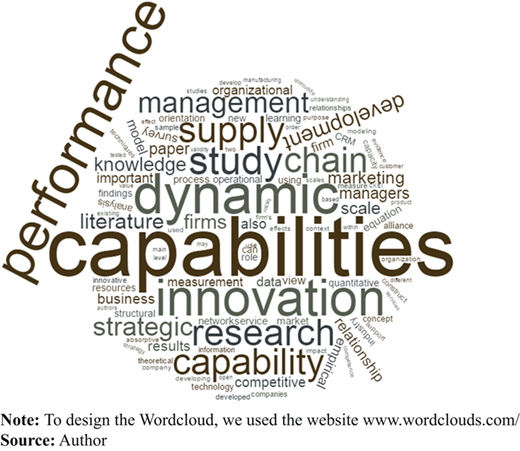
As we analyzed the main objective of the articles, we noticed that a great amount of the instruments aim to measure the relationship between DCs and some sort of innovation (12 out of 42 articles). This finding is corroborated as we counted the words contained in the abstracts of these articles. In total, the word “innovation” is mentioned 86 times. Figure 3 illustrates the word frequency of the 42 abstracts.
Another interesting finding is that a considerable amount of the select articles (14 out of 42) aim to measure the influence of DCs on some aspect of organization performance – i.e. portfolio performance (Biedenbach and Müller, 2012), customer-oriented organizational performance (Desai et al., 2007), innovation performance (Plattfaut et al., 2015). Even though some argue that the relationship between DCs and organizational performance is difficult to measure (Easterby-Smith et al., 2009), we could observe an increasing interest of researchers on investigating this perspective of DCs. This finding is corroborated by the word frequency of the abstracts - word “performance” is mentioned 94 times (see Figure 2).
In fact, findings indicate that initiatives to develop measure instruments for DC’s are recent. Out of the 42 selected measure instruments, 38 were published in the 2010s. This finding is understandable, since the seminal works of this theory were published between the end of the 1990s and the beginning of the 2000s (i.e. Eisenhardt and Martin, 2000; Teece et al., 1997; Winter, 2003).
As mentioned in the methodology section, to evaluate the validity and reliability of the scales on DCs, we adopted the criteria proposed by Slavec and Drnovesek (2012). We analyzed the methodology adopted by the authors according to the three stages of scale development: theoretical importance and existence of the construct, representativeness and appropriateness of data collection and statistical analysis, and statistical evidence of the construct (Slavec and Drnovesek, 2012).
As we analyze Table II, we can see that only 12 articles (out of 42) followed all the steps of scale development according to Slavec and Drnovesek (2012).
Again, we analyzed the methodological procedures according to our interpretation of Slavec’s and Drnovesek’s (2012) study. Another important point is that as we analyzed the process of scale development, we verified if the step of translation and back-translation was applicable or not. In most cases, this step was not necessary. Besides that, some studies do not clearly mention the procedures regarding specific steps of scale development. For instance, in the study of Agarwal and Selen (2013), authors do not report the procedures they conduct to develop and evaluate the questionnaire.
Within the 12 reliable and valid instruments, five received at least 60 citations according to Google Scholar: Kandemir et al. (2006), Lin and Wu (2014), Mitrega et al. (2012), Jin et al. (2014) and Cheng and Chen (2013).
Within the 42 scales, there are 15 with more than 60 citations. An intriguing finding shows that, within these highly cited papers, ten are not completely reliable and valid according to Slavec and Drnovesek’s (2012) criteria. Yet, the scale development process found on these papers follows most of the needed steps for scale development. For instance, Camisón and Forés (2010) only omitted the step of CVE; Herrmann et al. (2007), the step of CDS and PS; Santos-Vijande et al. (2013) and Zheng et al. (2011), the step of conducting a PS.
As we analyze the reliability and validity of these 42 instruments, we noted that the steps of scale development that are overseen or not reported more often are CVE (21 articles), CDS (15 articles), PS (16 articles) and CVA (7 articles).
CVE involves getting knowledgeable people to reviewing the scale items. Slavec and Drnovesek (2012) recommend researchers to ask experts (academicians, experienced practitioners) to evaluate the instrument to propose changes. According to research findings, half of authors (21) have neglected this important step. Getting advices from experts minimizes deviations and misconceptions of measurement items, especially regarding the construct of DCs which is too abstract and difficult to evaluate (Ali et al., 2012; Easterby-Smith et al., 2009).
CDS refers to defining what is going to be measured (DeVellis, 2003). Slavec and Drnovesek (2012) suggest researchers to conduct literature reviews and/or exploratory qualitative researches in order to define and delimitate the construct that will be quantitatively evaluated. The fact that many authors have missed this step can indicate a warning regarding empirical studies on DCs. As the construct of DCs remains ambiguous and difficult to identify on organizational settings (Ali et al., 2012), researchers should be more careful as they develop scales to measure it. Otherwise, researchers may develop instruments that will not measure the phenomenon as expected.
PS refers to engaging on a PS with a sample of the target population in order to collect critics, suggestions and thoughts, as well as to prevent possible problems such as semantic issues or misspelling. As findings show, 16 papers authors did not conduct this step nor reported it on their methodology.
CVA refers to the extent to which the scale measures what it is intended to measure in the setting that it will be used (Slavec and Drnovesek, 2012). In our analysis, seven papers have not accomplished this requirement. In some cases, authors do not clearly describe the statistical procedures they conduct during scale development. In these cases, we considered that specific methodological step as “not reported.” There are papers in which the description of the statistical procedures is ambiguous and insufficient. For instance, Biedenbach and Müller (2012) use the term unrotated factors analysis, but do not mention if they used exploratory factor analysis (EFA) or confirmatory factor analysis (CFA). In the same manner, Sprafke et al. (2012) present an obscure description of statistical procedures used in the research.
5. Conclusions
The perspective of DCs has emerged to explain how organizations can develop competitive advantage on dynamic environments (Eisenhardt and Martin, 2000; Teece et al., 1997). Despite the increasing interest of the academia on DCs, the empirical studies on DCs are few, not as reliable, too abstract and limited to case studies (Ali et al., 2012). For this reason, this research aims to identify the existing measure instruments for DCs in order to understand the context of quantitative studies on DCs as well as to assess the reliability and validity of these scales. To accomplish this objective, we conducted a systematic review of literature on DCs.
Main findings indicate that quantitative researches on DCs have focused on the contexts of brand innovation, knowledge (other related aspects of knowledge such as absorptive capacity and organizational learning), strategic alliance, relationship with stakeholders (partners, customers, suppliers), organizational capacity and brand.
Findings also show that the initiatives to measure DCs are very recent: out of the 42 analyzed instruments, 38 were published in the 2010’s.
Regarding the reliability and validity of the scales, results indicate that quantitative researches on DCs lack more rigorous methodological procedures regarding scale development. As we analyzed the methods of the 42 articles according to the study of Slavec and Drnovesek (2012), we realized that most of quantitative studies have not accomplished all recommended steps for scale development.
Even though researchers are aware of the importance of measure reliability and validity, findings show that the majority focuses more on the amount sampling data than on building an accurate and reliable instrument to measure the object of study.
Finally, results show that academicians have a good opportunity to develop rigorous and more accurate empirical researches on DCS. Academicians need to develop more reliable and valid instruments to measure this important aspect of strategic management.
A limitation of this research is that we have not analyzed in which perspective these 42 instruments were used. Another limitation is that the analysis of reliability and validity of these instruments is based on our interpretation of Slavec and Drnovesek’s (2012).
For future studies, we suggest researchers to compare the relationship between qualitative studies and quantitative studies on DCs. By analyzing the similarities and differences of context on qualitative and quantitative studies on DCs researchers can identify the most used methods in both research approaches as well as which research approach is more appropriate according to the context that DCs is analyzed.
This paper was funded by the CNPq project entitled “Exploring the Role of Customer Relationship Management in Organizational Innovation Capability,” under Grant No. 459491/2014-8.