This study examines the influence of digital marketing levers – email, mobile, social media, and content marketing – on the purchase intention of Tunisian Generation X consumers in the automotive sector.
A quantitative research design was adopted, collecting data from 367 Tunisian Generation X consumers to assess the impact of digital marketing levers on purchase intention.
Results indicate that all digital marketing levers significantly affect purchase intentions, though their influence differs in strength. Mobile marketing had the strongest impact, followed by social media and content marketing, while email marketing, though significant, was the least influential.
This study is limited to Generation X consumers in the automotive sector, which may restrict the generalizability of the findings to other cohorts or industries.
Findings encourage car dealers to focus on Generation X, a cohort shaped by both traditional and digital marketing by providing high-quality content, maintaining an active social media presence, and implementing well-targeted email and mobile communication strategies.
This study contributes to digital marketing literature by offering empirical evidence on the differential effects of digital marketing levers on purchase intention among Tunisian Generation X automotive consumers, a population underexplored in prior studies.
1. Introduction
The automotive sector is recognized as one of the most important industries on the planet, contributing approximately 3.5–5% to the global gross domestic product (GDP) and employing over 50 million people directly and indirectly (Helmold, 2021; Pala & Salahuddin, 2024). Technological advances have significantly transformed marketing strategies, and digital marketing has emerged as a vital tool for the large-scale promotion of automotive products and services (Zhong, 2023). However, buying a car is a complex and often highly involved purchasing decision for consumers (Zhang, 2025; Mehmood, Hassan, Arshad, & Batool, 2024). Among these consumers is Generation X, identified by the Pew Research Center as those born between 1965 and 1980 (Dimock, 2019). Generation X constitutes a strategic segment because of its high spending power, reported to exceed that of any other generation (Peralta, 2015 cited in Lissitsa & Kol, 2016). This Generation is further distinguished by specific purchasing patterns: consumers in this group are highly risk-averse, making calculated decisions based on the perceived value of the product and trust (Hwang, 2024), and demonstrating strong brand loyalty (Hou, Li, Fei, & Chen, 2025). Thus, Generation X represents a major strategic segment of the market. Despite this potential, the digital marketing field has long suffered from “demographic denial”, a tendency to ignore or marginalize older consumer segments in favor of younger populations (Nunan & Di Domenico, 2019). Indeed, the majority of prior research has predominantly focused on “digital natives” (Prensky, 2001), frequently treating younger cohorts as inherently more relevant to digital marketing strategies (Nunan & Di Domenico, 2019). Furthermore, the few existing studies examining Generation X consumer behavior in digital environments often isolate a single marketing lever (e.g. Rafki et al., 2023), thereby lacking a holistic, comparative approach.
This study addresses these empirical and theoretical gaps by overcoming stereotypes that consider older consumers as a technologically resistant group (Gilly, Celsi, & Schau, 2012). Its originality lies in investigating a “bridge” generation – one that has experienced the transition from traditional to digital media – through a comparative, multi-lever analysis within a high-involvement purchase context, namely the automotive industry. Specifically, this study aims to model the influence of digital marketing levers on the purchase intentions of Generation X, offering a nuanced perspective on a segment with considerable economic potential.
Therefore, the central questions of this research are as follows: Can the use of digital marketing impact the purchasing intentions of Generation X consumers in the automotive industry? If so, which digital marketing lever has the most influence?
To answer these fundamental questions, this study sets the following specific objectives:
Examine the relationship between mobile marketing and consumer purchase intention.
Examine the relationship between content marketing and consumer purchase intention.
Examine the relationship between social media marketing and consumer purchase intention.
Examine the relationship between email marketing and consumer purchase intention.
Compare the influence of these different digital levers on consumer purchase intention.
To answer these questions, we first introduce the theoretical background of this study. Then, we formulate the hypotheses to be tested and describe the methodology adopted for their verification. We conclude by discussing the results obtained, presenting the contributions, listing the limitations, and proposing avenues for future research in this area.
2. Theoretical background and hypothesis
2.1 Mobilized theories
This research is based on Mehrabian and Russell's (1974) S-O-R (Stimulus-Organism-Response) framework, which has been widely applied to explain how online marketing stimuli shape consumers' responses (Eroglu, Machleit, & Davis, 2001; Djafarova & Bowes, 2021). According to this theory, individuals exposed to external stimuli generate cognitive and emotional responses that are then transformed into behavioral responses (Donovan & Rossiter, 1982; Mehrabian & Russell, 1974).
In digital marketing, stimuli comprise visual and textual elements, social interactions, and targeted advertising. They induce mental and psychological reactions (Eroglu et al., 2001). These stimuli generate cognitive and affective evaluations that ultimately influence consumers' purchase decisions (Eroglu, Machleit, & Davis, 2003).
Beyond this reaction to stimuli, it is important to analyze the psychological mechanisms that structure purchase decisions. The Theory of Planned Behavior (TPB) is an indispensable complement to the S-O-R framework by explaining how this stimuli translate into purchase intention. It posits that attitudes, subjective norms, and perceived behavioral control significantly influence purchase intention (Ajzen, 1991). This theory is particularly relevant in the context of digital marketing, where consumer behavior is increasingly influenced by the interaction between persuasive online content (shaping attitudes) (Nadila, Kurlillah, & Safarida, 2024), social media interactions (reinforcing subjective norms) (Yadav, 2025), and the immediate accessibility of mobile platforms (Elhatrea, 2025) (increasing the perceived control over purchasing decisions).
More specifically, attitude reflects a consumer's overall favorable or unfavorable evaluation of the purchase behavior, subjective norms capture the perceived social pressure to perform or not perform that behavior, and perceived behavioral control reflects the perceived ease or difficulty of carrying it out. Together, these three determinants have been shown to reliably predict purchase intention in vehicle-purchase contexts (Guo & You, 2023).
The effectiveness of digital levers also depends on users' adoption of technological tools. To shed light on this dimension, we rely on the Technology Acceptance Model (TAM). This model, introduced by Fred Davis in 1986 following the work of Fishbein and Ajzen (1975), provides a fundamental theoretical framework to explain the acceptance of digital technologies (Davis, 1989). It postulates that the intention to use a technology is determined by two fundamental dimensions: Perceived Usefulness (PU) and Perceived Ease of Use (PEOU).
Perceived usefulness refers to the extent to which an individual believes that the use of a technological system would improve his or her performance in a given task (Davis, 1989). Perceived ease of use, on the other hand, reflects the degree to which a person believes that the use of this technology will be simple and effortless (Davis, 1989). Both of these variables directly influence the user's attitude towards the technology, which conditions their intention to use it and their actual behavior (Venkatesh, Morris, Davis, & Davis, 2003).
The joint mobilization of these three frameworks is grounded in their complementary and integrative properties, which are well established in the digital marketing literature. The S-O-R model in particular offers a strong integrative capacity, allowing it to be combined with other behavioral theories to build richer explanations of consumer behavior (Herzallah, Abosamaha, Salameh, & Alhayek, 2025). In a directly comparable digital marketing setting, Kokash et al. (2025) combined the S-O-R and TPB frameworks and found that digital stimuli, including social media engagement and digital marketing interactions, significantly shape subjective norms and, in turn, purchase intentions, closely mirroring the theoretical logic mobilized in the present study. The TAM further complements this combination by capturing the technology-acceptance dimension specific to digital marketing levers, so that the three frameworks together provide a more complete explanation of Generation X consumers' purchase intention than any single theory could offer alone.
2.2 Digital marketing
Digital marketing refers to all marketing strategies and techniques that use digital channels and technologies to promote products, services, or brands and influence consumer purchasing decisions (Kannan, 2017). It includes various methods, such as search engine optimization (SEO/SEA), social media marketing, content marketing, email marketing, online advertising, and data analysis (Visser, 2024). Digital marketing allows companies to reach their target audience more accurately, evaluate the effectiveness of their actions in real time, and interact directly with their consumers (Kotler & Keller, 2016). This provides unique opportunities to personalize customer experiences and maximize return on investment. Digital tools such as websites, sponsored links, and emails play a key role in this strategy because of their composition and the services they offer.
2.3 Influence of email marketing on consumer purchase intention
Email marketing is a strategic digital marketing tool that enables direct, personalized, and measurable communication with consumers (Pedrol & Romero, 2022). Companies often use this channel to inform customers about new offers, promotions, product launches, and after-sales services. Email marketing constitutes a significant development within digital marketing practices, encompassing direct emails, transactional emails, and email newsletters, with the dual objective of acquiring new customers and fostering the retention of existing ones (Rosário, 2021). Several studies confirm the practical effectiveness of this tool. Datchayai and Vasikar (2023) found that email marketing significantly influences purchase intentions, particularly among young consumers. Harum, Kusumawati, and Mawardi (2021) explained that effective email marketing strategies strengthen consumers' purchase intentions. According to Chittenden and Rettie (2003), well-designed and precisely targeted email campaigns promote purchase intention, particularly when they are based on consumers' previous purchasing behavior. Thus, we propose the following hypothesis:
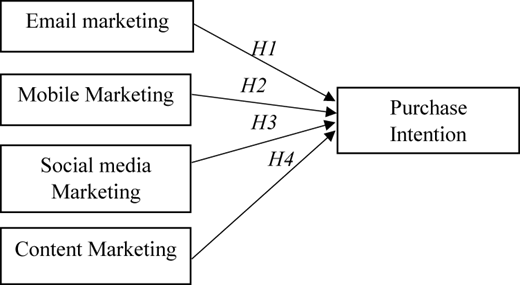
Email marketing positively affects the purchase intention of Generation X within the automotive sector.
2.4 Influence of mobile marketing on consumer purchase intention
Mobile marketing can be defined as an interactive exchange and promotion of offers between a company and its customers through mobile medium, device, or technology (Shankar & Balasubramanian, 2009). This channel has become increasingly central to marketing strategy due to the location specificity, portability, and wireless nature of mobile devices, which enable firms to reach consumers anytime and anywhere (Shankar & Balasubramanian, 2009). Mobile marketing provides consumers with quick access to promotional offers, discounts, and product information via applications and text messages (Omar & Atteya, 2020). For instance, a retailer can send a location-based, personalized offer – such as a price-reduction coupon for a specific product – to nearby customer to encourage an immediate purchase (Shankar & Balasubramanian, 2009). Teixeira and Nunes (2024) argue that location-based services and mobile apps are effective in fostering positive attitudes towards mobile marketing and stimulating purchase intent. Chinomona and Sandada (2013) specify that mobile marketing activities influence purchase intention primarily by first triggering consumer acceptance.
Based on these studies, following hypothesis is formulated:
Mobile marketing positively affects the purchase intention of Generation X within the automotive sector.
2.5 Influence of social media on consumer purchase intention
The emergence of Internet-based social media has fundamentally transformed how companies communicate with consumers, shifting from one-way promotional messaging to interactive, two-way dialogue (Mangold & Faulds, 2009). Mangold and Faulds (2009) describe social media as a hybrid element of the promotion mix, since it allows businesses to communicate with customers while also allowing customers to communicate directly with each other. According to Kaplan and Haenlein (2010), social media enables companies to promote their products, share customer reviews, and engage directly with potential customers. Beyond these theoretical foundations, several recent studies have quantified the direct effect of social media marketing on purchase intention across different markets and product categories. Dowansiba and Saputro (2025) found that social media marketing significantly influences consumers' intention to purchase shoes. The researchers explain that integrating engaging content with effective e-commerce strategies is essential for improving sales through social media marketing. Ma (2025) also asserted a strong correlation between social media marketing and purchase intentions, particularly among undergraduate students in Beijing. He added that positive comments on social media reinforce purchase intention. A study of Paraguayan consumers revealed that 63% frequently use social media. 53.4% of them believed that social media advertising is effective for purchases (Chung, Peña, Ortiz, & Colmán, 2023).
Therefore, the following hypothesis is proposed:
Social media positively affects the purchase intention of Generation X within the automotive sector.
2.6 Influence of content marketing on consumer purchase intention
Content marketing refers to the creation of valuable, relevant and compelling content by the brand itself, aimed to generate a positive behavioural response from a customer or prospect of the brand (Pulizzi, 2012). It enables companies to educate and inform consumers by providing them with articles, videos, and expert opinions (Pulizzi, 2012). The quality of this content is particularly important, as Holliman and Rowley (2014) show that high-quality content builds consumer trust and guides them in their decision-making process. According to Febrianti, Purwaamijaya, and Prehanto (2024), content marketing strategies on platforms like TikTok improve customer engagement and can increase purchase intentions among followers. According to Atiencie, Jaramillo, and Espinoza (2025), content marketing has a major influence on purchase intention in Latin America. The authors specifically highlight the predominant effectiveness of short-form videos and customer testimonials in this conversion process.
Therefore, we propose the following hypothesis:
Content marketing positively affects the purchase intention of Generation X within the automotive sector.
Figure 1 shows the conceptual model of this study.
3. Methodology
3.1 Research context and target population
This study focuses on Generation X. The choice of this target population is justified by its high purchasing power, cautious approach to decision-making, and gradual adoption of digital technologies. These characteristics make Generation X an ideal group for examining the differential impact of digital marketing levers on purchase intention (Lissitsa & Kol, 2016; Williams & Page, 2011).
The automotive sector was selected because of its highly competitive nature and extensive reliance on digital channels to influence consumer buying behavior (Rodrigues, Sousa, Gomes, Oliveira, & Lopes, 2023).
3.2 Sampling and data collection
We adopted a quantitative study design to test the research hypotheses. The main objective was to evaluate the impact of four digital marketing levers (content, mobile, social media, and email marketing) on the purchase intention of Tunisian Gen X consumers within the automotive sector.
Data were collected using convenience sampling. The choice of this non-probabilistic technique is explained by its practicality and effectiveness in reaching the target population (Msosa, 2023). According to Patton (2018), this method involves selecting participants based on their immediate accessibility and willingness to participate in the survey.
To ensure adequate statistical power, the required minimum sample size was determined a priori using G*Power (Faul, Erdfelder, Lang, & Buchner, 2007). Based on standard statistical criteria (α = 0.05, power = 0.80, medium effect size f2 = 0.15) and a maximum of four direct predictors pointing to the single endogenous construct (i.e. the four digital marketing levers influencing purchase intention), the analysis indicated a minimum threshold of 85 respondents.
A self-administered questionnaire was developed to operationalize the constructs (Appendix A). The survey opened with a screening question filtering for respondents born between 1965 and 1980 (Generation X). To maximize reach, the questionnaire was distributed online across multiple digital channels (Facebook, Instagram, WhatsApp, and email). To prevent missing data, mandatory completion was enforced for all survey items, ensuring that fully completed questionnaires were submitted.
Data were collected over three months, yielding 367 valid responses. This sample size largely exceeds the recommended threshold for PLS-SEM analysis, providing an adequate level of statistical power.
Collectively, these design choices – a three-month collection window, multi-channel distribution, and mandatory completion of all items – ensured a complete dataset for the subsequent statistical testing while enhancing overall data collection rigor.
In terms of demographic composition, the sample was composed of 53.7% males and 46.3% females. Table 1 provides a detailed description of the sample profiles.
3.3 Variables operationalizations
To measure the variables in our model, we selected measurement scales that had already been used in the literature and whose reliability and validity had been confirmed.
We measured email marketing using the scale developed by Kaushik and Prativindhya (2019). This scale consists of four items and uses a five-point Likert scale. Cronbach's alpha was 0.762.
We used the scale developed by Omar and Atteya (2020) to measure mobile marketing. This scale also consists of four items and uses a five-point Likert scale. The reliability was 0.840.
We opted for the scale of Kaushik and Prativindhya (2019) to measure social media marketing. This scale also consists of four items and has a Cronbach's alpha of 0.811.
We used the scale developed by Kaushik and Prativindhya (2019) to measure the content marketing. This five-item scale has a reliability of 0.784.
Purchase intention was measured using the scale developed by Xia and Bechwati (2008). This scale has a satisfactory internal consistency (α = 0.892).
All items were measured on a Likert scale ranging from 1 (strongly disagree) to 5 (strongly agree).
3.4 Data analysis
Principal component analysis (PCA) with SPSS 24 allowed us to retain all items from the measurement scales.
The measurement and structural models were estimated using partial least squares structural equation modeling (PLS-SEM) with SmartPLS 4.
Unlike traditional covariance-based SEM methods, this software allows modeling using variance-based structural equations (PLS-SEM). SmartPLS is less restrictive than other software (e.g. LISREL) in terms of sample size, distribution assumptions, and model complexity (Hair, Ringle, & Sarstedt, 2013). The use of this software is growing in the fields of marketing (Poddar & Madupalli, 2012; Rodríguez-Pinto, Carbonell, & Rodríguez-Escudero, 2011; Sattler, Völckner, Riediger, & Ringle, 2010) and information systems (Lin, Fan, & Chau, 2014; Martins, Oliveira, & Popovič, 2014).
Given the predictive objective of this study, PLS-SEM emerged as the most relevant methodological option (Memon, Ting, Ramayah, Chuah, & Cheah, 2017; Hair et al., 2013). This modeling technique is widely considered in academia as the “most advanced and general system” for variance-based structural analysis (Roldán & Sánchez-Franco, 2012). Following standard PLS-SEM procedures, the analysis proceeds in two steps: first, the measurement model is assessed to evaluate the reliability, convergent validity, and discriminant validity of each construct (Table 2); second, the structural model is evaluated to test the hypothesized relationships (Table 7). This sequential logic, together with the software and reliability/validity criteria reported above, is intended to make the analytical procedure fully traceable and reproducible.
4. Results
4.1 Assessment of measurement model
Convergent validity was evaluated using three indicators: factor loadings, average variance extracted (AVE), and composite reliability (CR).
We verified the absence of multicollinearity by calculating the Variance Inflation Factor (VIF).
The values of these indicators are listed in Table 2.
As shown in Table 2, Cronbach's alpha and composite reliability are higher than 0.7, demonstrating internal consistency reliability. All factor loadings were greater than 0.7. We can also conclude that convergent validity is ensured because the average variance extracted (AVE) of each construct is higher than 0.5.
Furthermore, our analyses reveal VIF values ranging from 1.997 to 4.727, thus respecting the stringent threshold of 5.0 recommended in the literature (Hair et al., 2013; Lin et al., 2014). These results attest to the stability of the estimated parameters and confirm that the model is not affected by collinearity.
4.1.1 Discriminant validity of constructs
Discriminant validity was assessed using the Fornell–Larcker criterion (Fornell & Larcker, 1981). The rule is that the square root of the AVE of each construct should be greater than its correlation with other constructs.
Table 3 confirms the discriminant validity of all constructs of the measurement model.
4.2 Structural model goodness of fit
To assess the explanatory and predictive power of the structural model in PLS-SEM, we generally use the following:
the coefficient of determination (value R2) for explained variance
the Stone-Geisser predictive relevance index Q2 for predictive accuracy
The effect size f2 to evaluate the impact of each exogenous construct on the endogenous constructs (Hair et al., 2013).
4.2.1 The coefficient of determination of the model “R2”
According to Chin (1998) the effect is:
substantial if the coefficient is above 0.67,
moderate if the coefficient is between 0.33 and 0.67,
small for a coefficient between 0.19 and 0.33.
Table 4 shows a substantial level of explanatory power. The model explained 77.1% of the variance in the dependent variable.
4.2.2 Cohen's f2 coefficient
Cohen's f2 indicator allows for the evaluation of the predictive contribution of endogenous variables when a variable is explained by several exogenous variables.
According to Cohen (1988):
If the coefficient f² is less than 0.02, the effect is small,
If the coefficient is less than 0.15, the effect is medium
When it is greater than 0.35, the effect is large.
Table 5 shows that content marketing and email marketing marginally contribute to the explanation of purchase intention. Social media has a modest influence while mobile marketing is the most influential factor in purchase intention.
4.2.3 Model predictivity index Stone-Geisser Q2
To evaluate the predictive relevance of the structural model, we calculated the Q2 value using blindfolding procedure. This metric assesses the model's in-sample predictive relevance for endogenous constructs. A positive Q² value indicates predictiverelevance (Hair, Hult, Ringle, & Sarstedt, 2017).
Table 6 shows a Q² value of 0.767 for purchase intention, indicating large predictive relevance of the model for this endogenous construct.
4.2.4 Overall model quality: Goodness-of-Fit (GoF) index
(GoF) is an index that considers both the measurement and structural models. The calculation formula is as follows: GOF = √R2̅̅̅̅∗AVE̅̅̅̅̅̅
By applying the above formula, we obtained GOF = √0.771*0.7888 = 0.779. GOF> 0.36, thus, we can deduce that the estimated model is valid (Wetzels, Odekerken-Schröder, & Van Oppen, 2009).
4.2.4.1 Testing the hypotheses of the structural model
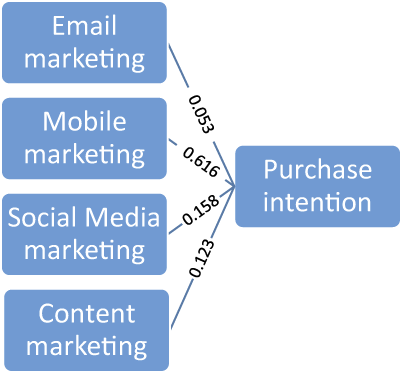
The causal relationships between the variables were tested using PLS-SEM. All of them were significant (p < 0.05). The results are presented in Table 7.
The results presented in Table 7 confirm all proposed hypotheses (H1 ‒ H4), as summarized in Table 8.
The conceptual model resulting from the empirical verification is illustrated in Figure 2.
5. Discussion
This study confirms the significant impact of digital marketing on the purchase intentions of Generation X consumers in the automotive sector. The four hypotheses were validated to varying degrees, revealing the importance of digital tools, especially mobile marketing, in the business strategy of car dealerships. Theoretically, these findings support the stimulus-organism-response (S-O-R) framework, where digital marketing levers (email, mobile marketing, social media, and content marketing) act as external stimuli (S). These stimuli influence the internal state of the consumer (Organism, O), which ultimately triggers the behavioral response (R) manifested as purchase intention.
The first hypothesis related to the influence of e-mail marketing was confirmed (p = 0.029). This result corroborates the study by Rana, Kiran, and Gul (2024), which demonstrated that personalized, attractive, and well-targeted emails strengthen brand loyalty and have a positive effect on all stages of the consumer purchasing process. However, this influence is not universal in nature. A study of students in Panama found that 51.1% felt that email marketing had no influence on purchasing decisions, while 36.2% indicated that the impact was minimal (Barría, 2023).
Despite these regional variations, email marketing remains a powerful tool for companies to build personalized relationships with customers, keep them informed about current offers, and foster trust in the brand. Moreover, consumers exposed to email marketing not only show significant purchase intent but also recommend the brand to friends and family (Datchayai & Vasikar, 2023). This suggests that email marketing is a vital strategy that allows the maintenance of lasting relationships with customers and improves their purchasing intentions (Datchayai & Vasikar, 2023). Nevertheless, the relatively modest coefficient suggests that, while this lever is undoubtedly advantageous, it remains subordinate to other instruments of influence.
The relatively low ranking of email marketing can be attributed to several factors. First, the professional nature of this channel leads Gen X consumers to limit the role of email as a simple tool for formal communication. They reject the idea of conceiving it as a means of entertainment or searching for products with high involvement (for example, the purchase of a vehicle).
In addition, this resistance can be compounded by heightened sensitivity to digital risks. Generation X remains particularly vigilant about cybersecurity (Wibowo & Triayudi, 2024), frequently associates unsolicited emails with spam or fraudulent activity. Consequently, for high-ticket items such as automobiles, consumers tend to favor channels that offer greater perceived control over suspicious embedded links that may appear insecure.
Furthermore, email marketing in the automotive sector can be perceived as an “intrusion” rather than a useful resource. This often triggers psychological reactance, where the consumer feels pressured and subsequently withdraws their interest. This passive stance aligns with the behavior of “Technology Spectators” (Calvo-Porral, Pesqueira-Sanchez, & Faiña Medín, 2019): while Gen X individuals may receive and acknowledge information via email, they prefer to take action through more engaging and interactive platforms, such as mobile applications or social networks. Evaluated through the Theory of Planned Behavior, this pattern makes theoretical sense: because email marketing offers limited perceived behavioral control over suspicious links and unsolicited content, it generates a weaker effect on purchase intention than channels perceived as safer and more interactive.
Mobile marketing had the greatest influence (β=0.616; f²=0.350, p-value <0.001), confirming the second hypothesis. This can be explained by the fact that smartphones play a significant role in the daily lives of Generation X, with push notifications, promotional text messages, and other mobile formats enabling instant and targeted interaction and generating a direct impact on consumer interest and engagement. Moreover, mobile marketing provides direct, convenient, and rapid communication. These features are consistent with the behavior of Generation X, who opt for utility, clarity, and convenience in digital interactions.
This finding is consistent with the conclusions of Varnali and Toker (2010). The authors assert that mobile marketing fosters a seamless and ongoing experience throughout the purchasing journey. The predominance of mobile marketing over other levers suggests that for Generation X, the Perceived Usefulness (PU) of mobile interfaces outweighs the traditional “push” of email. In the automotive sector, where information search is intensive, smartphones act as “boundary objects “ that facilitate real-time comparison. This aligns with the Technology Acceptance Model (TAM): Gen X consumers do not just use mobile because it is available, but because it reduces the cognitive friction associated with high-involvement purchasing decisions. Furthermore, the great influence of mobile marketing can be explained by the strengthening of perceived behavioral control: the smartphone allows Generation X to actively and autonomously manage its decision-making process.
The third hypothesis, which concerns the effect of social media, was also validated (p-value = 0.009). Social media platforms, particularly Facebook, Instagram, and TikTok, provide spaces for discovering, interacting with, and evaluating automotive offerings. These platforms influence consumers born between 1965 and 1980, who use them to compare products, read reviews, and follow brand news. This finding is consistent with the research of Rana and Goel (2023) and Yadav (2025). These authors explain that platforms such as Facebook, Instagram, Twitter, and TikTok engage users in a unique way that impacts their preferences and purchasing behaviors. Chung et al. (2023) show that in Paraguay, more than half of the surveyed population considers advertising on these platforms an effective purchasing lever.
The significant influence of social media marketing on Generation X's purchase intentions can be analyzed using the Theory of Planned Behavior (TPB). Social platforms simultaneously act on the three determinants of intention. First, they shape consumer attitudes by providing access to rich and transparent content (e.g. reviews and videos). Second, they activate subjective norms: for a status purchase, such as a car, validation by peers and online communities reduces perceived social risk. Finally, the interactivity of social networks reinforces perceived behavioral control, offering this “bridge generation” the necessary tools to guide their decisions proactively. Thus, social networks are not simply communication channels but psychological catalysts that transform digital exposure into concrete purchase intentions.
Finally, the hypothesis relating to content marketing was confirmed (p-value = 0.016), emphasizing the importance of the quality, relevance, and usefulness of the content offered. Explanatory videos, model comparisons, and expert opinions influence purchase intention by promoting a better understanding of the offer.
This result confirms Viviana and Hayuningtias (2025) study, which found that relevant, informative, and interesting content establishes trusting relationships with consumers and increases purchase intention. Similarly, Pahlevi, Ubaidillah, and Abadiyah (2025) emphasized that to effectively influence consumer behavior, companies must focus on providing interactive and valuable content.
Atiencie et al. (2025) indicated that content marketing significantly influences purchase intentions in Latin America. Their findings suggest that effective strategies leverage emotional storytelling and influencer collaborations.
The penultimate ranking of content marketing offers insights into complex buyer journeys. While informative content disseminated by companies is essential in the early stages of the buying process, it appears less influential in triggering purchase intentions. This could mean that in the automotive industry, Gen X individuals value peer-to-peer credibility more than corporate expertise, which may be perceived as inherently biased and less credible. Interpreted through the TAM and TPB frameworks jointly mobilized in this study, content marketing primarily shapes consumer attitude (a key TPB determinant) rather than perceived usefulness (a TAM construct) or subjective norms (TPB construct) associated with more interactive channels such as mobile applications and social media. This helps explain its comparatively lower ranking.
Taken together, this hierarchy of effects, with mobile marketing exerting the strongest influence, followed by social media, content marketing, and email marketing, directly addresses this study's objective of comparing the influence of different digital marketing levers on Generation X consumers' purchase intention.
Ultimately, this study demonstrates that when used effectively, digital tools can transform the relationship between dealerships and their Generation X customers, thereby positively influencing the latter's purchasing intentions.
6. Conclusion
In this study, we examined the impact of digital marketing tools on the purchase intentions of Tunisian Generation X consumers in the automotive sector. Through a combination of theoretical analysis and rigorous empirical research, we demonstrated that digital marketing tools such as content marketing, mobile marketing, social media, and email marketing have a significant positive effect on the purchasing intentions of consumers born between 1965 and 1980. However, their influence varies: mobile marketing displays the strongest impact, followed by social media, content marketing and email marketing. In sum, these findings highlight both the relevance of an integrated S-O-R, TAM, and TPB framework and its practical value for automotive marketing strategies.
The results of this study have significant theoretical and managerial implications.
From a theoretical perspective, this study examined the effects of digital marketing tools on consumers' purchase intention using the Stimulus-Organism-Response model (SOR), the Technology Acceptance Model (TAM), and the Theory of Planned Behavior (TPB). This study makes a major contribution to the academic understanding of the relationship between digital marketing and consumer behavior by integrating theories from three disciplines. Specifically, by empirically comparing four digital marketing levers, this study offers comparative insights - rather than single-lever analysis - on how digital stimuli translate into purchase intention. This comparative, theory-driven approach extends prior literature beyond studies examining single levers in isolation, such as email marketing alone (Rana et al., 2024) or social media alone (Yadav, 2025). Consequently, it provides a more comprehensive account of how Generation X, as a bridge generation, processes digital marketing stimuli in a high-involvement purchase context.
This study also aims to fill a major gap in the literature by focusing on Gen X consumers. Yet, Gen X represents a highly strategic segment that possesses considerable purchasing power and a unique cognitive process shaped by a transition from the traditional to the digital era.
From a managerial perspective, this study encourages car dealers to connect with Gen Xers by producing original content that is educational and real-world based. Original content can be produced by dealerships, in regular increments, in the form of articles, videos, and customer testimonials, and shared on either a dealer's website or social media channels. The recommendation is to use social media and regularly publish varied and interactive content (such as videos, polls and flash promotions). Specifically, practitioners should leverage social proof by highlighting peer reviews and success stories, as Generation X relies heavily on the experiences of others to reduce perceived risk in high-involvement purchases such as automobiles. Collaboration with local automotive industry influencers can also increase brand visibility and reinforce credibility through third-party validation. This strategy effectively transforms digital engagement into concrete purchase intentions.
The company could also use email marketing by sending personalized messages to customers, such as maintenance reminders and usage tips. Instead of being perceived as an intrusive 'push' marketing tool, companies should utilize email marketing as a delivery mechanism for post-purchase reassurance and individualized follow-up. This will accommodate Gen X consumers' increased wariness and vigilance regarding their safety and security concerning the Internet, online fraud, and identity theft. Segmenting the database would enable the company to target its messages more effectively, ensuring that communications are perceived as valuable resources rather than as unsolicited spam. This strategic approach improves the overall effectiveness of campaigns by building long-term trust and fostering a secure relationship with consumers.
Another important aspect of marketing is mobile marketing, which has a the most significant impact on consumers' willingness to buy vehicles. When dealers send relevant text messages to their customers at appropriate times to remind them of special deals or provide information on recently released cars, customers usually respond positively, especially when the number of text messages sent is reasonable. In addition to sending SMS messages to customers, dealerships can create live mobile comparison tools for consumers who are working on their buying process on their phones. Smartphones are a “boundary object” that allows Gen X consumers to independently control their buying decisions while searching for information about the vehicle they are buying. Implementing a customer relationship management (CRM) tool is essential for tracking each customer's history and tailoring marketing actions to their preferences. This would enable a more personalized and, therefore, more effective service that aligns with the high explanatory power of the mobile lever in this study's results.
While this research is interesting from both theoretical and managerial perspectives, it has some limitations. The first relates to the methodology. Indeed, the choice of convenience method limits the generalizability of the results. The second limitation relates to the selection of Generation X as the target group and the automotive sector as the context of the study. These choices limited the scope of our results.
For this reason, it would be relevant to explore other contexts or conduct studies with different target groups, such as Generation Y or Generation Z. It would also be interesting to introduce other variables into the conceptual model, such as trust and brand image, or to test the impact of AI or augmented reality on the customer's shopping experience.
The supplementary material for this article can be found online.