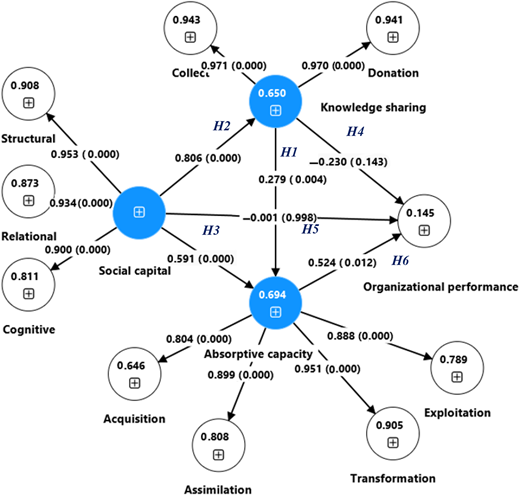
This study evaluated the effects of social capital, knowledge sharing, and absorptive capacity on the performance of family firms.
Data collection was carried out using a questionnaire with Likert-type scales. The sample of 108 respondents was planned using G*Power software.
Seven hypotheses were tested, and five were supported. The results reveal that social capital and knowledge sharing do not directly impact the performance of these firms. However, these variables proved to be important antecedents of absorptive capacity, which, in turn, influenced organizational performance.
Since the study does not represent the universe of family businesses, it is not generalizable. The scale used to measure performance, may not encompass all relevant indicators related to performance.
This study provides strategic guidelines for managers, reinforcing the importance of recognizing and managing social capital and encouraging knowledge sharing to strengthen absorptive capacity, thereby enhancing firm performance.
The research revealed that the relationship between social capital, knowledge sharing and absorptive capacity are more complex and indirect than usually assumed. While social capital and knowledge sharing do not directly contribute to performance, they are essential for the development of absorptive capacity, which positively affects the performance of family firms.
1. Introduction
Family businesses are a dominant organizational form worldwide, central to economic development, employment, and regional stability. Family-controlled firms account for over 70% of businesses globally, especially SMEs, although statistics remain fragmented in some countries, such as Brazil (Frezatti, Bido, Mucci, & Beck, 2017). They are also marked by distinctive governance structures, socioemotional priorities, and relational dynamics, setting them apart from non-family firms (Sharma, 2004; Dyer, 2018).
Operating in volatile, competitive environments, family businesses face persistent challenges in professionalization, succession, governance, and strategic renewal, intensifying the need to understand which resources best sustain performance. Prior research has examined many antecedents; however, three constructs recur: social capital, knowledge sharing, and absorptive capacity (Nahapiet & Ghoshal, 1998; Cohen & Levinthal, 1990; Zahra & George, 2002). Findings on their relative importance and interrelationships remain fragmented and, at times, contradictory.
Social capital has long been recognized as a valuable asset that facilitates access to information, resources, and opportunities through relational networks (Coleman, 1988; Nahapiet & Ghoshal, 1998). In family businesses, it is especially relevant given the overlap between family, ownership, and management, which can strengthen trust while constraining openness (Carr, Cole, Ring, & Blettner, 2011; Herrero & Hughes, 2019). Empirical studies nonetheless report mixed results, especially regarding its structural, cognitive, and relational dimensions (Romano, Favino, Pennacchio, & Grimaldi, 2020; Stasa & Machek, 2022).
One explanation lies in how social capital converts into performance. The benefits of social capital are not automatic but depend on processes that enable information exchange, learning, and knowledge utilization. Knowledge sharing is one such process that links individual-level knowledge to collective outcomes (Argote & Ingram, 2000). Although social capital is thought to facilitate knowledge sharing, its direct impact on family business performance remains inconclusive (Gede & Rihayana, 2019; Zhao, Jiang, Peng, & Hong, 2020).
A growing literature suggests that absorptive capacity plays a pivotal role in this transformation. Defined as the firm's ability to recognize, assimilate, transform, and exploit external knowledge (Cohen & Levinthal, 1990; Zahra & George, 2002), it converts knowledge flows into strategic and performance outcomes. It may be especially salient in family businesses, which rely less on formal R&D and more on relational and experiential learning (Ferreira & Ferreira, 2017; Kotlar, Massis, Frattini, & Kammerlander, 2020).
Despite these insights, prior studies frequently model direct relationships between social capital or knowledge sharing and performance, overlooking absorptive capacity's sequential, mediating role, and often assume causal relationships difficult to substantiate in cross-sectional designs. Addressing this gap, the present study examines the relationships among social capital, knowledge sharing, and absorptive capacity, focusing on their direct and indirect effects on performance — treating absorptive capacity as the mechanism linking social and knowledge-based resources to organizational outcomes, rather than assuming direct causal relationships between constructs (Langley, 1999).
Accordingly, the guiding research question of this study is:
How do social capital and knowledge sharing contribute to family business performance, and to what extent is this relationship mediated by absorptive capacity?
By clarifying the roles and interdependencies of these constructs, this study refines the understanding of relational and knowledge-based capabilities and their performance implications.
2. Theoretical foundation
2.1 Family businesses as a distinct organizational context
Family businesses differ from non-family firms not only in ownership structure but also in governance, decision-making, and relational dynamics. The overlap between family, ownership, and management systems creates unique advantages—trust, long-term orientation, and strong identification—as well as constraints such as centralization, path dependence, and resistance to change (Sharma, 2004; Chua, Chrisman, & Steier, 2003).
These characteristics make family businesses particularly sensitive to relational resources and knowledge-based capabilities, as they frequently rely on informal ties, shared values, and relational norms to govern behavior and allocate resources (Herrero, 2018). Therefore, understanding performance in family businesses requires a theoretical lens that incorporates relational and knowledge-based mechanisms rather than assuming direct effects from isolated resources.
2.2 Social capital in family businesses
Social capital refers to the sum of actual and potential resources embedded within, available through, and derived from networks of relationships (Nahapiet & Ghoshal, 1998), here adopted in its multidimensional form, distinguishing structural, relational, and cognitive dimensions.
In family businesses, social capital often emerges from long-standing interpersonal ties, shared family identity, and repeated interactions among family and non-family members (Sorenson, Goodpaster, Hedberg, & Yu, 2009). Such ties can enhance trust and cooperation but may also generate closed networks and excessive bonding, limiting exposure to diverse knowledge sources (Herrero & Hughes, 2019).
Empirical evidence on the impact of social capital on family business performance remains mixed. Some studies find positive associations (Tata & Prasad, 2015), while others find effects contingent on intervening mechanisms and context (Romano et al., 2020; Stasa & Machek, 2022), suggesting that social capital is not a direct driver but an antecedent resource whose value depends on how it is mobilized.
2.3 Knowledge sharing as a relational process
Knowledge sharing refers to the process through which individuals exchange information, experience, and expertise, allowing knowledge to circulate and recombine within organizations (Argote & Ingram, 2000), conceptualized here as a processual mechanism linking social relationships to organizational learning outcomes.
In family businesses, knowledge sharing is deeply embedded in relational contexts shaped by trust, reciprocity, leadership influence, and shared language (Rutten, Blaas-Franken, & Martin, 2016). However, centralization and hierarchical authority—common in family firms—may inhibit open exchange, particularly among non-family employees (Andrews, 2010).
Prior research suggests that social capital facilitates knowledge sharing via trust and shared norms (Chang & Chuang, 2011; Dijk, Hendriks, & Romo-Leroux, 2016), yet its direct impact on performance is inconsistent: knowledge sharing alone rarely yields performance gains unless organizations can absorb and apply it (Gede & Rihayana, 2019; Zhao et al., 2020). Thus, it is an intermediate process, not a direct driver of performance.
2.4 Absorptive capacity as a central mechanism
Absorptive capacity is defined as a firm's ability to recognize the value of new knowledge, assimilate it, transform it, and exploit it for commercial purposes (Cohen & Levinthal, 1990; Zahra & George, 2002), adopted here per Zahra and George's (2002) reconceptualization as a dynamic capability.
In family businesses, absorptive capacity plays a critical role given limited formal R&D investment and stronger reliance on experiential and relational learning (Ferreira & Ferreira, 2017; Kotlar et al., 2020), converting relationally embedded knowledge into actionable outcomes and thus functioning as a bridge between social capital, knowledge sharing, and performance.
Some studies find that absorptive capacity mediates the relationship between social capital and performance, suggesting that relational resources influence outcomes primarily through learning and knowledge-utilization processes (Chuang, Chen, Lin, & Ji, 2016; Hughes, Morgan, Ireland, & Hughes, 2014).
2.5 Organizational performance
Competitiveness in the global market requires strong synergy between family and business, as value is created for both simultaneously (Chua et al., 2003). Performance indicators help firms monitor goals and guide management. Facing environmental dynamism, organizations have expanded measurement beyond financial indicators—profit, ROE, ROA—to include quality, productivity, satisfaction, and delivery. Non-financial indicators are more associated with long-term performance, while financial ones are associated with short-term decisions (Chua, Chrisman, De Massis, & Wang, 2018).
In family businesses, performance assessment increasingly incorporates financial and non-financial dimensions beyond purely economic outcomes (Chua et al., 2003, 2018), given these firms' distinctive purposes, resources, and values. Recent studies emphasize cultural values and family commitments in achieving non-financial performance goals across national contexts (Alves & Gama, 2020).
2.6 Hypotheses
2.6.1 Social capital and organizational performance
Nahapiet and Ghoshal (1998) argue that social capital's structural, relational, and cognitive dimensions can contribute to competitive advantage and positively influence performance. The structural dimension, formed by weak and strong network ties, generates performance-relevant benefits (Tata & Prasad, 2015). The cognitive dimension (shared interpretations) and relational dimension (relationship quality and trust) have likewise been linked to performance (Andrews, 2010; Tata & Prasad, 2015).
However, especially in family businesses, the effects of social capital on performance may vary depending on how these relational resources are mobilized within organizational processes, such as commitment, shared vision, and goal alignment (Herrero & Hughes, 2019). Given this background and the mixed empirical evidence in the literature, social capital is expected to be positively associated with family business performance. Thus, Hypothesis 1 (H1) is formulated:
Social capital is positively associated with the performance of family businesses.
2.6.2 Social capital and knowledge sharing
Prior studies suggest that higher social capital increases effective knowledge sharing, as social relationships facilitate access to information and shared understanding among members (Wu & Lee, 2016), playing a foundational role in shaping knowledge-sharing processes (Chang & Chuang, 2011). Whether Nahapiet and Ghoshal's (1998) three dimensions of social capital influence knowledge sharing has been examined, although the findings are not entirely uniform (Dijk et al., 2016; Ganguly, Talukdar, & Chatterjee, 2019; Mäkelä & Brewster, 2009).
Dijk et al. (2016) found that all three social-capital dimensions act as antecedents of knowledge sharing and its quality. Ganguly et al. (2019) found a positive relationship between social capital and tacit knowledge sharing, with relational and cognitive dimensions stronger than structural. These mixed findings suggest that social capital overall creates a favorable relational context for knowledge sharing. Given this background, social capital is expected to be positively associated with knowledge sharing in family businesses, where trust-based relationships, shared values, and close social ties are particularly salient. Thus, Hypothesis 2 (H2) is formulated:
Social capital is positively associated with knowledge sharing of family businesses.
2.6.3 Social capital and absorptive capacity
Theoretically, social capital facilitates exposure to diverse knowledge through social networks, enhances trust-based interactions, and promotes shared understandings that support learning (Nahapiet & Ghoshal, 1998). Structural connections enable access to information, relational ties foster a willingness to exchange knowledge, and cognitive alignment supports interpretation and assimilation, together creating favorable conditions for absorptive capacity to develop.
Empirical studies show that social capital positively influences absorptive capacity, although the strength varies with its dimensions and context. Trust, shared values, and repeated interactions enhance firms' ability to acquire and assimilate external knowledge, while network structures shape opportunities for knowledge exposure and recombination, with social capital acting as a foundational relational resource for learning and capability development in complex, dynamic environments (Cao, Gedajlovic, & Zhang, 2020; Martínez-Cañas, Sáez-Martínez, & Ruiz-Palomino, 2022). It does not automatically generate absorptive capacity but creates the relational conditions for learning and knowledge transformation.
Given this background, social capital is expected to be positively associated with absorptive capacity in family businesses, where dense social ties, shared values, and long-term relationships shape learning processes. Thus, Hypothesis 3 (H3) is formulated:
Social capital is positively associated with the absorptive capacity of family businesses.
2.6.4 Knowledge sharing and organizational performance
Knowledge sharing enables the circulation of information, experience, and expertise among organizational members, supporting coordination, learning, and problem-solving. Prior research suggests that such exchanges contribute to performance by facilitating the dissemination of best practices and collective sense-making (Kamasak & Bulutlar, 2010; Curado, Oliveira, Maçada, & Nodari, 2017; Nguyen & Do, 2021; Pütz, Schell, & Werner, 2022).
However, this relationship is not uniform and may depend on organizational conditions that allow shared knowledge to be effectively used, appearing more strongly associated with performance when embedded in broader learning and capability-development processes (Kamasak & Bulutlar, 2010; Curado et al., 2017).
In family businesses, where informal communication channels and close interpersonal relationships are prevalent, knowledge sharing is expected to be positively associated with organizational performance, although its effects may vary according to how shared knowledge is mobilized within the firm. Thus, Hypothesis 4 (H4) is formulated:
Knowledge sharing is positively associated with the performance of family businesses.
2.6.5 Knowledge sharing and absorptive capacity
While knowledge sharing provides knowledge to organizational members, absorptive capacity is the firm's ability to recognize and apply its value (Curado et al., 2017). Sharing alone is insufficient without the capacity to absorb and utilize it (Gede & Rihayana, 2019), as its benefits depend on members' absorptive capacity (Zhao et al., 2020). Therefore, the two constructs are interdependent and complementary, not functionally equivalent (Balle, Oliveira, & Curado, 2020).
Empirical studies suggest that absorptive capacity is influenced by knowledge-sharing practices when organizations provide supportive learning and integration conditions (Balle et al., 2020), and may in turn reinforce knowledge sharing's continuity, indicating reinforcing dynamics (Zhao et al., 2020). Knowledge sharing tends to act as a primary enabling condition for absorptive capacity, especially in relationally embedded contexts (Martínez-Cañas, Sáez-Martínez, & Ruiz-Palomino, 2022). Given this background, knowledge sharing is expected to be positively associated with absorptive capacity in family businesses, where learning processes are strongly shaped by relational proximity and repeated interaction. Thus, Hypothesis 5 (H5) is formulated:
Knowledge sharing is positively associated with the absorptive capacity of family businesses.
2.6.6 Absorptive capacity and organizational performance
Absorptive capacity reflects a firm's ability to acquire, assimilate, transform, and exploit external knowledge, supporting innovation, competitiveness, and adaptation to environmental change (Cohen & Levinthal, 1990; Zahra & George, 2002). Firms with higher absorptive capacity are better positioned to incorporate new technologies and improve practices, enhancing organizational outcomes (Kostopoulos, Papalexandris, Papachroni, & Ioannou, 2011).
By converting external knowledge into actionable insights, absorptive capacity contributes to both financial and non-financial performance indicators (Ferreras-Méndez, Fernández-Mesa, & Alegre, 2019), operating as a critical capability associated with performance particularly in dynamic environments, though its effects may vary with strategic and contextual conditions (Flatten, Greve, & Brettel, 2011). Accordingly, absorptive capacity is expected to be positively associated with the performance of family businesses, where learning processes and long-term orientation play a central role in value creation. Thus, Hypothesis 6 (H6) is formulated:
Absorptive capacity is positively associated with the performance of family businesses.
2.6.7 Absorptive capacity as a mediating mechanism
Although social capital and knowledge sharing provide access to information and relational resources, their contribution to performance depends on the firm's ability to internalize and apply such knowledge. Absorptive capacity plays a central role here, enabling organizations to convert relational and informational inputs into performance outcomes (Cohen & Levinthal, 1990; Zahra & George, 2002).
Social capital fosters trust, shared understanding, and access to external knowledge, while knowledge sharing circulates information within the organization (Nahapiet & Ghoshal, 1998). However, without sufficient absorptive capacity, these resources may remain underutilized, as absorptive capacity functions as the key mechanism linking relational and knowledge-based resources to performance outcomes (Flatten et al., 2011). Thus, absorptive capacity is expected to mediate the relationships between social capital, knowledge sharing, and organizational performance in family businesses. Accordingly, Hypothesis 7 (H7) is formulated:
Absorptive capacity mediates the relationship between (a) social capital and organizational performance and (b) knowledge sharing and organizational performance in family businesses.
2.7 Theoretical integration and research model
Building on these arguments, this study advances a process-based framework in which social capital is an antecedent relational resource, knowledge sharing is an enabling process, and absorptive capacity is the key mechanism translating knowledge flows into performance outcomes.
Rather than assuming direct causal relationships between relational constructs and performance, this framework reflects the complex, sequential nature of value creation in family businesses, and the hypotheses are derived to reflect antecedent, intermediate, and outcome relationships, ensuring coherence between theory, model, and empirical testing. Figure 1 (Section 4.1) presents the final model.
3. Methodological procedures
3.1 Context of the study
The empirical context comprises family businesses in Brazil, mainly in industry and agribusiness, selected for their economic relevance and strong presence of family-controlled firms with established governance. Family businesses in emerging economies, such as Brazil, often face challenges in professionalization, succession, and knowledge management, making them apt for examining relational and knowledge-based capabilities.
Chua, Chrisman, and Sharma (1999) define a family business as an organization whose direction and strategic management are driven by the intention to cultivate and advance a corporate vision, shared and maintained by governance composed of members of one or a small number of families, and managed to ensure continuity across future generations of the family(ies) involved.
3.2 Research design
This study adopts a quantitative, cross-sectional, explanatory design grounded in survey research to examine the relationships among social capital, knowledge sharing, absorptive capacity, and organizational performance in family businesses (Creswell & Clark, 2011).
3.3 Sample and data collection
The sampling strategy was non-probabilistic and based on convenience, which is common in family-firm research given access and confidentiality constraints. After identifying a list of family businesses, the email addresses of individuals responsible for managerial decision-making were collected. The respondents included partners, directors, controllers, managers, and senior analysts. The questionnaire was distributed by email to 223 potential respondents, yielding 108 valid responses (a response rate of approximately 48.4%).
The questionnaire was sent to individuals on an audit/consulting firm's family-business register. Since some respondents belonged to the same company, the level of analysis was individual rather than organizational. Data were collected between August and September 2023 from companies in the São Paulo metropolitan region, Campinas, and the state's interior. No questionnaire was deleted for inconsistency or missing values, and respondents consented at the outset.
3.4 Measurement instruments
This study relied on previously validated scales selected for their conceptual alignment with the research objectives and prior application in organizational and family business research. Using validated scales did not eliminate the need to reassess reliability and validity in this sample, given the different empirical and cultural settings (Hair, Risher, Sarstedt, & Ringle, 2019).
Social capital was measured using the six-point scale developed by Fandiño, Marques, Menezes, and Bentes (2015), based on Nahapiet and Ghoshal's (1998) multidimensional framework, capturing the structural, cognitive, and relational dimensions without differentiating internal and external ties (15 items).
Knowledge sharing was measured using the six-point scale adapted by Balle et al. (2020) from Vries, Hoof, and Ridder (2006), focusing on donation and collection behaviors and widely applied in studies of knowledge processes (8 items).
Absorptive capacity was measured using the six-point scale developed by Fernhaber and Patel (2012), operationalizing it as a higher-order construct encompassing acquisition, assimilation, transformation, and exploitation of knowledge, previously applied in family business contexts (Pütz et al., 2022) (21 items).
Organizational performance was measured using the five-point scale adapted by Alves and Gama (2020), capturing both financial and non-financial dimensions and developed specifically for family businesses (8 items).
Since all scales were originally developed in English, a back-translation procedure ensured equivalence with the Portuguese versions (Brislin, 1970). Items were translated into Portuguese and then independently back-translated by a second bilingual researcher unfamiliar with the original. Discrepancies were reconciled to preserve each item's intended meaning rather than a literal translation.
Common method bias (CMB) was assessed via Kock's (2015) full collinearity test, preferred over Harman's single-factor test for its greater statistical power and precision. Most VIF values ranged from 2.858 to 3.263, below Kock's (2015) 3.3 threshold. One path (social capital → performance) reached 4.000, exceeding this conservative cutoff but remaining below the more liberal 5.0 threshold (Hair et al., 2019). Thus, CMB does not appear to pose a severe threat to the validity of the structural relationships examined.
3.5 Data analysis
The hypotheses were tested using SmartPLS 4.0 (Ringle, Wende, & Becker, 2024), following a two-part procedure: (1) measurement model assessment — convergent validity, discriminant validity, and internal consistency; and (2) structural model assessment — path coefficients, effect sizes (f2), and explained variance (R2). Bootstrapping with 5,000 resamples estimated standard errors and tested the significance of the structural paths.
PLS-SEM was justified by the sample size and several methodological features: the study predicts and explains variance in organizational performance from a network of latent-construct relationships, aligning with PLS-SEM's prediction orientation (Hair et al., 2019). The model incorporates second-order reflexive constructs for absorptive capacity, social capital, and knowledge sharing, and the study addresses an early stage of theory development on their interplay in family businesses, a context where PLS-SEM suits exploratory, theory-extension research (Hair, Hollingsworth, Randolph, & Chong, 2017). It also does not require multivariate normality, reinforcing its suitability for the survey data collected.
3.6 Methodological limitations
The adequacy of the sample size (n = 108) was assessed a priori using G*Power (Faul, Erdfelder, Buchner, & Lang, 2009), based on a linear multiple regression analysis (F-test, R2 deviation from zero), considering the maximum predictors for a single endogenous construct — organizational performance, predicted by three exogenous constructs. A medium effect size (f2 = 0.15) and significance level of α = 0.05 with power of 0.80 were adopted (Cohen, 1988), yielding a minimum required sample of 77; the actual sample (n = 108) exceeds this, indicating adequate power to detect the hypothesized relationships.
4. Results
4.1 Sample description
Respondents were predominantly male (70.4%), mostly aged 36–56 (88.8%), and highly educated (94.5%), with most holding a postgraduate degree (66.7%). Non-member respondents (55.6%) outnumbered partners (35.2%), and 65.7% had worked at the company for more than 11 years.
Most companies were industrial (53.7%), followed by agribusiness (21.3%) and wholesale/retail (11.1%). Half (50.0%) had turnover exceeding 200 million reais; 44.4% existed over 40 years, 38.9% for 21–40. Ownership was single-family in 52.8% of cases; boards were exclusively family in 66.7%, and management in 62.0%.
4.2 Measurement model assessment
As noted in Section 3.4, reliability and validity were reassessed for this sample (Table 1). Convergent validity was evaluated via factor loadings and AVE. All loadings exceeded 0.70 and were significant at 5%, and AVE values for all latent variables exceeded 0.50, indicating satisfactory convergent validity.
Discriminant validity was assessed using cross-loadings and the Fornell and Larcker (1981) criterion. Indicator loadings were higher for their own constructs than for others, and the AVE square roots exceeded the inter-construct correlations. Composite reliability exceeded 0.70 (Table 1). HTMT ranged from 0.163 (performance–knowledge sharing) to 0.845 (social capital–absorptive capacity), below the 0.85 threshold. Although social capital–absorptive capacity (0.845) and knowledge sharing–social capital (0.836) approached this threshold — reflecting their theoretical proximity — all HTMT ratios and their six confidence intervals (which excluded zero) confirmed adequate discriminant validity across the model's four constructs.
Effect sizes (f2) were calculated for the three antecedents of organizational performance, following Cohen's (1988) benchmarks (f2 ≥ 0.02 small, ≥0.15 medium, ≥0.35 large). Social capital showed a null effect (f2 = 0.000), consistent with its non-significant path coefficient; knowledge sharing showed a negligible effect (f2 = 0.020), only marginally reaching the small-effect threshold; and absorptive capacity showed a small effect (f2 = 0.098), also not significant. None of the three antecedents produced a statistically meaningful direct effect on performance individually, reinforcing that their influence operates primarily through indirect rather than direct mechanisms. Figure 1 represents the final model, and Tables 2–4 present the results.
Specific indirect effects (Table 3) tested the mediating role of knowledge sharing and absorptive capacity between social capital and performance, using bias-corrected bootstrap confidence intervals (95%), the more robust criterion given the typically skewed sampling distribution of these estimates (Preacher & Hayes, 2008). The indirect effect of social capital through absorptive capacity was the strongest in the model (β = 0.310, 95% CI [0.009, 0.558], p = 0.022). The indirect effect of knowledge sharing through absorptive capacity was also significant (β = 0.146, 95% CI [0.017, 0.344]), as was the sequential path from social capital through knowledge sharing and absorptive capacity (β = 0.118, 95% CI [0.015, 0.291]). Only the single-step path from social capital to performance through knowledge sharing alone, bypassing absorptive capacity, was not significant (β = −0.185, p = 0.148). Since neither social capital (β = −0.001, p = 0.998) nor knowledge sharing (β = −0.230, p = 0.143) had a significant direct effect, while their indirect effects through absorptive capacity did, these results indicate an indirect-only (full) mediation pattern (Zhao, Lynch, & Chen, 2010). Absorptive capacity fully accounts for how both resources relate to performance.
The structural model results show that relational and knowledge-related resources affect organizational performance primarily through indirect rather than direct mechanisms (Table 2). Social capital significantly predicted knowledge sharing (β = 0.806, p < 0.001) and absorptive capacity (β = 0.591, p < 0.001), and knowledge sharing significantly predicted absorptive capacity (β = 0.279, p = 0.004), confirming social capital's antecedent role. Neither social capital (β = −0.001, p = 0.998) nor knowledge sharing (β = −0.230, p = 0.143) had a significant direct effect on performance. Only absorptive capacity did (β = 0.524, p = 0.012), indicating that performance gains are explained solely by the firm's capacity to acquire, assimilate, transform, and exploit knowledge.
These results (Table 3) show that social capital and knowledge sharing are nonetheless associated with performance despite non-significant direct paths. Using bias-corrected bootstrap confidence intervals (BCa, 95%, Preacher & Hayes, 2008), three of the four mediated paths were significant. The strongest was social capital's indirect effect through absorptive capacity (β = 0.310, 95% CI [0.009, 0.558], p = 0.022). Knowledge sharing's indirect effect through absorptive capacity was also significant (β = 0.146, 95% CI [0.017, 0.344]), as was the sequential path from social capital through knowledge sharing and absorptive capacity (β = 0.118, 95% CI [0.015, 0.291]). Only the single-step path through knowledge sharing alone, bypassing absorptive capacity, was not significant (β = −0.185, p = 0.148), confirming absorptive capacity's full (indirect-only) mediation of both antecedents (Zhao et al., 2010).
The total effects (Table 4) add nuance. Absorptive capacity had the only significant total effect on performance (β = 0.524, p = 0.012), equal to its direct effect because no mediator intervenes. Social capital's total effect was positive but non-significant (β = 0.242, p = 0.100), reflecting offsetting indirect effects through absorptive capacity and knowledge sharing, plus a negligible direct effect. Knowledge sharing's total effect was small, non-significant, and slightly negative (β = −0.084, p = 0.638), combining a negative direct effect with a partially offsetting positive indirect effect through absorptive capacity.
Overall, this pattern converges on one interpretation: absorptive capacity is the central mechanism converting relational and knowledge-sharing resources into organizational performance. Social capital and knowledge sharing, in isolation, are not sufficient to generate performance gains; their value is realized only when the organization can acquire, assimilate, transform, and exploit the knowledge circulating through trust-based relationships and knowledge-sharing routines.
4.3 Structural model assessment
Path coefficients, effect sizes f2 (Cohen, 1988), and explained variance (R2) were assessed via bootstrapping with 5,000 resamples, as described in Section 3.5.
The results indicate that four of the six hypothesized relationships were statistically significant, highlighting the complex nature of the relationships among social capital, knowledge sharing, absorptive capacity, and organizational performance in family businesses.
Social capital showed no significant direct effect on organizational performance (β = −0.001; p = 0.998), leading to the rejection of Hypothesis 1, and knowledge sharing likewise showed no significant direct effect on performance (β = −0.230; p = 0.143), leading to the rejection of Hypothesis 4.
Social capital significantly predicted both knowledge sharing (β = 0.806; p = 0.000) and absorptive capacity (β = 0.591; p = 0.000), supporting Hypotheses 2 and 3; knowledge sharing predicted absorptive capacity (β = 0.279; p = 0.004), supporting Hypothesis 5; and absorptive capacity predicted performance (β = 0.524; p = 0.012), supporting Hypothesis 6 — and Hypothesis 7 was supported for both mediated paths, confirming full mediation by absorptive capacity.
In line with the theoretical framework, these results are interpreted as associative relationships, not as evidence of strict causality, given the cross-sectional design.
4.4 Explained variance and effect sizes
The structural model explained 14.5% of the variance in organizational performance, which was modest but meaningful in the family business context, while a higher explained variance was observed for knowledge sharing and absorptive capacity, reflecting the strong relational and learning-based mechanisms embedded in the model.
Effect-size analysis confirms that absorptive capacity's substantive contribution to performance is significant, while social capital's and knowledge sharing's direct effects are negligible — reinforcing that relational and knowledge resources contribute to performance primarily through absorptive capacity. The modest R2 is consistent with the multifaceted nature of performance in family businesses, shaped by contextual and governance factors outside the model.
4.5 Indirect effects
The indirect path from social capital to performance via absorptive capacity was positive and significant, whereas the indirect path via knowledge sharing alone was not — reinforcing absorptive capacity's central role as the primary mechanism through which relational and knowledge-sharing processes contribute to organizational outcomes.
Overall, these results support a process-based model in which social capital functions as an antecedent relational resource, knowledge sharing as an enabling process, and absorptive capacity as the key mechanism driving organizational performance in family businesses.
5. Discussion
This study examined how social capital, knowledge sharing, and absorptive capacity are associated with organizational performance in family businesses. The results support a framework in which relational resources and knowledge-sharing processes do not translate directly into performance but operate through absorptive capacity as a central organizational mechanism.
5.1 Social capital, knowledge sharing, and performance in family businesses
Social capital does not exert a statistically significant direct effect on organizational performance. While this may appear counterintuitive, it aligns with recent literature suggesting that the performance implications of social capital are highly contingent on contextual and processual factors, particularly in family business settings (Romano et al., 2020; Stasa & Machek, 2022).
In family firms, strong relational ties, shared identity, and dense networks can enhance trust and cohesion but also foster redundancy, excessive bonding, and resistance to new ideas, limiting social capital's translation into measurable performance. The absence of a direct effect thus reflects not irrelevance but that social capital functions as an antecedent resource whose value depends on subsequent organizational processes.
5.2 Knowledge sharing as an enabling but insufficient condition
Knowledge sharing does not directly influence organizational performance, reinforcing the argument that the mere exchange of knowledge — particularly in relationally dense family firms — is insufficient to generate performance gains unless the organization can absorb and apply it effectively.
Knowledge sharing is strongly associated with social capital, evidencing that trust, shared norms, and relational proximity facilitate the circulation of information. However, without absorptive capacity, knowledge remains fragmented or underutilized — consistent with studies emphasizing that knowledge-sharing processes must be complemented by learning and transformation capabilities to yield tangible outcomes.
5.3 Absorptive capacity as the central mechanism
The most robust finding concerns absorptive capacity, which shows a significant, positive association with organizational performance, corroborating prior research that positions it as a dynamic capability enabling firms to convert relational and informational inputs into strategic outcomes (Zahra & George, 2002; Kotlar et al., 2020).
In family businesses, absorptive capacity appears particularly critical given lower reliance on formalized R&D and greater dependence on experiential learning. It acts as a mechanism of translation, converting socially embedded and shared knowledge into improved performance — helping reconcile inconsistent results in prior studies that examined direct relationships between social capital or knowledge sharing and performance.
5.4 Implications for family business research
Theoretically, this study contributes to the family business literature by clarifying the roles of social capital, knowledge sharing, and absorptive capacity within a unified framework. Rather than interchangeable or independently impactful, these constructs play complementary and sequential roles.
Importantly, the results caution against overgeneralization when working with broad constructs. Each construct encompasses multiple dimensions and manifestations, suggesting that future research should focus on specific sub-dimensions and configurations rather than aggregate effects.
6. Theoretical and managerial contributions
6.1 Theoretical contributions
This study contributes to the family business literature by refining the understanding of how relational and knowledge-based constructs operate jointly rather than in isolation: social capital and knowledge sharing do not directly affect organizational performance but instead exert their influence through absorptive capacity, the central mechanism linking relational resources to performance outcomes in family businesses.
Rather than proposing new constructs, this study advances the literature by clarifying the functional roles of social capital, knowledge sharing, and absorptive capacity within a unified framework. By empirically supporting a sequential logic — social capital enabling knowledge sharing, which in turn strengthens absorptive capacity — this research helps reconcile previously inconsistent findings on the performance effects of relational resources in family firms.
This responds to recent calls for greater conceptual precision in family business research when dealing with broad, multidimensional constructs such as social capital and absorptive capacity. Treating them as direct, homogeneous predictors of performance may obscure the mechanisms through which value is actually created. Therefore, the primary theoretical contribution lies in repositioning these constructs as antecedents and mechanisms rather than independent performance drivers.
The findings also highlight the importance of contextualizing knowledge-based capabilities within the governance and relational structures of family businesses. By focusing on firms in an emerging economy, this study extends prior research conducted predominantly in developed-country contexts, offering evidence that supports — within clear limits — the generalizability of process-based explanations of performance in family-controlled organizations.
6.2 Managerial contributions
From a managerial perspective, these findings are particularly relevant for owners, managers, and advisors of family businesses. Investments in social capital and knowledge-sharing practices alone are unlikely to improve performance unless accompanied by deliberate efforts to develop absorptive capacity.
First, managers should recognize that dense relational networks and high trust — while valuable — do not automatically generate superior outcomes. These assets must be actively leveraged through organizational routines that enable the identification, assimilation, and application of knowledge, implying a shift from merely fostering relationships toward designing structures and practices that put shared knowledge into action.
Second, the findings emphasize the importance of developing absorptive capacity as a managerial capability, encouraging learning-oriented behaviors, promoting cross-functional interaction, and creating spaces where new ideas can be evaluated and integrated into decision-making. For family businesses, which often rely on informal coordination and experiential knowledge, strengthening absorptive capacity may offer a viable pathway to professionalization without undermining core family values.
Third, the results caution managers against assuming that knowledge-sharing initiatives will automatically enhance performance. Such initiatives should instead be aligned with broader learning and capability-development strategies, a point particularly relevant in family firms marked by centralization and strong family influence, where knowledge may circulate informally but remain underutilized organizationally.
7. Conclusions, limitations, and future research
7.1 Conclusions
This study examined the relationships among social capital, knowledge sharing, absorptive capacity, and organizational performance in family businesses. The findings indicate that relational and knowledge-sharing resources are associated with performance not directly, but primarily through absorptive capacity.
Rather than challenging prior empirical evidence, the results help explain why previous studies have reported inconsistent findings on the performance effects of social capital and knowledge sharing. These constructs function as enabling conditions whose performance implications depend on the firm's ability to absorb and apply knowledge effectively.
The conclusions of this study are not framed as evidence of causal relationships. Given the cross-sectional design, the results should be read as associative patterns supporting a sequential, process-based explanation of how relational and knowledge-based resources operate within family businesses.
7.2 Limitations
Several limitations should be acknowledged. First, the cross-sectional design restricts the ability to infer causal relationships among the constructs examined. Although the theoretical framework proposes a processual logic, longitudinal data are needed to test causal dynamics over time.
Second, the study relies on a non-probabilistic convenience sample of Brazilian family businesses. Although common in family business research due to access constraints, this limits external validity and generalizability. The sample size (n = 108), while statistically adequate for PLS-SEM, also remains relatively small.
Third, the study focuses on aggregate constructs such as social capital and absorptive capacity, each encompassing multiple dimensions, which constrains generalization and may obscure the differential effects of specific sub-dimensions.
Although non-response bias and respondents' hierarchical position were not formally tested, some considerations help contextualize this limitation. The survey was anonymous and voluntary, guaranteeing confidentiality and the right to withdraw, which may have reduced selective non-response on sensitive information. Since family businesses are often centralized, respondents were deliberately targeted among owners, managers, and others with direct knowledge of relevant practices, partially mitigating positional-bias concerns.
Finally, the measurement of organizational performance is based on perceptual indicators, which may be subject to respondent bias despite assurances of anonymity and confidentiality.
7.3 Future research agenda
These limitations point to several avenues for future research. First, longitudinal studies are needed to examine the dynamic relationships among social capital, knowledge sharing, absorptive capacity, and performance, allowing researchers to test causal assumptions and explore feedback loops — including the possibility that high-performing family firms are better positioned to develop social capital and absorptive capacity over time.
Second, future research should disaggregate broad constructs and examine specific dimensions of social capital (structural, cognitive, and relational), absorptive capacity (acquisition, assimilation, transformation, and exploitation), and knowledge-sharing behaviors.
Third, comparative studies across institutional contexts and governance configurations would enhance the understanding of how relational and knowledge-based mechanisms operate under different cultural, regulatory, and economic conditions; cross-country and cross-sector analyses in particular could shed light on the boundary conditions shaping the effectiveness of absorptive capacity in family firms.
Finally, future studies could integrate qualitative or mixed-method approaches to capture the micro-level processes through which family dynamics, leadership, and governance shape knowledge-related capabilities, complementing survey-based findings with richer insights into the mechanisms of value creation in family businesses.
Ethical statement
This research was approved by the Research Ethics Committee under protocol No. 6.524.868.