


Assess how Cultural Intelligence (CI) supports sustainable internationalisation through a review of WoS and Scopus articles across international business, organisational behaviour and sustainability. For this purpose, we define Environmental, Social and Governance (ESG) outcomes and theorize CI as a mediator between dynamic managerial capabilities and sustainable internationalisation.
The study uses a PRISMA-guided Systematic Literature Review (SLR) restricted to articles indexed in the WoS and Scopus databases, and conducts a guided screening with mapping of co-authorship, co-citation, and keywords; qualitative reading to framework linking CI, dynamic capabilities, and ESG performance.
From our analysis, five clusters emerged: innovation/small and medium-size enterprises (SMEs), dynamic capabilities, institutional adaptation, leadership/emotion, and cultural intelligence/global competence. CI sits at the hub, mediating dynamic managerial capabilities to sustainable outcomes, strongest in SMEs facing institutional voids, via knowledge transfer, legitimacy, and ESG alignment.
Dependence on indexed journals omits grey literature and some emerging-market views. Future empirical, longitudinal, and multilevel studies should test cultural intelligence mediation and explore circular-economy and crisis-resilience contexts.
Embedding CI in leader selection, talent metrics, alliance governance, and cross-cultural training reduces psychic distance and speeds foreign learning.
Combining bibliometric mapping and qualitative synthesis, this study presents CI as a multilevel dynamic capability driving responsible global growth agendas for scholars, managers, and policymakers. We propose a framework linking cultural intelligence to the ESG pillars via knowledge transfer, alliance governance, and ethical decision-making.
1. Introduction
In today's sustainability-oriented global economy, companies focused on international expansion must deal with an increasing complexity of institutional, environmental, and cultural boundaries. Internationalization strategies, which were previously focused primarily on economic opportunities and market access, are now assessed through their alignment with broader social objectives, including the Sustainable Development Goals (SDGs) and environmental, social, and governance (ESG) frameworks (Zahoor, Donbesuur, Nwoba, & Khan, 2023). For the purposes of this study, we consider sustainability as an important metric to analyze articles that also center on how international strategies and cultural intelligence are linked.
At the same time, companies operating in international contexts must work with different regulations and cultural expectations that influence stakeholder engagement, negotiation styles, and strategy execution. In this environment, cultural intelligence, as the capability to function effectively in culturally diverse scenarios, emerges as an essential facilitator of performance and responsible business conduct (Ang, Van Dyne, & Rockstuhl, 2015; Caputo, Ayoko, & Amoo, 2018). Several studies, such as Caputo et al. (2018) those by and Semenov and Randrianasolo (2024), show that cultural intelligence improves relationship building, knowledge sharing, and conflict resolution, which are critical to developing sustainable international partnerships. Consistent with this evidence, we consider cultural intelligence not merely a behavioral attribute but a strategic enabler that links managerial capabilities to international outcomes.
However, despite the growing relevance of these topics, research in these areas remains fragmented. International business research often focuses on market structures and dynamics (Floriani, Vasconcellos, Morandi, & Andersson, 2023), whereas sustainability studies concentrate on environmental impact. Cultural intelligence research tends to reside in behavioral or cross-cultural research niches (Richter, Schlaegel, Taras, Alon, & Bird, 2023). This fragmentation prevents a comprehensive understanding of how cultural intelligence and company-level capabilities jointly influence ESG-relevant outcomes during internationalization.
This study seeks to fill this gap by conducting a PRISMA-guided systematic literature review (SLR) on the relationship between internationalization strategies, cultural intelligence (Ang & Van Dyne, 2008), global mindset (Levy, Beechler, Taylor, & Boyacigiller, 2007), sustainability, especially in the context of sustainable development goals (SDGs), and responsible global leadership. The objective is to identify how these domains interact and to assess whether cultural intelligence acts as a mediating factor in achieving sustainable international performance. Accordingly, to fill this gap, this review consolidates knowledge surrounding cultural intelligence and dynamic managerial capabilities, illustrating their crucial role in steering firms toward ESG-aligned internationalization.
Therefore, this study aims to contribute to an integrated understanding of cultural intelligence, not only as a behavioral characteristic but also as a strategic skill that enables sustainable competitive advantage in international business contexts (Fiedler, Fath, & Whittaker, 2017; Zahoor et al., 2023). Our study aims to answer the main research question: How is cultural intelligence conceptualized and mobilized in international business research to support sustainable internationalization, including social and environmental (ESG) outcomes?
To simplify this main question, we address three sub-questions:
- Q1.
How is Cultural Intelligence contextualised in the intersection between international business and sustainability?
- Q2.
What role does Cultural Intelligence play in defining or enabling sustainable internationalisation strategies?
- Q3.
What are the main research gaps and emerging opportunities at the intersection of cultural intelligence, internationalization, and sustainability?
The remainder of this paper is structured as follows. Section 2 reviews the literature. Section 3 details the PRISMA-guided methodology employed for the systematic literature review. Following the methods, Section 4 reports the results of the review, presenting both descriptive statistics and key thematic findings. Section 5 discusses the implications of these findings for the proposed ESG mechanisms, responsible global leadership, and organizational development. Finally, Section 6 identifies research gaps and future research agenda derived from the identified gaps, and Section 7 concludes the paper.
2. Literature review
2.1 Internationalization and the strategic shift toward sustainability
The internationalization process has evolved beyond its traditional emphasis on market access and financial returns. In today's global environment, companies are increasingly evaluated on their ability to align international operations with broader social and environmental objectives, including the Sustainable Development Goals (SDGs) and environmental, social, and governance (ESG) performance metrics (Zahoor et al., 2023). Consequently, we consider ESG as a crucial outcome space against which cross-border strategies are formally assessed based on their environmental performance, social value creation, and governance quality.
As companies expand internationally, particularly into emerging and culturally diverse markets, they must develop dynamic capabilities that enable them to navigate institutional voids, engage ethically with local stakeholders, and create enduring value (Fiedler et al., 2017). These capabilities are operational or market-driven and are increasingly rooted in the firm's ability to understand and adapt to complex sociocultural and ecological systems (Sinkovics, Sinkovics, & Archie-Acheampong, 2021). Recent evidence on small and medium-sized enterprises (SMEs) shows that owner-managers’ cultural intelligence and emotional intelligence influence the degree of internationalization, with a global mindset partially mediating the effect and linking individual capabilities to firm-level international outcomes (Mammadov & Wald, 2025).
In the context of SMEs, Zaefarian, Tasavori, Eng, and Demirbag (2023) argues that sustainable internationalization hinges on developing market intelligence capabilities, adaptive learning, and collaborative governance structures. Moreover, relational, cognitive, and intercultural capabilities become foundational for firms aiming to embed sustainability into their international strategies, as they facilitate trust-building, knowledge transfer, and culturally appropriate decision-making (Hitt, Beamish, Jackson, & Mathieu, 2007). In MNCs, cultural intelligence repeatedly emerges as a facilitator of knowledge transfer, although geographical distance can still hinder reverse knowledge flows, highlighting the boundary conditions for capability deployment (Vlajcic, Marzi, Caputo, & Dabic, 2019).
The literature also highlights the relevance of institutional duality, in which multinational firms must align with home and host country expectations, in shaping sustainability performance (Kostova & Zaheer, 1999). Sectoral studies (e.g. international construction) also show that institutional distance moderates cultural intelligence and performance links, underscoring governance and compliance constraints in cross-border projects (Lin, Zhang, Kim, Xu, & Xu, 2021).
2.2 Cultural intelligence and global mindset in international business
Cultural intelligence (CQ), defined Ang and Van Dyne (2008) as the ability to function effectively in various cultural contexts, has emerged as a key variable in explaining performance variations in international companies and cross-border collaborations (Taras, 2020). We adopt the established four-factor view of CQ (metacognitive, cognitive, motivational, and behavioral), while noting recent conceptual refinements that place metacognitive CQ as an antecedent to cognitive and behavioral CQ (Semenov & Randrianasolo, 2024).
Caputo et al. (2018) demonstrates that cultural intelligence shapes the relationship between cultural value orientations and conflict management styles, improving team performance and collaboration in diverse environments. Beyond individual interactions, cultural intelligence also plays a strategic role. Awan, Kraslawski, and Huiskonen (2018) showed that cultural intelligence improves relationships between buyers and suppliers in socially sustainable supply chains.
Previous studies have also indicated that cultural intelligence contributes to organizational ambidexterity by promoting exploration and exploitation in international ventures (Eisenberg et al., 2013). Firms with culturally intelligent leadership are more adept at reconciling local responsiveness with global integration. Moreover, cultural intelligence has been positively linked to ethical sensitivity in decision-making, particularly in contexts where universal standards must be reconciled with local values (Ott & Michailova, 2018). This is essential for supporting responsible internationalization practices aligned with ESG and CSR agendas.
Recent evidence, Randel and Alexandra (2024), also clarifies how cultural intelligence translates into inclusion at work: in a three-wave, time-lagged study, cultural intelligence increased perceived inclusion via two mediators: synchrony preference and perceived work-style similarity, within diverse workgroups, grounding the mechanism in social identity theory. This provides important evidence that connects cultural intelligence to the ESG “S” pillar of social outcomes.
We focus on cultural intelligence as the focal construct; we use cross-cultural competence (CCC) to denote broader intercultural skill packs and global mindset (GM) to denote a cognitive orientation to global complexity that can moderate cultural intelligence outcome relationships (Kossowska & Rosiński, 2023).
Similarly, global mindset (GM) (Levy et al., 2007), as a manager's cognitive ability to appreciate global complexity, has been associated with recognizing opportunities, adaptive leadership, and stakeholder responsiveness (Heredia-Portillo & Armas-Arévalos, 2023). A recent synthesis from Kossowska and Rosiński (2023) catalogues the antecedents of GM across organizational factors, individual exposure, and international activity, placing GM as a cognitive framing that can mediate capability and outcome links. These skills are particularly valuable for navigating institutional gaps, as Fiedler et al. (2017) noted, and show that affective and cognitive trust, built through intercultural learning, helps companies become insiders in unfamiliar markets.
Thus, a global mindset is not merely an attitudinal trait but a form of cognitive framing that enhances strategic foresight and the capacity to engage with global uncertainty (Javidan, Teagarden, & Bowen, 2010). In parallel, sectoral studies Pantouvakis and Syntychaki (2021) link organizational cultural intelligence and organizational culture to strategic decisions, such as partner selection, suggesting that the operative organizational culture conditions how cultural intelligence is implemented in governance routines.
2.3 Cultural intelligence and sustainable internationalisation
Several authors have highlighted the importance of cultural intelligence (CQ) as central to opportunity recognition and sustainable internationalization, especially for SMEs. Dynamic managerial capabilities, such as managerial cognition and social capital, help SMEs find opportunities with both growth and long-term impact (Mostafiz, Sambasivan, & Goh, 2019), while cross-cultural knowledge absorption amplifies the gains from diverse alliance portfolios in regional expansion (Zahoor et al., 2023). CQ mediates between global strategy and local responsiveness, enabling hybrid business models that combine international standards with local relevance, which is crucial in bottom-of-the-pyramid contexts where firms must create social value and remain viable (Khavul, Bruton, & Wood, 2009).
Overall, cultural intelligence shifts firms from transactional to relational logics, prioritizing mutual value creation, ethical engagement, and responsible adaptation, and enhances legitimacy and alignment in high-growth, high-complexity markets.
Environmental (E): Culturally intelligent buyer–supplier engagement supports environmental compliance and sustainable supplier management in cross-border chains (Pantouvakis & Syntychaki, 2021).
Social (S): Cultural intelligence among employees and supervisors raises engagement and retention in multicultural groups (Presbitero, Fujimoto, & Lim, 2025).
Governance (G): Alliance governance quality (partner selection, interaction routines) benefits from culturally intelligent -enabled trust and sense-making (Pantouvakis & Syntychaki, 2021). At the MNC level, cultural intelligence facilitates both conventional and reverse knowledge transfers, although distance and directionality condition the effect.
2.4 Interpersonal skills and strategic capacity
Although cultural intelligence is often studied as an interpersonal or psychological variable, research supports its reconceptualization as a strategic and dynamic organizational capability (Fiedler et al., 2017; Zahoor et al., 2023). Recent studies in private-sector settings, including supply chains, shipping, construction, and SMEs, demonstrate how cultural intelligence interacts with organizational culture, alliance governance, and relational performance, reinforcing its role as a strategic organizational capability rather than a purely individual skill (Awan et al., 2018; Egwuonwu, Sarpong, & Mordi, 2022; Lin et al., 2021; Mammadov & Wald, 2025; Pantouvakis & Syntychaki, 2021). This view aligns with the resource-based (RBV) and dynamic capabilities theory, which considers intangible, context-specific skills, such as cultural adaptability, trust-building, and opportunity recognition, as critical enablers of sustained competitive advantage in international markets (Teece, Pisano, & Shuen, 1997).
According to Awan et al. (2018), cultural intelligence strengthens social sustainability in supplier relations, suggesting that culturally intelligent firms are more capable of embedding ESG principles into their cross-border operations. Other studies have also explored how cultural intelligence contributes to strategic sensemaking and ethical leadership in volatile and ambiguous international contexts (Alon & Higgins, 2005). Leaders with high cultural intelligence are more likely to anticipate and interpret cultural signals, enabling them to make proactive, ethically sound decisions that enhance legitimacy and stakeholder engagement.
Conceptually, metacognitive cultural intelligence appears to precede and shape cognitive and behavioral cultural intelligence, offering a causal path from reflective sense-making to adaptive action in organizations (Semenov & Randrianasolo, 2024). To avoid construct drift and in line with Richter et al. (2023), we distinguish cultural intelligence from adjacent constructs (CCC and GM) and rely on instruments aligned with their theoretical subdomains.
Interpersonal competencies, such as empathy, intercultural communication, and reflexivity, are no longer considered soft skills but rather core capabilities that drive innovation, cross-cultural collaboration, and sustainable strategy execution (Rockstuhl & Van Dyne, 2018, 2023).
This expanded conceptualization reinforces the relevance of cultural intelligence as both a behavioral trait and a strategic organizational asset. In a world marked by geopolitical tensions, institutional fragmentation, and growing environmental, social, and governance (ESG) demands, cultural intelligence emerges as a foundational element for achieving not only market-based objectives but also broader legitimacy and societal impact.
In addition to firm-level leadership and relational capabilities, recent research has shown that interpersonal skills linked to cultural intelligence can be deliberately developed through targeted learning interventions. Shinnar and Chang (2025), for example, analyzed a collaborative online international learning (COIL) course that connects management students in different countries and demonstrated that structured, technology-mediated collaboration can significantly enhance students' cultural intelligence. Their findings suggest that repeated intercultural interactions in a task-focused online environment foster the cognitive, motivational, and behavioral dimensions of cultural intelligence that underlie effective boundary-spanning, negotiation, and stakeholder engagement. This evidence reinforces the view that cultural intelligence-related interpersonal skills are not merely individual traits but can be cultivated as part of a broader strategic capacity-building process that prepares future managers to navigate complex international and sustainability-related challenges.
The preceding sections highlighted how cultural intelligence operates across multiple levels of analysis. However, important knowledge gaps remain.
2.5 Research gaps and future research agenda
Despite its growing relevance, the role of cultural intelligence in sustainable internationalization remains largely unexplored in empirical research. The main gaps include:
Limited integration of cultural intelligence into strategic sustainability frameworks, such as ESG alignment or the SDGs; few studies explicitly trace the cultural intelligence versus ESG outcome pathways inside firms.
Clarifying whether and when how cultural intelligence mediates sustainability-related outcomes in international alliances and joint ventures; alliance governance and partner-selection mechanisms remain under-specified (e.g. Pantouvakis & Syntychaki, 2021).
There has been little research on the role of cultural intelligence in the circular economy, the impact of entrepreneurship, or innovation across cultures.
Measurement agenda: strengthen construct–measure alignment (cultural intelligence vs. CCC vs. GM); report subdomain coverage and invariance; reduce construct sprawl (e.g. Richter et al., 2023).
There is also a methodological gap, as few studies have employed longitudinal or multi-level designs to capture how cultural intelligence capabilities evolve and embed over time within organizations. This presents a valuable opportunity for future research to bridge behavioral, strategic, and institutional perspectives in examining cultural intelligence as a dynamic enabler of sustainable global business.
3. Methodology
This study applies the PRISMA 2020 guidelines (Page, McKenzie, Bossuyt, Boutron, & Hoffmann, 2021), with a four-stage systematic review protocol: identification, screening, eligibility, and inclusion. The Web of Science (WoS) and Scopus databases were selected as the primary sources for document retrieval. This choice was justified by their extensive coverage of peer-reviewed academic publications, their inclusion of detailed bibliometric data (including authors, citations, affiliations, and keywords), and their established use in both bibliometric and systematic review methodologies (Aria & Cuccurullo, 2017; Donthu, Kumar, Mukherjee, Pandey, & Lim, 2021). Although the WoS categories (Management, Business, Economics, Business Finance) and the Scopus subject areas (Business, Management, Accounting, Economics, Econometrics, and Finance) may suggest a broad “business and finance” scope, in practice, these classifications index most of the journals that publish research on cultural intelligence in international business, cross-cultural management, and organizational behavior.
In line with the aim of this review, we retained only studies in which cultural intelligence is examined as an individual- or organisational-level capability related to communication, knowledge sharing, alliance management, or internationalization processes, rather than as a purely financial or macroeconomic construct.
Following an exploratory review of various preliminary search terms within the WoS and Scopus databases, the most effective query identified was “All Fields: ‘cultural intelligence’ AND (‘international business’ OR internationalization) AND sustainability”. The search executed in May 2025 was limited to the following Web of Science categories: management, business, economics, and business finance. The Scopus database limited the research to business, management, accounting, economics, econometrics, and finance.
This search strategy successfully retrieved 236 documents. A systematic screening process was implemented. Based on established bibliometric review standards, the initial sample was refined by filtering by document type. Specifically, editorials, notes, data papers, and conference reviews were excluded to concentrate exclusively on peer-reviewed research articles, proceedings papers, books, and book chapters.
The inclusion criteria for this review imply that the articles must explicitly relate to cultural intelligence within the context of internalization and must be published in peer-reviewed journals, as proceedings papers, or in book chapters. The exclusion criteria were articles focusing on unrelated fields or where internalization and cultural intelligence were not central themes or were used in unrelated contexts, as well as duplicates and inaccessible articles.
After retrieving the initial list of 236 documents from the databases, duplicate documents were excluded. Subsequently, a systematic multi-stage screening process was initiated. The first round involved a preliminary screening based on article titles to identify potential exclusion articles that did not align with the focus on cultural intelligence in the context of internalization.
After title-based preliminary screening, the researchers independently analyzed the abstracts of all remaining articles. At this stage, the main inclusion criterion was that the study explicitly addressed cultural intelligence and internalization.
This analysis resulted in the researchers agreeing on which articles to include. However, for a small number of ambiguous cases, complete text readings were conducted to assess their relevance to the study’s scope. Through this process, 21 documents were systematically excluded from the original dataset. The final sample comprised 204 articles that fulfilled all the established inclusion criteria and were consequently retained for analysis. Figure 1 presents a PRISMA flow diagram outlining each stage of article selection and the final sample inclusion process.
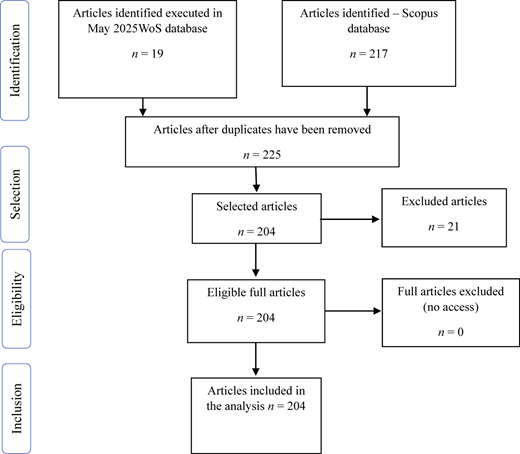
This analysis will employ two bibliometric tools. VOSviewer is utilised to create and visualise bibliometric networks in order to facilitate the identification thematic clusters (van Eck & Waltman, 2010). Additionally, consistent with methodologies suggested by Donthu et al. (2021), the Bibliometrix R package and its web interface, Biblioshiny (Aria & Cuccurullo, 2017), are applied for data processing and statistical analysis. Both tools are recognized for their robust nature and ability to generate high-quality, reproducible bibliometric outputs.
4. Results
4.1 Descriptive bibliometric analysis
Our analysis included 204 documents: 186 articles, two conference papers, and 16 books and book chapters. Table 1 presents a descriptive overview of the collected data.
Database description
| Description | Results |
|---|---|
| Main information about data | |
| Timespan | 2007:2025 |
| Sources (journals, books, etc.) | 127 |
| Documents | 204 |
| Annual growth rate % | 12.25 |
| Document average age | 3.8 |
| Average citations per doc | 27.27 |
| Document contents | |
| Keywords plus (ID) | 145 |
| Author's keywords (DE) | 767 |
| Authors | |
| Authors | 613 |
| Authors of single-authored docs | 21 |
| Authors collaboration | |
| Single-authored docs | 21 |
| Co-authors per doc | 3.34 |
| International co-authorships % | 49.51 |
| Document types | |
| Article | 186 |
| Book | 11 |
| Book chapter | 5 |
| Conference paper | 2 |
Note(s): Table 1 presents the descriptive statistics of the 204 documents collected from WoS and Scopus databases
An analysis of the annual publication output (Figure 2) reveals a growing scholarly interest in the intersection of cultural intelligence and internationalisation topics. The earliest records date back to the early 2000s, with modest activity. An increase is observed from the 2010s onwards, reflecting broader academic recognition of cultural intelligence as a critical skill for managing global complexity.
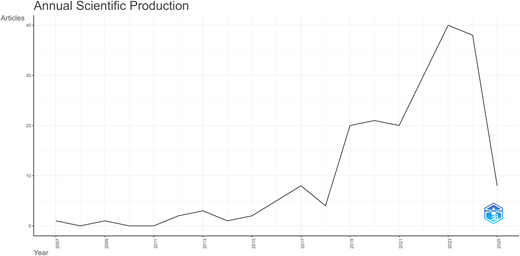
The increase in publications since 2015 suggests an accelerated consolidation of this line of research, driven by emerging concepts such as global mindset, emotional intelligence, and cross-border knowledge transfer.
The global distribution of published articles reflects an important concentration in Europe and North America, with the United Kingdom emerging as the most productive in the literature related to Cultural Intelligence and internationalisation. Table 2 summarises the top contributing countries, along with their total citation (TC) counts and average citations per article. The data indicate that while the UK leads in volume, Nordic countries such as Sweden and Finland demonstrate exceptional citation impact, suggesting highly influential scholarship despite a smaller volume of publications.
Top 10 contributing countries by total citations (TC) and citations per article
| Country | Total citations (TC) | Avg. citations per article |
|---|---|---|
| United Kingdom | 1,417 | 33.0 |
| Sweden | 627 | 104.5 |
| United States | 444 | 49.3 |
| China | 337 | 37.4 |
| Italy | 261 | 29.0 |
| Finland | 231 | 57.8 |
| Denmark | 228 | 25.3 |
| Spain | 182 | 30.3 |
| Germany | 146 | 24.3 |
| Norway | 129 | 43.0 |
Note(s): Table 2 presents the top 10 contributing countries by total citations and citations per article for the final sample of 204 documents retrieved from the WoS and Scopus databases
Increasing publication trends and international distribution reflect a field that is expanding and diversifying. The prominence of cultural intelligence, supported by cross-border clusters of emotional intelligence, leadership, innovation, and knowledge transfer, suggests a maturing domain with strong theoretical and practical relevance. The next section explores the conceptual landscape of the subject in more detail by analyzing the co-occurrence of keywords, offering a picture of thematic links and research frontiers.
4.2 Thematic analysis
4.2.1 Keyword co-occurrence analysis
To explore the intellectual structure of research regarding cultural intelligence and internationalization, a keyword co-occurrence analysis was conducted using VOSviewer. The resulting visual map (Figure 3) provides a clustered network of keywords based on their frequency and co-occurrence relationships in the literature. This analysis enabled the identification of five distinct thematic groups that together shape the cultural intelligence narrative in international business contexts.
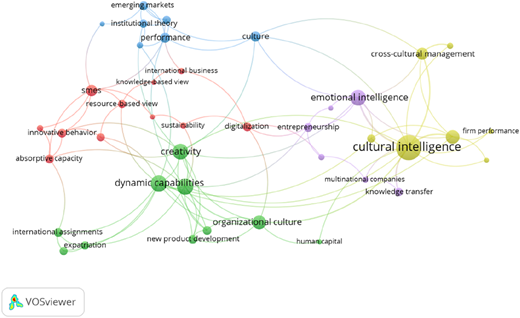
Cluster analysis. Note: Figure 3 presents the cluster analysis for the final sample of 204 documents retrieved from the WoS and Scopus databases
Cluster analysis. Note: Figure 3 presents the cluster analysis for the final sample of 204 documents retrieved from the WoS and Scopus databases
4.2.2 Cluster descriptions and thematic interconnections
4.2.2.1 Cluster 1: innovation/SMEs (red)
This cluster includes keywords such as SMEs, resource-based view (Barney, 1991), innovative behavior, and absorptive capacity. It reflects a concentration of literature addressing the innovation capabilities of SMEs and their reliance on internal competencies for international success. Studies in this cluster align with the resource-based and knowledge-based views of the firm, highlighting that SMEs' internationalization depends heavily on their capacity to absorb, integrate, and apply new knowledge (Zaefarian et al., 2023; Zahoor, Khan, Arslan, Khan, & Tarba, 2022). These findings support the relevance of dynamic internal capabilities in supporting global engagement, particularly in settings with limited external resources (Zaefarian et al., 2023).
Within Cluster 1, the keyword sustainability connects innovative behavior, absorptive capacity, and the strategic orientation of SMEs. Although not the most central term in the cluster, sustainability plays a bridging role, highlighting the increasing emphasis on responsible internationalization and innovation practices (Mammadov & Wald, 2025). In the SME context, sustainability is often associated with the long-term orientation of companies dedicated to international markets, especially as they develop dynamic capabilities to adapt to regulatory pressures, stakeholder expectations, and environmental challenges. This suggests that cultural intelligence and related competencies are not only facilitators of global expansion but also of ethically conscious and socially integrated strategies, reinforcing the alignment between competitive advantage and responsible innovation. The positioning of sustainability within this cluster suggests that future research will increasingly recognize the interdependence between cross-border adaptability and sustainable strategic behavior, particularly in knowledge-oriented companies with limited resources (Zahoor et al., 2023).
4.2.2.2 Cluster 2: dynamic capabilities/creativity (green)
Including terms such as dynamic capabilities, creativity, organizational culture, and new product development, this cluster is oriented toward organizational adaptability and innovation. The literature conceptualizes internationalization as a function of firms' ability to reconfigure resources in response to changing global environments (Boafo & Dornberger, 2024; Fiedler et al., 2017). Creativity emerges not only as a driver of innovation but also as a mediator between organizational culture and global responsiveness. This underscores the importance of non-technical competencies, such as creative thinking and cultural adaptability, in achieving international growth, particularly when firms must tailor products to culturally diverse markets.
In particular, dynamic capabilities are considered essential for managing uncertainty and the speed of change in global markets. The interaction between creativity and capability development reflects a company's potential to innovate and institutionalize flexibility in its international strategy (Floriani et al., 2023).
4.2.2.3 Cluster 3: institutional/contextual perspectives (blue)
This thematic group features institutional theory, emerging markets, performance, and culture. It represents a contextual lens on internationalization, focusing on how institutional environments shape firm behavior and strategic outcomes. Emerging market dynamics, in particular, are noted for their regulatory complexity and cultural distance, which amplify the need for cultural intelligence (Cramer, 2018; Heredia-Portillo & Armas-Arévalos, 2023). The inclusion of culture and institutional theory in this cluster suggests a theoretical link between macro-level structures and firm-level adaptation strategies, pointing to cultural intelligence as a potential safeguard against institutional uncertainty (Semenov & Randrianasolo, 2024).
This cluster highlights that successful internationalization requires alignment not only with market demands but also with institutional logics and cultural norms. Firms equipped with contextual sensitivity are better positioned to mitigate risk and leverage local legitimacy (Handoyo, Yudianto, & Fitriyah, 2021; Zahoor et al., 2022).
4.2.2.4 Cluster 4: leadership/emotional competence (purple)
Key terms here include emotional intelligence, entrepreneurship, digitalization, and transformational leadership. This cluster reflects the psychological and behavioral dimensions of internationalization. Emotional intelligence is positioned as a foundational trait for global leaders, influencing not only interpersonal effectiveness but also entrepreneurial orientation and openness to digital transformation (Mammadov & Wald, 2025; Richter et al., 2023). The convergence of emotional intelligence and leadership constructs implies that soft skills play a critical role in navigating complex, multicultural business environments, especially in SMEs, where decision-making is centralized in the owner-manager.
Emotional competence enables leaders to build trust, manage diverse teams, and adapt communication styles and skills that are increasingly critical in virtual and hybrid global work settings. In this way, leadership becomes both a relational and strategic capability in international contexts (Kossowska & Rosiński, 2023; Semenov & Randrianasolo, 2024).
4.2.2.5 Cluster 5: cultural intelligence/global competence (yellow)
At the core of the network lies cultural intelligence, closely linked with cross-cultural management, intercultural competence, multinational companies, and knowledge transfer. This is the most central cluster and represents the centerpiece of this study. It positions cultural intelligence as a key skill that enables companies to operate effectively across borders, facilitating knowledge exchange, reducing psychic distance, and improving company performance (Vlajčić, Caputo, Marzi, & Dabić, 2019; Zhang, Xiong, Zhou, Sun, & Cheng, 2023). The frequent co-occurrence with multiculturalism, global mindset, and firm performance suggests that cultural intelligence not only supports functional adaptation but also contributes to strategic outcomes, such as international market success and innovation diffusion (Egwuonwu et al., 2022; Taras, 2020).
This cluster captures the integrative potential of cultural intelligence, acting as both a cognitive resource and a behavioral enabler in navigating cultural complexity. It also affirms the centrality of global competence in achieving sustainable and scalable international growth (Boafo & Dornberger, 2024; Caputo et al., 2018).
4.3 Integrated results and implications
The combined evidence confirms that research on cultural intelligence, internationalization, and sustainability forms a growing but still fragmented field. Cultural intelligence emerges as a central construct in the keyword network (Cluster 5); however, its explicit connection with internationalization and sustainability remains uneven across clusters and publication channels.
In the context of international business and sustainability, how is cultural intelligence conceptualized?
The results show that cultural intelligence is primarily contextualized through two main lenses. First, it is treated as an individual or team-level psychological capability linked to leadership, emotional intelligence, and intercultural competence, as illustrated by the close proximity between Cluster 5 (cultural intelligence/global competence) and Cluster 4 (leadership/emotional competence). Second, cultural intelligence appears as an enabling factor in organizational learning, knowledge transfer, and global mindset, particularly in studies focusing on multinational companies and cross-border teams. However, while internationalisation-related terms (e.g. SMEs, global expansion, and international performance) are strongly represented in Clusters 1 and 2, many of these studies do not explicitly frame cultural intelligence within sustainability or ESG/SDG debates. Sustainability keywords appear mainly within the SME/innovation cluster, often without an explicit cultural intelligence construct, indicating that cultural intelligence is more frequently anchored in international business and organizational behavior discussions than in sustainability-oriented frameworks.
What role does cultural intelligence play in defining or enabling sustainable internationalization strategies?
Across the clusters, cultural intelligence appears as a transversal meta-skill rather than a standalone outcome. The centrality of Cluster 5 in the co-occurrence map indicates that cultural intelligence connects SME innovation and dynamic capabilities (Clusters 1 and 2) with institutional/contextual adaptation (Cluster 3) and leadership/emotional competencies (Cluster 4). In SMEs and emerging-market contexts, CQ is associated with opportunity recognition, relational quality, and knowledge transfer, which are preconditions for sustainable internationalization, particularly where institutional voids and stakeholder expectations are complex. However, only a limited subset of articles explicitly models cultural intelligence as a mediator between internationalization strategies and sustainability-related outcomes. In most studies, sustainability remains an implicit background condition rather than an explicitly measured performance dimension. This suggests that cultural intelligence is recognized as strategically relevant for responsible international expansion, but its enabling role for ESG alignment and SDG-related performance is more often inferred than empirically tested.
When the cluster structure is read together with the descriptive results, a pattern of compartmentalization becomes visible. Internationalization research in the sample is largely concentrated on market dynamics, entry modes, and firm performance, particularly in SME and dynamic capability studies, while sustainability-oriented work tends to rely on ESG, SDG, and social responsibility concepts that are not systematically linked to cultural intelligence. In parallel, cultural intelligence studies are predominantly located in organizational behavior, cross-cultural management, and education outlets, where internationalization and sustainability are not always central concerns. The fact that relatively few documents simultaneously include cultural intelligence, internationalization, and sustainability-related keywords supports the conclusion that the strategic role of cultural intelligence in sustainable internationalization remains under-theorised and empirically under-examined.
What are the main research gaps and emerging opportunities at the meeting point between cultural intelligence, internationalization, and sustainability?
The integrated results point to three overarching gaps that are further developed in the research agenda (Section 5). First, there is a conceptual gap, as most studies treat cultural intelligence, internationalization, and sustainability as parallel rather than integrated domains. Second, there is a methodological gap, reflected in the predominance of cross-sectional and single-level designs, which limits our understanding of how cultural intelligence capabilities develop and embed within organizations over time. Third, there is a contextual gap, as empirical work is still concentrated in large firms from developed economies, despite the clear relevance of cultural intelligence for SMEs and firms operating in institutionally complex environments. Together, these gaps delineate a promising research programme in which cultural intelligence is positioned not only as an interpersonal competence but also as a multilevel strategic capability for responsible and sustainable internationalization.
4.4 Theoretical and practical contributions
The keyword co-occurrence analysis improves theoretical understanding by confirming cultural intelligence as a pivotal theme that intersects with emotional intelligence, leadership, knowledge transfer, and strategic innovation. It reveals that internationalization research is increasingly shaped by interdisciplinary dialogues, merging insights from international business, organizational psychology, innovation studies, and sustainability science.
These findings highlight the need for firms, particularly SMEs, to invest in developing cultural intelligence and emotional intelligence capabilities among their leaders as part of broader internationalization readiness. The positioning of sustainability within the innovation and SME cluster also highlights a change in practice: cultural intelligence is becoming essential not only for navigating diverse markets but also for designing and executing strategies that are socially responsible and environmentally sustainable.
In addition to firm-level interventions, our findings have direct implications for management education and virtual international learning. Recent work on collaborative online international learning (COIL) demonstrates that structured, technology-mediated international projects can significantly strengthen students' cultural intelligence without requiring physical travel (Shinnar & Chang, 2025). Such initiatives align closely with our framework: they create repeated opportunities to activate the cognitive, motivational, and behavioral dimensions of cultural intelligence in real intercultural interactions, while simultaneously reducing the financial and environmental costs associated with traditional mobility. This suggests that universities and business schools can leverage COIL-type designs to internationalize the curriculum in a way that is both pedagogically effective and consistent with environmental, social, and governance (ESG) objectives, particularly during periods of pandemics, geopolitical tensions, or budget constraints.
5. Theoretical and practical implications
To visually synthesize the findings of this review and to guide future empirical inquiry, we propose a conceptual framework (Figure 4) that places cultural intelligence as a dynamic strategic capability that enables sustainable internationalization. The model is based on the resource-based view (Barney, 1991) and upper echelons theory (Hambrick & Mason, 1984), integrating antecedents, global mindset (Levy et al., 2007), international experience, (Fiedler et al., 2017) and emotional intelligence (Mammadov & Wald, 2025), which contribute to the development of cultural intelligence at both individual and organizational levels.
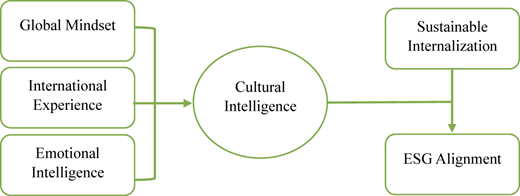
Proposed conceptual framework. Note: Figure 4 illustrates the framework with the role of Cultural Intelligence as mediating and linking a global mindset, emotional intelligence and international experience to strategic outcomes, such as sustainable internationalisation and ESG alignment
Proposed conceptual framework. Note: Figure 4 illustrates the framework with the role of Cultural Intelligence as mediating and linking a global mindset, emotional intelligence and international experience to strategic outcomes, such as sustainable internationalisation and ESG alignment
This framework directly builds on the patterns observed in bibliometric clusters and translates them into a multilevel model of strategic capability.
Cultural Intelligence is conceptualised here as a mediator and enabler that translates psychological attributes and leadership qualities into cross-cultural adaptability, ethical decision-making, and strategic alignment with sustainability goals (Ang & Van Dyne, 2008; Caputo et al., 2018). In this way, Cultural Intelligence does not operate in isolation but amplifies the impact of affective and cognitive competencies on outcomes such as:
Sustainable internationalisation, especially in SMEs (Mostafiz et al., 2019; Zahoor et al., 2023),
ESG alignment and SDG contribution (Zaefarian et al., 2023),
Intercultural knowledge transfer and innovation diffusion (Zhang et al., 2023).
This framework suggests that companies can no longer rely only on technical capabilities or market expansion tactics. Instead, the quality of human capital and its ability to navigate cultural complexity with ethical awareness are emerging as central sources of sustainable competitive advantage (Richter et al., 2023).
This model provides a theoretical roadmap for empirically testing the mediating and moderating roles of CI in international contexts. It supports the use of multi-level designs to examine how CI develops over time and how it interacts with firm-level structures, leadership styles, and institutional environments (Semenov & Randrianasolo, 2024).
In terms of practice implications, for managers, this framework reinforces the need to insert cultural intelligence development into leadership and global talent development (Taras, 2020), cross-cultural training and expatriate preparation, strategic sustainability planning and stakeholder engagement and recruitment criteria that evaluate global mindset and emotional competence. In parallel, policymakers and academic institutions can draw from this model to promote SDG-aligned ecosystems by promoting culturally intelligent leadership in educational and business support initiatives.
6. Conclusions and future research
This study explored how cultural intelligence interacts with internationalization and sustainability, two of the most pressing priorities in contemporary international business research and practice. Drawing from a systematic literature review and bibliometric analysis of 204 documents indexed in WoS and Scopus, the research identified five core thematic clusters: (1) innovation/SMEs, (2) dynamic capabilities/creativity, (3) institutional/contextual perspectives, (4) leadership/emotional competence, and (5) cultural intelligence/global competence.
Cultural Intelligence consistently emerges as a transversal and integrative capability, not merely a soft skill, but a strategic enabler that facilitates international adaptation, improves the transfer of intercultural knowledge, and aligns companies with environmental, social, and governance imperatives. The analysis also highlights how cultural intelligence interacts with related concepts, such as global mindset, emotional intelligence, and institutional sensitivity, creating a solid foundation for sustainable internationalization, particularly in volatile contexts and with limited resources.
The conceptual framework developed in this study advances the theoretical understanding of cultural intelligence by integrating it into the perspectives of dynamic and resource-based capabilities, as well as upper echelons theory. It is important to note that the framework also responds to recent calls in the international business literature to go beyond traditional market-entry models by integrating psychological and behavioral competencies into strategic decision-making processes.
From a practical standpoint, the findings underscore the need for firms, especially SMEs and MNCs operating in culturally complex environments, to incorporate cultural intelligence into leadership development, expatriation strategies, and sustainability planning. This includes implementing training programs that develop cognitive, motivational, and behavioral cultural intelligence dimensions; designing human resources policies that reward global competence; and aligning internal processes with stakeholder diversity and social impact objectives.
Furthermore, policymakers, business educators, and trade facilitators can draw on these insights to enhance cross-border capacity-building programs. Cultural intelligence training and assessment could be implemented into export readiness frameworks, international entrepreneurship incubators, or sustainability accelerator platforms. By doing so, stakeholders can cultivate a new generation of globally responsible leaders equipped to navigate cultural diversity and sustainability transitions.
However, the analysis also reveals persistent gaps in the literature that limit our current understanding. Despite growing conceptual interest, there is a shortage of longitudinal and multi-level empirical studies that examine how cultural intelligence develops over time and embeds itself in firm routines.
Moreover, there is insufficient integration of cultural intelligence into strategic sustainability frameworks, such as ESG, circular economy, or inclusive innovation models. Research in emerging markets, where institutional complexity is high and cultural adaptability is essential, remains under-represented.
This review is limited to documents indexed in the Business, Management, Economics, Econometrics, and Finance categories of WoS and Scopus. While these classifications capture the majority of CI research in international business, cross-cultural management, and organizational behavior, they may under-represent contributions published in adjacent disciplines such as communication studies, social psychology, linguistics, or education. The patterns identified here should therefore be interpreted as reflecting how CI is conceptualized and mobilized within management and international business research, rather than across the entire social sciences. Future reviews could purposefully extend the search strategy to these additional disciplinary domains.
Future research should therefore prioritize: (1) multimethod, cross-level studies that explore cultural intelligence ‘s role across individuals, teams, and organizations; (2) contextualized analyses in under-researched regions such as Africa, Southeast Asia, and Latin America; (3) empirical testing of how cultural intelligence mediates or moderates relationships between global leadership and sustainability-related performance; and (4) investigations into how cultural intelligence can contribute to systemic resilience in global crises, such as climate disruption, pandemics, and geopolitical instability.
In conclusion, this study contributes to an integrated and expanded view of CI as a strategic resource for responsible internationalization. In an increasingly interconnected, institutionally complex, and ethically conscious global economy, firms must navigate not only market challenges but also cultural differences and sustainability imperatives. As such, developing and leveraging CI is no longer an optional leadership attribute; it is a critical requirement for organizations aiming to thrive in the 21st-century global landscape.

