
Ace recirculating platen system
Ace recirculating platen system
Keywords Parts presentation, Platen systems
Tony Hollinshead, managing director of Ace Assembly Systems recalls numerous "first" conversations with his clients and confirmed, "Many clients needing an automated manufacturing process seem prepared to consider anything that works; indeed some give the impression of being almost desperate for an effective solution. When we explain our multi-layer platen system to them, it inevitably proves attractive because it is so flexible and uses our standard components which are simple to service. Also they like our flexible approach, as we are able to accommodate special design requirements."
The system is so simple,it is almost ingenious. A two-layer platen system can be constructed to any length using sections some 2 metres long. At each end would be an adapted standard "lift" unit to raise and lower the platens carrying the components (see Plate 4).
The manufacturing processes can be undertaken on either layer, dependent on convenience, client's preference, or indeed, building layout. For instance, the manufacturing processes can be undertaken on the lower level and recirculation can take place on the "upper" layer in the otherwise "dead" roofspace. In theory, there is no limit to the height of the upper "recirculation" layer. Equally, recirculation can be on the lower layer if preferred, with manufacture taking place on the upper layer.
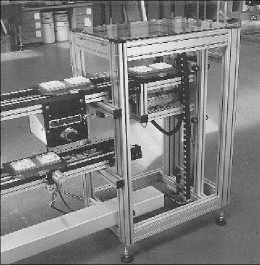
Plate 4 Ace Assembly's multi-layer platen system
Standard platen sizes are 200mm × 200mm although platens 200mm wide × 500mm long are not unusual and even 500mm or 1 metre square can be accommodated.
Assuming that manufacturing is undertaken on the upper layer, the operating principle of the system works as follows. Platens holding the workpiece(s) pass by the operator(s) of auto stations on the upper level, who undertake whatever the manufacturing demands are of the product. The specially developed self-contained"lift" system uses two moving devices, the first operates vertically and the second horizontally. When the platen arrives at the lift, a vertical pin engages a hole in the platen, which serves to "capture" it. The platen is then drawn off the moving belt system and on to the lift platform where it descends to the lower level. It then reverses its function and pushes the platen on to the lower belt system and retracts the capture pin from the platen which is then free to move along the lower belts. At the far end of the lower belt system, a second"lift" performs in a similar manner but raises the platen back to the original"upper" level (see Figure 1).
Tony Hollinshead continues, "In the past we have designed a 500mm square platen for one client but even larger platens (up to one metre square) are easily handled by the'lift' units. Moreover, we can supply platens with special tooling positions to retain components if required."
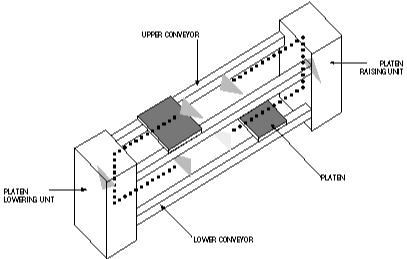
Figure 1 Line diagram of typical multi-layer system
As the horizontal belt systems move in opposite directions (as do the lift towers), it naturally follows that a cycle is produced. Whilst each platen on the new two-layer system carries the same load as the horizontal, single plane rectangular system, there are additional major benefits attached. As the new system does not require the platens to "turn" themselves through 90o corners, they can be much larger than with a horizontal rectangular system. Moreover, as it is not a"closed" rectangular configuration, operations can be undertaken from either side. Thus production operations demanding back-and-front access can now be satisfied with ease, whilst benefiting from a reduction in floorspace taken up by the machinery.
Tony Hollinshead concludes, "The new system is extremely cost-effective and in many respects is easier to modify than our conventional rectangular configuration. Best of all,the conveyor length is unlimited at either level, so a whole series of production functions can be undertaken either by operator or robot, including loading and unloading. If necessary, more than two conveyor levels can be achieved."
For further information contact managing director, Tony Hollinshead, Ace Assembly Systems Limited, Unit 24, Coleshill Industrial Estate, Station Road, Coleshill, Birmingham B46 1JP. Tel: +44 (0)1675 467003; Fax: +44 (0)1675 465989.


