

Automation end-users predict rapid growth for PC-based control
Automation end-users predict rapid growth for PC-based control
KeywordsAutomation, Industry, Personal computers
The European PC-based control systems market will be worth $129 million by 2004, following significant uptake by end-user industries, according to a new report from MarketLine International.
The report, PC-based Industrial Control Systems, incorporates a survey of more than 500 industry executives in some of the largest automation end-users in Europe, and reveals the following.
Automotive and food and beverage industries will be the key growth areas for PC-based control
Survey respondents were asked when they expected PC-based systems to be taken up by their industry, and asked to assign probabilities to a set of growth scenarios for PC-based control over the next five to six years. Each response was then weighted according to their company's annual control systems budget.
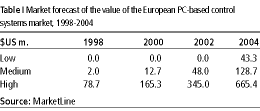
From the responses MarketLine has produced growth projections for PC-based control into the new millennium. The "medium" growth rate is the most likely rate at which the market will develop, and the report forecasts that the European market for PC-based control systems will reach $129 million by 2004 (see Figure 1 and Table I).
 Figure 1 Market forecast of the value of the European PC-based control systems market, 1998-2004
According to MarketLine,the pace of end-user uptake could potentially increase hugely towards the end of 1998 and early 1999, as companies which have already invested in PC-based control will have had their systems running for a reasonable length of time(spent on a combination of application development and actual PC-controlled process run-time). They will, therefore, be able to report to their market,giving PC-based control a positive endorsement or not.
Automotive and food and beverage industries will experience the most rapid uptake of the technology, as manufacturing techniques in these sectors are ideally suited to PC-based control.
The automotive industry,especially in the USA, has been an early, and high profile, consumer of PC-based control systems. Companies such as General Motors and Chrysler have invested in PC-based systems because they concluded that these systems offer advantages over current and more "traditional" forms of industrial control systems. General Motors had the advantage (and foresight) of already being familiar with PC-based systems, as it had previous exposure to one of Nematron's earlier releases,FloPro.
According to MarketLine,PC-based systems offer specific benefits to the automotive industry. Recently installed PC-based systems in the automotive industry are involved in a variety of automation tasks including multi-station press and robot control. Furthermore, aspects of PC-based control such as flow chart programming have been employed to create flexible solutions, which allow fast programming changes to be made when necessary on PCs which execute multiple control programmes simultaneously for the manipulation of work pieces on assembly lines.
The food and beverages industry is another area in which PC-based control has strong growth prospects. There are many enterprises which currently have little or no automation, but see investment in such technology as a way of boosting productivity, performance and profitability. Such companies now have more choice to invest in the control systems offering flexibility and performance and at an acceptable price,and so PC-based control is what many companies in this sector have been waiting for. MarketLine's survey also revealed that companies in the food and beverage sector which are already automation customers are optimistic as to the take-up rate of PC-based control systems over and above the current alternatives.
End-user opinion is highly fragmented between industry types, and even within similar industrial segments
MarketLine's survey identified several end-user "types", which displayed distinct characteristics:
those receptive to the benefits of PC-based control, and operating in an industry which has already embraced, or is likely in the near future to embrace,PC-based control technology;
those which appreciate the positive aspects of PC-based control but are realistic about the slim chances that PC-based solutions have in the short term,in their particular industry;
those adamant that PC-based control will never become a widely-utilised form of industrial control in their industry.
Interestingly, these different types also exist within the same end-user industries, highlighting a lack of conformity of opinion, and in many cases, basic knowledge about the generalities of PC-based control.
According to MarketLine,the wide divergence of opinion shows that developers need to start communicating more effectively with their potential clients, if they are to help them appreciate the finer points of PC-based control, and ultimately, sell them a system.
MarketLine consultant Martin Atherton comments: "There is little doubt that the future of industrial control lies in the hands of the PC, but the current market situation is extremely complex. Many end-users are not yet convinced that PC-based control can, or ever will, offer them the same functionality and reliability currently provided by proprietary solutions. In addition, the lack of agreement between automation manufacturers about the best methods for producing deterministic,real-time control on a PC only serves to make the situation more confusing. In the long run, it will be the end-users who decide, but their task is not made any easier by the myriad solutions, opinions and debates surrounding the issue.
"With proprietary DCS now evolving towards open, PC-based systems, however, many manufacturers believe one of the best chances PC-based control has of making a significant impact is via the 'back door'. End-users will be infinitely more receptive to PC-based control if they are simply investing in their traditional supplier's latest generation DCS which just happens to have evolved into a PC network."
For further information contact: MarketLine International, 16, Connaught Street, London W2 2AF, UK. Tel:+44 (0) 171 624 2200; Fax: +44 (0) 171 372 0130.

