The purpose of this study is to develop spent coffee grounds (SCG)-enhanced poly(lactic acid) (PLA) matrix biocomposites for improving the interfacial bonding between the enhancement and the matrix to increase their mechanical properties. The aim is to develop a sustainable material composition that can be used in the material extrusion-based additive manufacturing (MEX) method and has higher mechanical properties than neatPLA.
Surface modification of SCG with cellulose nanofiber (CNF) was applied to improve the interface between the matrix and enhancement and to increase the mechanical properties. CNF-modified SCG (mSCG) and SCG enhancement PLA biocomposites were compounded in a twin-screw extruder. SCG (PLASCG5) and mSCG (PLAmSCG5) were added into the PLA matrix at 5 wt% to be produced in the MEX method. Mechanical test specimens were produced using the MEX method with biocomposites. Tensile, charpy and impact tests were performed to determine and compare the mechanical properties; thermogravimetric analysis (TGA) and differential scanning calorimetry (DSC) analysis were performed for thermal properties and SEM images were examined.
The elongation at break (%) value of PLASCG5 and PLAmSCG5 specimens increased an average of sixfold compared to neatPLA. In Impact strength values, a 5% increase was observed in PLASCG5 specimens and a 19% increase in PLAmSCG5 specimens compared to neatPLA. SCG and mSCG reinforcements did not affect the thermal stability of PLA matrix biocomposites.
The findings obtained in this study show that the surface modification of SCGs with CNF positively contributes to their mechanical properties and that waste SCF can be used as an upcycle. The SCG enhancements and CNF interfacial modification are the unique aspects of the research.
1. Introduction
Since the late 15th century, coffee has been consumed by various civilizations and is now the second most traded commodity after crude oil (Vijayakumar, 2022; John et al., 2005). Although coffee production is localized to specific regions, its consumption is widespread (Amrouk, 2018). While there are over a hundred species of the coffee plant, only two, Coffea Arabica and Coffea Robusta, are commercially viable (Breitler et al., 2022; Cerdán et al., 2012; Dias and Benassi, 2015). Coffea Arabica, commonly known as Arabica, constitutes about 90% of the global coffee trade (Morris, 2018).
Before becoming a consumable beverage, coffee beans undergo harvesting, roasting and various brewing methods (Bastian et al., 2021). In addition to the brewing method, coffee grounds of different grain sizes are used in different regions of the world (de Figueiredo Tavares and Mourad, 2020). Among these, Turkish coffee, called Turkish Grind, is one of the varieties with the smallest grain size in the literature. In the Turkish coffee variety, which consists of extra finely ground coffee beans, there are between 1,500 and 35,000 pieces from one roasted bean (Derossi et al., 2018)Turkish coffee, known for its extra-fine grind size, stands out with particles ranging from (Özdestan, 2014; Yılmaz et al., 2017).
Post-brewing coffee grounds, known as spent coffee grounds (SCG), remain as waste. SCG can either decompose naturally or be incinerated (Blinová et al., 2017). Coffee is a product whose consumption is widespread, yet the generated SCG is often rendered valueless. Given the prevalence of coffee consumption and the waste generated, there is an opportunity to utilize SCG in biocomposite applications. In this sense, the Turkish SCG brewed in coffee grounds formed by extra grinding of coffee beans, which have the finest grain size, are much more valuable. For this reason, Turkish SCG was added to this study to enhance the biodegradable polymer matrix.
Among the thermoplastic types are those obtained from the by-products of petroleum raw materials and those obtained from several natural resources. Among these, those derived from natural sources, such as polylactic acid (PLA), synthesized from corn starch, are notable for their biodegradability (Taib et al., 2023). PLA has a significant volume consumption rate in additive manufacturing methods, the most innovative production method of polymers (Krishna et al., 2021; Anwajler et al., 2023). Among additive manufacturing methods, material extrusion-based additive manufacturing (MEX) is the most widely used production method (Savandaiah et al., 2022). There is significant market demand for materials that can be used in the MEX process (Krishna et al., 2021). New material development studies in this field are still trending. PLA, the most widely used material in these methods, is preferred for its melting temperature, easy shaping, environmentally friendly properties and low cost (Lu et al., 2014).
Various additives can improve the mechanical properties of the PLA matrix. This is possible with different fiber or particle reinforcements. For example, in their studies, Dogru et al. examined the effect of hemp (Doğru et al., 2022a) and wood (Doğru et al., 2022b) enhancement on the mechanical properties of the PLA matrix. In another study, they also investigated the mechanical properties of PLA-jute biocomposite fed in different sizes at extrusion (Havva et al., 2023). Silva et al. analyzed the mechanical and thermal properties of PLA composites enhanced with different proportions of coffee grounds (CG) (5 and 15 wt%) produced by hot press. The study confirmed an excellent interaction between CG and PLA and measured that PLA composites containing 5 wt% CG showed better impact resistance with an increase of 19%. PLA containing 15% CG also showed similar properties to pure PLA (da Silva et al., 2020). Yu et al. investigated the changes in mechanical and thermal properties of PLA matrix composites enhanced with CG (1, 3, 5 and 7 wt%) at different ratios produced by the MEX method. When more than 5 wt% CG was added, a decrease in the elasticity modulus and the flexural modulus was observed (Yu et al., 2023). Paramatti et al. similarly investigated the thermal, rheological and mechanical properties of PLA composites containing different ratios of SCG (5 and 10 wt%) enhancement produced by MEX method. With a tensile strength value of , it was found that specimens containing 5 wt% SCG exhibited higher mechanical properties compared to 10 wt% ones (Paramatti et al., 2024). Considering the experiences in the literature, 5 wt% CG enhancement was considered in this study. In addition, in the studies carried out, different enhancements to the PLA matrix slightly increased the mechanical properties, and recommendations were put forward for the value-added use of biodegradable additives. The interfacial bonding of the reinforcement with the matrix and the load transfer between them are very important and are emphasized by the researchers. On the other hand, interface improvement is also a critical issue in increasing the effect of fiber and particle reinforcements in the polymer matrix on mechanical properties (Debnath et al., 2004). Natural particle enhancement and interfacial modifications are environmentally friendly approaches to eliminate the mechanical property losses caused by recycling. There are many different applications for reinforcement/matrix interfacial enhancement in the literature (Debnath et al., 2004; Hao et al., 2018; Wang et al., 2019; Tokoro et al., 2008; Sujaritjun et al., 2013; Tian et al., 2016). Baek et al. enhanced different ratios of SCG to PLA matrix, and the mechanical strength decreased with increased natural filler content. However, they observed that mechanical and thermal properties increased by the addition of 4,4-methylene diphenyl diisocyanate as a coupling agent (Baek et al., 2013). Wu investigated the morphology, mechanical properties and biodegradability of composite materials containing PLA and SCG. The researcher also used treated spent coffee grounds (TSCG) with crosslinking solutions to improve the desired properties of the composites. It was reported that TSCG-enhanced composites exhibited better mechanical properties compared to SCG-enhanced composites (Wu, 2015).
Cellulose, the most abundant biomass material, is used in various industries (such as film, building materials, pharmaceuticals and food packaging) due to its hydrophilicity, biodegradability and chemical modification capabilities (Klemm et al., 2018). Biodegradable cellulose can be obtained from corn, paddy crops, natural vegetation, algae and bacteria (Seydibeyoğlu et al., 2023; Carolin C et al., 2023).
Nanocellulose is an excellent alternative as a nanofiller to enhance the mechanical properties of PLA without compromising its biodegradability and biocompatibility (Kamal and Khoshkava, 2015). Jonoobi et al. found that 5 wt% cellulose nanofibers (CNF) enhancement increased the tensile modulus and strength of the PLA matrix from and from , respectively (Jonoobi et al., 2010). The use of nanocellulose for interfacial modification in the processing of inorganic or organic particle fillers is also an innovative method. This study was carried out to contribute to the literature on surface modification for the positive effect of natural enhancement on mechanical properties.
In this study, the compounds obtained by adding SCG to the PLA matrix were converted into filaments suitable for the MEX device. The surface modification of the SCG with CNF was carried out to reduce mechanical property losses. Tensile, impact and flexural strength values were examined, thermogravimetric analysis (TGA) and differential scanning calorimetry (DSC) analyses were performed and the interface effect was visualized with scanning electron microscopy (SEM).
2. Experimental
2.1 Materials
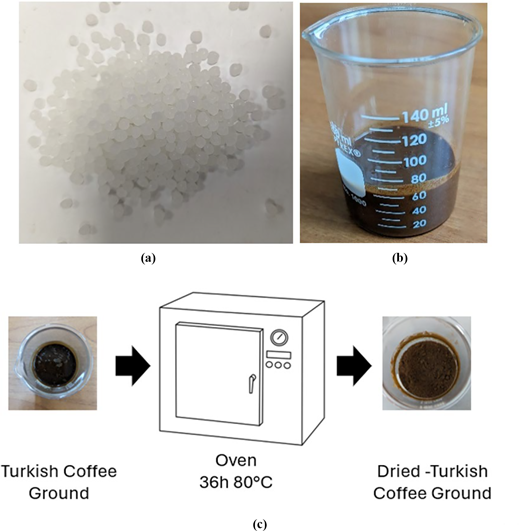
Biopolymer 4043D PLA product of Natureworks company, shown in Figure 1(a), was used as the matrix material in the study. The density of the PLA used is , the melting temperature () is 145–160°C, the glass transition temperature () is 55–60°C and the melt flow rate is (U.S. Food and Drug, 2025).
All SCG that is fine ground size used for enhancement purposes are Turkish coffee of the Kurukahveci Mehmet Efendi brand. This product was used because it has a long history in the Turkish coffee market and has a large market volume (Yaz and Şen, 2020). Unsweetened SCG was collected for this study. A section of the collected SCG is shown in Figure 1(b). CNF from Aidanano’s FORNAX T15M product was used in the modifications applied to the SCG surface to increase fracture toughness. CNF with hydrophilic surface properties has a solid content of 0.95 wt% in aqueous solution. Density is , fiber diameters are 5–10 nm and specific surface area is approximately (Fornax: Nanofibras 5/10 nm | AIDANANO, 2025).
2.2 Modification of spent coffee ground
First, the drying process of SCG taken as waste was carried out in a Nükleon brand NKD250 oven for 36 h and at 80°C. Images of the drying process are shown in Figure 1(c).
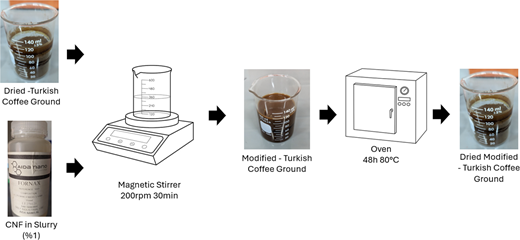
CNF in slurry form with a 1% concentration was used for surface modification of the SCG. A magnetic stirrer mixed 300 g of CNF in the slurry with 300 g of dried SCG. SCG was stirred in CNF slurry on a WF-MIA1 stirring hot plate (WEIGHTLAB, Turkey) at for 30 min at room temperature. After SCG was mixed with CNF in slurry form, it was dried again in an NKD250 (Nükleon, Turkey) oven for 48 h at 80°C. The entire process of surface modification is shown in Figure 2.
2.3 Compounding
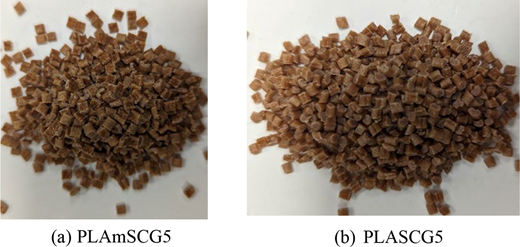
Two different compounds were produced by compounding modified SCG (mSCG) and unmodified SCG with 5 wt% PLA matrix. Figure 3(a) shows PLA compounds with 5 wt% mSCG enhancement, and Figure 3(b) shows with 5 wt% SCG enhancement. PLA matrix biocomposite compounds were produced in Labtech Engineering (Thailand) brand twin screw extruder. Bio-composite compounds with two different PLA matrices containing 5 wt% SCG were extruded at 180°C and screw speed. Water cooling was used in all processes.
2.4 Filament production
The prepared compounds were formed into filaments with a diameter of in a single screw extruder for use in the MEX method. The compounds were formed by winding on spools in The Arya brand (Turkey) laboratory-scale single-screw extruder at 200°C zone temperature and screw speed in an air-cooled system. The produced filaments were placed in a vacuum bag to protect against moisture.
2.5 Specimens production
The mechanical properties of PLASCG5 enhanced with 5% by weight SCG and PLAmSCG5 enhanced with 5% by weight mSCG were tested. neatPLA was also used as a control specimen for comparison. Specimens’ production was carried out with MEX, one of the innovative polymer production methods. The S3 (Ultimaker, Netherlands) model MEX device was used in all specimen production. All specimens were produced with printcore with nozzle diameter. The parameters of the productions using neatPLA, PLAmSCG5 and PLASCG5 filaments are shown in Table 1. All specimens were produced at room temperature in an air-conditioned room, and temperature and humidity changes during production were recorded with a Fisher Scientific brand 15-077-8D model Traceable Digital Thermometer.
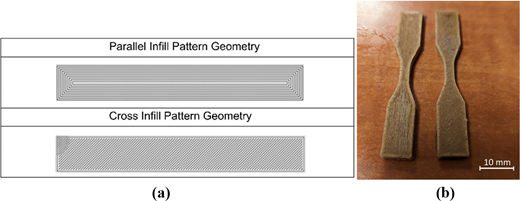
To study the effect of CNF surface modification on biocomposites’ mechanical properties, tensile, charpy and flexural test specimens were produced in two different infill patterns, as shown in Figure 4(a).
Tensile test specimens were produced from each material group in ASTM D638 type 5 geometry, as shown in Figure 4(b). Impact test specimens were produced separately from each material group in geometry in accordance with ASTM D6110 standard, parallel and cross-infill patterns. In addition, specimens were produced from each material group using two different infill patterns to determine flexural properties in accordance with the ASTM D790 standard. To calculate the standard deviation values, five specimens were produced from each material group for each test.
2.6 Mechanical testing
2.6.1 Tensile testing
The ASTM D-638 standard was used to compare the tensile properties of the specimens produced by the MEX method. The specimens that have type 5 geometry were tested. Tensile tests were performed with a Z050 (ZwickRoell, Germany). The tests were performed at a constant displacement rate of until the specimens failed. Load, displacement, time and strain were recorded at 10 Hz. The effect of infill pattern, CNF modification of SCG and SCG enhancement on the tensile properties of the specimens was also investigated.
2.6.2 Impact test
Charpy tests were performed on a CEAST Resil Impactor (Instron, USA) in accordance with ASTM D6110. Notch specimens with thickness, length and width were tested. All specimens were impacted with an impact velocity of and a kinetic energy of 13.5 J, as they were expected to break with an energy loss of no more than 85% of their capacity. The dynamic properties of all specimens in terms of absorbed energy were measured. The area under the impact force-displacement curve from the peak of the impact load to the first specimen of zero load following the maximum peak was used to calculate the absorbed impact energy at fracture.
2.6.3 Bending test
A three-point bending test was applied to apply load to a simply supported beam. Bending tests were performed in accordance with ASTM D790 using a Z050 (ZwickRoell, Germany) at a speed of . The specimens are thick, long and wide. The test continued until the peak values of the force.
2.7 Characterization
2.7.1 Thermogravimetric analysis
TGA of the bio-composite specimens was performed using TGA Q50 (TA Instruments, USA) to measure their thermal stability (i.e. decomposition temperatures). specimens’ parts were analyzed under the nitrogen () atmosphere at a heating rate of and a temperature range of 25–500°C.
2.7.2 Differential scanning calorimetry
DSC analysis was performed on a DSC Q200 (TA Instrument, USA) between 30 and 250°C at and flow rate under gas. and of neatPLA, PLAmSCG5 and PLASCG5 specimens produced with MEX were measured.
2.7.3 Scanning electron microscopy
The fracture surfaces of the tensile test-damaged specimens were examined by scanning electron microscopy (SEM). A Sigma500 (Zeiss, Germany) FESEM device was used for microstructure analysis at . Before examination, the specimens were fixed on the stubs with double-sided carbon tape and spray-coated with thick gold.
3. Results and discussion
3.1 Mechanical properties
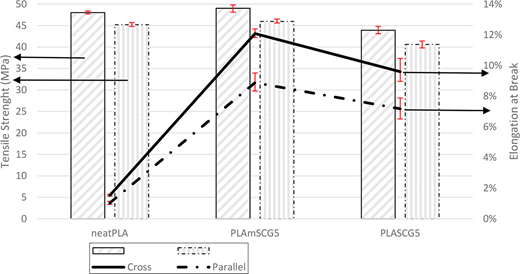
As shown in Figure 5, the tensile strength of neatPLA produced with parallel infill pattern is , whereas the enhancement of SCG to the PLA matrix decreased the tensile strength value (), but surface modification with CNF (mSCG) () increased the strength of the biocomposites. Yu et al. found that there was no significant difference in the tensile strength values of PLA biocomposites containing less than 3% CG supplementation compared to neatPLA in MEX-produced specimens. Yu et al. found that the addition of more than 5% coffee grounds also decreased the strength values (Yu et al., 2023). In the cross-infill pattern, the tensile strength value decreased from for neat PLA to for PLASCG5. In their study, Paramatti et al. measured a 4.46% decrease in the tensile strength value of 5 wt% CG enhanced PLA composites compared to neatPLA (Paramatti et al., 2024). However, a dramatic decrease was not observed in SCG-enhanced PLA biocomposites with small grain size and large surface area, as in the study of Paramatti et al.
The MEX methods basically extrude the melted polymer from the nozzle in layers, while the round cross-section of the nozzle causes the formation of gaps between the patterns. This is improved by cross-infill patterning and affects the mechanical properties (Bakır et al., 2021). Nozzle designs with different geometries have also been tested in the past, but considering the mobility of the nozzle in the production of various geometries, round-section nozzle designs are still the most widely used type (Papon et al., 2021; Hıra et al., 2022). When the effect of the infill pattern on tensile strength for neatPLA was examined, it was measured that the cross-infill pattern showed higher strength properties, similar to the studies in the literature (Chadha et al., 2019; Travieso-Rodriguez et al., 2021; Mishra et al., 2021). This was similarly measured for PLAmSCG5 and PLASCG5 specimens. In PLAmSCG5 biocomposites, the value measured as a maximum of in cross infill pattern was measured as a maximum of in parallel infill pattern. In PLASCG5 specimens without interfacial modification, the value measured as a maximum of in cross infill pattern was measured as a maximum of in parallel infill pattern.
The highest tensile strength value measured among all specimens is for PLAmSCG5 biocomposites with cross-infill patterns. The average tensile strength value of measured for neatPLA increased by 2.04% in the PLAmSCG5 specimen. It can be said that CNF applied to the surface of SCG increases PLA interfacial compatibility and, therefore, exhibits a positive effect.
In the comparison of elongation ratios, higher values were measured in cross-infill pattern specimens. Similarly, Kiendl et al. and Santo et al. observed that pure PLA has more elongation in cross-infill pattern (Kiendl and Gao, 2020; Santo et al., 2021). The 45° orientations of the cross-infill pattern are indicated to rotate in the direction of the force when the load is applied (Santo et al., 2021). This allowed the specimens produced with cross infill to take more load and elongate more before damage. This elongation contributed to a larger plastic zone. Similarly, larger elongation values were measured in the SCG, and mSCG-enhanced biocomposite specimens produced with cross-infill. The elongation difference between the cross and parallel infill pattern was more significant in the biocomposite specimens than in neatPLA. A slightly larger elongation was observed in the specimens produced with granule-based MEX compared to the filament-fed ones due to the effect of the thermal process applied for filament production (Liu et al., 2023). Similarly, the results obtained in this study may be the effect of the thermal process carried out for this particle enhancement process. The homogeneous distribution of the added nanoparticles improves the mechanical properties of nano-doped composites. The increase in tensile values with nanoparticle addition brought about elongation. SCG and mSCG enhancement increased the elongation at the break by promoting the fluidity of the polymer chain. In addition, CNF modification applied to SCG contributed to the plastic region as it created a better interface with the matrix, and the tensile strength value increased with the elongation amount.
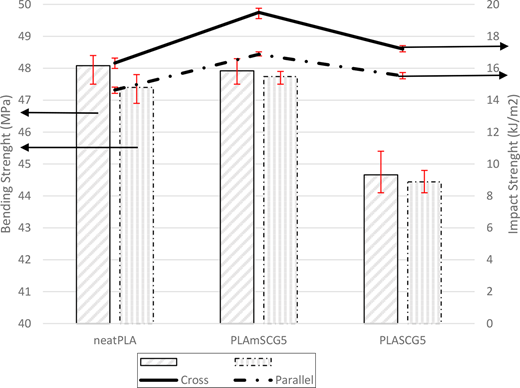
The flexural and impact strength values of the specimens are shown in Figure 6. It can be said that the infill pattern has no effect on flexural strength due to the intersection of standard deviations within the specimen groups. In all specimen groups, the specimens produced with cross-infill patterns had a low positive effect on the average value. In the specimens produced with the cross-infill pattern, 5 wt% SCG addition decreased the flexural strength value by 7.66% compared to neatPLA. The decrease in flexural strength may be a result of the agglomeration of the 5 wt% SCG enhancement, leading to phase separation and poor bonding of the interface (Mat Desa et al., 2014; Vidakis et al., 2021). The flexural strength value after CNF surface modification was applied to SCG, which was similar to neatPLA. The penetration of CNF between PLA chains may have affected the intermolecular forces and strengthened the polymer chains. This indicated an interaction between the PLA matrix and the mSCG. These results indicate that well-dispersed SCG and modification of the SCG positively affect interfacial bonding.
Impact strength is considered an essential index for evaluating the impact resistance of a material and can be used to determine the degree of brittleness and toughness (Chadha et al., 2019). When the impact strength values of the produced specimens were examined, it was measured that the specimens produced with cross infill pattern had higher impact strength in all specimen groups. Mishra et al. investigated the effect of 12 different infill patterns on the mechanical properties of neatPLA. Their study measured a higher impact strength value in cross-infill pattern specimens with a 100% infill ratio, like this study (Mishra et al., 2021). Silva et al. observed a 19% increase in the impact strength of 5 wt% CG-enhanced PLA composites produced by the MEX method compared to neatPLAs (da Silva et al., 2020). Similar to the results obtained in the study of Silva et al., a 16% increase was observed in PLAmSCG5 specimens produced with a cross-infill pattern compared to neatPLA specimens. PLASCG5 specimens also showed an increase of 6% (parallel) and 5% (cross) compared to neatPLA. As a result of the impact resistance in different infill patterns, when the surface images of the crack propagation in terms of the impact absorption ability of the specimen were examined, it was observed that the specimens produced with cross infill pattern had a rougher surface, while the specimens produced with parallel infill pattern had a flat fracture surface.
The CNF surface modification applied to SCG was measured to be favorable for strengthening the interfacial strength, which was beneficial in terms of impact strengths. In the case of PLASCG5 specimens, the weak stress transfer between the cross phases may have resulted in low mechanical properties. In addition, the direction of specimen formation in different planes changes the amount of extruded compounds aligned with the loading, which significantly affects the impact strength (Mishra et al., 2021; Ali et al., 2023). Similarly, the specimens produced in the cross-infill pattern exhibited high impact strength.
3.2 Thermal properties
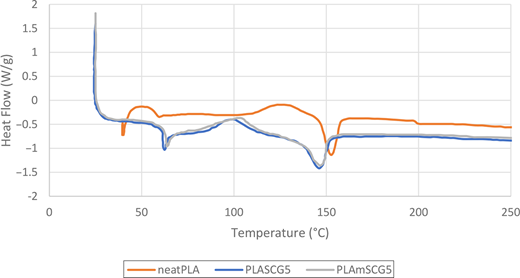
The addition of SCG affected the thermal performance of PLA, as seen in DSC curves are shown in Figure 7. The value of neatPLA specimens produced with the MEX was measured as 59.51°C with DSC analysis. In their study, Butto et al. measured the value of the filament of the same PLA product as 57.5°C (Butto et al., 2023), and Cruz Faria et al. measured the value of the granulated PLA of the same product, which was stated as 55–60°C in the catalog value, as 55°C (da Cruz Faria et al., 2021). Each thermal process resulted in a slight increase in the . The slight rise in may be due to increased crosslinking and decreased polymer mobility after the thermal processes (Tsuji et al., 2000).
As a result of SCG addition to neatPLA, values were measured as 62.5°C in PLASCG5 specimens and 63.43°C in PLAmSCG5 specimens with surface modification. Although surface modification with CNF resulted in a few increases in value when the biocomposite specimens were compared, there was a 6.59% increase in Tg values compared to neatPLA. A decrease in free volume leads to an increase in (Oksiuta et al., 2020; Wootthikanokkhan et al., 2013). The addition of bulky inelastic SCG enhancements could cause a decrease in the mobility of the polymers in the compound, and can be increased slightly.
As seen in Figure 7, CNF surface modification had an insignificant effect on . The value of 146.08°C for PLASCG5 specimens was measured as 146.82°C for PLAmSCG5. In addition, compared to the value of 152.61°C in the neatPLA specimen, SCG enhancement resulted in a 3.79% decrease in the value. The fact that the polymer chains are actively moving means that less energy is required for melting (Yu et al., 2023). Since the SCG enhancements dispersed in the PLA matrix were minor, the gap between the molecular chains of PLA did not increase much, and the intermolecular forces remained the same. Therefore, did not change significantly. It can also be said that the dispersion in the PLA matrix of a small amount of SCG enhancement is good. It can also be noted that due to the decrease in value, SCG enhancement caused some restrictions in the movement of PLA molecular chains.
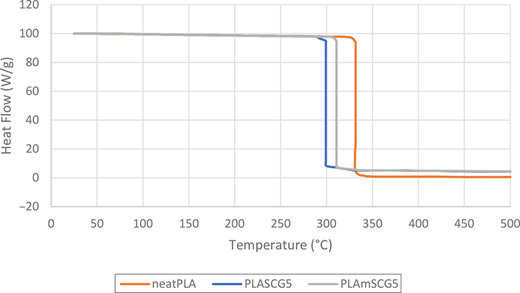
The effects of SCG enhancement on the polymer matrix’s thermal stability were investigated through TGA. The effect of SCG and mSCG enhancement on the thermal degradation of PLA and residual wt (%) values in biocomposites was investigated. TGA analysis graphs are presented in Figure 8. NeatPLA lost a weight of approximately 4% at 330°C. This low amount of residue may be due to the structure of PLA which is prone to vaporization when exposed to higher temperatures (Sachin et al., 2020). After 5% SCG by weight was added to the PLA matrix, the thermal stability decreased, as evidenced by the degradation starting temperatures. The Degradation Temperature starting point was 332.46C for the neatPLA, 310.82C for the PLATmCG5 and 299.63C for the PLASCG5 specimens. PLASCG5 and PLAmSCG5 specimens showed a decrease of 9.85% and 6.5%, respectively. This is because TSCG reinforcement reduces the thermal decomposition temperature due to weakening the intermolecular forces of PLA and aggravating the thermal movement of PLA molecular chains (de Bomfim et al., 2023). The reason for the lower decrease in the thermal decomposition temperature in the sample containing modified TSCG reinforcement is that the strengthening of the interfacial bonds between the polymer matrix and the reinforcement leads to an increase in the thermal decomposition temperature (Baek et al., 2013).
Degradation temperature onset temperatures were measured at a higher temperature than the processing temperatures at the compounding, filament extrusion and MEX production stages. However, the decreasing degradation temperature onset temperatures with the addition of SCG may lead to a gradual decrease in the degradation temperature with the addition of higher enhancement (Pascual-González et al., 2022). Biocomposite specimens containing 5 wt% SCG enhancement measured residual wt (%) at the expected rates. This showed that the prepared compounds contained the right amount of enhancement. In addition, residual wt (5%) values show that the dehumidification processes performed before the compounding process were also effective.
3.3 Scanning electron microscopy
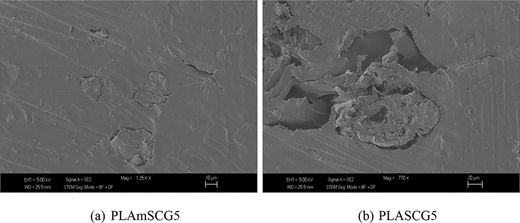
Figure 9(a) shows that surface modification with CNF positively affects the bonding of SCG with the matrix. The bonding observed on the fracture surfaces after the tensile test and the tensile test results confirm this. It is seen that the matrix material is adhered to the particles on the fracture surfaces.
The specimens without surface modification show capillary cracks and voids/gaps around the particle in Figure 9(b). These images also confirm the test results.
When cross-infill pattern and parallel-infill pattern specimens were analyzed, parallel-infill pattern specimens had more void structures on the fracture surfaces. This shows that the joints between the layers are weak, and the bonding of the polymer chains extracted from the nozzle is weak.
4. Conclusions
SCG with fine ground dimensions was used as an enhancement and compounded with PLA matrix. SCG enhancements were modified with CNF to improve the reinforcement interfacial bonding with the PLA matrix. The obtained compounds were produced in filament form using the MEX production method. Thermal and mechanical performances of the biocomposites were characterized by tensile, flexural and impact testing, DSC, TGA and SEM analyzing. SCG reinforcement to the PLA matrix did not cause a significant decrease in tensile strength and impact values, while flexural strength decreased. SCG reinforcement significantly improved the elongation at the break of PLA. CNF modification applied to SCG enhancement also improved the mechanical properties due to the chemical bonding at the interface. SCG enhancement slightly increased the value of PLA and decreased the value. A decrease in the thermal degradation temperature of PLA was also observed with the addition of SCG. The results of this study provide an opportunity for the use of SCG in MEX application to expand the use of sustainable materials in production, the use of PLA matrix composites with improved mechanical properties in prototyping and final product production and the application of recycling in the rapidly expanding MEX production. The use of sustainable resources in the polymer industry and upcycle applications is a highly efficient way to reduce carbon footprint. The use of sustainable resources in the polymer industry and upcycle applications is a highly efficient way to reduce carbon footprint. The findings show that it would be beneficial to use natural particles and interfacial modifications with environmentally friendly approaches to eliminate the mechanical property losses caused by recycling. By transforming waste coffee grounds into useful products instead of throwing them away, adding these low-cost fillers to polymers will reduce costs and contribute to the circular economy. The use of SCG and surface modification with CNF can reduce the carbon footprint. The use of renewable resources provides advantages in sustainable materials. The modification of SCG with CNF offers an opportunity to realize thermal stability and mechanical performance applications. It also provides environmentally friendly solutions for many applications.
Special thanks to Kurukahveci Mehmet Efendi Company for providing the opportunity for this article to reach a wider audience and for their interest in the application of 3D printing for sustainability.