Although many demolished buildings contain concrete elements in good condition, these are rarely reused due to the perceived high costs of deconstruction. Design for Disassembly (DfD) has been proposed as a design approach to enable the cost-effective reuse of building components. This article investigates the impact of DfD practices on the end-of-life operational costs of a prefabricated building with a concrete inner frame and wooden envelope and compares them with current built-as-usual (BAU) design practices.
A computational analysis was conducted to compare the costs of deconstruction with the traditional crushing demolition. Moreover, the resale value ratio relative to the initial cost required to make disassembly economically feasible was examined.
The results demonstrate that current building design practices do not support the efficient and economically feasible reuse of building components. Under both the BAU and DfD design practices, the costs incurred by deconstruction were significantly higher than those of demolition by crushing. Even with the ideal DfD solution, a 50% resale value ratio for reusable concrete components was insufficient to fully offset the additional costs associated with deconstruction. The results indicate that improvements in disassembly practices, a significant increase in crushing costs, or changes in the market environment would be required to make DfD economically feasible.
This study provides a novel assessment of a concrete building using a detailed cost framework that captures key cost components and the economic implications of DfD. It offers new insights into the cost competitiveness of deconstruction compared with demolition and the valuation of reusable components.
1. Introduction
It is common for buildings to be demolished while the concrete structures are still in good condition. From a design perspective, the design life of load-bearing concrete structures is considered to be 100 years (Sarja, 2013). However, in practice, this is rarely achieved. For example, in Finland, the average demolition age for residential buildings is 58 years, and for nonresidential buildings about 43 years (Huuhka and Lahdensivu, 2016). In Denmark, buildings have longer lifespans; however, recent stock studies indicate a shift toward shorter service lives (Andersen and Negendahl, 2023). Although demolition may be a justified decision in cases when the building cannot reach the modern standards for energy efficiency or seismic resistance (Dragonetti et al., 2025; Marquis et al., 2017; Takagi and Wada, 2019), in practice, the most common reasons for demolition are high repair costs relative to the value of the building, planned new construction in the area or the fact that the buildings no longer serve their original purpose (Durmisevic and Yeang, 2009; Huuhka and Lahdensivu, 2016).
It has been shown that concrete structures, particularly those situated within the building envelope, have exceptionally long service lives and could be highly reusable, despite their age (Lahdensivu et al., 2015). The practice of reuse is encouraged by legislative measures pertaining to waste management, which prioritize the preparation of materials for reuse above recycling and other forms of recovery, as outlined in the waste hierarchy (Directive, 2008//98/EC, 2008). To address climate change and environmental concerns, it is proposed that building components should be reusable in the future (ISO, 20887, 2020). Current challenges associated with the disassembly and recovery of buildings lead to an unnecessary waste of resources, as all building components are discarded or recycled only at the material level at the end of the building's life cycle.
Recovering building elements in good condition from demolished buildings for cost-effective reuse is challenging because current building design does not take into account the possibility of deconstruction and component reuse (Lahdensivu et al., 2015). In the case of concrete frame structures, the use of steel-reinforced cast-in-place concrete connection methods binds the structures together, requiring laborious and expensive methods such as diamond sawing and jackhammering for disassembly (Harsunen, 2024; Hradil et al., 2014). The heavily integrated structures make it difficult to replace individual components during repairs and prevent the collection of building components for reuse during the demolition phase (Durmisevic and Yeang, 2009). This suggests that current buildings are primarily designed for efficient assembly rather than disassembly.
1.1 Literature review and research gap
Design for Disassembly (DfD), also known as Design for Deconstruction, has been proposed as a strategy to support the transition toward a circular economy in the construction industry by facilitating disassembly (Besiktepe and Gurgun, 2025; Joensuu et al., 2022; Ostapska et al., 2024; Salama, 2017; Swarnakar et al., 2025). This innovative design approach seeks to enable the reuse of building elements across different construction projects (Eckelman et al., 2018). Research has demonstrated that DfD can generate notable environmental, social and economic benefits (Akbarnezhad et al., 2014).
The European Commission proposes a set of indicators for the assessment of the sustainability of residential buildings through Level(s) (Dodd et al., 2021). The Level 2 provides an introduction to the setting of design targets and the comparison of design options for their deconstruction potential, with the consideration of ease of recovery, reuse and recycling (Dodd et al., 2021). Safe disassembly requires that when elements are being lifted from the building, it can be assured that the load is completely disconnected from the surrounding structure (Cruz-Rios and Grau, 2020). Therefore, the use of mechanical and demountable connection methods has been identified as the most commonly discussed boundary condition in previous research on DfD strategies (Ostapska et al., 2024). The Peikko Group has carried out research projects on demountability and reuse at the connection method level (Yrjölä, 2022). Danish industrial collaboration engendered the demonstration of the DfD concept for residential buildings with concrete load-bearing structures and timber frame envelopes (GXN, 2018). The results indicate that the concept is gaining industrial and academic interest with an emphasis on design strategies.
Current design solutions make disassembly more cost-intensive, and therefore, the traditional crushing demolition method is chosen instead of deconstruction and reuse at end-of-life (Harsunen et al., 2025). The reuse of components may require additional testing, evaluation and repair, resulting in additional costs (Akbarnezhad et al., 2014). In addition, the impact of DfD on the future costs associated with dismantling buildings intact remains difficult to estimate (Harsunen et al., 2025). Despite the financial challenges posed by DfD (Cruz-Rios and Grau, 2020), the potential benefits arising from the resale of salvaged components (Rios et al., 2015) and the avoidance of landfill costs (Akbarnezhad et al., 2014; Rios et al., 2015) may ultimately offset the initial higher costs of disassembly. More broadly, the reuse and resale of durable construction components are considered a cornerstone of circular economy principles in construction, as they preserve embedded value and reduce reliance on virgin materials (Otasowie et al., 2025).
Although several studies discuss the economic implications of DfD implementation, there is only limited documented research on the utilization of design solutions to provide a foundation for calculations. Vares et al. (2020) have made calculations of deconstruction to estimate the costs and environmental impacts of reusing a DfD steel-framed industrial structure. Akbarnezhad et al. (2014) conducted an economic and environmental assessment of deconstruction strategy using building information modeling for a DfD building. Naber (2012) has compared the costs of the disassembly and reuse of hollow core slabs in a 16-story office building to the costs of using new slabs. Furthermore, Harsunen et al. (2025) conducted a comparative analysis of the calculated costs of deconstruction and demolition between a two-story DfD building and a conventionally constructed daycare building.
As concrete is one of the most widely used construction materials and a significant source of greenhouse gas emissions (Scrivener et al., 2018), extending the lifespan of concrete components is a critical sustainability priority (Bandeira Barros et al., 2023; Otasowie et al., 2025). Despite this, there is a notable lack of research on the cost implications of deconstructing concrete buildings, particularly when accounting for the influence of design solutions and connection methods on labor costs (Harsunen et al., 2025). To date, only a small number of studies have compared deconstruction costs with demolition costs or studied the valuation of reusable components as cost-offsetting factors (Akanbi et al., 2018). Furthermore, while the ISO 20887 standard (ISO, 20887, 2020) emphasizes the importance of designing for disassembly to enable future reuse, little is known about the economic consequences of implementing such design strategies (Montalbano et al., 2025).
This study fills these gaps by conducting a computational case study that compares the deconstruction costs of a conventional residential building with those of a building designed using DfD principles. The analysis quantifies potential cost savings from component reuse and determines the resale value of salvaged elements required – relative to the material costs of new components – for deconstruction to be financially advantageous over traditional crushing demolition.
2. Methods
This study assesses the economic feasibility of disassembly at the end of a building's life cycle. The methodology focused on a comparative economic analysis between two end-of-life strategies: deconstruction and conventional demolition by crushing. The analysis did not consider initial construction costs; rather, it concentrated on determining whether disassembly would be a more cost-effective approach than demolition by crushing. This was based on the premise that the costs would be offset by the sale of recovered components. A set of design scenarios was evaluated in order to assess the disassembly outcomes, particularly the required amount of work and the profitability: it was anticipated that the value of recovered materials would not fully offset the costs of disassembly.
This study concentrated on the utilization of a DfD strategy and reusable building components with a particular emphasis on the concrete elements of the frame. The focus was directed toward components that are technically most suitable for reuse, as some elements, such as foundations are typically difficult to recover (Harsunen et al., 2025). The calculation of disassembly costs was carried out for BAU (Built as usual) and DfD design solutions for apartment buildings with identical functional characteristics. The BAU building represents a custom design solution for a residential building constructed from prefabricated concrete components using traditional joining methods.
2.1 Design solutions studied
The economic feasibility of the end-of-life operation was assessed for an apartment building with different design solutions as follows:
BAU: represents traditional practice in terms of design and construction. Traditional practice does not incorporate the principles of demountability and reusability in any way. The design solution is divided into two end-of-life scenarios, disassembly and conventional crushing demolition described as
BAU-R: (Reuse) In this scenario, the act of disassembly represents an attempt to reuse components, despite the fact that the building was not designed with disassembly in mind. This scenario was evaluated to determine the probable consequences of maintaining the current construction methodology while the reuse of building components might be necessary in the future for climate-related considerations.
BAU-D: (Demolition) A reference cost that reflects current crushing demolition practice where all building components are recycled or disposed of at the material level only. In this case, costs only are incurred and no revenue is generated. The other implementations are compared to this cost.
DfD-W: (Wet joint) represents a construction method whereby the building is designed with a frame and auxiliary structures that effectively support disassembly and reuse. However, the existing connecting methods between concrete elements are limited and require the use of force-transferring grouting concrete for building stabilization, which requires destructive separation, thereby increasing the time and labor required for disassembly and reuse (Cai et al., 2019; Figueira et al., 2021).
DfD-I: (Ideal) also represents a construction method whereby the building is designed with a frame and auxiliary structures that effectively support disassembly and reuse. In addition, the connections between concrete components are designed for straightforward attachment and detachment through the utilization of mechanical connectors. Such demountable connection systems have been investigated and experimentally tested in recent studies (e.g. Cai et al., 2019; Yrjölä, 2022), which demonstrate the structural feasibility of dry joints in precast concrete structures and their potential to enable nondestructive disassembly and reuse. Furthermore, this design obviates the necessity for force-transferring grouting (Cai et al., 2019; Figueira et al., 2021). In the case of theoretical ideal connections, the objective was to ascertain the cost of disassembly of a case in which the optimal types of joints for disassembly and reuse of the elements have been developed.
2.2 Cost estimation and data
The costs associated with the deconstruction entailed calculation of the labor inputs necessary for the disassembly of reusable concrete elements and demolition of other structures at the case site. An estimation of the site costs and procurement was conducted based on the labor inputs, site duration and requirements. The costs were disaggregated into the Following categories:
Labor costs,
Equipment procurement,
Management,
Site tasks,
Planning,
Waste fees,
Contractors' margins,
and Verification of the condition of the elements.
Contractors, typically, determine the crushing demolition price per concrete cubic meter (Harsunen et al., 2025). To simulate a real-life situation, the implementations of the demolition and disassembly cost estimate were similar to the methods typically utilized by contractors in their own cost estimates.
The number of reused components is diminished by stress tests that are mandatory for certain elements prior to their acceptance for reuse. The cost of testing was calculated with the following elements in mind: firstly, drill-testing for compressive strength for a fifth of the elements to be reused; secondly, proof load tests up to fracture for two elements that will not be reused. This testing approach is aligned with the procedures outlined in the Norwegian standard NS 3682:2022 Hollow core slabs for reuse (“NS 3682:2022,” 2022), which defines verification methods for assessing the structural suitability of reclaimed precast concrete elements. Furthermore, as the essential performance characteristics presented in the harmonized product standards for wall, column and beam elements are largely comparable to those defined for hollow-core slabs, the principles of NS 3682:2022 (2022) can be considered applicable for demonstrating the structural suitability of these elements as well.
Based on the labor inputs, a schedule analysis was prepared for the disassembly activities, considering relationships between operations and the potential for time optimization by overlapping contributions. The refined schedule was used to assess site management, services and equipment requirements. Given the relatively limited availability of data on deconstruction, the quality of the data used in the calculation was of particular importance, in terms of both labor input and cost data. The costs for deconstruction tasks were calculated by multiplying the labor input data by the unit price for each stage of the work. Hourly labor rates, including social costs and area-specific allowances, were collected using the Ratu construction cost calculation software (Ratu Kustannustieto, 2024). Labor input data was collected from the guide cards (“RATU KI-6035 Rakennustöiden menekit”, 2019; Ratu KI-6036, 2023) and the Ratu cost calculation software (Ratu Kustannustieto, 2024). The Ratu software data is derived from meticulously researched sales data and a comprehensive structure library, which is subject to annual revisions to incorporate material and product prices. Reports from previous disassembly pilots (Yrjölä, 2022) and material collected through previous interviews with experts' views and experiences on the progress, methods, and challenges of the deconstruction process (Harsunen, 2024) were used to further evaluate the specialized work. There was measured data on the general processes of demolition work, but critical evaluation was also used to formulate and apply the overall processes on a large scale. The cost data used to estimate the site and management costs for the disassembly project were based on the cost estimates for the construction phase of the corresponding building according to the Haahtela TAKU (Kustannustieto TAKU, 2024) building element estimate procedure (conceptual estimate), and the cost relationships between the construction and disassembly were estimated based on the site requirements. This software is commonly used in Finland for evaluating the costs of building and renovation projects, because it uses cost and time data collected from real life. The cost of the crushing demolition method for the reference BAU-D case was estimated based on a demolition contractor's prices per cubic meter of concrete, which included all demolition work and material recycling. The price data used in the values of the reusable building elements was collected using a building element estimate procedure with Haahtela TAKU cost calculation software, which provides continuously updated cost data linked to the building cost index (Kustannustieto TAKU, 2024).
All cases of disassembly and demolition, including BAU-D, considered the costs of interior demolition, as demolition waste must be recycled in accordance with the waste legislation. The building elements and their quantities used in the calculations were collected and measured from the building implementation plans, element list and building type description of the actual site corresponding to the BAU design solution. The quantities of building elements for the DfD solution were measured using the preliminary conceptual design drawings designed and dimensioned by the research group. The implementation plans were also used to collect the quantities of potentially reusable building components. Previous studies considering the physical durability and mechanical properties of structures for reuse (Lahdensivu et al., 2015) and estimates of waste during the demolition phase (Eberhardt et al., 2019; Harsunen et al., 2025) were used to estimate the reusable components. More detailed calculation data, including component quantities, labor inputs and costs, are provided in Supplementary Data File 1.
To assess the significance of the assumptions and estimates made in the previous steps, a sensitivity analysis was performed after the results were generated. The sensitivity analysis also assessed the impact of future operating environments, such as the impact of crushing demolition methods and the increasing cost of waste recycling.
2.3 Economic feasibility assessment
In this study, economic feasibility refers to a short-term comparative cost position at end-of-life, where deconstruction is considered feasible if the additional deconstruction costs can be offset by salvage value and avoided crushing demolition costs.
The following formula (Equation 1) was used to estimate the profitability of disassembly, including resale of the components compared to crushing demolition:
where,
V = total value achieved with disassembly and reuse
D = initial material cost of the salvaged building components
s = resale value ratio compared to initial cost
= cost of crushing demolition used as reference cost
C = cost incurred in deconstruction
The structure of Equation 1 follows established economic assessment logic in deconstruction research, in which net economic benefit is calculated as the sum of salvage value and demolition costs minus the deconstruction costs (Akanbi et al., 2018; Akbarnezhad et al., 2014). This equation therefore represents a comparative end-of-life cost logic, in which the net value of deconstruction is determined by the relationship between deconstruction costs, salvage value, and the avoided cost of crushing demolition.
The required resale value ratio of salvaged components to achieve economic feasibility for the deconstruction compared to the crushing demolition was then calculated using the formula (Equation 2):
As the demolition, deconstruction and resale of the salvaged components occur within the same short project phase, the time interval between costs and revenues is limited. Since the cash flows take place within the same accounting period and no long-term capital binding is involved, discounting was not applied in the calculation. The analysis therefore represents a short-term cost comparison rather than a full life-cycle cost assessment.
A sensitivity analysis was conducted to assess how changes in selected economic parameters influence the comparative feasibility of deconstruction. The analysis focused particularly on crushing demolition and waste fees, while also testing the sensitivity of total deconstruction costs to changes in labor, equipment, management, planning and interior demolition costs.
3. Case building and structures
The calculation was based on conventional (BAU) design plans of a 6-story apartment building in Helsinki, Finland, completed in 2019, with a floor area of 1700 gross square meters and a volume of 5500 cubic meters. The comparison between the BAU and DfD design solutions was carried out by modifying the structure of this apartment building while keeping the apartments and functions unchanged. The building has a total of 21 apartments.
In terms of the building frame, the BAU design solution represents the frame system used in residential buildings, where the intermediate floor slabs are supported by load-bearing external walls and concrete load-bearing walls between the apartments (RT 82-10821, 2004).
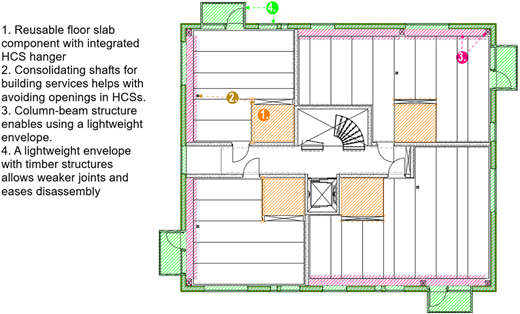
The building frame in the DfD design solution is a hybrid implementation of load-bearing walls and a column-beam frame. The exterior load-bearing walls were replaced by a column-beam structure, but load-bearing walls between the apartments inside the building were retained because of their favorable acoustic and fire insulation properties. The intermediate floors are supported on the exterior side by columns and beams (L-shaped) and on the interior of the building by partition walls using a removable steel bracket solution.
BAU uses traditional connecting methods between concrete parts, mainly steel-reinforced cast-in-place joints. In the DfD-W design solution, the necessary joints are also cast-in-place, but because of the frame modifications, there are fewer such joints than in the BAU solution. The second DfD solution, DfD-I, represents a hypothetical ideal frame, where the fixation of the elements is based on mechanical joints that are easy to dismantle, and weaker lime mortar is used at the joints only to meet sound and fire insulation requirements.
In DfD design solutions, the use of a column-beam frame on the outer perimeter of the building allows the use of non-bearing façade elements in the outer walls. Non-load-bearing timber-framed façade elements were chosen for the DfD solution because as lightweight structures, they are easier to install during new construction and, on the other hand, to remove when the building is disassembled. The elements used in the façade are also unlikely to be suitable for reuse after decades of weathering as Durmisevic and Yeang states (2009). Wooden elements have a lower carbon footprint than concrete Sandwich elements and therefore support the DfD's goal of reducing emissions in situations where reuse of the building element is not possible (Joensuu et al., 2022).
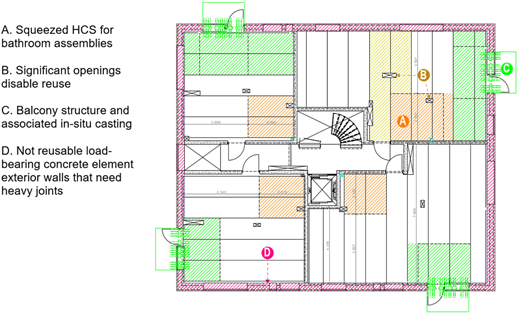
In BAU design, presented in Figure 1, concrete balcony slabs are anchored to the intermediate floor slabs with steel reinforcements and cast-in-place concrete. The balconies chosen for the DfD solution are light timber balconies supported from the building's frame.
In the BAU design solution, bathrooms are constructed with recessed hollow core slabs that are filled on site. In the DfD solution, presented in Figure 2, the intermediate floor slabs in the bathrooms were implemented using a separate slab with integrated slab hanger to bear the load of the HCSs directed at it and steel brackets to support the structure against adjacent slabs or walls. This facilitates separation during disassembly. A comparison of the BAU and DfD layouts shows that the overall design remains largely similar.
The roof structure in the BAU solution is a common structure in apartment building consisting of thermal insulation and expanded clay installed on top of the hollow core slabs of the upper floor, a cast-in-place concrete slab, and bituminous roofing. In the DfD solution, prefabricated timber elements with pre-fitted thermal insulation and roofing underlays were used.
In both cases, the apartments were heated by water-circulating underfloor heating; however, in the DfD solution, the heating pipes were installed in EPS sheeting, whereas in the BAU design solution, the pipes were cast into the floor screed. The DfD and BAU solutions have nearly identical structural and energy performance characteristics. Table 1 summarizes the structures used in the design solutions studied.
4. Results
4.1 Disassembly and associated costs
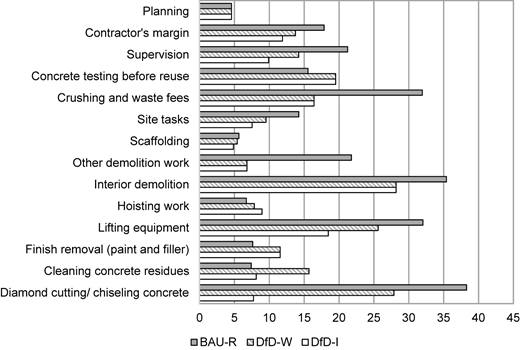
There were significant differences between the design solutions in terms of the work required for disassembly and, consequently, the total costs. The costs of disassembly in Figure 3 and the costs of crushing demolition in Figure 4 illustrate the costs incurred in each sub-area. The main cost items were diamond sawing the wet-jointed elements, interior demolition, lifting equipment and crushing the non-recoverable concrete parts in BAU-R. The total disassembly time, including all calculated procedures, was 118 days for BAU-R, 79 days for DfD-W and 55 days for DfD-I. The detailed schedules and their calculations are presented in Supplementary Data File 1.
The amount of diamond sawing required had a major impact on the disassembly cost. In the DfD solutions, the external walls were constructed as timber-framed non-load-bearing cladding elements, which can be removed from the frame without diamond sawing. Furthermore, the vertical connection between the load-bearing partitioning walls and the external wall element does not require diamond sawing. In the DfD solutions, the fixing method for the columns is a bolted connection, which has been shown in pilot tests to be easy to dismantle (Yrjölä, 2022). The hidden brackets used to fix the beams are also removable (Harsunen, 2024). In the BAU-R solution, significantly more diamond sawing is required for disassembly and also for the demolition of the roof slab and small in situ-cast concrete parts in the intermediate floors. Diamond sawing of the element joints restricts crane operation, as sawing is much slower than lifting. For safety reasons, the elements cannot be sawn in advance before lifting, which adds to the cost of lifting equipment. The total duration of the work phases affects the time-based costs of the site, with high workloads significantly increasing these costs. Similarly, in the case of interior demolition costs, a higher workload increases costs as the duration of the worksite increases. In the interior demolition, especially in the BAU-R design solution, the removal of the floor screeds in the apartments was a laborious phase due to the large mass and the difficulty of removal.
4.2 Resale value
The proportions of the building components identified as reusable during the disassembly phase, along with the calculated value of the corresponding new components, are presented in Table 2 expressed as cost per gross square meter. The value calculation takes into account losses during disassembly and testing. The material costs generated by the building element estimate procedure were employed to ascertain the value; however, the further costs associated with the cost of additional connection methods included in DfD components were not incorporated into the resale value, because taking account of these factors would distort the benefit obtained.
Table 3 illustrates the masses of the building components, as well as the proportion of these components that can be reused when dismantled intact. The reuse rate, expressed in terms of total building mass, was found to be 34% for BAU-R and 68% for the DfD solutions. The use of timber structures in facades, balconies and the roof, a reduction in the amount of floor screed in the intermediate floors and a significantly higher reuse rate of hollow core slabs all contributed to a reduction in the mass of waste generated by DfD solutions. The additional columns and beams in the DfD frame contributed to an increase mass, yet their high reuse rate also increased the relative reuse rate of the entire frame. It is important to acknowledge that in wet-jointed structures, at least the joints of the wall elements will be damaged, and some of the elements intended for resale will in fact require refurbishment.
4.3 Feasibility of deconstruction
The value achieved with deconstruction, described with, is presented in Table 4. Value is defined as the profitability of disassembly compared to crushing demolition. In this study, the required resale value ratio can be interpreted as a break-even threshold: it indicates the minimum share of the initial material cost that must be recovered through resale for deconstruction to match the cost position of crushing demolition. The calculation took into account the disassembly cost and used the initial material cost of components as the resale value. The costs that would have been incurred if the crushing method had been used were deducted from the value. The deconstruction cost results demonstrate considerable variation in overall costs across the design solutions. Compared to crushing demolition (BAU-D), deconstruction was 278% more expensive for BAU-R, 201% for DfD-W and 139% for DfD-I. However, compared to deconstruction in BAU-R, the cost savings in disassembly were 20% and 37% for DFD-W and DFD-I, respectively. If the resale value of the recovered components could reach the price of a new equivalent component, it would be economically viable to disassemble buildings with DfD solutions for component reuse.
The resale value ratio in Table 5 represents the minimum resale price that must be achieved in order to cover the additional costs of disassembly relative to the cost of new components. The differences in disassembly costs, depending on the extent of the work required and the quantity of the reusable components, resulted in considerable variations in the requisite resale value.
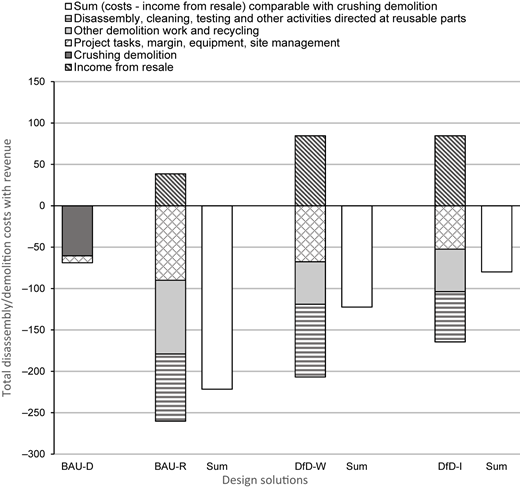
The shares of disassembly costs and revenues per total gross square meter for the design solutions are presented in Figure 5. Costs are broken down into activities directly attributable to reusable elements, including diamond sawing, cutting, scaffolding and supports, lifting, cleaning and stress testing. Other demolition and recycling costs include interior demolition and the dismantling, crushing, and recycling of other structures not suitable for reuse. The costs of site tasks, equipment, supervision and site planning, as well as the contractor’s margins were included under project tasks. In the case of crushing demolition, site and supervision costs are included in the crushing costs, and the project tasks describe only the client's own project tasks. The negative axis represents the cost of dismantling, while the positive axis represents the income generated from resale, which serves to offset the cost incurred. The resale value used is estimated at 50% of the material cost of a new equivalent component. The overall economics of disassembly are represented by the sum of the disassembly costs and the potential revenues from the resale of the components. This sum is directly comparable to the cost of crushing demolition.
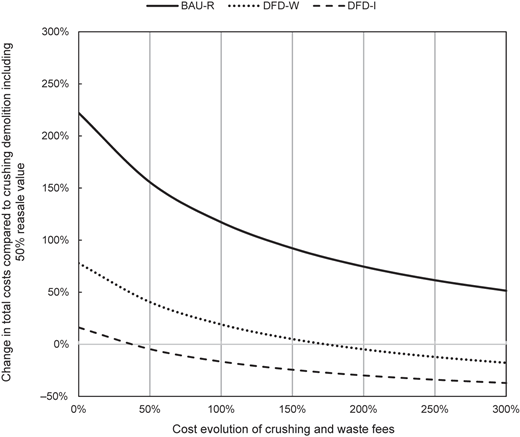
Even with the ideal design solution, the 50% resale value ratio was insufficient to entirely offset the additional costs associated with deconstruction, as previously indicated by the ratio. The total costs and revenues associated with deconstruction, with a 50% resale value incorporated, were found to be 222% higher than those of crushing demolition in BAU-R, 78% higher in DfD-W and 16% higher in DfD-I. When the resale value was considered, the disassembly of the DfD-I solution was found to be close to the total cost of crushing demolition. Nevertheless, the actual resale value will determine the profitability of deconstruction.
4.4 Sensitivity analysis
The main outcome of the sensitivity analysis, presented in Figure 6, demonstrates the influence of possible future alterations in the costs associated with crushing and waste fees on the profitability of deconstruction. The horizontal axis shows an increase in the cost of crushing and waste fees. The vertical axis shows the change in total costs compared to crushing demolition, with a negative result indicating cost savings. A resale price of 50% was also used in this analysis. When the cost of crushing and waste fees is sufficiently increased, disassembly can become economically viable for DfD solutions. The sensitivity analysis shown in Figure 6 revealed that DfD-I could gain a competitive advantage with just a 36% increase in the cost of crushing demolition, while DfD-W would require a 174% increase. On the other hand, the disassembly of the BAU design solution does not achieve economic feasibility even with increased crushing costs, as a significant amount of material is not suitable for reuse because of the design solutions. The unsuitability for reuse results in a large amount of waste being crushed and recycled, despite the process being considered a deconstruction for reuse. The impact of other individual variables on the total cost of deconstruction is presented in Table 6.
5. Discussion
For DfD to become a mainstream approach, it is essential to demonstrate that the economic feasibility of disassembly can be achieved compared to crushing demolition. The use of prefabricated elements has been shown to be efficient during the construction phase and has the potential to speed up disassembly, provided that the elements are not inseparably joined on site during the construction phase. The study assumes that if the cost of using the recovered components could be lower than the price of a new equivalent component, it would be attractive to disassemble buildings with the DfD solution for component reuse.
To simulate a real-life situation, this study analyzes the feasibility of DfD building disassembly through a detailed cost estimation based on a contractor’s bidding method, using data on material unit prices, task prices and site costs. The computational study found that the cost of disassembly was significantly higher across all design solutions when compared to traditional crushing demolition. As deconstruction causes additional costs compared to crushing demolition, the resale value of the second-hand parts must offset the costs to be economically feasible. Ultimately, the demolition method chosen at the end of a building's life cycle is likely to be determined by the circumstances that prevail at that time.
One of the key findings of this study was that it is not economically feasible to disassemble a building where component demounting had not been considered at all, as with the design solutions described in BAU. Demounting of components that have been cast together with concrete requires a high level of specialized expertise. In the BAU-R and DfD-W sites, concrete diamond sawing represented the costliest operation. In the case of DfD-I, which remains partially based on theoretical mechanical joints, the assumption was made that diamond sawing would not be required. The current cast-in-place joining methods (in BAU-R and DfD-W) require additional work for repair under factory conditions if the elements were to be reused, as the joints of wall elements are destroyed during the demolition phase. The extension of the total disassembly time will also result in indirect cost increases.
The share of reusable parts determines the profitability of disassembly, and low reuse rates significantly reduce the overall profitability. In BAU-R, the proportion of reusable parts was relatively small, with a considerable proportion being included in the crushed mass. For example, only about 56% of the hollow core slabs were considered reusable with the BAU design solution, because of the localized casting and openings. Deconstruction for reuse does not allow the selection of only reusable parts but also requires the careful removal of nonreusable parts one by one. A low reuse rate therefore requires a great deal of work that does not produce any direct value through resale value. The calculation of the disassembly is therefore sensitive to the quantities of parts that can ultimately be reused. The results show that the resale price of salvaged components from BAU-R would need to be multiple times higher than the price of new equivalent components to cover the additional costs of disassembly because of the limited quantity and higher costs of deconstruction.
The profitability of disassembly is fundamentally governed by two interrelated factors: the share of components that can ultimately be reused and the achievable salvage value of those components. Akanbi et al. (2018), through whole-life performance modelling of buildings, demonstrated that recoverability and reusability are strongly influenced by structural system choice and connection design. In their study, steel-framed buildings with demountable connections achieved very high reusability ratios, up to 0.93, whereas conventional concrete buildings exhibited substantially lower reusability, 0.42. In the present study, for the BAU design solution representing a conventional concrete structure, the overall reuse rate was 34%, which is consistent with the relatively low reusability ratio reported by Akanbi et al. (2018) for concrete buildings. This similarity indicates that conventional concrete buildings are generally poorly suited for component-level reuse, as extensive in situ casting, rigid connections and the lack of demountable joints hinder nondestructive disassembly and limit reuse potential. However, it is important to note that in the DfD solutions examined in this study, the reuse rate increased to 68%, which is significantly higher than that of the conventional concrete building and even exceeds the reusability ratio reported by Akanbi et al. (2018) for timber buildings. Nevertheless, caution is required when comparing the results, as the case buildings differ in type and characteristics — this study examined a 6-storey apartment building, whereas Akanbi et al. (2018) analyzed a two-story office building. In addition, differences in modelling approaches, calculation methods, system boundaries and other underlying assumptions introduce uncertainties that may influence the comparability of the results.
Previous research on mass timber buildings has demonstrated that end-of-life economic performance is highly sensitive to reclaiming rates and resale price assumptions, with salvage value emerging as a decisive parameter in total life cycle cost comparisons (Liang et al., 2021). In their sensitivity analyses, Liang et al. (2021) showed that even high recovery rates do not automatically ensure cost competitiveness if resale prices remain modest, underscoring the importance of effective value retention. A related conclusion was reached by Öberg et al. (2025) in the context of timber buildings designed for structural adaptation. Their results showed that the economic feasibility of circular design depends strongly on keeping the additional investment cost low, even when long-term adaptability benefits are expected. This supports the present findings by suggesting that DfD solutions are more likely to become economically attractive when implementation cost premiums can be minimized and future value recovery becomes more credible.
A similar sensitivity is evident in this study for precast concrete structures. In the BAU-R solution, the proportion of reusable elements was limited, with a considerable share ending up in crushed mass. For example, only approximately 56% of hollow core slabs were considered reusable due to localized casting and openings. Moreover, deconstruction for reuse requires the careful dismantling of reusable parts, meaning that a low reuse rate entails substantial labor without generating corresponding resale revenue. Consequently, the economic outcome is highly sensitive to the final quantity of reusable components.
The results of this study demonstrate that, in the DfD design solutions, the resale value ratio required for profitability ranged between 57% and 82% of the initial material cost. In contrast, for the BAU design solution, the required resale value ratio was multiple times higher than the initial cost of new equivalent components. This indicates that improved recoverability through DfD substantially lowers the break-even threshold for salvage value. However, it also confirms that salvage value alone cannot compensate for limited reuse shares and higher dismantling costs. Consistent with previous findings (Liang et al., 2021), both recovery rate and achievable resale value must reach sufficient levels for deconstruction to become economically competitive with crushing demolition.
From an economic perspective, value is generated only through the recovery and resale of reusable components, whereas all other dismantling work represents a cost burden. Consequently, minimizing non-value-adding work is critical for improving economic feasibility. The calculations carried out showed that there are clear aspects, such as screed for intermediate floors, roof structures and facades, where the economic feasibility of dismantling can be improved by selecting easy-to-dismantle solutions. This study shows that there are still many obstacles for concrete buildings to become profitable to deconstruct and reuse the components. Design decisions that reduce cutting, demolition of composite layers, and damage during separation directly decrease labor intensity and increase the proportion of recoverable elements. This finding aligns with Vares et al. (2020), who demonstrated that in steel structures with demountable connections, deconstruction and component reuse can be more economically viable than demolition and recycling. Their results underline that economic feasibility is strongly linked to connection strategy and assembly logic rather than material value alone. It must also be noted that changing market conditions may alter this balance in the future. Carbon pricing, embodied-carbon requirements, public procurement criteria, higher landfill and crushing fees, and rising virgin material costs may all improve the attractiveness of DfD construction even in situations where direct cost parity with crushing demolition has not yet been reached.
Even though, the results of this study display significantly higher cost for deconstruction than demolition by crushing, the deconstruction might be worthwhile when assessed by other criteria. Compared to demolition by crushing, deconstruction generates lower levels of dust, air pollution, noise, vibration and overall disturbance (Anuranjita et al., 2018; Patel and Patel, 2020). These features could have a high priority, especially in urban areas, near sensitive built environment or nature. Moreover, deconstruction, particularly of a DfD building, facilitates the reuse of components and the recycling of materials. Consequently, it is unparalleled in terms of environmental impact.
5.1 Limitations and future research directions
Because of the inherent properties of the methods and subject of this study, one must be careful when aiming to generalize the results. First, this study analyzes only one unique apartment building, which implies that the outcomes are case-sensitive to some extent. The building examined was relatively small in scale, which may not represent the most favorable conditions for disassembly. Previous research (Harsunen et al., 2025) indicates that the potential disassembled mass of a building is strongly linked to building size and the number of floors. Fixed site setup costs for intact disassembly are not directly proportional to building size, and smaller buildings may have a higher proportion of non-value-adding dismantling operations, e.g. foundations, roof and nonreusable structures. Furthermore, unit costs for crushing demolition were assumed equal across scenarios, although in practice they may vary depending on waste volumes, contractor pricing and local disposal practices. Future waste policies and disposal fees may also influence these costs.
Another clear uncertainty of this study is the limited empirical knowledge of DfD technologies, especially the unit and task prices of their disassembly. This is because the concept is new and there is still little consensus on the technologies. Only occasional demonstration or research projects have been carried out on the deconstruction of buildings, providing limited empirical data on the costs of disassembly. Because of this lack of experiment, the calculations for DfD were based on subjective assumptions about the labor and equipment expenses of demounting in the ideal case. In the end, disassembly costs are determined by contractors labor and equipment costs, the evolution of disassembly method efficiency, the development of recycling policies and fees, the logistics of the site, the level of the deconstruction plan, the extent and accuracy of the component information documented, and the costs of the requirements imposed by legislation on disassembly and reuse. Currently, the final intact demolition price is determined by the price at which someone agrees to perform the project, taking into account the risks involved. As disassembly becomes more common and experience is gained, the financial risks will also decrease.
A further key uncertainty concerns the future resale value of second-hand components. The prices of many conventional building components are very competitive: in particular, the material cost of hollow core slabs was low, around €55/m2. If a resale value for a used part is considered to be 50% of the initial material cost, the cost of just one person-hour of labor to dismantle and clean a slab may exceed the potential resale value. Since structural elements represent only a small share of total project costs, the economic incentive for buyers remains limited and combining reused and new components may increase logistical complexity. Although rising material and energy costs may improve market conditions (Akbarnezhad et al., 2014), resale values remain uncertain.
As the results of this study are based on a computational analysis of the case study of a prefabricated concrete building, more building types and sizes, and a variety of building materials, such as timber and steel, should be investigated to allow a broader comparison of deconstruction and demolition options. Furthermore, future research needs demonstration projects to gain empirical knowledge of the task and unit prices of the assembly and disassembly of DfD structures and predictive analysis to understand the cost development of building waste disposal and virgin components. Analyzing the overall cost-effectiveness of the options through extending this study into a life cycle cost analysis would also benefit the real estate business.
6. Conclusions
The aim of this study was to analyze the economic feasibility of disassembly and compare different design solutions where the incurred disassembly costs are compensated by the revenue from the resale of the salvaged components. Moreover, the disassembly costs were compared to the costs arising from the traditional crushing demolition method. Cost analysis from the point of building end-of-life is relevant, since the choice between disassembly and demolition is made at the point with cost analysis, regardless of the initial construction costs.
As a result, with all design solutions, the cost incurred by disassembly was significantly higher than the cost of demolition by crushing, despite the resale value for second-hand components being assumed to be 50% of the original. However, comparing deconstruction costs for conventional BAU design solutions, the DfD solutions achieved significant savings. The DfD-I solution, based on mechanical joints, made deconstruction more cost-effective compared to the wet joints methods in DfD-W. The DfD solutions also had a higher number of reusable elements than the BAU solution and a recyclable waste mass of just over a third of that of the BAU solution. Therefore, while this study focused on costs, it is important to emphasize the environmental benefits of DfD construction that were identified in this study.
With DfD solutions, a high resale price or reuse of parts for own use can make disassembly profitable compared to crushing, especially if the cost of crushing and recycling increases in the future. In the case of conventional BAU design solutions, deconstruction is not feasible in a cost-effective way. With DfD solutions, the resale value ratio required for profitability was 57–82% of the initial material cost, while for the BAU design solution, the ratio was multiple times higher than the initial cost. This confirms that end-of-life economic feasibility is not dependent solely on material choice, but is largely determined by design decisions made during the initial design and construction phase.
No deconstruction cost analysis has been carried out before for apartment buildings that would allow accurate analysis of the effects of different design solutions and component joining methods at the level of labor costs. Hence, this study offers novel information on the effects of design solutions and the assembly of components on deconstruction costs and the profitability of the deconstruction phase between DfD and conventional solutions in the deconstruction phase of a residential building. The computational results demonstrate that decisions made during the construction phase and adherence to the principles outlined in the ISO 20887 standard have a considerable influence on the deconstruction process.
The findings of this study highlight broader implications for the transition toward circular construction. By increasing the share of reusable components and reducing recyclable waste mass, DfD solutions contribute to material value retention and reduced dependency on virgin raw materials. In the future, changes in the market environment may improve profitability, as increases in crushing costs were found to affect economic outcomes in the sensitivity analysis.
From a policy perspective, the study underscores the importance of integrating disassembly considerations into building regulations and procurement practices. Encouraging demountable connection strategies and adherence to standards such as ISO 20887 can systematically improve reuse potential at the building stock level. Public sector clients, in particular, could play a pivotal role by incorporating reuse-oriented requirements into tendering processes, thereby creating demand for DfD solutions and accelerating market transformation.
Ultimately, this study contributes to the wider discourse on circular economy implementation in the built environment by quantifying how structural detailing and connection strategies influence reuse rates and economic feasibility in concrete apartment buildings. While further empirical validation across different building types and materials is needed, the findings provide actionable insights for designers, contractors, real estate developers and policymakers seeking to align construction practices with long-term circular economy objectives.
Ethical approval
No human participants or animals were involved in this research.
Declaration of generative AI and AI-assisted technologies in the writing process
The authors used an AI-based language editing tool (ChatGPT) to improve the clarity and language of the manuscript. All scientific content, analysis and conclusions are the sole responsibility of the authors.
The supplementary material for this article can be found online.