Conservation auctions have been advocated as a way to increase the cost-effectiveness of payment for ecosystem services (PES) programs by reducing the informational rents captured by participating landowners. Most PES programs have continual or periodic (rather than one-time) enrollment. In repeated auctions, it is possible for participants to learn the winning bids from previous auctions and use this information to strategically set their bids, thereby capturing more informational rents. We develop an agent-based model, using data from Costa Rica’s Pago de Servicios Ambientales (PSA) program, to examine how strategic behavior, specifically through learning about previous winning bids, affects program participation and cost-effectiveness. When learning and strategic behavior occur among landowner agents in the model, informational rents increase and environmental benefits captured per dollar decrease over time. However, we also show that the distribution of participation can be adjusted by targeting for social as well as environmental benefits.
Introduction
Over the past three decades, payment for ecosystem services (PES) programs have been established in both developed and developing countries to encourage private provision of public goods, such as carbon sequestration, watershed management, and wildlife habitat. Specifically, the goal is to encourage the provision of ecosystem services that are worth more to the public than the private cost of providing them. In many PES programs, the program administrator (often the government) enters into contracts with landowners to implement specific management practices that are expected to generate ecosystem services of public value. Most PES programs employ Pigouvian subsidies in the form of flat-rate payments (such as a fixed amount per hectare) to all landowners who enroll. Concern about the information rents captured by landowners in those programs has motivated interest in alternative approaches to allocating and setting rates for PES contracts. Many economists have proposed conservation auctions or tenders (Ferraro, 2008; James, 2018; Rolfe et al., 2017). We examine the implications of using an auction to allocate contracts with the longest running national PES program in the tropics: Costa Rica’s Pagos de Servicios Ambientales (PSA).
In the case of PES programs designed to protect native forests, such as the forest protection option under PSA, Pigouvian subsidies in the form of flat-rate payments inherently offer rents to landowners whose opportunity costs of forest conservation are low. The difference between the payment the landowner receives and their actual cost of participation (including both opportunity and transaction costs) is called informational rent. Informational rents reduce the cost-effectiveness of PES programs as the program administrator conserves fewer hectares or environmental benefits per dollar than it would have if landowners were paid their exact participation costs (Deng and Xu, 2015; Ferraro, 2008). PES was originally envisioned as a Coasean approach to the undersupply of ecosystem services. The Coase Theorem states that negative environmental externalities can be reduced through voluntary, market-like transactions, as long as transaction costs are low and property rights are clearly defined (Coase, 1960; Pascual et al., 2010; Pattanayak et al., 2010). However, in practice, the Coasean approach is difficult to implement efficiently on a national scale because of the large number of parties engaged in direct negotiations and consequently high transaction costs (James and Sills, 2019; Sattler and Matzdorf, 2013).
Economists have argued that conservation auctions can increase the cost effectiveness of PES by reducing information rents collected by participants (Deng and Xu, 2015; Ferraro, 2008). In conservation auctions, landowners who would like to participate in a program submit bids specifying the payment level that they require to implement the management practice needed to generate the desired ecosystem service. The lowest (or most favorable) bids are selected until a pre-determined quota is filled. A landowner can increase their chance of being selected by submitting a low bid, but if the landowner submits a bid that is too low, they might incur a net loss if the opportunity cost of implementing the management practice is higher than the payment. If a landowner bids above their cost, they may receive a large net payoff, but their chances of being selected into the program are reduced. Therefore, in these auctions, landowners have an incentive to bid close to their actual cost. In this way, auctions can reduce informational rents through competitive bidding (Amdur et al., 2011; Deng and Xu, 2015). In addition, while there may be a large number of bidders in an auction, the program administrator would not need to directly negotiate with each potential participant (bidders) as would be required in the Coasean approach.
Several studies have examined the cost-effectiveness of auctions compared to fixed price schemes in PES programs. Trial runs of one-shot auctions in Scotland (Latacz-Lohmann and Schilizzi, 2005), Australia (Stoneham et al., 2003), China (Wang et al., 2012), and Germany (Groth, 2011), as well as computational models (Lundberg et al., 2018), show that conservation auctions can be more cost-effective than fixed price schemes for obtaining environmental benefits.1
While a one-shot auction could be useful for setting payments or for programs with only a single enrollment opportunity, operational use of conservation auctions is more likely to involve repeated enrollment opportunities. For example, Costa Rica offers new contracts in its PSA forest protection program every year. The program has been criticized for not taking landowner costs into account when setting payments, thereby reducing its cost-effectiveness for conserving forest (Hartshorn et al., 2005). This concern could be addressed with an auction mechanism, but the government has not adopted this approach. Indeed, conservation auctions have not been incorporated into any PES program with repeated enrollment periods in any developing country. One possible reason is an expectation that landowners will learn how to “play the game,” eroding the benefits of auctions. Another possible reason is a concern that differential ability to “play the game” will bias participation against disadvantaged landowners, eroding any poverty alleviation benefits of PES. To explore these possibilities, we posit two forms of landowner learning across repeated enrollment periods of an auction, and we examine their implications for conservation auctions in a program like the PSA, which started with open sign-ups and then implemented targeting.2 Specifically, we consider two questions: (i) does the cost-effectiveness of an auction diminish over time and by how much, and (ii) what are the implications for equity, as defined by the types of landowners enrolled in the program?
We develop an agent based-model (ABM) to examine these two questions about how outcomes would be affected by strategic bidding if Costa Rica were to incorporate an auction into the PSA program. We posit two decision-making heuristics that incorporate learning about previous auction results, and we assess whether they would substantially reduce the benefits of introducing an auction given the actual sizes and locations of parcels in the Costa Rican PES program. Conservation auctions have been promoted primarily as a way to increase cost-effectiveness, which we measure as the informational rents captured by landowners and the dollars spent per hectare. Maximizing cost effectiveness requires minimizing both of those measures. However, the PSA program is expected to contribute to rural development and poverty alleviation as well as conservation. Thus, we also consider the distribution of participation, measured as the number of contracts issued to landowners (i) with small properties, and (ii) in districts with low socio-economic standing, which are the social priorities identified in PSA policy. Thus, we offer evidence relevant to both the cost-effectiveness and equity implications of auctions. In the next section, we review what auction theory suggests about how landowners decide on their bids, including how learning could impact those decisions. The following section describes the model used, including its representation of the PSA program, landowner decision-making, and the auction process. The next two sections present the results and draw conclusions, respectively.
Repeated Auctions
Previous studies have examined the outcomes of one-shot conservation auctions, in which the bidders cannot learn from the results of prior auctions. Stoneham et al. (2003) compared a flat-rate scheme to the results of the BushTender auction in Australia and found the budget would have to be seven times higher under a flat-rate scheme to achieve the same level of environmental benefits. Groth (2011) examined the results of the Steinburg County Biodiversity Auction and found that compared to a hypothetical flat-rate payment scheme, the cost advantages of auctions ranged from 41% to 50% across years. The Woodlands in and Around Towns (WIAT) Challenge, funded by the Scottish Forestry Commission, implemented a first price auction for the creation, management, and expansion of woodlands. Analyses following the auction found that if a flat-rate payment had been offered, the budget would have had to be 33% to 36% greater to secure the same number of hectares (Latacz-Lohmann and Schilizzi, 2005).
In practice, PES programs generally offer contracts through repeated enrollment opportunities. If a conservation auction were used in each enrollment period, it would be possible for bidders to learn from the previous auction results. Learning from previous auctions could help bidders determine information that is not directly disclosed to them such as the program budget, the maximum allowable bid, or the program administrator’s assessment of environmental benefits that can be gained from land enrolled in the program (Klemperer, 2002). Learning about previous auction results could generate positive or negative results for the landowner and program administrator, depending on how bidders use this information. For example, consider a landowner who has a parcel of land that can generate a high level of ecosystem services, but their cost of participation is high. As a result, they may not participate in a flat-rate PES program, and they may be discouraged from submitting a bid in a conservation auction. However, if they learn the maximum allowable bid in the auction is greater than their cost of participation, they may submit a bid. This is a positive result for both the landowner, who may obtain a payment high enough to cover their cost, and for the program administrator, which may enroll land that can generate valuable ecosystem services. This illustrates one of the key arguments in favor of using conservation auctions to allocate PES contracts.
Landowners can also use information that they learn about previous bids to strategically change their bids to capture more informational rent (Klimek et al., 2008; List and Shogren, 1999). From the perspective of the program administrator, this diminishes cost-effectiveness over time (Klimek et al., 2008). In this sense, learning could undermine the benefits of an auction and potentially make an agency wary of incorporating auctions into an existing PES program such as PSA in Costa Rica. We focus on the potential for learning to help landowners capture more informational rents and thus undermine the argument for auctions.
The only empirical evidence from the field about the effect of learning on the cost effectiveness of conservation auctions in PES programs comes from studies of the Conservation Reserve Program (CRP) in the United States.3 Introduced in 1985, the CRP is the longest-running conservation auction for PES. The CRP general signup process allows farmers to enter a bid in a first-price sealed auction for the portion of land they are willing to remove from agricultural production and place into conservation. Studies of the initial years of the program found evidence of learning. For example, in the auctions that took place in 1986, the distribution of bids decreased in the period from May to August compared to the distribution of bids from March to May, suggesting that potential participants were learning about the maximum possible payment rates, or the bid caps (Reichelderfer and Boggess, 1988). Considering the first four rounds of sign-ups, Shoemaker (1989) found that in the initial auctions, bids for conservation contracts were well below the bid cap. By the fourth round of sign-ups, the average bid rate was close or equal to the bid cap, consistent with learning about the bid cap.
After 5 years, an Environmental Benefits Index (EBI) was incorporated into the CRP. Bids are now accepted based on a combination of the lowest bid price and the highest environmental score (Claassen et al., 2008; Vukina et al., 2008). The definition of this score is not revealed to landowners.4 In an analysis of the period after the EBI was introduced, Kirwan et al. (2005) found that CRP participants captured more informational rents over time across five CRP general sign ups from 1997 to 2003, again suggesting that they were basing their bids on information that they had learned about previous auctions. In this case, landowners may learn about the valuation of ecosystem services (i.e., the EBI) as well as the bid cap.
While the much of the empirical evidence on conservation auctions in PES comes from the CRP, agent-based models can be used to assess how the cost-effectiveness of PES programs would be affected by different types of learning and strategic bidding in different types of auctions. ABMs are computational models that allow for a bottom-up approach to analysis. Agents in ABMs interact over space and time, within a closed system, according to a set of rules. The micro-level interactions of these purposeful agents create emergent patterns, such as increased/decreased provision of ecosystem services (Page, 2005; Tesfatsion, 2003). When they incorporate realistic assumptions about the behavior of agents and the timing of micro-level interactions, ABMs are a useful tool for understanding policy outcomes, especially when empirical evidence is not available.
In an ABM developed by Hailu and Schilizzi (2004), landowner agents bid on conservation contracts annually. In each subsequent year, agents use information about their performance in the previous year’s auction to adjust their bids. For example, if an agent won the auction in the previous year, they could maintain their bid or bid a higher amount in the next year. If an agent lost, they might lower their bid. Similarly, Lundberg et al. (2018) developed an ABM in which agents learn their neighbors’ winning bids in previous years and use this information to adjust their own bids. Both studies showed that the cost-effectiveness of conservation auctions erodes over time when agents learn the results of past auctions and use that information strategically to change their bids.
Value Models and Learning
The effect of learning previous auction results depends on how landowners assess value and form bids. While clearly each landowner (or bidder) is different, auction theory offers two basic models for bid formation: the independent private values model and the common value model. In the independent private values model, bidders know their exact cost of participation and any one bidder’s value is statistically independent from any other bidder’s value. Thus, in a PES conservation auction, the bidder’s value would reflect their own personal participation cost and motivations for participation, independent of the valuation of any other bidder. In contrast, the common value model posits that the good being auctioned has a true value that is not known to any one bidder. In a PES conservation auction, landowners typically know the opportunity cost of their land but not the PES administrator’s valuation of the ecosystem services that can be generated on their land. However, bidders may have access to information that could help them make informed guesses about the value of those ecosystem services, which in turn could help them determine how much the PES administrator might be willing to pay to enroll their land in the program (McAfee and McMillan, 1987).
We draw on the independent private values model and the common value model to bound the space for assumptions about bidder learning and behavior. For example, in the common value model, if a bidder were to learn that their neighbor had been awarded a contract via a conservation auction in the previous year and was told their bid, the bidder could assume that conservation of their land had the same value and would update their bid accordingly. Conversely, in the independent private values model, learning about a neighbor’s winning bid would not affect a landowner’s bid in the next enrollment period, because their valuations are independent of each other. In reality, bids in a PES conservation auction are likely to include both an independent private values component and a common value component.
Landowners are likely to obtain the most relevant information from previous auction participants with landholdings in close proximity. Neighboring lands are likely similar in terms of potential environmental benefits, based on Waldo Tobler’s (1970) first law of geography that “everything is related to everything else, but closer things are more closely related.” For example, consider a landowner who learns about an immediate neighbor’s winning bid in a previous enrollment period of the auction. If the neighbor’s winning bid is higher than the planned bid of the landowner, the landowner takes this as a signal that their bid is below the “common value,” i.e., too low based on the actual costs of participation and/or the environmental benefits that their land can provide. Thus, learning that a neighbor has won a contract with a higher bid acts as a signal about the level of environmental benefits their land can provide. Armed with this new information, the landowner raises their bid. This scenario has been observed in experimental settings. For example, Cason and Gangadharan (2004) observed that when landowners were made aware of the level of environmental benefits their land can generate, their bids increased.
There are likely to be more landowners in the region who have won conservation contracts, but that information is also likely to be less relevant, because the landowner does not know whether the other land awarded contracts is similar to their own. Nonetheless, the information that higher bids resulted in contracts acts as a signal that they may be able to increase their bid thus increase their informational rent. Thus, the landowner may increase their bid, even though they have no new information on either their cost of participation or the environmental benefits potentially generated by their land.
We examine how different heuristics for strategic bidding based on learning about previous auctions affect outcomes in an ABM, using real world data on participants in the PSA program. We expand on previous literature by considering a program and a setting other than the CRP in the United States, by considering different program priorities and different landowner decision rules, and by using real data, rather than initializing agents based on assumptions about the joint distribution of landowner and land characteristics (Hailu and Schilizzi, 2004; Lundberg et al., 2018).
Model Description
Costa Rica’s PSA offers a useful test case for modeling the introduction of auctions, both because it is the longest running national PES program in the developing world and because the responsible agency maintains a high-quality database on participants. We utilize data about landowners and characteristics of their land enrolled in the PSA forest protection program to model and understand how implementing repeated auctions could allow for learning and strategic bidding behavior within the framework of the program. We also draw on the program’s stated criteria for prioritizing applications to incorporate targeting into our model. The following sections describe the PSA forest protection program and the auction model.5
Costa Rica’s Pago de Servicios Ambientales
Since its establishment in 1996, the PSA program has been administered by the Fondo Nacional de Financiamiento Forestal (FONAFIFO). Each year, FONAFIFO establishes a new cohort of 5-year contracts to protect forest for a flat rate paid per hectare and per year. While FONAFIFO has also offered other types of contracts, here we only consider the forest protection program. For roughly the first 15 years of the program, FONAFIFO reviewed and accepted applications from landowners on a “first-come, first-served” basis. In 2011, they changed the application process to score applications using a “Matrix” that reflects the environmental and social goals of the program.
The Matrix implements targeting, or prioritization of certain environmental and social factors, by assigning points based on the expected environmental and social benefits of a contract. Table 1 depicts the scoring system used since 2012 (Aguilar, 2015). The Matrix includes three environmental criteria based on where the forest parcel proposed for the program is located, with points awarded for parcels located in three priority zones: protected areas, conservation gaps, and biological corridors. Each application can only receive points for being in one priority zone. If the forest is located in several priority zones, the landowner receives the points from the zone offering the most points. The Matrix also awards points to applications for new contracts on properties that previously had forest protection contracts. In addition to the environmental priorities, the Matrix considers social equity concerns. Specifically, applications for contracts on properties smaller than 50 hectares are awarded 25 additional points. The Matrix also references the Social Development Index (IDS), which is calculated by the Ministry of National Planning and Economic Policy (MIDEPLAN) for each district in the country. Applications for contracts on properties in districts with IDS less than 40 receive an additional 10 points. None of these point allocations are weighted by the number of hectares being enrolled. The lowest score possible is 55 for forested parcels not in any priority zone. The highest score possible is 130 for forested parcels in conservation gaps within indigenous territories (85 points), on properties that are smaller than 50 hectares (25 points), that had a contract in previous years (10 points), and that are located in a low IDS district (10 points).
Auction
In this study, we implement repeated, first price auctions with various targeting rules based on the Matrix to examine the implications of learning and strategic behavior. Auction theory and empirical evidence (Kirwan et al., 2005; Reichelderfer and Boggess, 1988; Shoemaker, 1989) suggest learning can lead to strategic bidding and that this can diminish the cost-effectiveness of auctions over time. Thus, we hypothesize that learning and strategic behavior will decrease the cost-effectiveness of auctions and increase the informational rents captured by landowners over time, regardless of which value formation model we assume. However, several studies suggest that targeting should increase cost-effectiveness (Hartshorn et al., 2005; Porras et al., 2013; Sanchez-Azofeifa et al., 2007; Wunscher et al., 2008), and therefore we hypothesize that learning will have a larger negative effect on cost-effectiveness in auctions without targeting compared to auctions with targeting. In addition to the implications of learning for cost-effectiveness, we also explore the implications for equity of participation. The equity implications of strategic behavior in conservation auctions have not received as much attention as the implications for efficacy and cost-effectiveness, and thus, we do not pose specific hypotheses about how learning affects the distribution of participation.
Learning Environments
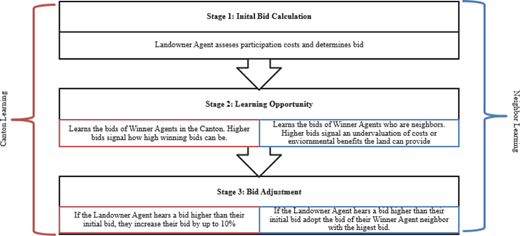
Based on the framework of the two learning models presented in “Value Models and Learning ,” we specify two heuristics for how information could be acquired and used, generating a canton learning (CL) environment and a neighbor learning (NL) environment.6 Cantons are the lowest tier of government in Costa Rica. As outlined in Figure 1, the schedule for each time step takes place in three stages. First, the Landowner Agents participating in that year’s auction calculate their initial bids based on their opportunity costs and transaction costs of participation.7 We assume that all landowners calculate their initial bids this way in both learning environments and in all variants of the auction.
In the second stage of the CL environment (left side of Figure 1), each Landowner Agent9 interacts with all of the Winner Agents in their canton who submitted winning bids in the previous year’s auction. The Winner Agents do not provide Landowner Agents with their exact bids. Instead they give the Landowner Agent a “rough idea” of their winning bid by shading their bid by a random factor drawn from a uniform distribution between −10% and +10%. This could be interpreted as the Landowner Agent hearing rumors about winning bids from other landowners in the same canton. If a Landowner Agent hears of a winning bid that is higher than her optimal bid, this is taken as a signal that the auction can tolerate higher bids. By increasing her bid, the Landowner Agent can increase her informational rent. However, the Landowner Agent knows that she may not have received precise information, and she therefore only increases her bid calculated in the first stage by up to 10% in order to limit the risk of losing the auction by bidding too high.10 If a Landowner Agent does not have any Winner Agents in her canton or if she does not hear of any winning bids higher than her initial bid, her bid stays the same. Each Landowner Agent increases her bid only once.
In the NL environment (right side of Figure 1), Landowner Agents only interact with Winner Agents who are their immediate neighbors.11 However, Winner Agents provide Landowner Agents with their exact bids from any previous auction year.12 The Landowner Agent is aware that the land she is seeking to enroll in PSA may be similar to land her neighbors have enrolled in the program. Therefore, if the Landowner Agent hears of a winning bid that is higher than her initial bid, she takes this as a signal that her initial valuation was too low relative to the actual costs of conservation or the environmental benefits her land can provide. Unlike the CL learning environment, the Landowner Agent knows her neighbor is providing accurate information about their winning bid and the information can provide insight into the actual value of the land she plans to enroll in the program. Therefore, rather than increasing her bid by some percent, the Landowner Agents updates her bids by adopting the bid of her neighbor with the highest winning bid. If the Landowner Agent does not have any neighbors that are Winner Agents or if she does not hear of any winning bids higher than her initial bid, her bid stays the same.
The CL and the NL environments represent bounds on the spectrum of possible learning, ranging from relatively low-quality information (shaded and only from the previous year) from all previous winners in the local jurisdiction to relatively high-quality information (exact and from all years) only from immediate neighbors. In the NL environment, Landowner Agents are assumed to receive more accurate information from more years compared to the Landowner Agents in the CL environment. In reality, how bidders learn and use information to formulate their bids is likely a combination of both learning environments. However, by examining these learning environments separately, we gain insight into whether the effect of learning differs according to whether landowners learn accurate information from a few trusted sources or less accurate information from more sources.
First Price Auction
After the steps outlined in Figure 1 are completed, the Landowner Agents participate in the conservation auction. We consider three versions of first price, discriminatory auctions with three possible targeting rules: no targeting (NT), environmental benefits (EB) targeting, and environmental and social benefits (EBS) targeting. When there is no targeting, bids ($/hectare) are sorted in ascending order and accepted until the budget is exhausted. In auctions where there is targeting of environmental benefits, the agents in the auctions are assigned an environmental benefits score based on the first four factors of the Matrix. When there are environmental and social benefits targeting, the agents are assigned a score based on all factors in the Matrix. The bids with the highest score per dollar are accepted until the budget is exhausted. In this model, we assume that bidding behavior of the Landowner Agents is the same in each learning environment and auction setting. This is consistent with limited dissemination and understanding of the details of the targeting mechanism. While Landowner Agents are likely to know whether the auction targets for environmental and/or social goals, they are unlikely to know the details of the Matrix (e.g., which environmental conditions or social characteristics are awarded the most points) and how it applies to their property. As a result, it would be difficult for them to use this information strategically.
Agents are parameterized using data on new PSA forest protection contracts issued from 2005 to 2014. These data include the location of the property, the number of hectares enrolled in the program, estimated opportunity costs, and the information required to calculate the Matrix score.13 A subset of agents is assigned to participate in each year based on the year their contract was issued. For each learning environment, there are 10 auctions (i.e.,time steps), representing the 10 years of data.
Results and Discussion
In the following sections, we first discuss the cost-effectiveness of the auctions in each learning environment in terms of the informational rents collected by Winner Agents and the area of forest contracted per dollar spent. Next, we discuss the implications of auctions for the distribution of participation in each learning environment. In each case, first price auctions with no learning (B) serve as the baseline.
Cost-effectiveness
Cost-effectiveness is measured by two factors: (i) the value of informational rent captured by landowners awarded contracts14 and (ii) the area of forest placed under contract per dollar.
Informational Rents
When informational rents are reduced, more land area can be brought under contract, thus more environmental benefits can be generated. Table 2 summarizes the average informational rents captured over all time steps (10 years) by agents in each learning environment and for each level of targeting in the first price, discriminatory auction. When there is no learning, informational rents captured by landowners are below $1.4 million. Learning allows landowners to capture substantially more informational rents. In the CL learning environment, informational rents captured by landowners more than double with learning. In the NL learning environment, informational rents captured by the landowners increase more than five times with learning.
Thus, the specific learning environment does have a substantial influence. In the NL environment, motivated by the common value model, Landowner Agents generally have access to fewer Winner Agents, but they learn the exact value of their winning bids from any previous auctions. In the CL environment, motivated by the independent private values model, Landowner Agents only learn the approximate value of bids from the previous year (time step). The higher quality information available in the NL environment results in capture of more informational rents and greater degradation of cost-effectiveness. This would be problematic for an agency implementing auctions in PES programs, because learning is difficult — and perhaps not desirable — to prevent. For example, FONAFIFO probably could not stop landowners who are interested in participating in the auction from talking about it with their neighbors, who might encourage them to participate in addition to giving them information about previous bids.
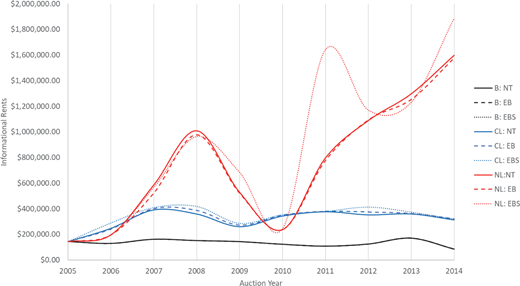
To examine our hypothesis that learning and strategic bidding could erode the cost-effectiveness of an auction over time, Figure 2 shows the average informational rents captured by agents in each learning environment in each year. The Landowner Agents participating in the auction in 2005 have no Winner Agents to learn from, and therefore, informational rents for all learning environments start at the same point. Using the auctions with no learning as a baseline, in the CL learning environment, learning has an immediate effect on informational rents in the auctions in 2006. Rents increase through 2008, decline from 2008 to 2009, increase again from 2009 to 2010, and then stay roughly in the same range through 2014. The relatively stable information rents captured from 2010 to 2014 could indicate that there were a limited number of landowners in the canton offering winning bid information from the previous year.
The initial effect of learning on informational rents is not as high in the NL environment. The reason there is an immediate effect in the CL environment and not the NL environment is that there are relatively more Winner Agents available to learn from in the canton compared to the number of Winner Agents who are immediate neighbors. In the early years in the NL environment, few Landowner Agents have Winner Agents as neighbors, and hence there is little learning. However, over the years, as more agents win the auction, more Landowners find Winner Agents among the neighbors from whom they can learn. Thus, the informational rents captured by Landowner Agents in the NL environment eventually surpass those of the CL environment in 2007. There is a sharp decrease in 2009 and 2010. As informational rents decrease in 2009 in both the NL and CL model, this may be due to the particular pool of Landowner Agents in the auction that year. Their initial bids may have been higher than the bids reported by Winner Agents, or they may have been located where there were few Winner Agents (either in the canton or as immediate neighbors).
After 2010, informational rents continually increase through 2014 in both the auctions with no targeting and the auctions with just environmental benefits targeting. There are particularly noticeable increases in informational rents captured in the NL auction with environmental and social benefits targeting in 2011 and 2014. This may be explained by both timing and spatial location. In auctions where smallholders are targeted for contracts, there tend to be more individual winners. It is possible that the agents participating in the 2011 and 2014 auctions were more likely to have neighbors who: (i) won in previous auctions and (ii) had high bids. In this scenario, the landowner agents could bid high and collect large informational rents.
As noted above, targeting is often recommended as a way to increase cost-effectiveness, but the results do not support our hypothesis that cost-effectiveness would erode more slowly in auctions with targeting. Learning and strategic bidding behavior erode the cost-effectiveness of conservation auctions over time regardless of targeting.
Price Per Hectare
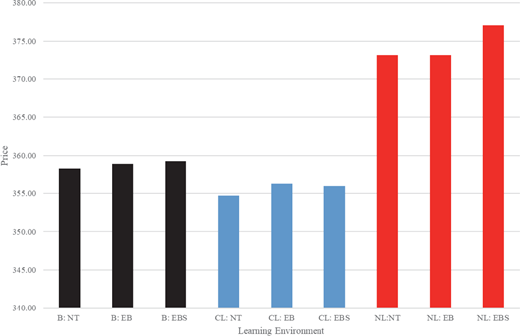
The cost-effectiveness of an auction mechanism could also be measured by the hectares placed under contract for each dollar in the budget, or the inverse: the average price paid to place a hectare under contract. These results are presented in Figure 3. The average number of hectares enrolled in the program is presented in Table 3.
In the auctions where there is no learning, the PES administrator pays about $358 per hectare and enrolls over 199,000 hectares into the program. When Landowner Agents are able to learn from members of their canton in the CL environment, the price per hectare is slightly lower (about $355) than in auctions with no learning and over 201,000 hectares are enrolled. Over the course of 10 years, this could represent substantial savings. On the other hand, in the NL environment, the price per hectare ranged from $373 to $377 and compared to the baseline and the CL environment, the least number of hectares are placed under contract.
Comparing Figures 2 and 3 raises an interesting point. Intuition suggests that if landowners capture more informational rents when they learn and bid strategically, they should also receive a higher price per hectare. However, in the CL environment, results show that while the program administrator is spending more money (several thousands) compared to an environment where there is no learning, they are also contracting more hectares.15 Thus, the price per hectare is lower. Conversely, in the NL environment, the program administrator is spending more money (several millions) for fewer hectares compared to an environment where there is no learning.
All of the auction scenarios resulted in an average price higher than the flat payment offered by FONAFIFO in the years examined.16 The most likely explanation for this is that our estimate of opportunity cost is inflated, at least in part because it does not account for the legal risk and the loss of on-site ecosystem services associated with deforestation. Both of these would reduce the net benefits of converting forest to agriculture and hence reduce the opportunity cost. The CL environment does result in average price per hectare that is closer to the actual payment during the time period examined. These results are consistent with an experimental study conducted by Duke et al. (2017). In an experimental PES conservation auction, they provided 180 participants with varying levels of public information, such as the auction budget and previous winning bids. Auction results were examined for efficiency measured by informational rents. The most efficient auction tested was a discriminatory price auction with partial information. This begs a question that we leave for future analysis; what is the optimal level of learning from the perspective of a program administrator that is seeking to maximize cost-effectiveness?
Equity in Participation
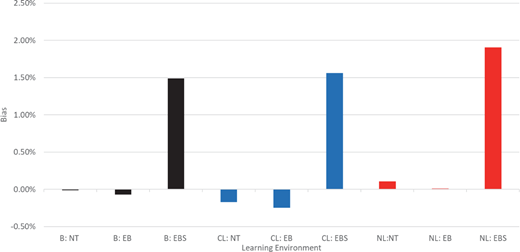
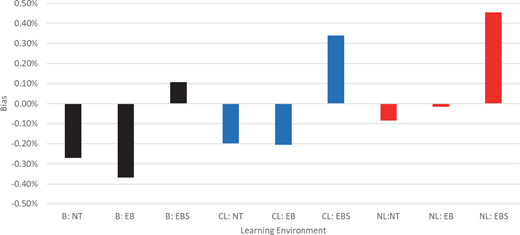
In addition to its primary goal of forest protection, the PSA program is intended and justified as a means to alleviate rural poverty. Therefore, we also examine participation by disadvantaged landowners, using two indicators of socio-economic status incorporated in the Matrix. The Matrix gives priority to owners of small properties and properties in low IDS districts. Strategic behavior could potentially have implications for participation by these two groups. We examine equity in participation in terms of under or over representation of these groups with a bias indicator that measures the difference between the percentage of participants and percentage of winners who own properties that are small or in low IDS districts. A negative (<0) bias indicates that the targeted social category was underrepresented among winners and a positive (>0) bias indicates an overrepresentation of the targeted group among winners.
Smallholders
The Matrix targets smallholders by awarding 25 extra points to their PSA forest protection applications. Figure 4 shows the bias in representation of smallholders among winners of the auctions at various levels of targeting, in each learning environment. In auctions where there is no learning, there is a negative bias in representation in auctions with no targeting and auctions with only environmental benefits targeting. However, there is a positive bias in representation in auctions with both environmental and social targeting. The pattern is similar in the CL environment. However, in the NL environments, there is a positive bias in representation in each auction, with the most positive bias in the auction with both environmental and social targeting.
Landowners in Low IDS Districts
The Matrix also prioritizes landowners in low IDS districts by awarding 10 extra points to their applications for forest protection contracts. Figure 5 shows the bias in representation for each learning environment and level of targeting. These results are similar to the smallholder analysis. In auctions with no learning, low IDS landowners are under represented in auctions where there is either no targeting or when only environmental benefits are targeted. However, when there is targeting for both environmental and social benefits, there is a positive bias in representation, i.e., overrepresentation of landowners in low IDS districts among auction winners. The same trend occurs in the CL and NL learning environments. Only auctions that targeted for both environmental and social benefits resulted in positive bias in representation for low IDS landowners among winners.
Conclusion
Conservation auctions have been advocated as a way to increase the cost effectiveness of PES programs, with supporting evidence from studies of one-shot auctions. In reality, PES programs such as Costa Rica’s PSA forest protection program offer contracts on an annual basis and thus could run annual auctions. When auctions are repeated, bidders have the opportunity to learn from previous bids. Landowners could use this information to strategically extract informational rents.
In this analysis, we develop an agent-based model (ABM) to examine the implications of incorporating a repeated auction into an existing PES program in which bidders are able to learn from previous auction results. Using the structure and data on participants in Costa Rica’s PSA forest protection program over the decade from 2005 to 2014, we model first price, discriminatory auctions in two learning environments. In the first environment, Canton Learning (CL), Landowner Agents learn from Winner Agents in their canton who won in the previous year’s auction. The Winner Agents in this environment give the Landowner Agents a “rough idea” of their winning bid. If Winner Agents submitted higher bids, Landowner Agents take this information as a signal that they can increase their own bids although not necessarily to the same level as the Winner Agent. In the second environment, Neighbor Learning (NL), Landowner Agents learn from Winner Agents who are their neighbors. The Winner Agents in this environment give the Landowner Agents their exact winning bid. If the Landowner Agents learn of winning bids higher than their own, they take this information as a signal that they have underestimated either the cost of participation or the value of the ecosystem services their land could provide. Thus, they increase their bid to match the Winner Agent’s bid. Three variations on first price, discriminatory auctions are considered: no targeting (as in the first 15 years of the PSA), environmental targeting (based on points allocated to applications from different zones since 2012), and both environmental and social targeting (based on the full Matrix of criteria used to prioritize applications since 2012). Outcomes are evaluated based on cost-effectiveness (measured by informational rents and price per hectare) and equitable participation (measured by representation of smallholders and owners of land in low IDS districts among winners).
Findings regarding cost-effectiveness are consistent with other ABM, field, and experimental studies that have examined the implications of learning in repeated auctions. In both learning environments, informational rents generally increase over time. However, the Canton Learning environment results in the government paying the lowest average price per hectare. Landowners capture more informational rents over the 10 years in the Neighbor Learning environment, as compared to the Canton Learning environment. Generally, in the Canton Learning environment, Landowner Agents have access to more Winner Agents than in the Neighbor Learning environment. In contrast, in the Neighbor Learning environment, Landowner Agents have access to the auction results from all previous years and directly adjust their own valuation in response to that information. Thus, these results suggest that when landowners share higher quality information (from more years and more relevant to valuation), there are more serious implications for the cost effectiveness of the auction. This holds true regardless of whether the auction incorporates targeting based on environmental and/or social priorities.
Targeting based partly on social priorities (owners of properties that are small and/or located in districts with low socio-economic status) does effectively shift participation towards the groups that are explicit priorities of the Costa Rican government. This result is robust across learning environments, suggesting that targeting can help address equity concerns. However, targeting could also potentially affect the way initial bids are formed, with landowners submitting higher bids for parcels that are higher priority. The relationship between targeting and the initial bid function should be explored in future analysis.
This analysis contributes to a growing set of literature examining the implications of strategic behavior by bidders in conservation auctions. We examine two possible ways that landowners can learn, but of course, there are many more ways that landowners can gain information about past auctions. For example, landowners could learn from their own experience in the auction and use that information to increase their future chances of winning and informational rents. In addition, we suggest that future work should consider social networks, both among landowners and between landowners and professionals, and draw on behavioral economics to model how landowners use information gained from their networks to bid strategically. Further, landowners may place more weight on recent information, such as winning bids in the most recent auction. Once all major channels of learning are accounted for, the next step would be to consider what level of learning (if any) would be optimal for a program administrator seeking to maximize cost effectiveness.
Appendix A: Landowner Initial Bidding Strategy
Each auction offers a 5-year forest protection contract. This is based on the actual contract duration for the PSA forest protection program for contracts awarded from 2005 to 2011 and 201417. Each bid submitted by the landowner is the bid per hectare for a 5-year contract to preserve the forest. The bidding strategy presented below represents how Landowner Agents determine their initial bid in stage one (see Figure 2).
The optimal bidding strategy used in the first price, discriminatory auctions for this model is based on Iftekar and Latacz-Lohmann (2017). They derive the optimal bid to maximize the net payoff in a first price discriminatory auction, considering both the probability of winning and the payment level as follows:
where is the optimal bid of an individual landowner; ci, the total cost to the landowner (opportunity cost and transaction cost); the cost of participation for the landowner with the highest costs; and N, the number of landowners participating in the auction.
Appendix B: Initial conditions for each time step, where time t0 = 2005
Previous studies have examined the effectiveness of second price, uniform payment auctions in developing countries (Jack et al., 2008; Jindal et al., 2013; Leimona et al., 2009). In these auctions, the weakly dominant bidding strategy is for the landowners to bid their opportunity cost (Vickrey, 1961, 1976). We add to this literature by examining first price, discriminatory payment auctions in a developing country context.
Targeting refers to any method of identifying and actively encouraging enrollment of prioritized areas (often areas deemed environmentally sensitive) or landowners in a voluntary conservation program (Alix-Garcia et al., 2008; Nordén et al., 2013).
There has been much more research in the lab regarding learning in different conservation auction formats, including by Schilizzi and Latacz-Lohmann (2007), who find that auctions only outperform fixed price schemes in a one-shot setting. As bidders in the experiment became more familiar with the auction and learned, the effectiveness of the auction decreased.
Landowners are told their score for each component of the EBI. However, landowners do not learn their exact EBI score because the precise weight given to each component of the score is not revealed (Claassen et al., 2008).
The ODD protocol is often used to describe ABMs in detail. The ODD protocol for this model is documented in James (2019) and can be accessed at https://www.srs.fs.usda.gov/pubs/59032.
In this ABM, the landscape is deterministic in that there are no random weather or climate events that alter learning behavior.
The transactions cost includes a 15% fee that the landowners pay to a forester or intermediary organization to create the management plan that is required in order to receive a forest protection contract.
Winner Agents are agents that won a contract in a previous auction. Winner Agents do not take part in the present auction but may share information about their winning bid with the Landowner Agents.
In the first-time step, there are no previous auctions winners; hence these Landowner Agents do not have the opportunity to learn.
This 10% increase is consistent with other work done by Hailu and Schilizzi (2004) and Lundberg et al. (2018).
Neighbors are agents that have properties adjacent to the Landowner Agent’s property.
There are a number of reasons why, in the real world, Winner Agents, like in the Neighbor Learning environment, would be truthful about bids. Perhaps trust among neighbors is important. This trust could be useful as neighbors may want to continue to share information as they re-enroll in the program.
Appendix A outlines the formula for calculating bids. Appendix B describes the initial conditions for each auction year (time step). A full description of the dataset can be found in James (2019).
Informational rents are not a direct measure of cost effectiveness, however, they are inversely related. We expect that as informational rents decrease, cost effectiveness will increase as more of the budget can be used towards awarding contracts.
Although the budget is fixed for each auction, the amount spent per auction can be different. For example, if there is $1 million left in the budget but the next offer by ranking is $1.5 million the offer cannot be accepted. In another auction if there is $1 million left in the budget and the next offer by ranking is $900,000 the bid will be accepted. Therefore, even though the budget is fixed, the amount spend per auction will vary.
For most of the years in this case study (2005–2011), FONAFIFO offered payments of $320 per hectare.
In 2012 and 2013 contracts were awarded for 10 years. However, for consistency in the model, contracts in these years will be awarded for 5 years.