This study aims to examine how institutional pressures shape the adoption, assimilation and integration of blockchain technologies in supply chain organisations. By combining Gallivan’s innovation assimilation model with institutional theory, the paper explains why blockchain projects frequently stall or regress.
Qualitative data from semi-structured interviews with blockchain vendors, adopters and ecosystem actors are triangulated with a systematic literature review to map institutional influences across assimilation stages.
The analysis identifies four institutional mechanisms; network legitimacy, coordinated uncertainty reduction, institutional paradoxes and cross-organisational cognitive reframing which collectively explain non-linear and uneven assimilation trajectories. Regulative, normative and cognitive pressures function as both enablers and constraints at different stages, particularly during routinisation and infusion.
The findings provide managers and policymakers with guidance on reducing institutional friction, aligning incentives across supply chain tiers and supporting stable governance and assurance structures required for sustained blockchain integration.
The study advances supply chain management research by showing how multi-tier governance, power asymmetries and certification regimes shape blockchain assimilation. It offers a multi-level explanation for why blockchain rarely progresses beyond early pilots into embedded, long term practice.
1. Introduction
Blockchain has been widely promoted as a technology capable of transforming supply chain coordination by enabling tamper resistant data sharing, enhanced traceability and multi-party trust (Karaduman and Gülhas, 2025; Samuels, 2025). Despite sustained interest, most blockchain initiatives in supply chain settings struggle to progress beyond small scale proofs of concept, with few reaching routinised or fully infused use across organisational tiers (Zhang, Jia and Chen, 2025). This persistent implementation gap highlights a core tension in the literature; while technical barriers such as interoperability and data heterogeneity are well documented, they do not adequately explain the uneven and frequently regressive trajectories observed in real world blockchain projects (Pawar and Alsedais, 2026).
A growing body of information systems and supply chain scholarship suggests that blockchain assimilation is shaped as much by its institutional environment as by technical or economic considerations. Regulative, normative and cognitive forces play a central role in how organisations interpret, adopt and embed new technologies (Scott, 2013; DiMaggio and Powell, 1983). In multi-tier supply chains, these pressures are amplified by structural characteristics such as downstream buyer dominance, certification regimes, inter organisational dependencies and uneven cost distribution (Della Valle and Oliver, 2021; Komulainen and Nätti, 2023). These factors shape not only whether blockchain is adopted, but how organisations negotiate the ongoing behavioural, organisational and governance adjustments required for deeper assimilation.
Despite these insights, prior research has not provided a process based explanation of how institutional forces evolve across blockchain’s progression from initiation to routinisation and infusion (Saberi et al., 2019; Choi et al., 2020). Existing studies typically examine either institutional pressures or assimilation stages in isolation. This provides limited understanding of how and why blockchain projects stall, regress or develop unevenly across supply chain tiers. In addition, the role of technology vendors, certification bodies and ecosystem actors remains under theorised. This is despite their central influence in shaping shared expectations, reducing uncertainty and affecting cross actor legitimacy (Barley et al., 2017; Kulkarni et al., 2024).
This study addresses these gaps by examining how institutional pressures interact with supply chain structures to shape blockchain assimilation over time. Drawing on qualitative data from blockchain vendors, adopters and ecosystem actors, we develop an integrated explanation of how four institutional mechanisms, network legitimacy, uncertainty reduction, institutional paradoxes and cognitive reframing, operate across assimilation stages and are intensified by supply chain structural amplifiers. In doing so, the study offers a multi-level account of why blockchain assimilation remains nonlinear and institutionally brittle, and what is needed to support more durable and widespread integration within supply chain environments.
The research is guided by three questions:
How do blockchain vendors support supply chain organisations in understanding and integrating blockchain-based interoperability?
What vendor capabilities influence early-stage blockchain adoption and assimilation?
How does blockchain progress from awareness to routinisation and institutionalisation, and what mechanisms shape this trajectory?
2. Theoretical background
2.1 Innovation assimilation
Because blockchain adoption evolves over a long and often uneven path, the innovation assimilation lens is well suited to analysing its progression in supply chain contexts. To address these gaps, Gallivan (2001) proposed a distinction between adoption, the decision to begin using a technology, and assimilation, which concerns the extent to which the technology becomes embedded into organisational routines and practices. Gallivan’s process framework demonstrates that assimilation unfolds through multiple stages and is shaped by both implementation events and the contextual factors surrounding them (Gallivan, 2001). This perspective is especially useful for complex innovations that require behavioural change, organisational redesign, and ongoing alignment between technical and organisational systems.
Applied to supply chain contexts, assimilation presents additional challenges. Technologies such as blockchain require consistent participation across multiple organisations rather than within a single firm. Studies of supply chain technology assimilation illustrate that external dependencies, supply network structures and cross firm coordination affect whether and how technologies become embedded (Ranganathan et al., 2004). This means that assimilation cannot be explained solely by internal organisational characteristics but must also account for inter organisational dynamics and shared governance structures. Therefore, while Gallivan’s framework provides a useful foundation for analysing how blockchain progresses from awareness to infusion, it does not fully capture the external, collective, and institutional forces that shape assimilation in multi-tier supply chain environments. To understand these dynamics, assimilation theory must be complemented by institutional theory, which explains how norms, regulations and shared cognitive frames influence cross organisational technology integration.
2.2 Institutional theory
Institutional theory explains how organisations adopt innovations in response to regulative, normative, and cognitive pressures rather than purely technical or economic considerations (Scott, 2013). Regulative forces stem from rules and compliance expectations, shaping whether firms regard recent technologies as permissible or risky. Diffusion scholarship shows that organisations adopt innovations more readily when the regulatory environment provides clarity and reduces uncertainty (Rogers, 2003; Fichman, 2000). Normative pressures arise from professional standards and industry conventions that signal what constitutes appropriate behaviour. Such norms can reduce ambiguity and guide adoption, particularly in emerging technology contexts where best practice templates help stabilise expectations (DiMaggio and Powell, 1983; Scott, 2013). Cognitive pressures reflect shared beliefs and interpretive frames that make certain technologies appear sensible or legitimate within an organisational field. Together, these pillars generate isomorphic pressures, coercive, normative and mimetic, that drive firms toward similar practices (DiMaggio and Powell, 1983). Institutional theory therefore provides a useful foundation for understanding blockchain assimilation, as it highlights how regulative, normative and cognitive pressures shape organisational responses to emerging technologies within complex supply-chain environments.
3. Conceptual framework: institutional mechanisms shaping blockchain assimilation
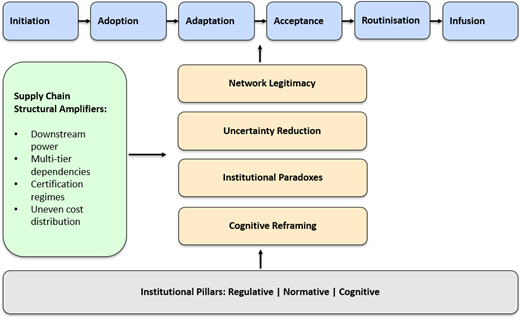
Blockchain assimilation in supply chains unfolds within an institutional environment shaped by uneven power, certification requirements and multi-tier interdependence (Mishra et al., 2024; Bae et al., 2024; Della Valle and Oliver, 2021). These conditions intensify organisational exposure to regulative, normative and cognitive expectations, influencing how blockchain is interpreted and enacted as projects move through assimilation stages (Saberi et al., 2019; Choi et al., 2020). To explain these dynamics, the conceptual framework integrates Gallivan’s six assimilation stages with institutional theory and supply chain specific structural characteristics. It proposes that assimilation is shaped by four cross stage institutional mechanisms that interact with supply chain structural amplifiers, producing non-linear, uneven, and sometimes regressive assimilation trajectories.
3.1 Overview of the framework
Figure 1 provides a visual representation of the integrated framework, showing how assimilation stages, institutional pressures, institutional mechanisms and supply chain structural amplifiers interact to shape blockchain assimilation trajectories.
As shown in Figure 1, blockchain assimilation in supply chains is shaped by multi-level institutional pressures and cross stage institutional mechanisms, which are further intensified by supply chain structural amplifiers. The following subsections elaborate these mechanisms and amplifiers. The framework identifies four institutional mechanisms that operate at each assimilation stage: network legitimacy, uncertainty reduction, institutional paradoxes and cognitive reframing. These mechanisms are further intensified by structural amplifiers inherent in supply chain relationships, including downstream power concentration, multi-tier interdependence, certification regimes and uneven cost distribution. Together, these elements provide a structured lens for interpreting blockchain assimilation across supply chain contexts.
3.2 The four institutional mechanisms
3.2.1 Network legitimacy
Network legitimacy reflects the influence of powerful supply chain actors whose expectations shape whether organisations progress with blockchain assimilation. Downstream buyers, brand owners and certification bodies define acceptable transparency and compliance standards, generating strong coercive and normative pressures that drive early stage adoption and shape interpretations of blockchain’s role (Thomas and Lamm, 2012; Gupta et al., 2023).
3.2.2 Uncertainty reduction
Uncertainty reduction captures the role of emerging standards, templates and assurance practices that help organisations navigate ambiguity about governance, compliance and data requirements. In multi-tier settings, uncertainty can only be reduced collectively, making blockchain assimilation dependent on coordinated norms, shared protocols and industry guidance (Keck et al., 2021; European Commission, 2023).
3.2.3 Institutional paradoxes
Institutional paradoxes arise when blockchain’s characteristics conflict with established supply chain norms. Examples include tensions between transparency and confidentiality, decentralised coordination and centralised accountability, and network level value and uneven organisational costs. These paradoxes create friction that can slow or reverse progression across assimilation stages (Hyland-Wood and Khatchadourian, 2018; Della Valle and Oliver, 2021).
3.2.4 Cognitive reframing
Cognitive reframing involves the gradual shift in how organisations interpret blockchain’s purpose and feasibility. Vendor education, benchmarking, cross actor learning and exposure to practical use cases encourage organisations to see blockchain as legitimate infrastructure rather than experimental technology (Barley et al., 2017; Kulkarni et al., 2024).
3.3 Supply chain structural amplifiers
Blockchain assimilation is also shaped by supply chain structural conditions that amplify the effects of institutional pressures and explain why progression is highly uneven across tiers.
3.3.1 Downstream power concentration
Supply chains often feature powerful downstream actors that define compliance and transparency expectations. These actors exert strong coercive and normative influence, accelerating adoption while placing disproportionate burdens on smaller suppliers (Thomas and Lamm, 2012; Gupta et al., 2023).
3.3.2 Multi-tier interdependence
Blockchain produces value only when multiple supply chain actors participate. Misalignment at any tier can delay or reverse assimilation, making progression contingent on coordinated governance, standards and data practices (Lynberg and Deif, 2023; Komulainen and Nätti, 2023).
3.3.3 Certification and assurance regimes
Certification bodies function as institutional gatekeepers by defining acceptable auditability, compliance and data-handling practices. Changes in certification requirements can disrupt or reverse assimilation, even after routinisation (Della Valle and Oliver, 2021).
3.3.4 Uneven distribution of costs and benefits
Although blockchain generates network-level benefits, integration costs often fall disproportionately on upstream suppliers, reducing incentives for sustained engagement and causing partial or stalled assimilation (Saberi et al., 2019; Choi et al., 2020).
These structural amplifiers interact with the four institutional mechanisms to shape assimilation trajectories, making supply chain blockchain integration particularly sensitive to legitimacy demands, uncertainty, paradoxes and cognitive alignment. The interaction between the four institutional mechanisms and the structural amplifiers outlined above highlights that blockchain assimilation depends on more than internal organisational readiness. Progression across assimilation stages is shaped by how organisations interpret and respond to shifting regulative, normative and cognitive expectations, as well as by the extent to which supply chain partners align around shared governance, compliance and data handling requirements. These influences do not operate uniformly. Instead, specific types of institutional pressure become more salient at different stages, reinforcing or constraining movement as organisations navigate uncertainty, legitimacy demands and evolving network expectations.
To clarify how these institutional pressures manifest across the assimilation trajectory, Table 1 summarises the dominant regulative, normative and cognitive drivers associated with each stage. The table integrates insights from prior literature with themes emerging from our qualitative data, providing a stage-by-stage view of the institutional landscape that shapes blockchain adoption, adaptation, acceptance and routinisation in supply chain settings. This mapping also supports the empirical analysis that follows by illustrating why certain pressures become more influential at particular moments, and how these pressures interact with the structural characteristics of supply chain networks to amplify or inhibit progression.
The patterns summarised in Table 1 highlight that assimilation is shaped by shifting institutional pressures whose influence varies across the six stages. While regulative signals are most salient in the early phases, normative expectations and cognitive alignment become more prominent as organisations move toward acceptance, routinisation and eventual infusion. These pressures do not operate in isolation. Instead, they combine with the four institutional mechanisms and the structural amplifiers outlined in the conceptual framework to create conditions that either support or hinder progression across stages.
4. Methodology
Our research methodology uses a comprehensive and integrated approach, combining systematic literature review (SLR), thematic analysis and semi structured expert interviews. This methodological triangulation approach ensures a deep understanding of the subject. We delineate this approach in the following sections.
4.1 Systematic literature review
The systematic literature review aimed to identify research on blockchain, institutional theory and assimilation. Following established guidance (Xiao and Watson, 2019; Boell and Cecez-Kecmanovic, 2015; Watson, 2015; Kitchenham and Brereton, 2013; Tranfield, Denyer and Smart, 2003; Webster and Watson, 2002), we conducted structured searches across five multidisciplinary databases: EBSCOhost, Google Scholar, ScienceDirect, Scopus and Web of Science. Search strings combined “Blockchain”, “Assimilation”, “Institutional Theory”, “supply chain”, “operations” and “logistics”, with searches limited to titles and abstracts to ensure relevance. After importing results into Zotero, duplicates were removed and titles/abstracts were screened using predefined inclusion and exclusion criteria. Full texts were reviewed where abstracts were unclear. The review included empirical, theoretical and grey literature relevant to the research questions, and excluded studies only tangentially referencing the keywords. Snowballing and researcher consultation were used to validate the completeness of the search.
4.2 Data collection
Data were gathered through semi-structured interviews, applying an exploratory qualitative approach well suited to the context dependent nature of blockchain assimilation within supply chain organisational environments. Drawing on best practices for reliability and transparency, the interview protocol incorporated elements from Myers and Newman (2007) and Carcary (2020), enabling adaptation and depth via tailored questions following participant responses.
A purposive sampling strategy was used to identify participants with direct knowledge of blockchain use, implementation, advisory work, regulation, certification or ecosystem coordination in supply chain settings. This was appropriate because the study sought detailed insights from actors with relevant experience of blockchain assimilation, rather than a statistically representative sample. The sample was designed to capture three perspectives central to blockchain assimilation in supply chains. Vendors were included because they support technical integration, client education and interoperability decisions. Adopters were included because they provide first hand insight into how organisations assess, pilot and embed blockchain in operational settings. Ecosystem actors, including consultants, legal specialists, policy actors and development agencies, were included because they help shape regulatory interpretation, standards development and cross organisational coordination. Participants were identified through professional networks, blockchain related industry contacts and supply chain innovation communities. Targeted referrals were also used where interviewees identified other relevant actors. To be included, participants had to have direct experience of blockchain related activity in a supply chain or ecosystem context. The use of semi-structured interviews allowed participants to describe their experiences in depth, while enabling follow up questions to be adapted to each organisational context. This is consistent with qualitative interview guidance in information systems research (Myers and Newman, 2007). Data collection continued until conceptual sufficiency was reached, with later interviews yielding no substantively new themes across the three stakeholder groups. This is consistent with guidance on assessing and reporting thematic saturation (Guest et al., 2020). The final sample comprised 24 participants: six vendors, ten adopters and eight ecosystem actors. These participants represented blockchain infrastructure, Web3, food and beverage, agriculture, fisheries, green technology, consulting, legal, policy and development agency contexts. This supported comparison across different positions in the assimilation process and helped capture variation across the supply chain network. As summarised in Table 2, participants comprised 24 key stakeholders from blockchain vendors, adopters and ecosystem actors across multiple European sectors, each possessing relevant organisational influence or practical experience of blockchain assimilation All interviews were conducted remotely via secure video conferencing platforms, following informed consent protocols regarding confidentiality, benefit, and risk disclosure. Interviews lasted 1–2 h, were audio recorded in English, and transcribed verbatim for analysis. Data collection continued until conceptual sufficiency was reached, with later interviews yielding no substantively new themes across stakeholder groups (Guest et al., 2020).
The data collected for this study were analysed using thematic analysis, a systematic and iterative process involving familiarisation, coding, theme identification and interpretation (Terry et al., 2017). This approach was selected because it accommodates both structured theoretical enquiry and the emergence of novel insights within complex organisational settings. To support consistency, transparency and analytical depth, all interview transcripts were uploaded into NVivo, which was used to manage coding, memoing and theme development. The analysis process combined deductive and inductive coding to generate a comprehensive understanding of participants’ perspectives. Deductive coding was guided by the study’s theoretical foundations, including institutional theory (Scott, 2013), isomorphic pressures (DiMaggio and Powell, 1983) and Gallivan (2001) assimilation stages, ensuring strong alignment between the literature and initial analytical categories. These early codes focused on concepts such as regulative uncertainty, normative expectations, cognitive framing, multi-tier dependencies, vendor roles and certification influences. At the same time, inductive coding was undertaken to capture unexpected ideas and emergent dynamics that were not anticipated in the initial framework. During coding, categories were refined, excluded or expanded to better reflect the nuances expressed by participants. Themes developed iteratively through cycles of coding and reflection. Patterns began to surface that connected individual and organisational experiences to deeper institutional dynamics, including tensions between regulatory compliance and transparency, uneven distribution of costs across supply chain tiers, the amplification effects of buyer power, and the significant role of vendors in providing cognitive scaffolding for adopters. NVivo’s hierarchical node system and query tools supported this process by enabling comparisons within and across participant groups, which helped reveal cross cutting themes that spanned multiple organisational tiers.
To enhance the rigour and credibility of the analysis, several validation steps were incorporated throughout. Firstly, analyst triangulation was used: a second researcher independently coded a subset of transcripts, and any discrepancies in interpretation were discussed until agreement was reached (Nowell et al., 2017). Secondly, code excerpt audits were conducted using NVivo node reports to ensure that themes were grounded in the data and not imposed by the theoretical frame (Lester et al., 2020). Thirdly, negative case analysis was used to retain excerpts that contradicted emerging interpretations, for example, stalled pilots, supplier withdrawal or reversals triggered by certification changes, ensuring that the resulting thematic structure did not overlook disconfirming evidence (Wiltshire and Ronkainen, 2021). Finally, an audit trail comprising coding logs, memos and decision notes was maintained in NVivo to document the evolution of codes and themes, supporting transparency and methodological robustness (Naeem et al., 2023). In the final stage, these interconnected themes were synthesised into a coherent narrative that captures the complex, context-dependent nature of blockchain assimilation across multi-tier supply chains. This narrative framework provided a comprehensive lens for interpreting the data and directly informed the stage-organised findings presented in the next section.
5. Findings
The Findings are organised according to the six stages of Gallivan’s assimilation model and apply the institutional mechanisms and structural amplifiers outlined in the conceptual framework. Each stage highlights how organisations interpret blockchain, respond to evolving institutional pressures and navigate tensions arising from multi-tier coordination, certification requirements and uneven participation incentives. By presenting the results stage by stage, the analysis illustrates how coercive, normative and cognitive influences shift over time, how institutional mechanisms such as network legitimacy and uncertainty reduction shape decision-making and how paradoxes and cognitive reframing contribute to the non-linear assimilation trajectories observed across the supply chain.
The patterns presented in Table 3 provide an overview of how different institutional pressures surface at each stage, illustrating the tensions, enablers and contradictions that shape blockchain’s progression across supply chain contexts. The sections that follow expand upon these patterns, presenting stage specific findings supported by participant quotations and linking them directly to the institutional mechanisms and structural amplifiers outlined in the conceptual framework.
5.1 Initiation: sensemaking, early frictions and regressions
At the initiation stage, assimilation is shaped primarily by early cognitive reframing and uncertainty reduction, as organisations attempt to make sense of blockchain while responding to diffuse legitimacy expectations. Early government strategies and regulatory signals helped spark organisational interest in blockchain, consistent with studies showing that coercive pressures often trigger initial engagement (Mishra et al., 2024). Interviewees noted that national digital agendas and industry conversations helped build awareness: “When we first started talking about blockchain, it was a brand new topic […] a big part of our job was to educate clients.” (P2) However, early regressions were common. Several organisations stepped back from exploration once regulatory, privacy or compliance teams reviewed the proposals: “There were companies excited at the start, but once compliance got involved, everything stopped. They felt regulations pulled them in two different directions.” (P6). This finding reflects broader evidence that conflicting institutional cues create uncertainty and slow early blockchain progress (Nadime et al., 2025). Confusion between blockchain and crypto markets also created cognitive barriers. Vendors’ efforts to normalise vocabulary and clarify non crypto use cases were central to mitigating these issues. This chimes with earlier observations that cognitive legitimacy is a prerequisite for initial traction (Liu and Zhang, 2024). These patterns illustrate how early cognitive reframing and unresolved uncertainty interact with downstream legitimacy demands, setting the foundation for later institutional paradoxes and uneven progression.
5.2 Adoption: threshold crossing and stalled pilots
The adoption stage is driven by heightened network legitimacy pressures and normative uncertainty reduction as organisations respond to regulatory signals and expectations from powerful supply chain partners. Many interviewees described how clear frameworks such as MiCA increased confidence in moving ahead: “Once frameworks like MiCA started to arrive, companies felt more comfortable because there were clear rules and regulated partners to work with.” (P20). External research supports this: coercive and normative pressures remain key predictors of blockchain adoption, especially when security and regulatory clarity are present (Mishra et al., 2024). Yet many pilots stalled. Upstream partners faced higher integration costs with fewer immediate benefits, generating misaligned incentives: “We got the pilot working, but our suppliers refused to keep going […] they were doing most of the work and couldn’t see the payoff.” (P13). This mirrors industry wide patterns where blockchain initiatives struggle due to uneven cost distribution and low supplier participation (Najati, 2025). A lack of agreed interoperability standards also delayed adoption. Interviewees highlighted contractual ambiguity around data formats and SLAs: “Creating SLAs is tricky because there aren’t established industry standards for blockchain yet.” (P4). These concerns reflect well documented interoperability challenges in supply chain blockchain integration (Kayıkcı and Subramanian, 2022). Together, these adoption stage dynamics demonstrate how network legitimacy and uncertainty reduction combine with uneven cost burdens to determine whether organisations advance beyond pilots.
5.3 Adaptation: aligning technology, governance and expectations
During adaptation, institutional paradoxes become more visible as organisations reconfigure systems to meet regulatory and certification requirements while attempting to maintain operational feasibility. Adaptation required organisations to configure blockchain systems, adjust governance practices and mobilise user buy-in. Interviewees noted that industry consortia, templates and shared governance frameworks helped reduce uncertainty. This aligns with findings that normative pressures and shared standards support adaptation in inter organisational technologies (Hastig and Sodhi, 2020). However, adaptation often exposed institutional misalignment. Regulatory requirements intersected with certification rules in ways that forced repeated redesigns: “We had to rebuild the entire data architecture when the certification update came out.” (P11). This reflects research showing that supply chain certifications function as gatekeepers whose evolving standards can destabilise blockchain solutions (Della Valle and Oliver, 2021). Cognitive alignment was another challenge. Interviewees described difficulties helping internal teams understand new roles associated with decentralised systems. This mirrors broader findings that blockchain implementations require substantial organisational sensemaking (Najati, 2025). These findings show how uncertainty reduction efforts interact with paradoxes created by certification updates and multi-tier dependencies.
5.4 Acceptance: building trust, professionalisation and cross actor legitimacy
The acceptance stage reflects the growing influence of cognitive reframing and normative legitimacy as organisations begin to internalise blockchain’s value and embed it in strategic planning. Interviewees described rising maturity: “[…] a big maturity over the last number of years […] less about proofs of concept and more strategic thinking about how to scale.” (P2). Professional certification bodies played a crucial role: “Certification is appealing because it complements existing processes and removes some control elements.” (P16). Prior studies note that normative expectations, especially around assurance, auditability and professional legitimacy, strongly shape blockchain acceptance in supply chains (Hastig and Sodhi, 2020; Chowdhury et al., 2022). Yet fragmented regulation continued to produce friction, with multi-jurisdictional supply chains struggling to reconcile differences in privacy, tracing requirements and data sovereignty. This confirms findings that regulatory divergence remains one of the most persistent institutional barriers to blockchain scaling (Nadime et al., 2025). Acceptance is achieved when cognitive reframing aligns with normative expectations, enabling organisations to treat blockchain as a credible, strategically relevant infrastructure.
5.5 Routinisation: institutional embedding and operational contradictions
Routinisation is shaped by the interplay of normative stability, network legitimacy and institutional paradoxes as blockchain becomes embedded into everyday workflows and compliance routines. This stage aligns with research highlighting the importance of embedded governance and process stability (Hastig and Sodhi, 2020). Consumers and buyers reinforced routinisation: “Consumers appreciate traceability more and are willing to pay more for food that can be verified.” (P15). “Supermarket chains […] require products to be certified by external organisations.” (P13). However, routinisation was vulnerable to contradictions between stability and innovation. Retailers encouraged rapid innovation and new blockchain use cases and certification bodies imposed strict, sometimes updated requirements. This institutional tension created regressions and operational friction, a pattern consistent with real world failures where governance ambiguity and confidentiality constraints impeded progress (Najati, 2025). These routinisation patterns show how paradoxes between stability and innovation remain active, particularly when downstream buyers or certification bodies impose new or updated requirements.
5.6 Infusion: strategic integration, scaling and reversals
At the infusion stage, assimilation depends on strong cognitive reframing and stable normative structures, as blockchain becomes integrated into long term strategy and industry wide expectations. Interviewees described blockchain as foundational: “[…] tracking the entire supply chain […] from production to retailers.” (P22). Cross sector learning and mimetic isomorphism supported infusion, echoing findings that firms adopt blockchain to remain competitive in rapidly changing markets (Mishra et al., 2024). Yet infusion was not always stable. Some organisations with mature systems had to roll back features due to new privacy laws or interoperability constraints: “We had a fully operational system […] but with new data-protection laws, we had to pause everything and redesign.” (P20). This underscores the nonlinear nature of blockchain assimilation. New regulatory, competitive or governance changes can trigger reversals, consistent with multi-stage models of digital disruption (Nadime et al., 2025). Across all stages, blockchain assimilation in supply chains is shaped by dynamic, shifting and sometimes contradictory institutional pressures. Interview evidence confirms that coercive, normative and cognitive pressures interact in complex ways; multi-tier coordination and certification regimes create interdependencies; adoption frequently stalls or regresses due to misaligned incentives; and routinisation and infusion remain vulnerable to regulatory and governance changes. These findings align with and extend contemporary research on institutional blockchain adoption in supply chains (Mishra et al., 2024; Najati, 2025; Nadime et al., 2025). These infusion stage dynamics reveal how institutional paradoxes and structural amplifiers can still disrupt assimilation, underscoring the non-linear nature of blockchain progression in supply chain settings.
6. Discussion
This study shows that regulative, normative and cognitive forces do not exert uniform effects across assimilation stages. Instead, they shift, combine and sometimes conflict with each other. This leads to non-linear assimilation trajectories. Early stage enthusiasm often regressed once firms encountered ambiguous or conflicting regulatory signals, a pattern consistent with broader findings that inconsistent institutional cues undermine blockchain adoption (Frederiks et al., 2024). Similarly, early pilots frequently stalled because suppliers perceived blockchain as costly, risky or misaligned with existing compliance frameworks. This echoes findings that uneven cost distribution and governance uncertainty weaken blockchain projects (Najati, 2025). Across the middle stages of adaptation and acceptance, the findings show how normative expectations such as, industry standards, certification protocols and professional assurance practices became central to reducing uncertainty. This supports previous evidence that normative alignment is a key enabler of blockchain legitimacy in supply chains (Hastig and Sodhi, 2020). However, even after early alignment, routinisation remained fragile. Certification updates or new privacy laws could force partial reversals of otherwise stable implementations. This aligns with Nadime et al. (2025) observation that regulatory change frequently disrupts blockchain integration. At the infusion stage, blockchain became strategically embedded yet still vulnerable. Interviewees described how new legal or governance requirements forced redesigns of already deployed systems. This demonstrates that infusion is not a final, stable stage but one subject to ongoing institutional renegotiation. Companies at infusion continued to respond to evolving rules, standards and legitimacy expectations, confirming that blockchain remains institutionally contingent even at advanced stages.
This study advances understanding of why blockchain assimilation unfolds differently in supply chains compared to other inter organisational settings. Three dynamics emerged clearly – Downstream power and network legitimacy: Our findings show that dominant retailers and lead firms drive coercive and normative pressures throughout the supply chain. Suppliers adopt blockchain partly to maintain legitimacy rather than to achieve internal efficiencies. This supports recent work highlighting the central role of nodal firms in shaping blockchain adoption across inter-organisational networks (Mishra et al., 2024). However, we extend this by showing that this power asymmetry persists through all stages of assimilation, influencing not only adoption but also adaptation, routinisation and infusion.
Multi-tier coordination and institutional interdependence: Supply chains depend on multi-tier information flows that require shared standards, aligned incentives and consistent governance. Blockchain’s value depends on network participation, one actor’s hesitation or misalignment can delay progression for all. This dynamic reflects broader evidence that blockchain assimilation requires coordinated governance and interoperability (Nadime et al., 2025). Our results show that misaligned incentives, fragmented regulatory obligations and inconsistent certification practices make multi-tier assimilation highly fragile.
Certification bodies as institutional gatekeepers: Certification and audit regimes emerged as powerful normative and regulative forces. Updates to certification requirements created regressions even in routinised systems, illustrating how blockchain remains tightly coupled to evolving assurance practices. This reinforces the central role of certification institutions in stabilising or destabilising supply chain digital innovations (Della Valle and Oliver, 2021). Together, these dynamics emphasise that blockchain assimilation in supply chains is shaped not only by organisational readiness or technological maturity but by ecosystem level legitimacy, compliance and governance dependencies.
The findings also clarify how the four institutional mechanisms identified in this study differ from more general accounts of blockchain adoption. Prior research often explains adoption through the presence or absence of institutional drivers, such as regulation, industry norms or perceived legitimacy. Our findings suggest that these drivers matter, not simply as external pressures, but through the mechanisms by which they are interpreted, coordinated and contested across supply chain actors. Network legitimacy explains why firms may continue or abandon blockchain initiatives depending on expectations from lead buyers, certification bodies and wider industry networks. Uncertainty reduction describes the practical work of translating unclear rules, standards and governance expectations into usable templates and routines. Institutional contradictions explain why blockchain can be simultaneously attractive and difficult to embed, particularly where transparency, confidentiality and decentralisation conflict. Cognitive reframing shows how blockchain moves from being viewed as an experimental or crypto associated technology to being understood as a credible infrastructure for traceability, assurance and coordination. This distinction is important because it shifts the explanation from whether institutional pressures exist to how they operate over time. The evidence suggests that the same pressure can enable movement at one stage and constrain it at another. Regulatory clarity, for example, can support adoption, but later regulatory change can destabilise routinised systems. Certification can legitimise blockchain use, but updated certification requirements can also create redesign costs and regressions. Similarly, downstream buyer expectations can accelerate adoption, while also increasing burdens for smaller suppliers. These patterns reinforce the need to treat blockchain assimilation as a continuing process of institutional negotiation rather than as a one-off adoption decision.
The discussion also extends assimilation theory by showing that progression across stages is not cumulative or secure. Initiation, adoption, adaptation, acceptance, routinisation and infusion are better understood as provisional states that can be interrupted by changes in regulation, standards, partner readiness or cost distribution. This is especially important in supply chains because value depends on participation across multiple tiers. A blockchain system may be technically functional within one organisation, but assimilation remains incomplete if suppliers, auditors, buyers or certification bodies are not aligned.
7. Theoretical contributions
This contribution is not presented as a wholly new theory of blockchain adoption. Rather, it refines and extends existing assimilation and institutional perspectives by explaining how established regulative, normative and cognitive forces operate across the stages of blockchain assimilation in supply chain settings. Prior studies often examine blockchain adoption as a decision shaped by institutional factors. In contrast, this study focuses on the process through which those factors are translated, negotiated and sometimes contested as blockchain moves from initiation to infusion. The four mechanisms identified here add explanatory value by showing how assimilation progresses, stalls or reverses across organisational and supply chain boundaries. The mechanisms also differ from broader institutional adoption constructs because they explain movement over time. Network legitimacy captures how buyer, certification and ecosystem expectations affect continued participation. Coordinated uncertainty reduction explains how actors turn unclear rules and standards into workable routines. Institutional paradoxes show why blockchain may be valued and resisted at the same time. Cross-organisational cognitive reframing explains how blockchain becomes understood less as an experimental technology and more as credible infrastructure for traceability, compliance and coordination. In this way, the study contributes a process-based account of blockchain assimilation rather than a static account of adoption drivers.
This study advances theory in three ways: Re-theorising assimilation as a dynamic, non-linear institutional process. Most existing research treats blockchain adoption as a discrete event or linear progression (Mishra et al., 2024). Our findings show that assimilation is non-linear, shaped by contradictory or shifting institutional pressures that produce regressions, stalls and reconfigurations. The concept of assimilation as a stable, cumulative process is replaced with a model of continuous institutional renegotiation.
Introducing four institutional mechanisms shaping supply chain assimilation: The study identifies four mechanisms, network legitimacy, coordinated uncertainty reduction, institutional paradoxes and cross organisational cognitive reframing that explain why institutional pressures shape blockchain assimilation differently in supply chain settings. These mechanisms extend prior institutional blockchain research by explaining not just where pressures matter, but why they produce specific assimilation trajectories.
Advancing supply chain governance theory: Blockchain assimilation reveals that supply chain governance is increasingly shaped by data driven legitimacy and assurance practices. Certification bodies, regulators and lead firms function as institutional orchestrators, shaping standards, data formats and expectations. This contributes to supply chain governance research by illustrating how institutional actors co-create digital infrastructures across multi-tier networks.
8. Implications for research, practice and policy
This section outlines how the study’s findings offer actionable guidance for managers, policymakers and ecosystem actors, as well as a clearer agenda for future research.
8.1 Managerial implications
8.1.1 Initiation: build shared understanding early
The findings show that organisations often step back during early exploration due to confusion about blockchain, regulatory ambiguity and misconceptions linking blockchain to crypto. Managers should therefore invest in early joint education efforts involving suppliers, auditors and compliance teams. This is consistent with research emphasising the importance of reducing institutional uncertainty at early adoption stages (Nadime et al., 2025).
8.1.2 Adoption: align incentives across the supply chain
Adoption frequently stalled when upstream suppliers perceived high integration effort with low returns. Managers should develop shared cost/benefit model to ensure all partners see value. Prior studies confirm that coercive pressure alone does not guarantee sustainable adoption when incentives are misaligned (Mishra et al., 2024).
8.1.3 Adaptation: stabilise governance before scaling
Adaptation efforts were often disrupted by certification updates and regulatory shifts. Managers should implement stable governance structures, version control for data standards and clear escalation pathways. This aligns with prior research showing that unclear governance and boundaries can derail blockchain initiatives (Najati, 2025).
8.1.4 Routinisation: codify processes to avoid regressions
Routinised systems risk breakdown when new compliance or certification requirements emerge. Managers should codify interoperability rules, audit procedures and data exchange standards to maintain stability. Prior work shows that routinisation depends on process consistency and operational discipline (Hastig and Sodhi, 2020).
8.1.5 Infusion: connect blockchain to long term strategy
Interviewees described infusion as a stage where blockchain supports sustainability, circular economy goals and cross sector learning. Managers should integrate blockchain into broader strategy rather than treating it as a technical solution. External studies show that blockchain’s strategic value emerges through its integration with wider transformation efforts, such as resilience and sustainability (Liu and Zhang, 2024).
8.2 Policy implications
Harmonise regulations across jurisdictions: Regulatory fragmentation created regressions even in advanced implementations. Policymakers should harmonise data protection, provenance and traceability standards across sectors and countries. This echoes recent reviews identifying regulatory inconsistency as a core barrier to blockchain scalability in supply chains (Nadime et al., 2025).
Support multi-stakeholder standards bodies: Unclear or inconsistent industry standards inhibited adoption and adaptation. Policymakers should fund or formally support standards setting consortia to accelerate normative and technical alignment. Prior research confirms that consortia play a critical role in reducing uncertainty and coordinating institutional expectations (Nadime et al., 2025).
Enable SME participation through targeted support: SMEs faced disproportionate integration costs relative to anticipated benefits. Policymakers can provide digital transformation grants, subsidised infrastructure access or shared service platforms to level participation across tiers. This aligns with empirical studies showing that uneven resource distribution weakens blockchain adoption across inter-organisational networks (Mishra et al., 2024).
8.3 Ecosystem implications
Vendors as institutional translators: Interviewees highlighted the importance of vendors in clarifying regulatory, normative and cognitive expectations. Vendors should continue to function as institutional translators, simplifying compliance and certification requirements for adopters. This reflects broader findings that blockchain projects succeed when vendors support governance, education and institutional alignment, not only technical integration (Najati, 2025).
Consortia as drivers of collective value: Consortia are positioned to mediate between regulators, lead firms and suppliers, reducing misaligned incentives and fostering trust. This is consistent with research highlighting that collaborative governance reduces institutional uncertainty and improves adoption outcomes (Nadime et al., 2025).
Certification bodies as stability providers: Certification organisations should provide stable, versioned audit frameworks compatible with blockchain solutions. Our findings showed that shifting certification requirements caused regressions after routinisation. This aligns with research identifying inconsistent assurance practices as a key barrier to blockchain continuity (Hastig and Sodhi, 2020).
9. Limitations and future research
While this study provides new insights into the institutional dynamics shaping blockchain assimilation in supply chains, several limitations should be acknowledged. These limitations create opportunities for future research to extend and deepen the findings.
9.1 Limited geographic and sectoral scope
The empirical data were collected primarily from European supply chain actors, including vendors, adopters and ecosystem organisations. Although this allowed for detailed analysis of blockchain assimilation within a relatively mature regulatory environment, the findings may not generalise to supply chains operating in regions with different regulatory structures, institutional norms or levels of digital readiness. Interviewees highlighted the influence of EU specific regulations such as MiCA on adoption decisions, indicating that institutional conditions may differ significantly elsewhere. Research shows that blockchain adoption is strongly shaped by national and sectoral institutional pressures (Mishra et al., 2024), suggesting the need for comparative studies across regulatory environments. Future research should therefore conduct cross regional and cross sectoral analyses of blockchain assimilation, focusing on how institutional pressures differ in emerging economies, less regulated markets or sectors with distinct governance structures.
9.2 Cross sectional design and limited longitudinal insight
The study used a cross-sectional interview design, capturing perceptions at a single point in time. However, blockchain assimilation unfolds over extended periods. Interviewees frequently described regressions, shifting standards and evolving regulatory obligations that influenced their assimilation trajectories, indicating that institutional pressures are dynamic and fluid rather than static. Prior research likewise shows that blockchain initiatives evolve through cycles of alignment and misalignment as institutional rules and expectations change (Rahman et al., 2024). Future research could use longitudinal case studies to observe how organisations navigate these institutional shifts over time, including how they respond to regulatory updates, certification changes or shifts in downstream buyer expectations.
9.3 Limited examination of technical configuration and platform variation
While this study captured broad experiences of blockchain integration, it did not systematically differentiate between specific blockchain architectures, governance models or technical configurations. Interviews indicated that differences in permissioned vs public blockchains, ledger governance structures and interoperability solutions affected assimilation challenges, but exploring these variations in depth was beyond the scope of the research. External research also highlights that blockchain adoption outcomes vary significantly depending on architecture and governance choices (Nadime et al., 2025). Future research could compare assimilation trajectories across different blockchain platforms or governance models, examining how technical choices interact with institutional pressures to shape adoption and scaling.
9.4 Limited focus on power and value distribution mechanisms
Although power asymmetry and uneven cost distribution emerged as central themes, the study did not conduct a formal power relations analysis. Interview data highlighted that downstream buyers and certification bodies exerted disproportionate influence over assimilation outcomes, while smaller suppliers bore higher integration burdens. Similar findings in external studies confirm that power dynamics can facilitate or hinder blockchain initiatives (Mishra et al., 2024; Najati, 2025). Future research should examine the institutional economics of blockchain adoption in supply chains, exploring how incentive misalignment, value distribution and power relations affect multi-tier participation.
Future research could build on this study in four main ways. Firstly, longitudinal studies could follow blockchain projects over time to see how they move forward, stall or reverse as regulations, certification rules and partner expectations change. Secondly, comparative studies across countries, regions and sectors could examine whether blockchain assimilation develops differently in other institutional settings. This would be useful because the present study focuses mainly on European supply chain actors. Thirdly, future studies could compare different blockchain designs, such as public and permissioned blockchains, to understand how technical choices affect assimilation. Finally, more research is needed on power and value distribution across supply chain tiers. This is important because smaller suppliers may carry much of the cost of integration, while larger downstream actors may gain most of the traceability, compliance and legitimacy benefits. These areas would help develop a fuller understanding of how blockchain assimilation varies across time, sectors, technologies and supply chain relationships.
10. Conclusion
This study examined how blockchain assimilation unfolds in supply chains by integrating Gallivan’s assimilation model with institutional theory. Using insights from vendors, adopters and ecosystem actors, the analysis shows that blockchain progression is shaped less by technical maturity than by changing rules, norms and cognitive frames across stages and supply chain tiers. Assimilation is not linear. Early interest often collapses when regulatory ambiguity or privacy concerns emerge. Adoption stalls when suppliers bear disproportionate costs, and routinised systems remain vulnerable to certification updates or legal changes. The findings highlight several supply chain specific dynamics. Downstream buyers and certification bodies function as powerful institutional anchors, shaping legitimacy conditions for suppliers. Multi-tier interdependence means that hesitation at one tier can stall progress for the whole network. Certification regimes function as gatekeepers whose evolving expectations can stabilise or destabilise blockchain use. The study also shows that blockchain creates network level value but imposes uneven costs upstream, contributing to stalled pilots and partial withdrawals. The research contributes theoretically by reframing blockchain assimilation as a dynamic institutional process rather than a technical or adoption driven progression. It identifies four mechanisms, network legitimacy, coordinated uncertainty reduction, institutional paradoxes and cross organisational cognitive reframing that explain how institutional forces shape assimilation across stages. These insights extend supply chain governance research by showing how regulators, certification bodies, consortia and lead firms collectively shape technological expectations and data practices. Practically, the study emphasises the need for early cross actor education, incentive alignment, stable governance structures and harmonised regulatory guidance. Vendors and consortia have a key role as translators and orchestrators, helping partners navigate evolving standards and interdependencies. While this research provides a clearer picture of blockchain assimilation, future work should examine cross regional differences, longitudinal trajectories, additional institutional dynamics and variations across blockchain architectures. Overall, blockchain assimilation in supply chains is revealed as an institutional, relational and multi-tier challenge, requiring sustained alignment across organisations, governance bodies and technological frameworks for its full potential to be realised.
Dr Colin Callinan is a lecturer at Atlantic Technological University, Sligo. In his role, Colin is involved in teaching courses in Information Systems and Business Analytics within the faculty of business. His research interests and publications revolve around technology adoption and innovation assimilation, with a special focus on blockchain technology.
Dr Trevor Clohessy is a Senior Lecturer in the Department of Mechanical and Industrial Engineering and a member of the Transcend research groups, Atlantic Technological University, Galway City Campus. With a multidisciplinary research profile spanning digital transformation, blockchain, artificial intelligence, cloud computing, business analytics, data visualisation, information systems and emerging technologies, he has developed a strong record of applied and interdisciplinary scholarship. His publication record includes work in recognised international outlets such as the Journal of Production and Planning, European Journal of Information Systems, Computers in Human Behavior, Information Technology & People, Industrial Management & Data Systems, Strategic Change and the International Journal of Sport and Exercise Psychology.
Dr Amaya Vega is a Senior Lecturer/Associate Professor in Economics at Atlantic Technological University (ATU) Faculty of Business and a Visiting Research Fellow at the Institute of International Economics at the University of Valencia, Spain. Amaya has over 20 years’ experience working on transport policy evaluation, focusing on passenger and freight transport demand analysis, maritime transport, and ports. Amaya is leading the transport research stream of the Atlantic Futures project, a €4million four-year cross-border research project funded by the North-South Research Programme. Amaya is the co-PI of the EMBRACE-Mobility project funded under the Research Ireland National Challenge Programme on Sustainable Communities and the ROBUST project, funded by the Sustainable Energy Authority of Ireland. Prior to joining ATU, Amaya was a Research Fellow in the Socio-Economic Marine Research Unit (SEMRU) at J.E Cairnes School of Business and Economics, University of Galway, where she is still and associate member. Amaya holds a Ph.D. (Economics) and M.A (Economics) degrees from University College Dublin, Ireland. She also holds a BSc in Business Administration and Management, from the Universidad Autónoma de Madrid, Spain. Amaya’s main research interests are in marine and maritime economics and policy appraisal, transport economics and microeconomic analysis, related to maritime transport and the valuation of the marine economy. Her work has been published by a number of the top ranked journals in the fields of transportation, marine studies and regional science.
Professor Graham Heaslip is Dean of the Faculty of Engineering and Computing and Head of Galway-Mayo College at Atlantic Technological University (ATU), and Professor of Logistics. An internationally recognised expert in logistics and supply chain management, his career spans academia, defence, professional sport, and humanitarian operations across Europe and Australia.Before joining ATU, Professor Heaslip held the position of Professor of Logistics at Hanken School of Economics, following his role as Associate Professor of Logistics at UNSW Sydney. He completed his PhD at the Logistics Institute, University of Hull, specialising in Civil–Military Cooperation and Coordination. His doctoral research was recognised with the prestigious James Cooper Memorial Cup, awarded by the Chartered Institute of Logistics and Transport for the best PhD in Logistics and Supply Chain Management. He is a Chartered Engineer (C.Eng.), a Fellow of Engineers Ireland (FIEI), and a Fellow of the Chartered Institute of Logistics and Transport (FCILT).Prior to his academic career, Professor Heaslip served for fourteen years in the Irish Defence Forces, including as an Explosive Ordnance Disposal (EOD) officer, undertaking a range of logistical appointments both nationally and internationally. During this time, he also worked in humanitarian settings through secondments to international aid agencies, gaining extensive operational experience in complex and crisis environments. He later served as Deputy Director of the Special Olympics World Games, and played professional rugby for Connacht and at Ireland squad level.His research explores the intersection of global logistics and supply chain management, humanitarian logistics, resilience, and organisational development, with a particular focus on how organisations adapt and respond in uncertain and disrupted environments. He is co-editor of a leading textbook on humanitarian logistics, now in its fifth edition.