This study aims to investigate how ambidextrous supply chain orientations – exploration and exploitation – independently influence eco-design adoption and environmental performance. Additionally, the moderating role of supply chain emissions data management practices on these relationships is examined.
A quantitative survey approach was used, gathering data from 158 firms operating across various industries in Finland. Data were analyzed using partial least squares-structural equation modeling to test direct and moderating effects among the constructs.
Results indicate that an explorative orientation significantly enhances eco-design practices and environmental performance, whereas an exploitative orientation directly improves environmental performance but does not significantly drive eco-design adoption. Moreover, supply chain emissions data management practices positively moderate the relationship between exploitation and environmental performance, emphasizing the value of emissions data in efficiency-driven operational improvements. However, supply chain emissions data management practices did not significantly moderate the relationships involving exploration or eco-design practices.
The sample size and geographic context may limit the generalizability of the findings. Future research should test the model in different industries and geographic settings, as well as explore additional contextual moderators and mediators that influence eco-design and sustainability outcomes.
This study contributes to the sustainable supply chain management literature by clarifying how explorative and exploitative orientations may align with short- and long-term expectations for sustainability in supply chains, shaping sustainable production practices and environmental outcomes in supply chains. Moreover, it provides novel empirical evidence on the moderating role of emissions data management practices.
1. Introduction
Across major markets, climate and product-policy frameworks are shifting environmental performance (EP) from a voluntary ambition to an operational expectation among firms and their supply chains. In Europe, instruments such as the European Climate Law, the Corporate Sustainability Reporting Directive and its European Sustainability Reporting Standards, the Ecodesign for Sustainable Products Regulation and the Carbon Border Adjustment Mechanism tighten the emphasis on environmental sustainability in product design, sourcing and supply chain decisions (European Union, 2021, 2022, 2024; European Commission, 2023, 2025). Because environmental impacts are often shaped by upstream material choices and downstream product-use and end-of-life outcomes, design-stage decisions often have an influential role in improving EP (Sarkis, 2012). In this context, research and practice treat eco-design practices (EDP), defined as embedding environmental considerations into product and process design, as a key mechanism for improving EP because EDP can reduce energy and material use, lower emissions and enable reuse and recycling across the supply chain (Zhu and Sarkis, 2004; Longoni et al., 2018; Cousins et al., 2019; El-Kassar and Singh, 2019; Graham et al., 2023).
A central challenge is that firms are expected to deliver both near-term, verifiable reductions in waste and emissions and longer-term sustainability improvements that require redesign of products and processes, often in coordination with supply chain partners (Schaltegger and Csutora, 2012; Czerny and Letmathe, 2024; Yenipazarli, 2026). Achieving both of these objectives simultaneously is difficult because they compete for organizational resources (Shi et al., 2024). Ambidexterity theory offers a way to contextualize this challenge by distinguishing exploitation (which emphasizes incremental optimization for efficiency) from exploration (which emphasizes experimentation and innovation), as distinct orientations that can shape sustainability-related actions in supply chains (March, 1991; O’Reilly and Tushman, 2013; Lee and Rha, 2016). Recent studies have begun to connect ambidextrous orientations with EP and sustainability-related processes (Gomes et al., 2020; Coelho et al., 2024; Laguir et al., 2024) and show that competitive and institutional pressures often stimulate such dual pursuits (Dai et al., 2015). What remains unclear, however, is how exploitative and explorative orientations become reflected in specific supply chain sustainability practices that can have major environmental outcomes across organizational boundaries, such as EDP (Sarkis, 2012). Prior research also tends to treat exploration and exploitation jointly in the context of environmental sustainability (Asiaei et al., 2023; Santos et al., 2025; Wetsandornphong et al., 2025), which limits insight into how the two orientations can translate into sustainability outcomes differentially. Addressing this gap also responds to calls for more nuanced insight into how ambidextrous orientations are used in practice in the context of green innovation (Peters and Buijs, 2022).
We focus on supply chain emissions data management practices (EDMP) as a second focal practice that has become salient under regulatory and stakeholder scrutiny. Firms are increasingly expected to develop verifiable product- and supply chain emissions information that can be shared across partners and used in product-related decision-making, for example, through emerging requirements for digital product information (European Union, 2024). EDMP enable organizations to systematically track, analyze and use supply chain-related emissions information in decision-making, providing the measurement, feedback and coordination to support both efficiency-driven improvements and design-related change (Schaltegger and Csutora, 2012; Hettler and Graf‐Vlachy, 2024; Vieira et al., 2024). Ambidexterity theory implies that exploitative and explorative orientations shape the kinds of sustainability improvement and innovation initiatives firms pursue in their supply chains, but whether these initiatives are reflected in EP can depend on the availability of emissions information that supports implementation and monitoring across partners. EDMP provide an enabling mechanism by making emissions sources more visible, rendering performance comparable through shared metrics and supporting coordination and accountability in inter-firm planning and decision processes (Luoma et al., 2023; Balci and Ali, 2024; Helo et al., 2024). These functions address a basic constraint in supply chains: improvement and redesign efforts often span multiple organizations, and without consistent emissions data, partners can misidentify hotspots, apply inconsistent baselines and face limited ability to track whether the implemented actions and outcomes are as intended. EDMP, therefore, is not expected to replace efficiency improvements or redesign efforts; it conditions whether such efforts can be targeted, aligned across firm boundaries, monitored and reflected in EP. Consistent with this argument, we theorize EDMP as a moderator that shapes the strength of the relationships linking exploitation, exploration and EDP to EP. Despite growing recognition of the importance of emissions-related data management practices in achieving net-zero supply chains (Balci and Ali, 2024; Mehmood et al., 2024; Schilling and Seuring, 2024; Steiner et al., 2024), research provides less clarity on how such practices support firms’ sustainability objectives, including supply chain decarbonization and the role of digitalization and emissions information in sustainability performance (Acquaye et al., 2014; Lerman et al., 2022; Vieira et al., 2024; Ellram and Tate, 2025).
We pose two research questions:
How are exploitative and explorative supply chain orientations associated with EDP and EP?
How do EDMP moderate the relationships linking these orientations and EDP with EP?
In our framework, orientations reflect strategic intent (optimize vs innovate), EDP capture that intent at the design and specification stage, and EDMP provide the cross-firm emissions information infrastructure that can condition how orientations and EDP translate into EP. We test the model using survey data from 158 firms in Finland and estimate a moderated-mediation structure with partial least squares-structural equation modeling (PLS-SEM), which supports simultaneous estimation of direct, indirect and moderating effects in complex models (Hair et al., 2013). We find that exploration is positively associated with both EDP and EP, whereas exploitation is positively associated with EP but not with EDP. Further, EDMP strengthens the exploitation–EP association, while no comparable moderation is observed for exploration or for the EDP–EP link. These findings clarify that exploitation and exploration are associated with design-stage sustainability practices and EP in different ways. They also show that emissions data management practices condition only specific relationships, rather than broadly strengthening sustainability outcomes across all studied pathways.
The rest of the study is structured as follows: Section 2 reviews the conceptual background. Section 3 develops hypotheses. Section 4 outlines the research methodology and data collection process. Section 5 presents the results. Section 6 discusses the findings and implications for theory and practice, as well as concluding the study with limitations and directions for future research.
2. Conceptual background
2.1 Ambidexterity in supply chains: exploitation and exploration for environmental performance
Organizational ambidexterity refers to the ability to pursue exploration and exploitation in parallel to achieve strategic objectives (March, 1991; O’Reilly and Tushman, 2013). Exploration involves search, experimentation and innovation, whereas exploitation emphasizes refinement, efficiency and incremental improvement based on existing knowledge and routines (March, 1991; O’Reilly and Tushman, 2013; Lee and Rha, 2016). In supply chains, exploitation is commonly reflected in leveraging existing supplier relationships, established technologies and proven processes to improve reliability and efficiency (Kristal et al., 2010; Lee and Rha, 2016). Supply chain exploration involves searching for novel approaches, experimenting with new partners or configurations and developing new knowledge across the supply chain. Prior research suggests that supply chain managers often need to support exploitative improvements in existing operations while enabling exploratory initiatives that introduce new approaches, which reflects the tension between operational refinement and more substantive change highlighted in sustainability contexts (Souza-Luz and Gavronski, 2019).
There are competing views on how organizations manage exploration and exploitation. While some studies suggest they exist on a continuum, requiring firms to balance activities in response to changing internal and external factors (Gibson and Birkinshaw, 2004), others argue they are independent characteristics, and the total magnitude of both contributes to high ambidexterity (Kristal et al., 2010; Junni et al., 2013). Our study adopts the latter perspective, where exploration and exploitation are measured as distinct yet complementary orientations (Lee and Rha, 2016).
Research suggests that ambidexterity can support sustainability performance by enabling firms to pursue efficiency-oriented improvements while also investing in innovation-oriented change (Dixit et al., 2022; Asiaei et al., 2023; Coelho et al., 2024). Evidence from supply chain and operations settings indicates that ambidexterity can be consequential for environmental and financial outcomes, including in logistics contexts and in balancing standardization with innovation in quality management (Gomes et al., 2020; Rintala et al., 2022). Recent studies likewise highlight the need to simultaneously manage exploratory and exploitative efforts across supply chain relationships to align actors toward sustainability goals (Kumar et al., 2021; Santos et al., 2025; Wetsandornphong et al., 2025). However, recent literature raises the possibility that treating exploration and exploitation as uniformly beneficial and equally actionable may be misleading: the two orientations can differ in both their environmental payoffs and the practical difficulty of enacting them in supply chains. For example, Peters and Buijs (2022) indicated that while exploration-oriented sustainability efforts can yield more substantial environmental improvements in contexts where product redesign and innovation are required, explorative activities are riskier to implement, and firms may instead often choose more conservative, efficiency-seeking practices. This tendency is also reflected in recent evidence that supply chain exploitation contributes more to EP than supply chain exploration, with exploitation showing a somewhat stronger association in their setting (Laguir et al., 2024). Lee and Rha (2016) found that when a firm experiences EP shortfalls, it is more likely to choose a risk-averse exploitation strategy. This asymmetry may be especially consequential in supply chains because environmental impacts and the actions needed to reduce them are distributed across partners, making coordination and shared information a central constraint. It follows that the sustainability implications of exploration and exploitation should vary across supply chains depending on the conditions that enable coordinated action, including supplier integration and digital capabilities (Zhao et al., 2021; Belhadi et al., 2022).
Despite these advances, existing research provides limited understanding on how exploitative and explorative orientations are addressed in practice in ways that translate into environmental outcomes, particularly with respect to design-stage sustainability practices in supply chains. This is a relevant omission because EDP can embed environmental impact reductions into products and processes early, shaping supply chain activities and also affecting what can be achieved through later efficiency improvements (Yin et al., 2023). In response to recent studies (Peters and Buijs, 2022; Laguir et al., 2024), it therefore becomes important to identify the specific practices through which the orientations are most likely to be expressed and reflected in EP, and to accumulate evidence on whether exploration and exploitation differ in both their environmental payoffs and their implementation.
2.2 Eco-design practices
EDP are defined as the integration of environmental practices into product and process design to promote more sustainable resource usage and minimize environmental impacts (Zhu et al., 2008). Prior research links EDP to life-cycle improvements, including reduced use of hazardous inputs and lower emissions arising from manufacturing processes and product use (Zhu and Sarkis, 2007; Schaltegger and Csutora, 2012). These design-stage activities are widely recognized as central for implementing environmentally responsible design and manufacturing strategies and have been associated with improved operational and sustainability performance in supply chains (Lefebvre et al., 2003; Yu et al., 2014; Balasubramanian and Shukla, 2017). Research further shows that performance benefits may be stronger when EDP are implemented with supplier involvement and when suppliers possess relevant environmental management capability (Wang et al., 2021), which highlights their interorganizational nature. EDP is often discussed in relation to sustainability innovation, but it can also be pursued through incremental design-for-efficiency refinements in existing technologies, processes and material use (Dangelico and Pujari, 2010; Bocken et al., 2016). This range of activities is consistent with ambidexterity theory. Exploitation aligns with design-for-efficiency refinements (e.g. lightweighting within existing product architecture or lowering energy usage in production), whereas exploration aligns with novel redesign and experimentation in materials, architectures and circular design principles (e.g. design for disassembly and recovery, modular product architectures, redesign for reuse and recycling).
We focus on EDP because they represent a comparatively high-leverage sustainability practice in supply chain management. Design decisions specify materials, architectures and process parameters that shape up- and downstream environmental impacts and constrain what can be achieved later through operational improvements. In this sense, EDP can “lock in” key elements of EP by setting requirements for manufacturing strategies and also for complementary or supporting sustainability practices, such as internal environmental management, purchasing and logistics, that must support the selected designs and material configurations (Zhu et al., 2007, 2008; Balasubramanian and Shukla, 2017). These design commitments also create information requirements: firms need to identify material emissions sources, specify which product and process parameters to track and coordinate emissions data contributions across supply chain actors so that environmental assessment is comparable and usable across organizational boundaries (Zhu and Sarkis, 2007; Schaltegger and Csutora, 2012).
2.3 Supply chain emission data management practices
Rising regulatory and stakeholder scrutiny has increased the salience of supply chain emissions as a central environmental concern for firms. In many industries, a substantial share of emissions originates outside the focal firm’s direct operations, which increases the importance of managing both direct and indirect emissions to improve EP (De Stefano and Montes-Sancho, 2024). Because emissions accounting and reporting impose comparatively strong requirements for standardization and comparability across firms, the role of emissions data is becoming increasingly elevated in supply chains and can have material effects on sustainability efforts (UN, 2025; Science Based Targets Initiative, 2025).
We define EDMP as the set of organizational practices used to collect, analyze and apply emissions-related information across the supply chain in decision-making and coordination. EDMP includes establishing emissions-related targets, developing routines and systems for emissions data collection and analysis across supply chain activities and using this information to support evaluation, reporting and improvement efforts (Acquaye et al., 2014; Balci and Ali, 2024). Prior research notes that systematic understanding of how firms use supply chain emissions data to support sustainability objectives remains limited, particularly regarding how digitalization and data practices enable EP improvement across interorganizational settings (Luoma et al., 2023; Helo et al., 2024).
EDMP are relevant in this study’s context because emissions data can improve the visibility of emissions hotspots and support more informed decisions about products, processes and supply chain configurations. For example, firms can assess emissions at the product or process level and use more reliable emissions information to support supplier–customer coordination and sustainability assessment and reporting (Luoma et al., 2023; Helo et al., 2024). However, EDMP also faces well-established constraints. Data security and privacy concerns can limit willingness to share data and affect compliance with regulatory requirements (Song et al., 2018). Research also shows that product-level life-cycle disclosures and related documentation can raise concerns about commercial sensitivity and risks of reverse engineering, which can reduce data granularity or restrict disclosure (Stenzel and Waichman, 2023). In addition, disagreements regarding life-cycle assessment choices and methodological conventions can yield variation in reported emissions and complicate comparability across firms and products (Rainville et al., 2015; Elias Mota et al., 2020).
These characteristics make EDMP particularly important in our study. Ambidexterity theory suggests that exploitative and explorative orientations shape sustainability-relevant actions, but in supply chain settings, whether such actions can be taken and become reflected in EP likely depends on the availability and usability of emissions information across supply chain partners. This notion is supported by recent research; for example, Shi et al. (2024) suggest that business analytics capabilities enable organizations to gain information to decide how to engage in exploitative or explorative sustainability practices. We therefore theorize EDMP as a moderating condition because it can strengthen emissions visibility, comparability and governance in ways that support targeting, coordination and verification of improvement efforts (Lopes de Sousa Jabbour et al., 2019; Busch et al., 2022). This moderating logic is especially relevant because emissions data practices and their standardization remain emergent, with shared definitions and rules still evolving, even as stakeholders increasingly demand evidence of progress and compliance with regulatory reporting requirements (European Commission, 2021; Busch et al., 2022).
2.4 Conceptual model development
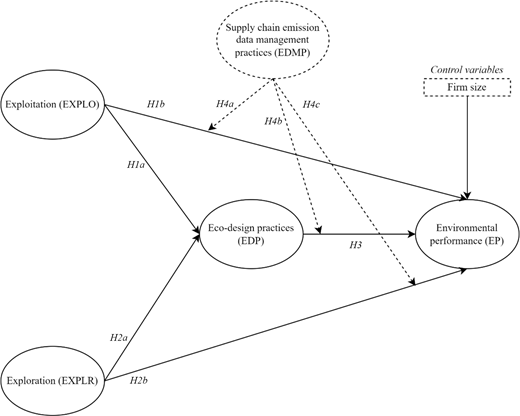
Figure 1 presents the conceptual framework grounded in ambidexterity theory (March, 1991; O’Reilly and Tushman, 2013). We model exploitation and exploration as distinct orientations that can be associated with EP through two pathways. First, orientations may relate directly to EP through efficiency-oriented improvement (more closely aligned with exploitation) and innovation-oriented change (more closely aligned with exploration). Importantly, we also test whether exploitation and exploration relate to EP indirectly through EDP, which captures product- and process design-related sustainability decisions. We further incorporate EDMP as a moderating condition. EDMP are expected to shape the extent to which orientation- and EDP-related efforts become reflected in EP by strengthening emissions visibility, comparability and accountability across supply chain partners (Schaltegger and Csutora, 2012; Hettler and Graf‐Vlachy, 2024; Vieira et al., 2024).
3. Hypotheses development
3.1 The effect of exploitative orientation on eco-design practices and environmental performance
Exploitation-oriented supply chains emphasize refinement, efficiency and incremental improvement based on existing knowledge and routines (Lee and Rha, 2016). In sustainability contexts, this orientation can align with design-related efforts that emphasize efficiency within established technologies and supplier relationships. Firms may draw on mature process knowledge and long-standing supplier ties to incorporate life-cycle considerations such as lean material use and energy minimization into product and process design. Consistent with this logic, recent evidence suggests that efficiency-driven ambidexterity facilitates incremental green innovation in quality systems (Gomes et al., 2020) and that exploitation-focused collaboration may accelerate carbon-neutrality maturity through green procurement (Luqman et al., 2024). At the same time, prior research cautions that reliance on existing technological and market competencies can be associated with marginal design changes and limited progress in environmental outcomes when exploitation is not complemented by exploration (Peters and Buijs, 2022). Relatedly, Cancela et al. (2023) reported that exploitation in product and technology development is not associated with firms’ sustainability outcomes. Building on these views, we expect exploitative orientation to be positively associated with the adoption of EDP, particularly where eco-design is pursued through incremental refinement and efficiency-oriented design choices.
Exploitation is also expected to be positively associated with EP. By tightening process controls and eliminating redundancies, firms can reduce resource inputs and emissions per unit of output, which can be reflected in EP outcomes. Laguir et al. (2024) reported a positive association between supply chain exploitation and EP outcomes, such as emissions reduction, arguing that established processes are more transparent and easier to incrementally improve (Laguir et al., 2024). Cao et al. (2023) link exploitation to broader sustainability performance through operational efficiency gains. This reasoning is consistent with the idea that incremental learning and process refinement can lower environmental footprints without requiring substantial redesign. Therefore, we expect a positive association between exploitative orientation and EP:
Exploitative orientation affects the adoption of eco-design practices.
Exploitative orientation affects environmental performance.
3.2 The effect of explorative orientation on eco-design practices and environmental performance
An explorative supply chain orientation is based on experimentation, risk-taking and the search for novel solutions, which are traits that expand the design space beyond familiar, efficiency-driven routines (Lee and Rha, 2016). Exploration can support the identification and evaluation of alternative materials, technologies and product architectures, as well as iterative redesign with supply chain partners, which are relevant for eco-design efforts such as reducing emissions and resource use, enabling reuse/recycle/recovery and avoiding hazardous inputs (Dangelico and Pujari, 2010; Deutz et al., 2013). Recent research argues that exploration-focused collaboration accelerates carbon-neutrality maturity by promoting cross-partner knowledge sharing and pilot projects (Luqman et al., 2024). Related work suggests that firms developing green products cultivate exploration at technological and market levels and accept greater uncertainty in development projects; their development projects are neither cross-contaminated by exploitation nor constrained by excessive focus on existing customers’ concerns (Peters and Buijs, 2022). Accordingly, we expect an explorative orientation to influence the adoption of EDP.
Exploration is also expected to be positively associated with EP. By investing in novel technologies and experimenting with new supply chain arrangements, firms may access expertise and learning that supports improved resource productivity and lower environmental impacts (Dai et al., 2015; Malacina and Teplov, 2022). Empirical studies report positive associations between exploration-led supply chains and environmental or broader sustainability performance outcomes (Dixit et al., 2022; Cao et al., 2023; Laguir et al., 2024). We therefore anticipate a positive association between explorative orientation and EP:
Explorative orientation affects the adoption of eco-design practices.
Explorative orientation affects environmental performance.
3.3 The effect of eco-design practices on environmental performance
EDP embed environmental criteria, such as material selection, energy efficiency, end-of-life recovery, at the product- and process-design stage, locking sustainability into the life-cycle trajectory of the offering. Because most of a product’s environmental footprint is determined during design (Zhu and Sarkis, 2004; Zailani et al., 2012), systematic EDP implementation can yield immediate reductions in resource use, emissions and hazardous substances. Empirical research supports this expectation. Studies report that circular-economy design measures improve energy conservation, waste reduction and pollution prevention across industries (Yin et al., 2023); firm-level surveys show positive links between EDP and environmental metrics in manufacturing (Sahoo and Vijayvargy, 2020) and ICT sectors (Sihvonen and Partanen, 2017). At the same time, prior research suggests that the strength of the EDP–EP relationship can vary with implementation quality and external validation. Yang et al. (2020) find that firms may implement EDP in a superficial manner when commitment to environmental management is limited or when operational priorities dominate, which can weaken performance improvements. Further, customer understanding of what is considered “green,” and how it is measured, can affect the incentives to implement EDP rigorously. For instance, life-cycle assessment routines embedded in design efforts may be viewed as unreliable due to subjectivity in setting system boundaries and variation in input data quality (Peters and Buijs, 2022). These considerations suggest potential attenuation in some settings, but the overall expectation remains that EDP is positively associated with EP:
Eco-design practices affect environmental performance.
3.4 The moderation effect of emission data management practices on environmental performance
Firms are increasingly integrating environmental data into their product and supply chain systems; however, there is a lack of efficient methods for managing and using this environmental data. This is due to several factors, including issues with data accountability, incompleteness, limited coverage of the value chain and the absence of common definitions and methodologies (Luoma et al., 2023). EDMP could provide granular and timely visibility into carbon hotspots across supply chain processes and supplier tiers, enabling managers to target high-leverage improvements and verify outcomes. In efficiency-oriented (exploitative) settings, this information intensifies the payoffs of standardization and waste reduction by directing incremental changes to where environmental returns are greatest and by institutionalizing monitoring routines in the supply chain (Melville and Whisnant, 2014; Helo et al., 2024). Recent research suggests that emissions-oriented data practices can help firms prioritize actions and evidence progress, particularly for incremental optimization in established processes (Luoma et al., 2023; Hettler and Graf‐Vlachy, 2024; Vieira et al., 2024). Accordingly, EDMP should have an effect on the relationship between exploitation and EP.
EDP embed lifecycle thinking at the point of product and process design (Lewis and Gertsakis, 2001; Zhu et al., 2008; Dangelico and Pujari, 2010). When complemented by EDMP, firms can quantify product-level impacts more consistently (e.g. product carbon footprints, environmental product declarations) (Ferguson Aikins and Ramanathan, 2020), compare redesign options on a like-for-like basis (e.g. materials, architectures for reuse/recycling, hazard substitution) (Schaltegger and Csutora, 2012) and govern the diffusion of revised specifications across suppliers through shared metrics and traceability (Acquaye et al., 2014; Helo et al., 2024). At the same time, because methodological choices and evolving standards in life cycle assessment (LCA) shape how emissions information is generated and interpreted, EDMP help align and standardize design-stage assessments across products and partners, strengthening comparability and reporting consistency (Rainville et al., 2015; Elias Mota et al., 2020). Thus, we expect that EDMP will moderate the EDP–EP link.
Explorative orientation emphasizes innovation and experimentation, which are essential for identifying breakthrough solutions to sustainability challenges in supply chains (Cao et al., 2023; Laguir et al., 2024). However, exploratory initiatives involve uncertainty about which options will scale and deliver measurable performance gains, and they often depend on knowledge-seeking activities and learning with supply chain partners. Empirical research shows that the capacity to acquire knowledge from supply chain partners is important for innovative product development (Lee and Rha, 2016). EDMP may support this learning by providing emissions-related feedback on pilots and trials and by enabling shared metrics for coordination and knowledge exchange across partners (Stekelorum et al., 2021; Luoma et al., 2023). Recent research likewise shows that practices aimed at coordinating across supply chain actors toward shared emissions reduction do not necessarily generate shared responsibility, which reinforces the importance of data practices that can support transparency and cross-partner coordination (Vieira et al., 2026). Thus, EDMP are expected to affect the ability of an explorative orientation to drive meaningful environmental improvements:
Supply chain emission data management practices moderate the relationship between exploitative orientation and environmental performance.
Supply chain emission data management practices moderate the relationship between eco-design practices and environmental performance.
Supply chain emission data management practices moderate the relationship between explorative orientation and environmental performance.
4. Research method
4.1 Sample description
The survey sample consisted of n = 158 respondents from various industries, with the majority representing medium-sized firms (51–250 employees), which comprised 58.2% of the sample. The questionnaire was sent to n = 481 firms by which the response rate is 33%. Large firms (over 250 employees) accounted for 39.2%, while small firms (11–50 employees) made up 2.5%. There were no responses from micro-firms (less than 10 employees). In terms of respondent positions, top management was the most represented group, making up 57.6% of the participants, followed by middle management at 22.8% and experts at 19.0%. A small proportion, 0.6%, held other roles. Industry representation was diverse, with the largest group, 38%, coming from the manufacturing sector. Other notable industries included construction (10.1%), commerce (5.7%), energy (5.7%) and logistics (5.1%). Additional industries such as ICT, the public sector, food and restaurant services and research and development were also represented, though in smaller numbers. This distribution highlights a broad range of perspectives from different organizational levels and industries, with a strong emphasis on larger firms and senior management roles. Respondent characteristics are shown in Table 1.
4.2 The survey instrument
This study uses a multi-dimensional survey instrument to assess various aspects of sustainability, including ambidextrous supply chain orientations, EDMP, EDP and EP ( Appendix). The survey questions are designed to measure an organization’s ability to effectively use existing resources, proactively seek out new opportunities, collect and analyze environmental data, design products and processes with sustainability in mind and reduce its ecological footprint through various metrics and practices. The survey instrument is grounded in validated measures from the literature.
Ambidexterity, exploitation (“EXPLO”) refers to an organization’s ability to optimize and use existing resources, processes and technologies to improve efficiency and productivity. This dimension focuses on leveraging operational competencies, reducing redundancies and enhancing current digital technologies to meet sustainability goals (Lee and Rha, 2016). The survey items assess the extent to which sustainability goals influence supply chain activities, such as improving existing processes and technologies.
Ambidexterity, exploration (“EXPLR”) refers to an organization’s pursuit of innovative supply chain solutions, experimentation and proactive identification of opportunities to improve sustainability outcomes. This dimension emphasizes innovation-driven activities such as finding novel approaches and experimenting with new practices to address supply chain challenges (Lee and Rha, 2016). The survey items reflect the degree to which sustainability goals drive exploratory activities in supply chain management.
Supply chain “EDMP” measure an organization’s capability to collect, analyze and use CO2 emissions data across the supply chain and product lifecycle to inform sustainability decisions. This includes identifying high-emission actors, leveraging data-driven insights to minimize environmental impacts to support sustainability assessment and reporting (Lopes de Sousa Jabbour et al., 2019; Busch et al., 2022; Luoma et al., 2023; Helo et al., 2024). The survey items also evaluate the ability to report lifecycle emissions and align practices with sustainability regulations.
“EDP” involve embedding environmental considerations into product and process design to reduce material and energy consumption, minimize hazardous substances and enhance the recyclability of products (Zhu et al., 2008). This construct evaluates an organization’s commitment to designing sustainable products and processes, focusing on reducing their environmental footprint through targeted eco-design initiatives.
“EP” captures the extent to which organizations achieve sustainability outcomes, such as reducing emissions, waste, hazardous material usage and environmental accidents. It also measures improvements in the overall environmental situation and the recycling rate of products. The items provide a holistic view of how organizations perform across multiple environmental dimensions (Zhu et al., 2007; Bocken et al., 2016).
5. Results
We used PLS-SEM to test the hypotheses, as the study’s data characteristics and research objectives align with a variance-based, prediction-oriented estimator. The distributional properties of the observed indicators were examined prior to model estimation. Tests of univariate normality using the Kolmogorov–Smirnov and Shapiro–Wilk statistics indicated statistically significant deviations from normality for all indicators (p < 0.001). Inspection of skewness and kurtosis values further showed that several items exhibited noticeable asymmetry and kurtosis, although all values remained within commonly accepted absolute thresholds. Overall, these results indicate that the observed variables do not meet strict normality assumptions, supporting the use of a distribution-robust, variance-based estimation approach. In addition to these distributional considerations, the research model specifies multiple direct, mediated and moderated relationships across several endogenous constructs, and the analytical emphasis is on explaining variance and predictive relevance (R2 and Q2) rather than reproducing an empirical covariance matrix. PLS-SEM is well-suited to these conditions because it imposes minimal distributional assumptions, accommodates complex models with latent variable interactions and performs efficiently with small-to-medium sample sizes such as ours (n = 158) (Henseler et al., 2014; Sarstedt et al., 2014; Hair et al., 2019). In contrast, covariance-based SEM typically requires stricter distributional assumptions and larger samples to yield reliable estimates for complex models involving interactions and multiple endogenous variables (Olsson et al., 2000; Flora and Curran, 2004). All analyses were conducted using SmartPLS 4.0 with 5,000 bootstrap resamples. Moderation effects were estimated using the two-stage approach, and model evaluation followed established PLS-SEM guidelines, including the assessment of variance inflation factors (VIF), effect sizes (f2), explained variance (R2) and predictive relevance (Q2) (Ringle et al., 2024).
5.1 Construct reliability and validity
The research instrument was assessed by reliability using the construct reliability (CR), construct validity using the average variance extracted (AVE) and discriminant validity (Fornell and Larcker, 1981; Gefen and Straub, 2005; Henseler et al., 2009). For CR, the coefficients should exceed 0.50 to ensure acceptable validity, with values above this threshold indicating good reliability (Little et al., 2002; Kline, 2011). The reliabilities of the measurements are presented in Table 2, which shows good reliability for all latent variables. The CRs of the latent variables were acceptable, ranging from 0.784 to 0.88 (very high). The factor structure of the measurement model was analyzed using significance, the weight of loadings and cross-loadings between the latent factors. All the loadings in the measurement model were significant at p < 0.05 and acceptable, ranging from 0.603 to 0.902. The convergent validity of all the latent factors was acceptable, and the AVE was greater than 0.50 for all the latent concepts, ranging from 0.519. to 0.749 (Fornell and Larcker, 1981). The discriminant validity of the measurement model was assessed by the cross-loadings of the measurement items, the square root of AVE and the heterotrait–monotrait (HTMT) criterion (i.e. the Fornell–Larcker criterion) (Gefen and Straub, 2005; Henseler et al., 2009; Hair et al., 2019). All the measurement items were highly loaded to the latent factors, and the cross-loadings varied from 0.098 to 0.606. The square roots of AVE were higher than the correlations between any of the latent factors, demonstrating the acceptable discriminant validity of the measurement model. Finally, the HTMT ratio between latent factors did not exceed the critical value for HTMT < 0.90, varying from 0.436 to 0.770.
5.2 PLS main path estimates and moderation effects
The main effects were analyzed as defined by the hypotheses. The parameters for estimating the PLS model were bootstrap sample n = 158 (equals the original sample) and resampling rate of 5,000 repetitions, which is adequate for estimating the parameters in the model (Henseler et al., 2009). The default model (Table 3) indicates that EXPLO does not have a statistically significant effect on EDP, but it does significantly influence EP. Consequently, hypothesis H1a is rejected, while H1b is confirmed.
EXPLR, on the other hand, demonstrates more consistent effects, with statistically significant relationships observed for both EDP and EP, though the effect on EP is relatively weaker. These results confirm hypotheses H2a and H2b. Furthermore, the analysis reveals a strong positive effect of EDP on EP, supporting hypothesis H3. All observed main effects are positive in direction.
The moderating effects of EDMP were tested to examine their influence on the relationships driving EP. The results indicate that EXPLO has a statistically significant positive interaction effect with EDMP, confirming hypothesis H4a. However, no significant moderating effects were found for the interactions of EDMP with EDP (H4b) or with EXPLR (H4c), leading to their rejection.
The post hoc analyses highlight that EXPLR exerts a significant total effect on EP, driven by both direct and indirect effects via EDP. This indicates that exploration leads directly to improved sustainability outcomes and facilitates the adoption of EDP, which in turn enhances EP. In contrast, EXPLO shows a significant direct effect on EP but no significant indirect effect via EDP, suggesting that efficiency-oriented practices improve sustainability outcomes without necessarily promoting EDP adoption.
5.3 PLS model quality, endogeneity and robustness
The quality of the structural model was tested and validated using the following steps:
collinearity issues and overall fit;
explanatory power;
path significances; and
an evaluation of potential endogeneity.
The collinearity and goodness of the model were assessed to validate the structural model. The VIF of the latent constructs did not indicate any serious collinearity issues when the highest value of the inner-VIF = 2.559 remained below the critical value of VIF = 5 (Hair et al., 2019). The explanatory power and predictive relevance of the model were evaluated using the proportion of the variance explained for an endogenous variable (R2), the predictive relevance of the model for an endogenous variable (Q2), and by the sizes and significances of the path coefficients in the structural model (Astrachan et al., 2014). In practice, the R2 is an indicator for the proportion of the variance captured in the endogenous constructs, and the Q2 provides an indicator of whether the endogenous construct can be accurately predicted by the structural model (Hair et al., 2014, 2019). The Q2 for the endogenous constructs must be positive to signal any predictive relevance, where other critical values are at 0.25 and 0.50, depicting the medium and large accuracy, respectively, of the structural model (Hair et al., 2019). A remarkably high level of R2 can also signal existing collinearity issues in the model, which should be considered with the VIF before the results are interpreted. The R2 for the latent variables in the path model were EDP = 0.386 and EP = 0.592. Q2 for the endogenous were EDP = 0.366 and EP = 0.460. The explanatory power and predictive accuracy of the model are acceptable but due relatively low sample size and complexity of the phenomenon results must be interpreted carefully, because multiple influences outside the tested model may exist (Abelson, 1985; Prentice and Miller, 1992). Nonetheless, the model has some out-of-sample generalizability potential. Finally, the model was evaluated using a Gaussian copula procedure to address potential identification issues in the empirical model to test the hypothesis (Hult et al., 2018; Hair et al., 2019). Through the assessment, none of the copulas showed significant effects at p < 0.05, which indicate low risks of pathological endogeneity.
Sample size requirements and, non-response and selection bias define the quality of sample in the PLS -modeling. The “10-times rule” provides a widely used rule of thumb for model-configuration-based sample size by which the minimum count of observations equals 10 times the maximum number of paths pointing to the latent in the inner or outer model (Hair et al., 2011). By following the rule, the minimum sample size is 60 observations. Furthermore, the statistical power of the sample is assessed by effect sizes (i.e. f2) of significant paths in the inner model which has critical values of 0.02, 0.15 and 0.35 termed as small, medium and large effect, respectively (Sullivan and Feinn, 2012; Hair et al., 2017; Haverila et al., 2020). The test statistics show that effect sizes vary from small to large effect (f2min > 0.034, f2max > 0.295), indicating meaningful relations and enough potential of the sample to provide enough statistical power. This distribution of effect sizes is consistent with expectations for multi-causal models in supply chain and sustainability research, where individual mechanisms typically exert incremental rather than dominant effects.
Endogeneity in empirical models may arise from omitted variables, simultaneity, measurement error, selection bias or socially desirable responding, potentially leading to biased parameter estimates and invalid inferences (Hill et al., 2021; Busenbark et al., 2022). The empirical model in this study is grounded in well-established constructs embedded in a theoretically motivated framework, and the hypothesized relationships have received consistent support in prior research. Consequently, the risk of bias due to omitted variables is expected to be limited. Simultaneity may nevertheless occur when constructs are conceptually related, measured using a single survey instrument or embedded in shared contextual conditions, which can inflate observed relationships and introduce endogeneity concerns (Baumgartner et al., 2021). To address this risk, common method bias was assessed using the full collinearity test procedure, which is particularly suitable for PLS-SEM applications (Kock, 2017; Baumgartner et al., 2021). This approach evaluates construct-level VIFs against the recommended threshold of VIF < 3.3, indicating the absence of severe common method bias (Kock, 2017). The results show that VIF values range from 1.412 to 2.203, suggesting that common method bias and related endogeneity concerns are unlikely to affect the model estimates.
Potential sources of bias were systematically assessed to ensure the robustness of the survey-based findings. Non-response bias was examined by comparing early and late respondents (Armstrong and Overton, 1977). The comparison revealed no statistically significant differences (p < 0.001) across observed variables, indicating that non-response bias is unlikely to be present. Response bias was further evaluated through diagnostic checks of response patterns, and no indications of systematic or atypical responding were detected. The responses to observed variables were first compared between industries which indicated no existing statistically significant (p < 0.001) differences between response patterns. To further strengthen confidence in the findings, the model included firm size as control variables. This control did not have a significant influence on the estimated relationships, suggesting that the results are not driven by sample composition or sectoral effects.
These analyses indicate that no pathological methodological issues were identified, providing additional assurance regarding the validity of the empirical results within the studied context. Importantly, the observed levels of explanatory power and effect sizes are consistent with expectations for complex organizational and sustainability-related phenomena, where outcomes are shaped by multiple interacting influences rather than single dominant drivers (Abelson, 1985; Prentice and Miller, 1992). Accordingly, the model is intended to offer theory-informing explanation rather than maximal predictive accuracy, and moderate R2 values and heterogeneous f2 effects are considered substantively meaningful in this context.
6. Discussion and conclusions
The objective of this study was to examine how exploitative and explorative supply chain orientations are associated with EP, how these associations may operate via EDP, and how EDMP shape these linkages. The findings suggest that exploration aligns with both EDP and EP, whereas exploitation aligns with EP but not with EDP; they further suggest that EDMP matter most for the exploitation–EP relationship. In what follows, we discuss these results in relation to prior research.
The study addresses our first research question on how exploitative and explorative orientations relate to EDP and EP. We found that exploitation is positively associated with EP (H1b) but is not significantly associated with EDP (H1a). This clarifies prior research linking exploitative orientations to EP by suggesting that exploitation may be more consistently associated with environmental improvement through broader refinement of existing supply chain operations than through design-related practices. These findings corroborate prior evidence that exploitative orientations often coincide with incremental environmental gains through process and quality-system improvements (e.g. continuous improvement routines, waste reduction, energy efficiency and tighter operational control), which can translate into performance outcomes even when the underlying product or system architecture remains largely unchanged (Gomes et al., 2020; Cao et al., 2023; Laguir et al., 2024). The non-significant exploitation–EDP association suggests a potential constraint in our setting: although EDP can include efficiency-seeking, the broader set of design commitments captured by EDP may more often require experimentation and departures from established routines that align more closely with an explorative supply chain orientation (Dangelico et al., 2017; Peters and Buijs, 2022). This distinction may have relevant implications because, in turbulent environments or under resource constraints, firms often gravitate toward incremental improvement as a lower-risk approach, even if it does not, by itself, advance the adoption of EDP (Laguir et al., 2024). An additional possibility is that EDP also frequently involve recombining knowledge across the supply chain (e.g. evaluating alternative materials, redesigning component interfaces or reconfiguring end-of-life architectures), and these tasks may be less compatible with a strong emphasis on refinement of current routines.
In contrast, we found that exploration significantly drives both EDP (H2a) and EP (H2b). This pattern is consistent with the view that proactive experimentation, openness to novel solutions and a forward-looking mindset expand the design space and enable the uptake of EDP (Zhu et al., 2008; Dangelico and Pujari, 2010). From an ambidexterity perspective, exploration directs attention and resources toward searching for new solutions and recombining knowledge across organizational boundaries, which is often necessary for design-stage sustainability changes that involve suppliers and downstream partners (March, 1991; O’Reilly and Tushman, 2013). In supply chains, explorative activities (such as new product design) commonly manifest in greater willingness to engage in joint problem solving and iterative redesign, for example, through supplier involvement, joint product development and the exchange of design-relevant information that enables new materials, reuse and recycling architectures or hazard substitution to be implemented at scale (Wang et al., 2021; Malacina and Teplov, 2022). Prior research similarly links exploratory orientation and collaboration to environmental outcomes (Dai et al., 2015; Dixit et al., 2022; Laguir et al., 2024; Luqman et al., 2024). In relation to this stream of research, our results clarify that EDP is likely a key route through which exploratory orientation is associated with EP. This interpretation is compatible with ambidexterity research that treats exploration and exploitation as distinct orientations with different roles in sustainability transitions (Lee and Rha, 2016; Junni et al., 2013). Previous research further suggests that exploitation is associated with efficiency (e.g. reduced material use and short-term, limited-scope goals), whereas exploration aligns with more significant, long-term changes (Jakhar et al., 2020; Peters and Buijs, 2022), which may further explain why H2a was supported while H1a was not.
The positive effect of EDP on EP (H3) indicates that design-related sustainability choices are associated with environmental outcomes. Decisions regarding EDP made at the specification and design stage can shape up- and downstream environmental impacts by embedding environmental considerations into material and energy choices, reuse and recycling architectures and hazard substitution, thereby influencing performance over the product and process life cycle. This finding aligns with the established evidence across different domains (Zhu et al., 2008; Dangelico and Pujari, 2010; Sihvonen and Partanen, 2017; Sahoo and Vijayvargy, 2020; Graham et al., 2023). Within our model, EDP also functions as a pathway through which exploration translates into performance: our post hoc tests show a significant indirect effect of exploration on EP via EDP, alongside a smaller direct effect, indicating partial mediation. At the same time, the magnitude of EDP-EP association is likely contingent on the extent to which design specifications are implemented beyond the focal firm, since design changes often require alignment with suppliers and other partners to translate into realized environmental improvements (Wang et al., 2021).
With regard to our second research question, we find that EDMP amplify the relationship between exploitation and EP (H4a), but do not significantly moderate the exploration-EP (H4c) or EDP-EP (H4b) relationships. These findings suggest that EDMP may not strengthen all sustainability pathways in the same way, and that its role may be more salient for improvement efforts that rely on standardized processes and monitoring. From this perspective, EDMP can be most aligned with exploitation because emissions information supports visibility and verification of incremental process improvements and coordination around efficiency-focused targets across supply chain partners (Schilling and Seuring, 2024; Vieira et al., 2024; Agrawal et al., 2025; Ellram and Tate, 2025). Efficiency-oriented improvements typically involve well-understood and standardized processes that can be monitored and validated through emissions data metrics (Gomes et al., 2020; Laguir et al., 2024). The remainder of this section discusses potential measurement and implementation-related contingencies and alternative interpretations for why comparable moderation is not observed for exploration or EDP.
The non-significant moderation of EDMP on the exploration–EP relationship (H4c) is consistent with the possibility that EDMP may be less consequential for innovation-driven sustainability outcomes than for efficiency-oriented improvement. One plausible explanation is that exploration yields environmental benefits that are harder to detect and validate in the short run. Exploration typically involves experimentation and risk-taking (March, 1991; O’Reilly and Tushman, 2013; Cao et al., 2023; Laguir et al., 2024), which means that its payoffs may be uncertain, emerge only over time or materialize in ways that current emissions metrics are not able to readily capture. This mismatch is also partially consistent with prior studies emphasizing that exploratory sustainability innovations are complex, uncertain and less predictable than efficiency-driven improvements (Dai et al., 2015; Dixit et al., 2022). Another explanation could be that EDMP, as operationalized here, emphasizes standardized emissions information practices in the supply chain, which may be better suited to tracking incremental changes in known processes than to evaluating exploratory initiatives whose effects are not yet widely diffused or routinized (Stekelorum et al., 2021; Luoma et al., 2023). The institutional setting may further reinforce these dynamics. In Finland, comparatively high regulatory expectations and digital infrastructure may lead to the prioritization of standardized and more verifiable emissions reporting, potentially strengthening the fit between EDMP and efficiency-oriented improvements (European Union, 2022; European Commission, 2024). Thus, EDMP adoption may not automatically enhance the performance benefits of exploration unless emissions information systems are designed to accommodate experimentation and longer time horizons (Rainville et al., 2015; Elias Mota et al., 2020).
The non-significant moderation of EDMP on the EDP–EP relationship (H4b) also suggests that they do not necessarily strengthen the performance consequences of eco-design in the way we hypothesized. An important consideration is that EDP often require emissions information at a level of specificity that may not be consistently available from supply chain partners. Design-stage choices typically depend on product- or process-specific emissions parameters that support comparing alternative materials, components and production configurations, whereas according to recent studies, supply chain emissions reporting is frequently aggregated, partially based on generic or average factors when primary data are unavailable, or constrained by limited willingness to share product-level emissions information due to commercial sensitivity and concerns about reverse engineering (Stenzel and Waichman, 2023; Vieira et al., 2024). For new materials and product configurations, even rough estimates for environmental considerations may not be readily available. A related explanation is that many established eco-design approaches can already embed emissions-related assessment through LCA and related design tools, which can reduce the incremental contribution of EDMP for strengthening the EDP–EP link (Zhu et al., 2008; Dangelico and Pujari, 2010; Acquaye et al., 2014; Bocken et al., 2016).
Overall, EDMP may remain unevenly diffused and not yet consistently integrated into design-stage decision routines across firms and their supply chains, which could attenuate interaction effects even if firms are improving emissions reporting practices (Hettler and Graf‐Vlachy, 2024; Vieira et al., 2024). EDMP appears most consequential when environmental gains are pursued through exploitation, where standardized emissions information supports monitoring, comparability and coordination around efficiency-oriented targets. The lack of comparable strengthening for exploration and for EDP is consistent with the possibility that these pathways rely more on design-relevant and forward-looking emissions intelligence than on reporting-oriented routines, including product-level data availability, supplier transparency and analytical routines that translate information into design choices. Thus, the implication here is that EDMP may currently yield its greatest environmental returns in contexts where improvements are verifiable and incremental, while offering more limited leverage for innovation-driven and design-stage sustainability pathways under the conditions captured in this study. While these explanations are plausible, our cross-sectional survey design does not allow us to adjudicate among them; we therefore outline measurement- and design-related avenues for future research in Section 6.3.
6.1 Theoretical implications
This study extends research on supply chain ambidexterity and environmental sustainability by clarifying how explorative and exploitative supply chain orientations relate to EP through design-related practices. Prior ambidexterity research has established associations between exploration, exploitation and EP, but has offered less clarity on how these orientations are expressed in supply chain sustainability practices (Junni et al., 2013; Laguir et al., 2024). Our framework and findings position EDP as a central practice through which an explorative supply chain orientation is associated with design decisions and, in turn, EP. In contrast, exploitation is more closely aligned with efficiency-oriented refinement of existing operations, which is often more implementable and monitorable in the near term, even when more substantive improvements require exploration and design-related change (Peters and Buijs, 2022; Laguir et al., 2024). This distinction clarifies prior research on ambidexterity and sustainable supply chain management by specifying that exploitation and exploration may not be interchangeable routes to EP: the orientations may differ in the type of sustainability improvement they support and in the likely time horizon over which gains materialize (Dangelico et al., 2017; Coelho et al., 2024).
A second implication concerns the potentially contingent role of emissions data in sustainability outcomes. Existing literature has frequently treated environmental measurement and reporting practices as homogenous, often discussed alongside broader environmental practices (Zhu et al., 2008; Balasubramanian and Shukla, 2017; Sahoo and Vijayvargy, 2020; Graham et al., 2023), whereas recent studies have called for more nuanced conceptualizations of sustainability-related capabilities and their performance implications in supply chains (Yang et al., 2021; Lerman et al., 2022; Schilling and Seuring, 2024). By distinguishing EDMP as a moderating condition, the study highlights that they may not strengthen sustainability pathways uniformly, but instead have more selective effects. EDMP seems to synergize especially well with approaches consistent with incremental improvements and optimization in the supply chain, which points to the particular usefulness of emissions data in more standardized product- and process environments, where data is sufficiently comparable and accountable across supply chain partners (Hettler and Graf‐Vlachy, 2024; Vieira et al., 2024; Ellram and Tate, 2025).
6.2 Managerial implications
Regulatory and stakeholder expectations increasingly require firms to demonstrate environmental progress through product and process design choices. Thus, our findings may provide practical guidance for firms seeking to improve their EP through EDP and EDMP. Managers aiming to integrate EDP in their supply chains should explicitly prioritize supply chain exploration – investing in innovation and experimentation. Proactive experimentation allows organizations to discover and implement novel sustainable practices, improving both EDP adoption and EP. Nonetheless, exploration is riskier and more uncertain than exploitation (Peters and Buijs, 2022) and can lead to economic losses if new outputs do not outperform existing solutions (Laguir et al., 2024). That is why the external business environment a firm is facing should influence resource allocation between explorative and exploitative activities. In a turbulent environment and in a case of scarce resources, exploitation may be a less risky choice for limited periods of time (Maletič et al., 2014; Laguir et al., 2024).
EDMP may enhance EP, especially in an efficiency-focused context. Managers should therefore consider implementing robust systems to systematically track, analyze and report emissions and related sustainability metrics. Such detailed data practices enable managers to more accurately measure environmental impacts, optimize existing supply chain processes and achieve incremental sustainability improvements. While exploitation directly contributes to environmental gains through incremental improvements, our findings caution against relying exclusively on this approach for long-term sustainability. Given that an exploitative orientation alone does not significantly enhance EDP, managers should explicitly supplement incremental optimization with proactive innovation initiatives. Rather than pursuing a generic “balance,” resource allocation decisions should reflect the understanding that incremental improvements and innovation-driven practices may serve distinct but complementary roles in achieving sustainable supply chain outcomes.
6.3 Limitations and future research
While this study provides robust findings, several limitations should be noted. The sample size is relatively small, which may affect statistical power and external validity. Although PLS-SEM is appropriate for small sample sizes and complex models, future research should assess the robustness of these relationships using larger data sets and alternative estimation approaches to strengthen confidence in the stability of the observed patterns.
The findings are likely most useful in industries where product design strongly affects environmental impact and where firms face rising pressure to measure and report supply-chain emissions. Examples include product- and material-intensive supply chains with large upstream emissions, where firms must balance quick, measurable improvements with longer-term redesign. Future research should test whether the same patterns hold in sectors and regions with weaker reporting pressure or less design-driven environmental impact.
Our empirical setting is limited to firms in Finland, which may constrain generalizability to institutional environments with different regulatory pressures, stakeholder expectations and digital infrastructures. Finland is characterized by comparatively high levels of environmental regulation and relatively advanced digital capabilities in organizations, which may facilitate both EDP and EDMP in ways that differ from contexts where regulatory enforcement is weaker or measurement infrastructures are less developed. Future research should therefore replicate the model in contrasting institutional environments (e.g. regions with less stringent regulation and lower reporting maturity, as well as regions where reporting requirements are rapidly tightening) to test the boundary conditions of the relationships observed here.
While we measured exploitation and exploration as distinct constructs, we did not investigate their interplay or balance. Future research could explicitly capture the synergies or trade-offs between these orientations, potentially revealing whether certain configurations better support sustainability transitions. Although we explored the moderating role of EDMP, the non-significant result for the exploration-EP pathway suggests there may be mechanisms that limit its relevance for early-stage innovation activities. Future work could use qualitative or mixed-method designs to examine how emissions data practices are (or are not) embedded in exploratory projects, including case studies of innovation processes where measurement practices are absent or emergent. Such approaches could also examine whether particular types of emissions data or technological systems are more suited to explorative versus exploitative settings. All firm characteristics that might influence EP, such as other internal strategies, employee training or environmental disclosure, were not included in the model because of the supply chain focus. Also, there may be other contextual moderators (e.g. stakeholder engagement intensity, industry-level sustainability norms) that shape the observed relationships. Investigating these factors would further refine the understanding of when and how strategic orientations and environmental practices interact to deliver performance outcomes.
Finally, our cross-sectional design and construct operationalizations limit our ability to distinguish among competing explanations, especially for the non-significant EDMP moderations. In particular, future research should directly measure emissions-data granularity, partner willingness to share product-level emissions information, and the degree to which EDMP is integrated into exploratory initiatives and design-stage decisions. Longitudinal and multi-source designs across different institutional contexts could further assess whether EDMP becomes more consequential for exploration and EDP as initiatives mature and as measurement infrastructures become more tightly coupled to design processes.
References
Further reading
Appendix. Survey instrument
Ambidexterity, exploitation (EXPLO)
Lee, S. M. and Rha, J. S. (2016) ‘Ambidextrous supply chain as a dynamic capability: building a resilient supply chain’, Management Decision, 54(1), pp. 2-23. doi: 10.1108/MD-12–2014-0674.
Evaluate how sustainability goals affect the development of the following supply chain activities: (1 = strongly disagree, 5 = strongly agree).
EXPLO 1 We focus on reducing operational redundancies in our existing processes.
EXPLO 2 We focus on developing strong competencies in our existing supply chain processes.
EXPLO 3 We focus on improving our existing technologies.
EXPLO 4 Leveraging our current digital technologies is important to our firm’s strategy.
Ambidexterity, exploration (EXPLR)
Lee, S. M. and Rha, J. S. (2016) ‘Ambidextrous supply chain as a dynamic capability: building a resilient supply chain’, Management Decision, 54(1), pp. 2–23. doi: 10.1108/MD-12–2014-0674.
Evaluate how sustainability goals affect the development of the following supply chain activities: (1 = strongly disagree, 5 = strongly agree).
EXPLR 1 We proactively pursue new supply chain solutions.
EXPLR 2 We continually experiment to find new solutions that will improve our supply chain.
EXPLR 3 We explore new opportunities to improve our supply chain.
EXPLR 4 We are constantly seeking novel approaches to solve supply chain problems.
Supply chain emission data management practices (EDMP)
Based on Luoma et al. (Luoma et al., 2023), Helo et al. (Helo et al., 2024), Lopes de Sousa Jabbour et al., (Lopes de Sousa Jabbour et al., 2019).
Compared to other firms in your industry, please evaluate your organization’s sustainability data management practices: (1 = low, 5 = high).
EDMP 1 Our organization is committed to quantitative CO2 emission reduction goals in the supply chain.
EDMP 2 Our organization is able to identify which supply chain actors contribute the highest emissions.
EDMP 3 Our organization is able to assess CO2 emissions in product/service level.
EDMP 4 Our organization makes data-driven decisions to impact our environmental footprint.
EDMP 5 Our organization is able to report product life cycle emissions for selected products (e.g. EPD reporting).
Eco-design practices (EDP)
Zhu, Q., Sarkis, J., & Lai, K. H. (2008). Confirmation of a measurement model for green supply chain management practices implementation. International journal of production economics, 111(2), 261–273.
Evaluate your firm’s commitment to sustainable development: (1 = low, 5 = high).
EDP 1 Design of products and processes for reduced consumption of energy.
EDP 2 Design of products and processes for reduced consumption of material.
EDP 3 Design of products and processes for reduced carbon emissions.
EDP 4 Design of products and processes for reuse, recycle, recovery of material, component parts.
EDP 5 Design of products and processes to avoid or reduce use of hazardous products and/or their manufacturing process.
Environmental performance (EP)
Zhu, Q., Sarkis, J. and Lai, K. (2007), ‘‘Green supply chain management: pressures, practices and performance within the Chinese automobile industry’’, Journal of Cleaner Production, Vol. 15 Nos 11-12, pp. 1041–1052. doi:10.1016/j.jclepro.2006.05.021.
Please indicate the extent to which you perceive that your firm has achieved each of the following during the past year: (1 = low, 5 = high).
EP 1 Reduction of air emission.
EP 2 Reduction of waste water.
EP 3 Reduction of solid wastes.
EP 4 Decrease of consumption for hazardous/harmful/toxic materials.
EP 5 Decrease of frequency for environmental accidents
EP 6 Improvement of an enterprise’s environmental situation.
EP 7 Improving the recycling rate of products*.
Note(s): *The item “Improvement in the recycling rate of products” was added by the authors to the original scale from Zhu et al. (2007) based on insights from recent literature (Bocken et al., 2016)