


Supply chain due diligence (SCDD) entails substantial information processing. Drawing on organizational information processing theory (OIPT), this study aims to examine SCDD-related uncertainties and the resulting organizational needs for managing human rights and environmental information across supply chains.
A multistage qualitative approach is used, combining a structured literature review and exploratory expert interviews to identify and refine uncertainties in SCDD-related information processing. Thirty-six stakeholders from economic (textile, food and automotive), societal and intermediary domains were interviewed. A cross-stakeholder comparison revealed differences in the salience of uncertainty and in the conditions shaping organizational information needs.
Ten SCDD-related information processing uncertainties were identified. All are relevant across stakeholder groups and sectors, with several consistently emerging as central, and others varying in salience across different organizational contexts. This study thus reveals organizational characteristics and structural constraints that amplify or attenuate information processing needs.
This study advances OIPT research by foregrounding context-sensitive and legitimacy-oriented information processing in multi-stakeholder settings. It lays the groundwork for future research on how organizations deploy information processing mechanisms and capacities to address SCDD-related uncertainties.
This study conceptualizes SCDD requirements as information processing uncertainties, thereby advancing research at the intersection of due diligence regulation and organizational information processing.
1. Introduction
The growing of supply chain due diligence (SCDD) legislation is reshaping the informational landscape in which companies operate (Koos, 2022; LeBaron and Rühmkorf, 2017). Regulations such as the German Supply Chain Due Diligence Act (GSCDDA) and the European Corporate Sustainability Due Diligence Directive (CSDDD) require large companies to assume responsibility not only for their own operations but also for social, environmental and ethical impacts throughout the multi-tier supply chain (European Union, 2024; Germany, 2021). SCDD prescribes a range of instruments, including human rights and environmental risk management systems, grievance mechanisms and reporting obligations. Importantly, the implementation of these instruments relies on the active involvement of relevant stakeholders, such as suppliers, industry associations, nongovernmental organizations (NGOs) and affected individuals (OECD, 2018). As a result, SCDD introduces new levels of transparency and information processing complexity, driven by the need to collect, interpret and integrate information on human rights and the environment across supply chains and by a shift from predominantly top-down compliance approaches toward more collaborative and participatory forms of governance.
A central challenge of successful SCDD implementation is the need to manage information effectively across supply chains so that implementing firms can meet regulatory requirements while adequately considering the needs and expectations of business partners, affected rights-holders and the broader socioenvironmental context (Hess, 2021; Smit et al., 2021). Organizations face multiple sources of uncertainty related to limited data availability, concealed information, power dynamics and insufficient engagement, which impede the effective assessment and communication of human rights and environmental conditions (Deva, 2023; Rogerson et al., 2024). While prior research has documented these challenges, less attention has been paid to how organizations process SCDD-related information in response to heightened uncertainties. Organizational information processing theory (OIPT) provides a useful lens for addressing this gap, as it conceptualizes organizations as systems that develop information processing capacities to cope with uncertainty (Tushman and Nadler, 1978).
However, previous OIPT research has largely focused on economic contexts and firm-centric decision-making (Bensaou and Venkatraman, 1995; Cegielski et al., 2012; Lu et al., 2023), neglecting sustainability-related information and the multi-stakeholder nature of SCDD. Given that SCDD-related uncertainties arise across organizational and supply chain boundaries, information processing must be understood from a stakeholder perspective (Buttke et al., 2024). Accordingly, this study adopts a stakeholder-oriented approach to examine information processing under SCDD. It addresses the following research questions (RQ):
How does SCDD shape information processing uncertainties from a multi-stakeholder perspective?
Which conditions influence how SCDD-related information processing uncertainties translate into organization-specific information needs?
This study uses the GSCDDA as an empirical case, as it represents one of the most comprehensive and controversial SCDD regulations and exhibits significant overlaps with the CSDDD (Koos, 2024). Building on a review of the existing SCDD literature, the study identifies a set of SCDD-related information processing uncertainties and explores these with 36 stakeholders from economic, societal and intermediary domains who are directly involved in GSCDDA implementation. The study contributes to the theory by conceptualizing SCDD requirements in terms of information processing uncertainties, thereby advancing research at the intersection of supply chain governance and organizational information processing. In doing so, it addresses a key gap by examining SCDD from an information processing perspective, which is central to organizational decision-making and the effective design of due diligence practices in supply chains. Moreover, the findings reveal the organizational and structural conditions under which SCDD-related uncertainties intensify or attenuate their effects on firms, allowing for differentiated assessments of organizational exposure. Finally, by adopting a stakeholder approach, the study advances a more comprehensive understanding of information management in SCDD contexts that goes beyond a firm-centric view and enhances the adaptability and legitimacy of due diligence processes.
2. Background
2.1 Supply chain due diligence
SCDD legislation is rooted in the framework proposed by Ruggie (2008) that effective respect for human rights requires robust global governance structures that ensure corporate responsibility, states’ duties to protect and access to remedy for affected rights-holders. These expectations of responsible business conduct were initially articulated through voluntary (soft-law) instruments, most notably the United Nations Guiding Principles on Business and Human Rights and the OECD Guidelines for Multinational Enterprises (OECD, 2018; United Nations, 2011). More recently, the concept has been translated into binding national legislation, including the French Duty of Vigilance Law (France, 2017), the Norwegian Transparency Act (Norway, 2021), the Swiss Ordinance on Due Diligence (Switzerland, 2021) and the GSCDDA, alongside the European CSDDD, which aims to harmonize SCDD requirements across the European Union. The objective is to prevent, mitigate and remedy adverse human rights impacts arising from corporate activities. Over time, this responsibility to respect human rights has been broadened to encompass environmental impacts, resulting in contemporary regulations that integrate both social and ecological due diligence, as exemplified by the GSCDDA and the CSDDD.
SCDD describes a process operationalized through a set of interrelated practices that structure how organizations generate, process and act upon sustainability-related information (European Union, 2024; Germany, 2021). The process includes aligning corporate policies with due diligence requirements to establish and communicate the company’s responsibilities across departments and toward customers and suppliers. The identification and assessment of actual and potential human rights and environmental risks form the basis for implementing preventive actions and remedial measures. To ensure affected people can report occurring complaints, an accessible grievance channel must be established. The company then communicates the manner in which it operationalizes SCDD through formal reporting. Finally, the effectiveness of these practices and their outcomes is evaluated through continuous monitoring. These practices are guided by several key characteristics outlined in the OECD Due Diligence Guidance for Responsible Business Conduct (OECD, 2018). Due diligence is conceived as risk-based, requiring companies to prioritize efforts according to the severity and likelihood of adverse impacts, rather than applying uniform measures across all supply chain activities. It should be integrated into corporate governance and operational processes and proportionate in scope and depth to the specific risk context. Furthermore, it is an ongoing and iterative process, requiring regular reassessment and adaptation over time. Finally, meaningful stakeholder engagement extends due diligence beyond firm-centric assessments by incorporating the perspectives and knowledge of affected external actors, thereby enhancing the identification, evaluation and management of adverse impacts (Buhmann et al., 2025; Smit et al., 2021).
2.2 Supply chain due diligence and information processing requirements
Building on established approaches in sustainable supply chain management (SSCM), SCDD is a regulatory development that embeds sustainability practices within a legally grounded and structured due diligence process characterized by a risk-based, integrated, iterative and stakeholder-oriented approach (OECD, 2018; United Nations, 2011). In doing so, SCDD intensifies information requirements in ways that have not been systematically examined from an information processing perspective.
Risk analysis is a core component of SCDD, as it detects and assesses human rights and environmental risks, supports early intervention and identifies severe cases requiring remediation. To obtain meaningful information, organizations must draw on multiple sources (e.g. country risk indices, media research and certifications; Buttke et al., 2022). In addition, preventive and remedial measures must be implemented in a targeted manner for the affected supply chains and rights-holders. A grievance mechanism should be established both within and beyond the supply chain to facilitate access to relevant information. Finally, the collected information and implemented measures must be systematically consolidated and reported formally.
With regard to the substantive scope of due diligence, companies must collect, assess and interpret heterogeneous forms of data related to human rights, environmental protection and ethical business conduct, as defined by international conventions and regulatory standards (ILO, 2010; Rotterdam Convention, 1998). These include standards on adequate remuneration, protection of life and personal safety, preservation of endangered species, restrictions on hazardous chemicals in production processes and prevention of ozone depletion (European Union, 2024). Importantly, these information requirements extend a firm’s own operations to encompass direct suppliers and, where substantiated risks exist, indirect business relationships beyond tier-1 suppliers. Information derived from (in)direct relationships is often fragmented, context-specific, dynamic and difficult to verify, while standardized procedures for generating reliable and comparable data across global supply chains remain limited (Deva, 2023; Quijano and Lopez, 2021; Smit et al., 2021). Similar challenges have been documented in modern slavery studies, where the absence of standardized indicators and reliable measurement approaches severely constrains organizations’ ability to detect and address violations (Esoimeme, 2020; Gold et al., 2015; New, 2015).
Furthermore, SCDD reconfigures how information is processed through its procedural characteristics. Risk-based prioritization requires systematic filtering and ranking of information, iteration mandates continuous updating and reassessment and integration increases cross-functional information flows within organizations (OECD, 2018). The principle of appropriateness also requires context-sensitive judgment regarding the depth and intensity of information collection and analysis in relation to specific risk profiles (cf. Germany, 2021). Most notably, stakeholder engagement extends organizational information processing by incorporating external actors, such as multi-stakeholder initiatives (MSIs), NGOs and intermediaries, into the interpretation and evaluation of due diligence information (Buttke et al., 2024). In addition, the engagement of directly affected people ensures that due diligence processes are informed by firsthand knowledge of risks and lived experiences (Buhmann et al., 2025). This “meaningful stakeholder engagement” is most effective when stakeholders are involved interactively throughout SCDD processes to identify shortcomings and adapt practices accordingly (Buhmann et al., 2024). This challenges predominantly firm-centric information processing approaches and introduces bottom-up perspectives that help balance economic, social and environmental considerations, thereby enhancing the relevance, credibility and legitimacy of corporate decision-making (Aaltonen et al., 2024). Taken together, the expanded informational scope and SCDD characteristics, particularly the inclusion of external stakeholders, extend organizational information requirements beyond those addressed in the literature.
2.3 Organizational information processing theory
OIPT draws on the concept of bounded rationality, which posits that decision-makers face inherent cognitive limitations that prevent them from fully processing all relevant information and evaluating all possible alternatives (Simon, 1947). Galbraith (1973) and Tushman and Nadler (1978) built on this foundation, conceptualizing organizations as information processing systems to examine how organizational structures and processes are designed to manage information processing needs. In this view, information processing is distributed across hierarchical and functional levels and is enacted primarily by managers and decision-makers, supported by organizational routines, structures and information systems (Daft and Lengel, 1986). Responsibility for organizational information processing does not reside in a single actor but is embedded in roles, governance arrangements and cross-functional mechanisms (Galbraith, 1973). The purpose of organizational information processing is therefore not merely the accumulation of data, but the reduction of uncertainty and the development of capacities that enable coordinated action and effective decision-making (Tushman and Nadler, 1978).
To address organizational information processing needs, organizations rely on a range of structural and technological mechanisms. Galbraith (1973) identified four design strategies: creation of slack resources, creation of self-contained tasks, investment in vertical information systems and creation of lateral relations. Subsequent research has extended these to encompass a broader range of mechanisms, including formal reporting systems, information technologies, process design and stakeholder collaboration (Bensaou and Venkatraman, 1995; Foerstl et al., 2018; Lorentz et al., 2020). The effectiveness of these mechanisms determines an organization’s information processing capacity, defined as its ability to handle information needs arising from environmental, relational and task-related uncertainty (Tushman and Nadler, 1978). A central construct in OIPT is information processing fit, which refers to the alignment between an organization’s information processing needs and its capacity (Galbraith, 1973; Tushman and Nadler, 1978). When such a fit is achieved, organizations can cope with uncertainty, improve decision quality and coordinate actions effectively. Conversely, misfit may result in degraded performance, as organizations either lack the capacity to process the information they need or invest in processing capacity that exceeds their actual requirements (Premkumar et al., 2005). As such, information processing fit serves as a core theoretical construct linking organizational design to organizational effectiveness (Daft and Lengel, 1986; Premkumar et al., 2005). Building on this logic, the present study applies OIPT to examine how SCDD generates information processing uncertainties and under which conditions these translate into organization-specific needs.
2.4 Information processing uncertainty
Information processing uncertainty refers to conditions in which the information required to perform tasks exceeds the information available to the organization (Galbraith, 1973). This encompasses not only deficiencies in data availability and quality but also contextual and structural factors that complicate the access, interpretation and integration of relevant information (Daft and Lengel, 1986). As uncertainty increases, organizations face greater information processing needs. The OIPT literature distinguishes three primary types of information processing uncertainty (Bensaou and Venkatraman, 1995; Cegielski et al., 2012; Premkumar et al., 2005; Tushman and Nadler, 1978):
task uncertainty arising when tasks are difficult to analyze or standardize due to insufficient knowledge, high variability, or strong interdependencies among organizational units;
interorganizational uncertainty stemming from dependencies between organizations, limited transparency and coordination challenges across supply chain relationships; and
environmental uncertainty referring to the volatility, complexity and dynamism of the broader environment in which organizations operate, including societal demands, market dynamics and technological developments that are difficult to predict or fully comprehend.
These uncertainty dimensions are directly relevant to SCDD contexts. SCDD involves integrative internal tasks, extensive cross-organizational coordination across supply networks and adaptation to rapidly evolving market, regulatory and societal expectations. Empirical research indicates that SCDD implementation is associated with pronounced information processing uncertainties, resulting from limited organizational expertise, fragmented and nonstandardized data, restricted visibility beyond tier-1 suppliers and the integration of heterogeneous stakeholder perspectives (Brandenburg et al., 2024; Bueno and Kaufmann, 2021; Deva, 2023; Smit et al., 2021). Consistent with OIPT research, such uncertainties constitute the primary drivers of organization-specific information processing needs (Lorentz et al., 2020). Understanding how SCDD-related uncertainties are perceived, interpreted and prioritized by organizational actors and relevant stakeholders is, therefore, a necessary precondition for specifying information needs and designing appropriate information processing mechanisms in due diligence contexts.
3. Research methodology
3.1 Research design
This study examines the types of uncertainties that emerge in SCDD contexts and how multi-stakeholder actors perceive them. To account for the complexity of global supply networks and the diversity of stakeholder perspectives in emerging due diligence contexts, a multistage qualitative design is used (Flick, 2022). In a first stage, a structured literature review is conducted to identify and conceptually organize SCDD-related uncertainties in information processing. This review serves two purposes:
developing a theoretically informed preliminary classification of uncertainty dimensions; and
providing a sensitizing framework to guide the empirical inquiry.
In the second stage, exploratory expert interviews are conducted to contextualize, critically assess and refine the literature-derived classification (Bogner and Menz, 2009). This empirical phase enables triangulation and facilitates a deeper understanding of how different stakeholder groups perceive and interpret uncertainty in due diligence settings.
Exploratory interviews are particularly well-suited to capturing actors’ sensemaking processes in complex, evolving environments (Bogner and Menz, 2009; Jain, 2021), especially where legal, ethical and organizational considerations intersect. The final analytical step includes a stakeholder cross-comparison, systematically comparing uncertainty perceptions across economic, societal and intermediary actors to identify alignments, differences and their implications for information-processing requirements. The GSCDDA serves as the empirical case context due to its regulatory comprehensiveness and substantive alignment with the European harmonization of CSDDD (Koos, 2024). The study focuses on stakeholders directly involved in GSCDDA implementation, monitoring or advisory activities across economic, societal and intermediary domains.
3.2 Literature-informed classification development
For the development of an initial classification of SCDD-related information processing uncertainties, a focused review of relevant academic literature on mandatory due diligence regulations and human rights due diligence was conducted. Given the relative novelty and evolving nature of SCDD regulation, the review followed a qualitative theory-informed approach rather than a fully systematic review design. The corpus comprised 34 publications identified through keyword searches of major academic databases (e.g. Scopus and Web of Science), screened for substantive engagement with information processing challenges.
Consistent with the interpretivist orientation of this study, uncertainties were not assumed to be explicitly stated in the literature; rather, they were identified through close reading of texts describing information processing challenges. The analysis focused on passages about topics such as challenges and was guided by the three overarching uncertainty dimensions derived from OIPT: task uncertainty, interorganizational uncertainty and environmental uncertainty. An abductive coding approach was used to link the information processing challenges reported in the literature to the theoretical categories (Timmermans and Tavory, 2012). For example, Smit et al. (2021) noted that “first-tier suppliers may not wish to disclose information about their suppliers and often protect their supply chain fiercely.” This challenge was categorized as “supplier dependence,” reflecting a subtype of interorganizational uncertainty. To enhance methodological rigor, the classification was reviewed and cross-validated by a second researcher, and discrepancies were discussed until consensus was reached.
3.3 Exploratory expert interviews
In the second stage, semistructured exploratory expert interviews were conducted between September 2024 and April 2025 to empirically refine the literature-based classification of SCDD-related information processing uncertainties (Creswell and Poth, 2016). To ensure the clarity and reliability of the interview guide, a pretest was conducted before data collection (Kvale and Brinkmann, 2009). Experts were selected through purposive sampling based on their sustained involvement in GSCDDA practices, particularly through roles in supporting, monitoring, or implementing due diligence processes over several years (Palinkas et al., 2015). The final sample comprised 36 experts from companies, trade associations, NGOs, MSIs, public authorities and intermediary organizations.
From the economic domain, 16 experts from companies subject to the GSCDDA and five representatives from trade associations were interviewed. The empirical focus was on the textile, food and automotive industries because these are classified as high-risk sectors under GSCDDA requirements (Weiß et al., 2020). To incorporate perspectives representing individuals and communities affected by human rights and environmental violations, two interviews were conducted with NGOs, three with MSIs and one each with an independent public institution and a public authority. In addition, eight intermediary actors, such as certification bodies and consultancies, were included due to their active involvement in audits and the implementation of GSCDDA measures. All interviews were conducted in German via Zoom. Each lasted 35–75 min and was audio-recorded and transcribed with the participant’s informed consent. Table A1 in the Appendix provides an overview of the experts, including their roles, years of experience and the abbreviations used in the findings and discussion sections.
The process illustrated in Figure 1 was intended to identify alignments, refinements, differences and inconsistencies emerging from practice. During the interviews, participants were asked to assess whether the identified SCDD-related information-processing uncertainties were perceived as uncertainties or had already materialized in practice. They were further invited to describe concrete instances, sector-specific variations and potential additional uncertainty dimensions. The literature-derived uncertainties were used as predefined deductive categories to which the interview statements were assigned. Inductive coding was applied to identify additional uncertainty dimensions not fully captured by the initial classification and where necessary, these dimensions were then integrated as new subdimensions. For instance, under the subtype “stakeholder involvement” (within the higher-order category of interorganizational uncertainty), a trade association emphasized the difficulty of establishing contact with directly affected workers for information, noting that “large plantations are characterized by high turnover among anonymous workers in the fields.” This insight led to a refinement of the classification, with the introduction of the subtype “consultation of vulnerable individuals,” which captures a specific information processing challenge related to stakeholder access.
 The three-stage flow diagram shows headings 1. Scope, 2. Stakeholder Assessment, and 3. Outcome. Under Scope, three stacked boxes contain Literature-based uncertainties, G S C D D A implementation context, and Relevant stakeholders. Arrows point to Stakeholder Assessment. This section contains three grouped categories. The Economic sector textile, food, automotive group includes Companies and Trade associations. The Societal group includes N G O s, M S I s, and Public sector. The Intermediary group includes Certification bodies and Consultants. Arrows point to four vertically stacked boxes labelled S C D D-related information processing uncertainties, Task, Inter-organisational, and Environmental. A final arrow points to the Outcome section with four stacked boxes labelled Alignments, Refinements, Differences, and Inconsistencies.
Iterative assessment and refinement process of SCDD-related information processing uncertainties
Source: Author’s own work
The three-stage flow diagram shows headings 1. Scope, 2. Stakeholder Assessment, and 3. Outcome. Under Scope, three stacked boxes contain Literature-based uncertainties, G S C D D A implementation context, and Relevant stakeholders. Arrows point to Stakeholder Assessment. This section contains three grouped categories. The Economic sector textile, food, automotive group includes Companies and Trade associations. The Societal group includes N G O s, M S I s, and Public sector. The Intermediary group includes Certification bodies and Consultants. Arrows point to four vertically stacked boxes labelled S C D D-related information processing uncertainties, Task, Inter-organisational, and Environmental. A final arrow points to the Outcome section with four stacked boxes labelled Alignments, Refinements, Differences, and Inconsistencies.Iterative assessment and refinement process of SCDD-related information processing uncertainties
Source: Author’s own work
A stakeholder cross-comparison was then conducted. Interview data were segmented by stakeholder group (cf. economic, societal and intermediary) and industry sector to enable systematic comparison of how different actors perceived, prioritized and interpreted SCDD-related uncertainties. This comparative analysis enabled the identification of alignments and differences in the perceived salience of uncertainty. In particular, it revealed instances in which identical uncertainty types were attributed high salience by some stakeholders but lower salience by others. In addition, cross-comparison facilitated the identification of overarching organizational and structural conditions, such as power asymmetries and resource constraints, that shape organization-specific information processing needs. Methodological reliability was ensured through systematic documentation of coding procedures, rule-guided categories and intercoder checks (Krippendorff, 2004). Validity was strengthened through data triangulation between literature-based categories and interview data, as well as through pretesting of the semi-structured interview guide (Kvale and Brinkmann, 2009).
4. Results
4.1 SCDD-related information processing uncertainties
Ten subtypes of SCDD-related information processing uncertainties were identified across the three higher-order categories: task, interorganizational and environmental uncertainty. Overall, there was broad alignment with the literature-informed dimensions, although differences in the perceived salience of specific uncertainties emerged (discussed in subsection 4.2). Beyond this alignment, several uncertainty subtypes were refined and complemented through stakeholder input. Figure 2 presents the literature-derived information processing challenges in SCDD and the corresponding literature-informed classification, alongside stakeholder refinements resulting in a stakeholder-enriched final classification. Table A2 in the Appendix provides the corresponding literature sources for each uncertainty subtype and indicates which stakeholder groups contributed to the respective refinements. The following description of the identified uncertainties is based on the data presented in Figure 2 and Table A2.
 The framework is a five-column comparison. The first column is titled O I P T uncertainty and groups entries into Task uncertainty, Inter-organisational uncertainty, and Environmental uncertainty. The second column is titled S C D D-related information processing uncertainties from the literature and lists uncertainty factors under each group. Task uncertainty includes reliability of data, triangulation of various data, diverse methods to identify modern slavery, dependence of moral corporate commitment, insufficient sustainability awareness, profit-driven tools, bureaucracy and costs, resources and costs, and bureaucracy impact. Inter-organisational uncertainty includes supplier power asymmetry, information concealment of suppliers, untrustworthy certifications, social auditing as weak measurement, audit fatigue, stakeholder engagement, top-down and bottom-up approaches, integration of rights-holders, remediation from the perspective of rights-holders, access to local knowledge, and surrogate accountability through stakeholders. Environmental uncertainty includes imbalance of local and focal firms, imbalance between industrialised and developing countries, socio-economic conditions, regional implementation limits, judicial system limits, government regulation, culture and traditions, lack of specification of appropriate measures, variety of global S C D D regulations and standards, and missing legal guidance. The third column is titled Literature-informed classification and contains labelled boxes connected to the literature items. The boxes are Data quality, Sustainability awareness, Resources and bureaucracy, Supplier power, Certification dependence, Stakeholder involvement, Socioeconomic structure, Regional restrictions, and Legal restrictions. The fourth column is titled Stakeholder refinements and lists additional refinement factors connected to each classification. These include data consolidation, validation and verification of data, digital system interfaces, handling large amounts of data, top management mindset, leadership responsibility, skilled sustainability personnel shortages, sustainability strategy planning, procurement practices, interdisciplinary dependence, supplier dependence, sole sourcing, confidential supplier data restrictions, dependence on risk analysis systems, profiteering of service providers, inflexibility of digital systems, stakeholder involvement phases, lack of structured methods, limited N G O resources, low grievance mechanism utilisation, affected individuals’ lack of clarity and fear of retaliation, bureaucratic burden for small and medium-sized enterprises, absence of monetary incentives, divergent mentalities, long-term transformation of S C D D, political monopolists, environmental issues such as biodiversity, consumer expectations, and volatile legislation. The fifth column is titled Stakeholder-enriched classification and contains boxes labelled Data quality and consolidation, Sustainability awareness, Resources and process flows, Supplier dependence, Agency dependence, Stakeholder involvement, Consultation with vulnerable individuals, Socioeconomic structure, Regional restrictions, and Sustainability demands.
Literature-based and stakeholder-refined classification of SCDD-related information processing uncertainties
Source: Author’s own work
The framework is a five-column comparison. The first column is titled O I P T uncertainty and groups entries into Task uncertainty, Inter-organisational uncertainty, and Environmental uncertainty. The second column is titled S C D D-related information processing uncertainties from the literature and lists uncertainty factors under each group. Task uncertainty includes reliability of data, triangulation of various data, diverse methods to identify modern slavery, dependence of moral corporate commitment, insufficient sustainability awareness, profit-driven tools, bureaucracy and costs, resources and costs, and bureaucracy impact. Inter-organisational uncertainty includes supplier power asymmetry, information concealment of suppliers, untrustworthy certifications, social auditing as weak measurement, audit fatigue, stakeholder engagement, top-down and bottom-up approaches, integration of rights-holders, remediation from the perspective of rights-holders, access to local knowledge, and surrogate accountability through stakeholders. Environmental uncertainty includes imbalance of local and focal firms, imbalance between industrialised and developing countries, socio-economic conditions, regional implementation limits, judicial system limits, government regulation, culture and traditions, lack of specification of appropriate measures, variety of global S C D D regulations and standards, and missing legal guidance. The third column is titled Literature-informed classification and contains labelled boxes connected to the literature items. The boxes are Data quality, Sustainability awareness, Resources and bureaucracy, Supplier power, Certification dependence, Stakeholder involvement, Socioeconomic structure, Regional restrictions, and Legal restrictions. The fourth column is titled Stakeholder refinements and lists additional refinement factors connected to each classification. These include data consolidation, validation and verification of data, digital system interfaces, handling large amounts of data, top management mindset, leadership responsibility, skilled sustainability personnel shortages, sustainability strategy planning, procurement practices, interdisciplinary dependence, supplier dependence, sole sourcing, confidential supplier data restrictions, dependence on risk analysis systems, profiteering of service providers, inflexibility of digital systems, stakeholder involvement phases, lack of structured methods, limited N G O resources, low grievance mechanism utilisation, affected individuals’ lack of clarity and fear of retaliation, bureaucratic burden for small and medium-sized enterprises, absence of monetary incentives, divergent mentalities, long-term transformation of S C D D, political monopolists, environmental issues such as biodiversity, consumer expectations, and volatile legislation. The fifth column is titled Stakeholder-enriched classification and contains boxes labelled Data quality and consolidation, Sustainability awareness, Resources and process flows, Supplier dependence, Agency dependence, Stakeholder involvement, Consultation with vulnerable individuals, Socioeconomic structure, Regional restrictions, and Sustainability demands.Literature-based and stakeholder-refined classification of SCDD-related information processing uncertainties
Source: Author’s own work
With regard to task uncertainty, three prominent intraorganizational challenges emerged from the literature. In particular, limitations in data quality and objectivity, such as difficulties in identifying reliable indicators of forced labor, are highlighted. Studies emphasize the need for data triangulation, drawing on diverse data sources and analytical techniques to ensure robust information on human rights and environmental issues (Chambers and Vastardis, 2020; Gold et al., 2015). The stakeholders were largely aligned with this uncertainty dimension. In addition, several stakeholder groups highlighted challenges with data consolidation and communication across fragmented digital systems. Improved system integration was perceived as a prerequisite for enabling the effective reuse and further processing of data, as illustrated by a textile company (T-C III):
Systems need to be developed that not only collect data but also consolidate it, that is, […] calculate data such as energy indicators and subsequently convert them into emission values.
Moreover, the literature suggests that insufficient sustainability awareness, particularly at the top management level, is limiting effective SCDD–related information processing (Fasterling and Demuijnck, 2013; Smit et al., 2021). Corporate moral commitment is considered decisive in setting organizational priorities and strategic orientations (Fasterling and Demuijnck, 2013). It is further argued that, in the absence of such commitment, due diligence instruments tend to be designed in a profit-driven rather than a rights-driven manner (Deva, 2023). Among the interviewed companies, leadership responsibility emerged as a key driver of sustainability-oriented data practices. In addition, stakeholders emphasized the importance of raising employees’ awareness. This includes both knowledge of SCDD-related information requirements and sensitivity to different motivational structures, as “a distinction between extrinsic and intrinsic motivation of employees is necessary, as both types of motivation need to be considered” (cf. Con I). A certification representative (cf. CF I) further noted, “The implementation of Eco-Management and Audit Scheme (EMAS) was driven by the workforce’s demand, to activate and leverage employees’ potential.”
Furthermore, the literature identifies substantial resource requirements and the high costs associated with SCDD-related information transactions as a significant source of task uncertainty (Buttke et al., 2024; Hofmann et al., 2018). The bureaucratic burden linked to due diligence requirements is likewise emphasized (Camoletto et al., 2022). SCDD requires cross-departmental collaboration and specialized expertise to process relevant data, and stakeholders highlighted dependencies across interdisciplinary units and the need to avoid fragmented or parallel processes (cf. T-C IV, Con I). As one societal representative (cf. NGO I) noted, the “integration of processes to prevent the emergence of data silos” is essential. Beyond internal organizational dynamics, an intermediary representative (cf. CF III) noted that “a great deal lies in the hands of purchasing companies, as forecasting determines whether overtime work is required or not [at suppliers].” These statements underscore how resource allocation and workflow coordination constitute additional sources of task uncertainty.
Interorganizational uncertainty arises from partnership dependencies, opportunistic behavior and insufficient stakeholder engagement. Such uncertainties arise within supplier relationships through power relations and concealed or falsified information (Bright et al., 2020; Deva, 2023), complicating the collection of reliable data. The stakeholders confirmed these dependencies, referring to limited supplier availability, single-sourcing strategies and preselected suppliers imposed by customers (cf. T-C IV, F-C III, F-C V). Contractual arrangements on the supplier side further restrict information access, including “limited access to information from indirect suppliers due to the protection of direct suppliers’ business secrets” (cf. A-C V). The literature further highlights reliance on social audits and certifications, as these mechanisms may be affected by local corruption or inconsistent certification quality, thereby undermining trustworthy data (Delalieux and Moquet, 2020; Nolan, 2022). From a practical perspective, this dependency extends to external agencies commissioned to conduct information-related activities. The stakeholders frequently emphasized reliance on service providers offering risk analysis and rating systems. This reliance was associated with concerns about misinterpretation of data (cf. T-TA I) and the “profiteering” behavior of service providers (cf. F-C I). Moreover, the stakeholders stressed that there is no one-size-fits-all software solution for managing SCDD-related information. As one economic representative (cf. A-C III) noted:
The product carbon footprint serves as an overarching example for CO2, but it will soon need to be extended to include water consumption as well as land and resource use, which will require an integrated system.
Furthermore, the literature emphasizes the importance of stakeholder involvement, including industry associations and MSIs, for ensuring that due diligence strategies align with stakeholder needs. It further highlights the need to include rights-holders directly and to establish surrogate accountability mechanisms that facilitate their participation in due diligence processes (Krajewski et al., 2021; Schilling-Vacaflor and Lenschow, 2023). The interviewees emphasized the absence of structured methods for engaging stakeholders, particularly before, during and after the due diligence process (cf. IPI I). A salient challenge concerns the consultation of vulnerable individuals directly affected by human rights violations, which is hindered by inadequate infrastructure, inaccessible or unknown grievance mechanisms and the risk of retaliation. One representative of the food sector (cf. F-TA I) noted that “on large plantations, there is a high turnover of ‘nameless’ workers in the fields, which makes it nearly impossible to identify affected individuals.” Beyond the broader category of stakeholder involvement, a distinct subtype, “consultation with vulnerable individuals,” was introduced.
Environmental uncertainty in SCDD arises from weak regional socioeconomic structures, cultural and judicial constraints and sustainability demands driven by regulatory and societal expectations. Studies highlight pronounced imbalances between industrialized and developing countries, where limited local resources hinder the implementation of sustainability standards (Hofmann et al., 2018; Schleper et al., 2022). Information-collection and reporting instruments may impose substantial costs on local firms, while buyer companies simultaneously lack reliable insights into actual on-the-ground improvements. As one trade association (cf. F-TA I) noted, “solutions need to be developed jointly, rather than shifting responsibility to the countries of origin.” Several stakeholders further noted the absence of financial incentives and the bureaucratic burden faced by small and medium-sized suppliers (cf. NGO II). Research also indicates that information processing is constrained in regions characterized by diverse judicial and cultural systems, where enforcement structures and transparency regarding human rights and environmental conditions are limited (Deva, 2023; Gold et al., 2015). The stakeholders observed divergent mindsets and varying acceptance of practices, such as child labor, as well as limited cross-cultural expertise within buyer companies. Several stakeholder groups emphasized respectful engagement as a necessary starting point. As a certification body (cf. CF IV) observed, “ways of thinking and mentalities differ across countries, and establishing mutual respect is the first prerequisite.” Appropriate mechanisms must therefore account for regional constraints, including the realistic level of management system given local socioeconomic conditions (cf. CF V).
Finally, legal ambiguity constitutes an additional source of environmental uncertainty. Emerging due diligence regulations often lack a clear specification of what constitutes “appropriate” measures (Malaihollo, 2021; Schilling-Vacaflor and Lenschow, 2023), while global variations in regulatory scope lead to inconsistent and sometimes conflicting requirements (Quijano and Lopez, 2021). The stakeholders similarly referred to insufficient regulatory guidance, particularly on environmental issues such as biodiversity, and criticized legislative volatility (e.g. the EU Omnibus Regulation). Beyond the formal regulation, stakeholders highlighted growing consumer expectations. A trade association (cf. T-TA I) noted “consumers are often overwhelmed, raising the question of how sustainability-related information can be simplified, for instance through labeling schemes […].” Accordingly, legal constraints were conceptualized more broadly to include sustainability demands emerging from both regulations and societal movements.
4.2 Stakeholder differences in perceived uncertainty salience
This section reveals variation in how SCDD-related information processing uncertainties are prioritized and assessed. Figure A1 in the Appendix presents a heatmap showing the perceived salience of uncertainties across stakeholders. To facilitate the interpretation of these differences, Table 1 provides an overview of stakeholder-specific salience assessments, along with illustrative quotations that explain the rationales for the classification of particular uncertainties as highly or less salient.
Stakeholder quotes illustrating differences in the perceived salience of SCDD-related information processing uncertainties
| SCDD-related uncertainty | Illustrative stakeholder quotes | Stakeholder group (ID) | |
|---|---|---|---|
| Sustainability awareness | Low | “Sustainability awareness is sector-specific” | Economic (T-C I) |
| “In most companies, sustainability awareness is already well established” | Economic (T-TA II) | ||
| “It is not perceived as a relevant issue, as companies in Germany are already legally required to comply due to existing labor protection and occupational safety regulations” | Intermediary (CF IV) | ||
| High | “Leadership and cultural awareness require a top-down mindset change” | Economic (A C I) | |
| “There are hidden agendas at the top management level, where one thing is communicated while another is actually intended but not openly disclosed” | Intermediary (CF I) | ||
| Supplier dependence | Low | “There is strong cooperation with suppliers in the outdoor industry” | Economic (T-C II) |
| “Suppliers are also affected by the German Supply Chain Due Diligence Act or have been made aware of it through other industry partners” | Economic (F-C V) | ||
| “Suppliers are generally willing to cooperate, as sourcing is primarily regional within Germany” | Economic (A-C II) | ||
| “It is rare that measures cannot be enforced, particularly when suppliers are tied to procurement decisions” | Economic (A-C IV) | ||
| High | “Lower market power vis-à-vis raw material suppliers was frequently observed, as competitors are often larger” | Economic (F-C IV) | |
| “A traditional procurement approach persists in which information is not shared due to concerns over trade secrets” | Economic (A-C V) | ||
| “There is a strong dependence on suppliers due to prices and availability” | Economic (F-C II) | ||
| “The sector is dominated by large players, which leaves small and medium-sized enterprises with limited influence” | Societal (MSI I) | ||
| “Single sourcing and customer-mandated suppliers further constrain flexibility” | Intermediary (CF I) | ||
| Agency dependence | Low | “This is relatively unproblematic, as collaboration primarily involves large European suppliers that operate according to recognized standards such as ISO” | Economic (T-C II) |
| “Audits are conducted through the Responsible Supply Chain Initiative and the Responsible Business Alliance, which are established standards in the automotive industry” | Economic (A-C IV) | ||
| “There is an established and standardized certification process with clearly defined framework conditions” | Intermediary (CF IV) | ||
| High | “This also poses a risk when using risk analysis tools, as measures are only taken if the risk potential is adequately reflected” | Societal (NGO II) | |
| “The rigidity of these tools is problematic, as they do not adapt to organizational processes; instead, organizations are required to adapt to the tool” | Societal (MSI III) | ||
| “Large certification schemes are not designed to identify impacts on workers or systemic failures, but rather to inform end consumers and protect brand reputation by signaling risks” | Intermediary (CF V) | ||
| “Software providers are perceived as profit-driven, raising questions about what is promised by vendors versus what is actually implemented” | Intermediary (Con I) | ||
| Sustainability demand | Low | “There are guidance documents and funding programs related to environmental and human rights issues” | Economic (T-C I) |
| “This is perceived as less of a challenge, as the textile industry has already made substantial progress in this area” | Economic (T-TA I) | ||
| “In practice, not much is changing, as the same foundational standards, such as those of the ILO, continue to apply” | Societal (PA I) | ||
| High | “The government needs to engage in regular dialogue with companies to better understand the specific challenges they face in implementing due diligence obligations” | Economic (A-TA I) | |
| “There is a risk of misinterpretation of legal requirements” | Societal (MSI II) | ||
| “More best practice examples need to be published to support companies” | Intermediary (CF III) | ||
| Data quality and consolidation | High | “The systems require far too much information. Everyone maintains their own databases, resulting in a large number of separate systems without effective data integration” | Economic (T-C II) |
| “Due to the lack of standardization in agricultural supply chains, data collection is more difficult” | Economic (F-C III) | ||
| “With indirect suppliers, a key challenge is the absence of consensus on relevant data points, for example, which certifications are appropriate in relation to risk levels” | Economic (A-C IV) | ||
| “Managing large volumes of data represents a significant challenge” | Intermediary (CF I) | ||
| “A major challenge concerns the quality and reliability of the data” | Intermediary (Con II) | ||
| Consultation of vulnerable individuals | High | “A key difficulty is that cocoa, for example, is supplied to multiple companies, raising the question of whose grievances should be addressed to” | Economic (F-C II) |
| “Large plantations are characterized by high turnover among “anonymous” workers in the fields” | Economic (F-TA I) | ||
| “Why is there no standardized system that can be adopted and simply promoted?” | Economic (A-C IV) | ||
| “Legal requirements alone are insufficient, for example, with regard to language accessibility, confidentiality, and related aspects” | Societal (PA I) | ||
| “Monitoring retaliation is difficult; therefore, trusted local actors are essential to communicate concerns back to companies” | Intermediary (CF III) | ||
| “This should be the responsibility of trade unions, NGOs and other professional associations, as company-led efforts may carry negative connotations and trigger fears of retaliation” | Intermediary (Con I) | ||
| “Companies should refrain from establishing their own grievance channels due to a lack of trust; instead, local institutions and NGOs are needed, as they are closely embedded in local contexts and possess relevant local knowledge” | Intermediary (Con II) | ||
| Socioeconomic structure | High | “As a small company, we lack the leverage that large firms have, such as the ability to engage in collective bargaining and negotiations with trade unions” | Economic (T-C II) |
| “Customers demand specific certifications, but companies have to bear the costs themselves; requirements are imposed without any corresponding support” | Economic F-C IV) | ||
| “This cannot be resolved immediately; there is no step-by-step guide to address the issue, as it is a lengthy and highly individualized process” | Economic (F-TA II) | ||
| “Before considering incentives for suppliers, companies must first assess what can be improved within their own organization” | Economic (A-C I) | ||
| Regional restrictions | High | “Legal and cultural conditions hinder implementation” | Economic (T-CII) |
| “In China, for example, implementation is particularly challenging, and companies attempt to insist on compliance with requirements or influence practices through training” | Economic (T-C IV) | ||
| “Human rights and environmental standards differ across global contexts” | Societal (NGO II) | ||
| “This is problematic, as child labor is socially accepted in some countries” | Societal (MSI II) | ||
| “Cultural practices are difficult for companies to change and need to be addressed through state regulation” | Intermediary (CF II) | ||
| “Mindsets and mentalities differ across countries, and establishing mutual respect is a necessary first step” | Intermediary (CF IV) | ||
| “Companies have limited capacity to address these issues, and solutions ultimately lie with governments” | Intermediary (CF V) | ||
The results reveal that four uncertainty types – sustainability awareness, supplier dependence, agency dependence and sustainability demand – were attributed both high and low salience across stakeholders. These differences emerged not only between sectors but also within the same sector, particularly among corporate actors. Supplier dependence was perceived as less salient when firms reported long-standing cooperative supplier relationships, predominantly regional sourcing, substantial bargaining power, or the integration of sustainability requirements into procurement guidelines. This assessment was especially evident in segments such as outdoor textiles, where collaborative supplier engagement has become well established. By contrast, supplier dependence was considered highly salient in contexts characterized by low purchasing volumes, single-sourcing or supplier markets dominated by powerful competitors. The stakeholders also identified competition law and antitrust considerations as constraints, noting that traditional procurement practices and the protection of business secrets restrict information disclosure. Several experts emphasized the need to reduce fear in transparent supplier relationships as a precondition for improved information exchange.
Agency dependence was assigned lower salience, particularly in the textile and automotive sectors, where cross-industry standards and established certification schemes are widely implemented. For instance, initiatives such as the Responsible Supply Chain Initiative are commonly used in the automotive sector as standardized instruments for on-site information collection. However, both economic and societal stakeholders expressed concerns about overreliance on such mechanisms, particularly on software-based risk assessment providers, arguing that data accuracy is often insufficient and that due diligence measures are only as robust as the quality and granularity of the underlying data (cf. T-C IV, A-C I, NGO II). Certification bodies themselves echoed this concern. An internationally recognized certification organization (cf. CF V) cautioned that large-scale schemes (e.g. Sedex Members Ethical Trade Audit) are not designed to detect systemic failures or worker-level impacts but primarily to inform brands and end consumers about risk exposure. The interviewee further noted a persistent mismatch between corporate expectations of certification bodies and the financial resources firms are willing to allocate, given the largely voluntary nature of such schemes.
Sustainability awareness and sustainability demand were comparatively lower salience within the textile sector. The stakeholders attributed this to sector-specific characteristics, noting that many textile firms have engaged with sustainability issues for decades and have deeply embedded them in their organizational cultures (cf. T-C I). Societal stakeholders likewise regarded sustainability demands as less salient, pointing to the availability of extensive guidance materials, funding schemes and frameworks for environmental and human rights issues, often grounded in international standards such as those of the International Labour Organization. By contrast, stakeholders within the automotive industry partly perceived sustainability demand as highly salient. As a representative (cf. A-C IV) noted, regulatory clarity and consistency should precede the development of appropriate tools and methodologies. This process requires continuous dialogue between governments and companies to address firm-specific implementation challenges and to avoid counterproductive resistance to sustainability legislation.
In contrast to the previously identified differences in salience, several uncertainty types were consistently attributed high salience across stakeholder groups. These include data quality and consolidation, consultation with vulnerable individuals, suppliers’ socioeconomic structures and regional restrictions. Various interviewees noted that firms often maintain multiple isolated databases, resulting in parallel data infrastructures without meaningful integration (cf. T-C II; C-IV). This challenge is particularly pronounced with (in)direct suppliers, where the interviewees highlighted the absence of data consensus, such as which certifications constitute appropriate indicators for specific risk levels (cf. A-C IV). A further recurrent concern is grievance mechanisms, due to mistrust and fears of retaliation associated with company-led channels, as well as their heterogeneous implementation across firms. The stakeholders, therefore, advocated for more standardized approaches involving neutral third parties, such as NGOs. Regarding environmental uncertainties, the stakeholders emphasized that buyer firms often insufficiently reflect on how their own business practices impose burdens on suppliers. For instance, suppliers are required to obtain specific certifications, with the associated costs borne entirely by them.
4.3 Contextual conditions of organizational information processing needs
The empirical findings indicate that organizational information processing needs are influenced by varying contextual conditions associated with task, interorganizational and environmental uncertainties. These conditions encompass organizational characteristics that amplify or attenuate uncertainties, as well as structural constraints that limit or enable firms’ access to and control over relevant information. As illustrated in Figure 3, SCDD requirements give rise to information processing uncertainties, which in turn translate into organization-specific information processing needs influenced by organizational conditions and structural constraints.
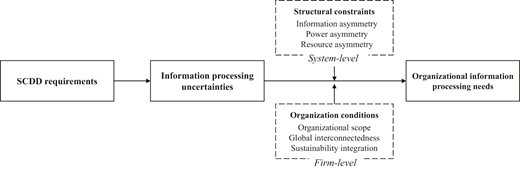
Conditions and constraints of organizational information processing needs
Source: Author’s own work
Conditions and constraints of organizational information processing needs
Source: Author’s own work
Firm-level characteristics shape organization-specific information needs. A central characteristic is organizational scope, referring to company size, product and material diversity and the regulatory and sustainability-related demands embedded across operations. Organizations with a broad product portfolio and high regulatory exposure reported elevated information processing needs, as they address diverse social and environmental data across materials and components. As a food company noted, “[…] our product comprises a wide array of diverse materials, which increases complexity and prevents a focused reliance on just one or two materials” (cf. F-C III). Information needs were intensified where regulatory guidance was ambiguous. For example, “[…] there are currently no practical implementation guidelines available for the Battery Regulation” (cf. A-C IV). These conditions increase the need for granular, product-specific information to meet evolving regulatory requirements.
Global interconnectedness also substantially affects information processing needs. Organizations sourcing from multiple regions and operating across numerous supplier tiers face more fragmented and difficult-to-verify information flows. As one textile company explained, the “textile sector [is] high risk due to the high interconnections of the supply chain” (cf. T-TA II). Similarly, one automotive interviewee emphasized that “the more regions and suppliers are affected, the greater the challenge in dealing with monopolistic and state-controlled suppliers” (cf. A-C V). In such contexts, uncertainties related to socioeconomic structures and regional restrictions are perceived as particularly salient. The degree of sustainability integration further shapes information needs. Organizations that embed sustainability as a long-term strategic priority rather than a compliance-driven obligation reported lower salience in certain areas of uncertainty. Collaboration through industry initiatives and alliances was frequently identified as a mechanism for collective risk mitigation and for extending influence. As one participant stated, “Specific risks are addressed collectively […], as this enables exerting influence beyond the political level” (cf. A-C IV). A textile company similarly noted, “As a member of the Textile Alliance, we operate within a framework of established sustainability standards” (cf. T-C IV). Among organizations with a strong sustainability focus and long-standing engagement, such as those in the coffee and tea sectors aligned with Fair Trade principles, socioeconomic-structure-related uncertainty is perceived as less critical (cf. F-TA I).
Beyond firm-level characteristics, system-level asymmetries shape how information processing needs emerge in the context of SCDD. Informational, power-related and resource-based asymmetries stem from market structures, regulatory regimes and uneven distributions of influence and resources. Because these asymmetries lie beyond the direct control of individual firms, they serve as overarching structural constraints that both intensify and delimit firms’ information processing needs.
Information asymmetry arises when supply chain actors have unequal access to relevant data, resulting in selective disclosure, misinterpretation or strategic withholding (Quijano and Lopez, 2021; Smit et al., 2021). Legal constraints, data protection requirements and competitive concerns inhibit transparent data exchange in multi-tier supply chains. As one participant observed, “The traditional procurement process is characterized by a reluctance to share information, citing the protection of trade secrets as justification” (cf. A-C V). Moreover, requested data may conflict with legal norms, as:
[…] data protection regulations must also be clarified with all countries with which association or free trade agreements exist. This proved to be a significant challenge in the case of Indonesia, particularly concerning geospatial data (cf. F-TA I).
Regulatory differences further exacerbate ambiguity in definitions, metrics and enforcement thresholds (Malaihollo, 2021). Competitive considerations also emerged, as “information is deliberately withheld, given that a supplier relationship had been developed with considerable effort and monetary investment” (cf. T-TA I).
Power asymmetry refers to inequality between supply chain actors in terms of their respective capacity to shape standards and compliance expectations (Bright et al., 2020; Deva, 2023). Dominant firms may impose unilateral data and compliance requirements, leaving smaller actors with limited influence over due diligence practices (cf. MSI I, A-TA I, T-TA I). This imbalance may be intensified through “corporate lobbying, where powerful companies shape policy environments to their advantage” (cf. CF IV). Participants described this imbalance as particularly pronounced in sectors dominated by multinational corporations (cf. F-TA I). A trade association (cf. F-TA I) stated that “international agribusiness corporations, which control 80% of the grain market, have the responsibility […] in supply chains.” Resource asymmetry reflects disparities in financial and organizational capacities (Deva, 2023; Schleper et al., 2022). Resource-constrained suppliers often lack the means to respond to extensive data requests, especially when standardized due diligence instruments are not adapted to local conditions. “Incentives through long-term contracts, cost assumptions, price adjustments […]” (cf. PA I) or “environmental topics associated with efficiency-driven optimization such as waste management […]” (cf. CF IV) can mitigate these burdens.
5. Discussion
5.1 Theoretical contributions
This study complements OIPT research by applying the theoretical lens to the context of SCDD. In doing so, it identifies a set of previously neglected information processing uncertainties that emerge from stakeholder-oriented due diligence requirements. These include uncertainties related to consultations with vulnerable rights-holders, interactions with disadvantaged suppliers and coordination with intermediary actors such as auditors, service providers and civil society organizations. While prior OIPT research has primarily addressed uncertainties associated with product characteristics, operational processes and technology adoption (Bensaou and Venkatraman, 1995; Cegielski et al., 2012; Lu et al., 2023), SCDD introduces a distinct set of challenges shaped by stakeholder diversity, socioeconomic and cultural distance and forms of interdependence beyond organizational boundaries. These differences point to the need for context-sensitive and legitimacy-oriented forms of information processing that go beyond the firm-centric perspective prevalent in existing OIPT applications.
Prior OIPT research has recognized that organizational factors moderate the relationship between uncertainty and information processing needs. For instance, Busse et al. (2017) introduced “uncertainty intolerance” as a moderator that determines the extent to which sustainability-related uncertainties translate into information processing needs. In a similar vein, this study conceptualizes organizational characteristics as contextual conditions that amplify or attenuate the information processing uncertainties arising from SCDD. In addition, the findings reveal the presence of structural asymmetries – namely, information, power and resource asymmetries – that function as conditions beyond the direct control of individual organizations and substantially shape their information processing needs. Research on sustainability management and modern slavery in supply chains has identified contingency variables that correspond to these organizational and structural conditions, including power dynamics, geographical distance (Flynn, 2019), as well as firm size, prior social responsibility commitment and network involvement (Tachizawa and Yew Wong, 2014). By linking both organizational conditions and structural asymmetries to information processing needs, this study offers a more integrated understanding of how these needs emerge and vary across organizations implementing SCDD.
Prior research has also shown that firms’ efforts to detect and manage modern slavery risks are constrained by cognitive and relational barriers. Simpson et al. (2021) demonstrated that psychological distance limits managers’ ability to recognize and respond to modern slavery risks in their supply chains. Pinnington and Meehan (2023) found that managers may engage in “convenience framing,” interpreting modern slavery requirements in ways that rationalize limited or delayed substantive action. Other studies have highlighted that mistrust and fragmented interorganizational relationships constrain reliable social exchange across supply chain tiers (Gimenez and Tachizawa, 2012; Pesterfield, 2026). Beyond these barriers, this study identifies structural constraints in accessing, verifying and integrating sustainability-relevant information across multi-tier supply chains – arising from legal and cultural restrictions, limitations in risk data services and information consolidation. By mapping specific uncertainties across internal, interorganizational and external environments, it shows that effective due diligence implementation depends not only on overcoming cognitive and relational barriers but also on organizations’ capacity to process information under SCDD-related uncertainties.
5.2 Managerial and policy implications
This study identifies:
key information processing uncertainties associated with SCDD; and
the organizational and structural conditions under which these uncertainties intensify or attenuate, facilitating companies to anticipate where information-related challenges are likely to arise and to prioritize managerial attention and resources accordingly.
Although information processing needs are inherently company-specific, these findings indicate that almost all identified uncertainties occur across organizations, with several emerging as consistently central irrespective of sector or firm characteristics. The comparative analysis further shows that no uncertainty type is exclusive to a single sector or absent from others, suggesting that SCDD-related information challenges represent cross-sectoral challenges rather than isolated sector-specific phenomena.
Comparisons of individual textile, automotive and food companies nevertheless highlight differences in organizational responses to these shared challenges. Textile companies, especially in the outdoor segment, benefit from well-established industry collaborations that support the joint implementation of sustainability standards and information exchange. In contrast, individual firms in the food sector face greater challenges due to biological variability and limited upstream standardization, resulting in more fragmented due diligence practices. For managers, these differences underscore the importance of combining firm-specific prioritization of information needs with active engagement in sectoral or cross-sectoral collaborations.
Although the GSCDDA was predominantly perceived positively by participants, the stakeholders consistently raised concerns about the credibility and prioritization of SSCM due to frequent regulatory amendments and regulatory attenuation. These dynamics risk undermining planning certainty and reducing incentives to invest in robust information processing structures for SCDD implementation. In addition, several constraints affecting SCDD-related information processing lie beyond firms’ direct control (e.g. competitive pressures and market structures). Policymakers may consider clarifying existing antitrust and trade secret regulations to better accommodate transparency obligations related to human rights and environmental information. Finally, the stakeholders emphasized the growing importance of third-party service providers, such as digital tools for data management and risk analysis. However, the lack of standardized data languages and harmonized methodologies currently limits data comparability and reliability. To address this gap, policymakers could promote sector-specific standards, support the validation of digital risk analysis systems and provide targeted support for supply chain traceability tools, particularly for small and medium-sized enterprises.
5.3 Limitations and future research
This study lays the groundwork for future research examining how organizations deploy information processing mechanisms when confronted with SCDD-related uncertainties. Building on the identified uncertainty types, future researchers should identify SCDD-specific information processing mechanisms from a stakeholder perspective, examine their associations with distinct uncertainty profiles and analyze how these mechanisms jointly contribute to organizations’ information processing capacities. A key objective of this research agenda is the development of a process-oriented model that supports organizations in selecting appropriate information processing mechanisms under different SCDD-related uncertainty conditions and in understanding the capacities enabled through their use. Such a model would offer actionable guidance for information management in due diligence contexts and contribute to more effective, credible and legitimate SCDD implementation across supply chains.
This study is subject to certain limitations that provide avenues for future research. First, the data set was collected from companies operating in selected sectors and from specific stakeholder groups. Future studies could expand the sample by including additional high-risk sectors, such as financial services, and underrepresented stakeholder groups, such as trade unions, to capture a broader range of similarities and divergences in SCDD-related information processing. Second, the study focuses on the GSCDDA as a focal regulatory context. While this provides analytical depth and has a high degree of transferability to the European CSDDD due to its close similarity, differences in regulatory design, enforcement intensity and legal traditions may limit the direct transferability of findings to non-European frameworks.
Third, the findings are based on stakeholders’ perceptions and interpretations of information processing uncertainties, which are socially constructed and may vary across organizational roles and over time. Longitudinal research could capture how these perceptions evolve as SCDD implementation matures. In addition, future studies could complement the qualitative insights presented here by applying alternative methodological approaches, such as focus groups, Delphi studies or quantitative designs, to further validate and extend the findings. Finally, while the study identifies power-related dynamics as an important condition of information processing needs, it conceptualizes these dynamics primarily at the level of contractual relationships between organizations and their partners (e.g. suppliers, service providers and certifiers). Future research could draw more explicitly on principal–agent theory or related perspectives to deepen the analysis of information-related power asymmetries in SCDD contexts.
6. Conclusion
Guided by OIPT, this study examined how the introduction of SCDD reshapes information processing uncertainties and organization-specific information needs related to the generation, interpretation and management of sustainability-related information. It adopted a multistage qualitative design, combining a structured literature review and exploratory expert interviews to identify, contextualize and refine uncertainties in SCDD-related information processing. The study identified ten subcategories of uncertainty and revealed organizational conditions and structural constraints that shape how these uncertainties translate into organization-specific information processing needs. In doing so, it lays the groundwork for future research into how organizations deploy information processing mechanisms and capacities to address SCDD-specific uncertainties. It highlights that successful SCDD implementation depends on an organization’s ability to manage the underlying processes of information acquisition, interpretation and integration across organizational and stakeholder boundaries. By foregrounding information processing as a central challenge of due diligence, this study contributes to ongoing debates on the design, implementation and governance of sustainable supply chains.
References
Appendix
Table A1 presents details of the stakeholders who participated in the expert interviews. The columns display the expert’s stakeholder group, business sector, professional position, years of experience with SCDD implementation, and interview duration. To ensure anonymity, professional positions were generalized to the closest comparable role titles. Years of experience were reported in ranges.
Stakeholder composition of the expert interviews
| SCDD stakeholder | Expert position | Experience | Interview duration |
|---|---|---|---|
| Economic stakeholder – textile sector | |||
| Company I (T-C I) | Head of Corporate Social Responsibility and Supply Chain | 10–15 years | 40 min. |
| Company II (T-C II) | Expert 1: Sustainability and Supply Chain Management Expert. Expert 2: Sustainability Director | 4–6 years, 15–20 years | 35 min. |
| Company III (T-C III) | Head of Corporate Sustainability | 20 + years | 35 min. |
| Company IV (T-C IV) | Human Rights Due Diligence Manager | 1–3 years | 45 min. |
| Trade association I (T-TA I) | Head of Corporate Social Responsibility | 10–15 years | 75 min. |
| Trade association II (T-TA II) | Innovation and Environment Expert | 1–3 years | 35 min. |
| Economic stakeholder – food sector | |||
| Company I (F-C I) | Sustainability Manager | 4–6 years | 45 min. |
| Company II (F-C II) | Sustainability Specialist | 1–3 years | 45 min. |
| Company III (F-C III) | Expert 1: Sustainability Manager, Expert 2: Sustainability Manager | 15–20 years, 4–6 years | 50 min. |
| Company IV (F-C IV) | Corporate Social Responsibility Specialist | 1–3 years | 60 min. |
| Company V (F-C V) | Sustainability Manager | 10–15 years | 45 min. |
| Trade association I (F-TA I) | Trade and Markets Expert | 10–15 years | 50 min. |
| Trade association II (F-TA II) | Certification and Regulation Expert | 1–3 years | 40 min. |
| Economic stakeholder – automotive sector | |||
| Company I (A-C I) | Corporate Social Responsibility Manager | 10–15 years | 70 min. |
| Company II (A-C II) | Procurement Specialist | 1–3 years | 35 min. |
| Company III (A-C III) | Procurement and Supplier Management Specialist | 4–6 years | 50 min. |
| Company IV (A-C IV) | Sustainable Supply Chain Specialist | 1–3 years | 40 min. |
| Company V (A-C V) | Sustainable Supply Chain Manager | 1–3 years | 50 min. |
| Trade association I (A-TA I) | Sustainability Expert | 7–9 years | 40 min |
| Intermediary stakeholder | |||
| Certification agency I (CF I) | Environmental Auditor | 7–9 years | 60 min. |
| Certification agency II (CF II) | Head of Sustainability | 7–9 years | 35 min. |
| Certification agency III (CF III) | Regulation Specialist | 10–15 years | 40 min. |
| Certification agency IV (CF IV) | Expert 1: Senior Environmental Auditor, Expert 2: Environmental Auditor | 20+ years, 4–6 years | 50 min. |
| Certification agency V (CF V) | Senior Standards Manager | 7–9 years | 45 min. |
| Consultant agency I (Con I) | Sustainability and Data Management Expert | 1–3 years | 45 min. |
| Consultant agency II (Con II) | Sustainability and Innovation Expert | 4–6 years | 35 min. |
| Societal stakeholder | |||
| Nongovernmental organization I (NGO I) | Corporate Social Responsibility Specialist | 1–3 years | 40 min. |
| Non-governmental organization II (NGO II) | Supply Chains and Environment Expert | 1–3 years | 50 min. |
| Multi-stakeholder Initiative I (MSI I) | Sustainability Manager | 7–9 years | 30 min. |
| Multi-stakeholder Initiative II (MSI II) | Sustainability and Stakeholder Management Senior Expert | 20+ years | 40 min. |
| Multi-stakeholder Initiative III (MSI III) | Human Rights and Labor Standards Expert | 1–3 years | 45 min. |
| Independent public institution (IPI I) | Research Associate for Human Rights | 7–9 years | 60 min. |
| Public authority (PA I) | Responsible Procurement Expert | 10–15 years | 45 min. |
Table A2 displays the top-level OIPT uncertainty category, literature-derived SCDD-related uncertainties and corresponding references, stakeholder-based refinements and respective stakeholder groups and resulting consolidated classification of SCDD-related information processing uncertainties.
Literature references and stakeholder contributions to identified SCDD-related information processing uncertainties
| OIPT uncertainty | SCDD-related uncertainties from literature | Reference | Stakeholder refinements | Stakeholder group | Classification |
|---|---|---|---|---|---|
| Task uncertainty | Reliability of data | Camoletto et al. (2022), Chambers and Vastardis (2020), Deva (2023), Esoimeme (2020), Gold et al. (2015), New (2015), Schilling-Vacaflor and Lenschow (2023 | Data consolidation | Economic (T) | Data quality and consolidation |
| Triangulation of various data | Validation and verification of data | Intermediary, societal | |||
| Need for diverse methods to identify modern slavery | Interfaces of digital systems | Economic (T, A), intermediary | |||
| Data quality | Handling a significant amount of data | Economic (T, A), intermediary | |||
| Lack of data basis | Economic (T) | ||||
| Dependence of moral corporate commitment | Buttke et al. (2024), Deva (2023), Fasterling and Demuijnck (2013), Krajewski et al. (2021),Smit et al. (2021) | Mindset of top management | Economic (F, A), intermediary, societal | Sustainability awareness | |
| Insufficient sustainability awareness | Leadership responsibility | Economic (T) | |||
| Tools are profit-driven rather than rights-driven | Addressing extrinsic and intrinsic motivation | Intermediary | |||
| Shortage of skilled sustainability personnel | Intermediary | ||||
| High bureaucracy and costs | Buttke et al. (2024), Camoletto et al. (2022), Hofmann et al. (2018), Schilling-Vacaflor and Lenschow (2023) | Early planning of sustainability and sourcing strategies | Intermediary, societal | Resources and process flows | |
| Resources and costs | Responsible procurement practices | Economic (T) | |||
| Bureaucracy impact | Dependence across interdisciplinary departments | Intermediary, societal | |||
| Avoidance of separate processes to foster acceptance | Economic (A), intermediary | ||||
| Overload for sustainability managers | Intermediary | ||||
| Interorganizational uncertainty | Supplier power asymmetry | Bright et al. (2020), Buttke et al. (2024), Deva (2023), Schleper et al. (2022), Smit et al. (2021) | Dependence due to raw material price and availability | Economic (T, F) | Supplier dependence |
| Information concealment of suppliers | Dependence on single and sole sourcing | Economic (F, A), intermediary | |||
| Suppliers required by customers | Economic (T) | ||||
| Restriction due to confidential data of suppliers | Economic (A), societal | ||||
| Untrustworthy certifications | Bright et al. (2020), Buttke et al. (2024), Delalieux and Moquet (2020), Nolan (2022), Schleper et al. (2022) | Dependence on risk analysis and rating systems outcomes | Economic (T, F), societal | Agency dependence | |
| Social auditing as weak measurement | Profiteering of service providers | Economic (T, F), intermediary | |||
| Phenomenon of “audit fatigue” | Inflexibility of digital systems from providers | Economic (T, F), intermediary, Societal | |||
| Stakeholder engagement | Bueno and Kaufmann (2021), Chambers and Vastardis (2020), Deva (2023), Gold et al. (2015), Nolan (2022), Schilling-Vacaflor and Lenschow (2023) | Pre-, during and postphases of stakeholder involvement | Societal | Stakeholder involvement | |
| Need for a top-down, bottom-up approach | Absence of structured methods | Economic (T, F, A) | |||
| Integration of rights-holders | Limited resources of NGOs | Economic (T), societal | |||
| Effective remediation from the perspective of rights-holders | Low utilization of the grievance mechanism | Economic (T, F), intermediary | Consultation with vulnerable individuals | ||
| Effective remediation from the perspective of rights-holders access to local knowledge | Affected individuals’ lack of clarity about which enterprise bears responsibility, and the contact point | Economic (T, A) | |||
| Affected individuals’ fear of retaliation | Societal | ||||
| Right of surrogate accountability through stakeholders | Large-scale plantations with a high turnover of workers | Economic (F) | |||
| Environmental uncertainty | Imbalance of local and focal firms | Gold et al. (2015), Hofmann et al. (2018), Koos (2022), New (2015), Quijano and Lopez (2021),Schleper et al. (2022) | Bureaucratic burden for small and medium-sized enterprises | Economic (T, F, A), societal | Socioeconomic structure |
| Imbalance between industrialized and developing countries | Absence of monetary incentives | Economic (T), intermediary, societal | |||
| Socioeconomic conditions | Reducing supplier switching behavior | Intermediary, societal | |||
| Limited implementation in a specific region | Buttke et al. (2024), Delalieux and Moquet (2020), Deva (2023), Hofmann et al. (2018), New (2015), Quijano and Lopez (2021), Smit et al. (2021) | Divergent mentalities and acceptance (e.g., child labor) | Intermediary, societal | Regional restrictions | |
| Limited implementation due to the judicial system | Long-term transformation of SCDD | Intermediary, societal | |||
| Government regulation | Absence of cross-cultural expertise | Intermediary | |||
| Culture and traditions | Political monopolists | Societal | |||
| Lack of specification of “appropriate” measures in regulations | Bueno and Kaufmann (2021), Malaihollo (2021), New (2015), Quijano and Lopez (2021), Smit et al. (2020) | Dealing with environmental issues (e.g. biodiversity) | Societal | Sustainability demands | |
| Variety of global SCDD regulations and standards | Growing consumer expectations | Economic (T, F, A), intermediary | |||
| Missing guidance by laws | Volatile legislation (e.g. EU Omnibus regulation) | Economic (T, F, A) |
Figure A1 presents the heatmap showing the perceived salience of uncertainties across stakeholders. Dark red shading indicates uncertainties assigned particular salience by a given stakeholder, whereas white shading reflects comparatively lower salience. Green shading denotes general agreement regarding the existence of an uncertainty.
 The heatmap matrix is titled S C D D-related information process uncertainties. The columns are labelled Data quality and consolidation, Sustainability awareness, Resources and process flow, Supplier dependence, Agency dependence, Stakeholder involvement, Consultation with vulnerable individuals, and Socioeconomic structures. The rows are grouped into Economic Stakeholder, Societal Stakeholder, and Intermediary Stakeholder categories. Economic Stakeholder includes Textile, Food, and Automotive sectors with companies and trade associations. Societal Stakeholder includes N G O one, N G O two, M S I one, M S I two, M S I three, I P one, and P A one. Intermediary Stakeholder includes Certifier one to Certifier five and Consultant one to Consultant two. Each cell contains either a light-shaded block indicating salient, a dark-shaded block indicating highly salient, or an empty block. The matrix displays different salience patterns across stakeholder groups and uncertainty categories. A scale at the bottom identifies salient and highly salient classifications.
Heatmap of perceived salience of SCDD-related information processing uncertainties across stakeholders
Source: Author’s own work
The heatmap matrix is titled S C D D-related information process uncertainties. The columns are labelled Data quality and consolidation, Sustainability awareness, Resources and process flow, Supplier dependence, Agency dependence, Stakeholder involvement, Consultation with vulnerable individuals, and Socioeconomic structures. The rows are grouped into Economic Stakeholder, Societal Stakeholder, and Intermediary Stakeholder categories. Economic Stakeholder includes Textile, Food, and Automotive sectors with companies and trade associations. Societal Stakeholder includes N G O one, N G O two, M S I one, M S I two, M S I three, I P one, and P A one. Intermediary Stakeholder includes Certifier one to Certifier five and Consultant one to Consultant two. Each cell contains either a light-shaded block indicating salient, a dark-shaded block indicating highly salient, or an empty block. The matrix displays different salience patterns across stakeholder groups and uncertainty categories. A scale at the bottom identifies salient and highly salient classifications.Heatmap of perceived salience of SCDD-related information processing uncertainties across stakeholders
Source: Author’s own work

