This study aims to explore the effectiveness of Halliday’s (2014) Systemic Functional Linguistics (SFL) for translator education. It aims to enhance translation education research by following an interdisciplinary approach where SFL is used as a translation pedagogical tool.
The sample of the study (n = 66) comprised translation students at King Saud University. A quasi-experimental pretest–posttest design with control and experimental groups was used. The intervention activities encompassed analyses of texts at three levels: the register level (field, tenor and mode), the semantic level (ideational, interpersonal and textual metafunctions) and the lexico-grammar level (transitivity, mood and modality, and theme). For triangulation purposes, the participants’ perceptions were collected through a questionnaire. The instructor’s observations were collected using a reflective journal. Following Creswell and Creswell (2018), a convergent mixed methods approach was employed (qualitative analysis for the reflective journal, and quantitative analysis for the tests and questionnaire).
The results provide empirical insights about how SFL is beneficial for translator education. It assists students by reducing errors in meaning transfer or strategic errors.
Further studies can investigate SFL in other translation fields since every field has its specific features.
This paper includes practical implications for facilitating SFL for translation education. It provides detailed instructional material on how to implement SFL in every lesson for a translation course.
This paper fulfils the need to support English–Arabic translator education by finding an objective tool to analyze the source text and justify translation choices.
Introduction
Translator education refers to the instruction type used to train students in university classrooms to combine theory and practice in translating different genres of texts in various fields (Wang, 2015). The challenge that both instructors and students encounter is the complexity of the translation practice due to its interdisciplinary feature where different theories can be incorporated to explain both the process and the product of translation (Toury, 2012). This challenge led to relying on intuition to understand the meaning of the text to be translated and made it difficult to justify translation choices (Kim, 2007). Discourse analysis was investigated by Way (2012) to search for an objective tool that could analyze in detail the source text (ST), which is the original text to be translated into another language, and help explain to the students the underlying meanings of a text. Furthermore, Bnini (2007) found that text and discourse analyses were effective in training English-Arabic translators. Applying discourse analysis in translation studies (TS) resulted in the investigation of more specific tools, such as Halliday’s Systemic Functional Linguistics (henceforth, SFL) analysis. According to Halliday (2014) language is a system. SFL maps the choices available in any language variety using its representation tool of a “system network.” Language is functional because it evolved under pressure of the functions that the language system must serve. SFL views language through two contextual levels (global and local contexts) to analyze the ideational, interpersonal and textual metafunctions (Halliday, 1978).
Research supported the benefits of applying SFL analysis in TS and considered it a rich theoretical framework (Manfredi, 2011). The reason why SFL can complement the practice of translation is its focus on meaning. The advantages of using SFL as a tool in translation is that it can be used in assessing the quality of a translated text (Halliday, 2001; House, 2014), in understanding the social implications of a text (Hatim and Mason, 1996) and in understanding the process of translation (Bell, 2016).
In SFL, both the clause level and the text level of discourse are included in the analysis (Halliday, 2014). The effectiveness of SFL as an objective detailed analysis tool has been investigated in different educational discourses (e.g. Alyousef, 2016; Alyousef, 2020; Troyan et al., 2022). SFL is also significant in training translators (Trosborg, 2000). Several empirical studies investigated SFL in translator education classrooms. Some focused on using SFL as a pedagogical tool for analyzing a text for ideational, interpersonal and textual metafunctions (Kim and McDonald, 2012) or for the analysis of errors in the target text (TT), which is the translated text (Aghagolzadeh and Farazandeh-Pour, 2012). Others investigated specific elements of SFL analysis in translation education such as Theme (Alshehri, 2017; Kim, 2007; Sofyan and Tarigan, 2018), cohesion (Jun, 2018; Khany, 2014; Kostopoulou, 2007) and logical links (Choi, 2013).
The interdisciplinary approach of the current study was based on how previous research such as Kim et al. (2021) highlighted the interconnection of SFL and TS. The intervention in this study considered Steiner’s (2021) study which revealed that reading of a text in the pre-translation phase is similar to reading in SFL which considers the language system as a whole in addition to specific instances of the text. Neumann (2021) asserts that SFL can account for register variations which is why register analysis was conducted in the pre-translation phase of this study. The current study acknowledges Munday (2021) who emphasized the significance of TS as an essential part of the linguistic system by focusing on interpersonal meanings and the SFL-based Appraisal system and how it was employed in TS. Baker and Saldanha (2020) acknowledged SFL as a linguistic theory that was significantly employed in translation studies in the past and can still be investigated in future studies. Recently, considering new technical innovations, SFL is being investigated as a framework for machine translation (Pagano et al., 2022). Pagano et al. (2022) highlighted the fact that future research especially process-based research can benefit from SFL theory and its objectivity as a tool in improving and evaluating machine translation.
Although SFL is a significant objective and detailed tool for translator education, the universality of the findings of these studies is not applicable due to the complexity and diversity of language systems (Marais, 2013). Therefore, it is pertinent to examine the use of SFL in different contexts and across different languages. Also, research on applying SFL analysis in a Saudi University translation classroom is scarce. The present study attempted to fill in the gap in research by investigating the effectiveness of applying SFL analysis of English-Arabic texts as a pedagogical tool in a Saudi University translation classroom using a mixed-method research design encompassing quantitative and qualitative analyses. Quantitative analysis was used to compare performance (pretest and posttest); descriptive analyses were used to elicit perceptions (questionnaire); qualitative analyses were used to analyze the observations of the instructor (reflective journal). The study addressed the following research questions:
To what extent does training translators using SFL text analysis as a process approach to translation improve the quality of their translation in terms of reducing errors in meaning transfer or strategic errors and mechanical errors?
What are the perceptions of the participants posited in the questionnaire on applying SFL as a process approach to translation?
What are the observations of the instructor on the intervention as expressed in the reflective journal?
Methodology
Theoretical framework
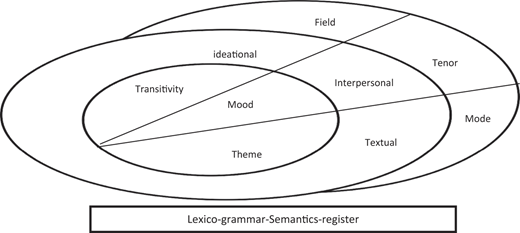
Halliday’s (2014) SFL analysis was used as the primary framework of the current study. This study was concerned with the applicability of SFL tools in an English-to-Arabic translation course. SFL tools focus on the context level which is expressed through the clause level (Halliday, 2014). The SFL framework acknowledges the interrelation of language levels and identifies meanings through the correlation between register (context), semantics and lexicogrammar levels. The Register level that carries the semantic metafunctions was recognized at the clause level through lexicogrammar and cohesive devices. There are three semantic metafunctions which are ideational, interpersonal and textual. The ideational (experiential and logical) metafunction refers to the natural reality; interpersonal refers to the social reality and textual meaning refers to semiotic reality. These three metafunctions correspond respectively to three register variables which are field, tenor and mode, which are recognized through lexico-grammatical analysis through transitivity, mood and modality and theme and rheme (Halliday, 2014). Field expresses the ideational meaning which is classified into experiential and logical meanings and is expressed through transitivity and cohesion, Tenor expresses the interpersonal meaning and is expressed through MOOD and modality, Mode expresses the textual meaning, which is expressed through theme and rheme, and cohesive devices (Figure 1).
Transitivity identifies the different types of processes and the participants and circumstances in a clause. There are different types of processes which determine the type of participants and circumstances used in a clause. Processes can be material, mental, behavioral, existential, verbal and relational (Halliday, 2014). Mood consists of a subject and a finite. The ordering of the subject and finite reflects the purpose of the message. It could be to exchange information or to ask or give goods and services. Modality is concerned with the judgement of the speaker/writer or request of judgement on what has been said (Halliday, 2014). Theme is the starting point of the message in a clause whereas Rheme is the new information. A Theme can be topical, interpersonal or textual depending on the clause in which it occurs. Thematic progression in a text can be of three patterns; Continuous or constant, linear or zig-zag pattern and Split-Rheme pattern (Halliday, 2014). Cohesion involves cohesive ties and cohesive devices. Halliday (2014) and Halliday and Hasan (2014) identify five types of cohesive devices: substitution, ellipses, lexical cohesion, reference and conjunctions.
Research approach and design
The research approach used in this study is a mixed-method approach. The design of the mixed method approach used in this study is called convergent mixed method design following Creswell and Creswell (2018). Both quantitative and qualitative data were collected, analyzed and compared. The purpose is to investigate if the results confirm or contradict each other. The quantitative approach involved statistical analyses of the data collected from the pretest and the posttest of the control and the experimental groups. Descriptive analysis with quantifying measures was conducted on the participants’ responses to the questionnaire, and qualitative analysis was applied to the instructor’s recorded observations in the reflective journal. A triangulation method was used to measure the same phenomenon using several instruments. The design of this current study in educational settings is called a quasi-experimental design (Ary et al., 2018). It is used to investigate the progress of the groups through a pretest and a posttest with a control and an experimental group.
Participants
The participants in this study included 66 female translation students at the College of Language Sciences at King Saud University in Riyadh, Saudi Arabia. They were level-six participants taking a course in translation in the field of finance and administration. The participants were native speakers of Arabic with English as a foreign language. They were between the ages of 20 and 24. Only female participants were considered because of King Saud University’s policy of gender-segregated education system in undergraduate programs. The participants were divided into two groups each in a different class according to their registry. One group was assigned to be the experimental group (n = 33) and went through the intervention. The other two classes (n = 13, and n = 20) were assigned to be the control group (n = 33). They did not go through the intervention or receive any SFL instruction. The instruction of the control group focused on the communicative purpose and the target audience, and it was guided by Vermeer’s Skopos theory of translation (Nord, 2022).
The participants were not randomly assigned due to the college registry system that assigns students automatically according to their student ID numbers. Therefore, the sampling in this study involved selecting groups randomly instead of selecting individuals. This kind of sampling in educational settings is called cluster random sampling (Mackey and Gass, 2015). Since the participants were not randomly assigned to groups, the compatibility between groups before applying the intervention was investigated by comparing their scores on the pretest. Statistical analysis showed that they were compatible.
Research instruments
The pretest and the posttest
The study used two authentic STs, one for the pretest and the other for the posttest to measure the quality of the translation. The STs were authentic administrative English texts about finance. Each was 500 words long with the same level of difficulty. This was determined in an earlier study (Alshalan and Alyousef, 2020).
Scoring Criteria. The responses of the participants in the pretest and the posttest were their translations from English to Arabic. The quality of the translation was assessed using the Framework for Standardized Error Marking of the American Translators Association Certification (ATA) Program [1]. It has been tested for inter-rater reliability and validity. It is a criterion-referenced assessment because each response was based on whether the criteria assessed were achieved and not according to the results of other participants like norm-referenced tests that rank a group of participants (Bond, 1996). The scoring criteria depended on error analysis. One point was calculated for every error. The error analysis in the rubric was divided into two main parts: errors regarding meaning transfer or strategic errors, and mechanical errors. Missing material within the passage was treated as a meaning transfer or strategic error under omission.
The Reliability and Validity of the Pre-test and the Post-test. Following Allen and Knight (2009), further measurements were taken to investigate the reliability and reproducibility of the rubric. To ensure repeatability, the researcher piloted the tests by assessing a sample (n = 10) and, after a week, the same sample was reassessed using the same rubric to ensure there were no statistically significant differences in the participants’ scores when assessed again. A pretest-posttest reliability coefficient (r) 1 indicates perfect reliability, while r = 0 indicates no reliability (Larson-Hall, 2015). The reliability coefficients (Cronbach’s alpha) were calculated (r = 0.99) which is considered highly reliable according to Larson-Hall (2015). As for reproducibility, another rater assessed the same participants to ensure no differences were noted, using the same rubric scoring criteria. The inter-rater reliability was 0.99 which according to Larson-Hall (2015) was considered reliable because it was above 0.60. Following Mackey and Gass (2015), the pretest and the posttest have face validity because the general appeal appeared to test what it is meant to be tested. They also have content and construct validity because they are authentic English texts used as STs.
The questionnaire
The questionnaire was used to detect the participants’ perceptions of the intervention, and it was collected via a five-point Likert scale questionnaire (strongly agree, agree, neutral, disagree, strongly disagree). It was distributed at the end of the intervention after the posttest was conducted. The questionnaire had two sections: a section on background information and a general attitude section. The general attitude section was based on three main categories (or items) adapted from Kim (2007) that addressed learning SFL as a theory, applying SFL in translation and the degree of difficulty.
The reflective journal
The reflective journal was collected from the instructor’s observations during the intervention. According to Mackey and Gass (2015), guided reflective journals will enhance the quality of the data reported. Therefore, the reflective journal was guided by the three main categories of the questionnaire. The data collected from the reflective journal was aligned with the participant’s responses in the questionnaire for triangulation purposes. This procedure made it possible to support the participants’ perceptions in the questionnaire with examples from the instructor’s observations.
Instructional materials
The texts used for the current study were analyzed for cohesive features in business texts collected from the administrative website “Investopedia” (Alshalan and Alyousef, 2020). Eight authentic English STs about finance were selected and additional two texts were used in the pretest and the posttest. Each text was around 500 words. The instructional material used in the intervention were ten lessons: an introduction, four main lessons, a revision session before the on-going assessment and four practice lessons (Table 1). After each lesson, the participants worked in groups to analyze the rest of the ST using the same SFL tool which was demonstrated in the lesson. During their practices, the instructor guided them and answered any questions because the aim was to instruct and guide the participants on how to apply SFL analyses during the intervention. However, it is essential to point out that the instructor did not support the participants or assist them during the pretest and the posttest where the data was collected. After analyzing the ST, the participants were given a translation brief which explains the purpose of the TT and the target readers. Nord (2022) emphasize the importance of identifying the purpose of the text and the audience reading the translated text. The purpose and audience of a TT is called a translation brief. Finally, the participants translated the ST in groups and their translations were compared and discussed in class. After the four main lessons and a revision session, an on-going assessment was conducted to ensure that the participants can explain SFL as a theory and apply it in translation, following Kim and McDonald (2012). It involved defining SFL concepts and applying SFL in analyzing a text. In the last four practice lessons, the participants analyzed four more STs for all the three metafunctions- (i) ideational; experiential and logical, (2) interpersonal and (3) textual metafunctions-in each lesson before they started translating the text.
Data analysis procedures
The research followed both quantitative and qualitative analyses in a mixed-method approach. The quantitative analyses were used to analyze the participants’ pretest-posttest results; descriptive analyses with quantifying measures were used to elicit the participants’ perceptions in the questionnaire, while the qualitative analyses were used to analyze the reflective journal. Statistical analyses were conducted using the Statistical Package for Social Sciences (SPSS Version 28.0). Following Larson-Hall (2015), the data was tested for normality before choosing the suitable statistical test.
The following hypotheses were proposed:
There are no statistically significant differences between the scores of the control and experimental groups in the pretest.
The experimental group who received SFL instruction outperformed the control group by conducting fewer meaning transfer or strategic errors and mechanical errors in the posttest.
SFL instruction results in significantly fewer errors in the posttest of the experimental group compared with their pretest.
Pilot study
Following Mackey and Gass (2015), a pilot study (n = 10) was conducted to identify any issues before the application of the study. Minor adjustments were made such as changing the on-going assessment from on-site to online with multiple attempts. This allowed the participants to take the exam several times because the main objective was to help the participants learn the key concepts of SFL before moving to the practice lessons.
Results and discussion
The pretest
The first hypothesis stated that there would be no statistically significant differences between the scores of the control and experimental group in the pretest. The pretest which was conducted before the intervention supported this hypothesis in their total scores. Additional analyses of their performance were applied to ensure their compatibility and to be able to attribute any development in their performances to the intervention. The following will discuss these findings in further detail.
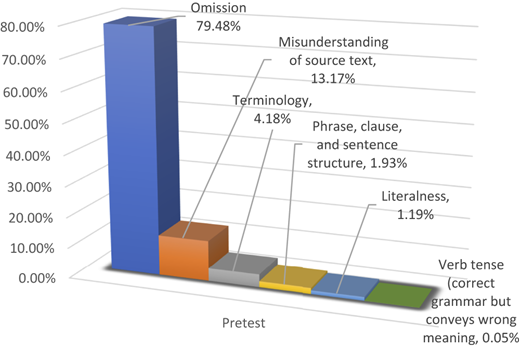
The findings showed that the most prominent error for both groups was omission. The participants probably committed this error either because they had difficulties understanding the ST or they were unable to choose the best Arabic equivalent. This claim can be supported by the second most prominent error in the data which was misunderstanding of the ST. This shows that understanding the meaning of the ST is essential in improving the quality of the TT in translation which is in line with Manfredi (2011) and Althumali (2021) whose results showed that the quality of the translation of the participants improved when the meaning of the ST was clear after analyzing it.
The importance of lexical cohesion can also be shown in the third most prominent error type, terminology. Neumann (2021) states that errors in terminology can result from the participants’ inability to use contextual clues to interpret the meaning of a word due to linguistic and cultural variations. SFL analysis of the context in which a new term occurs can assist in reaching an understanding of the lexico-grammatical shifts because SFL accounts for register variation and not only text type like other corpus-based translation methods (Neumann, 2021). This finding also reflects studies that were conducted on the importance of analyzing cohesion in STs to have a better understanding of the underlying meanings of a text such as Kostopoulou (2007) who found that focusing on the ST and analyzing it for coherence can assist the translator trainees to understand the communicative message of the text and improve the quality of their translations. In addition, Khany (2014) found a positive correlation between knowledge of lexical cohesion patterns and translation quality.
Errors in literalness showed a misunderstanding of the intended meaning. Understanding underlying meanings can help to avoid errors in translating the semantic meaning without considering its pragmatic meaning in the context, as supported by Jun (2018) who emphasized the importance of semantic coherence on the quality of a translated text. The fact that both groups conducted errors in this subcategory showed that they struggled with understanding the intended meanings of the text.
There was only one subcategory of mechanical errors: phrase, clause and sentence structure. Errors in this subcategory involved imitating the same structure as the ST which was similar to the findings of a study by Sofyan and Tarigan (2018) who emphasized the significance of thematic progression. The study showed that the participants focused less on the meaning transferred because they tended to imitate the style of the ST. This resulted in a low-quality translation that lacked cohesiveness.
The total score in the pretest showed that the experimental group (54.9%) had more errors than the control group (45.1%), but the difference was only around 10%. This difference was so low that the mean was identical (M = 95). Statistical analyses showed that the difference was not statistically significant because the p-value was greater than the significance level >0.05 (U = 432, p = 0.110 >0.05). This showed that the groups were compatible regarding the total scores in the pretest.
To sum up, the participants made two error types related to the ATA rubric, that is meaning transfer or strategic errors and mechanical errors. The subcategories of these errors found in the pretest were terminology, misunderstanding of the ST, literalness, omission, verb tense (grammar correct, but conveys wrong meaning) and phrase, clause and sentence structure. Figure 2 shows the proportions of these errors in the pretest.
The posttest
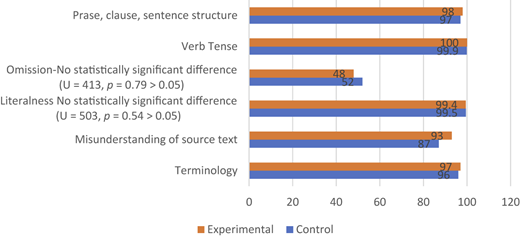
The second hypothesis stated that the experimental group who received SFL instruction would conduct significantly fewer meaning transfer or strategic errors and mechanical errors in the posttest compared with the control group. The results showed that this hypothesis was supported in the subcategory of misunderstanding the ST (Table 2).
The experimental group conducted 26% fewer errors than the control group in the subcategory of misunderstanding the ST (Figure 3). Statistical analysis has also shown that this difference is significant at the level of >0.01 (U = 790, p = 0.002 >0.01). Therefore, we can deduce that the SFL instruction in the intervention helped the participants understand the ST thoroughly, which is in line with a number of studies (e.g. Jun, 2018; Kim, 2007; Kostopoulou, 2007; Manfredi, 2011) which found that SFL text analyses can assist in revealing the underlying meanings of a ST which would lead to a better understanding of the ST before translating it.
The pretest and posttest of the experimental group
The aim of comparing the performance of the experimental group before and after the intervention was to explore if applying SFL text analyses in translator education affects the performance of this group by reducing errors, achieving higher scores and if the improvement was statistically significant. The third hypothesis posited in this study was set to investigate if SFL instruction would result in significantly fewer errors in the posttest of the experimental group compared with their pretest. The results support this hypothesis in the total scores and the meaning transfer errors.
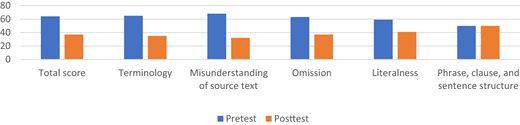
The results showed that the total number of errors was reduced by 26% in the post-test. The scores out of 100 were higher in the post-test (M = 38.2) than in the pre-test (M = 10.7). This improvement was statistically significant at the >0.001 level (Z = 253, p = 0.001 >0.001). Descriptive and statistical analyses of their total scores support that SFL instruction has helped the participants improve their overall translation competence which supports Matthiessen’s argument that SFL instruction can improve translation competence (Matthiessen et al., 2017). To understand this improvement thoroughly further analyses were applied to the subcategories of the meaning transfer or strategic errors and mechanical errors.
Terminology errors were 30% less in the posttest. The scores in the post-test were higher and this difference was statistically significant at the level of >0.001 (Z = 405, p = 0.001 >0.001). This finding indicates that the intervention helped the participants choose the correct equivalent in the TT. The participants understood context clues and chose the terminology that reflected the same meaning. This finding supports Kim’s (2007) and Herz’s (2021) arguments that SFL instruction provides translator trainees with tangible analysis that would help them choose and justify their translation choices and not depend on their instincts alone.
Errors in misunderstanding the ST were also reduced. The experimental group conducted 36% fewer errors in the post-test than in the pre-test. Their scores were also higher in the post-test (M = 92.5) than in the pre-test (M = 84.2). This improvement was statistically significant at the >0.001 level (Z = 517, p = 0.001 >0.001). This finding supports Kostopoulou’s (2007) argument that SFL analyses can help participants understand the ST thoroughly and improve the translation quality by reducing errors caused by misunderstanding of the ST.
Omission errors were the most common type of errors conducted in the pretest. Errors in the posttest were also reduced. The results showed that their performance included 26% fewer errors and the scores were higher in the posttest (M = 47.9) compared to the pretest (M = 22.9). The p-value was at the level of > 0.001 (Z = 309, p = 0.001 >0.001) which shows that this difference is statistically significant. This indicates that the participants translated most of the ST, as evidenced by their ability to use this strategy correctly because they understood the underlying meanings of the ST. This also shows that the participants successfully improved the quality of their translation and used translation strategies adequately which agrees with Kim (2007) and Herz (2021).
As for mechanical errors, only one type of error was found: phrase, clause and sentence structure. When compared to the pretest, the results were identical. The same number of errors was made (exactly 66 errors on both tests) and the scores out of 100 were the same (M = 98) As a result, the p-value showed that there was no significant improvement in this subcategory since the p-value was greater than the significance level >0.05 (Z = 130, p = 0.560 >0.05). This finding contradicts the view that SFL instruction can help to reduce mechanical errors. Halliday (2001) noted this problem when he mentioned how the quality of a translation may be undermined when following the same structures of the ST without considering the features of the target language. When Halliday (2001) argued that the quality of a translation is determined by the equivalence of the TT to the linguistic features that are favorable in the ST, he emphasized that even if the ideational meaning in the source text is equivalent to the TT, the textual and interpersonal meanings may be different and as a result cause errors in the translation. Also, Sofyan and Tarigan (2018) found that participants conducted phrase, clause and sentence structure errors because they were imitating the ST and its style without considering the thematic structures of the target language. We can also deduce that the underlying reason for the lack of improvement in mechanical errors is that the participants found thematic analyses more challenging as expressed in the questionnaire and reflected in the journal.
Figure 4 and the aforementioned results show that the experimental group benefited from the intervention, while SFL instruction helped in reducing errors in the TT, especially in meaning transfer or strategic errors which is in line with a number of studies (Jun, 2018; Khany, 2014; Kim, 2007; Kostopoulou, 2007; Manfredi, 2011).
Mechanical errors were identical which supported that SFL did not have an effect on reducing mechanical errors which supports that more practice is needed in understanding thematic progression and theme analyses which is in line with Halliday (2001) and Sofyan and Tarigan (2018).
The questionnaire and the reflective journal
The reflective journal documented the instructor’s observations of the participants in the intervention. Following Mackey and Gass (2015), the journal was guided by the three main categories to ensure the quality of the reported qualitative data analysis. These categories were similar to those used in the questionnaire, which were adapted from Kim and McDonald (2012). They were learning SFL as a theory, applying SFL in translation and the degree of difficulty in applying SFL in translation. To validate the data driven from the reflective journal, a triangulation approach was conducted by using the same categories in the questionnaire; the data in the journal was aligned with the participants’ responses to the questionnaire (Table 3).
The reflective journal showed that the participants defined and explored the main concepts of SFL, which supports their responses on the questionnaire where they all agreed that the key concepts of SFL can be defined and explained even when the terminology was new to them. This supports Newmark’s (1988) finding that SFL focuses on the centrality of meaning when employed as a tool in translation or for text analysis.
The responses in the questionnaire were all positive regarding how SFL assured their translation choices, improved their translation competence and skills and assisted them in thinking critically about the text before translating it. Examples from the reflective journal showed that the participants justified their translation choices based on analyzing the ST. They critically analyzed the underlying meanings of the ST and explained and supported their translation with evidence taken from their SFL analyses. This finding indicates that SFL analyses can be used as a tool to assist translators in justifying their translation choices objectively as argued by Aghagolzadeh and Farazandeh-pour (2012).
When asked in the questionnaire if register analysis of field, tenor and mode helped them understand the underlying meanings of the ST, the participants were neutral and neither agreed nor disagreed. The reflective journal documented several examples in different lessons that assert that the participants benefited from register analyses in understanding meanings, which supports Kim’s (2007) findings. The journal also mentions several incidents, such as the participants’ use of register analyses, but they had difficulty labeling them. They had difficulties in labeling the processes in transitivity analyses that reflected the field. When discussing the ongoing assessment in the intervention, the participants expressed how they did not define the terms even though they understood the concepts. They were provided with a Table to help them recall the main terminology of SFL analyses. Therefore, it can be deduced that the participants were neutral in expressing their perception because they did not recall the meaning of the terms field, tenor and mode.
Moreover, in the questionnaire, none of the participants expressed how they feel about whether applying SFL analyses before translating a text is time-consuming. The reflective journal was able to show that this issue was a concern from the beginning of the intervention and toward the end. This concern can be resolved with extra practice especially since the reflective journal showed how the participants were improving with every session and with more practice. In addition to the fact that all the participants unanimously agreed that extra practice is needed and that SFL was relevant to translator education which is in line with a number of studies (Alshehri, 2017; Kim, 2007; Manfredi, 2011; Trosborg, 2000).
The third and last category was the degree of difficulty. Most of the participants in the questionnaire declared that the instruction was clear, easy to follow and at an appropriate level for them; however, they were indecisive on whether the analysis itself was challenging and difficult to apply. The reflective journal showed that participants followed instructions, but they faced difficulty in applying some of the analyses especially when analyzing theme. This finding is in line with Sofyan and Tarigan (2018) who found that participants conducted errors in thematic progression in TTs because they found it difficult not to imitate the style of the ST. Also, it is supported by the finding of Kim and McDonald (2012) who found that the participants perceived applying SFL theory to translation as challenging. Their study reflected that the participants faced difficulty in the shift from one language to another considering the different set of structures and language choices.
Therefore, it can be noted from the questionnaire and the reflective journal that the instructor and the participants found applying SFL relevant to translation education, and some of the difficulties that arose could be resolved with extra practice and time.
Conclusion
The current study set out to investigate the effectiveness of SFL for translator education through an intervention and the observations of the instructor which were documented in a reflective journal as well as eliciting the participants’ perceptions by their responses in the questionnaire. It investigated the effect of training translators to use SFL text analysis as a process approach to English–Arabic translation at a Saudi University.
The results from the pretest provided an overview of the errors that the participants conducted. The main categories of errors found on both the pretest and the posttest were regarding meaning transfer errors and mechanical errors. Meaning transfer errors involved terminology, misunderstanding of the ST, omission, literalness and verb tense (grammar correct, but conveys wrong meaning). The results of the posttest showed that the experimental group was able to outperform the control group by conducting fewer errors in the subcategory of misunderstanding the ST. This finding confirmed how SFL has assisted the participants in understanding the ST thoroughly. Also, the fact that the control group did not outperform the experimental group with a statistically significant difference showed that SFL instruction was able to support the participants as any other translation theory. This finding supports the effectiveness of SFL as a tool in translation education. The performance of the experimental group was investigated by comparing their posttest after the intervention with their pretest before the intervention. The results showed that there was a statistically significant improvement in the total scores and the subcategories of the meaning transfer or strategic errors. There was no improvement in mechanical errors.
The perceptions of the participants were elicited from their responses to the questionnaire and the observations of the instructor in the reflective journal. Both the reflective journal and the questionnaire showed that the participants acknowledged how SFL assured and justified their translation choices, improved their translation competence and skills and assisted them in critically analyzing the underlying meanings of the ST. Furthermore, the participants were able to benefit from register analyses in understanding meanings, but they had difficulty in labeling them. The participants expressed that applying SFL is time-consuming and that more practice is needed. The results also showed that the participants found that the instructions were clear, easy to follow and at an appropriate level for them; however, they faced difficulty in applying some analysis, especially theme.
Finally, the data analyses of the pretest, the posttest, the questionnaire and the reflective journal supported that SFL was able to improve the quality of their translation, especially meaning transfer or strategic errors. SFL text analysis can be an effective tool for translator education.
Implications
There are theoretical and pedagogical implications for translation students, translation instructors and the applied linguistics-translation community. The implications for theory are evident in using an applied linguistics tool for translation education. This study showed that the participants were able to apply SFL during the process of their translation and it helped them improve the quality of their translation because it provided a deeper understanding of the ST before translating it. This study can contribute to both the field of applied linguistics and the field of translation because it shows how these two fields can be interrelated. This study supports the interdisciplinary feature of translation where many theories may be applied. The pedagogical implications of the findings can assist translation instructors in applying SFL text analyses in different translation courses such as administrative, legal and medical translations and so forth. The results of the experimental group, their perceptions and the observations in the reflective journal support SFL as a significant tool in translation education.
The results of this study showed that the participants needed more practice to apply SFL text analyses. A proposed implication would be to include SFL text analyses in prerequisite courses of translation. Translator instructors can also benefit from applying SFL text analyses in their translation courses. A workshop and some training may be conducted to familiarize instructors with how to apply SFL for translator education.
Limitations and suggestions
Generalizing the data of this research may be applicable with caution due to these limitations. Cluster random sampling was followed because only the groups were randomly assigned, following Mackey and Gass (2015). Individual random sampling was not followed since it was conducted on college students who were assigned to classes by the college registry system. All the students commencing in the course were chosen, but there were only sixty-six female participants. This research can be extended for further investigation as follows:
Future studies may exclude gender specifications by including male participants.
The perceptions of translation instructors may be collected after a session on SFL.
The Intervention was based on SFL and not the analysis due to the focus of the study where the direction of the translation was from English to Arabic only. SFL categories cannot be applied on Arabic unless a longitudinal study was conducted and thoroughly investigated.
The tests could be analyzed using SFL features; however, any kind of quality assessment must be validated through a longitudinal study to be able to generalize the results.
Further studies may conduct reflective journals of the participants and compare their responses.
A longitudinal study may be conducted after introducing SFL to participants in other translation courses and compare results.
The Skopos Theory was used in this study to compare it with SFL-based training. Other translation pedagogies could be investigated such as the Relevance Theory, to consider relative effectiveness.
The authors are indebted to the two anonymous reviewers for their insightful and helpful comments. The authors also express their gratitude to both the Deanship of Scientific Research and the Research Centre at the Faculty of Language Sciences at King Saud University for funding the current article.