Consumers are increasingly combining distribution channels, thus displaying so-called omni-channel behavior, both to complete a given purchase and between purchases. The authors make a distinction between omni-channel customers, who make use of distribution services in both channels and omni-channel users, who make partial use of the distribution services of one channel to support purchases in another. This paper aims to identify the omni-channel behavior among the customers of a global fast fashion retailer dealing in a wide range of apparel and clothing accessories.
Using a multinomial logit model, the authors perform a customer segmentation based on observed omni-channel behavior, considering the explanatory roles of demographics, distribution service features and customer service policies across the different retail channels.
The authors observe that the key retail channel features for explaining omni-channel customer behavior are product accessibility, both in store and online; the assurance that goods purchased online will satisfy the customer’s needs and expectations; and the option to return goods found unsatisfactory.
The results clearly show that the nature of the visits and purchases made by customers is determined by various components of the companýs customer service policy, which can, therefore, be used to guide the retailer’s segmentation strategy.
Future lines of research should explore the economic implications of this customer segmentation. The price perception data emerging from our findings suggest a greater sensitivity to prices in the mono-channel segment, which might be worth exploring in future research.
Future lines of research should explore the economic implications of this customer segmentation. The price perception data emerging from our findings suggest a greater sensitivity to prices in the mono-channel segment which might be worth exploring in future research.
Los consumidores combinan canales de distribución en el denominado comportamiento omni-canal cada vez en mayor medida, tanto para completar una misma compra como entre distintas compras. Distinguimos entre clientes omni-canal, que hacen uso de los servicios de distribución de ambos canales, y usuarios omni-canal, que hacen solo un uso parcial de los servicios de distribución de un canal para apoyar las compras en el otro canal. En este trabajo identificamos este comportamiento omni-canal entre los clientes de una empresa global del sector de la moda que vende un amplio rango de productos de ropa y complementos.
Mediante un modelo logit multinomial, realizamos una segmentación de los clientes en base a su comportamiento omnicanal. En esta segmentación, consideramos el papel explicativo, no solo de las características de los individuos, sino también el de los servicios de distribución y las políticas en cada canal.
Obtenemos cómo el acceso al producto, tanto en el establecimiento como a la página web, la garantía de que el producto comprado online tendrá las características esperadas y las facilidades para devolver el producto adquirido online si no cumple las expectativas, son rasgos clave de los canales que explican el comportamiento omnicanal de los clientes.
Nuestros resultados muestran claramente que diferentes aspectos de la oferta de servicios y de políticas de la empresa determinan las compras y las visitas y estos aspectos pueden ser utilizados para guiar la estrategia de segmentación del detallista.
En este trabajo contribuimos a la literatura sobre el marketing omnicanal presentando un modelo de segmentación, basado en los servicios de distribución ofertados por los minoristas, para las empresas que comercializan productos a través de distintos canales. Aportamos una distinción conceptual entre usuarios de un canal y compradores que tiene un amplio rango de aplicación.
Es necesario proseguir con las líneas futuras de investigación para investigar las implicaciones financieras de esta segmentación. La percepción de los precios que se detecta en nuestros resultados puede sugerir una sensibilidad mayor a los precios en el segmento mono-canal lo que puede ser una línea interesante a contrastar en investigaciones futuras.
Omni-canal, Moda rápida, Trabajo de investigación, Segmentación, Servicios de distribución, Comercio electrónico
Trabajo de investigación
1. Introduction
In an omni-channel context, consumers demand a seamless shopping experience across the various purchase channels (Guillot, 2015) and the available customer touch points (Verhoef et al., 2015). The explosion of digital technologies has brought a wave of new channels and devices that have made the customer’s shopping journey both longer and more varied (Hofacker and Belanche, 2016). Companies now have to address the “synergetic management of the numerous channels and points of contact with the customer” (Verhoef et al., 2015, p. 176), and thus, improve the perceived quality of their services (Herhausen et al., 2015).
In this background, changes in purchase processes, information-seeking behavior and decision-making throughout the customer journey have become a major focus of consumer behavior research. The new terminology includes, for example, the term “research shopping”, defined as “the propensity of consumers to research the product in one channel and then purchase it through another channel” (Verhoef et al., 2007, p. 129).
The retailer/manufacturer perspective in consumer behavior research aims to explain channel choice (Kim and Chun, 2018) and the implications of channel mixing (Herhausen et al., 2015) and channel cannibalization (Pauwels and Neslin, 2015), mainly through the comparative analysis of physical and online channels (Pauwels et al., 2011), focusing on the role of the channel mix in the overall customer value chain.
However, at least two significant gaps remain in this research:
Unit of analysis: Research from the consumer perspective focus on the purchase process, as just mentioned. However, when trying to analyze their channel mix, it is important for omni-channel managers to understand the role it plays throughout their customers’ purchase history rather than in a single purchase process or transaction. Nowadays, moreover, customers interact with firms across multiple channels and platforms (Lemon and Verhoef, 2016), making it increasingly difficult to distinguish the traditionally separate stages of a specific purchase process (recognition of a need, information search, purchase, etc.) and to differentiate between different purchase opportunities. This paper considers purchase history rather than purchase occasions in an analysis of omni-channel customer behavior.
Distribution services: Taking the retailer perspective, omni-channel retailers need to determine the level of distribution services they intend to provide through each channel to enhance the effectiveness of the consumer decision-making process across their entire customer base. These studies have accounted for the contribution of some services, such as location (Kim and Chun, 2018) or information (Pauwels et al., 2011). However, omni-channel managers need to consider the global role played by these services across all their channels for their entire customer base. We fill this second gap in the literature on consumer behavior by studying the way the overall set of distribution services and policies of online and offline channels influence omni-channel.
We organize this paper as follows: the Section 2 provides a detailed description of the conceptual framework and a review of the literature of studies segmenting omni-channel customers. Section 3 contains details of the empirical analysis. The results are presented in Section 4. Sections 5, 6 and 7 include a discussion of the findings and their practical implications and the paper concludes with limitations and future research.
2. Omni-channel behavior: the dual role of the customer as purchaser and service user
2.1 Omni-channel behavior
Omni-channel management has been defined as the “synergetic management of the numerous available channels and customer touch points in such a way that the customer experience across channels and the performance over channels is optimized” (Verhoef et al., 2015, p. 176). Two key points can be drawn from this definition: one, that omni-channel management implies the management not only of distribution channels but also of customer touch points and two, that it is related to customer experience across channels. From a logistics point of view, this paradigm shift implies “a seamless response to the consumer experience through all available shopping channels (browse, buy, return)” (Saghiri et al., 2018, p. 362); that is, a combination of distribution services and different shopping channels.
Behaviorally, omni-channel customers are described as moving freely between the different channels, all within a single transaction process (Kim and Chun, 2018). In the same vein, Yurova et al. (2017) define omni-channel consumer behavior as shopping for products and services using more than one retail channel in a single purchase; and, for Juaneda-Ayensa et al. (2016), omni-shoppers are customers who use multiple channels during their shopping journey. According to Huré et al. (2017, p. 315), “….omni-channel shopping involves: complexity due to the multiple interactions; a focus on brand; and a level of consistency and seamlessness”.
This literature, dealing with omni-channel shopping from the consumer perspective, analyze the use of different touch points at different stages of a single purchase process (Rapp et al., 2015; Frasquet et al., 2015; Viejo Fernández et al., 2018). From the customer journey perspective, it includes both distribution channels and communication channels (Herhausen et al., 2019; Mosquera et al., 2018; Payne et al., 2017) and one or more providers. Some of the phenomena that appear in this context include showrooming that is, customers’ experiencing products in the physical store, then buying them online and webrooming when they research products online but purchase them in a physical store (Kumar et al., 2017). Research has shown that webrooming has a positive impact on customer satisfaction (Flavián et al., 2016) and that showrooming is related not only to price savings but also to other factors such as perceived quality gains (Gensler et al., 2017).
However, omni-channel retailing involves not only omni-channel customers but also other customer segments with different needs that can be aligned with different channels, in what has also been called the “multi-channel perspective” (Ailawadi and Farris, 2017). A second stream of the literature takes the retailer perspective to study different channel combinations for different purchase occasions (Pauwels et al., 2011; Fornari et al., 2016). Among this literature, we find:
a business-customer view: the omni-channel behavior of consumers is defined with respect to a single retailer and not with respect to all potential suppliers;
a purchase channel view: mainly the physical channel versus the online channel. As pointed out by Bell et al. (2018), one of the most widespread environments is that in which consumers buy online and offline from the same retailer; and
a purchase history view: how the combination of online and offline channels provides customers with different distribution services, thereby adding value to the whole set of purchases (Pauwels et al., 2011; Kim and Chun, 2018).
We combine both perspectives for our study of omni-channel behavior. From the customer journey perspective, the omni-channel retailer enables customers to use services from both channels during the same purchase processes. These customers can make full use of a channel’s services to purchase goods or partial use, simply to aid the purchase process.
From the multi-channel perspective, moreover, the channels offered by an omni-channel retailer may also be designed to serve customer segments with different distribution service demands. The physical channel may be better suited to some customers and situations, and the online channel to others (Chocarro et al., 2013; Aragoncillo and Orús, 2018). Customers might, therefore, restrict their interactions with the company to a single channel and use only the distribution services available on that channel. Very often, however, consumers are immersed in a continuous purchasing process, in which they visit the website or the physical store, not with the intention of completing a specific purchase (Lemon and Verhoef, 2016) but as part of a regular routine. Customers who complete purchases through both channels use the set of distribution services offered by both, whereas those who buy goods through only one channel use the set of distribution services it has to offer and make partial use of those provided by the complementary channel.
Thus, for a complete understanding of omni-channel behavior, we might make a distinction between “mono-channel customers” that is, those who use a single channel both for purchasing goods and for other purposes, “omni-channel users”, who use only one channel for purchases but both for other services, and “omni-channel purchasers” who use both channels both for purchasing goods and for other services.
2.2 Segmentation of omni-channel customers
As summarized in Table I, existing studies have adopted an omni-channel perspective for segmenting customers, considering the use of channels for a specific transaction.
Early studies focused on channel usage in certain product categories without considering a specific retailer or company (Sands et al., 2016; Frasquet et al., 2015; Konus et al., 2008). Several researchers, however, have segmented customers based on their use of channels in a specific transaction with a specific retailer (De Keyser et al., 2015; Schröder and Zaharia, 2008; Herhausen et al., 2019). Regarding individual characteristics, the literature has considered brand loyalty (Herhausen et al., 2019; Konus et al., 2008; Sands et al., 2016), perceived shopping enjoyment (Konus et al., 2008; Sands et al., 2016), motivation to conform (Konus et al., 2008; Sands et al., 2016; Frasquet et al., 2015), innovativeness (Konus et al., 2008; Sands et al., 2016; De Keyser et al., 2015), time pressures (Konus et al., 2008; Sands et al., 2016; Frasquet et al., 2015), risk aversion (De Keyser et al., 2015; Schröder and Zaharia, 2008), gender (Konus et al., 2008; Sands et al., 2016; De Keyser et al., 2015; Frasquet et al., 2015), education (De Keyser et al., 2015), age (Konus et al., 2008; Sands et al., 2016; De Keyser et al., 2015; Frasquet et al., 2015) and income/revenue (De Keyser et al., 2015; Sands et al., 2016), etc.
However, among the existing studies, only Sands et al. (2016) measure the role of distribution service, namely, the information provided by the channel, despite the fact that as previously stated, distribution services are a fundamental function of all channels.
We segment customers according to their channel usage throughout their purchase history and describe the segments based on perceived channel characteristics, specifically, distribution services. We also consider channel policies and customer characteristics.
Finally, while most of these studies adopt a post hoc approach to segmentation, using latent class analysis or cluster analysis, ours follows Schröder and Zaharia (2008) by adopting an a priori segmentation framework, using online and offline channel usage as the segmentation criteria as we are interested in identifying possible differences between the segments previously defined by our conceptual approach.
2.3 Distribution services as segmentation criteria
The fundamental function of distribution channels is to provide those services that add value to the main product (Bucklin, 1966), therefore, the initial reason for introducing a multi-channel strategy (Kim and Chun, 2018) is to address the range of demands for such services (Coughlan et al., 2006).
The use of online and offline channels in different occasions provides customers with distribution services such as information (Bell et al., 2018), accessibility (Forman et al., 2009), variety (Brynjolfsson et al., 2011), assortment (Brynjolfsson et al., 2011; Chopra, 2016), personalization (Chatterjee and Kumar, 2017) and interaction with other people (Gao and Su, 2018).
However, this literature has neglected the fact that customers may use a combination of all the available distribution services in a single purchase process, even though the service-separability feature of online distribution services makes it possible for customers to use a combination of different channels during the shopping journey (Betancourt et al., 2016).
Distribution services fall into five general categories: the convenience of product accessibility, product information, availability of assortment at the moment of purchase (breadth and depth), assurance of product delivery (in time and form) and ambience (Betancourt et al., 2007; Kopalle et al., 2009). Viewed from the customer journey perspective, the distribution services offered through the different channels enable customers to select services from one or more channels during the same purchase process. Thus, customers may decide to make full use of the services provided for carrying out a purchase or opt for partial use simply to aid their purchase. This general framework includes phenomena such as research shopping (Verhoef et al., 2007), which implies the use of the information services of both channels, and other cross-channel behavior (Flavián et al., 2019), which implies using different channels to obtain information and assurance of product delivery in the desired form. Due to their potential to provide cross-channel complementarities, information search services and product delivery services are the most frequent cross-channel combinations (Murfield et al., 2017) but they are not the only possibility in this more general framework.
Therefore, the key questions are the following:
What role do distribution services play in omni-channel shopping behavior?
Do omni-channel shoppers attribute more value to distribution services than do other shopper segments?
Judging from the existing evidence, omni-channel consumer behavior is also heavily influenced by other channel features, such as delivery and/or return policies (Frasquet et al., 2015). Thus, Dholakia et al. (2010) suggest that more research is needed to identify the covariates underlying consumers’ channel choices. Moreover, customer characteristics, this paper includes the perception of distribution services and delivery policies as segmentation variables.
3. Empirical analysis
We focus on the segmentation of the customer base of an international fast-fashion retailer (Ferdows et al., 2005). The company has a well-known brand of clothing (sensory goods) with three main lines: women’s, men’s and children’s. It is a global leader within its sector and can be described as an omni-channel retailer offering a highly integrated shopping experience (browsing, buying, returning products) through its online and physical channels.
3.1 Data collection
Our target population includes both the company’s online and offline customers. For data collection, we use an online panel provided by a company specializing in online surveys, with a population of panel members totaling 111,250 and representing the Spanish internet surfer population. The questionnaire, designed ad hoc for this study, was sent, in April 2015, to a target population of clothes purchasers among the panel members.
To be included, the respondent must have made at least one purchase from the textile brand considered, within the past six months. According to the polling company’s reports, this condition gives a compliance rate of 7 per cent. The result in our case was a total of 450 valid responses. The answers describe the respondent’s purchasing behavior and service ratings over the past year in the two distribution channels used by this fashion retailer: physical stores and online channels.
To measure respective channel usage and characterize purchasing behavior, the questionnaire first posed a question regarding an actual purchase made through each channel in the past twelve months. Respondents were also asked whether they had visited either one or both channels in the past twelve months.
The following questions addressed the customer ratings of the services provided by each channel. The variables were assigned the index S for physical stores and O for the online channel. The first questions elicited ratings of the five types of distribution service, using measures adapted from the scales in Betancourt et al. (2007) and Betancourt et al. (2017). Three of the services are measured using direct indicators for both the physical and online store: the convenience of product accessibility (S1S and S1O), product information (S2S and S2O), and assortment available at the moment of purchase (S3S and S3O). Assurance of product delivery is measured in two dimensions: form (S4FS and S4FO) and time. Finally, the in-store shopping ambience is measured by a variable (S5S), which is the average of three items: how well the store is organized, the attentiveness of the employees, and the scope for social interaction among customers. The variable used to reflect the online store ambience (S5O) is the average of two items: clarity in the Web page directory and attractiveness of the website design.
The variables considered for the distribution service and policy ratings were the accessibility of the physical store, based on its location, and the accessibility of the website (P1S and P1O); product return policies (P2S and P2O); accepted payment methods (P3S and P3O); reliability of the online privacy and security policy (P4O) and price differences with respect to other similar brands (P5). Given that the prices are the same in both channels, this variable was measured as the average price across the two channels. The differences with respect to other similar brands in shipping fees for online purchases (P6O) were also analyzed. The service and policy variables were measured on a scale of 0 to 10.
The shopping attitude variables for both channels were innovativeness (A1) and the importance attributed to reducing purchasing lead time (A2).
The analysis also included consumer characteristic variables, such as gender (C1), age (C2) and income level (C3). Table II shows the descriptive statistics of these variables. The measurement instruments are included in Appendix. The breadth of our research questions and the exploratory nature of this research suggested the use, where possible, of single-indicator scales to reduce the burden for survey respondents. Other sociodemographics such as occupation, education and population were included but later removed from the analysis, having been found to have no significant effect with the variables of interest.
3.2 Modeling
Based on the conceptual framework developed in Section 2, we consider a three-part model including mono-channel customers, omni-channel users and omni-channel purchasers. We define mono-channel customers as those who have visited only one channel (physical or online) and have purchased goods through only one channel over the previous 12 months. Omni-channel users are those who have visited both channels during the past 12 months but have made purchases in only one; and omni-channel purchasers are those who have visited and made purchases in both channels during the past 12 months.
As independent segmentation variables, we use the various distribution service features and policies of the two channels, in addition to the consumer purchase attitudes and consumer demographics described above. Because mono-channel customers have not visited the alternative channel in the past 12 months, it could be argued that they should be disqualified from evaluating these variables. Mono-channel behavior could be the result of restricted access to the alternative channel or other issues, such as previous experiences. To control for the first of these possibilities, in the case of physical stores, we compute from the postal code the distance to the nearest store but no significant effect was observed. Given that all the respondents belong to an online panel, one could hardly expect any restrictions on their access to the online store. Taking this into account, we think it is relatively safe to assume that these mono-channel customers are able to visit the alternative channel but have chosen not to do so. The mono-channel segment was, therefore, included in the analysis together with their assessment of the services provided by the alternative channel. The decision not to discard this information was to allow for two possibilities; first that the evaluations of this group may be based on a previous visit to the channel in question, and, second that it may be a reflection of their expectations, and thus, explain their choices. The brand used in the empirical study is well-known and all the survey subject is internet users, so it is more than likely that they will have formed opinions about the services and policies of both channels. However, as our data do not enable us to distinguish the reasons for their evaluations, we are unable to offer any specific recommendations with respect to this segment.
We use a multinomial logit model (Hensher et al., 2005) in which the probability of individual Y’s membership in segment i is specified as:
and
where i = 1,2,3 represent segments 1 = mono-channel customers, 2 = omni-channel users, 3 = omni-channel purchasers.
The variables in xi are those used to describe the services and policies of both channels and consumer attitudes and demographics: S1, S2, S3, S4, S5, P1, P2, P3, P4, P5, P6, A1, A2, C1, C2 and C3. As C3 (income) is an ordinal variable, we also test the model with the inclusion of nine different income dummies, which yielded the same results (available from authors under request), so the simpler model was kept.
are the model parameters for each segment.
In addition, ui is the error term.
4. Results
As already stated, the degree of omni-channel behavior was measured by recording purchases made in either channel or whether both channels were visited. We show our segmentation in Table III.
Of the 450 consumers that form the customer base, 78 visited only the channel where they made a purchase, and did not, therefore, combine the services of different channels (mono-channel customers, Type 1 in Table III). The remaining 372 customers had visited both channels in the past year, indicating that regardless of where they had made their purchases, they were able to benefit from the services of both. In total, 106 of these 372 customers made purchases through only one channel despite visiting both. We define these customers as omni-channel users (Type 2). Finally, 266 consumers were omni-channel purchasers who had both visited and purchased goods from both channels (Type 3).
To analyze the three segment profiles, a multinomial logit estimation of the global model was performed. Table IV shows the result of the estimation using the mono-channel customers (Type 1) as the reference category in Columns 2 and 3 and when the reference category is that of the omni-channel users (Type 2) in Column 4.
The results show, first, the differences between customers who have visited only one channel and those who have visited both but purchased goods through only one. Column 2 in Table IV shows that there are 6 differences relating, respectively, to the importance of store ambience (S5S), website accessibility (P1O), prices (P5) and shipping fees (P6O) and to the proportions of innovators (A1) and women (C1), both of which are higher in the omni-channel user segment (Type 2) than in the mono-channel (Type 1) segment. Secondly, Column 3 of Table III shows that omni-channel purchasers (Type 3) differ from mono-channel purchasers (Type 1) in 9 variables. In their perceptions of distribution services, they attach different degrees of importance to physical store accessibility (S1S) and ambience (S5S); they also have significantly different perceptions of website accessibility (P1O), prices (P5) and online shipping fees (P6O); and their significant demographic differences relate to their innovativeness and openness to new channels (A1), gender (C1), age (C2) and income levels (C3).
These comparisons allow us to characterize the mono-channel customer segment as shoppers who place a high value on the ambience of the physical store (S5S) and on visiting the store and purchasing goods there. They characteristically have a negative opinion of the accessibility of the website (P1O). They are likewise put off by the online shipping fees (P6O) and would switch the channel if they observed a cheaper price for a similar brand (P5). Finally, this segment shows low innovativeness (A1) and has a very high proportion of male shoppers (C1). At this point, it is important to note that the mono channel segment is composed mainly of physical store shoppers (63 vs 15); therefore, the characteristics of the mono-channel segment are fairly consistent with those of the physical store shopper.
The Column 4 in Table IV shows that there are significant differences between omni-channel users and omni-channel purchasers with respect to the importance they place on the convenience of in-store product accessibility (S1S), reliability in the delivery of online purchases (S4FO), the online return policy (P2O), and also in terms of their innovativeness in channel usage (A1), age (C2) and income levels (C3).
From these results, the omni-channel user segment places a positive value on website accessibility (P1O), and less importance on store ambience (S5S), prices (P5) and online shipping fees (P6O) than is the case for mono-channel customers. Omni-channels users are also more innovative (A1) and predominantly female (C1). Among the 372 customers that make up this segment, the number of in-store shoppers is again higher (87 vs 19); thus, what differentiates them from mono-channel users is that they know and value both in-store and online services. The relative proportion of in-store to online purchasers in this segment is high, so they value in-store product accessibility (S1S), assurance of their chosen online purchase delivery option (S4FO) and the online return policy (P2O), all of which are guarantees for shoppers in any channel.
Finally, omni-channel purchasers, as visitors to both channels, characteristically value accessibility of the physical store (S1S) and the website (P1O). Likewise, they value the assurance that products purchased online will conform to their expectations (S4FO) and can otherwise be returned (P2O). The consumer profile of this segment shows that they are the most innovative (A1), the youngest (C2) and the highest income earners (C3).
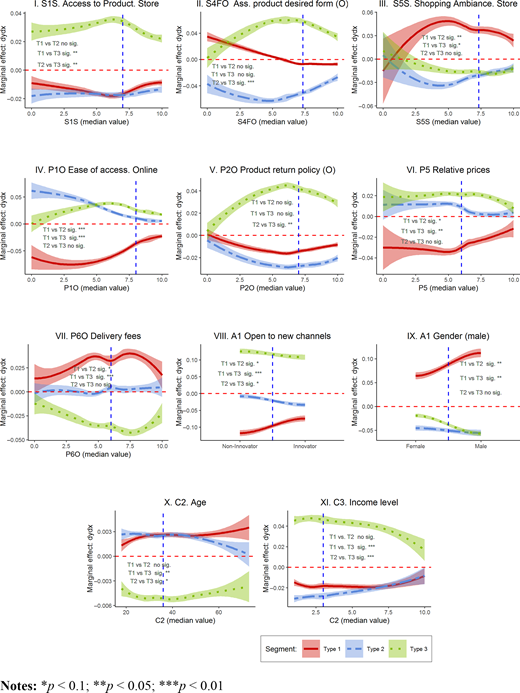
To facilitate the interpretation of these results of comparisons between pairs of segments, Figure 1 shows the marginal effects of the model’s significant variables; that is, the increase in their impact on the estimated probability of membership in each segment for every additional unit of the independent variable. In addition, each graph shows the statistical significance of the pairwise comparison parameters according to the data in Table IV. Thus, these marginal effects allow us to describe the impact of each variable on segment membership probabilities.
As observed in the model results, the variables that explain the probability of membership in the mono-channel customer segment (Type 1) are shown in panels III, IV, VI, VII, VIII and IX in Figure 1. The probability of membership in Segment 1 (customers who visit and purchase goods from one channel only) increases with higher importance ratings for physical store ambience (S5S) and decreases with lower importance ratings for website accessibility (P1O), prices (P5) and shipping fees (P6O). The customers in this segment also show lower innovativeness in channel usage (A1) and are predominantly men (C1).
Segment 2, omni-channel users, visit both channels but only purchase goods through only one of them. The main distinguishing characteristics of this segment are shown in Panels II, IV and XI. The probability of membership in this segment increases with higher importance ratings for the assurance of online purchase delivery (S4FO) and the online return policy (P2O). Demographically, this group is composed of lower income earners (C3).
Finally, Figure 1 enables us to corroborate the results obtained in the model. Thus, the omni-channel purchaser segment (Type 3) is characterized by the variables shown in panels I, II, V, VII, VIII, X and XI. The probability of membership in this segment increases with higher importance ratings for in-store product accessibility (S1S) the assurance of e-commerce delivery (S4FO), online return policies (P2O) and online delivery fees (P6O). Demographically, this group is predominantly made up of innovative, young, higher income earners.
5. Discussion
In this work, we segment the customer base of a fast fashion retailer with an approach integrating two research trends: one to explain channel choices across different customer segments based on online and offline channel attributes; and another based on the omni-channel literature, which focuses on explaining mixed channel usage for shopping and cross-channel combinations of distribution services along the purchase path. This approach allows us to examine the importance of the combination of channels throughout the entire purchase process for different types of consumers.
We describe three customer segments: one containing those who visit and purchase goods from only one channel, another containing those who use one channel to purchase goods but both channels for the services they provide, and a third containing those who use both channels for purchasing goods the services provided. This last group is the largest. This segmentation outcome may be specific to this particular retailer, whose market share within the sector is very large.
Setting out from a concept of distribution services similar to that analyzed in this paper, previous research has observed that the service assortment at the time of purchase, delivery assurance and the shopping ambience provided by retailers are the main contributors to customer satisfaction in the in-store shopping environment (Betancourt et al., 2007; Betancourt et al., 2014). The results of our analysis are consistent with these earlier findings.
All customers value accessibility both when seeking information and when exercising their preferred purchase option. If their behavior is mono-channel, they seek easy access, be it to the physical store or to the website. If they are omni-channel users/purchasers they value easy access to both channels.
The essential ingredient for turning omni-channel users into omni-channel purchasers is the assurance that purchases will conform to expectations, be delivered in time and in the desired form and can be returned if unsatisfactory. Therefore, it is very important to ensure that the product purchased conforms to the customer’s wishes by providing sufficient information online and that the product can, otherwise, be returned at little or no cost. The key content of e-commerce sites for the online buyer appears in the product area (Cortinas et al., 2019) and the way in which information is presented in this area is a crucial factor for success (Flavián et al., 2009, 2010). Consequently, web designers and omni-channel marketers should make a special effort to provide high quality information, useful content, and efficient and attractive navigation experience, as effective website design will determine the consumer’s decision to enter the store (Melián and Padrón, 2006).
Fourthly, the critical feature of omni-channel purchasers is the value they place on easy access to the product through the physical store. These customers benefit from this service feature whether purchasing in-store or online and when opting for “ship-to-store” delivery. Different pick-up options add value to omni-channel customers by providing greater flexibility. The transportation costs incurred by the online retailer are also significantly reduced when customers pick up at the store.
Finally, with respect to demographics, omni-channel purchasers are more innovative in their use of alternative distribution channels, and are also younger and have higher incomes than the other two segments. This confirms previous findings. Frasquet et al. (2015), for example, find that online information seeking is less frequent among older consumers than among younger ones. Strebel et al. (2004) also find that younger consumers tend to be more multi-channel-focused in their search for information and De Keyser et al. (2015) find that the omni-channel segment is mainly made up of young people with higher-than-average incomes.
6. Implications
As Verhoef et al. (2015) suggest, the retail world is changing its perspective from multi-channel to omni-channel marketing, as new devices and channels, including mobile phones, tablets and social media invade both the traditional physical and online shopping environments. However, previous research has approached this phenomenon mainly from the channel management angle; while exhibiting certain indifference toward the consumer behavior perspective. This paper contributes to advancing the knowledge of consumer behavior by including purchase history in an analysis of omni-channel shopping habits. In concrete terms, we segment customers by channel usage throughout their purchase history and describe the segments based on their members’ perceptions of channel characteristics, specifically, distribution services and channel policies. A greater understanding of the behavior and characteristics of the omni-channel consumer will assist retailers in making informed decisions regarding, which services to offer and what kind of policies to implement in each channel.
Consumer behavior can vary not only in the choice of purchase channel but also in the use of distribution services. Retailers, therefore, require a more comprehensive picture of the ways in which their customers use the distribution services and other resources provided by their distribution channels, whether for purchasing goods or not. Regardless of whether their behavior defines them as omni-channel users or omni-channel buyers, consumers seek a seamless shopping experience by using the distribution services of both channels in varying degrees. Our findings have valuable implications for omni-channel marketers. Our results clearly show that customers’ purchases and visits are determined by the different service features provided, which can, therefore, be used to guide the retailer’s segmentation strategy. Thus, greater accessibility to both distribution channels, together with greater flexibility for dealing with unsatisfactory purchases, will contribute to assuring the customer’s maximum satisfaction with their purchase, regardless of their choice of channel.
7. Limitations and future research lines
Regarding the possible limitations of this paper, various points are worth considering. Although this three-group customer segmentation can be extended to any retail sector offering a variety of online and offline distribution services, the size of the segments observed in this study may be conditioned by the fact that the fashion industry deals in sensory goods, in relation to which the match between product and consumer is a major issue. Other factors potentially influencing this customer segmentation outcome are the large market share and extensive store network owned by this particular retailer. This suggests an interesting area for future research extending the analysis to other, less sensory, products, to determine whether the findings regarding the distribution services that play the most decisive role in the segmentation still hold.
The nature of the study and size of the sample also prevent us from exploring any further into the reasons for single-channel behavior, which may differ greatly between exclusively online and exclusively in-store shoppers. It would be interesting to determine whether current behavior is influenced by previous usage experience. Prior studies have suggested that a fluent online shopping experience would evoke positive affective responses, and facilitate positive online behavior (Mosteller et al., 2014). Likewise, it would be useful to develop multi-item scales to measure these effects in a confirmatory analysis.
Future lines of research should explore the economic implications of this customer segmentation. The literature provides some evidence to show that omni-channel customers generate more revenue than mono-channel customers (Venkatesan et al., 2007), but we know little about the potential differences among omni-channel customers. Our findings for price perception may suggest higher price sensitivity in the mono-channel segment; which is another possibility worth exploring in future research.
Funding: We acknowledge the financial support for this research from the Spanish Ministry of Education and Science: Project ECO2015-65393-R.