This study examines The Chicago Defender in order to contextualize how lynching and legal forms of courtroom punishment were reported in the Black Press during the first half of the 20th century. Using a data sample of 198 articles published between 19051940, we employ a biopower analysis to identify narratives chronicling the decline of vigilante public lynching while forewarning the harms of legal “lynching” via courtroom trials that protected State racism in a more covert and legally accepted manner. Our findings indicate that the Defender not only described how the terror of lynching was the biopolitics of the Reconstruction era and the early twentieth century, but also the necropolitical cultural transition toward mass incarceration and state-sanctioned executions to control and subjugate Black populations.
By the early 1930s, the barbarism of public lynch mobs had become a rallying point for a growing social disdain towards extra-legal racial violence against Black Americans particularly in the American South. Although lynching was on the decline, vigilantes began employing more discreet tactics: “Instead of a large, noisy mob, a small group of five or six persons now kidnaps the victim and maim or kill him” (The Chicago Defender, 1940, p. 1). These unpublicized lynchings often were disregarded by the white press, creating the perception that lynching was dying out. But the shift from overt racial terror toward more veiled tactics to reinforce Black subjugation was merely a precursor to racial bifurcations in judicial and penal administration that have persisted long after American society has largely cleansed itself of public lynching. A 2015 report by the Equal Justice Initiative found that the 4000 Southern lynchings between 1877 and 1950 were “the precursor of modern-day racial bias in the criminal justice system” and “far more influential in shaping present-day racial reality than contemporary Americans typically understand” (see The New York Times, 2015).1
As lynching declined, the legal system remained as the most effective apparatus to reinforce white authority because constitutionally authorized punishment offered the pretense of due process, appeared to be free of vigilante violence associated with mob justice, and shielded the South from the backlash against “the penal excess of the lynching spectacle” (Garland, 2005, p. 817). Whereas the overt bigotry that underpinned slavery, convict-lease, segregation, and lynching affirmed a near unshakable ethos of separation and illusory Black inferiority, mounting opposition to Jim Crow and vigilantism by the 1940s rendered those power relations non-economical (see Foucault, 1982).2 With southern legislators pressured to curtail increasingly aberrant lynch mobs, the legal system ostensibly imparted a more humane appearance to disciplining Black Americans and reaffirming white authority. For many Southerners, the ease by which racialized laws were enforced, courtrooms were stacked with white prosecutors, judges, and jurors approved of (or were willing to ignore) blatantly racialized criminal proceedings, and Black defendants were railroaded to prison or execution affirmed that the legal system could properly dispense white supremacist Southern justice. The resulting harms disproportionately affected “racial and ethnic minorities—including foreign-born and non-English speaking European immigrants—[who] made up 40 to 50 percent of the prison population” between 1850 and 1940 (Delaney et al., 2018); and white supremacist authority constituted inside courtrooms and behind prison walls was eerily “reminiscent of the power exercised” through public lynching (see Foucault, 1977/1995, p. 129).
This study examines narratives published by The Chicago Defender articulating and critiquing cultural shifts away from public lynching spectacles toward legalized forms of oppression. Using a random sample of 198 articles published between the years of 1910–1940, we chronicle how Defender reporting advocated the abolition of lynching by any means necessary, while also framing political and legal institutions as disingenuous tools of white supremacist conquest and power maintenance that preserves Black subjugation as a “colonial condition of life-in-death” in American society (Bhabha, 2017, p. 37; see also Ndayisenga, 2022). Because the fear of death is constantly hovering over the colonized, the racial caste of anti-blackness is rendered normative by the State using constitutional means including police force, jury trials, mass imprisonment, and the death penalty (see Becker, 1975).
The Importance of the Chicago Defender and the Black Press
Founded by Robert S. Abbott in 1905, The Chicago Defender emerged during the early 20th century as a staunch defender of race and leading voice in the Black Press. Under Abbott’s direction, The Defender became the first Black newspaper to boast a circulation rate over 100,000 (and at its peak an estimated readership exceeding 500,000) and had extensive geographic reach from the urban north of Chicago to rural and isolated southern communities (PBS, 2016). At a time when the mainstream white press was unable or unwilling “to publicize black voices or to represent black issues in a nonpatronizing manner” or detail the brutal excesses of Jim Crow and racial injustice, newspapers like The Chicago Defender offered “a space of self-representation: not only to craft common identities and solidarities, but also to develop arguments which might effectively engage white civil society” (Jacobs, 2000, p. 21).
Many other Black newspapers in cities across the country modeled their reporting and mission after The Defender, helping legitimize Black politics, culture, commerce, and the vocal opposition of anti-Blackness: “[The Defender] protested racial injustice with a fury… and used strong language to protest racial inequality and oppression in the South…[which included] the paper’s willingness to criticize southern whites and advocate black migration” (Jordan, 2001, p. 32–33; see also, Bayton & Bell, 1951),3 Embodying a reporting ethos of “fearless militancy in protesting against wrongs” (Michaeli, 2016, p. 22), The Defender ascended as a powerful voice representing Black civil society challenging the “racist assumptions and stereotypes” that were perpetuated by a mainstream press that systematically “excluded black opinions” (Jordan, 2001, p. 2). In doing so, the Black Press became a motivating force in the movement of millions of people from the rural South to the urban North during the first Great Migration between 1900 and 1930.
During this time, the South witnessed the Black American population across the region decrease by almost 15 percent, with Black communities forming in cities of the upper Midwest. Chicago saw Black Americans increase from 1.8 percent of its population to 8.2 percent in four decades; Detroit 1.4 to 9.2; Saint Louis 6.2 to 17.9; Cleveland 1.6 to 9.6; and Cincinnati 4.4 to 12.2 (Gibson & Jung, 2002). The diaspora unsurprisingly gave rise to a small, yet culturally influential constituency that has been called the Black Metropolis (Drake & Cayton 1945/1962; see also Wilson, 1978). By helping to establish a social voice that buttressed the social, cultural, and economic evolution of Black American populations during the twentieth century, the Chicago Defender and the Black press, more broadly, “provided a space for forming arguments about integration and civil rights which would later find their way into the public spaces of communication in white civil society” (Jacobs, 2000, p. 47).
Foucault, Biopower, and the Biopolitics of State Racism
More than any other media source, the Black Press chronicled the widespread barbarity and vigilantism that consumed the American South for the century following the Civil War. While Emancipation abolished chattel slavery, the prevailing racial order was maintained using pre-Plessy Black Codes and Jim Crow segregation that reinforced Black subservience, a convict-lease apparatus that controlled Black labor power, and localized lynch mob terrorism (see Lichtenstein, 1999; Wacquant, 2000, 2002).4 Mass incarceration was effectively born from the social and economic insecurities emerging during the Reconstruction era when cultural efforts to restrict any meaningful progress for freedmen justified increasingly punitive legal and extra-legal criminal sanctions (Wacquant 2009). On one hand, vigilante lynching was meant to extend the exercise of sovereignty over the mortality of Black Americans through gruesome public exhibitions of physical torture that demonstrated the consequences of challenging white supremacy (Markovitz, 2004, see also Mbembé 2003; Wells 1893/1999). Ritualized legal proceedings, by contrast, legitimized the process of procuring “justice” via law enforcement, imprisonment, and execution as equitable and fair (for many white Americans, at least), in part because the institutionalized forms of penal authority and social control cloaked under the pretense of due process and equal protection offered little more than a just and humane veneer for disciplining people of color and the poor.
By the time that Rutherford B. Hayes removed occupying Northern forces from the South in 1877, Reconstruction mandated reforms were already being swiftly repealed and replaced with Black Codes that “narrowed the civil rights and liberties of Black Americans to circumstances very similar to the conditions of bondage that existed before emancipation” (Maratea, 2019, p. 30). The French former colony of Haiti (then SaintDominique) had already demonstrated that new forms of disciplinary power to subjugate and control entire populations could be developed to maintain white supremacy following the abolition of slavery (Martínez, 1999). In the American South, de jure segregation flourished and became the springboard for white supremacy to normalize the relationship of power with entire populations both under law and culture.5 Thus, a biopower over life and death was specifically developed and put in motion against Black Americans that gave birth to an ongoing system of mass imprisonment for disciplining of the physical body to compel individuals to consent to institutional white authority (Foucault, 1976/1997).
Of course, racialized biopower was not limited to agents of the state in the South (and the North, as well); extra-legal lynch mobs during the post-Emancipation period inflicted disciplinary power against specific individuals that diffused control to large swaths of people of color. The geographic center of the black population in bondage was concentrated in the Deep South, which not coincidentally was also the epicenter of lynching in the decades to come (see Figure 1). In Georgia, for example, there were 531 chronicled lynching events between 1882 and 1968, along with thousands of lessthandeadly assaults, disappearances, threats, and acts of intimidation delivered anonymously or by police (Chandler, 2021). To the extent that State racism affords the “power to kill… not only to the State but to a whole series of individuals [so that] everyone…ha[s] the power of life and death over his or her neighbors,” lynching as a mechanism of biopower demonstrated to white supremacists how “the death of the other, the death of the bad race, of the inferior race…is something that will make life in general healthier” (Foucault, 1976/1997, pp. 255, 259). In doing so, lynching and practices like convict-lease reflected how racial terrorism helped maintain white supremacy following the end of chattel slavery.6
Methodology
The data used for this study were collected using a systematic random sample of 198 articles published in The Chicago Defender between 1910 and 1940. The Defender was chosen for analysis because it had the highest circulation rate of any Black Press newspaper and was so influential among Black Americans that, “you knew it didn’t happen if it wasn’t in The Defender” (Davey & Eligon, 2019, emphasis added). All articles were retrieved in chronological order through The Defender’s online archives using appropriate keyword searches (e.g., lynch, lynching, lynch*) to ensure that every article containing a variation of the word lynch would be included in the preliminary sample (n=10,467). Using a random number to start, every fiftieth article was then selected, which yielded a final sample of 198 articles. If any of the randomly selected articles were deemed inadequately focused on lynching to include in the final sample (for example, a report about Lynchburg, VA), the next article from the list was selected; this process was continued until a suitable hit was reached, from which we continued selecting every fiftieth article.
Once our final sample was drawn, the implicit challenge was to document and measure the transition from explicit forms of racial intolerance to an array of actions by the states of the American South reflecting the appearance of less racially charged responses as it was reported and evaluated by The Chicago Defender. To accomplish this task, each article was coded using a tracking discourse approach to qualitative document analysis, which hinges on the examination of “numerous documents in order to become familiar with formats and emphases, while suggesting topics and themes that emerge or remain consistent over time” (Altheide, 1996, p. 70). Applying this method of content analysis allowed us to identify prominent framings, rhetorical devices, and communicated ideologies in The Defender’s commentary on lynching.7 An initial examination of each transcript was completed to collect a preliminary list of relevant themes. A second round of coding was then performed to collapse redundant primary codes and ascertain relevant secondary codes. Finally, the accuracy of each narrative was verified for accuracy by again reading each transcript in the sample and having the researchers cross-analyze the identified themes, after which the primary and secondary codes were charted by decade using FreeMind mapping software to visualize the development of narrative themes.
Lynching Narratives in the Chicago Defender, 1910–1940
In 1893, Ida B. Wells detailed “the origin of lynching as a tool of frontier justice and its increasing use in the South to deny Blacks their political rights” (Michaeli, 2016, p. 14, see also Wells, 1893/1999). Her words described how white supremacist racial terrorism was used to oppress Black Americans; they also reflected the desire of Robert S. Abbott’s Chicago Defender to foster “discontent, and militancy and [encourage] blacks to demand full citizenship” (Jordan, 2001, P. 3). While the mainstream press systematically ignored the plight of Blacks and often framed injustice through the lens of white civil society (Jacobs, 2000), the Defender provided readers with horrifying stories of “men, women, boys and girls who…[had] been hunted, lynched, burned, shot, outraged, run to the earth like rats,” often without any evidence of guilt (Sweney, 1915, p. 8).8 These sorts of graphic accounts were likely intended to yield visceral responses by situating public lynching as a ceremonial “exercise of terror,” enacted with the purpose of making Blacks aware, “through the body of the criminal, of the unrestrained presence of” white authority (Foucault, 1977/1995, p. 49). In this sense, Defender narratives convey an awareness that lynching “did not re-establish justice; it reactivated power” over Black populations, and therefore needed to be abolished for universal American democracy to survive (Foucault, 1977/1995, p. 49).
Yet it was also evident in The Defender’s reporting that overcoming the stain of lynching would not be enough to free Black Americans from anti-Blackness sentiment. Although lynching symbolized the problems of discrimination and indifference toward Black Americans since the end of slavery, there were five primary narrative themes that reflected how racial caste persisted in social, economic, and political institutions despite illusory claims of progress. First, Southern justice was not manifested merely through barbaric acts, but also an enduring discourse of white supremacy and Black inferiority. Second, racial bifurcations in justice and legal institutions allowed lynching to occur with little resistance and ensured that courtroom trials would protect the sanctity of whiteness. Third, the ambivalence of white Americans and the press (public perceptions) toward the plight of Black populations ensured that Black Americans would be unable to overcome the system of racial caste born from the vestiges of slavery and thrust upon them by white civil society. Fourth, cowardly (and corrupt) politicians could not be trusted to enact meaningful reform. Finally, the alleged progress toward racial equality realized by the eradication of lynching would ultimately reaffirm the sentiment of anti-Blackness in American society. Each of these five primary discourses of power-knowledge rejected the possibility of radical enlightenment of American values and foresaw the tyranny of the lynch mob being replaced by more covert forms through technologies of power, including legal ‘lynching’ enacted through the courts and corroborated by statutory law.
1910–1919: Exposing the History of Thought on Southern Lynching
Early reporting in The Chicago Defender condemned the brutality of lynching in the Southern states while exposing the intractable bigotry of Southern justice.9 It was noted that many southerners openly celebrated lynching, and that no evidence of guilt inhibited punishment since Blacks were just assumed to be guilty (The Chicago Defender, 1913, 1914b, 1919a).10 Recognizing that lynching was a social institution in the Jim Crow South, The Defender framed Southern culture as deeply ignorant and characterized by anti-Blackness hatred.11
The South is backward. It shames the United States by illiteracy and incompetence. Its hill men and poor whites, its masses of feared and bullied blacks, its ignorant and violent politicians…and its rotten social ideas exist in circumstances which disgrace the United States in the thought of Americans and in the opinion of foreigners. When the North exhibits a demonstration of violence against law by gutter rates of society there is shame in the locality of the exhibition. When the South exhibits it there is a defiance of opinion (Sweney, 1915, p. 8).
This “defiance of opinion” was symptomatic of the white Southern states’ culture of assumed Black inferiority. Whereas Southern states pursued harsh criminal sanctions when a white man was lynched, colonized Black Americans could easily be killed without having ever committed a crime; law-enforcement often refused to prevent lynching, and subsequent investigations were routinely whitewashed to produce no criminal charges even though lynching parties were often festive public celebrations attended by throngs of onlookers that sometimes exceeded 10,000 people.12
The Defender warned that anti-lynching legislation was a needed but unlikely solution given that anti-Blackness was not simply a Southern phenomenon in the United States (The Chicago Defender, 1914a). Although there were isolated instances when right-minded officials “awakened common sense of white citizens,” among them a Memphis sheriff who prevented a lynching by ordering a mob to disperse “while the going was good,” there was skepticism that the “best white people [would] stay awake” to the “realization of Colored people that they were human and free and Americans” (The Chicago Defender, 1919a, p. 17). The white press was criticized for stoking racial hatred by distorting the truth about lynching and failing to condemn the maltreatment of Black Americans (The Chicago Defender, 1917, 1919c). Furthermore, close-minded whites were blamed for perpetuating anti-Blackness ideologies that buttressed the need for de jure segregation.
The Caucasian complains that we are uneducated, but the minute we become educated he closes the door of hope in our face. Again he complains that we are not property holders, but the minute we begin to secure property he passes segregation ordinances, stones us out of our newly acquired home and otherwise obstructs or intimidates us. The North is just as prejudiced as the South, only it is not so frank and open with its vituperations. Every effort the Negro makes along honest lines is checkmated and when in despair he falls from grace, the cry is that he is naturally criminally inclined (The Chicago Defender, 1915, p. 8).
Where the criminalblackman discourse of the racist American state developed out of “the Negro is an animal, the Negro is bad, the Negro is mean” ideology (Fanon, 1952/1986, p. 112, see also Russell-Brown, 2021), a corresponding power-knowledge that freedman and freedwomen must be controlled was set in motion in the South during the Emancipation era. It is therefore unsurprising that Defender reporting prophesied that laws would continue to go unenforced or be administered in a discriminatory fashion. Nowhere was this more evident than in articles describing how local public officials participated in the lynching of Blacks (or were too fearful to intervene), politicians tacitly condoned deadly racial violence by failing to enact anti-lynching legislation, and post-lynch investigators whitewashed the truth by concluding that victims died by the hands of parties or persons unknown, thus concealing the operations of State racism.
1920–1929: Docile Acceptance and Blissful Ignorance
Opposition to lynching nonetheless intensified in the North, and there were sporadic attempts to eradicate mob justice in the South, including the circulation of an Atlanta petition “urging the United States [Congress] to pass a bill making the lynch law a federal charge” (The Chicago Defender, 1918, p. 16). Because public officials had proven unwilling to combat mob rule at the state level, it was suggested federal intervention was needed to eradicate lynching. However, it soon became clear that southern legislators would resist any efforts to eliminate lynching through federal legislation. The landmark Dyer Anti-Lynching Bill, for example, was first introduced in Congress in 1918, but was ultimately defeated despite considerable support among liberal whites (The Chicago Defender, 1922).
The Dyer Bill did succeed in raising public awareness to lynching and inspired numerous states to enact their own anti-lynching laws or strengthen already existing legislation (The Chicago Defender, 1925b); it was nonetheless clear that “the lynching of [Blacks had] become such a common occurrence that very little attention is paid to them” (The Chicago Defender, 1924, p. 12). Defender reporting suggested that many people chose to remain maliciously oblivious of lynching and the institutional injustices perpetrated against Blacks in the Southern states, thereby allowing mob justice to continue unabated as vigilantes knew their actions would go unpunished and, were it not for the Black Press, unreported as well.
Last week a white man was arraigned in a Raleigh (N.C.) court for an assault upon a young girl who was not white. The girl positively identified her assailant; he confessed his crime…then the judge turned the man loose with a warning. There was no attempt made to lynch him—no daily papers spoke out against him and the best citizens came to his rescue. He was made a hero and a martyr. The little girl was forgotten. That is life in the South…the land of depraved minds and blissful ignorance (The Chicago Defender, 1925c, p. A10).
In describing this unequal application of “justice,” the racial bifurcations evident in the legal system were described as perpetuating “hatred, prejudice, and race wars” by railroading Blacks and sanctioning them with significantly harsher punishments than white offenders (The Chicago Defender, 1925c, p. A10): “We know that the [Black man] will be lynched by the law anyhow, even when the law is allowed to take its course—his color assures that fact” (The Chicago Defender, 1926b, p. A2).
The claim that courts functioned as a vehicle to secure the legal lynching of Blacks was rooted in three primary concerns. First, lynching investigations as formations of power and discourse were ‘whitewashed’ to ensure white vigilantes and local authorities would not face prosecution for participating in lynch mobs. Second, criminal courts and the legal system cultivated two hues of justice whereby the sanctioning of blackness served to protect the supremacy of whiteness. Third, northern politicians failed to buttress their words of opposition with a positive sentiment in the form of legislative action against lynching. Of the 203 anti-lynching bills introduced in the US Congress between 1882 and 1968, three passed the House of Representatives and none survived Senate filibusters by Southern Democrats (U.S. Senate, 2005). Given the fact that many southern whites produced a discourse where lynching was “a necessary aid to the machinery of law” (The Chicago Defender, 1929, p. A2), the passage of a federal anti-lynch law required encouragement from the North and the backing of white politicians (The Chicago Defender, 1922).
Compounding matters, local authorities would often misclassify vigilante killings as something other than lynching, such as suicide or natural causes (The Chicago Defender, 1926a). Masking racially motivated murders was a common biopolitical tactic, as was deliberately obscuring lynching statistics; manufactured declines in lynch rates allowed southern politicians to claim that their states were coping with the problem (albeit by furthering a system of exclusion).
Statistics show that during the last year the number of victims at the hands of mob violence had been materially reduced. Many reasons are assigned for this result. An influential southern paper—the Asheville Times—gives the South more credit for this than it deserves. It states that ‘the South is rapidly learning that lynch law is a serious indictment of our Christianity and a death blow to our system of administering justice…The time once was when the public opinion of the South condoned lynch law—that day has very happily passed…This change of sentiment is reflected in the decrease of lynching; in fact it explains this reduction’ (The Chicago Defender, 1925a, p. 24).
In truth, disappearances and kidnappings continued even though it was unclear how many resulted from actual lynching. During that time, many Black men were compelled to leave their families—under pressure or threat—to find work in the North and kept their movements secret to avoid white intercessions and interference in northern migration.13 Furthermore, statistical data did not include unreported lynching, disappearances, or racially motivated homicides, more generally. There was also concern that lynch mobs were becoming more indiscriminate and killing proxy targets with greater frequency when they were unable to locate their intended victim (The Chicago Defender, 1927). Consequently, The Defender warned that changing lynching rates were not necessarily indicative of improved conditions for Black Americans in Southern states, but rather reflected the duplicity of discriminatory anti-Blackness in American society.
1930–1939: The Gentle Way of Lynching
Data on lynching were misleading, in part, because reported decreases in vigilantism did not document the emergence of covert lynching. By 1937, The Defender reported that 72 percent of the total population and 57 percent of southerners favored ratification of anti-lynching laws (The Chicago Defender, 1937b). With brazen public lynching drawing the attention of abolitionists and civil rights advocates, vigilantes began to operate surreptitiously by adopting a technology of power that Thurgood Marshall called “the subcommittee technique” of killing lynch victims “quietly by a few persons instead of by large mobs” (The Chicago Defender, 1940, p. 1). His argument that racialized violence was not dying out, but rather evolving toward more furtive methods indicated that necropolitics of anti-Blackness would remain intact in a world without public lynching.14
The presence of biopower as covert racial violence demonstrated that lynching did not merely constitute publicly visible offenses perpetrated against a powerless population. Rather, it reflected the fact that racially bifurcated justice was infused throughout the existing justice system (i.e., proxy forms of Southern justice were endemic everywhere), thereby ensuring a power-knowledge discourse of legal lynching could be carried out in the courtroom under the guise of law. One of the more notable incidents of legal lynching occurred in March of 1931, when nine Black American teenagers were arrested for the alleged rape of two white females on a freight train in Alabama. Then-Governor B.M. Miller dispatched the National Guard to protect the prisoners from an outraged lynch mob, and the Scottsboro Boys were subsequently convicted multiple times by all-white juries. Described in the Defender as the attempted “lynching of innocent boys by a law court” (The Chicago Defender, 1931a, p. 11), the Scottsboro case demonstrated how insidious problems of discrimination and racial bias extended to the courts where Black Americans “would either be lynched or ‘railroaded to the chair’” (The Chicago Defender, 1931b, p. 2). Indeed, many southern whites were so assured that criminal courts would dispense “justice” (The Chicago Defender, 1935, p. 10), there was a penchant “in some sections to curtail mob lynching and wait for the ‘legal lynching’” (The Chicago Defender, 1932, p. 4).
This recognition that the courtroom was a more subtle apparatus to legally perpetuate the color line is noteworthy because Defender reporting framed institutional progress as illusory since it would likely spawn more insidious forms of discriminatory power and control.15 From a Foucauldian perspective, the biopolitics of power explain how decades of mob terror and whitewashed investigations were accomplished with virtual impunity (see Foucault, 1976/1997). Whether it was due to racist judges, jurors reaching bogus verdicts, or authorities fraudulently testifying during criminal trials, The Defender regarded the legal institutions vested with curing lynching as untrustworthy in protecting the lives of Black Americans (The Chicago Defender, 1936b, 1939). Take, for example, the Florida Constable who “knew lynchers for 14 years [but failed] to recognize them” in court following alleged pressure from the Ku Klux Klan, or that prospective jurors were questioned to see if they supported racial equality (The Chicago Defender, 1939, p. 4).
Pushing for a federal investigation, the I.L.D. (International Labor Defense) pointed to the campaign of intimidation of witnesses and prospective jurors by the local Ku Klux Klan. The I.L.D. also stressed the anti-race atmosphere in which the trial was conducted, as exemplified by questions put to the veniremen during the selection of the jury. Each prospective juror was asked if he had been approached by, contributed to, or supported either the I.L.D., the Workers Alliance, or the National Association for the Advancement of Colored People. One juror was asked if he had ever contributed to any organization which advocated equal rights for the Race (The Chicago Defender, 1939, p. 4).
Despite an ersatz veneer of social progress during Emancipation, the colonized were considered mere “spectators,” while the colonizers made legal decisions and controlled their existence (see Ndayisenga, 2022). Thus, continued expressions of white power combined with Northern ambivalence and systemic inequality throughout the South (and the United States more generally), ensured courtroom trials as a performance of biopower would be as capricious, arbitrary, and prejudiced as the lynch mobs they sought to abolish (The Chicago Defender, 1936a).16
Analysis
On April 4, 1936, The Defender reported that 50 percent of lynch victims were neither accused nor found guilty of a crime; an astounding 59 percent were also found to be innocent in post-lynch investigations, according to a study conducted by the Commission on Interracial Cooperation.17 Despite the fact that these figures suggest that lynching was capricious and arbitrary, there nonetheless was a discernable antiblackness rationale behind the selection of victims.18 These data also underscore the moral conflict evident in Chicago Defender narratives arguing for abolition of lynching while acknowledging the dangers of state sanctioned justice offering the appearance of due process. In contrast to the brutal spectacle of a lynching, which activated repressive power through application of violent racist force to terrorize and intimidate, the performance of biopolitics as courtroom trials offered a more humane appearance while functioning to reaffirm anti-Blackness. The cursory physics of power might have been altered, but the fundamental discursive aim—an objective and metaphysical subordination of Black Americans to social, political, and legal exclusion—remained viable and lethal.
Accordingly, The Defender told the tale of shifting yet unchanging power dynamics, whereby both lynching and more surreptitious forms of biopolitical control enacted via a discourse of courtroom punishments both produced outrageous legal behaviors. From a Foucauldian perspective, the role of biopower is essential to understanding why The Defender predicted other deeply insidious harms would continue to burgeon following the eradication of lynching. Although Foucault asserted public executions had begun to disappear nearly one hundred years before lynching would peak in the U.S., the practice of sovereign power nonetheless succeeded in facilitating “a collective memory of terror among blacks in order to fully emphasize not only the superiority of white power but also the consequences of challenging that power, and the extreme uses of violence were absolutely essential to achieve this end” (Markovitz, 2004, p. 117–118). When Southern whites chose to flaunt overt barbarism, it was hardly coincidental; it was a direct and frantic response to defeat in the Civil War, when occupation by federal troops during Reconstruction fostered progressive gains that threatened to forever eliminate the legal, cultural, and moral abyss separating an excluded population from social integration and civil equality.
With the advent of Emancipation and its attendant loss of the slave system’s marking of the African-American body as property, lynching emerged to reclaim and reassert the centrality of black male corporeality, deterring the now theoretically possible move toward citizenry and disembodied abstraction (Wiegman, 1995, p. 94).
A process of killing that the colonial state birthed in the form of slavery continued in the Emancipation era through the necropolitical discourse of lynching, which not only served to reassert and reinforce anti-Blackness, but also preserved the dissymmetry between white supremacy and Black inferiority. The necropolitics thus perpetuated the movement of an entire population from mere survival to possible death since colonialism “uses fear and (fear of) death as imperative elements that allow its perpetual run” (Ndayisenga, 2022, p. 478).
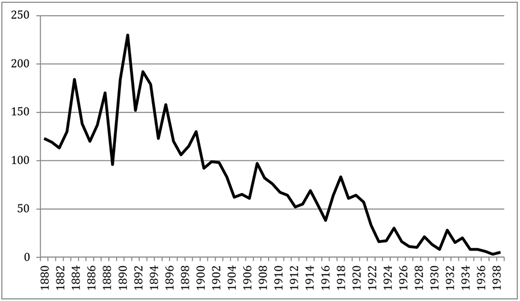
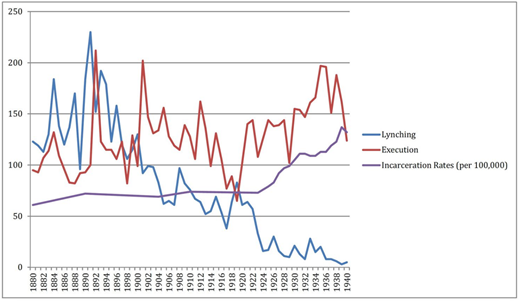
By the 1930s, however, it had become evident that a substantial portion of white Americans could no longer ignore the inhumanity of lynching, particularly as images and tales of tortured victims made their way into news reports and became matters of public record. As Figure 2 illustrates, lynching was in decline following its peak in 1890s and was nearly extinct by 1940. But in its place remained widespread and variable forms of de jure discrimination. Jim Crow segregation was firmly entrenched as the law of the land following the Supreme Court’s ruling in Plessy v. Ferguson (1896); the institution of convict-lease in the South created a system of by-proxy slavery until it was finally abolished in 1928;19 and Black Codes allowed for disproportionately harsh punishment of the descendants of slaves (see Du Bois 1935/1992). These (and other) openly racist bifurcations in the legal process were manifest in myriad ways, including maltreatment by law enforcement, the systematic exclusion of Black Americans from jury pools, and the ease with which disenfranchised defendants were routinely railroaded by the courts. If lynching was indeed a response to fears of expanded Civil Rights for Black Americans, then its decline was evidence of “progress” toward integration that allowed Black power and self-determination to flow into cultural spaces historically reserved for white authority. Still, lynching had insidious institutional surrogates, readily identifiable as the biopolitics of Black Codes and Jim Crow justice, which exposed legal institutions as technologies of power that ensured the continued subjugation of Black Americans.20
Notwithstanding that public sentiment was turning against lynching, the evolution of Defender narratives suggests popular beliefs about Southern justice were firmly couched within a broader discourse of perpetual exclusion and anti-Blackness. In echoing W.E.B. Du Bois’s assertion that “the color line is a permanent social institution,” mob terror was framed as symptomatic of other problems that would persist after lynching’s demise (The Chicago Defender, 1937a, p.1, quoting Du Bois 1903/1989). In particular, the biopolitics of courtroom performance would permit “millions of Negro people [to be] persecuted daily in forms similar to the persecution of the Scottsboro Boys” (The Chicago Defender, 1934b, p. 1). Criminal trials became spectacles reinforcing the consequences of Black challenges to the status quo in Southern white society. The resulting semblance of progress permitted legal disenfranchisement and abuses via policing, judicial, and penal institutions to be accomplished amidst broader social support and among southerners concerned with keeping Black Americans in their system of exclusion.
Foucault’s notion of punishment in general, as a thematic and essential expression of repressive sovereign power in a society, was certainly at play in anti-lynching critique. What is apparent in the pages of The Chicago Defender in the first decades of the twentieth century was the newspaper’s concern not only with the nature of punishment as it was applied during Jim Crow, but also the staff’s insightful concern for Black Americans accessing guaranteed civil rights and liberties, which still have not arrived in full. Where Foucault documents a decline of public execution and torture across Europe, the terror of lynching in the United States gradually transitioned into an institutionalized system of exclusion in the form of mass incarceration and state-sanctioned executions. The result has been a flourishing system of so-called race-neutral devices, by which champions “of racial hierarchy found they could install a new racial caste system without violating the law or the new limits of acceptable political discourse, by demanding ‘law and order’ rather than ‘segregation forever’” (Alexander, 2010, p. 40).
Conclusion
In the decades following the Civil Rights movement, de jure segregation was supplanted by official color blindness, race neutrality, and nominal equality. However, in convention and custom a predominant culture of exclusion persists, and the punitive disciplining of people of color continues to thrive (Alexander, 2010). Stripping off the outer layers of bigotry and bias, toning down the rhetoric, and rinsing away the intractable messages of permanent intolerance, obligatory prejudice, and compulsory public discrimination left intact an apparatus of anti-Blackness hatred that has never ceased to cast a pall over the pursuit of justice in the United States. The Defender narratives function as a précis of the shifting discourse of black-white relations, specifically the application of sovereign power (read “legal” lynching) and the subsequent use of the justice process to discipline in a more exacting and thereby more insidious manner (read biopolitics). Using legally sanctioned executions (read legal “lynching”) and wider applications of incarceration as new technologies of power, courts have filled the void left by the nullification of state slave codes, the Emancipation Proclamation decree, and the affirmation of the Thirteenth Amendment. Look no further than the social framing of Black American criminality as an example of contemporary biopolitical discourse that institutionalizes the reduction of subjects to docile bodies at best or death at worst. Cloaked in a guise of cultural progress, the technological strategy of statutory law has proven remarkably effective at maintaining a system of racial exclusion while concealing the fact that the agents and vehicles of intimidation (e.g., segregation, lynching, and so forth) during Emancipation and throughout Jim Crow were never really eliminated. They were simply displaced by those social and biopolitics institutions where de facto discrimination could flourish through the pretext of expanded racial equality.
Author Note
Correspondence concerning this article should be addressed to R.J. Maratea, Department of Sociology and Criminal Justice, St. Francis College, Brooklyn, NY, 11201. Contact: rmaratea@sfc.edu Giancarlo Panagia, Department of Criminal Justice, California State University, Stanislaus
Sophia Frontale, Department of Psychology, University of Maryland
David P. Keys, Department of Criminal Justice, New Mexico State University
Notes
For more updated Equal Justice Initiative lynching reports, see “Lynching in America: A Community Remembrance Project” (2016), and “Lynching in America: Confronting the Legacy of Racial Terror” (3d Ed., 2017).
Jim Crow refers to a series of local and state laws enacted in the American South beginning in the 1870s that enforced de jure segregation in accordance with the ‘separate but equal’ legal doctrine upheld by the Supreme Court in Plessy v. Ferguson (1896). Despite being deemed unconstitutional in the landmark Brown v. Board of Education of Topeka (1954), Jim Crow laws remained in effect in some jurisdictions until the passages of the Civil Rights Act of 1964 and Voting Rights Act of 1965.
The Defender advocated both against the naturalist aspect of Black inferiority and the historicist “primitiveness” of African culture. For both points as indices of antiBlackness, see David Theo Goldberg’s, The Racial State (2002).
Although discriminatory laws against Blacks existed in both Northern and Southern states from the early 19th century, we specifically use the term Black Codes in reference to laws passed by Southern state legislatures to control the labor, social behavior, civic participations, and movement of freedmen (see Maratea, 2019).
By de jure discrimination we refer to segregation explicitly imposed by law (as opposed to de facto discrimination, which indicates that segregation does factually exist despite being deemed unconstitutional and no longer sanctioned by law).
Mbembé (2003) notes that the biopolitical experiment of the Emancipation era not only addressed slavery but “the very structure of the plantation system and its aftermath manifests the emblematic and paradoxical figure of the state of exception” (p. 21).
A more thorough explanation on this methodological application is provided by Bonnie S. Brennan in Qualitative Research Methods for Media Studies (2013).
The Defender also recounted instances when lynch mobs quietly dispersed upon finding out that the women or little children, who had been raped or murdered, were Black American victims.
Mobs were not entirely a southern problem, but lynching was almost southern stereotyped despite intermittent occurrences in the North.
For a discussion of the ongoing myth of Black criminality and social construction of Black Americans as criminals, see Katheryn Russell-Brown, The Color of Crime (2021).
The Defender did acknowledge the existence of “non-Negro” lynching.
The Defender (1919b, p. 7) articulated this point when noting that “the state of Alabama sentenced thirty men to hard labor for having lynched a citizen. Contrary to the custom, the unfortunate victim was a white man, therefore the justice. Of course, if he had been one of our people the result would have been a holiday for all participants.”.
To this point, Gregory (2006) discusses the intense fear and repression experienced by Black Americans in the South during the era of the Great Migration.
By necropolitics, we are referring to the actualization of racialized biopolitics “to exercise control over mortality and to define life as the deployment and manifestation of power” (Mbembé, 2003, p. 12). Specifically, disciplining freedmen and freedwomen improved the post-slavery living conditions of the colonizer, while necropolitics became the reality of the colonized. Under necropolitics, a new political calculation was introduced regarding whose welfare was to be sacrificed, and who among the colonized and others deemed “disposable” would face the resulting risk of death (Mbembé, 2003, see also Foucault, [1976] 1997).
The Defender (1934) also notes that lynching had been a vehicle for perpetuating economic inequality. Each of the approximately 5000 lynching victims in a 45-year period had been financially poor, meaning that discrimination and injustice were (and are) simultaneously racial and socioeconomic problems.
It is worth noting that some jurors had likely participated in lynch mobs and were therefore presumably supportive of discriminatory verdicts.
The Commission’s study was drawn from a sample of 84 persons lynched over a fiveyear period (The Chicago Defender, 1936a).
For a complete discussion of capricious and arbitrary racialized punishment, see Justice Potter Stewart’s concurring opinion in Furman v. Georgia, 408 U.S. 238, 92S. Ct 2726, 33 L. Ed. 2d 346 (1972).
All references to convict-lease refer to the post-Civil War forced penal labor system wherein Black American prison convicts were leased out directly or via for-profit intermediaries to most commonly work on privately owned “sugar and cotton plantations, as well as coal mines, turpentine farms, phosphate beds, brickyards, sawmills, and other outposts of entrepreneurial daring in the impoverished” Southern states (Mancini, 1996, p. 1). As Oshinsky (1996, p. 44) notes, the horrors of convict-lease “in terms of human misery…could hardly have been worse;” prisoners found themselves “laboring for the profit of three separate parties: the sublessee, the lessee, and the state,” with no party incentivized to protect them from grueling working conditions, physical beatings, and overall neglect: “If a convict died or escaped, his employer lost nothing” since a replacement would be supplied for the cost of a new lease. According to Loïc Wacquant (2002, p. 46), convict-lease resulted from emancipation fears that the newly freed Black labor force would threaten the existing racial hierarchy and economy order by collapsing the “cardinal status distinction between whites and ‘persons of colour’.” Convict-lease was therefore intended to maintain white supremacy using legally mandated Jim Crow segregation that reinforced black subservience to control black labor power through forced confinement and penal labor (Lichtenstein, 1999; Wacquant, 2000, 2002).
Michelle Alexander (2010) notes that “racial caste systems do not require racial hostility or overt bigotry to thrive. They only need racial in difference” (p. 14).
Refrence
Legal Cases
Brown v. Board of Education of Topeka, 347 U.S. 483 (1954).
Furman v. Georgia, 408 U.S. 238, 92 S. Ct. 2726, 33 L. Ed. 2d 346 (1972).
Plessy v. Ferguson, 163 U.S. 537 (1896)