Book recommended for 3rd grade–5th grade.
Lesson recommended for 3rd grade–5th grade.
This lesson is designed for four periods.
Book summary
George Washington's Spectacular Spectacles: The Glasses That Saved America, by Selene Castrovilla, shares a true story from the end of the Revolutionary War, the Newburgh Conspiracy. It showed how one quiet moment helped hold the new nation together. After years of fighting, American officers were frustrated because they had not been paid by the Continental Congress. Angry and worried about their futures, some officers began planning a protest that could have turned into a dangerous rebellion.
When George Washington discovered their plan, he met with the officers to stop it. He spoke sincerely about their struggles and urged them to stay loyal to the country they had fought so hard to create. At first, however, his message did not convince them.
Everything changed when Washington tried to read a letter from Congress and had difficulty seeing the words. Reluctantly, he reached into his pocket and put on his spectacles, something he had been embarrassed to do in front of others. This simple moment showed the officers that Washington had grown older and tired while serving alongside them. He reminded them not just with words, but through his actions, how much he had sacrificed for their cause.
Deeply moved, the officers abandoned their plans and renewed their loyalty. The story highlights how leadership is not just about strength and authority, but also about empathy, loyalty, calmness, humility, self-sacrifice, and perseverance. With humor and warmth, the book shows how Washington's “spectacular spectacles” became a powerful symbol of trust and unity at a critical moment in American history.
Lesson overview
This lesson is embedded within the historical context of the Newburgh Conspiracy of 1783, an important early test of the relationship between civilian political authority and military power in the new United States. Frustrated by unpaid wages, and other financial grievances, some Continental Army officers considered forceful measures to pressure Congress, raising concerns about the possibility of military coercion or a coup. George Washington helped defuse the crisis by urging the officers to exercise patience and maintain confidence in Congress. Ultimately, the officers abandoned calls for forceful action, reaffirming their loyalty to Congress and the principle that the military remained subject to civilian authority. Washington's leadership was instrumental in achieving a peaceful resolution, reinforcing the emerging principle of civilian control of the military and demonstrating that political grievances should be addressed through representative government rather than military force. The resolution of the crisis strengthened the foundations of constitutional government and offered an early example of how the rule of law and civic leadership could prevail over the use of force in the new United States (George Washington's Mount Vernon, n.d.).
This lesson integrates history and civics education by using a pivotal historical event to examine how democratic principles are tested and upheld. Through the analysis of historical evidence, students explore constitutional government, the rule of law, civilian authority, civic leadership, and responsible citizenship while developing skills in historical inquiry, evidence-based reasoning, and civic reasoning.
This lesson is grounded in research supporting the use of children's literature and historical trade books as powerful tools for helping students engage with complex historical topics, develop historical understanding, and connect past events to contemporary issues (Levstik and Barton, 2015; Shifflet and Hunt, 2019; Sonu, 2026; Williams and Cheeseman, n.d.). Research also highlights the value of inquiry-based social studies instruction in fostering students' abilities to ask questions, analyze evidence, consider multiple perspectives, and construct informed interpretations of the past (NCSS, 2013; Swan et al., 2017). In addition, opportunities to examine historical actors' decisions and actions can promote civic dispositions, character development, and democratic participation, all of which are central goals of social studies education (Parker, 2018). By integrating historical inquiry, literacy practices, and reflection on personal and civic responsibility, this lesson aligns with research-based approaches that support meaningful civic learning in elementary classrooms. Accordingly, the lesson is designed not only to address content standards but also to cultivate inquiry, civic reasoning, and character development through engagement with historical literature.
In this series of lessons, students explore the virtues of effective leadership. Using the story, George Washington's Spectacular Spectacles: The Glasses That Saved America, by Selene Castrovilla, students learn how George Washington demonstrated the virtues of an effective leader during the Newburgh Conspiracy. He persuaded frustrated Revolutionary War officers not to rebel against Congress by demonstrating empathy, loyalty, calmness, humility, self-sacrifice, and perseverance. During reading, students use text evidence to explain how virtues helped Washington lead. After reading, students work in small groups to create a Leadership Poster and complete a Virtue Passport activity.
This lesson is designed using the 5E Instructional Model – Engage, Explore, Explain, Elaborate, and Evaluate (see Table 1) – to position students as active participants in developing historical and civic understanding. The 5E sequence allows students to encounter leadership virtues and democratic principles within a meaningful historical context, analyze evidence, develop explanations, apply their understanding, and reflect on their learning. This inquiry-based approach supports historical thinking while providing opportunities to examine leadership decisions and civic dispositions. The instructional strategies complement the 5E model by engaging students with historical narrative, evidence, discussion, and collaborative activities. The Leadership Poster and Virtue Passport encourage students to identify, apply, and reflect on leadership virtues such as empathy, responsibility, perseverance, and respect for democratic processes. Together, these approaches connect historical inquiry with civic learning by helping students understand the significance of the Newburgh Conspiracy while considering how leadership decisions and civic dispositions can contribute to democratic life.
NCSS themes
- 2.
Time, Continuity, and Change.
- 10.
Civic Ideals and Practices.
C3 framework standards
D2.Civ.8.3-5. Identify core civic virtues and democratic principles that guide government, society, and communities.
D2.His.4.3-5. Explain why individuals and groups during the same historical period differed in their perspectives.
Materials
The book–Washington's Spectacular Spectacles: The Glasses that Saved America–by Selene Castrovilla
A projector and screen
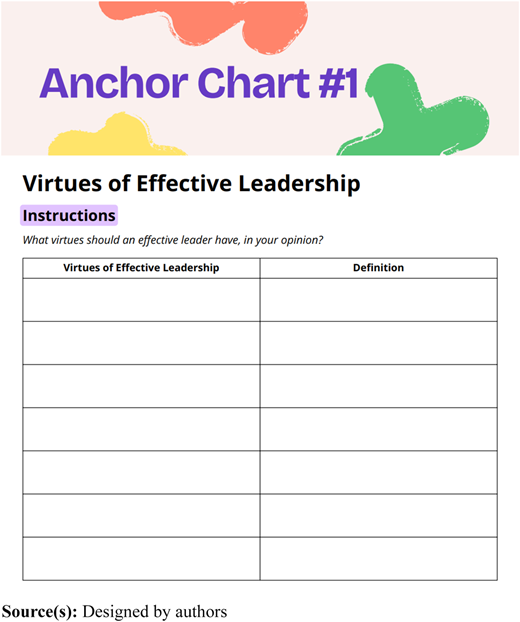
Anchor Chart # 1 ( Appendix 1)
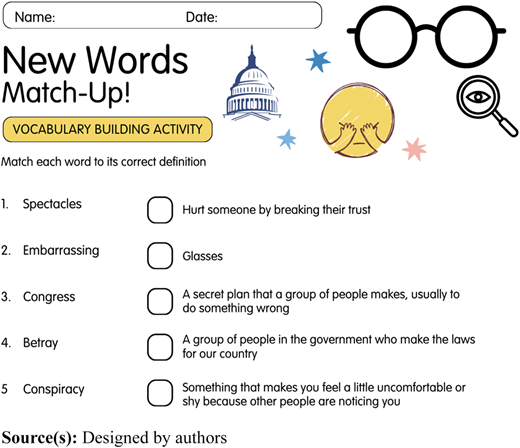
Exit Ticket ( Appendix 2)–copies for each student
Anchor Chart # 2 ( Appendix 3)–copies for each student
Leadership Poster ( Appendix 4)–copies for each group
Virtue Passport ( Appendix 5)–copies for each student
Objectives
Engage and Explore: Students will be able to identify the virtues of effective leadership and explain the meaning of new vocabulary.
Explain: Students will identify and explain effective leadership virtues demonstrated by George Washington in Washington's Spectacular Spectacles, using text evidence, and describe how these virtues helped him lead.
Elaborate and Evaluate: Students will synthesize key leadership virtues by creating a leadership poster and evaluate personal application through class discussions and the Virtue Passport.
Engage and explore
Estimated Time to Complete: 30 min.
Objective: Students will be able to identify the virtues of effective leadership and explain the meaning of new vocabulary.
Assessment Method: Opening Discussions ( Appendix 1) and the Exit Ticket ( Appendix 2).
[10 min] Opening Discussions:
- •
Before class begins, project a blank Anchor Chart #1 ( Appendix 1) on the Whiteboard.
- •
Begin the class with this: Starting today, we will learn about leadership. In our school, the principal is our leader. In our community, the mayor is our leader. In our state, the governor is our leader. In our country, the president is our leader. Effective leaders usually demonstrate certain virtues that help them lead. Virtue means a positive character trait or quality that shows moral goodness and doing what is right. What virtues should an effective leader have, in your opinion?
- •
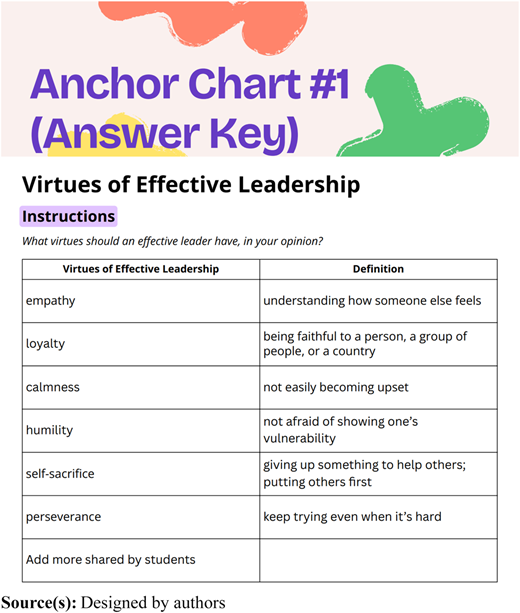
As students share their answers, the teacher will record their answers on Anchor Chart #1. Make sure to cover these six virtues of effective leadership on the anchor chart (empathy, loyalty, calmness, humility, self-sacrifice, and perseverance), as they are directly connected to the next lesson. Feel free to add more when students share their answers, such as “kind” and “courageous.”
- •
Transition: Let students know that they will learn about George Washington, particularly what kind of leader he was.
- •
[10 min] Who was George Washington?
- •
[2 min] What do you know about George Washington? Students are likely to share the following facts:
- ○
He is our (first) president.
- ○
He had fake teeth.
- ○
He was the only president who did not live in the White House.
- ○
He is on the dollar bill.
- ○
He led and fought the Revolutionary War. (When students share about the war, make sure to follow up with questions: Which two parties fought the Revolutionary War? Why was the Revolutionary War fought? Who won the war? What did the victory mean to us?)
- ○
- •
[8 min] Newburgh Conspiracy
- ○
Introduce the history of the Newburgh Conspiracy. Thank you for sharing what you already knew about George Washington. Now, I'm going to tell you a story about him that you may not have heard of. Listen carefully, because you will have to make a decision as if you were George Washington at the end of my story.
- ○
In October 1781, the British army surrendered at Yorktown, signifying the end of the last major British field army in the colonies. At the time, the British realized that they could not win the war. The war was basically over, but not officially. It was not until September 1783 that the United States and Great Britain signed the Treaty of Paris, officially ending the war. In other words, during the two years between October 1781 and September 1783, the US was not yet legally independent. After years of war, the US was facing many challenges, one of which was its financial situation. The Congress did not have money to pay the Continental Army officers for years. The officers worried that they would never receive payment because they would soon no longer be needed once the war ended. In March 1783, these officers, based in Newburgh, New York, were drawn into a plan to take down the new nation's Congress, which later was known as the Newburgh Conspiracy. If they succeeded, the new nation would be in danger. Fortunately, Washington found it out in time. Now, I want you to put yourself into Washington's shoes and decide what you would do next. You can choose from one of the following options:
- ■
Option 1: Arrest the officers
- ■
Option 2: Convince the officers to be patient
- ■
Option 3: Pressure Congress to act
- ■
- ○
Give students 1–2 min to think and write down their answers with a brief explanation. Tell them that they will share their answers in class tomorrow. After they finish writing, transition to teaching new words to prepare students for tomorrow's read-aloud.
- ○
- •
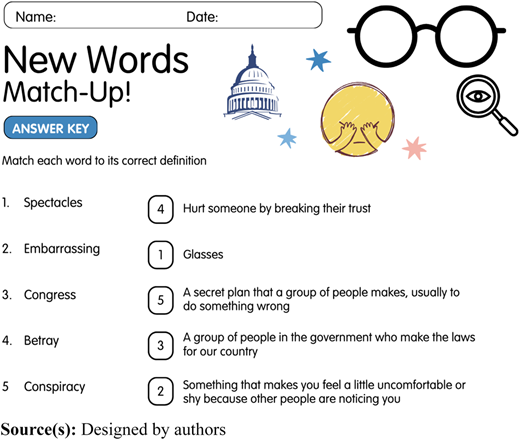
[5 min] New Vocabulary
- •
Spectacles: glasses
- ○
e.g.: He has to put on his spectacles to read the world map.
- ○
- •
Embarrassing: something that makes you feel a little uncomfortable or shy because other people are noticing you.
- ○
e.g.: If you trip and fall in front of your class, that might feel embarrassing.
- ○
- •
Congress: a group of people in the government who make the laws for our country.
- ○
e.g.: If there needs to be a new rule, Congress talks about it and decides if it should become a law.
- ○
- •
Bulged: something puffed out instead of staying flat
- ○
e.g.: His backpack bulged because it was full of books.
- ○
- •
Betray: hurt someone by breaking their trust
- ○
e.g.: Jane betrayed Jerry by telling his secret to others after promising not to.
- ○
- •
Conspiracy: a secret plan that a group of people makes, usually to do something wrong
- ○
e.g.: If a group of people secretly plans to trick someone, that's a conspiracy.
- ○
- •
[5 min] Exit Ticket ( Appendix 2)
Assessment:
Opening Discussions ( Appendix 1)
Exit Ticket ( Appendix 2)
Explain
Estimated Time to Complete: 30 min.
Objective: Students will identify and explain effective leadership virtues demonstrated by George Washington in Washington's Spectacular Spectacles, using text evidence, and describe how these virtues helped him lead.
Assessment Method: Anchor Chart #2 ( Appendix 3).
[5 min] Before Reading–Review of lesson 1
- •
Review lesson 1: In our last lesson, we discussed the virtues that make someone an effective leader.
Direct students' attention back to Anchor Chart #1 and briefly review the identified virtues. Encourage students to recall ideas they contributed. Draw specific attention to the 6 virtues: empathy, loyalty, calmness, humility, self-sacrifice, and perseverance, which George Washington exhibits in the book Washington's Spectacular Spectacles: The Glasses that Saved America.
- –
Empathy: understanding how someone else feels
- –
Loyalty: being faithful to a person, a group of people, or a country
- –
Humility: not afraid of showing one's vulnerability
- –
Calmness: not easily becoming upset
- –
Self-sacrifice: giving up something to help others; putting others first
- –
Perseverance: keep trying even when it's hard
These are the good qualities that make someone an effective leader.
We also learned about a historical event, the Newburgh Conspiracy, in which George Washington had to make a decision after learning of the Continental Officers' plan to take down the new nation's Congress because they were frustrated about never receiving payment for their service and feared they would never be paid. You were asked to put yourself in Washington's shoes and decide what you would do from the following options:
- ○
Option 1: Arrest the officers
- ○
Option 2: Convince the officers to be patient
- ○
Option 3: Pressure Congress to act
What option did you choose and why?
Provide time for students to share by having them turn and talk.
- ○
- –
- •
Introduce the book, George Washington's Spectacular Spectacles: The Glasses That Saved America, by Selene Castrovilla. Today, we are going to read a book about George Washington and the decision he made when he learned the Continental Officers were planning to rebel against or take down the new nation's Congress.
As we read, think about how George Washington acts as a leader, look closely for the leadership virtues he demonstrates in learning about and addressing the officers' plan of taking down Congress, and compare his decision (option 2–convince the officers to be patient) to the decision you chose.
- •
[15 min] During Reading
- •
Read George Washington's Spectacular Spectacles aloud to the class. Pause at key moments to guide thinking and check understanding. Ask questions such as:
- ○
Why are the officers upset? (They worried the war was ending, that they would never be paid by Congress, and worried about facing their families because they were unable to support them.)
- ○
What is Washington trying to do as a leader? (He tried to stop the officers from taking over/attacking the new nation's congress/government, asked congress to reassure the officers they would be paid, reminded officers of their honor and why they fought in the war–for a new nation's liberty).
- ○
What decision did George Washington make in addressing the officers' plan to rebel (option 2–convince the officers to be patient)? Was this the option you chose? Explain why his decision was effective using one leadership virtue (e.g., loyalty–not respecting a decision to attack the government they had fought so hard to protect).
- ○
- •
[10 min] After Reading/Closure:
- •
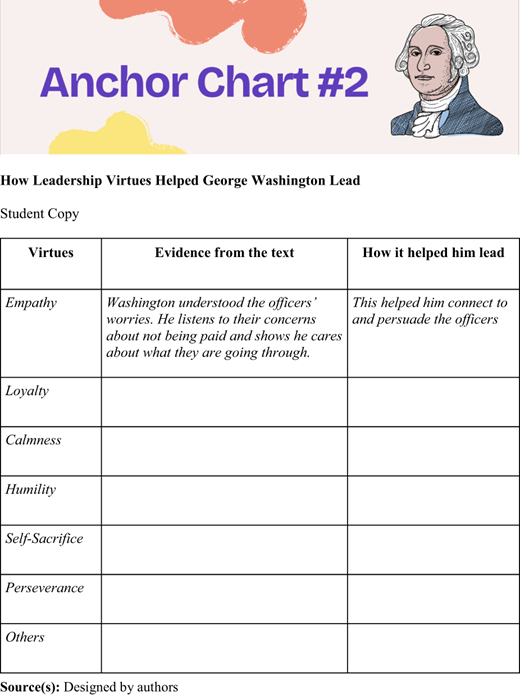
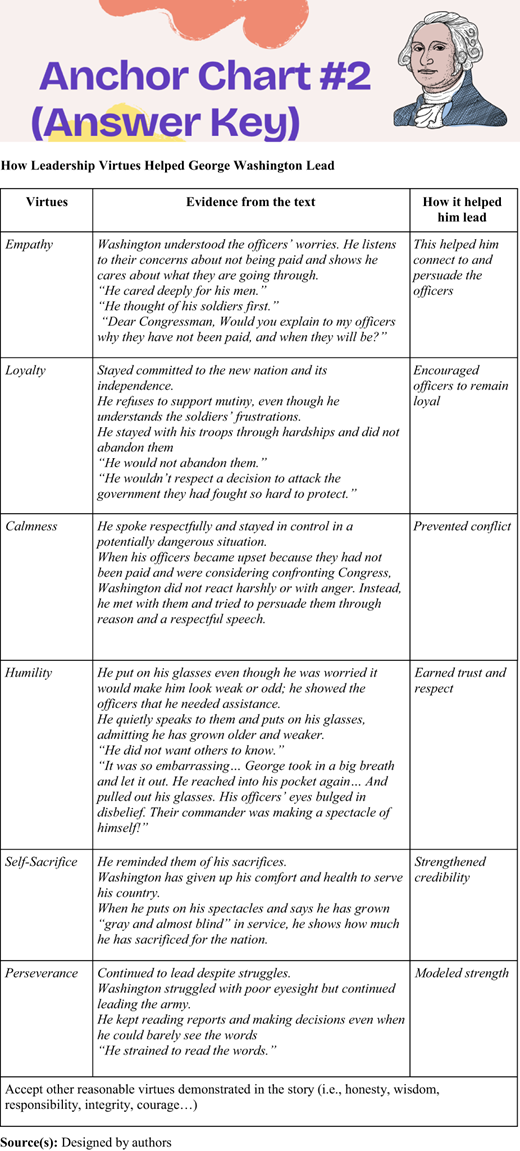
Distribute Anchor Chart #2 ( Appendix 3) to students.
- •
Explain to students that they will be describing how George Washington demonstrated leadership virtues using evidence/examples from the story, and explain how these virtues helped him lead.
- •
Model for students how to complete the anchor chart by talking through the first example, which has been done. Encourage students to add additional leadership virtues beyond those listed.
- •
Students will complete the anchor chart independently or in pairs and submit.
- •
Assessment: Anchor Chart #2 ( Appendix 3).
Elaborate and evaluate
Estimated Time to Complete: Approximately two class periods, 30 min each.
Objective: Students will synthesize key leadership virtues by creating a characteristic poster and evaluating personal application through class discussion.
Assessment Method: Students will be assessed through a combination of teacher observation during group work, poster presentations, and completion and engagement during class discussion.
Period 1:
[5 min] Opening Discussions:
- •
Class discussion and review of Anchor Chart #2 ( Appendix 3) from the previous lesson.
- ○
Begin by asking students to have their Anchor Chart #2 ready and remind students what was discussed in the previous lesson.
- ■
In the previous lesson, we discussed the virtues of a good leader and found examples in George Washington's Spectacular Spectacles story. Remember the six virtues we discussed previously: loyalty, empathy, calmness, humility, self-sacrifice, and perseverance.
- ■
Questions to discuss:
- ●
Were there any new virtues you added to the Anchor Chart? If so, which ones? Why?
- ○
Student answers will vary.
- ○
- ●
While completing the chart, were there any leaders in your own life you thought of? What makes them good leaders?
- ○
Possible Student responses:
- ■
Parents/Grandparents
- ■
Older siblings
- ■
Coaches
- ■
- ○
- ●
- ■
- ○
- •
Transition to activity and explain to students that they will be working in small groups of 3 or 4 to create a Leadership poster based on the leadership virtues we learned about in George Washington's Spectacular Spectacles.
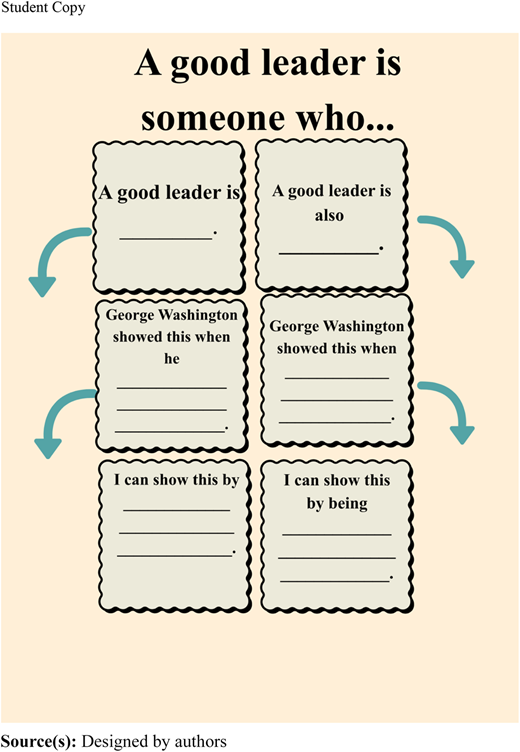
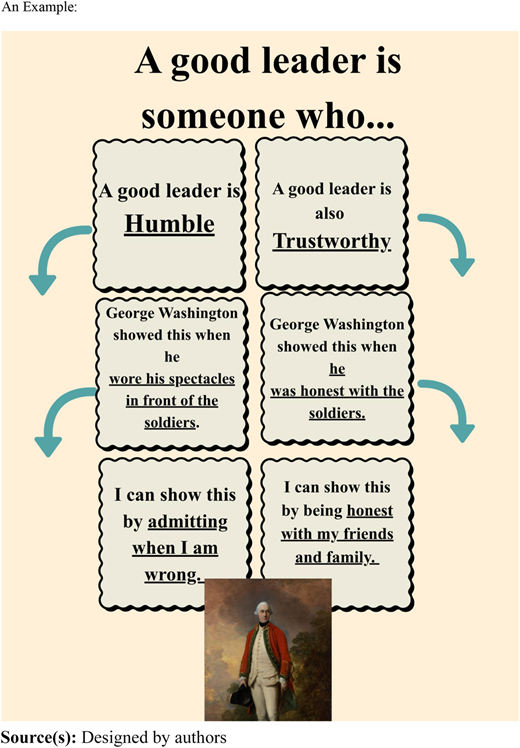
[20 min] Leadership Poster (See Appendix 4 for Poster examples):
Students will get 20 min to complete their poster. This poster can be used with a variety of modalities. See Appendix 4 for an online example, but teachers may also use other formats. Group members should be assigned roles within the group dynamics. Depending on class size, this could include roles such as recorder/writer, timekeeper, group leader, and materials manager. Give students the following guidelines for their poster:
Title: “A Good Leader Is Someone Who …”
Leadership Traits (2–3 virtues)
Write:
- •
A good leader is _____.
- •
A good leader also _____.
- •
Example from George Washington
Write:
- •
George Washington showed this when he _____.
- •
Example from Your Life
Write:
- •
I can show this by _____.
- •
Illustration
Draw a picture showing:
- •
Washington as a leader OR
- •
Yourself being a leader
- •
[5 min] Closure
Let students know they will present their posters in class tomorrow, so if they do not finish, they will need to take them home as homework.
Assessment: Teacher observation during group work.
Period 2 Presentations and Feedback:
[5 min] Opening: Tag Team Presentation
- •
Explain to students the presentation process. Each group member will choose a section of the poster to present to the class. Since students have only 2 min total to present, each student gets 30 s to present their part and “tag” the next member of the group to present.
- •
[15 min approximately] Presentations:
- •
As teams present, students will individually complete a Virtue Passport that highlights virtues they encounter from other groups and ways they can showcase them in their own lives or in leadership roles.
- •
[10 min] Closure and Final Class Discussion:
- •
Possible Questions for Class Discussion:
- (i)
What new leadership traits did you discover after listening to the presentations?
- (ii)
What is an actionable step you can take to be a good leader like George Washington?
- (i)
- •
Assessment: Virtue Passport ( Appendix 5).
Evaluation/assessment
Engage and Explore: Opening discussions ( Appendix 1) and Exit ticket ( Appendix 2).
Explain: Anchor Chart #2 ( Appendix 3).
Elaborate and Evaluation: Teacher observation during group work, the Leadership Poster ( Appendix 4), and the Virtue Passport ( Appendix 5).
Suggested extension activities
Leadership Comic Strip. Students create a four-panel comic, including any of the following information:
- a.
Problem (angry soldiers)
- b.
Washington arrives
- c.
The speech
- d.
The spectacles moment
- e.
Resolution
The comic should include speech bubbles with virtue words learned from the lesson.
- a.
Student-Friendly Speech Writing. Students will write a short speech that begins with “Officers, I understand how you feel …” The speech must show empathy, stay calm, and encourage teamwork. Then share aloud.
Diary Entry. Write as a frustrated officer before the speech, and then as the same officer after the speech.
Primary Source Detective. Provide simplified excerpts from Washington's speech (see Web-Based References). Ask students to answer the following questions after reading the excerpts:
- a.
What is the tone of this document?
- b.
What kind of emotion is shown in the document?
- c.
What leadership virtues are shown in the document?
- a.
Role Play. To help students understand multiple perspectives of this historical event, the teacher could design a role play activity, including the officers, Congress, and Washington.
Appendix 1
Appendix 2 Exit ticket (engage and explore)
Appendix 3
Appendix 4: Poster example
Appendix 5: Virtue passport