Interim managers (IMs) are consultants who take on managerial positions during limited periods to perform changes, handle crises or cover vacancies. The increasing use of these short-term outsiders shapes new conditions for organizational learning in contemporary work life. The purpose of this paper is to contribute to research-based knowledge and theoretical understanding of the relationship between interim management and organizational learning.
The paper presents a literature review on interim management published within the years 2000–2020 and analyzes it through the lens of organizational learning.
An interim management assignment is characterized by a period of uncertainty, a limited time frame, knowledge from the outside and rather invisible outcomes. The concepts of shared mental models, dialogue, knowledge creation and organizational culture shed light on possibilities and constraints for organizational learning in these arrangements. The findings highlight the IM’s position as central for transforming the organizational culture, put a question mark for the establishment of the IM’s knowledge, show the need for defining outcomes in terms of learning processes and indicate tensions between opportunities for dialogue and the exercise of power.
The study provides a new conceptual understanding of interim management, laying the foundation for empirical studies on this topic from an organizational learning perspective.
Introduction
Over the past decades, flexible work arrangements have made up an increasing part of organizational staffing and knowledge strategies. One of these growing phenomena is the interim manager (IM), which can be described as an external consultant who takes on a managerial position during a limited period of 6–12 months. In this way, the organization access required knowledge and experience for a specific need, such as change initiatives, crisis management and urgent needs to fill vacancies (Bruns & Kabst, 2005; Woods, Diprose, Murphy-Diprose & Thomas, 2020). Several reasons explain the emergence of this profession; a growing demand for organizations to quickly adapt to new circumstances (Dźwigoł, 2020), a general reduction of managerial capacity (Vorst, 2009), and human resource investments (Bruns and Kabst, 2005) and a general outsourcing trend to cut costs (Jas, 2013).
This rising use of interim management as a tool for performance improvement and change management raises interesting challenges regarding organizational learning (OL). The engagement of temporary external leaders seems to contradict our established knowledge of preconditions for OL. Dominant research in the field shows that sustainable organizational performance and abilities to cope with changing environments are dependent on learning at all different levels in the organization (Crossan, Lane & White, 1999; Dixon, 1999). Furthermore, literature on OL emphasizes the importance of continuity and long-term relationships between leaders, teams and individuals, which strengthen commitment, shared mental models and sense of belonging and safety (Dixon, 2019; Kets de Vries, 1995; Pedler, Boydell & Burgoyne, 2019; Senge, 1990). The IMs stay for a short time, lack much of the internal history and are considered outsiders, which raises the question of how it is possible for the IMs to contribute to OL.
Thus, the increasing use of “learning by hiring” as a strategy to develop the organization’s knowledge base (Song, Almeida & Wu, 2003; Tzabbar, Silverman & Aharonson, 2015) certainly shapes new conditions for OL in contemporary work life. However, research on interim management is relatively sparse, and studies that explicitly connect interim management to OL are rare. Therefore, the aim of this study is to contribute to research-based knowledge and theoretical understanding of the relationship between interim management and OL. We do this by reporting on a literature review of interim management, which we analyze through the lens of OL to elaborate a frame of reference for further empirical studies of the topic.
The following section describes central concepts in the OL literature and their mutual relatedness. Next, we report on our methodological approach to the literature review and the subsequent thematization. After that, we present our findings from the literature on interim management using the OL concepts as analytical tools. This is done on the basis of four themes: organizational uncertainty, a limited time frame, knowledge from the outside and invisible outcomes. In the discussion, we highlight the IM’s position as central for transforming the organizational culture, put a question mark for the establishment of the IM’s knowledge, show the need for defining outcomes in terms of learning processes and indicate tensions between opportunities for dialogue and the exercise of power.
Organizational learning – theoretical points of departure
This section will clarify our understanding of OL by pinpointing a number of central concepts from the mainstream in the literature. Although there is no clear consensus-based definition of OL, there are many similarities concerning basic conceptual reasoning and essential themes. In the following, we will highlight a number of core components and demonstrate their interrelatedness.
A key aspect of OL is the relationship between the individual and the organization, where individual learning is regarded as a necessary but not in itself sufficient condition for OL (Argyris & Schön, 1978; Dixon, 1999; Kim, 2004). OL also needs action and reflection at the team, as well as the organizational level (Crossan et al., 1999; Dixon, 1999; Kim, 2004), where the development of shared mental models (Kim, 2004; Senge, 1990) or meaning structures (Dixon, 1999) is pointed out as the link between the individual and the collective learning. This process is usually illustrated as a cyclic movement, where individual experiences, priorities or ideas are socially transformed into a collective level and back to the individual in the form of new dispositions for actions, principles, rules or routines (Argyris & Schön, 1978; Crossan et al., 1999; Dixon, 1999; Kim, 2004; Nonaka & Takeuchi, 1995). It is seen as a crucial strategic issue for the organization to balance between improvements within existing mental models and the creation of new thought and action patterns outside of existing mental models (Argyris & Schön, 1978; Crossan et al., 1999; March, 1991; Senge, 1990).
In Dixon’s (1999) cyclic process model, the dialogue appears as the most central of her concepts. Through the dialogue, people in the organization make their own meaning structures available and collective. Trust and safety among organizational members are pointed out as two central prerequisites for a fruitful dialogue (Argyris & Schön, 1978; Roloff, Woolley & Edmondson, 2011). Similarly, Nonaka and Takeuchi (1995) describe the importance of dialogue in the ongoing and dynamic processes of knowledge creation in organizations, where tacit and explicit knowledge are created and converted in a spiral movement from the individual to the organization and the other way around. Tacit knowledge is depicted as the experience-based knowledge people create through everyday work. Through the ongoing dialogue in the organization, this tacit knowledge is shared, which opens up opportunities to build new conceptual understanding and thereby explicit knowledge for further dissemination. This cycle is conceptualized in Nonaka and Takeuchi’s (1995) SECI-model, which describes how the processes of Socialization (tacit to tacit), Externalization (tacit to explicit), Combination (explicit to explicit) and Internalization (explicit to tacit) keep the knowledge creation spiral moving throughout the organization.
The outcomes of OL form parts of the organizational culture in terms of shared mental models and explicit knowledge (Nonaka & Takeuchi, 1995; Senge, 1990), available and collective meanings structures (Dixon, 1999), institutionalized organizational norms, rules and routines (Crossan et al., 1999; Kim, 2004). At the same time, the organizational culture constitutes the basis for further OL (Schein, 2004). Thus, from the central role of organizational culture, we conclude that managerial initiatives that aim to develop the organization’s strategy, capacity or actions always require cultural anchoring.
With this theoretical point of departure, we will use the concepts of shared mental models, dialogue, knowledge creation and organizational culture as intertwined and critical steps in the OL process. In this regard, the engagement of an IM can be seen as a managerial intervention that probably both affects and is dependent on these interrelated aspects of OL. Accordingly, in the following, we will treat the OL process and the interim management intervention as concurrent processes with strong interdependence.
Methodology
For the literature review, we conducted searches in the electronic databases of Scopus and ProQuest Social Sciences, as well as in more general sources such as EBSCO and Google Scholar, using the following keywords appearing in abstracts or subject terms: interim management, IM, interim leader or interim executive. The search included peer-reviewed journal articles, monographs and edited volumes published in English within the years 2000 to 2020. The database search was also supplemented by a manual search in the bibliographies of all relevant publications. A few publications were removed from the collection due to vague anchoring in the scientific literature or too much focus on normative reasoning.
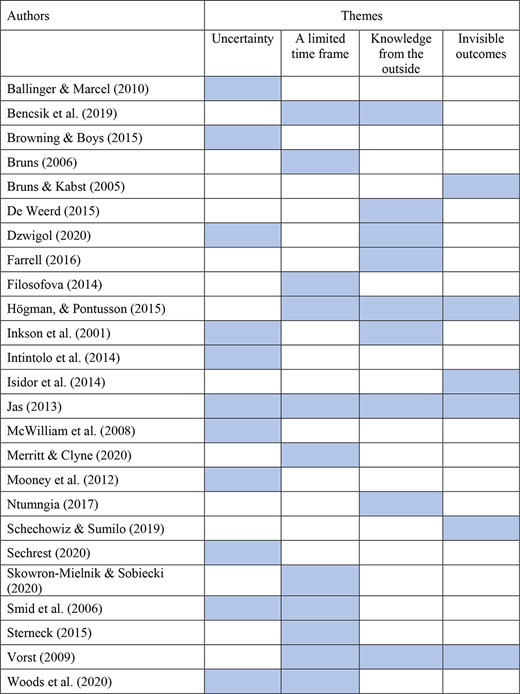
The total number of publications qualified for this review amounts to 25 (detailed in Appendix), showing that the field is still relatively under-researched. The focus of the study is on external IMs; however, literature on internal stand-ins was included when relevant. The majority of the studies do not specify the hierarchical level of the IM, although a few articles have their explicit focus on a certain level or function. The articles are published in a wide range of journals, with a predominance of business and management orientations with the primary source of data from the IMs themselves and less from members of the client organizations.
The analysis of the literature was conducted by applying Braun and Clarke’s (2006) approach to thematic analysis for qualitative data. The initial coding was made manually and from a data-driven perspective. We paid specific attention to how interim management and the IMs were framed and described, the studies’ problem statements and the results that followed. When reading through the publications, we marked sentences and shorter pieces of text and copied them to a separate document, together with the reference data. Longer texts were first summarized. In the next step, we tagged and sorted the text pieces in an iterative process that resulted in 13 different codes.
In the following step of merging the codes into themes, several aspects were considered. First, we strived for a manageable number of themes with clear relevance for OL. Second, since this managerial intervention constitutes a process in itself with a clear start and ending, we found the chronological order of the interim assignment as central for distinguishing the themes and presenting them in due course. For the subsequent analysis, the selected thematization also made it possible to make use of the processual character of both OL and interim management. Third, we aimed for a depiction that would be easy to grasp for the reader, which meant that we wanted to create themes that allowed us to stay close to the empirical descriptions from the reviewed publications.
During the work process, the main author performed the search and final selection of literature and made the initial coding and first drafts of thematization. The coauthor’s role was primarily to secure the accordance of the thematization in the literature by reading the full texts and contributing to the themes’ refinement.
Results
This section aims to present the literature review and provide an analysis of the relationship between interim management and OL. The literature review is structured around four themes representing critical aspects of the interim assignment. The report of each theme is interspersed with analytical reasoning based on the theoretical concepts of OL. In this way, the analysis is outlined throughout the result section. At the end of this section, we present a summarizing table of our main findings.
Uncertainty creates opportunities and threats for organizational learning
The literature proposes various approaches to what a period of interim management means to an organization in terms of opportunities and threats. IMs are generally hired due to one of three different scenarios (Woods et al., 2020): the first is to fill critical gaps in management teams in case of sudden exits, where the role of the IM is to doll into the ongoing operations and prepare for the new permanent leader. This function can be regarded as the traditional interim management role (Mooney, Semadeni & Kesner, 2012). The second situation occurs in times of crisis and turnarounds, which requires problem-solving to cut costs, manage redundancies and improve performance (Woods et al., 2020). Here the IM’s role is often to do the “dirty work” and be assigned the responsibility for tough decisions (Dźwigoł, 2020). The third scenario regards change management and transition needs (Woods et al., 2020), the most common deployment (Institute of Interim Management, 2020).
Accordingly, the striving for OL varies widely between the different cases: the focus for an assignment can either aim to maintain the prevailing norms and routines or perform changes outside of the existing mental models with a transformation of cultural patterns. However, since the literature on interim management mainly refers to change-oriented assignments, the transformation of organizational culture can be seen as a core aspect of this study.
A recurrent topic connected to the nature of the assignments is the state of the organization. On the one hand, the interim period is portrayed as a precarious situation (Jas, 2013; McWilliam, Bridgstock, Lawson, Evans & Taylor, 2008), with difficulties in the short-term versus long-term planning (Browning & Boys, 2015). Ballinger and Marcel (2010) show that the organization runs a higher risk for underperformance due to delayed critical decisions and the lack of a frontman representing the organizational culture and strategy to stakeholders. However, replacing a permanent leader with an IM might serve as a necessary signal to stakeholders that decisive actions are being taken (Jas, 2013; Mooney et al., 2012; Smid, van Hout & Burger, 2006). The interim period is also considered a necessary buffer before the members are willing to accept a new permanent manager (Sechrest, 2020). Intintoli, Zhang and Davidson (2014) point out that the circumstances preceding the appointment of an IM are essential for how the organization reacts to the interim period, where an involuntary turnover creates better possibilities for the IM to add value. This aligns with Inkson, Heising and Rousseau (2001), who propose that turbulent or less structured organizations create more space for the IM to make a more significant influence.
From a cultural perspective, both the absence of the former leader and an uncertain environment entails opportunities for new thought and action patterns to be developed. When the rules and routines created under the previous manager’s leadership no longer can be taken for granted, a space opens up for the organization’s shared mental models to be renegotiated. The declaration of the scope for the IM can be seen as a way to frame the gap between the existing state and the desired outcomes. In this way, the IM functions as a central actor in the OL process, where the temporary leader enters the organization in a moment where the organizational culture is potentially open to change.
However, this situation can only be seen as a mere opportunity that needs to be managed carefully to be able to lead to OL. Insufficient dialogue among organizational members about the scope for the IM might lead to difficulties in gaining support for the new direction. In this way, there is a risk for the unsettled situation with a new change initiative, embodied by the IM, to be perceived as a threat rather than an opportunity. This situation would interfere with the possibility of cultural anchoring and further possibilities for OL.
A limited time frame
The fast access and limited time frame are frequently referred to in the accounts of an IM’s way of operating and contain much of the basic idea of interim management. Bruns (2006) points out that this flexibility allows organizations to acquire management expertise at the right moment when it is needed. The time dimension is also present during the course of the assignment since it is always limited to a certain period, even if it may be prolonged in the meantime (Vorst, 2009). Most assignments end up lasting around six months to a year (Bencsik, Godany & Mathe, 2019; Jas, 2013; Skowron-Mielnik & Sobiecki, 2020; Sterneck, 2015).
Through the lens of OL, the limited time frame entails a clear question mark; it takes time for new norms and habits to be established. Since OL is consolidated through the development of organizational culture, the cyclic process of experiencing new routines and reflecting on one’s own experience in an ongoing dialogue with colleagues must take its course. Before the change is consolidated in the shared mental models, the bearer of the initial idea is vital to keep the topic alive among the organizational members. This development is put at risk if the IM leaves when this process is still at an early stage.
Another aspect of the time dimension is the informal structure of the assignment that has been identified in terms of a number of generic phases (Bruns, 2006; Högman & Pontusson, 2015; Merritt & Clyne, 2020; Sterneck, 2015; Woods et al., 2020), for example, preparation – entry – delivery – exit (Woods et al., 2020). Although the different authors’ versions are pretty similar, each study has its specific focus on what the phases serve to demonstrate, such as knowledge creation (Högman & Pontusson, 2015), the effectiveness of the IM (Woods et al., 2020) and critical actions of the hiring manager (Smid et al., 2006; Vorst, 2009).
One of the crucial moments highlighted more or less clearly by all the mentioned authors is the tempo and timing in the preparation phase. Usually, it does not take more than a couple of weeks from the first contacts being initiated until the IM is ready to commence the assignment (Filosofova and Karzunke, 2014; IMM, 2020). This quick access is promoted as a blessing for many organizations in times of crisis, where consequential decisions must be taken in a timely manner. However, Smid et al. (2006) point out that it is easy to overrate the ability of the IM to contribute to organizational change in these urgent situations and underestimate the efforts needed from internal stakeholders.
In terms of dialogue and shared mental models, the distinct structure and approach for an interim assignment can be viewed as both a facilitating and obstructive aspect for OL. On the one hand, before starting the assignment, a time frame, specific scope and an assigned responsibility need to be pinpointed. This entails an opportunity for dialogue to create shared mental models for the assignment. If the situation is critical, the time pressure can be viewed as a reinforcement of the matter, giving higher priority through the sense of urgency. On the other hand, time pressure also decreases the room for dialogue, reducing the opportunities for shared mental models to be developed.
Knowledge from the outside
A benefit of an ambulant knowledge worker is that insights and knowledge from a broad range of organizations can be reused and taken advantage of in new settings. This continuous learning both strengthens their own competitive advantage and adds value to the new clients (Farrell, 2016; Högman & Pontusson, 2015; Inkson et al., 2001). Therefore, bringing an outside perspective to a local context is considered one of the IM’s primary skills (Högman & Pontusson, 2015). Vorst (2009) points out that an essential characteristic of the ideal IM’s competence is an overqualification for the task, making it possible to start contributing immediately. The outside perspective is also reflected in the perception of the IM as someone balancing between being perceived as an insider or an outsider (Inkson et al., 2001). Although it is seen as desirable to keep a certain distance to be able to provide new perspectives, Jas (2013) points out that “going native” might be necessary to show one’s fidelity.
Nevertheless, before being able to contribute in the new context, the IM has to close their own knowledge gap of the client organization’s unique conditions. This is accomplished through document research, such as reading financial reports (de Weerd, 2015; Högman & Pontusson, 2015), formal interviews or casual conversations (de Weerd, 2015). Despite these efforts, de Weerd (2015) emphasizes the possible pitfall to be unconscious of certain fundamental aspects of the actual project or problem. However, several authors mean that less awareness of past events and old routines and no close relationships with employees make it easier for the IM to assess situations objectively and take tough decisions (de Weerd, 2015; Dźwigoł, 2020; Farrell, 2016; Högman & Pontusson, 2015; Jas, 2013).
With this background, the IM’s contributions to OL seem highly dependent on balancing the roles of an outsider and an insider of the organizational culture. First, the different manners of interacting with subordinates and colleagues and participating in daily work are possibilities for socialization: in these ways, the IM might gain an understanding of the tacit dimensions of the organization’s knowledge and culture. Engaging in dialogues also makes it possible for the IM to make their own tacit knowledge accessible. Second, by participating in the daily operations and at the same time being on the border of the organization, the IM facilitates the externalization of the organization’s tacit knowledge. When encountering a culture taken as a given by the permanent organizational members, it becomes possible for the IM to put their finger on institutionalized norms and routines that seem particularly important or counterproductive.
For the organization to take advantage of the IM’s external perspective, the transfer of tacit as well as explicit knowledge is considered a central aspect (Bencsik et al., 2019; Högman & Pontusson, 2015). Actions for transferring tacit knowledge include, for example, joint work and regularly sharing of experiences, while explicit knowledge transfer can be found in the documentation, elaboration of regulations and training sessions (Bencsik et al., 2019). Especially the tacit knowledge of the IM is considered substantially valuable for the client organization (Bencsik et al., 2019).
In terms of knowledge creation, we can see how socialization not only forms a way for the IM to understand the organizational culture, but it also plays an important role when the IM’s experiences from previous assignments are being used in the daily work and dialogue in the new setting. Following the previously mentioned second step of externalization, the third step of combination is also apparent when the IM engages in more formal training situations and tasks.
Another significant aspect that influences the contribution is the subordinates’ and colleagues’ openness to the IM’s advice and decisions. In this context, mutual trust is emphasized as a central component (Bencsik et al., 2019; de Weerd, 2015; Jas, 2013; Ntumngia, 2017). De Weerd (2015) means that the clients often require an IM with previous knowledge from the same industry. However, according to the IMs themselves, the right background primarily serves to gain trust rather than add practical value. Bencsik et al. (2019) point out that the trust is developed gradually and iteratively between both parties, where any initial mistrust for the IM is likely to disappear after their first proven accomplishment.
This continuous flow of knowledge creation can be described as a mutual process where the IM’s contribution is only made possible when it is preceded by their own understanding of and adapting to the new organizational culture. It is also noteworthy that the IM’s experience, loyalty and demonstrated results, first and foremost, are portrayed as trust-building mediators rather than having a direct value on their own. Since trust and interpersonal safety are essential for dialogue and mutual understanding, these indirect relationships entail vital functions for facilitating knowledge creation.
Invisible outcomes
The question of how the temporal leadership of an IM can contribute to organizational performance, in the long run, has been addressed from different angles. In her study of IMs in the public sector, Jas (2013) states that the contributions of an IM are most visible at the beginning of the assignment, where great efforts are being made to tackle the most critical situations. The long-term results are hard to ascribe to the IM since the duration of the assignment is typically too short in relation to the organization’s improvement curve (Jas, 2013; Schechowiz & Sumilo, 2019). Another aspect of the invisibility of the improvements regard the higher priority for the client organization to give credit to the permanent successor rather than to the outgoing IM (Jas, 2013).
Vorst (2009) means that the clients’ primary concern is that the IM attain short-term improvements and create a solid point of departure for the successor. This narrow focus makes the long-lasting effects of the second concern. Thus, to secure the continuity of the improvement efforts, a proper hand-over to the successor is pointed out as one of the few concrete actions that the client organizations are taking (Jas, 2013; Vorst, 2009). Another long-lasting contribution is made when the IM adds another perspective or provides a new problem statement (Vorst, 2009).
Although the literature describes the results of an IM assignment as hard to distinguish, at least two aspects are interesting from an OL perspective. First, the analysis of a problem that results in a new perspective is a typical example of changes in the shared mental models, where the organization is helped to tackle their challenges in a new way. In this way, the outcome consists of a new direction rather than a final result. Second, when the delivery of the IM is partly centered on the preparation for and hand-over to the successor, the dialogue and shared understanding between the two leaders appear to be central for the continuity of the initiated work. This hand-over can be interpreted as an opportunity to externalize the IM’s experience from the client organization and possibly reach a combination of existing organizational knowledge, ongoing efforts and IM’s advice about future steps.
Several studies point out that organizational change is a complex process where more factors than the personal efforts of the IM are crucial for the success of a particular project. The assignment is, therefore, largely dependent on organizational prerequisites such as change readiness (Högman & Pontusson, 2015), general agility (Schechowiz & Sumilo, 2019) and support for the change by subordinates and management colleagues (Vorst, 2009). However, in terms of firm flexibility (Atkinson, 1984), two studies have provided some support that the utilization of IMs increases financial and numerical firm flexibility, which, in turn, has an impact on organizational performance (Bruns & Kabst, 2005; Isidor, Schwens & Kabst, 2014).
These nuanced accounts on the dependence on the organization’s internal prerequisites underline the outcomes of an interim assignment as a joint accomplishment. This can also be understood from the OL perspective, emphasizing the reciprocal dependency between individual actions and organizational conditions. Thus, the literature has insofar provided little understanding of how the fourth step of internalizing new explicit knowledge in the organization’s tacit routines and culture might be carried out. The often indirect, invisible and delayed effects of the IM’s contribution appear to be difficult to trace back to prior knowledge creation.
Summary of the results
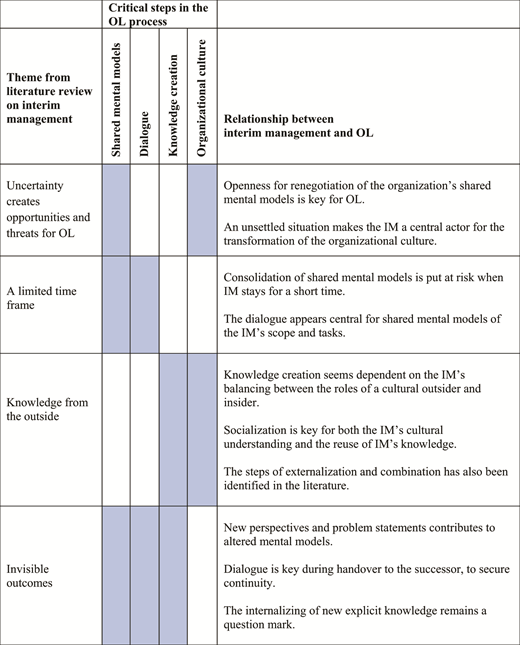
Table 1 summarizes the result section by pinpointing the main findings of the relationship between critical steps in the OL process and interim management. As previously stated, all critical steps in the OL process are intertwined; thus, the analysis of the literature review has shown that the steps have different emphases for each theme.
Discussion
As stated in the theoretical point of departure, we understand the engagement of an IM as a managerial intervention to influence organizational action patterns. Fertilizing the ongoing OL process by an IM intervention means that the IM is highly dependent on the organizational culture and the continuous learning processes. At the same time, the IM intervention creates new conditions for OL. Therefore, this discussion will highlight this mutual interdependence between the interim management and critical steps in the OL process.
The analysis shows that the OL process is dependent on the IM’s balancing on the border of the organizational culture, taking on the role as both an outsider and an insider. This is particularly apparent when the IM’s previous experiences are to be taken advantage of in encountering a new organizational culture. This position where the shifting embeddedness is a part of the professional role has been addressed by several authors in other client-consultant contexts in terms of “liminality” (Borg & Söderlund, 2014; Handley, Clark, Fincham & Sturdy, 2007; Iszatt-White & Lenney, 2020), which is described as a position between existing structures that are both related to tasks and social relations (Borg & Söderlund, 2014). However, most of these studies focus on how the individual manages their own work conditions and less on the potential benefits for the client organization.
In terms of knowledge creation, the three steps of socialization, externalization and combination have been identified and exemplified to varying extents in the literature. Thus, the fourth step of internalizing new explicit knowledge remains a question mark. To achieve OL in the IM intervention, internalization is a crucial aspect. Although we find it probable that this step is also present in some interim assignments, existing literature has not presented what conditions are needed to realize this step. Neither we know little about what kind of knowledge is most likely to be internalized.
The concept of shared mental models in relation to interim management points out both opportunities and difficulties for OL. Uncertain organizational conditions without a permanent leader might induce openness to renegotiate the organization’s shared mental models. New problem statements proposed by the outsider constitute an example of a direct contribution to altered mental models. Nevertheless, the characteristic of the interim assignment in terms of a limited time frame threatens the consolidation of the shared mental models. With this multifaceted background, we see the need for more detailed knowledge about the indirect, delayed and somewhat invisible outcomes with the OL process in focus. Using the OL toolbox with several intertwined steps will allow for a broader approach where specific steps along the way might become more relevant than keeping a unilateral focus on the final outcomes. One processual aspect that has already been identified in this review is the importance of trust-building relations. This has also been highlighted by studies in adjacent fields of consultancy and staffing (Nikolova, Möllering & Reihlen, 2015; Sankowska & Söderlund, 2015; Tzabbar et al., 2015).
The dialogue has been portrayed as a central aspect in several steps of the interim assignment; during the initial startup, the socialization process and the final handover. At the same time, the IM’s hierarchical position and mandate to make decisions are portrayed as significant characteristics of an assignment, which might prevent room for dialogue and mutual understanding. This tension becomes apparent when an outsider is contracted to perform what seems undoable by the permanent managers due to their embeddedness in the organizations’ internal relations and history. Carrying out changes without dialogue entails a significant risk of losing the anchoring of the intended action patterns in the organizational culture.
Although this review is analyzed through the lens of mainstream concepts, this reasoning opens up for one less acknowledged aspect of OL, namely, the perspective of power and conflicting interests. This approach has been recognized for a while (Coopey, 1995; Lawrence, Mauws, Dyck & Kleysen, 2005), even though it has not gained so much attention in the broader field of OL. In recent years, several studies have illustrated its sustained relevance (Field, 2017, 2019; Flood & Romm, 2018; Newman & Newman, 2015; Valentine, 2018). The power perspective highlights the risk of letting the organization rely on managerial demands to the extent that delimits participation and autonomy, which might impede the OL cycle.
Conclusion
This article is set out to review the literature on interim management and contribute to research-based knowledge and theoretical understanding of the relationship between interim management and OL. The analysis framed the interim period as an unstable organizational interlude, where cultural patterns might be open for renegotiation, implying an opportunity for the IM to facilitate change. The limited time frame entails challenges since it takes time to consolidate new routines and shared mental models. Nonetheless, the finite time and specified tasks make the dialogue a central aspect that facilitates the formation of the intervention. We also pinpointed the position of an outsider as an opportunity for the IM to contribute to knowledge creation by socialization, externalization and combination. However, the internalizing of new explicit knowledge remains a question mark. Finally, the rather invisible outcomes were still identified as including possibilities for OL, such as changes in the shared mental models and opportunities for dialogue.
The analysis of the literature review has provided a frame of reference for further empirical studies on interim management and OL. We will now concretize four research proposals based on each step in the OL process. First, the IM’s balancing on the border of the organization entails an advantageous position for transforming the organizational culture. As this encounter is mainly illustrated from the outsider’s perspective, there is a task for future research to gain more knowledge about challenges and opportunities for the organization to take advantage of the outsider’s position as a catalyst for transforming cultural patterns.
Second, in terms of knowledge creation, the fourth step of internalization has been pinpointed as a weak or less identified part of the spiral movement. We neither know what kind of knowledge has the most potential to become internalized. For this reason, it is of great interest to explore the possibilities for the IM’s knowledge to be established in the organizational culture.
Third, there is a lack of understanding of how the IM’s contribution to the organization’s shared mental models and action patterns is developed gradually during an assignment. By unpacking this “black box” in future studies, it will be possible to indicate critical steps in the learning process and identify intermediate objectives for an interim assignment.
Fourth, the central role of the dialogue entails opportunities for OL in several steps of the interim assignment. However, considering the power dimension might weaken the perceived possibilities for OL. From this perspective, the engagement of an IM as an exercise of power can be seen as one end of a continuum and participation through dialogue as the other. Therefore, a proposal for future research will be to study the potential balance between these elements in connection with OL.
Practical implications
The relationship between interim management and OL has several practical implications. As we have seen, the reasons for hiring an IM can be many, with different weights and focus for the managerial intervention. From the literature review, it is possible to distinguish three types of interventions where each type has its specific implication on OL: hiring an IM as an external expert, a change agent and a formal manager. Depending on the nature of the particular interim assignment, different challenges will apply for the organization to make use of the IM in their OL cycle.
The external expert role puts focus on knowledge creation and highlights the challenges of using and preserving the newfound knowledge brought to the organization by the IM. The role of a change agent can be used to facilitate cultural change and demands an understanding of the circumstances related to the limited time frame; to take advantage of the initial momentum and continuously arrange for the long-lasting continuity of the IM’s efforts. Finally, the need for a formal manager intervention points to the risk of letting tough decisions and strong measures overshadow the need for dialogue and shared mental models to lead the collective actions. With this article as a point of departure, it will be possible for upcoming empirical studies to enrich further the theoretical knowledge and practical implications of the relationship between interim management and OL.