The primary objective of this study is to address the limitations of traditional port performance monitoring systems by introducing an advanced, data-driven platform. By integrating real-time analytics, the proposed system provides port authorities with a comprehensive tool to enhance operational efficiency, sustainability and competitiveness. The research seeks to support strategic decision-making by offering a holistic evaluation of port activities across multiple stakeholders and domains. Additionally, this study aims to align port operations with evolving environmental regulations and technological advancements, thus ensuring enhanced efficiency of port management activities.
The present study adopts a data-driven approach to enhance port performance monitoring through an integrated digital platform. The research methodology involves a combination of quantitative data analytics, real-time monitoring technologies and stakeholder feedback analysis. A multi-dimensional performance dashboard is developed to aggregate and detect key performance indicators (KPIs) from various sources, including port operations, market trends, concessionaire activities and environmental metrics. The platform utilises big data analytics, machine learning and cloud computing to ensure real-time processing and predictive insights. A case study methodology is used to validate the system's effectiveness in improving decision-making within port management.
The implementation of a real-time performance dashboard significantly improves port authorities’ ability to monitor and evaluate key operational metrics. Findings indicate that data integration across multiple domains enhances transparency, optimises resource allocation and fosters proactive decision-making. The proposed platform effectively addresses challenges related to efficiency, sustainability and competitiveness, thus allowing ports to respond dynamically to market and regulatory demands. Moreover, the research highlights how predictive analytics and automated reporting streamline port management, reducing inefficiencies and operational bottlenecks. The case study analysis confirms that digital transformation plays a pivotal role in facilitating a smarter and more sustainable port ecosystem.
This study contributes to the existing literature on port digitalisation by introducing a novel, data-driven approach to performance monitoring. Unlike conventional monitoring tools, the proposed decision support system integrates advanced analytics and real-time data processing, offering port authorities a more adaptive and strategic framework for decision-making. The research provides practical value by presenting an innovative technological solution that aligns with contemporary challenges in port management, such as environmental sustainability, operational complexity and evolving regulatory frameworks. Ultimately, this study underscores the transformative potential of digitalisation in port operations, highlighting the potential benefits of more efficient, resilient and sustainable maritime logistics networks.
1. Introduction
The ongoing digital transformation of maritime logistics has deeply reshaped the strategic role of port authorities. Beyond their traditional function as infrastructure managers, ports have progressively evolved into complex multi-actor ecosystems in which operational efficiency, environmental sustainability, regulatory compliance and stakeholder coordination need to be managed simultaneously. Such a transformation has been accelerated by the diffusion of digital technologies – including Artificial Intelligence (AI), the Internet of Things (IoT), cloud computing, big data analytics and digital twins – which increasingly support real-time monitoring and data-driven decision-making throughout port operations (Notteboom et al., 2022; Zhang et al., 2025).
Within the described evolving context, performance measurement has become a strategic capability for port authorities. Effective monitoring systems are no longer limited to assessing operational efficiency. Instead, they are expected to provide integrated information supporting governance, long-term planning, sustainability and collaboration among multiple stakeholders. However, despite the growing adoption of digital technologies in ports, existing performance measurement frameworks remain largely focused on terminal-level operational indicators such as cargo throughput, vessel turnaround time, berth productivity or financial performance. Similarly, the currently available dashboard solutions primarily support operational control, whereas Port Community Systems (PCS) mainly facilitate information exchange among port actors, and decision support systems (DSS) are generally designed to support specific managerial decisions rather than providing an integrated strategic monitoring framework.
Therefore, a relevant gap in the literature remains. Indeed, existing studies rarely provide an integrated governance-oriented dashboard capable of simultaneously combining operational, managerial, market, environmental and stakeholder-related dimensions into a unified decision-support framework. Additionally, previous research has devoted limited attention to the role of strategic key performance indicators (KPIs) that enable port authorities to shift beyond operational monitoring towards proactive governance and long-term value creation.
In order to address the highlighted gap, the present paper proposes a Smart Port Dashboard, conceived as an integrated decision-support framework that combines digital technologies with a multidimensional performance measurement system specifically designed for port authorities. Rather than functioning solely as a technological platform, the suggested dashboard represents a governance-oriented framework that integrates operational performance, market intelligence, sustainability indicators, concessionaire monitoring and stakeholder coordination within a single strategic monitoring architecture.
The originality of the proposed study lies in the integration of these multiple dimensions into a unified Smart Port Dashboard specifically designed to support strategic decision-making within Port Authorities. Unlike existing dashboard solutions that primarily focus on operational performance or isolated technological applications, the novel framework described in this work combines digital infrastructure, governance-oriented KPIs, sustainability metrics and multi-actor collaboration into a coherent decision-support architecture. Accordingly, the contribution of the research is primarily conceptual and methodological, while also offering practical guidance for port authorities undertaking digital transformation initiatives.
The study addresses the following research questions:
How can a Smart Port Dashboard integrate operational, strategic, market and sustainability dimensions within a unified performance measurement framework for port authorities?
How can data-driven digital technologies support strategic monitoring and governance beyond traditional operational performance measurement systems?
Which key performance dimensions should be incorporated into a governance-oriented dashboard capable of supporting multi-actor decision-making in contemporary port systems?
To answer these questions, the paper develops a design-oriented conceptual framework supported by evidence collected from the Central Tyrrhenian Sea Port Authority, focusing on the ports of Naples and Salerno. The study combines an extensive review of the literature with qualitative evidence gathered from relevant stakeholders to identify the key dimensions and indicators required for an integrated Smart Port Dashboard.
The present paper offers three main contributions. First, it extends the literature on port performance measurement by proposing a governance-oriented dashboard that moves beyond traditional operational KPIs. Secondly, it contributes to research on digital transformation in port management by integrating DSS, dashboard technologies and data-driven governance within a unified conceptual framework. Lastly, it provides practical guidance for port authorities and policymakers by identifying a multidimensional architecture capable of supporting strategic monitoring, stakeholder coordination and sustainability-oriented decision-making.
The remainder of the paper is organised as follows. Section 2 reviews the relevant literature on digital transformation, performance measurement and decision-support technologies in port management. Section 3 presents the research design and methodological approach adopted for developing the framework. Section 4 illustrates the development of the proposed Smart Port Dashboard. Section 5 discusses the theoretical and managerial implications of the framework, while Section 6 concludes the paper by outlining its contributions, limitations and directions for future research.
2. Theoretical background
The integration of data-driven innovation in the transport and maritime industries is leading to transformative advancements, which are mostly guided by the expanding growth of big data, AI and the IoT. These technologies enable real-time monitoring, predictive analytics and intelligent decision-making, leading to enhanced operational efficiency, reduced costs and improved safety standards.
Narrowing the scope to the maritime sector, all the innovations mentioned above are finding broader applications to optimise fleet management, enhance navigational safety and streamline logistics operations.
This section provides an up-to-date review of the latest body of literature addressing data-driven innovation with a specific hint to the transportation sector. Subsequently, an overview of the most relevant theoretical background on innovations related to port management and monitoring technologies is described. As a complementary framework instrumental to the aim of this study, a final sub-section is dedicated to the literature regarding the innovation frontiers in port management supported by data-driven solutions.
2.1 Digital transformation in port management
Digital transformation has profoundly reshaped the management of maritime transport and port operations during the last decade. Rather than representing isolated technological innovations, AI, the IoT, cloud computing, blockchain, digital twins and big data analytics constitute complementary technological capabilities supporting data-driven decision-making across the entire port ecosystem. Their integration enables ports to evolve from infrastructure-based logistics hubs towards intelligent, interconnected systems capable of continuously collecting, processing and exploiting operational information.
Table 1 below compares the mentioned technologies in terms of main functions and related strategic contribution.
The increasing adoption of data-driven technologies in the transport and maritime sectors has facilitated enhanced operational efficiency, safety and sustainability. Advanced digital solutions such as AI, the IoT and blockchain are revolutionising fleet management, predictive maintenance and logistics optimisation. Recent studies emphasise the ways in which these technologies can be integrated in order to attain smart maritime ecosystems capable of real-time monitoring and decision-making (Zhang et al., 2025).
In such a context, predictive maintenance, powered by AI and big data analytics, represents a valuable innovation in so that it enables early detection of mechanical failures in vessels. By analysing historical sensor data, machine learning algorithms can forecast maintenance needs, reducing operational downtime and improving safety (Nitonye et al., 2025). An additional key development is the implementation of digital twins, since the latter create virtual simulations of ships to optimise fuel efficiency, assess structural integrity and ensure compliance with environmental regulations (Yang et al., 2024).
Smart port technologies, specifically underpinned by IoT, have also brought changes in maritime logistics. Indeed, the integration of automated berth management systems, cargo tracking and congestion prediction tools has enhanced port efficiency and supply chain resilience (Dehghani et al., 2024). Furthermore, blockchain applications in maritime trade are contributing to ease a more secure and transparent transaction processing, thus reducing the risk of fraud and enhancing regulatory compliance (Perkovic et al., 2024). In connection with said innovations, autonomous shipping is increasingly emerging as a novel application, with research focusing on AI-powered navigation systems that can independently assess maritime traffic, weather conditions and optimal routes. This innovation is currently under regulatory review by bodies such as the European Maritime Safety Agency, with related ongoing discussions about safety standards and legal frameworks (Ayadi, 2024).
Recent advancements are also addressing the role of AI-driven route optimisation in reducing fuel consumption and emissions, hence aligning with global decarbonisation efforts (Nitonye et al., 2024). Meanwhile, sensor fusion techniques in collision avoidance systems have significantly improved maritime safety, with a particular focus on congested waterways (Alrefai et al., 2024). The technological innovations listed so far highlight the potential of data-driven strategies in redefining the next frontiers of transport and maritime operations.
2.2 Technologies in port management and monitoring
The evolution of port management has been significantly influenced by the integration of data-driven solutions, particularly through AI, machine learning (ML), big data analytics and the IoT. These technologies have redefined port community monitoring by enabling both short-term operational efficiencies and long-term strategic decision-making. The deployment of DSS and port community systems (PCS) has been at the forefront of this transformation, offering insights into ex post data analysis for predictive modelling while simultaneously optimising real-time logistics, vessel traffic and environmental sustainability.
Port community monitoring is increasingly reliant on AI-driven analytics to enhance decision-making across multiple dimensions. Short-term monitoring leverages IoT-enabled sensors and AI algorithms to provide real-time insights into berth availability, container movements and port congestion. These capabilities facilitate the immediate coordination of vessel arrivals, optimise crane scheduling and minimise turnaround times. Studies such as those by Dinh et al. (2024) and Li et al. (2023) highlight how AI-based traffic monitoring has significantly improved the responsiveness of port operations, reducing delays and enhancing throughput. Additionally, predictive analytics models, as explored by Xiao et al. (2024), have enabled ports to anticipate demand fluctuations and dynamically allocate resources accordingly.
From a long-term perspective, port performance optimisation mainly relies on ex-post data analysis, where historical data are leveraged to refine infrastructure planning, investment decisions and regulatory compliance strategies. The integration of digital twins, as demonstrated by Kaklis et al. (2023), has allowed port authorities to simulate operational scenarios, enabling them to develop resilient strategies for weather disruptions, security risks and environmental sustainability. Furthermore, the role of blockchain in PCS has facilitated transparent data exchange between shipping companies, customs authorities and logistics providers, reinforcing trust and security in port transactions.
The deployment of green technologies within port management has been increasingly prioritised, with AI-driven emissions monitoring systems playing a central role in achieving sustainability targets. Research by Inkinen et al. (2021) underscores how data analytics has been used to optimise energy consumption, reduce vessel emissions and promote shore-side electrification solutions such as cold ironing. These advancements align with broader international efforts to decarbonise maritime transport and improve the ecological footprint of port operations.
The interplay between DSS and PCS has also shaped the landscape of digital transformation in ports. While DSS frameworks emphasise long-term strategic planning through data-driven insights, PCS is more focused on the real-time coordination of port activities. This distinction has been analysed in recent studies, such as those by Heikkilä et al. (2022), who demonstrate that an integrated approach combining predictive analytics with real-time monitoring can significantly enhance port efficiency. AI-based DSS, incorporating machine learning models trained on historical port traffic data, have been used to predict congestion patterns and optimise resource allocation. Meanwhile, PCS solutions have introduced automated workflows that enhance the interoperability of various port stakeholders, reducing paperwork and streamlining logistics processes.
The latest research suggests that the future of port management will be defined by an increasingly interconnected ecosystem where real-time and predictive analytics work in tandem. The continued evolution of AI, IoT and digital platforms will drive further enhancements in operational resilience, environmental sustainability and logistical efficiency. Future research should focus on refining the integration of DSS and PCS to create holistic, adaptive port management systems that can seamlessly transition between short-term responsiveness and long-term strategic planning.
2.3 Performance measurement and data-driven governance
From a theoretical perspective, the proposed Smart Port Dashboard builds upon the literature on Performance Measurement Systems, which considers performance indicators as strategic instruments supporting organizational learning and decision-making (Kaplan and Norton, 1996, 2004). Unlike traditional operational metrics, strategic performance measurement integrates financial, operational, customer, innovation and sustainability dimensions into a coherent management framework.
The evolution of digital infrastructure in port systems is facilitating the convergence of platform-based management solutions, real-time monitoring systems and predictive analytics, each of which contributes to optimising logistics, resource allocation and emission reductions. The dichotomy between DSS and port community systems further illustrates the distinction between long-term strategic planning and short-term operational execution, both of which are essential for a resilient and adaptive maritime industry.
Digital platforms in port management now serve as central nodes where logistics, environmental monitoring and traffic management intersect. The incorporation of ex-post data analysis in DSS has allowed for improved forecasting of port traffic, congestion patterns and equipment utilisation, enabling terminal operators and stakeholders to make informed long-term investment decisions. Munim et al. (2020) have highlighted the ability of AI-powered DSS to refine supply chain predictions and optimise hinterland connectivity, directly impacting port performance and competitiveness. The advent of cloud-based solutions has further expanded the capabilities of port platforms, facilitating seamless integration between shipping companies, terminal operators and regulatory agencies.
Parallel to DSS, real-time management systems embedded within PCS have focused on the immediate efficiency of maritime and port operations. By leveraging IoT-enabled sensors, automated gate operations and blockchain-based data sharing, PCS ensures that port stakeholders operate within an optimised framework. Jović et al. (2022) emphasise that the increasing deployment of digital twins has allowed ports to create virtual replicas of infrastructure, simulating operational scenarios and mitigating congestion risks before they materialise. The enhanced coordination of vessel traffic, berth allocation and customs clearance has resulted in reduced waiting times and improved cargo throughput, underscoring the tangible benefits of short-term, real-time data applications.
Green technologies within port management have also gained significant traction, particularly in the pursuit of emissions reduction and sustainable energy practices. Recent studies (Kaklis et al., 2023) demonstrate that data-driven energy management systems can dynamically adjust power consumption based on demand forecasting models, significantly lowering greenhouse gas emissions. The integration of AI-driven algorithms into cold ironing operations, where ships rely on shore-based electricity instead of onboard diesel generators, has further contributed to the decarbonisation of port activities. In parallel, autonomous electric vehicle fleets are increasingly being deployed for container transport within port terminals, aligning with broader sustainability goals.
Performance optimisation within port management extends beyond technological advancements to the strategic deployment of digital governance frameworks. Decision transport systems, operating within the DSS model, have adopted big data analytics to enhance predictive modelling, allowing authorities to proactively manage traffic flow and minimise disruptions. Meanwhile, PCS-driven real-time collaboration has redefined how ports respond to unpredictable events such as adverse weather conditions, strikes or security threats. The synthesis of both long- and short-term data-driven strategies has positioned modern ports as complex, intelligent ecosystems that balance efficiency, sustainability and resilience.
Emerging literature continues to explore the intersection of DSS and PCS in port management, emphasising the need for integrated solutions that bridge predictive planning with real-time adaptability. The rapid evolution of AI, IoT and blockchain-based systems suggests that future research should focus on refining interoperability between decision-making frameworks and real-time operational execution, ultimately fostering a new era of smart, sustainable and highly efficient port environments.
The deployment of cloud-based platforms for monitoring port authority performance represents a fundamental shift in the way port logistics and governance are managed. These platforms integrate DSS, real-time monitoring and dashboard technologies to facilitate more effective decision-making, optimise resource allocation and enhance operational transparency. The widespread adoption of cloud computing in port management has been driven by its ability to provide scalable, cost-efficient and interoperable solutions, enabling seamless data-sharing across different stakeholders (Sharma et al., 2021). With the increasing complexity of global trade and supply chain logistics, port authorities have turned to advanced digital infrastructures that integrate real-time data analytics with predictive modelling, ensuring that operations remain efficient and adaptable to changing market conditions (Kaparthi et al., 2021).
The resort to performance dashboarding can effectively support the process of translating large volumes of data into actionable insights, thus enabling port governance to track KPIs related to cargo throughput, energy consumption and berth utilisation. The design principles of performance dashboards emphasise the role of the latter in visualising complex datasets, allowing decision-makers to monitor trends and anticipate operational challenges (Eckerson, 2010). The integration of cloud-based dashboarding further enhances such functionality by enabling real-time updates, automated alerts and customisable data visualisation, ensuring that critical information is readily accessible to all relevant stakeholders. Recent studies have shown the pivotal role of collaborative dashboards in stakeholder management, particularly in resolving conflicts and improving coordination among port operators, shipping companies and customs authorities (Ferretti et al., 2017; Parola and Maugeri, 2013).
Cloud-based DSS have also enhanced port governance by promoting strategic planning and risk assessment. Consistent literature has shown that DSS frameworks facilitate more efficient cargo handling, reduce congestion and improve the overall resilience of port infrastructure (Rodrigue and Notteboom, 2020). Additionally, the introduction of digital twins – virtual models that replicate real-world port operations – has further improved decision-making by allowing authorities to simulate different operational scenarios and optimise logistics flows (Hofmann and Branding, 2019). The integration of these technologies has proven particularly valuable in managing disruptions caused by extreme weather events and unforeseen logistical challenges, enabling ports to maintain continuity and mitigate economic losses (Zhang and Lam, 2016).
Sustainability concerns have also reinforced the need for cloud-based monitoring systems in port management. Digital innovation in ports has proven to enhance energy efficiency, reduce emissions and promote greener operational practices (Ferretti et al., 2016). The incorporation of green KPIs into performance dashboards allows port authorities to track and report environmental impacts, aligning with global sustainability objectives (Acciaro et al., 2014). Furthermore, IoT-enabled smart port technologies facilitate automated monitoring of cargo movements, equipment diagnostics and predictive maintenance, all of which contribute to more sustainable and efficient operations (Perera et al., 2015). The growing reliance on IoT-driven analytics has enabled ports to transition towards more data-centric governance models, improving overall resilience and adaptability in the face of evolving challenges (Moccia et al., 2020).
The integration of cloud computing, DSS, performance dashboards and IoT into port logistics represents a significant advancement in maritime management.
The technologies described above can improve operational efficiency, while also fostering greater transparency and accountability. These positive effects ensure that port authorities can meet the demands of an increasingly complex and competitive business environment. As digital transformation continues to innovate the maritime sector, the role of data-driven port governance and management will acquire higher relevance, also in terms of a performative collaboration among stakeholders within Port Authorities.
A synthesis of the main academic contributions on data-driven innovation in port management is presented in Table 2 below:
Consequently, this study proposes an integrated Smart Port Dashboard that addresses these gaps by combining governance-oriented KPIs, digital decision-support technologies, sustainability indicators and stakeholder coordination into a unified conceptual framework.
3. Research design
This study adopts a design-oriented conceptual research approach supported by an illustrative case study. The objective is not to test causal relationships or validate hypotheses experimentally but to develop a theoretically grounded decision-support framework capable of supporting strategic performance monitoring in port authorities. The research combines conceptual framework development with qualitative empirical evidence collected from a real-world port authority.
Our research fills a critical gap in the academic literature concerning the strategic monitoring activities in PAs. Previous studies largely focused on terminal-level analysis (micro level) and mainly examined limited aspects of port performance, such as operational efficiency and financial metrics. In contrast, this study broadens the scope to include various functional areas within PAs, advocating for proactive oversight of emerging analytical dimensions such as port operations, market trends and green technologies.
The unit of analysis taken into account is the Central Mediterranean Tyrrhenian Sea Port Authority. Data drawn from the ports of Naples and Salerno are compared. In order to detect and systematise an appropriate set of KPIs focusing on key functional areas, the analysis is based on a qualitative conceptualisation.
This study adopts a design-oriented conceptual research design (Schiavone et al., 2023), systematically conceptualising and testing an advanced data-driven DSS for port authorities. The research focuses on the Central Mediterranean Tyrrhenian Sea Port Authority, drawing empirical data from the ports of Naples and Salerno.
The methodological approach involves both qualitative and quantitative assessments, incorporating structured interviews with port managers, stakeholder surveys and real-time data analysis. The study also leverages a comparative analysis of existing port monitoring frameworks to benchmark the proposed dashboard against current industry standards.
The design-oriented conceptual research design follows a methodological framework articulated along four main propositions. The latter are presented and discussed throughout the study's conceptualisation in order to provide arguments to support the validity and usefulness of the smart port dashboard described in this study.
The mentioned propositions refer to four main strategic improvements offered by the implementation of the original DSS framework presented hereto, which supports the relevance of such a novel framework as follows:
The proposed Smart Port Dashboard enhances digitalisation in Ports.
The proposed Smart Port Dashboard enables the systematisation of a set of Stakeholders for Multi-Actor usage (in data collection + output/decision making);
The proposed Smart Port Dashboard contributes to maximising value creation and co-creation (efficiency/effectiveness);
The proposed Smart Port Dashboard provides evidence of a Green/sustainability impact.
The research design includes the analysis of the current state of port management, emphasising the importance of strategic monitoring in optimising multi-player governance, operations and environmental sustainability. Through a literature review, the study identifies gaps in existing performance measurement frameworks and proposes an original cloud-based platform to support strategic decisions in port authority management.
More specifically, the study addresses a significant gap in the literature on port operations by examining the absence of long-term strategic monitoring tools in port management. Previous research has primarily focused on micro-level analyses, often restricted to terminal-level operational efficiency and financial metrics (Dooms et al., 2013; Ferretti et al., 2017); however, a meso-level perspective (as discussed by Dooms et al., 2013) is necessary to capture the broader strategic implications of port authority management. The present research extends beyond traditional terminal-level assessments and proposes a more holistic approach that integrates various functional areas of port authorities, including port operations, market trends and the role of green technologies. By doing so, it provides a more comprehensive understanding of how port authorities can effectively oversee and optimise their activities in an increasingly complex maritime logistics environment.
3.1 Case selection
The study takes the Central Mediterranean Tyrrhenian Sea Port Authority as its primary unit of analysis, drawing empirical evidence from the ports of Naples and Salerno.
The Central Tyrrhenian Sea Port Authority was selected because it represents one of the largest integrated port systems in Southern Europe, combining two ports characterised by different operational profiles while operating under the same governance structure. This configuration provides an appropriate empirical setting for identifying common strategic monitoring requirements while controlling for institutional variability.
3.2 Framework development
The research follows a design-oriented conceptual research design, conceptualising a set of KPIs to systematise port functions and improve strategic decision-making. This framework is built upon an original DSS, which serves as the foundation for a smart port dashboard capable of enhancing digitalisation, engaging multiple stakeholders, maximising value creation and promoting sustainability. The proposed dashboard is designed to facilitate real-time data integration and decision-making processes, allowing port authorities and terminal operators to navigate the complexities of modern port management effectively.
Through a qualitative conceptualisation of port performance, the study presents a theoretical model that supports the strategic implementation of a cloud-based platform. This platform is intended to improve governance mechanisms by integrating digital tools with decision-making processes, thereby bridging the gap between data collection and actionable insights. The emphasis on digitalisation aligns with contemporary trends in supply chain management, where data-driven approaches play a crucial role in enhancing operational resilience and efficiency. Furthermore, the study highlights the importance of multi-actor collaboration, recognising that the effectiveness of strategic monitoring hinges on the ability of different stakeholders – including port authorities, terminal operators and policymakers – to access and utilise shared data.
In this context, the research contributes to the literature by extending performance measurement frameworks beyond operational efficiency, incorporating economic, environmental and market-driven considerations into port governance. The study’s theoretical design provides a structured yet flexible approach to performance monitoring. By integrating the latter into port management, the proposed framework aims to enable port authorities to transition from traditional operational models towards data-driven, efficiency-oriented management strategies.
4. Findings: development of the smart port dashboard
The conceptual development of this study suggests that an integrated, data-driven DSS for port performance monitoring not only enhances operational decision-making but also fosters collaboration among port stakeholders.
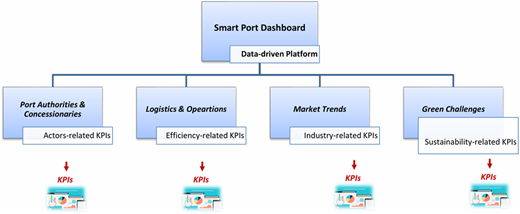
The platform supports data sharing across multiple entities, including terminal operators, shipping companies and environmental agencies, thus promoting transparency and efficiency in port management. Furthermore, the integration of green indicators into the dashboard underscores the strategic importance of sustainability in the future of maritime logistics. Indeed, the framework of the cloud-based dashboard is structured around four performance domains aimed at measuring port competitiveness, namely:
Port authorities and concessionaries (actor-related KPIs);
Logistics and operations (efficiency-related KPIs);
Market trends (industry-related KPIs);
Green Challenges (sustainability-related KPIs).
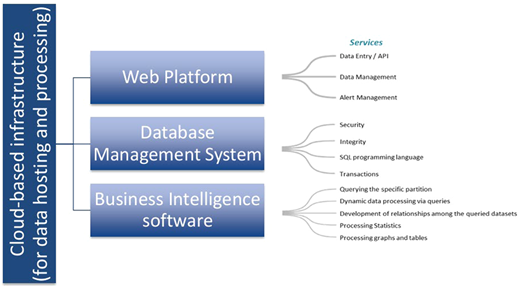
More specifically, theoretical speculations provided by the analysis of the illustrative evidence support a specific framework to describe the implementation of the designed Smart Port dashboard, both from a software and from a hardware level. According to the former, such an original platform is organised along two main technology domains, namely: Big data and data storage on the one hand and Communication and IT on the other hand. Each of the mentioned technological domains characterises the analysed Smart Port Dashboard as a multilayered product granting a defined set of services. Such services are of a threefold nature: 1. Web Platform; 2. Database Management System; 3. Business Intelligence software levels.
The Web platform grants a (manual) data entry/Input service, paired with an Automatic Acquisition of Data (API) service through an application programming interface.
The database management system provides data security and data integrity services, with a specific programming language. Finally, the Business Intelligence Software is dedicated to data analysis services via queries.
Shifting towards the hardware level, the mentioned Smart Port Dashboard is supported by a virtual, cloud-based server.
The framework indicates that the implementation of a data-driven DSS significantly enhances port performance monitoring, fostering both operational efficiency and multi-stakeholder collaboration. The cloud-based platform developed in this research facilitates seamless data exchange between various entities, including terminal operators, shipping companies and regulatory bodies, thereby improving transparency and coordination within the port ecosystem. The integration of digital monitoring mechanisms allows port authorities to track KPIs across multiple dimensions, ensuring a more comprehensive assessment of port competitiveness.
A key aspect of the illustrative evidence drawn by the study is the emphasis on sustainability, which is embedded in the framework through the incorporation of green performance indicators. The study highlights that monitoring environmental metrics is no longer a peripheral concern but a strategic imperative for ports aiming to align with global sustainability goals. By integrating environmental KPIs into the smart port dashboard, the study provides a tool that enables ports to evaluate their ecological impact and implement targeted sustainability initiatives. This aligns with broader European Union policies promoting decarbonisation and energy efficiency in the maritime sector.
The conceptualisation of the smart port dashboard is structured around two core technological domains: big data management and communication technology. These elements function together to support a multilayered platform that offers a range of digital services, including real-time data acquisition, secure database management and advanced business intelligence analytics. The platform operates through a web-based interface that enables both manual data input and automated data acquisition via application programming interfaces (APIs), ensuring accuracy and consistency in data collection. Furthermore, its database management system is designed to maintain data integrity and security, while business intelligence software facilitates in-depth data analysis through query-based methodologies.
Beyond software considerations, the study underscores the significance of a robust hardware infrastructure. The smart port dashboard is supported by a cloud-based virtual server, ensuring scalability and reliability in data processing. This cloud-based architecture not only enables real-time analytics but also enhances the resilience of port operations by providing secure data storage and remote accessibility. By integrating these technological components, the proposed framework represents a significant advancement in the way port authorities monitor and manage their operations, shifting towards a more predictive and data-driven approach.
The findings also suggest that the adoption of such a digital infrastructure encourages a shift in governance models within port authorities. Rather than relying solely on traditional internal performance indicators, the study advocates for a more outward-looking approach that incorporates market trends and stakeholder-driven insights. This shift is crucial for ensuring that ports remain competitive in an increasingly complex and interconnected maritime industry.
From a managerial perspective, the Smart Port Dashboard introduces a paradigm shift in port governance by embedding strategic foresight into decision-making. The dashboard's ability to integrate cross-functional KPIs allows port authorities to adopt a more proactive and data-informed approach, minimising inefficiencies and enhancing stakeholder coordination. The digital dashboard fosters greater accountability and transparency, ensuring that port authorities align their operational goals with broader industry trends. Additionally, the integration of market trend analytics allows ports to anticipate trade fluctuations, optimise pricing strategies and improve competitiveness. The multi-actor framework enhances communication between port authorities, logistics providers and concessionaires, reducing conflicts and improving operational synchronisation.
Figure 1 below shows the Smart Port Dashboard conceptual framework:
On a technological level, the Smart Port Dashboard leverages cutting-edge innovations to enhance data processing and real-time decision-making. Indeed, a cloud-based database management system ensures secure, scalable data storage, whereas business intelligence tools facilitate advanced data analytics, providing actionable insights for port authorities.
IoT-enabled sensors automate real-time data collection across port activities, from berth occupancy tracking to emissions monitoring. API-driven connectivity enables seamless data exchange between the dashboard and external logistics platforms.
Figure 2 illustrates the technological framework of the Smart Port Dashboard, along with the service categories provided by the platform.
By combining these technologies, the Smart Port Dashboard offers a robust solution for optimising port efficiency while ensuring compliance with global sustainability standards.
Hence, the four key strategic improvements facilitated by the implementation of the Smart Port Dashboard verify the suggested propositions, namely:
P1. Enhanced digitalisation in port operations, facilitating automated data collection and real-time monitoring.
P2. A systematised multi-actor framework, enabling collaborative decision-making between stakeholders such as port authorities, terminal operators, logistics firms and regulatory bodies.
P3. Maximised value creation and co-creation, enhancing efficiency and effectiveness in operational and strategic decision-making.
P4. A structured sustainability impact framework, integrating green indicators to support decarbonisation and environmental responsibility in maritime logistics.
5. Discussion and implications
5.1 Interpreting the smart port dashboard within the existing literature
The proposed Smart Port Dashboard extends the current literature on data-driven port management by shifting the focus from operational monitoring towards strategic governance. Previous research has primarily investigated digital technologies – including AI, IoT, blockchain, digital twins and cloud computing – as instruments for improving operational efficiency, logistics optimisation and information exchange (Heilig and Voß, 2017; Notteboom et al., 2022). Similarly, existing dashboard applications have mainly concentrated on visualising operational performance indicators or supporting specific managerial decisions (Ferretti et al., 2017). In contrast, the framework developed in this study integrates technological capabilities with strategic performance measurement, enabling port authorities to monitor operational, economic, environmental and governance dimensions within a unified decision-support architecture.
Such a strategic tool effectively integrates digital interfaces, advanced algorithms and data processing capabilities. This tool not only tracks operational efficiency – such as container throughput and dwell times – but also captures economic, market and environmental indicators critical to maintaining a competitive edge in the global logistics network. The platform allows port authorities to assess their performance against both internal targets and external benchmarks, aligning their objectives with broader European Union policies on sustainability and decarbonisation.
5.2 Theoretical implications
From a theoretical perspective, the study contributes to three streams of literature.
First, it extends research on performance measurement systems by demonstrating how traditional KPI frameworks can evolve from operational reporting tools into strategic governance mechanisms. Rather than monitoring isolated indicators, the proposed dashboard supports multidimensional performance evaluation capable of informing long-term strategic decisions.
Second, the study contributes to the literature on digital transformation in port management by proposing an integrated conceptual framework that combines technologies, governance processes and performance measurement. Existing studies generally analyse technological innovations separately, whereas the proposed framework illustrates how these technologies may jointly support strategic decision-making.
Third, the study contributes to port governance research by highlighting the importance of multi-actor information sharing. Rather than considering port authorities as isolated organisations, the Smart Port Dashboard conceptualises the port as a collaborative ecosystem where value is generated through coordinated interactions among terminal operators, shipping companies, logistics providers and public institutions.
5.3 Managerial and policy implications
From a policy perspective, the framework aligns with current European initiatives promoting digitalisation, sustainability and data-driven governance in maritime transport. The integration of environmental indicators supports compliance with increasingly demanding decarbonisation objectives, while cloud-based monitoring facilitates accountability and transparency in public port governance.
The outcomes of this study provide valuable insights for public managers and policymakers. Port executives are urged to recognise the advantages of incorporating profit-driven management practices within PAs. In particular, the implementation of strategic monitoring based on smart dashboarding is beneficial for those PAs moving from traditional to efficiency-oriented management frameworks.
Although transitioning from an internal-focused to an external-oriented KPI development represents a significant strategic advancement in their monitoring efforts, a paradigm shift is needed in terms of strategic managerial decisions within PAs.
The introduction of a smart port dashboard represents a transformative approach to port management, integrating digital interfaces with advanced data analytics to enhance decision-making. The study's conceptual framework underscores the necessity of transitioning towards a more dynamic and responsive port governance model, where real-time data play a central role in strategic planning. By capturing KPIs across operational, economic, market and environmental dimensions, the dashboard provides a comprehensive tool for performance assessment, enabling port authorities to align their objectives with broader industry trends and regulatory requirements.
5.4 Revisiting the design propositions
One of the key contributions of this study lies in its demonstration of how digitalisation can facilitate more effective stakeholder engagement. The proposed platform allows multiple actors within the port ecosystem – including port authorities, terminal operators, shipping companies and policymakers – to access and analyse data collaboratively. This multi-actor approach fosters a more integrated decision-making process, ensuring that different perspectives are considered in strategic planning. The study highlights that such collaboration is essential for improving efficiency, particularly in contexts where coordination between public and private entities is critical to port operations.
The implications of this research extend beyond immediate operational improvements, as the findings suggest a paradigm shift in port management strategies. Traditionally, port authorities have focused on internal performance metrics, but the smart port dashboard encourages a broader perspective that incorporates market intelligence and sustainability considerations. This shift aligns with contemporary trends in logistics and supply chain management, where the ability to anticipate market changes and regulatory developments is crucial for maintaining competitiveness. The study's results indicate that port authorities adopting such digital monitoring tools can achieve greater agility in decision-making, enabling them to respond proactively to emerging challenges and opportunities.
From a policy standpoint, the research provides valuable insights into the role of technology in enhancing regulatory oversight and compliance. By integrating sustainability indicators into performance monitoring, the study supports the development of policies that promote environmental responsibility in the maritime sector. The findings highlight that green technologies are not merely an ancillary aspect of port operations but a fundamental enabler of long-term competitiveness. As global regulations on emissions and energy efficiency become more stringent, the ability to monitor and optimise sustainability performance will be a critical factor in port governance.
As shown in the framework section, the conceptual development of the Smart Port Dashboard provides support for the proposed design propositions. Rather than empirically validating causal relationships, the framework illustrates how the integration of digital technologies, strategic KPIs and multi-actor governance can potentially enhance strategic monitoring within port authorities. Consequently, the propositions should be interpreted as design principles guiding the development of integrated decision-support systems rather than as experimentally verified hypotheses.
More specifically, the Smart Port Dashboard enables automated data collection, real-time monitoring and predictive analytics for port operations, while fostering collaborative decision-making by integrating diverse port stakeholders, including authorities, terminal operators, logistics firms and regulatory bodies. Furthermore, the platform streamlines port processes, improving resource allocation, throughput and operational effectiveness. Finally, integrated green indicators support the transition to decarbonised and environmentally responsible port operations.
Ultimately, the study advocates for a strategic rethinking of port management, where digitalisation and data-driven decision-making become central pillars of governance. While transitioning to such a model requires investment in technological infrastructure and capacity-building, the long-term benefits in terms of efficiency, transparency and sustainability far outweigh the initial costs. The research provides a compelling case for the adoption of smart port dashboards, demonstrating their potential to transform port authorities into more agile, responsive and sustainability-oriented organisations.
A key insight emerging from this study is that digital transformation should not be interpreted merely as the adoption of advanced technologies. Rather, digital transformation involves the redesign of governance processes through data-driven decision-making. Within this perspective, the Smart Port Dashboard is conceived not simply as an information visualisation tool but as a governance mechanism that integrates operational intelligence, stakeholder coordination and strategic performance management. This interpretation extends existing research by positioning dashboard technologies as organisational capabilities supporting institutional governance rather than solely operational efficiency.
6. Conclusion
This study addressed the growing need for strategic performance monitoring in contemporary port authorities operating within increasingly digital and sustainability-oriented environments. Although digital technologies have transformed port operations, existing performance monitoring approaches remain largely focused on operational efficiency and fail to provide integrated governance-oriented decision support.
To address this gap, the paper proposed a Smart Port Dashboard integrating operational, market, governance and environmental dimensions within a unified decision-support framework. Unlike existing dashboard solutions, the proposed architecture combines technological infrastructure with multidimensional performance measurement, supporting strategic monitoring across multiple organisational functions and stakeholders.
The study makes three principal contributions. First, it advances the literature on port performance measurement by extending existing KPI frameworks towards strategic governance. Second, it contributes to digital transformation research by integrating decision-support technologies, performance dashboards and governance processes within a unified conceptual framework. Third, it offers practical guidance for port authorities seeking to implement data-driven monitoring systems capable of supporting long-term decision-making and sustainability objectives.
The Smart Port Dashboard represents a dynamic decision-support interface that integrates digital analytics, advanced algorithms and performance tracking mechanisms. By embedding real-time data processing, it not only enhances operational efficiency – such as container throughput and vessel turnaround times – but also introduces a strategic layer of oversight for economic, market and environmental performance.
The research underscores the importance of aligning port monitoring efforts with broader European Union policies on sustainability and decarbonisation. Through benchmarking and strategic forecasting, the Smart Port Dashboard equips PAs with the tools necessary to navigate shifting regulatory landscapes, including IMO 2050 decarbonisation targets and the European Green Deal. By leveraging digitalisation, PAs can proactively address sustainability challenges while simultaneously improving logistics competitiveness.
The study also provides practical insights for public managers and policymakers. Port executives are encouraged to transition towards a more efficiency-oriented governance model that integrates strategic monitoring into daily operations. The adoption of smart dashboarding is particularly advantageous for PAs shifting from traditional port governance structures to data-driven decision-making frameworks. However, this transition requires a fundamental shift in managerial strategies, emphasising real-time performance tracking and inter-organisational collaboration.
Furthermore, the findings reinforce the role of green technologies as key enablers of sustainable port operations. The integration of sustainability KPIs into the Smart Port Dashboard ensures that port management practices are aligned with global environmental standards. Policymakers should support the digital transformation of ports through regulatory incentives, funding mechanisms and collaborative research initiatives that promote the adoption of smart port technologies. By advancing the discourse on strategic port management, this study highlights the critical role of long-term monitoring tools in strengthening the resilience and competitiveness of maritime logistics networks. The Smart Port Dashboard represents a significant step towards a more integrated, data-driven approach to port governance, ensuring that digitalisation and sustainability remain at the forefront of future port development strategies.
Despite these contributions, several limitations should be acknowledged. First, the proposed framework represents a conceptual design supported by an illustrative case study rather than a fully implemented digital platform. Consequently, the framework has not yet been empirically evaluated in operational environments. Second, the empirical evidence was collected within a single Port Authority, limiting the generalisability of the proposed architecture to different institutional and regulatory contexts. Third, although the study identifies a multidimensional set of KPIs, their relative importance may vary across ports characterised by different governance structures, cargo specialisations and technological maturity.
While the conceived platform marks a significant step forward in port management by integrating digital analytics, automated monitoring and strategic decision-making, some limitations can be highlighted. The study primarily focuses on the conceptual and technical aspects of the Smart Port Dashboard; however, the potential challenges related to data interoperability, cybersecurity risks or the adaptability of the system across diverse port environments are not fully addressed. Moreover, the real-world implementation of such a framework requires additional validation through extensive case studies and empirical testing.
Future research should focus on the empirical implementation and validation of the proposed Smart Port Dashboard in different national and international port systems. Comparative studies across multiple Port Authorities could assess the adaptability of the proposed KPI architecture under different governance models and operational conditions. Additional research could investigate the integration of artificial intelligence, digital twins and predictive analytics into the dashboard to support dynamic scenario analysis and strategic forecasting. Finally, quantitative assessment of the framework’s impact on operational efficiency, stakeholder coordination and environmental performance would further strengthen its practical applicability.
Also, it would be beneficial to expand the scope of data-driven decision-support systems in order to accommodate varying regulatory, operational and environmental conditions in different maritime regions. Addressing the mentioned gaps could contribute to a more robust and scalable smart port ecosystem, paving the way for further advancements in digital transformation and sustainable port governance.
This research was conducted as part of the project “CENTRO NAZIONALE PER LA MOBILITÀ SOSTENIBILE – CNMS” – CUP I63C22000340001. The authors gratefully acknowledge the financial support provided under the National Recovery and Resilience Plan (Piano Nazionale di Ripresa e Resilienza – PNRR) – Mission 4.