This study aims to investigate how targeted communication interventions influence sustainability implementation within the tourism sector. It explores how these interventions activate existing motivational drivers, address key barriers – including novel concerns about guest behaviour – and strengthen the connection between academic research and practical sustainability outcomes across the tourism value chain.
This study used a mixed-methods approach, combining qualitative observations and interviews with quantitative survey data. Communication interventions were deployed across a hotel group, including digital and in-person formats. Survey responses and field notes were analysed to assess intervention effectiveness, identify implementation drivers and barriers and inform future communication strategies.
The study found that communication interventions activated existing sustainability drivers and helped overcome barriers, leading to higher implementation levels. Notably, concern about guest behaviour emerged as a novel barrier. Multi-channel approaches were most effective, highlighting the role of tailored communication in bridging intention-action gaps in tourism sustainability practices.
The small sample size and self-reported data limit generalisability and introduce risk of bias. However, the findings offer unique and practical implications for designing targeted sustainability communications in hospitality. Future research should explore scalability across brands and regions to assess broader carbon reduction impacts and strengthen academic–industry collaboration in tourism sustainability.
This study offers a novel contribution by demonstrating how tailored communication interventions can activate known motivational drivers and overcome key implementation barriers, including the underexplored concern of guest behaviour. It highlights the importance of internal communication strategies and provides actionable insights for fostering sustainability uptake across the tourism value chain.
1. Introduction
The environmental impact of tourism has become a landmark global climate issue. Within the tourism industry, the hotel sector and specifically the construction, development and maintenance of hotel infrastructure consumes vast amounts of energy and creates 264 million metric tonnes of carbon emissions every year, or approximately 2%–5% of global tourism emissions (EY Parthenon, 2021; UNWTO, 2025). Major challenges remain in the hotel sector to recognise and mitigate environmental impact, with many barriers to engage corporate social responsibility programmes (Khatter et al., 2019).
To combat barriers, research has developed measures aimed at prompting pro-environmental tourist behaviours (Dolnicar, 2020; Goldstein et al., 2008; Juvan and Dolnicar, 2014; Kallbekken and Sælen, 2013; Knezevic Cvelbar et al., 2021). These measures do not require excessive investment and will not compromise guest satisfaction (Dolnicar, 2020). However, empirically identifying measures to reduce carbon emissions is only step one. The industry requires crucial information of scientific measures and motivation to implement them. Bridging the gap between academic success and widespread industry uptake remains a challenge. Factors driving sustainability implementations in hotels are well studied, including pressures for service innovation, global competitiveness and financial interests (Khatter et al., 2021; Prud’homme and Raymond, 2016). Yet to our knowledge, no studies have investigated communication interventions as a driver of sustainability measures from academia to industry.
This research tests the effectiveness of five communication interventions that contain scientifically proven measures in the hotel context to determine which achieves the highest level of implementation. Theoretically, this study explores the emerging idea of communication convergence as a superior information sharing model in driving innovation uptake. Practically, this paper aims to demonstrate effective communication of sustainability information from academia to industry in a way that promotes wide-scale adoption of sustainability measures.
2. Literature review
2.1 Practical behavioural measures
Investigations of sustainability measures in industry settings grounded in behavioural theories have demonstrated positive environmental results (Demeter et al., 2023). Successful interventions include measures such as reducing plate size at hotel buffets, which has shown a 20% reduction in plate waste (Dolnicar et al., 2020). Changing defaults for room cleaning to “upon request” has also proven successful in reducing unnecessary daily cleans and can be effectively combined with incentives like drink vouchers for guests (Knezevic Cvelbar et al., 2021; Dolnicar et al., 2019a, 2019b). Another intervention involved reducing cotton serviette use by changing the default to recycled paper napkins resulting in a 95% reduction in cotton serviette use (Dolnicar et al., 2019a, 2019b). Increased recycling rates, achieved by leveraging varied messaging theories, have also been documented (Grazzini et al., 2018). Furthermore, reducing kitchen preparation waste by adapting bins to show their contents has demonstrated a 73% reduction (Chawla et al., 2020).
These measures require minimal hotel investment and generally low levels of environmental knowledge, but a key challenge remains in measuring their long-term implementation as follow-up studies on prolonged success are scarce (Demeter et al., 2023). While academic research continues to develop creative sustainability solutions, the methods for effectively communicating these solutions to the industry remain a disputed and unclear practice (Walters et al., 2015). Bridging this gap between scientifically proven solutions and industry uptake is a critical area requiring further attention, and this research aims to address this specific need by examining how to effectively communicate theory-driven sustainability best practices.
2.2 Communication in diffusion of innovation theory
This study leverages the communication element of the diffusion of innovation theory, which provides a framework for understanding the factors influencing the uptake of sustainable practices by tourism enterprises (Dibra, 2015). Traditionally, the theory distinguishes between mass media - like TV, radio and newspapers - and interpersonal channels, which involve two-way communication between parties (Rogers, 2003). The theory suggests that interpersonal channels are typically more effective for challenging strong attitudes towards innovation because of the highly social process of diffusion (Rogers, 2003; Sahin, 2006).
The concept of converged media, which integrates mass media and personal approaches, has gained increased attention due to technological advancements like smartphones, which allow for both extensive mass information access and interpersonal exchanges (Srivastava and Moreland, 2012). The evolution of convergence within the diffusion of innovations has been leveraged in studies examining the role of participatory communication in sustainable development, stressing the importance of involving key stakeholders and community members in a bottom-up approach (Anani-Bossman and Blankson, 2023; Qasmi and Ahmed, 2020). These studies highlight that a more combined approach to communication can result in improved levels of innovation adoption by fostering ownership and relevance to the needs of adopters (Qasmi and Ahmed, 2020). While focused on community development, these studies demonstrate the potential for combined communication methods to enhance innovation adoption (Qasmi and Ahmed, 2020). Despite this growing understanding, this study tests a broad combination of existing communication methods within the context of sustainability.
2.2 Communication methods
Sustainability communication lacks a clearly defined theoretical foundation (Barendsen et al., 2021) but often falls into two categories: communication for sustainability – typically top-down messaging from management – and communication about sustainability, which encourages horizontal, participatory dialogue among actors (Newig et al., 2013). Effective internal communication can foster positive working climates and stimulate green innovation (Demirović Bajrami et al., 2024). Different methods offer distinct benefits. Seminars effectively build knowledge and shift attitudes (de Grave et al., 2014), while small-group workshops enhance motivation, self-awareness and enthusiasm (Steinert et al., 2006). While digital formats such as videos and e-books provide efficient, scalable content delivery, their impact on behaviour change in hospitality and tourism is inconsistent, given a lack of interactivity and engaging content (Zhang et al., 2006). These passive educational formats often lead to disengagement and recent works reinforce this concern, showing that while digital tools offer flexible solutions for upskilling in tourism and hospitality, they must be designed for interactivity, personalisation and provide real-time feedback to drive sustainable behaviour change (Kalbaska and Cantoni, 2022; Romagosa et al., 2025).
Smartphones and review platforms provide hospitality and tourism firms direct access to consumers, enabling tailored brand positioning and service adaptations that support sustainability (Romagosa et al., 2025). These tools also facilitate peer-to-peer interaction, empowering tourists to co-create experiences and spread sustainability messaging organically (Borges-Tiago and Avelar, 2025). Influencers and informal digital dialogues enhance the relatability of sustainability content (Berne-Manero and Marzo-Navarro, 2020), while artificial intelligence (AI)-driven tools personalise content based on user behaviour, increasing engagement (Dwivedi et al., 2021). Despite their potential, digital methods often lack stakeholder interactivity (Barendsen et al., 2021), suggesting hybrid methods may be more effective. This study builds on that premise, testing whether combining digital and in-person interventions enhances uptake. As stakeholder engagement enhances the credibility and legitimacy of sustainability efforts (Kim, 2014), strong management of internal engagement and communication is needed to improve organisational reputation (Guix et al., 2018; Barendsen et al., 2021). One-on-one training remains highly engaging by personalising content and allowing tailored feedback (Read and Kleiner, 1996).
Given the demonstrated ability to improve motivation, enthusiasm and stakeholder engagement, we hypothesised that small-group workshops and one-on-one sessions would be the most effective interventions for achieving implementation. Yet, despite the promise of these methods, barriers to uptake remain, indicating that communication alone cannot guarantee implementation success.
2.3 Barriers to implementation
Strong forms of communication might be ineffective if they do not address the broader barriers to implementation. Prior studies highlight numerous barriers to environmental management programmes and sustainability implementation. Cost or financial limitations are the main barrier that tourism and hotels currently face (Chan, 2011; Khatter et al., 2021; Wan et al., 2017). Many firms lack the capital to invest in environmental management or believe investment will not generate the returns required for board or owners’ approval (Chan, 2021; Chan et al., 2014). Lack of environmental knowledge is the second most prevalent barrier (Khatter et al., 2021). Poor understanding of inefficient operations and environmental issues, a subsequent lack of environmental management skills and inability to set sustainability policies are all common themes (Bonilla Priego et al., 2011; Chan, 2021; Oluwadare et al., 2020).
Implementation of new procedures can face significant challenges from customer perceptions of service quality and product quality (Khatter et al., 2021). Hotels fear perceptions of cost-cutting, and believe environmental initiatives negatively impact guest experience, particularly among high-value guests (Baker et al., 2014; Wan et al., 2017). To date, only one study investigated the factors that drive hotel managers to overcome barriers and adopt sustainable practices. Findings suggest that providing knowledge and expertise to managers in development and implementation of environmental programmes lowers adoption barriers (Prud’homme and Raymond, 2016). Research has not yet tested how scientifically proven sustainability measures – which have the potential to combat these barriers – are communicated to industry. This represents a gap in the literature that would expand understanding of industry needs and offer foundations for the development of sustainability initiatives that reduce implementational barriers.
3. Methodology
This study used a mixed-methods approach in collaboration with a hotel chain during its annual conference in Australia. The research team worked with the chain to promote sustainability measures and assess the effectiveness of communication interventions delivered both prior to and at the conference which took place in August. Given regional climate variation, some hotels were in peak season while others were not. To encourage participation, follow-up surveys avoided peak periods like school and public holidays.
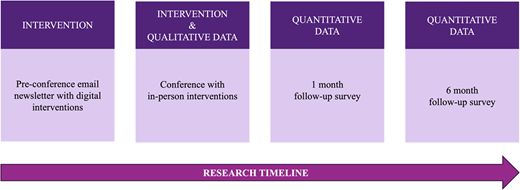
The study tested five interventions – three digital and two in-person – all delivering the same content. The digital interventions, sent via an email newsletter from the brand’s marketing manager, included: (1) informational video links, (2) a step-by-step implementation handbook created by the research team, and (3) a link to book a one-on-one online consultation. The in-person interventions consisted of (4) a keynote presentation and (5) small-group workshops offering guided implementation support. Email follow-up surveys were sent to the same group as the newsletter prior to the conference at one and six months after the conference. Figure 1 illustrates the procedure in deploying interventions, follow-up surveys and data gathering timeline. For clarity, the first intervention (pre-conference email newsletter) was sent one month prior to the conference, so the total research timeline was approximately eight months. This study adheres to the guidelines of the ethical review process of The University of Queensland and was approved by the university ethics committee 2023/HE001418.
3.1 Participants
Study participants are owner-managers or managers of properties licenced by a hotel chain across Australia. Hotels are diverse in type (family, business and leisure) as well as location (urban, suburban and rural). The brand is a franchise model, so while all properties are independently owned, each receive sales, marketing and operational support. All participants were invited to the annual conference held in Australia. The research team presented a keynote address about sustainability measures and conducted implementation workshops. The email newsletter had the highest number of participants (n = 150), followed by the keynote address (n = 50), small group workshops (n = 18) and then downloads of the digital handbook (n = 7). No participants opted for a one-on-one consultation (n = 0). At the time of data collection, the brand did not enforce any corporate social responsibility programmes.
3.2 Content
The digital interventions in the email newsletter involved video links that explained the sustainability measures. The newsletter also contained a digital handbook with implementation instructions of eight sustainability measures. These measures were (1) reducing plate size intended to plate waste at buffets, (2) room cleans upon request to reduce room cleans, (3) room clean options to reduce room cleaning, (4) anthropomorphising towels to increase towel reuse, (5) installing shampoo dispensers to reduce single use plastic, (6) air conditioning signs to reduce AC usage (7) table signs to reduce plate waste at buffets and (8) transparent kitchen bins to reduce food preparation waste (Kallbekken, and Sælen, 2013; Chawla et al., 2020; Knezevic Cvelbar et al., 2021).
Each measure was given a full page with a paragraph of background information and steps guiding managers on how to implement. The handbook is available in the supplementary materials. The one-on-one consultation link was also in the newsletter offered personal instruction time for any questions.
The in-person interventions involved the conference keynote presentation of PowerPoint slides, and a researcher talk as well as small group workshop breakout sessions. In the workshops, a researcher guided participants through the same content as other interventions.
3.3 Measurement of the implementation
One and six months after the conference, the marketing manager distributed surveys to all participants (n = 150) via email. Surveys consisted of three sections. Section 1 contained multiple choice questions about the communication interventions, including: “Did you hear about the environmental sustainability measures proposed by the university through any of the following information sources?” (1) newsletter, (2) downloaded the handbook through the newsletter, (3) downloaded the handbook at the conference, (4) I attended a free one-on-one session with a researcher, (5) I attended the conference and was present at the keynote address and (6) I attended the conference and participated in a workshop. Respondents were then asked to indicate which intervention they found most and least useful and why. The second section consisted of “Yes” or “No” questions asking which measures they implemented, if any. Hoteliers also had an opportunity to list other measures they implemented that were not presented. Finally, respondents were asked their future implementation intention for each presented measure using “Yes”/“No” answer format.
3.4 Data analysis
Two data sets were collected:
the observational insights from workshops; and
self-reported follow-up surveys.
The observational insights formed the core analysis with richer data. We conducted a reflexive thematic analysis with inductive coding, as there was no formal structure to this data gathering. This offered flexibility in analysis and for themes to emerge organically (Clarke and Braun, 2017). The surveys did not yield a large enough data set to conduct a deep statistical analysis due to low response levels. For t-tests or ANOVAs to measure group differences, a reasonable sample size of 30 is generally accepted (Cohen, 1988; VanVoorhis and Morgan, 2007). In the follow-up surveys, the sample was 12; therefore, these analyses could not be conducted. The hoteliers in the total sample of 150 received three follow-up emails from the marketing manager seeking responses, and the research team emailed workshop attendees on two occasions seeking responses. This proved unsuccessful, and so the quantitative data is presented as a data summary (Table 1).
4. Results
4.1 Quantitative data
Table 1 shows, from left to right, (1) the communication interventions or combinations of interventions hoteliers engaged with, (2) number of hoteliers who self-reported responses in that group, (3) how many of the measures were implemented by that group, (4) which measures were implemented, (5) the number of intentions to implement in the future and (6) which measures that group intends to implement. Twelve responses were recorded in the follow-up survey between one- and six-months reporting. The results have been combined. The most comprehensive communication group, which included engagement with the email newsletter, handbook, conference talk and workshop had the highest number of implementations (13 across 4 participants) and intentions to implement (14). On average, this group implemented 3.25 measures per participant. The group that engaged only with the email newsletter on average implemented 0.5 measures each. While those who only on engaged with the in-person methods (the conference talk and workshop) implemented 1.33 measures on average.
One participant who engaged with none of the communication interventions (but responded to a follow-up survey) reported five implementations of independent measures, meaning these measures were not in the content provided across the interventions.
4.2 Qualitative data
Researchers spent eight hours at the conference and were able to collect observational data from 18 managers throughout six small-group workshops. Observations took place while a researcher guided hoteliers through intervention content, discussing the sustainability measures. The hoteliers conversed with the presenting researcher but did not interact with the observers.
Managers reported sustainability measures they had already implemented. Room cleaning upon request was a common practice, although in slightly different ways (e.g. “room service daily, but nothing over the weekend”, “we do not clean every day” and “every 2 days gets a light service and every 4 days gets a full service”). Air conditioning management was another measure some had implemented, typically via predetermined thermostat settings (e.g. “I limit it to 16–23 degrees”) or in-room messaging [e.g. “I say if you go outside this (temperature) range, the aircon does not work”]. Another measure in place was waste management but for waste bins in general, rather than kitchen waste specific per our handbook (e.g. “10 years ago, I put a small rubbish bin, like table bin in rooms”). Two measures that managers implemented exactly as the researchers presented were the reduction of plate size at hotel buffets and changing toiletries to refillable dispensers. Of the two, the refillable toiletries dispensers were more prevalent, with hoteliers stating on four occasions that this was already in place (e.g. “we’ve replaced them – no problem at all”). Smaller plates at buffets had also already been somewhat implemented, (e.g. “we already have the small plates, not tiny but medium”).
Managers expressed concern about guest behaviour, typically relating to room cleaning upon request (e.g. “we had netball teams break beds last year”, “people can do horrific stuff overnight” and “kids are the worst”). As a result, they saw value in daily room cleaning. Concerns were also raised about switching to refillable toiletry dispensers. Managers expected guests to steal from dispensers and wanted more information before committing to making a change (e.g. “What am I doing if I’m spending all this time and money on getting this bottle on the wall only to have my guests empty them?”).
Certain measures offered novel value to managers. Replacing kitchen waste bins with smaller transparent bins that allow staff to see the waste was of interest to the managers sharing that “they can see what they’re wasting, that’s quite clever”. The idea was novel to many participants and resulted in positive responses, such as “ah, good idea!” in ways that other measures did not. Managers also expressed a level of self-awareness in their sustainability measures or the need for them. One shared “Our portions are too big” in response to the plate size intervention and another expressed air conditioning cost stating, “We’ve got two in every apartment” and “Some of them are 50% of our electricity bill”.
4.3 Conceptual framework
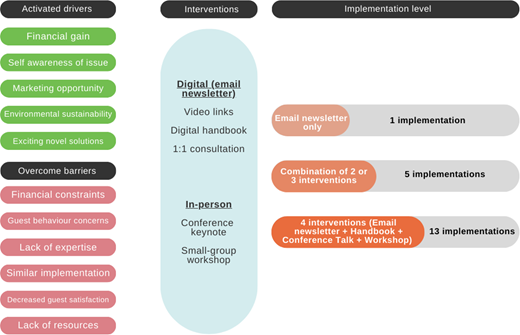
Figure 2 shows a new conceptual framework. Based on drivers and barriers to sustainability implementation in literature and those identified in this study, we demonstrate that the communication interventions either activate drivers or overcome barriers. In this study, we identify self-awareness of a lack of sustainability practices and positive attitudes towards the novel measures (to this sample) as additional drivers. We also identify similar (but not exactly replicated) implementations to our presented measures as a barrier, as well as concerns of overnight guest behaviour as a novel barrier in the context of sustainability implementation. The tested communication interventions in the centre are leveraged to activate these drivers and overcome the barriers. Study findings of implementation level are shown on the right.
5. Discussion
This study advances previous assumptions about drivers and barriers to sustainability in the hotel context that suggest identification of these factors will result in action. These communication interventions provided solutions to overcome the most common barriers of a lack of time, financial limitation and lack of expertise (Bonilla Priego et al., 2011; Chan, 2011; Khatter et al., 2021; Wan et al., 2017) and activated the drivers such as increased marketing opportunities, reducing operating costs and improving environmental awareness (Chan et al., 2014; Dolnicar, 2020; Khatter et al., 2021). Increased touchpoints across interventions demonstrated higher levels of implementation but the overall level is still very low, suggesting that identifying barriers and drivers and proposing solutions is not enough to drive implementation. Out of 150 managers that received at least one communication intervention, only 11 reported any implementations.
An additional key result is the manager’s strong concern about guests’ behaviour, particularly about changing room cleaning operations to improve sustainability. Many assumed reduced cleaning would lead to property damage due to a lack of guest supervision. This concern for protecting property emerges as a novel barrier in the hospitality sustainability literature. While past studies identify damaging guest behaviour and crime in hotels (Chan, 2011; Ho et al., 2017; Huang and Leung, 2025; Kátay, 2015; Khatter et al., 2021), these have not previously intersected with sustainability implementation challenges.
This risk-averse mindset reveals a shift in managerial thinking and complicates assumptions about cost as a primary barrier (Chan, 2011; Khatter et al., 2021; Wan et al., 2017). Some managers were willing to absorb higher operational costs to maintain cleaning routines, prioritising damage prevention over the economic benefits of the presented sustainability measures. This suggests that reputational and operational concerns can outweigh even financially advantageous initiatives. These findings also echo recent research on customer incivility, which links guest behaviour to increased staff stress and the proliferation of passive retaliation behaviour, such as resistance to change and sustainability implementation (Baker and Kim, 2021; Boukis et al, 2020; Huang and Leung, 2025). This also demonstrates the significant impact of customer behaviour on the wellbeing of frontline employees but requires further investigation (Huang and Leung, 2025). Our findings suggest greater operational and behavioural challenges exist in the managerial context than previously understood and that operational compromise – such as modifying the room clean upon request measure to a daily room check rather than a full clean – may be more effective.
Interestingly, none of the hotels commented on the negative perceptions from guests of implementing measures, another prevalent barrier (Khatter et al., 2021). This aligns with shifts in consumer attitudes towards sustainability, given that 76% of travellers on the site Booking.com, want access to more sustainable options (Booking.com, 2023). This demonstrates that barriers extend beyond resource scarcity, introducing the perspective that reputational and operational concerns can take precedence over financially beneficial decisions. This also reiterates the complexity of drivers and barriers on a broader scale and invites further research on the potential for competing managerial concerns and how best to balance operational needs with sustainability goals.
The quantitative data suggests that even when information is presented in clear language with step-by-step instructions, hotels implement sustainability measures at a very low rate. Email newsletter communication supplemented with the handbook, small group workshops and keynote proved most effective while email communications alone are least effective. The intent data suggests the same combination drives highest intentions to implement, and the email only leading to the lowest. Contrasting early understanding of communication in diffusion of innovation theory which stipulates that interpersonal communication methods are much more powerful in driving innovation uptake (Rogers, 2003), our findings suggest that a combination of mass media and interpersonal communication is the most effective. This aligns with the conceptual understating of communication convergence as technology advancements have allowed for mass media simultaneously with interpersonal communication via smartphone or tablet (Srivastava and Moreland, 2012). This suggests that while interpersonal communications may be effective in the context of a single hotel, to scale this effect, combining mass media with supporting interpersonal communications such as the small group workshops could be more effective.
Convenient digital interventions in this study allowed for participants to access information without time constraints and regulatory pressure from the managing brand. The brand also does not enforce any environmental policies giving owner–managers the freedom to implement measures at will. This freedom could explain why this combination worked best. Unexpectedly, none of the participants elected to engage in a free of charge one-on-one consultation session. We understand that a lack of time and staff are common barriers to sustainability implementation (Khatter et al., 2021), but given the flexibility of these sessions, we expected this to be more popular. The one-on-one consulting sessions were designed to directly assist implementations and was in essence the confirmation stage of the innovation-decision model where adopters seek support to mitigate uncertainty (Rogers, 2003). But as stated, none of the hoteliers elected this intervention which can lead to potential discontinuance. The high level of engagement with the workshops could explain this lack of interest in a consulting session, demonstrating possible information saturation. Adjusting how the one-on-one consultation sessions are delivered, such as integration with existing conference activities in-person could mitigate this for future works.
Environmental policy mandates within this brand could complement the voluntary communication interventions by standardising the expectation of sustainability involvement. Periodic reporting on sustainability practices that feed into a structed framework is a potential solution. This would encourage prioritisation of measures while allowing for management of operational responsibilities, simultaneously. Policies could be integrated into existing digital communication channels to ensure long-term engagement by aligning voluntary sustainability practices with mandated reporting benchmarks in specific areas of energy, food and waste reduction as we have suggested. This approach could also potentially avoid information saturation by guiding hoteliers towards actionable items in their day-to-day rather than an overwhelming number of options to choose from.
The qualitative data revealed an understanding from hoteliers of the need to implement sustainability measures that have financial and environmental value. This demonstrates a level of awareness knowledge regarding the innovation (presented measures), promoting further motivation to implement (Rogers, 2003). However, based on the survey data we see was not the case. The observational data showed managers demonstrated levels of how-to knowledge and an understanding of how measures worked, with many having implemented similar measures, but lacked the principal knowledge needed to fully understand the theoretical mechanisms. Participants’ level of self-awareness and enthusiasm in our observations aligns with workshops’ educational value and motivational qualities (Steinert et al., 2006) but did not translate to enthusiasm specifically about implementation.
Taking the Rogers (2003) model into the process of communication with the hoteliers, the workshops enacted the second step of the innovation decision process; persuasion. During this stage, the hoteliers formed and developed opinions about each innovation from their own understanding, and external influences such as their peers in the workshops. The persuasion stage is much more affective and feeling oriented compared to the highly cognitive knowledge stage, and this was evident in the strong opinions shared by hoteliers about specific measures. The positive response was high when hotels had already implemented one of the presented measures and there was a sense of pride in this. Applying diffusion of innovation theory in this context, we have examined implementation across a group of early adopters and extend the practical use of elements of the theory in a tourism and hospitality setting. Previous assumptions about communication in sustainability should be challenged as earlier linear models of increased information leading to behaviour change are not sufficiently robust.
These insights offer practical implications and demonstrate that for communicating sustainability from academia to industry, there is no blanket solution. Fragmented hotel and tourism organisations with numerous stakeholders should develop information sharing that accounts for internal positioning and decision-making cultures. Franchise businesses need additional support from their parent brands to enact meaningful environmental management. A combination of communications is most likely needed to generate engaged sustainability implementation in this business model. In this sample, combined interventions that incorporated wide reaching digital communication and in-person formats that drove stakeholder engagement proved more effective. However, different market segments have different needs. Budget offerings often prioritise cost control and occupancy rates, whereas luxury markets focus on the guest experience and differentiation (Yan et al., 2016). Adapting communication interventions to address these priorities is key to a successful exchange of information. Leveraging local workshops and accessible digital resources with actionable cost-saving content supports the budget market, while private briefings and high-profile events that emphasise experience enhancement and storytelling would support the luxury segment (Walls et al., 2011).
Leveraging AI-based communication tools offers the possibility of personalised messaging and automated learning tailored to contextual differences. This could offer ongoing support after initial learning and has potential application across market segments. Popular online platforms for information sharing could also be leveraged to create more engaging digital experiences and offer a hybrid experience. This could develop as an online learning facilitator to in-person activities related to the learning outcomes. These approaches are broad enough to still have a high level of reach while offering the localisation and reinforcement of information conveyed in in-person formats.
Communication tailoring is also appropriate for hotel size. Most study participants would fall into the small and medium-sized enterprise (SME) category that suffers typical barriers to implementation. These family-run businesses face typical constraints of time and people, and per the qualitative results, we see resistance to innovation uptake in various measures – such as room cleaning upon request. Given the persistent barriers in this market segment, SME engagement is key to the development of sustainability research and subsequent return of knowledge to the industry. Community positioning is another leverage point to developing communication interventions that are culturally appropriate, highlight low-cost measures and offer greater flexibility than rigid brand-wide policy mandates. To this, managers should consider specific steps in the implementation process. For example, this could be (1) integrating sustainability information sharing in incremental on-site ways – such as into existing team meetings – to reduce overwhelming staff, (2) allocating financial and human resources to a specific role that is responsible for sustainability communications and (3) co-creating measures with staff input across all levels to promote buy in and understand the nuances of each role. This highlights potential opportunities for dedicated personnel to be drivers of this change, such as a dedicated “green team” that could act as moderators between innovative idea generation and sustainability strategy development (Demirović Bajrami et al., 2024).
Theoretically, this study highlights communication convergence (Srivastava and Moreland, 2012) as a superior information sharing model in driving innovation uptake in the context of internal communication between corporate brands and individual businesses. Our findings build upon internal communication driving green innovations (Demirović Bajrami et al., 2024). and that converged internal communication could significantly improve sustainability uptake. This contributes to a more detailed understanding of the intersection between organisational communication and sustainability implementations, providing a foundation for future works around tailored communication and implementation strategies.
6. Limitations and future research
This study is not without limitation. Due to the structure of the hotel brand, properties are inconsistent. Many have similar attributes, but they differ in guest mix, type of hotel (business, leisure and resort), price point and more. Respondents in our follow-up surveys are also self-reporting which introduces social desirability bias. They are also self-selecting which can lead to volunteer bias and an overrepresentation or underrepresentation of implementation in the more engaged properties or less engaged properties. Future research should consider triangulating survey findings with operational records of sustainability implementations or direct observation of the implementation – possibly framed as follow-up support – at each individual property or business, providing that resources allow.
We also do not know whether properties that did not respond to our survey implemented any of our measures. The small survey sample did not allow statistical comparisons and limits the generalisability of the quantitative findings. Future studies on multiple hotel chains or tourism businesses would allow for more representative sampling. The unique development of this study created a valuable research opportunity and a contextual limitation. Managers are a notoriously difficult group to reach, so being invited to engage at the hotel chain’s annual conference was an invaluable opportunity. While this is the first study, to our knowledge, to be conducted in this specific context, elements such as the digital handbook and small-group workshops are easily replicable. As this study focused on a single Australian hotel chain, findings cannot be generalised globally. However, replication across other regions and types of businesses could provide a broader foundation for comparative studies.
Future studies examining communication content could also use segmented approaches – such as hotel type or market positioning – to refine the delivery and relevance of sustainability measures. Additional research into marketing and co-branding of the academic partnership has the potential to activate motivational drivers and increase uptake. Based on feedback from our existing research partners, interest in co-branding recognition of engagement may be a strong enough marketing motivator to drive implementation. Broadly, these findings highlight the need for scalable sustainability communication interventions that move beyond one-off initiatives and support widespread behavioural change.
Beyond individual hotel benefits, this research contributes to broader societal goals, such as reducing tourism-related carbon emissions. Given the significant role tourism and hospitality play in global emissions, the development of scalable sustainability measures remains critical to meaningful industry-wide mitigation. Our findings suggest that communication interventions – particularly those that activate existing motivators and overcome implementation barriers – have strong potential to be adopted across similar hotel settings. If scaled across brands or regions, these interventions could cumulatively support measurable reductions in emissions. Future research should quantify this by examining the cumulative impact of successful interventions at different levels (brand, regional and national). In addition, our study highlights how internal communication practices may shape broader sustainability action in the sector, signalling a shift towards more structured, behaviour-focused strategies. There remains considerable opportunity to expand collaboration between academia and industry to co-develop scalable, contextually appropriate solutions that improve environmental outcomes and enhance industry resilience amid the ongoing climate crisis.
7. Conclusion
How academic reserach is communicated to hotels, and how this drives sustainability action remains underexplored. Previously identified barriers persist throughout the industry; solutions to overcome them are scarcely tested. This research attempted to bridge the academia–industry knowledge gap by testing communication interventions to overcome these implementation barriers and determine how to best drive uptake of sustainability measures. The results indicate that a combination of communication interventions was most effective in this sample but while engagement through small-group workshops and digital materials was high, this did not translate to widespread implementations. The results also demonstrate a novel barrier of concerns of guest behaviour in the sustainability implementation context. A very small subset of participants demonstrated successful uptake suggesting that further testing of communication interventions is needed to better understand how industry receives, processes and distributes information from academia. The potential for information sharing that drives positive environmental change in the hotel industry is vast. However, without collaborative solution development to our most pressing climate issues, the disruption of current unsustainable hotel operating practices will be limited.
Supplementary material
The supplementary material for this article can be found online.
Acknowledgment
The authors acknowledge support from the Australian Research Council (FL190100143).