This paper aims to examine how gender shapes leadership dynamics in succession processes in small and medium tourism family firms (SMTFFs), focusing on the role of unlearning in overcoming entrenched norms. It investigates how successors negotiate traditional expectations and how unlearning enables business renewal and a more inclusive leadership.
A qualitative approach was adopted through ten biographic narrative interviews with family business leaders (seven women, three men) in SMTFFs that have undergone intra-family succession in Austria, Germany and Italy. Using the Gioia methodology, this study traces the interplay between gendered roles and unlearning mechanisms.
Results show that unlearning in succession within SMTFFs occurs through two key mechanisms: 1) critical reflection on inherited norms and 2) the active challenging of established power dynamics and traditions, often shaped by gendered experiences.
By highlighting how gender norms are reproduced or challenged in succession, this study contributes to gender equality debates and advances knowledge on tools and mechanisms that foster inclusive leadership in SMTFFs.
This study introduces unlearning as a novel conceptual lens for analysing gendered dynamics in family firm succession, exploring how it supports organizational renewal and survival while reshaping individuals’ leadership.
1. Introduction
Despite 54% of women in the tourism workforce (UNWTO, 2019), gender inequality still pervades hospitality. In this context, we understand gender inequality as a difference between the socially constructed system of roles, expectations and power relations attributed to people socialized as women compared to others. Inequalities exist because access and barriers for different roles are distributed gender-specifically, as structural inequalities assign primarily traditional work (productive) roles to men and supportive (reproductive) roles to women, which is reflected in the gendered nature of role resources and prescriptions (McAdam et al., 2020; Zheng et al., 2021).
Gender inequalities in the tourism sector are reflected not only in the persistence of a gender pay gap (UNWTO, 2019; Iverson, 2024) but also: in higher child penalty rates compared to other sectors (Fontenay et al., 2023) and in the gender leadership gap (Pritchard and Morgan, 2017). The latter refers to a gender imbalance in management positions, which in turn reflects vertical segregation (Baum, 2013). Indeed, despite their high participation in the labour market, women account for only 21% of top leadership positions (Russen and Dawson, 2024). Moreover, horizontal segregation persists (Campos-Soria et al., 2011), as shown by the overrepresentation of women in “pink collar jobs” (Iverson, 2024).
Gaining leadership positions and steadily pursuing career progress is instrumental for individual economic and psychological empowerment (Bagheri et al., 2023), but also a leverage for social and political empowerment (Gutierrez, 2024). Achieving gender equality and promoting women’s leadership is an ethical imperative, as it not only contributes to the gender-specific Sustainable Development Goal (SDG) of the UN 2030 Agenda (SDG 5), but also to several other interrelated goals (SDGs 1, 8 and 11).
When becoming leaders, women (or people socialized as such) engage in specific strategies and frames to navigate gendered dimensions of their leadership (Zheng et al., 2021). Leadership has long been conflated with masculine attributes such as being assertive, aggressive, dominant and risk-taking, which gives rise to penalties for both men and women who act beyond the socially desired gender-based traits (Blake-Beard et al., 2020). Women in particular face unique challenges while exerting leadership (Alvarado-Alvarez and Euwema, 2024; Bettinelli et al., 2022). For instance, motherhood implies career disruptions with immediate and long-term effects in terms of loss of (potential) earnings (Iverson, 2024) and a higher sense of guilt (work-family guilt) for mothers than for fathers (Aarntzen et al., 2022).
Within this framework of gender inequality in leadership positions, family firms offer a unique case for exploring how gender shapes leadership dynamics. Indeed, family-run businesses represent a key asset for the tourism sector (Peters and Kallmuenzer, 2018), and they appear to be a more inclusive environment for women than non-family firms (Chadwick and Dawson, 2018). However, as businesses and families are not gender-neutral spaces, neither are the roles and norms operating within them (Byrne et al., 2019). Because gendered roles are upheld by long-held beliefs, biases and habits, women in family firms still encounter gender-based discrimination entrenched in the family and social system (Bang et al., 2024) and still struggle to achieve legitimacy and recognition inside and outside the organization (Alvarado-Alvarez and Euwema, 2024). Specifically in the tourism sector, women navigate a paradoxical position: they often embody traditional family-related values and roles (Gashi Nulleshi and Kalonaityte, 2023), while simultaneously striving to shape a transformation in both their own identities and their business cultures (Isetti et al., 2025).
Despite their importance for the tourism economy and their unique features in terms of gendered roles, research on gender equality in family hospitality firms is scarce to the authors’ knowledge, constituting a significant research gap (Bayram et al., 2023). A key moment to critically reflect on gendered roles and become aware of gender biases and discrimination in family firms is the succession phase, as discrimination patterns become increasingly visible when younger generations take over leadership.
To approach this phenomenon, this paper merges gender studies in hospitality and organizational studies about unlearning patterns and seeks to provide a novel interpretative lens for achieving gender equality in family firms during and after succession. Organizational unlearning refers to the process by which organizations discard entrenched knowledge, routines and beliefs that are no longer functional or suited to interpret correctly the current scenario (Tsang and Zhara, 2008). In the context of succession and leadership transitions in family firms, unlearning becomes particularly salient, as these organizations often need to cope with deeply institutionalized frameworks that reinforce traditional gender roles and leadership archetypes (Becker, 2005). By applying an unlearning perspective, scholars can examine how successors engage in processes of disentangling themselves and their organizations from inherited norms and practices that limit new and unprecedented leadership potentialities. Moreover, the unlearning lens also allows to explore how new meanings and practices around gender and leadership can be negotiated through a deliberate deconstruction of past beliefs and habits (Akgün et al., 2007). As such, organizational unlearning not only complements identity work in this context but also provides a dynamic framework for understanding how family firms might lead the transition towards more inclusive and adaptive leadership configurations over time.
The paper is structured into five sections. The theoretical background sheds light on Small and Medium Tourism Family Firms (SMTFFs), on the specific moment of succession as a key stage for the transformation of gendered roles, and on organizational unlearning as a construct. The following methodological section introduces the qualitative approach to data collection and analysis, while the results section illustrates how the unlearning lens can help interpret gendered roles’ changes during succession. Finally, discussion and conclusion reflect on the power of conscious unlearning patterns as key elements for an organizational and individual path towards gender equality.
2. Theoretical background
2.1 Small and medium tourism family firms
Despite their relative importance in the tourism economic system, small and medium-sized tourism firms (SMTF) are not homogeneously defined from a global perspective, and they have been for long time under-researched and under-theorized (Thomas et al., 2011). To better understand this business typology, the authors first refer to SMTF and later to family firms.
SMTF is defined as a company that creates a tourist attraction using local resources (Agndal and Elbe, 2007). These firms are described in academic literature as less financially secure than bigger firms, with shortage in human capital and access to information, as well as competitive disadvantages due to lacking economies of scale, but with a certain flexibility due to their small size (Kim and Shim, 2018; Pikkemaat and Zehrer, 2016). As the majority of these businesses are run by entrepreneurial families (Glowka et al., 2020; Bastakis et al., 2004), we refer to them as small and medium-sized tourism family firms (SMTFFs). Like SMEs, also family firms lack a unique definition across the globe. In the European context, the European Commission acknowledges a “wide heterogeneity of different definitions applied in socio-economic research” (p.13) to family businesses and recognizes a “floating transition” (p.14) from the concept of family to the concept of non-family business in most countries. Ward (2011) defines family firms as one that will be passed on for the family’s next generation to manage and control” (Ward, 2011, p. 273). Small and Medium Family Firms play a crucial role in the European tourism economy, accounting for 70%–80% of firms in the EU-28 countries, with a prevalence in labour intensive sectors such as tourism (European Commission, 2009). Tourism is particularly appropriate for family-run businesses also bacause of the the direct host-guest relationship (Getz and Carlsen, 2000, 2005; Getz and Petersen, 2005; Anderson et al., 2002; Peters and Buhalis, 2013). The majority of papers on SMTFFs were empirical studies that sought to identify the key characteristics distinguishing SMTF, their owners as well as management and entrepreneurship practices (Page et al., 1999; Thomas et al., 1998). In SMTFFs, parents face the decision of whether and when to involve their children in the business, typically driven by a mix of motives such as convenience, economic gain and the desire to educate the next generation (Telling and Martin, 2023). The integration among family and business, however, causes personal and professional lives to intertwine, which entails both challenges and opportunities. On the one hand, a strength of SMTFFs is the family itself, i.e. the more family members are involved in the business, the more knowledge is available to develop innovations (Pikkemaat and Zehrer, 2016). Moreover, tourism and hospitality demand a high degree of guest-host interactions, which family continuity in management allows to foster and nurture (Kallmuenzer et al., 2022). On the other hand, the blending of family and firm may reinforce traditional role divisions and exacerbate work-family conflicts (Segovia-Pérez et al., 2019).
2.2 Succession in small and medium-sized tourism family firms
The transition of a family firm from one generation to another represents one of the most challenging incidents during the life of a family firm (Bizri, 2016; Zhou et al., 2016). Rather than being a single disruptive event, succession is typically a prolonged multistage process that may include initiation, integration, joint reign and withdrawal of the predecessor (Ferrari, 2021). This transition is particularly challenging in SMTFFs, where formalized management structures and governance mechanisms are often limited, which often leads owners to make intuitive decisions (Runyan et al., 2007). In these contexts, successors’ behaviours are largely driven by implicit or explicit expectations created during the succession process (Martínez-Sanchis et al., 2020). These expectations often extend beyond business performance to include the preservation and passing on of family values, attitudes and legacy (Marciánová et al., 2025; Telling and Martin, 2023; Kallmuenzer et al., 2022), which can be constructed as stereotypically masculine and thus heavily influenced by gendered norms (Mustafa et al., 2019; Byrne et al., 2019). Indeed, SMTFFs are less likely to adopt formal training and development initiatives, which makes them more susceptible to sociocultural expectations about gender roles (Mustafa et al., 2019).
Succession is described in previous research (Camilleri and Valeri, 2021) as a “contentious issue”, with potentially positive or negative repercussions on the business itself. Different forms of succession (Schlömer-Laufen and Rauch, 2020) exist: internal (Muskat and Zehrer, 2017; Zehrer and Leiß, 2020) and external succession (Scholes et al., 2010). The preferred type is the traditional intra-family transition of ownership and management, which is challenging due to the complexity of emotional ties, entrenched traditions and the inevitable conflict between past and future interests, which can hinder smooth transitions (Leiß and Zehrer, 2018). Intra-family succession is understood as a disruptive although ambiguous process (Ferrari, 2021), capable of reshaping gendered roles both within the company and the family environment. The matter of intra-family succession is a relevant milestone in the problematization of gender equality, as male heirs are usually preferred to female ones (Nickel et al., 2023; Sentuti et al., 2019). Even when they inherit the family business, daughters are likely to be labelled “daddy’s little girl” (Calabrò et al., 2024) and to receive little or no family recognition, rendering them “invisible” (Brophy et al., 2023) and taken for granted (Bang et al., 2023). They often struggle to find a mentor figure to help them navigate the business environment (Kokkranikal et al., 2024), and, if they do so, it is usually their father or husband (Calabrò et al., 2024), or a childless woman (Nickel et al., 2023), replicating typically male leadership styles. These critical issues can lead to the preservation of gender stereotypes and masculine managerial styles, which can be in turn criticized for being incongruent with expected feminine stereotyped behaviours (Calabrò et al., 2024).
2.3 Organizational unlearning
Organizational unlearning is widely considered an important condition for successful adaptation to changes as it frees organizations from constraints of past practices and opens space for new learning (Maccioni and Ghiringhelli, 2024). It appears particularly fitting to approach the issue of changing leadership (succession) in a path dependent environment (SMTFFs) (Sydow et al., 2009) for several interrelated reasons. Firstly, these firms operate within long-standing, self-reinforcing traditions and practices that can hinder strategic renewal. Secondly, succession typically requires a shift not only in leadership but also in the organizational assumptions and values that underpin their decision-making processes. Thirdly, unlearning provides a lens to examine how deeply embedded beliefs and routines, like gendered role expectations, can be challenged, critically reflected on and transformed.
Within these contexts, organizational unlearning is not merely a matter of discarding obsolete knowledge, but a necessary precondition for restoring strategic flexibility (Akgün et al., 2007; Tsang and Zhara, 2008; Klammer et al., 2024). It involves a deliberate and often difficult process of interrupting path dependence (Schreyögg et al., 2011; Schreyögg and Sydow, 2011) and positive feedback loops, such as routines, beliefs and normative expectations, that sustain the prevailing path (Peschl, 2019). Unlearning functions as a reflective and disruptive force that challenges historically embedded assumptions and practices, enabling organizations to reconfigure their trajectories in response to new environmental and societal demands (Maccioni et al., 2024). Therefore, unlearning is particularly useful for organizations undergoing change processes, especially with deeply ingrained cultural knowledge such as gendered roles.
However, while unlearning offers a valuable lens on organizational renewal, scholars note clarifications and boundary conditions that sharpen, rather than diminish, its utility. Conceptually, along its conceptual history the term has been erroneously used to denote forgetting, and others similar yet different phenomena, underscoring the need for clearer definitions and measures (Maccioni et al., 2024). Moreover, greater attention to levels of analysis is also needed so that individual cognition is connected to organizational routines and governance, particularly where family power relations and socio-emotional attachments condition what can be relinquished (Becker, 2018). Finally, from a methodological point of view distinguishing unlearning from knowledge decay or from mere recombination remains challenging (Maccioni et al., 2024). Taken together, these critiques refine the framework by directing attention to those mechanisms that repurpose legacy practices without naïve “erasure”, a perspective especially relevant for SMFFs and their pursuit of more inclusive outcomes (Klammer et al., 2024).
Unlearning is particularly pertinent for analysing succession moments in SMTFFs with long traditions and history. Recent family business research emphasizes that continuity across generations may require the unlearning of old values and their replacement by new ones, especially under changing societal conditions (Bika et al., 2019). In this context, unlearning means more than just discarding old habits, beliefs or routines; instead, it is an active and deeply reflective process of questioning assumptions to dismantle path dependencies and negative transfer effects (old learnings that inhibit the ability to learn new ones) (Maccioni et al., 2024). Although empirical investigations in this area remain limited, existing studies suggest that organizational unlearning constitutes a critical cognitive and social mechanism through which organizations can detach from entrenched assumptions, including those rooted in gendered reasoning and normative role expectations (Mavin et al., 2004). By facilitating the suspension and critical examination of implicit mental models, unlearning enables actors to question the legitimacy and functionality of historically dominant beliefs and behaviours (Klammer et al., 2024). This process is particularly pertinent for addressing deeply institutionalized gender roles in organizational contexts, where masculine coded leadership ideals often persist through unconscious reproduction (Bendl et al., 2025).
Starting from these standpoints, the purpose of the study is to explore how gender shapes leadership dynamics during intra-family succession in SMTFFs, using organizational unlearning as a lens to understand how successors negotiate and move beyond entrenched norms towards business renewal and a different kind of leadership. Following this purpose, the research questions that leaded the study were: How does intra-family succession function as a critical juncture for organizational unlearning in SMTFFs? And how are gendered role expectations discarded, reframed or exapted through leadership transitions in these firms?
3. Methods and materials
Emphasizing the cocreation of knowledge with key stakeholders, we adopted a qualitative approach (Myers, 2019) in which theory development emerges through the investigation of how a phenomenon is interpreted and enacted by those embedded within its practical context (Van de Ven, 2018). Given their everyday immersion in the setting under examination, practitioners are well positioned to offer in depth, structured insights into how unlearning manifests within organizational life (Van de Ven and Johnson, 2006). While it is acknowledged that practitioners’ accounts may be influenced by subjective or organizationally situated perceptions (McKelvey, 2006), combining these perspectives with academic inquiry can facilitate a more nuanced and contextually grounded understanding of the phenomenon under study.
3.1 Sampling and data collection
Biographic and narrative interviews, i.e. free developed impromptu narratives, (Hopf, 2004) with family business leaders of SMTFFs were conducted to gather detailed insights into the lives and personal developments of entrepreneurs. The interviews were conducted online because “the quality of the interviews [conducted online] did not differ from face-to-face interviews” (Gray et al., 2020; p. 1294). The interviews were conducted in German (the language spoken by the researchers), lasted approximately 50–70 min, and with the consent of the participants, were first recorded and then transcribed verbatim. The protocol was designed to direct the conversation to focus on the business story (question 1), on the personal career trajectory of the heir (question 2) and on the role gender played in both (question 3). The sample consists of 10 family business leaders, 7 women and 3 men to ensure a view on both genders and their perceived roles. All selected cases reflect successful transitions from the interviewees’ perspective.
We purposefully (Breckenridge and Jones, 2009) selected SMEs in which an intra-family managerial succession process had already taken place. This focus reflects our interest in how gendered roles are navigated when leadership expectations, often shaped during succession (Martínez-Sanchis et al., 2020), are rooted in traditionally male dominated frameworks. At the same time, including men in our sample responds to calls in family business research to also make male experiences visible, particularly concerning how they reproduce or question gendered norms (Byrne et al., 2019).
Purposeful sampling was used to select informants (Breckenridge and Jones, 2009; Patton, 2002), to select “information rich cases” (Patton, 2002, p. 230) on intra-family successions in which gendered issues played a major role. The sample was made up maximizing the depth and richness of cases, as well as their heterogeneity (Patton, 2002). This is why, not only man to women successions were selected, but also different cases of succession in which gender played a key role. Data collection continued until saturation, when new interviews yielded no additional relevant insights (Gioia et al., 2013; Glaser and Strauss, 1967). The key informants were successive family leaders who aimed to take over the business, all of whom held leadership roles. The data was collected until saturation was reached, as new interviews did not reveal further relevant information (Gioia et al., 2013). The posture of the researchers was reflexive and pragmatic oriented (Corlett and Mavin, 2018). Rather than treating reflexivity as a short, retrospective limitations exercise, researchers engaged with it as a continuous practice. In particular, this meant to explicitly questioned how disciplinary backgrounds, prior experiences with the field and theoretical commitments shaped the findings, the framing of the questions and the interpretations of participants’ restitution. At the same time, a pragmatic orientation guided research choices, in the sense that methodological and analytical decisions were evaluated not only in terms of internal coherence and rigour, but also in terms of their usefulness for generating practically relevant insights for the organizations studied. Moreover, to minimize gender biases the interviews were conducted by a woman, instead the analysis and the coding were conducted by a man and gender-based interpretations or biases were often addressed in the research team to minimize their effects on data interpretation. Finally, the outcomes were critically discussed within the entire research team. Table 1 illustrates the sample.
The interviewees’ family businesses are located in the Alps: North Tyrol (Austria), Bavaria (Germany) and South Tyrol (Italy). These countries share similarities in terms of tourism intensity, hotel accommodation concentration, landscape features and employment in tourism (Permanent Secretariat of the Alpine Convention, 2013). Moreover, the historical connection between South Tyrol (Italy) and Tyrol (Austria), as well as the common language and similar building culture, reinforce the similarities in cultural backgrounds (Volgger et al., 2020). The data collection period spans from April 2021 to June 2022. The interviews, conducted in the interview partners’ mother tongue, i.e. German, were performed via Zoom, video recorded and transcribed verbatim. The length of the interviews ranged from 32 to 95 min. Three open questions were posed in line with a narrative approach. The first targeted the company’s history. The second question asked about the personal development of the interviewee, and the final question inquired about the extent to which influences of traditional roles were experienced. Narratives about change processes were elicited without explicitly referencing “unlearning”, thereby avoiding any interpretive priming of respondents and promoting the collection of undirected, experience based insights. This choice aligned with the principles of deductive qualitative analysis (Gilgun, 2019), combined with a constructivist grounded theory methodology (Charmaz, 2006), which was deemed more appropriate than classical grounded theory (Glaser, 1992), given that the researchers were already theoretically sensitized to the concept of unlearning. Constructivist grounded theory acknowledges the role of researchers as engaged participants in meaning making processes, rather than detached observers (Charmaz, 2006).
The small sample aligns with the qualitative research design, particularly narrative and grounded theory approaches. Qualitative inquiry emphasizes depth over breadth, and small samples allow the development of rich, detailed accounts essential for theory building (Patton, 2015). As Morse (2000) argues, qualitative research seeks theoretical insights rather than statistical generalization. In addition, constructivist grounded theory often relies on small, information rich samples to explore how meanings are constructed in specific contexts (Charmaz, 2006). Moreover, when participants share a common experience, even a small sample provides strong informational power (Malterud et al., 2016).
3.2 Data analysis
The Gioia methodology was adopted to ensure qualitative rigour. Data structuring involved three steps: first-order concepts, second-order themes and aggregated dimensions (Gioia et al., 2013). The analysis was informed by sensitizing concepts (Bowen, 2006), which had emerged during an extensive review of the existing literature. Data analysis was iterative in nature: interview transcripts were repeatedly examined to familiarize with the content, and analytical memos were used to document preliminary interpretations and connections to the research aims. The coding process followed a three-phase model – open, axial and selective coding – drawing on established qualitative research procedures (Miles and Huberman, 1994). While guided by the initial sensitizing concepts, the researchers remained attentive to emergent themes that did not align with the deductive framework, allowing novel insights to surface through grounded theory coding. NVivo12 software was used to systematically manage coding tasks, track theoretical developments and structure analytical outputs.
To clarify our data typology and its link to operationalization, following the deductive qualitative analysis applied (Gilgun, 2019), we classified meaning units into three interlocking dimensions of unlearning that advance gender equality in SMTFFs. Firstly, we analysed belief-level unlearning, surfacing and revising gendered role prescriptions and legitimacy claims; secondly, we coded practice-level unlearning, namely, situation where the interviewees had actively challenged inherited routines and status hierarchies in day-to-day work; and finally, we analysed governance-level unlearning, that encompassed reconfiguring decision rights, succession scripts and oversight. These dimensions guided axial coding and allowed us to trace mechanisms that dismantled entrenched norms, delegitimization of stereotypes, displacement of patriarchal control, distributed decision rules and therefore, redesigned the organization.
4. Findings
Table 2 and 3 present a structured analysis of qualitative interview data using the gioia methodology (Gioia et al., 2013). The tables are organized to reflect the progression from raw data (exemplary quotes) to first-order concepts and then to second-order themes that conceptually integrate the findings.
4.1 Unlearning needs emerging from succession
The first analysis focussed on identifying how ingrained assumptions and inherited routines obstruct organizational transformation, particularly within the context of family-run tourism enterprises facing succession. Gender roles and intergenerational expectations emerge as central dimensions in which the need for unlearning emerges serendipitously from the situation.
The findings reveal a compelling need for unlearning during succession processes in SMTFFs, particularly where entrenched beliefs and institutionalized routines intersect. As intended by the literature, here the idea of unlearning is not merely the rejection of outdated practices, but a deeper process of surfacing, questioning and reconstructing underlying assumptions that shape behaviour and decision-making. It emerges as a critical mechanism for navigating the complex interplay of gender norms, generational authority and legacy practices that characterize family business transitions.
A salient theme that emerges from the data is the persistence of gendered beliefs that constrain women’s roles in leadership and succession. The view that daughters are unfit to lead, or suitable only for front of house tasks (Interview 3), exemplifies a belief system rooted in traditions, a quote reflecting a male perspective. Viewed through the lens of a brother-sister dynamic, these interactions may have helped him to question and distance himself from traditional gender roles, allowing him to adopt a new interpretation of his identity. However, these assumptions are further reinforced by normative expectations surrounding motherhood, as in the suggestion that single mothers should avoid working evening shifts (Interview 4), and by broader societal judgments against women who work full-time post-childbirth (Interview 7). Such beliefs do not operate in isolation; they are socially embedded and often internalized, thus necessitate deliberate unlearning to enable more inclusive leadership pathways and empower female leaders in their management roles. Moreover, path dependencies further entrench resistance to change. Succession protocols that pre-emptively assign shares or roles based on outdated principles (Interview 2), attachment to symbolic assets like the childhood home (Interview 8), and repeated reliance on unsuccessful business models (Interview 6) illustrate how past decisions continue to shape current practices. These inherited logics are often emotionally and historically charged, making them resilient to change even in the face of failure. This reinforces the notion that unlearning requires not only cognitive shifts but also emotional disentanglement from legacy values. Yet, within the narratives, there are moments of reflexivity that point to a nascent recognition of the need for transformation. The metaphor of maintaining the fire rather than worshipping the ashes (Interview 9) encapsulates the tension between preserving tradition and embracing renewal. Likewise, the awareness that creativity is stifled under rigid hierarchies and inherited pressures (Interview 1) reflects an emerging space for critical reflection.
In sum, the findings suggest that unlearning constitutes a foundational capability for intergenerational renewal in the tourism sector. It demands a dual focus: on surfacing and dismantling obstructive beliefs – particularly those linked to gender – and on loosening the grip of past dependent routines that hinder adaptability. In such contexts, unlearning functions as both a cognitive and emotional process, essential for constructing more equitable, resilient and forward-looking organizational futures.
4.2 Emerging unlearning strategies and patterns to cope with succession
Building on the previous analysis, the following table deepens the investigation by focusing on how patterns and strategies of unlearning take shape through action and reflection during succession in family-run tourism businesses. This second layer of coding identifies not just the barriers posed by inherited routines, but the concrete ways in which these routines are questioned, reinterpreted or dismantled. The table captures moments where actors actively reframe roles, disrupt traditional power dynamics or critically reassess established practices. In doing so, it highlights how unlearning becomes a generative process – particularly in contexts shaped by gendered expectations and the pressures of generational handover. Also in this case, following the Gioia methodology, the structure moves from selected quotes to first-order themes and then to second-order concepts that reveal how unlearning operates as a pathway towards organizational transformation.
The data reveal that unlearning in generational transitions within tourism family businesses occurs through two key mechanisms: critical reflection on inherited norms and the active challenging of established power dynamics and traditions, often shaped by gendered experiences. Several participants described processes of intentional disengagement by the older generation, allowing successors to step in (Interviews 2; 4). This marked a deliberate break from the tendency towards prolonged control or informal interference. At the same time, successors questioned the relevance of maintaining traditions solely for their symbolic or historical value, suggesting that many practices had become outdated and no longer aligned with present needs (Interviews 5; 6). These reflections indicate a pattern of strategic unlearning, where inherited routines are critically examined and sometimes consciously set aside to allow for innovation and responsiveness in a rapidly evolving context. Unlearning also emerged in the reconfiguration of leadership and governance logics. In one family, a decision to split ownership equally among siblings was framed as a direct challenge to traditional hierarchies, aimed at fostering balance and joint responsibility (Interview 2). In other cases, value-based frameworks replaced centralized decision-making, empowering individuals to act with autonomy while remaining aligned with shared principles (Interview 6). Successors frequently rejected the notion of automatic entitlement, particularly younger women who emphasized the importance of earning their position, rather than inheriting it by default (Interviews 1; 9). In some cases, young successors had to defend their role and authority in front of historically present employees and in one case they reported that those collaborators that did not accept the new leader, left spontaneously (Interview 10). Female respondents also highlighted the need to counter scepticism and prove legitimacy in leadership roles, exposing (and questioning) deeply ingrained gendered assumptions about who is considered capable or authoritative (Interviews 1; 8). These experiences reveal that unlearning gendered roles is not only a matter of personal reflection, but a relational, cultural and empowerment related process in which expectations, activities and values are collectively renegotiated during transitions.
5. Discussion
In this article, we addressed the importance of conscious unlearning, as an organizational, relational and personal strategy to overcome path dependencies during succession in SMTFFs. SMTFFs present unique and contrasting conditions to explore how to overcome path dependencies, as they exacerbate the tension between established norms and desired change. While women are more likely to attain leadership positions in SMTFFs than in corporate contexts because of business succession arrangements, the pressure to emulate the (more often than not) male predecessor (very often the father) is intensified by a strong emotional tie. Balancing the tension between continuity and change, between transmitting family practices and unlearning counterproductive behaviours, is not an easy task. Moreover, the low level of formalization of management structures and governance mechanisms of SMTFFs may create a false sense of flexibility. This may also clash with the explicit or implicit expectations (Martínez-Sanchis et al., 2020; Kallmuenzer et al., 2022; Telling and Martin, 2023) of the predecessor, other family members and long-standing staff.
The results presented through this exploratory study reveal some interesting outcomes in relation to unlearning needs and associated strategies triggered by intra-family succession.
Unlearning needs emerge when (both female and male) heirs inherit, together with the businesses, gender biases, stereotypes and occupational segregation patterns. During the succession process, gendered roles, prejudices and expectations are first automatically passed to the younger generations, but they are soon perceived as being dissonant and outdated. To cope with this dissonance, emerging leaders embrace unlearning as a strategic choice to shape a new business culture and actively reframe roles, change power dynamics and reshape leadership, governance logics and organizational assets. This happens by a deliberate disengagement from leadership styles, norms and routines that have become personifications of the predecessor’s identity. In family firms, these patterns are often gendered and strongly tied to the founder’s patriarchal authority, making their unlearning a particularly sensitive and transformative act. In our sample, both female and male interviewees detected how their gender shaped the predecessor’s expectations and treatment of them (see also Brophy et al., 2023), e.g. with reference to the assumptions that women are at best suited for front-desk responsibilities, or that they do not have “what it takes” to be a successful leader. Female successors interviewed in our study reported to engage in unlearning by critically distancing themselves from such prejudices, norms and behavioural scripts, but also from communication modes and decision-making styles associated with paternal figures. In doing this, they unlocked the power of unlearning dynamics at the organization’s deep structure level (Gersick, 1991), including the redistribution of power, the revision of control systems and the reshaping of cultural values; thus, generating a revolutionary change.
Compared to male successors, women in the sample appear more inclined to foster collaborative, reflective and participatory approaches and to reject patriarchal leadership styles. For example, in some cases the persistence of patriarchal leadership models is confronted by successors advocating partnership based or competence driven alternatives (Interview 7; 1) and thereby a transformational leadership style emerges. This pattern is also confirmed in previous studies on family firms, that link women to participative and transformational leadership styles (Fries et al., 2021). This transformative agency of women in leadership positions and their lower likelihood to exhibit autocratic leadership styles in family firms has the power to trigger changes beyond their individual role: it affects gendered roles in the business, as well as expectations towards employees and female collaborators overall, and it can influence other leaders in SMTFFs, as well. This means that unlearning individual gendered roles when being in leadership positions has the power to unlock cascade effects that redefine not only individual practices but also collective organizational (and societal) behaviours. Moreover, the tension between inherited and renewed practices transcends organizational and business-related boundaries and extends into family dynamics, where gendered expectations, emotional loyalties and power relations must also be renegotiated. This interplay between organizational and familial dimensions reinforces the need to interpret succession not only as a business process but as a socio-emotional transformation grounded in unlearning.
In traditional family businesses such as manufacturing or professional services, unlearning gendered leadership roles may predominantly involve reconfiguring task allocation, governance structures or succession criteria within relatively formalized organizational systems (Becker, 2018; Maccioni et al., 2024). By contrast, our interviewees described unlearning in SMTFFs as unfolding through highly embodied, relational practices; changing who welcomes guests at the reception or in the dining room, who is visible as the face of the business and whose emotional labour is taken for granted. Successors used these everyday moments of guest contact to signal different leadership models; for example, by sharing decision-making with female partners in front of staff and guests, or by refusing to confine daughters to front-stage helping roles. In this sense, unlearning in tourism family businesses is continuously tested, negotiated and re-inscribed in the flow of tourist encounters, which amplifies both the costs and the transformative potential of challenging gendered leadership scripts. These sector-specific dynamics suggest that SMTFFs can be understood as a critical case for studying the unlearning of gendered leadership roles in family firms more broadly. Because work, family and leisure spaces are compressed in tourism businesses, and because guests are constantly present as observers and co-producers of the service, the tensions between continuity and change, between reproducing and unlearning gendered scripts, become particularly salient. Insights from this context therefore travel beyond tourism by showing that unlearning in family firms is not only a matter of formal governance reforms, but also a deeply relational and emotional process that unfolds in everyday interactions where legitimacy, authority, roles and care are continuously enacted.
5.1 Theoretical contribution
Based on unlearning theories and empirical cross-case comparison, a theoretical pattern of generalization around succession related unlearning dynamics in SMTFFs emerged. This model provides an answer to the above-mentioned research questions: How does intra-family succession function as a critical juncture for organizational unlearning in SMTFFs? And how are gendered role expectations discarded, reframed or exapted through leadership transitions in these firms?
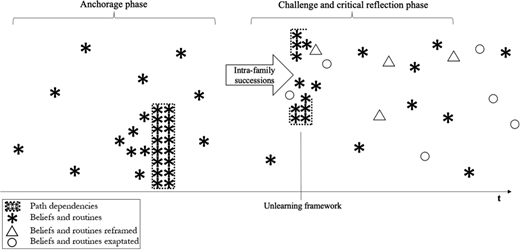
The graphical representation of the unlearning framework in Figure 1 depicts succession not as a simple, mechanical process of transferring ownership and management, but as a transformative socio-emotional process of unlearning in which (gendered) beliefs, routines and expectations are challenged, questioned and possibly reconfigured. Specifically, it distinguishes between two distinct yet interconnected phases: an anchoring phase and a challenging and critical reflection phase.
During the anchorage phase, (socially) established beliefs and routines, such as assumptions about the role of women in leadership or their supposed duties towards the family, become institutionalized through repetition. Over time, these practices, through positive feedback loops, solidify into actual path dependencies; this means that past decisions and traditions hinder not only present possibilities but also the ability to conceive new ones in the future (Sydow et al., 2009). In this phase, efficiency in terms of stability and continuity goes in pair with a certain rigidity and resistance to change. In fact, practices that once worked are constantly repeated, surrounded by an aura of effectiveness, without questioning their appropriateness to the context.
The persistence of a path dependent gender logic in the anchoring phase is strongly evidenced by our data. Daughters who are disregarded as potential successors (Interview 3), mothers who are negatively judged for working full-time (Interview 7) or shifts instead of devoting themselves to the home (Interview 4). These results exemplify how traditional gendered roles have been naturalized and turned into routines and beliefs in the organizations before succession. Furthermore, data show family specific and emotionally charged patterns of path dependency, e.g. the symbolic attachment to family assets (Interview 8), the trust placed in obsolete leadership models (Interview 6) or the natural inclination to prioritize tradition over creativity (Interview 1).
Intra-family succession typically triggers a challenge and critical reflection phase, two dynamics that happen simultaneously. Succession, by introducing new leaders with different leadership styles, as well as different gendered norms and expectations, generates friction and energy that can destabilize routines and beliefs never questioned before. Therefore, the dimension of challenge refers to the confrontation that arises between inherited practices (including gendered roles and norms) and novel expectations brought about by successors. Critical reflection is the process that follows such challenges, entailing questioning assumptions previously taken for granted, such as the naturalization of male leadership or the inevitability of female caregiving roles hindering female leadership. Therefore, critical reflection is not only a cognitive process involving a different way of thinking, but it also embodies an important emotional component, because family members must free themselves from the values of their legacy and their attachments. This resonates with the literature that sees unlearning practices as having little to do with removal, but rather with the ability to let go to evolve (Tsang and Zahra, 2008; Maccioni et al., 2024).
When emerging leaders engage in challenging the status quo and reflecting about its effectiveness, outdated beliefs and routines can evolve in three main ways (Maccioni et al., 2024): discarding, reframing or exaptation. If discarding applies, original practices are eliminated, following a substitution logic. This can only rarely happen at organizational level, as patterns are rooted in the business culture. However, the voluntary resignation of an employee because of incompatibility with new leaders (Interview 10) represents a form of discard that occurred in our sample. If reframing applies, original practices, while not substantially modified in form, are reinterpreted in light of new values and context. For example, leadership may remain collective but reframed in a way that strongly prioritizes collaboration rather than patriarchal authority (Interview 7). If exaptation applies, practices originally developed for one purpose are reused for another one. For example, the professional experience acquired by the heirs outside the organization, initially perceived as irrelevant or unrelated to the business, is exapted into new sources of legitimacy (Interview 8). The occurrence of reframing and exaptation in our sample suggest that unlearning does not always and only involve discarding, but more often deals with attributing new meaning and renewing existing patterns (Maccioni et al., 2024).
The above illustrated framework and its processes highlight that unlearning in SMTFFs is as much about gendered cultural scripts as it is about business strategies, making succession a site where deeply rooted assumptions about identity and authority are contested. At the same time, the metaphor “preserve the fire, don’t worship the ashes” (Interview 9) captures the possibility of renewal through reinterpretation, emphasizing that unlearning requires a balance between continuity and innovation.
With reference to the graphical representation of the model, it is important to emphasize that, despite the linear process at micro level shown in Figure 1, unlearning is conceived here as recursive and cyclical rather than linear: each succession exposes both the effect that the past has on the present and simultaneously generates an opportunity to reinterpret the present and shape change. Moreover, unlearning unfolds as an individually triggered but relational process, as the agency of successors is constantly shaped through cross-generational interactions.
The unlearning model developed in this study contributes to the growing body of literature on gender and leadership in family business succession by introducing organizational unlearning as a novel conceptual and analytical lens to interpret how gendered roles are reproduced, contested and redefined in SMTFFs. By situating unlearning at the intersection of gender studies, family business research and organizational change, it advances an understanding of succession not merely as a transfer of ownership or managerial responsibility, but as a key organizational and transformative process involving both cognitive, relational and emotional disentanglement from inherited norms and capable of activating both disruptive and generative dynamics to untangle knots and create spaces for experimentation and renewal.
Besides the unlearning framework, a second theoretical contribution of the work lies in the explicit connection between gender dynamics and intra-family succession processes in SMTFFs, highlighting how succession processes themselves become critical junctures for negotiating identity, legitimacy and continuity in the business.
5.2 Practical implications
The study provides several implications for family business owners, advisors and policymakers. Firstly, it underscores the importance of fostering reflective spaces during succession (such as mentoring, coaching and peer learning initiatives) that encourage successors and predecessors alike to critically question inherited routines, values and role expectations from an individual perspective. These could reduce emotional tension between continuity, unlearning dynamics and renewal, and support smoother transitions towards alternative and more inclusive forms of leadership. In addition, targeted training initiatives, interventions (see also Alvarado-Alvarez and Euwema, 2024) or mentoring programs could support planned successors in developing the competencies to navigate, emotionally and practically, the family-related challenges of unlearning. Secondly, it points to the need for structured interventions aimed at supporting successors, particularly women, in developing competencies to navigate the emotional and relational complexities of unlearning deeply embedded gender norms. In this sense, networking among SMMTFFs could create a support system to share new role models, to activate mentoring programmes and to foster mutual support among leaders. Thirdly, the findings suggest that external facilitators (consultants, educators or mediators) can play a valuable role also at a systemic level, in helping families balance continuity with renewal, creating an environment where challenging tradition is not perceived as disloyalty but as a legitimate act of organizational care. Finally, policymakers and sectoral associations in tourism and hospitality could draw from this research to design capacity building programs that integrate gender equality, leadership development and intergenerational knowledge transfer. By translating unlearning from an abstract concept into a set of actionable practices, SMTFFs cannot only ensure smoother successions but also cultivate leadership models that are more inclusive, collaborative and future oriented.
6. Conclusion and limitations
This exploratory study illustrates how intra-family successions can trigger moments of conscious disentanglement from outdated family and business-related norms in SMMTFFs. Besides illustrating and contextualizing the unlearning phases of anchorage, challenge and critical reflection (Maccioni, Ghiringhelli, 2024) to the SMMTFFs’ context, the study creates a novel link between unlearning theory and gender studies, providing new avenues to shape the path towards gender equality. Indeed, unlearned gender related norms often relate to stereotypically masculine traits, such as assertiveness and competitiveness, which can penalize those people who do not conform to them (Byrne et al., 2019). Furthermore, these norms may represent an unconscious aspirational model for some young female leaders, who are likely to experience a tension between the perception of dissonance and the pressure to inherit an established business culture. The legitimization of the process of unlearning these norms has the power to improve equal opportunities at business level, to free space for the agency and creativity of novel leaders, to support the development of different leadership styles and the activation of cascade effects on employees’ and middle managers’ behaviours. If this happens at a systemic level, unlearning can question established occupational segregation patterns and implicitly support unconventional roles for women in the industry.
6.1 Limitations
The study’s qualitative and exploratory nature, based on ten narrative interviews conducted across Austria, Germany and Italy, limits the empirical generalizability of the findings beyond the specific cultural and sectoral context examined. Although the sample enabled a nuanced exploration of gendered dynamics in Alpine SMTFFs, it may not fully capture the diversity of experiences found in larger or non-European family firms, nor the potential variations in industries beyond tourism and hospitality. Future studies could build upon these findings through longitudinal or comparative research designs, incorporating larger samples and mixed methods to further investigate how unlearning processes unfold over time and influence organizational outcomes such as innovation, resilience and intergenerational cohesion.
Acknowledgements
The authors would like to acknowledge the comments of the four anonymous reviewers and the support received from Valerie Nickel, PhD during the data collection phase and from Luisa Sophie Rueggeberg in the final proof-check.
Funding
This research received no external funding.