The purpose of this paper is to empirically evaluate the significant influence of four sustainability dimensions in predicting the residents’ satisfaction with the development of sustainable tourism in the emerging tourism industry of Pakistan.
1. Introduction
The last decades of the twentieth century witnessed a major focus on a wide range of environmental issues, including pollution and green-orientation, that helped people and countries think of a better and more sustainable world (Cottrell et al., 2013; Nair et al., 2015b). As a major mainstay of the economy, the tourism sector is exceptionally vital to achieving sustainable goals, thereby empowering sustainable tourism to priorities many organizations and countries (Trupp and Dolezal, 2020). Sustainable development refers to “meeting the needs of existing generations unless compromising the capability of upcoming generations to meet their demands” (WCED, 1987). In the 21st century, as human society is rapidly evolving, sustainability (including sustainable tourism) is revamping the political and economic agenda in the context of environmental development (Chang et al., 2020). The success and positive perception of sustainable tourism, a longed-for phenomenon, is under-researched in developing countries concerning counting its innumerable benefits for the local residents lying on or living near the tourists’ destinations. The local inhabitants perceive their future to be excelled with tourism, expecting more jobs, building service markets, government support and nourishing their rich and green environment through sustainable tourism. Reducing the costs of sustainable tourism and increasing the paybacks in the shape of environment up-gradation, economic and social development and local community satisfaction is the theme of sustainable tourism (Cottrell et al., 2013; Nair et al., 2015b). Consequently, many researchers investigated tourist and operators' satisfaction, but being in a global cry for go-green initiatives, research on this topic still attracts researchers and practitioners' attention (Rasoolimanesh et al., 2020), especially in developing country contexts. Pakistan is one of the best tourist countries, has tremendous opportunities for sustainable tourism growth. Conde Nast Traveler's US-based publication declared Pakistan the top attractive destination for travelers in 2020 (POOK 2020). In this regard, the Pakistan Tourism and Development Authority (PTDC) is keenly working to improve tourists’ destinations with eco-friendly drives and guidelines. This study will light the way policymakers, PTDC and researchers know the local community's fundamental issues toward tourism and unearthing the primary factors of their satisfaction. This research aims to assess the effect of sustainability dimensions on resident’s satisfaction with environmental awareness as a moderator in rural areas of Gilgit-Baltistan. The study adds not only to the tourism literature but also to sustainability-based studies that are a growing field of research and practice. Thus, the contributions of this research are twofold. First, conceptualizing and enhancing the understanding of sustainability dimensions' impact on the resident’s satisfaction. Second, investigating the moderating effect of environmental awareness on the relationships between sustainability constructs and residents’ satisfaction.
2. Literature review
2.1 Prism of sustainability and its indicators
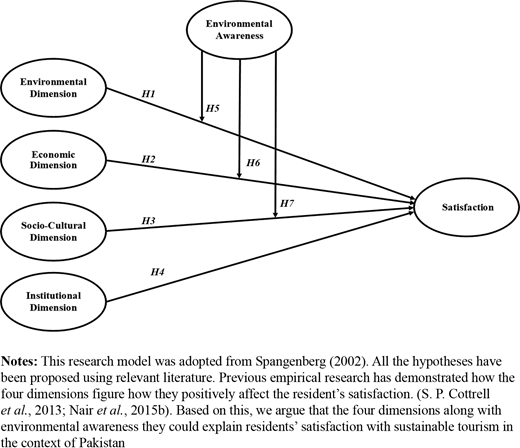
The sustainable tourism model consists of the following dimensions: economic, socio-cultural and environmental dimensions (Spangenberg, 2002). The ability to apply the three classical-dimensional of sustainable tourism is hard to achieve without the context of institutions to accomplish, market and assist growth (Edén et al., 2000; Spangenberg, 2002). Spangenberg (2002) theorized and incorporated dimensions of sustainable tourism development in a framework with clear links between these aspects. The demonstration and evaluation of sustainability and sustainable development should be based on established structures, such as sustainability prism. This framework is grounded on the definition of the Brundtland Report on Sustainable Development (Valentin and Spangenberg, 1999). To create more comprehensive models, the sustainability model has been developed in four interconnected dimensions:
environmental;
economic;
socio-culture; and
institutional (Figure 1).
Environmental sustainability indicates restrictions on natural capital and natural resources regarding both renewable and non-renewable resources. Economic sustainability encompasses human-made infrastructure, including many forms of support (for example, road and rail network and housing) and promoting human rights, occupation, and livings. Socio-cultural sustainability identifies human resources, such as consciousness, skill, information and attitude, and assimilate fundamental rights. Lastly, institutional sustainability refers to the social capital, having public, state-owned enterprises, physical interactions, participatory planning processes, collaboration/associations and power relations (Cottrell et al., 2013; Nair et al., 2015b). Figure 1, which provides the framework, has four dimensions that allow for the organization of sustainability indicators. It uses the three Ps, “people/profit/planet,” as a critical index but integrates an institutional aspect as a central dimension. The prism of sustainability allows the development of sustainability indicators and standards for residential planning and management (Cottrell and Cutumisu, 2006). Miller (2001) defines biophysical, social, managerial or other indicators as important factors to people in a particular situation. Miller and Twining-Ward (2005) nevertheless, standards quantify management Objectives and establish adequate standards of adequate effect variable limits. Many organizations have come up with indicators and benchmarks for the development of sustainable tourism. For example, The World Tourism Organization (WTO) has established eleven critical indicators for sustainable tourism, divided into four categories: ecological, social, economic and planning. These predictors lacked local focus and limited stakeholder involvement (Huayhuaca et al., 2010). Also, the UN Commission on Sustainable Development launched in 1995 a five-year program to develop sustainability indicators. The indicators proposed were global in scope and concentrated exclusively on the environmental aspect of sustainability (Cottrell et al., 2013). In addition to professional organizations, scholars have also developed sustainability indicators for specific areas. For example, Dymond (1997) has developed sustainability indicators for New Zealand. Twining-Ward and Butler (2002) have concentrated on Samoa, and Yuan, James. (Yuan et al., 2003) worked in Chongming country, Shanghai, China. To sum up, these researches on the development of sustainability benchmarking confirmed the development of distinct display indicators for individual communities connected by a single framework (Cottrell et al., 2013; Huayhuaca et al., 2010).
3. Hypotheses development
Some previously published studies have examined the effect of sustainability dimensions on residents’ satisfaction in developing sustainable tourism. Cottrell and Cutumisu (2006) examined these associations in Hoge Veluwe National Park in The Netherlands. They found that all sustainability dimensions are essential indicators of resident satisfaction. In another research carried out by Shen et al. (2009) on agri-tourism in the village of Chongdugou, China, three dimensions of sustainability were identified as substantial predictors of residents’ satisfaction. Huayhuaca et al. (2010) contextualized the model in Bulgaria in the Central Balkan National Park and confirmed that social and institutional dimensions greatly influenced locals' satisfaction. In the same line, Cottrell et al. (2013) also used the sustainability framework in the Perspective of the Frankenwald Nature Park, Germany, and found that the economic dimension was the most reliable indicator of residents' satisfaction. Additionally, it was accepted that all environmental initiatives should be integrated into the preparation and tracking of sustainable tourism growth. Finally, Nair et al. (2015b) also implemented a sustainability framework in India Jammu and Kashmir and investigated that all sustainability dimensions are the best predictor of residents' satisfaction. The present research extends sustainability models to evaluate sustainable tourism development in Gilgit-Baltistan. Previously published research such as (Nair et al., 2015). Spangenberg (2002) and Valentin and Valentin and Spangenberg (1999) advocate that all aspects of sustainable tourism can be generalized and affect residents' satisfaction with tourism in different ways. To explore the influence of sustainability dimensions on resident’s satisfaction, the following hypotheses have been formulated:
The four dimensions of the prism of sustainability (Environmental, Economic, Socio-Cultural and Institutional Dimensions) positively influence the residents with sustainable tourism development in Pakistan.
3.1 Moderating effect environmental awareness
Tourist environmental awareness (EA) can be described as a tourist perspective on the value of environmental preservation for a better quality of life. EA seeks to recognize the role of the ecosystem and the approach to environmental protection efforts (Hill et al., 2007; Utomo and Kusumawati, 2018). EA was recognized as hugely important by a significant number of researchers worldwide (Mobley et al., 2010). Research on tourism and environmental awareness has been undertaken. An environmental analysis by Gao and Bai (2014) disclosed that EA affects behavior intention. Cummings et al. (2017) reported that EA takes a critical view of environmental conservation for the better life of a person.
The level of environmental awareness of tourists differs (Cummings et al., 2017). Theoretical reasons that the environment's awareness will either improve or bolster the association between sustainability and satisfaction. Mihalic (2016) has clarified that tourism is significant to EA preserving tourism destinations for the future. More recently, Kusumawati assessed the moderating effects of environmental awareness between sustainability on WOM intention and behavior intention and found their curvilinear relationship. This can be explained by the fact that tourists know the environment will favor and choose respectful, well-preserved destinations. Tourists with a strong degree of environmental awareness would be responsive, care about and appreciate protecting the ecosystem and tourism attractions.
Conversely, low-level environmentally friendly visitors do not appreciate the protection of the environment, so they are less concerned. Moreover, even the careless tourists about the environment can bring a negative impression on the destination, and they feel that they only live for a while so inclined to think that there is no need to describe the behaviour of the environment (Mihalic, 2016; Nicholas and Thapa, 2010). Tourists visiting tourist destinations can experience tourism destinations' sustainability to respond to interests and needs. When tourists value sustainability well, and their response to environmental awareness is high, there is interest in residents’ satisfaction. Based on the above mentioned information, EA of tourism can influence sustainability through its realistic/logical connection between environmental awareness and sustainable dimensions. Thus, it provides a solid basis for the influential role of environmental awareness and must be studied separately to understand the moderate role it plays in sustainable tourism. Thus, the current study posits that:
Environmental awareness positively moderates the relationship between the sustainability dimensions and residents' satisfaction.
4. Methodology
4.1 Data collection and method
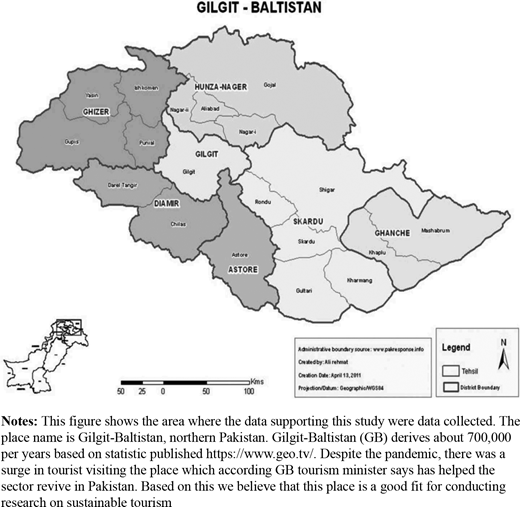
The research was mainly conducted in northern Pakistan (Gilgit-Baltistan), famous for its tourism and traveling (Figure 2). Gilgit-Baltistan, Pakistan's most exciting and beautiful region. The Himalayas, Karakorum, Hindukush and Pamirs cross here in four famous mountain regions. Gilgit-Baltistan as a paradise on earth has gained renewed interest for alpine, adventurous, hiking, exploring and fishing people from the most famous ‘Trout Fish’ (www.tourism.gov.pk/northern_areas.html). The survey included the 8 Gilgit-Baltistan districts (GB). The data was collected by a purposeful survey concerning the study. The survey was carried out at various periods of the day and over three months by distributing questionnaires to locals. The aim of the study was clarified to respondents before the questionnaires were distributed. Four researchers were also recruited to help with the data collection, and overall, 500 questionnaires were distributed containing 32 items among the participants and asked them to rate their responses. A total of 354 completed questionnaires was received and used for further analysis. This study explores how residents perceive tourism development in all identified places within the framework of sustainability.
Table 1 presents the demographic profile of residents. As shown in Table 1, males (59.88%) are greater than females (40.12%). Most of the respondents fell within the 24–29 years age group (31.7%). One-half of the sample has a high school degree (27.3%). In terms of income, 36.7% of respondents’ monthly income is less than 14,000 PKR, 46.7% of the respondents’ household income is between 15,000 and 27,000 PKR and the remaining 16.6% respondents’ monthly income is over 28,000 PKR (Table 1).
4.2 Research instrument
The survey was adopted from previously published studies developed for resident satisfaction from tourism. Drawing from the prior research (S. Cottrell et al., 2004; Cottrell et al., 2013; Sirakaya et al., 2001; Yuxi and Linsheng, 2017), 22 items (environmental, economic, institutional, socio-cultural dimensions) was used to quantify the various dimensions of sustainability (see Appendix). The environmental awareness was measured using five questions, and the resident’s satisfaction was measured with five items. All these 32 items were tested on a scale of seven-point Likert scale.
5. Results and analysis
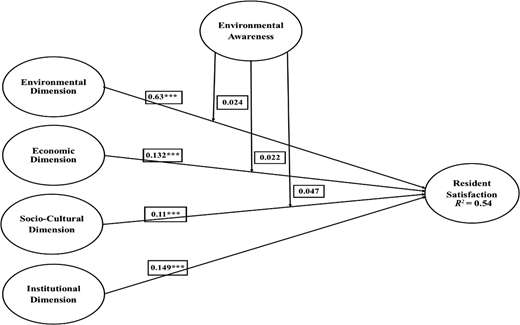
The PLS-SEM was utilized to evaluate and validate the construct and assess the hypothesized model. PLS-SEM is an integrated modeling technique that enables researchers to determine the relationships among variables and the reliability and validity of any research framework (Hair et al., 1998b). In the context of tourism literature, PLS-SEM has gained considerable research interest (Wu and Lai, 2021). Furthermore, PLS-SEM is a powerful technique that can anticipate a complex model without the need for distribution assumptions (Hair et al., 2014). Given the advantages of PLS, the current study investigated the variables impact of sustainability dimensions on residents’ satisfaction with sustainable tourism development employing PLS; these variables are deemed appropriate to assess the association in any structure model, particularly in the IS setting. We utilized the Smart-PLS 3 software in this research (Figure 3).
5.1 Common method bias
Although the questionnaire has been assembled using a self-reporting technique, common method bias may become a conundrum to the findings' validity. The present study uses the Harman single factor test (Podsakoff et al., 2003). Statistically, if a single factor represents 40% or more, it might be common method bias (CMB) in the data set. In the present research, all the elements have been loaded and fixed on factor 1; the total number of explained variances results lower than 40%, 35.78%. Therefore, it is concluded that the current data are free of CMB and do not present any uncertainty on the empirical results.
5.2 Measurement model
Saunders et al. (2009) described validity as ‘the degree to which methods of collecting data correctly determine what was to be measured.’ The proposed model has been evaluated employing CFA (Hair et al., 1998a). We measured the proposed model in terms of composite validity, average variance extracted and Cronbach's alpha. The PLS algorithm was performed to estimate the outer loads for each of the constructs. Table 2 highlights the results of composite validity, and Cronbach's alpha constructs' loadings has crossed the recommended threshold 0.7 (Nunnally and Bernstein, 1978b), and the AVE variance outperformed the 0.5 thresholds (Hair et al., 2016, 2014). CFA results disclose that each item loading factor is more significant than 0.7. As shown in Table 2, CFA results meet the cut off value of CA, CR and AVE, which were more than 0.7, 0.7 and 0.5, correspondingly, indicating good convergent validity (Fornell and Larcker, 1981; Hair et al., 1998a, 1998b; Nunnally and Bernstein, 1978a).
Finally, the discriminant validity (DV) was established to determine whether the variable's measures differed from other variables. Following Gefen and Straub (2005), we have used two approaches to evaluate the discriminant's validity. As Fornell and Larcker (1981) indorsed, we calculated DV by associating the relationship amongst variables and AVE of all the constructs. Table 3 validates that the AVE square root for all constructs is overhead the correlation values and shows adequate validity. Second, we analyzed the items loading and cross-loading. The study found that the item's loading value was more significant than the cross-loading of other variables that displayed positive discriminant validity. The discriminant validity was considered to be acceptable for all constructs. Besides, to evaluate discriminant validity, the Heterotrait–Monotrait Ratio of Correlations (HTMT) was used (Henseler et al., 2015). Thus, the result of HTMT in Table 3 simplifies the sufficient DV.
5.3 Structural model assessment
Smart-PLS. Three was engaged in calculating the path coefficient of the research model (Henseler et al., 2009). We evaluated the structural model to measure the relationship between latent variables seen in Figure 2. The direct and indirect effects on the independent construct have been studied and offer practitioners potential outcomes, apropos and relationships between variables. The results are obtainable in Table 4. To estimate the significance level (Ringle et al., 2015), we performed the bootstrap method with the resampling of 2,000 times, which gives the most desired results with zero change (Hair et al., 2016). All hypotheses were tested, and significant findings are revealed. The result in Table 5 presenting that END positively influences the resident’s satisfaction (Β = 0.63, p < 0.001), ECD → resident satisfaction (β = 0.132, p < 0.001), SCD → resident satisfaction (β = 0.11, p < 0.001), ID → resident satisfaction (β = 0.149, p < 0.001). These results indicate that H1, H3 and H4 hold for positively influences the resident satisfaction, demonstrating that all sustainability dimensions positively influence residents’ satisfaction. The model explains 0.54% of the intention of resident satisfaction with tourism. Regarding the model validity, Chin et al. (2008) categorize the dependent variables as considerable, moderate or poor depending on an R square of 0.67, 0.33 or 0.19. Consequently, resident’s satisfaction (R2= 0.54) can be considered moderate.
Having obtained a satisfactory measurement model, we took the next analytical step of testing the moderating effect of environmental awareness on sustainability dimensions, e.g. (environmental, economic and cultural), on the residents' satisfaction. The results indicate that the interaction terms (environmental dimension × EA) (β = 0.024, p < 0.05), (economic dimension × EA) (β = 0.022, p < 0.05), (cultural dimension × EA) (β = 0.047, p < 0.05) find the positive impact on residents’ satisfaction intention so the results confirm H5, H6 and H7 is accepted. The results designate that EA significantly moderate the impact of environmental, cultural and economic dimensions on resident’s satisfaction intention.
6. Discussion
Sustainability and sustainable development of tourism are being more important for all investors on a daily basis (i.e. business, tourists and host societies) for the tourist industry's expansion (Nair et al., 2015a). This research investigates the measurement models for all dimensions of sustainability on residents' satisfaction with the moderating effect of environmental awareness). While many previous studies have directed on the tourism business and customer satisfaction, a small number of scholars have an emphasis on the satisfaction of local communities in sustainable tourism development (Cottrell et al., 2013; Nair et al., 2015a). Given the importance of local community satisfaction in assessing sustainable tourism development, the present study investigated the impact of a sustainable dimension on foreseeing residents’ satisfaction with sustainable tourism development. The survey was conducted in Gilgit-Baltistan, and data were collected from 354 local participants. The results established that the measurement model for the sustainability dimension and residents’ satisfaction. Besides, the findings also showed that the whole dimension of sustainability predicted residents’ satisfaction significantly.
In line with previous results, this study highlights the critical and decisive role of the prism of sustainability on the satisfaction of residents. In the proposed model, environmental, economic, institutional and socio-cultural dimensions act as antecedents of residents toward satisfaction. Also, environmental awareness significantly moderator between the relationship between environmental, economic, cultural and resident satisfaction. In this respect, as would be expected with a hypothesis related to the direct impact of environmental, economic, cultural and institutional dimensions, the results show that the direct relationship between environmental, economic, cultural, institutional and residents’ satisfaction is significant. The study findings are also with the line of previous research of Cottrell et al. (2013), Huayhuaca et al. (2010) and Nair et al. (2015a) and support the prism of sustainability as a framework for assessing and investigating the sustainable tourism development (Valentin and Spangenberg, 1999). The study conducted in Gilgit-Baltistan, Pakistan, showed that all dimensions of sustainability were essential predictors.
In contrast, previous studies showed only two or three. Also, the importance of each dimension varied across studies. The present research results advocate for using all aspects of prospective research conducted via the prism of sustainability. The secret to the sustainable growth of tourism in natural regions is resident satisfaction. As a result, classification and sampling following criteria and factors are critical for community satisfaction. The prism of sustainability is introduced in this perspective; it is a valuable management mechanism that offers a comprehensive basis for enhancing sustainability through the use of related metrics and criteria. The study's findings indicate that indicators and metrics for sustainable tourism destinations should be developed, reflecting the dimensions of sustainability. This is the least often used approach to initiating, evaluating, and tracking sustainable development. In addition, the local community of Gilgit-Baltistan, Pakistan, has a positive awareness of tourism development, which stands to benefit the whole society significantly.
6.1 Conclusion and implication
Overall, the research demonstrates unequivocally that people have mixed feelings about the impact of sustainable tourism on their communities. Regarding the moderating effect of environmental awareness, the study results indicate that caring tourists about the environment can positively affect the destination and feel that they have only lived for a while, so prone they think there is no need to describe the environment's behavior. Correspondingly, it is observed that environmental awareness about tourism positively moderate the relationship.
The study's findings are from comparatively less explored developing tourism sites in Pakistan, which offers numerous theoretical and practical implications. The fact that residents have both a favorable and adverse attitude toward tourism demonstrates the critical nature of sustainability. The area residents are aware of the benefits of tourism and can measure and confirm their satisfaction in general. Considering the findings of previous studies and their nature, it can be established that the four dimensions of sustainability have a significant impact on resident's satisfaction with tourism compared to other less studied areas (Nair et al., 2015a; Utomo and Kusumawati, 2018). Furthermore, the effect on the people of the multiple dimensions of tourism differs according to the circumstance. The results of this study offer management implications and practical policy. Consistent with earlier research work results that indicate the impacts of residents' perceptions of the various dimensions of sustainable tourism have different strengths on their satisfaction (Ngowi and Jani, 2018). This is important for policymakers and the tourism planner to identify sustainable tourism dimensions that residents identify in their tourism plans and strategies. Also, tourism's effect on residents' satisfaction with tourism must be examined, and policies must be implemented to increase residents' satisfaction and tourism support.
6.2 Opportunities for further research
Regardless of the study's significance, the current study is not free of shortcomings and drawbacks. Although this study's results have highlighted many important issues, future work limitations need to be considered. The current research was limited to Gilgit-Baltistan due to time and financial constraints, and only a questionnaire has been used to gather data. It can be spread via social media, emails; the findings will be more stringent if the study is conducted with a large sample. An important suggestion is that future studies could also explore the associations proposed in this study with other sustainable and protected tourist areas in Pakistan and other developing countries with the same conditions. Continuing with all the four dimensions using the prism of sustainability, it might be interesting to assess why the four predictors' impact on population satisfaction varies across countries. One significant point is whether these inconsistencies are the proper technique (for example, the reversion into various dialects of the research units) or the distinctive sense of the four dimensions, dependent on their specific characteristics of all cultures. This transition trend may allow tourism planners in various countries to determine sustainability dimensions in their unique circumstances. Finally, the present study could be extended to other developing as well as underdeveloped countries.
Some recommendations for government and other stakeholders: sustainability dimensions have a significant impact on residents’ satisfaction. Derived from the research findings, as Gilgit-Baltistan is exceptional in terms of protecting natural scenery, nature and economic benefits, tourism managers can leverage sustainable tourism as an advantage in marketing strategies.