Skip to article sections
Purpose

Ecotourism in Bali is undergoing a transition to digital and sustainable practices, but sustainability implementation remains constrained by uneven access to resources and capabilities. This study aims to examine the relationship between knowledge sharing, digital adoption, green innovation and sustainable financial performance in the ecotourism sector.

Design/methodology/approach

A quantitative approach was used using structural equation modeling (SEM) with data collected from 200 respondents, including managers, employees and tourists involved in ecotourism activities in Bali. The effect of mediation was assessed using the Sobel test procedure.

Findings

Results show that knowledge sharing and digital adoption have a significant positive effect on green innovation and sustainable financial performance. But digital adoption and government policies have not shown a significant influence on financial performance. Green innovation shows an inability to mediate, while the moderation effect of government policies is not supported.

Research limitations/implications

This study is limited by its cross-sectional design and reliance on self-reported data, which may introduce common method bias. The focus on ecotourism small and medium enterprises (SMEs) in Bali may also limit generalizability to other sectors or regions. Future research should adopt longitudinal approaches, incorporate objective performance measures and explore different geographical contexts. The findings imply that knowledge sharing and digital adoption can directly enhance financial performance, while green innovation may require longer time horizons. Practically, managers should integrate knowledge management, digital strategies and sustainability initiatives to maximize long-term value creation in ecotourism.

Practical implications

The findings suggest that ecotourism managers should prioritize knowledge sharing and digital adoption to enhance financial performance and operational efficiency. Developing digital platforms, such as online booking systems and data-driven marketing tools, can improve market reach and service quality. Managers should also foster collaborative knowledge-sharing cultures involving local communities to strengthen innovation capacity. Although green innovation does not show immediate financial impact, it should be strategically integrated as a long-term investment. Policymakers should provide more practical support, including training, incentives and infrastructure, to bridge the gap between policy design and implementation in ecotourism SMEs.

Social implications

This study highlights the importance of collaborative knowledge sharing in strengthening social cohesion among stakeholders in ecotourism, including local communities, businesses and government institutions. By integrating local wisdom such as Tri Hita Karana, ecotourism development can promote balanced relationships between humans, nature and culture. Digital adoption further enhances inclusivity by enabling wider participation and access to information. Although green innovation shows limited immediate financial impact, it contributes to long-term environmental sustainability and community well-being. Therefore, fostering socially embedded innovation practices is essential for achieving inclusive and sustainable tourism development.

Originality/value

This study provides empirical evidence on the important role of digital knowledge networks in supporting ecotourism transformation. It highlights the importance of a collaborative approach between governments, businesses and local communities to accelerate sustainable development in the context of ecotourism.

Ecotourism destinations benefit from the protection of natural resources, which increases competitiveness in the tourism business. This symbiotic relationship suggests that conservation efforts can drive the economic benefits associated with ecotourism (Boley and Green, 2016). Ecotourism has been shown to produce positive economic impacts, such as increased local incomes and job opportunities. For example, the eco-friendly Punta Islita lodging in Costa Rica contributes significantly to local economic income and environmental conservation (Almeyda et al., 2010). In community-based ecotourism, such as home-stay arrangements, ecotourism can provide additional income for poor rural communities, perhaps involving tradeoffs between livelihoods and conservation (Sarkar and Sinha, 2015). Ecotourism is often a tradeoff, especially when driven by economic pressures rather than genuine conservation efforts (Ma et al., 2019). Ecotourism can reduce poverty; ecotourism can also increase income inequality in local communities, especially those living in nature reserves (Gomez-Chambi et al., 2026; Jackson et al., 2015). Companies with good financial performance are better able to allocate resources to support environmental initiatives. Investments in such initiatives should not divert resources away from core functions, as this can affect the overall survival of the company (Dayour et al., 2024).

Public-private partnerships are essential to catalyze positive sustainability outcomes in ecotourism projects. The success of ecotourism depends on effective governance, stakeholder collaboration and the implementation of green infrastructure (Puspa et al., 2026). Community-led ecotourism and stakeholder engagement for long-term sustainability (Angessa, 2025; Snyman, 2017). Effective ecotourism governance requires collaboration among stakeholders, including local communities, private sector operators and government entities. This collaboration is critical to ensuring the long-term sustainability of ecotourism initiatives (Dayour et al., 2024; Samal and Dash, 2024). Ecotourism can produce a variety of sustainable outcomes, such as biodiversity conservation, improved water quality and preservation of cultural heritage. These benefits are often manifested through increased incentives that ecotourism brings to the conservation of natural resources and humans (Ma et al., 2019; Yan et al., 2025).

Knowledge sharing is essential to improve the performance of ecotourism. It involves disseminating information related to ecotourism practices among employees and stakeholders, which can lead to increased tourism attractiveness and digital management systems (Martínez-Falcó et al., 2025; Mekhum and Torasa, 2020). Findings (Hawkins et al., 2012; Zhu et al., 2026) said that the priority of knowledge sharing The use of professional virtual communities to share knowledge can contribute significantly to the development of global sustainable tourism. These communities use information communication technology (ICT) to identify tourism priorities and share knowledge effectively (Ditta-Apichai and Gretzel, 2026; Polukhina et al., 2025; Setini et al., 2020, 2021). The adoption of digital technologies, such as big data, mobile apps and e-commerce, can improve the efficiency and sustainability of tourism services. These tools help improve service quality, reduce environmental impact and predict consumer preferences, thereby supporting sustainable development in local destinations (Hossain et al., 2023; ul Haq et al., 2025). The emergence of digital entrepreneurship in ecotourism, driven by technological advancements and the demand for economically valuable travel experiences, highlights the sector’s shift toward innovative business models (Hossain et al., 2023). Social media and digital platforms play an important role in promoting ecotourism. The existence of social media can make it easier to share knowledge, increase tourist engagement and support the marketing of sustainable practices (Kansra et al., 2024).

Digital management systems mediate the relationship between knowledge sharing and ecotourism performance, suggesting that effective digital management can lead to better financial outcomes for ecotourism providers (Kuo et al., 2026; Mekhum and Torasa, 2020). The use of green marketing practices and engagement with digital influencers can increase the patronage intention of tourists, thereby contributing to sustainable financial performance. Cooperative green activity programs and tourists’ trust in social media influencers are important factors in this process (Nguyen et al., 2025). Ecotourism policies, green innovation and strategic use of social media are direct antecedents to sustainable ecotourism development. These elements help in achieving financial sustainability by promoting environmentally friendly practices and engaging local communities (Kansra et al., 2024).

Sustainable ecotourism is already a major focus of building tourism in the global but the challenge of reach in financial sustainability is still an academic debate. Recent studies show that knowledge sharing can increase destination attractiveness by up to 37%, along with sustainability. However, evidence regarding long-term financial sustainability remains inconclusive (Kansra et al., 2024; Chang et al., 2026). This phenomenon indicates an empirical gap in understanding the mechanisms through which knowledge is transformed into sustainable financial performance. On the one hand, research reveals that digital strategies can increase the short revenue compass by up to 42%, but on the other hand, there is a risk of erosion of authentic cultural values when dependence on digital platforms becomes excessive (Liu and Chamaratana, 2024). The Icelandic case shows that digital tourism apps can increase customer retention by up to 29%. From traditional methods (Falter et al., 2024), but there is no strong evidence of the impact on financial sustainability beyond three years. The government policy aspect also shows the implementation of a significant gap. The Transparent Governance framework system has been proven to increase financial benefits for local communities by 23% (Pasape et al., 2015), but the majority of study locations (89%) experience significant inconsistencies in policy enforcement. Public-private partnerships actually increase public-private partnerships actually increase dividend revenues by up to 31%, but most deals (67%) do not include a sustainability clause (Putri et al., 2024). These findings reinforce the argument that only 12% of ecotourism policies explicitly link community engagement to measurable financial outcomes (Hussain et al., 2025). A holistic approach that combines multiple strategies shows great potential, with increased financial resilience (Robba et al., 2026). But the implementation of high costs and tradeoffs in 39% of cases becomes a serious obstacle (Baloch et al., 2023). Regional variation is also significant, where Southeast Asia shows a 32% better performance of financial sustainability metrics than African regions (Dayour et al., 2024), indicating an important contextualization strategy. Based on these findings, the researchers emphasized the need for a longitudinal research design that tracks financial outcomes for at least five years (Partarakis et al., 2025). A multidisciplinary approach is estimated to capture 92% of variables that were overlooked in current research (Dhakal and Tjokro, 2024), while a policy experiment with a random control test can resolve 68% of existing empirical ambiguities. This narrative underscores the complexity of the challenge and the urgency for a more integrated approach in sustainable ecotourism research.

Knowledge sharing is recognized as beneficial; its direct impact on ecotourism performance, especially in terms of financial sustainability, is not fully understood. Studies show positive effects on tourism performance and attractiveness (Zhang and Kim, 2026), but the mechanisms and long-term impacts need to be explored further. Lack of comprehensive guidelines on best practices for knowledge sharing among ecotourism stakeholders, including local communities, businesses and governments (Hassan et al., 2026). While Adoption digital is well-known for its potential to boost ecotourism by connecting with travelers and promoting destinations (Kuo et al., 2026). Said by Samal and Dash (2024), its long-term effectiveness and how it can be optimized for financial sustainability. The balance between digital adoption and traditional ecotourism practices remains unclear (Kuo et al., 2026). The role of digital tools in improving the visitor experience while maintaining ecological integrity needs to be investigated further (Liu and Chamaratana, 2024; Islam and Widen, 2023).

There is a significant gap in understanding how different policy frameworks impact the sustainability and financial performance of ecotourism. This study highlights the importance of transparent and accountable governance (Pasape et al., 2015; Ragazou et al., 2026), but the specific policies that are most effective in supporting sustainable financial outcomes are not well documented. The role of government policies in encouraging community engagement and ensuring that local communities benefit financially from ecotourism has not been fully explored (Almas et al., 2026). There is a need for research on integrated strategies that combine knowledge sharing, digital adoption and government policies. The interaction between these elements and their collective impact on sustainable financial performance is not well understood (Lee et al., 2013). The objectives of this research are, first, to integrate digital adoption and knowledge sharing in the context of ecotourism small and medium enterprises (SMEs), addressing gaps in sustainability-oriented digital transformation research. Second, it expands the acceptance of technology and knowledge management (KM) perspectives by linking it to green innovation and sustainable financial performance. Third, it provides empirical evidence from the context of emerging economies, highlighting how digital technologies and knowledge-sharing mechanisms support sustainability outcomes in ecotourism.

The study is based on a variety of theoretical perspectives, including the Resource-Based View (RBV), the Life Cycle of Tourism Areas (TALC) and technology acceptance theories such as the Integrated Technology Acceptance and Use Theory (UTAUT-2). RBV and Butler Tourism Area Life Cycle (TALC) remain the main theoretical anchors, but additional perspectives and criticisms are combined to strengthen the conceptual foundation. In addition to the RBV, this research is also based on technology acceptance theory, especially the Technology Acceptance Model (TAM) and the Unified Theory of Acceptance and Use of Technology (UTAUT-2). This framework describes how individuals and organizations adopt and use digital technologies based on key determinants such as performance expectations, business expectations, facilitation conditions and habits. Integrating these models provides a stronger theoretical basis for understanding digital adoption in the context of ecotourism and knowledge-based systems.

These theories are applied to understand the drivers of environmental performance in Bali’s tourism industry. In particular, green transformational leadership and green HR practices are identified as key factors driving green environmental innovation, which in turn improves environmental performance (Salam et al., 2024). RBV argues that companies can achieve a sustainable competitive advantage by having valuable, scarce, unrivaled and non-replaceable (Barney, 1991). In the context of digital tourism, adding that the capabilities of digital platforms, big analysis data and Internet of Things (IoT) systems are now a dynamic and continuous strategic resource become reconfigured (Clulow et al., 2003; Fatma and Bhatt, 2026). This theory also highlights the role of capability, which is the ability of companies to use resources effectively (Abbas, 2026; Clulow et al., 2003). RBV theory is widely accepted, empirical support varies and scholars suggest focusing on the expansion of contemporary theories rather than the original model (Kosiol et al., 2023; Newbert, 2007). Recent developments in RBV combine dynamic and relational perspectives, recognizing that resources are constantly being shaped and reshaped in networks of relationships and organizational processes (Dhrubo et al., 2024; Redaputri et al., 2026). RBV has been applied in a variety of contexts, including construction project management, healthcare and financial services, demonstrating its versatility and relevance across a wide range of industries (Ferlie et al., 2015; Kosiol et al., 2023; Mansour et al., 2022).

Type The Tourism Area Life Cycle (TALC) is used to assess the impact of tourism on land use and cultural conflicts in Bali (Rosilawati and Ariyati, 2021). It is said in Rosilawati and Ariyati (2021), demonstrating that the integration of smart tourism elements such as tourist density sensors and cloud-based reservation systems allows for real-time evaluation of each phase of the TALC, enriching traditional analytics with a digital dimension. It outlines six stages of a tourism destination: exploration, engagement, development, consolidation, stagnation and decline or rejuvenation (Costa et al., 2026). This model helps in understanding the phases that have been passed on tourism Bali and the challenges it faces today, such as density and environmental degradation (Rosilawati and Ariyati, 2021).

According to Fennell (2012), sustainable ecotourism must maintain a balance between ecological, socio-cultural and economic dimensions, but there is often a tradeoff between short-term benefits and long-term conservation. Meanwhile, Lee et al. (2013), emphasizing the existence of a spectrum between strict conservation-based hard ecotourism and more mass and commercial soft ecotourism. The integration of these two perspectives enriches the RBV and TALC frameworks: RBV helps to see digitalization and green innovation as strategic resources, while TALC explains the dynamics of the destination cycle. By combining the hard-soft ecotourism spectrum, policy strategies, green innovations and digital adoption can be directed to strengthen hard forms of ecotourism that are more aligned with local values such as Tri Hita Karana (THK) so that Bali tourism is not only profit-oriented but also based on long-term sustainability (Ardiana et al., 2026).

The TALC model explains the dynamics of destinations from the exploration stage to possible stagnation or decline, as seen in the case of overtourism, which can lead to environmental degradation and a decrease in the quality of the tourist experience (Albaladejo and Martínez-García, 2015; Irwana Omar et al., 2014). Although useful for understanding development patterns, TALC is often criticized for its linear nature and lack of flexibility in accommodating external factors such as technological changes or government policies (Gretzel, 2025). The integration of TALC with sustainable tourism principles requires adaptive strategies, for example, through green innovation, product diversification and the use of digital technology to manage tourist flows (Han and de Vries, 2026). Thus, this theory not only predicts the cycle of goals but also serves as a framework for designing interventions that prevent decline and encourage sustainability-based rejuvenation.

The THK philosophy put forward by Dhakal and Tjokro emphasizes the importance of harmony between humans, nature and God as the main foundation of life (Dhakal and Tjokro, 2024). This concept was later developed by Tasa et al. (2024), in the context of smart city infrastructure in Bali, where the application of technology such as water quality sensors and open data platforms plays a role in strengthening environmental harmony through technology-based monitoring. THK itself consists of three main aspects that are interrelated, namely spiritual harmony (Parahyangan), social harmony (Pawongan) and environmental harmony (Palemahan). This approach is not only religious but also has implications for spiritual accountability in the financial governance and reporting practices of organizations (Tasa et al., 2024). Furthermore, social harmony prioritizes the importance of cooperation, friendship and collective decision-making that can strengthen social cohesion (Brownell et al., 2025; Wondirad et al., 2020). Finally, environmental harmony invites the management of natural resources and the application of sustainable practices that are in harmony with traditional values (Holden, 2005; Maryani and Indrianty, 2024). Traditional agricultural systems such as Subak are concrete examples of democratic and sustainable water resource management as an integral part of environmental harmony (Rosilawati and Ariyati, 2021). In addition, this aspect is also the basis for land consolidation and environmental conservation efforts that not only maintain the sustainability of the ecosystem but also preserve the cultural heritage inherent in the Balinese people (Pai et al., 2026).

Digital transformation in the tourism sector is based on well-established technology acceptance theory, specifically the TAM and the Integrated Technology Acceptance and Use Theory (UTAUT). This framework describes how individuals and organizations adopt and use digital technologies based on determinants such as performance expectations, business expectations, social influence and facilitation conditions. UTAUT-2 further expands this construct by incorporating additional factors such as motivation and hedonic habits, which influence the use of sustainable technology (Alkhwaldi, 2025; Alkhwaldi et al., 2024).

From an organizational perspective, digital adoption goes beyond individual acceptance and reflects the extent to which digital technologies are embedded in business processes and strategic activities (Yan et al., 2025). The adoption of organizational technology emphasizes the implementation, routinization and integration of digital tools to improve operational efficiency, knowledge sharing and innovation. In this context, digital capabilities can be seen as a strategic resource in the RBV, enabling companies to achieve competitive advantage and sustainable performance (Abdulmuhsin et al., 2026).

In this study, digital adoption is defined as the extent to which ecotourism SMEs actively use and integrate digital technologies such as online platforms, mobile applications, reservation systems and data analysis into their operational and strategic business processes. In contrast to traditional technology acceptance studies that focus on behavioral intent, this study conceptualizes digital adoption as actual usage behavior, which reflects the real implementation of digital technology in organizational activities (Alkhwaldi, 2025; Cheng et al., 2025). This study (Zaheer et al., 2024) refers to UTAUT-2 to explain digital adoption behavior. Key determinants such as performance expectations, business expectations, facilitation conditions and habits influence the extent to which digital technology is used. Instead of modeling these constructs individually, this study conceptualized digital adoption as a high-level construct that captures the outcomes of these factors in the form of actual usage behaviors (Abdulmuhsin et al., 2025).

In particular, performance expectations are reflected in the perceived benefits of digital technology in improving operational efficiency and customer engagement. Effort expectations are captured through the ease of use of digital platforms such as ordering systems and mobile applications (Zaheer et al., 2024). The facilitation condition refers to the availability of digital infrastructure and organizational support, while the habit reflects the routine use of digital technology in daily business operations (Alkhwaldi, 2025). By integrating these dimensions into a single construct, the study captures the overall level of digital integration in ecotourism organizations.

The use of high-level digital adoption construction is particularly relevant in the context of ecotourism SMEs, where technology decisions are not only driven by individual perceptions but are also influenced by resource constraints, managerial capabilities and environmental conditions (Pushpakumara et al., 2026). Many ecotourism SMEs operate with limited financial resources, inadequate digital infrastructure and low levels of technological capability (Walewangko et al., 2026). In addition, some operators consider digital technologies to be potentially misaligned with ecological values and traditional practices (Ghobakhloo et al., 2026).

Despite these challenges, digital technologies also provide significant opportunities for sustainable tourism development. Tools such as IoT sensors enable environmental monitoring and resource management, while digital platforms and virtual reality technologies increase visitor engagement and support sustainable destination promotion. When applied responsibly, this technology can be aligned with local wisdom values such as THK, for example, through a community-based environmental monitoring system (Sriariani et al., 2026).

From a theoretical perspective, digital adoption plays a crucial role in enabling green innovation. Digital technology facilitates real-time data collection, improves resource efficiency and supports the development of environmentally friendly products and services. This is in line with recent studies that emphasize the role of digital technology in the integration of knowledge and innovation processes across organizations (Abdulmuhsin et al., 2026). So that digital adoption capable improves the company’s ability to generate and implement green innovations, especially in resource-constrained ecotourism SMEs.

In addition to the perspective of technology acceptance, digital transformation in tourism has also been examined through complementary frameworks such as the Digital Maturity Model (DMM) and the Smart Tourism Ecosystem (STE), which emphasize organizational readiness, technology integration and data-driven tourism experiences (Diaz et al., 2026). In this study, only special focus on digital adoption from the perspective of technology acceptance (UTAUT-2), which emphasizes actual usage behavior and organizational integration in ecotourism SMEs.

Knowledge sharing is an essential component of KM that enables organizations to improve innovation and performance. In the context of ecotourism, knowledge sharing cannot be seen solely as an internal organizational process but must be understood in a broader network involving local communities, tourism businesses and government agencies (Hasanein and Al-Romeedy, 2026). In such a setting, knowledge flows across organizational boundaries and innovation depends on the company’s ability to absorb and apply external knowledge (Sumiati et al., 2024).

From KM’s perspective, knowledge can be categorized into explicit and tacit forms. Explicit knowledge, such as environmental guidelines, operational procedures and best practices, can be codified and disseminated through digital platforms and information systems (Ghazwani and Alzahrani, 2024; Ola-Oluwa, 2024). On the other hand, silent knowledge such as local wisdom, cultural practices and sustainability values rooted in THK are embedded in experience and require social interaction and experiential learning for effective transfer (Liestiandre et al., 2024). In line with the RBV, knowledge is considered a strategic asset that can provide a sustainable competitive advantage (Hermawan et al., 2024). Human resources that have a strong sense of ownership of local knowledge and values can be a valuable, scarce and unparalleled resource for tourism SMEs (Maziliauske, 2024). This perspective is further supported by recent research showing that psychological ownership and knowledge sharing play an important role in enhancing innovation capabilities and maintaining a competitive advantage (Khurana et al., 2025).

Digital technologies and Knowledge Management Systems (KMS) play a crucial role in facilitating explicit and discreet knowledge sharing. Online platforms, databases and digital communication tools enable the codified dissemination of knowledge, while social networks and collaborative platforms support the quiet exchange of knowledge through shared interactions and experiences. The latest study also highlights that new technologies such as AI, blockchain and metaverse platforms are improving the creation process innovation, integration and knowledge sharing across the organization (Abdulmuhsin et al., 2026).

From a theoretical perspective, the relationship between knowledge sharing and green innovation can be explained through knowledge-based views and dynamic capability theory (Ma et al., 2025). Knowledge sharing facilitates the transfer of environmental practices, sustainable techniques and innovative ideas across the organization (Martinez-Falco et al., 2024). Positive impact, the company is better prepared to develop environmentally friendly products, improve environmental performance and achieve a sustainable competitive advantage.

From a KM perspective, knowledge sharing plays a crucial role in improving organizational performance by facilitating explicit and discreet exchange of knowledge (Qiao and Wang, 2021). Through effective knowledge sharing, organizations can improve operational efficiency, strengthen service innovation capabilities and enhance their ability to adapt to market changes (Iqbal et al., 2026). The mechanisms by which knowledge sharing affects performance is reflected in adaptive capacity building and more efficient resource utilization (Garrido Pintado and Recuero Virto, 2024). In the tourism sector, knowledge-sharing practices have been shown to significantly improve service innovation and operational performance, ultimately leading to better financial outcomes (Wang et al., 2025).

Furthermore, empirical studies where quantitative research on hotels (Patwary et al., 2025; Zhang et al., 2025) In addition, KM capabilities have been found to positively influence sustainable performance through the mediating role of intellectual capital (Zaragoza-Sáez et al., 2023). Knowledge sharing is expected to have a positive effect on sustainable financial performance:

H1.

Knowledge sharing has a positive effect on sustainable financial performance.

The adoption of digital technologies such as IoT and AI in the tourism sector has been proven to improve revenue management through personalized services and improved energy efficiency (Zaheer et al., 2024). A longitudinal analysis over five years across 50 smart tourism destinations showed an average 22% increase in profit margins after the implementation of an integrated digital system (Li et al., 2026).

From a RBV, digital technology can be positioned as a strategic asset that contributes to a sustainable competitive advantage (Jindal and Anshika, 2023). Furthermore, research reveals that (Al-Romeedy, 2026; Cui, 2025) the implementation of an AI-based knowledge management system significantly improves the efficiency of knowledge sharing in the hospitality sector. These findings highlight the important role of information systems as a driver of digital adoption. Resort case studies in the UAE also identify key success factors for integrating digital technologies into knowledge sharing processes (Ghorbanzadeh and Rahehagh, 2026).

Based on the UTAUT-2 literature and digital transformation, the actual use of digital technologies is driven by perceived usability, ease of use and facilitation conditions (Tang et al., 2023). When these factors are met, organizations are more likely to adopt digital systems that improve operational performance and strategic outcomes (Setyaningrum et al., 2023):

H2.

Digital adoption positively impacts sustainable financial performance.

From a KM perspective, knowledge sharing enhances organizational capabilities by facilitating explicit and discreet knowledge transfer (Martinez-Falco et al., 2024). In the context of ecotourism, knowledge exchange often occurs through a social learning process involving local communities and tourism stakeholders (Mekhum and Torasa, 2020).

Empirical evidence suggests that knowledge sharing plays an important role in supporting green innovation (Sharma et al., 2025). For example, knowledge exchange in community-based tourism facilitates the adoption of environmentally sustainable practices through social learning and local knowledge transfer (Mekhum and Torasa, 2020). Previous studies have also identified knowledge sharing as a key mediator in the implementation of green innovation in the hospitality sector (Majeed et al., 2026). In addition, sharing knowledge secretly, especially local wisdom such as THK, has been found to be a strong predictor of eco-innovation, as it supports the development of context-specific sustainable solutions (Ardiana et al., 2026). In this case, knowledge sharing is expected to have a positive effect on green innovation:

H3.

Knowledge sharing has a positive effect on Green Innovation.

Digital technologies play a critical role in enabling green innovation by facilitating real-time data processing, improving resource efficiency and supporting environmentally sustainable decision-making (Abbas and Najam, 2024; Meng and Zhang, 2022). Technologies such as IoT, digital twins and data analytics enable organizations to monitor environmental impacts and optimize energy consumption (Hutahaean et al., 2025).

Previous studies have shown that digital technology can significantly improve environmental performance. For example, the application of digital twin technology has been proven to improve energy efficiency in the hospitality sector (Wang et al., 2026). Digital platforms also accelerate the diffusion of green innovation through collaboration, virtual prototyping and knowledge sharing (Alnoor et al., 2026; Cammarano et al., 2026). In addition, empirical evidence shows that digital adoption improves business performance and supports sustainable innovation, particularly in small and medium-sized businesses (Arridho et al., 2025; Hutahaean et al., 2025). This is consistent with recent research highlighting the role of digital technology in enabling sustainability-oriented innovation through data integration and resource optimization (Deepa Raj and Shyam Kishore, 2026). These findings are expected digital adoption is expected to have a positive effect on green innovation:

H4.

Digital adoption positively impacts green innovation.

From an institutional perspective, government policies are expected to shape organizational behavior by providing regulatory frameworks, incentives and supporting mechanisms for sustainable practices. In the tourism sector, policies such as environmental regulations and sustainability guidelines are designed to encourage companies to adopt green innovation strategies (Chen and Liu, 2025; Liça et al., 2024).

In developing countries, especially among SMEs, formal policies may have limited direct influence if enforced weakly or not fully aligned with operational realities (Liça et al., 2024). Instead, companies often rely more on informal networking, community-based knowledge and market-driven pressures in shaping their strategic decisions (Barbosa and Ferreira, 2024).

In the context of ecotourism, government policies are often intertwined with the framework of local wisdom such as THK (Ardiana et al., 2026). While these policies provide normative guidance, they may not always serve as a direct driver of innovation or performance (Granados Maguiño et al., 2024). So, in this case, government policies are expected to moderate the relationship between green innovation and sustainable financial performance:

H5.

Government policies have a positive impact on sustainable financial performance.

Green innovation has been widely recognized as a key driver of sustainable financial performance in the tourism and hospitality sectors. It improves operational efficiency, strengthens the green brand position and facilitates access to sustainable financing (Liça et al., 2024; Majeed et al., 2026). Over time, the impact of green innovation becomes cumulative, contributing to long-term improvements in the company’s performance (Yan et al., 2025).

A meta-analysis conducted by Majeed et al. (2026); Setyaningrum et al. (2023); Sumiati et al. (2024) on international studies confirms that eco-innovation is significantly associated positively with long-term profitability (Hassan and Shaukat, 2026; Traskevich and Fontanari, 2018). Other research also shows that the adoption of green innovation not only strengthens competitiveness but also improves the financial performance of companies (Harsanto et al., 2024). In line with that, Osei and Amoah (2026) emphasize that green innovation serves as a strategic instrument that bridges the achievement of ecological sustainability with long-term economic growth. Thus, cross-contextual and sectoral evidence consistently shows that green innovation practices play a crucial role in improving sustainable financial performance:

H6.

Green Innovation Positively Impacts Sustainable Financial Performance.

Empirical studies show that green innovation can improve sustainable financial performance through operational efficiency, market differentiation and strengthening a company’s reputation (Almas et al., 2026). The strength of this relationship often depends on the context, dithered there is government policies can strengthen economic benefits of green innovation (Chen and Liu, 2025; Hussain et al., 2025; Scott, 2024). In Indonesia, especially Bali, Local Wisdom (THK), It has also been proven to increase the legitimacy and effectiveness of green innovation (Ardiana et al., 2026; Liestiandre et al., 2024). Previous studies suggest that government policies may strengthen the relationship between green innovation and sustainable financial performance:

H7.

Government policies moderate the link between green innovation and sustainable financial performance.

Pathway modeling shows that there is an indirect relationship between knowledge sharing and sustainable financial performance through green innovation (Majeed et al., 2026; Martínez-Falcó et al., 2024). These findings are consistent with previous studies that emphasized that knowledge sharing, particularly tacit knowledge, plays an important role in driving eco-innovation and organizational performance (Ghazwani and Alzahrani, 2024; Qiao and Wang, 2021). Other research has also shown that KM practices contribute to the development of green innovation through the integration of internal and external knowledge (Ma et al., 2025; Wang et al., 2025). This confirms that knowledge sharing not only has a direct impact but also works through green innovation mechanisms in improving sustainable financial performance, especially in the context of tourism based on local wisdom:

H8.

Green Innovation Mediates Knowledge Sharing Relationships and Sustainable Financial Performance.

Empirical research shows that digital adoption plays an important role in improving sustainable financial performance through green innovation (Li et al., 2026; Meng and Zhang, 2022). Digitalization enables organizations to leverage data, improve operational efficiency and strengthen technology-based innovation capabilities (Li et al., 2026). In addition, digital technologies such as AI, IoT and data-driven platforms contribute to creating more efficient and environmentally friendly tourism destinations (Gretzel, 2025; Kuo et al., 2026). Another study also confirms that digital transformation improves the ability of organizations to develop green innovations that have an impact on sustainable performance (Harsanto et al., 2024; Zaheer et al., 2024). Thus, digital adoption not only has a direct impact on performance, but also through green innovation as a mediation mechanism that strengthens sustainable financial performance:

H9.

Green Innovation Mediates the Relationship between Digital Adoption and Sustainable Financial Performance.

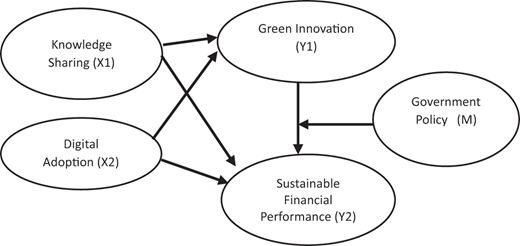
In Figure 1 is the relationship between variables obtained from the construction of previous research findings.

This study used a quantitative survey design with a cross-sectional design. This approach was chosen to measure the relationship between green leadership, knowledge sharing, digital adoption, government policies and sustainable financial performance among ecotourism stakeholders in Bali. Since the focus construction of this study is organizational, this analysis emphasizes respondents who are directly involved in organizational processes and decision-making. The population and sample characteristics used in this study are presented in Table 1.

The sampling method used is stratified random sampling with three strata grouped based on the criteria of managers, employees and tourists. The main structures examined in this study are digital adoption, knowledge sharing, green innovation and sustainable financial performance. This structure is at the organizational level, so the sampling design mainly emphasizes managers and employees as respondents informed by the organization. Tourists were included primarily to capture external perceptions of digital service experiences and sustainability practices. So, the role of the tourist is considered additional and is not intended to evaluate internal organizational processes or strategic decision-making.

The sampling method used is stratified random sampling with three strata (managers, employees, tourists) to ensure the representation of each group. Strata proportion (based on Bali Provincial Tourism Office (BPPB) data): 20% (40 people) are managers; employees are 50% (100 people); and tourists are 30% (60 people in total). The proportion of tourists has increased slightly to balance the consumer perspective.

The sample size used the rule of 10 respondents per indicator (Hair and Alamer, 2022) and took into account the potential data loss to 15%. With 25 indicators (5 variables × 5 indicators) a minimum of 250 respondents is needed. High validity of the instrument (Cronbach α > 0.85) and weight of the analysis, the size of 200 respondents could be maintained.

A sample size of 200 is considered acceptable for AMOS-based Structural Equation Modeling (SEM), especially when the model has moderate complexity and the indicator demonstrates satisfactory reliability and validity. This is consistent with SEM guidelines which indicate that a sample size of 150–200 is sufficient for models with well-behaved indicators and adequate model suitability (Bogaert et al., 2026; Buchanan et al., 2026; Scott, 2024).

The selection procedure for the list of units from BPPB was carried out randomly using Excel RAND(), where at each stratum, the selected unit was contacted via email/telephone; respondents were asked to fill out a questionnaire online or on paper (for those who do not have internet access). All items were tested for content validity (CVI > 0.80) and reliability (Cronbach α > 0.87) on a presurvey with 30 respondents. The complete measurement scales and questionnaire items used in this study are presented in  Appendix 3.

In this study, knowledge sharing refers to the exchange of knowledge within and across tourism organizations and stakeholder networks, including interactions between managers, employees, local communities and institutional actors. It does not refer to the exchange of knowledge between tourists and companies as an evaluative source of internal organizational practices.

While travelers may not fully observe internal organizational processes such as knowledge sharing, green innovation routines or financial performance, their inclusion provides complementary insights into user-side perceptions of digitalization and sustainability practices. It can be concluded that the interpretation of results places greater emphasis on responses from managers and employees.

The data collection procedure using the questionnaire consisted of three parts (demographic profile, variable measurement and open-ended questions) prepared in Indonesian and English.

Then the questionnaire is distributed using Google Forms (online) and the printed questionnaire is distributed at ecotourism service points (hotels and tourist attractions). The data collection time is from July to August 2024, coinciding with the holiday season so that it can reach active tourists.

Ethics: Written consent is obtained; data is anonymous and stored on an encrypted server and the research procedure was approved by the Research Ethics Committee of Universitas Warmadewa (Approval No. 20240601).

To reduce the potential for automatic response bias, several questionnaire items were designed using reverse-coded statements. A minimum of two reverse-coded items were inserted into each scale, for example, “I rarely use digital technology in my work”, to check the consistency of respondents.

In addition, to minimize social bias of desire, the questionnaire was designed anonymously and accompanied by an explanation that there is no right or wrong answer, but rather the respondent’s personal judgment. The study also added the social desirability scale (e.g. the short form of the Marlowe-Crowne) as a control in the structural model.

If the social desirability score is high, the analysis is conducted in a biased manner or using latent variables so that bias can be suppressed. Respondents are guaranteed confidentiality through informed consent and the storage of encrypted data, so they are encouraged to provide honest answers.

4.1.1 Data analysis.

4.1.1.1 Description of respondent characteristics.

Of the 200 respondents divided by age, education and gender groups, most of the respondents, namely 135 people (67.5%), came from the age group of 15–25 years, which shows the high interest of the younger generation in the topic of ecotourism. Based on educational backgrounds, respondents consisted of various levels of education, with 85 people (42.5%) educated in high school and 75 people (37.5%) of respondents held a bachelor’s degree. This suggests that ecotourism attracts individuals from diverse educational backgrounds. In terms of gender, female respondents dominated, as many as 125 people (62.5%), while men, as many as 75 people (37.5%). The dominance of women in this study shows a more active participation of women in environmental issues and sustainable tourism. This combination of demographic data provides a comprehensive picture of respondents’ characteristics, which helps to better understand people’s attitudes and behaviors toward ecotourism in Bali. The sample showed the dominance of 15-25 years old (67.5%) and women (62.5%). To reduce bias, weighting was carried out on the SEM analysis based on the demographic distribution of the entire Bali ecotourism workforce (BPS, 2023). This study focuses on Bali; the findings cannot be automatically generalized to other ecotourism areas with different policy or cultural contexts.

The study involved three main groups of participants: customers (45%), tourists (35%) and employees (20%). Demographic profiles show significant variation in experience duration (customers: 2.3 years on average versus tourists: 1.7 visits) and engagement rates. This composition reflects a typical heterogeneity in service sector research, where Multi perspectives are considered essential for ecological validity (Ladeira et al., 2025). One-way ANOVA results showed significant differences (F = 6.72, p  < 0.01) in service satisfaction scores between groups. Travelers show the highest average (4.2 ± 0.3), followed by customers (3.8 ± 0.4) and employees (3.5 ± 0.5). Tukey’s post-hoc test confirms all significant pair differences on α = 0.05 (Tukey, 1949). These findings are consistent with previous research on perspective-based evaluation bias (Kim et al., 2025).

Validity and reliability tests are carried out to ensure that the research instrument has adequate consistency and accuracy. To test the research hypothesis, inferential analysis in the form of multiple linear regression was used to identify the influence of green innovation on sustainable financial performance. The data analysis in this study began with testing statistical assumptions, namely normality using Kolmogorov-Smirnov and multicollinearity through the value of theVariance Inflation Factor (VIF) with the criterion < 5. To ensure that there is no redundancy between the indicator and the construct, the study also conducted a convergent and discriminant validity test at the confirmation factor analysis (CFA) stage. The results of the study show that each construction has a unique contribution so that there is no duplication of meaning. Furthermore, a confirmatory factor (CFA) analysis was carried out using the Maximum Likelihood method with the feasibility criteria of the CFI and TLI models ≥ 0.90 and RMSEA ≤ 0.08.

The next stage is SEM to test the structural relationships between variables, as well as a moderation test by bootstrapping 5,000 samples to assess the role of government policies as moderators. The analysis process was carried out using IBM SPSS 28 for descriptive and statistical assumption tests, as well as AMOS 28 for CFA, SEM and moderation tests. Figure 2 presents the structural model illustrating the influence of green innovation on sustainable financial performance.

SEM was carried out using AMOS version 24 to test the proposed hypothesis. SEM was chosen for its ability to analyze multiple relationships simultaneously and evaluate measurement and structural models.

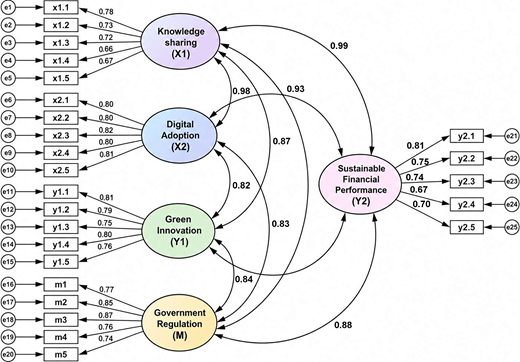
The sample size of 200 respondents was considered adequate for SEM analysis using AMOS, especially given the reliability and validity of the measurement model being satisfactory (Bogaert et al., 2026; Buchanan et al., 2026; Scott, 2024). Model measurements are assessed using Confirmatory Factor Analysis (CFA). The results showed that all indicators were significantly loaded on their respective constructs, with critical ratios exceeding the recommended threshold of 2.0, indicating adequate indicator performance, as presented in Table 2.

Table 2 shows that all constructions meet the recommended thresholds for convergent validity and reliability, with AVE values exceeding 0.50 and CR values above 0.70. These findings confirm that the measurement model is satisfactory. Detailed indicator-level information, including item source, standard load and critical ratio, is provided in  Appendix 1. Based on these results, the measurement model was judged valid and reliable and the analysis proceeded to structural model testing.

The validity of the discriminator was assessed using the Fornell-Larcker criterion. As shown in Table 3, the square root of AVE for each construction exceeds its correlation with other constructions, suggesting that all constructions are empirically different.

The Heterotrait-Monotrait Ratio (HTMT) is also used to assess discriminant validity. All HTMT values were below the conservative threshold of 0.85, confirming that discriminatory validity was established. As presented in Table 4, all HTMT values were below the recommended threshold of 0.85, providing additional evidence of discriminant validity among the constructs.

The cross-loading analysis (see  Appendix 2) further confirms that each indicator loads the highest on the intended construct compared to the other, supporting discriminant validity.

Multicollinearity is assessed using the VIF at the construct level. As shown in Table 5, all VIF values are below the critical threshold of 10 and within acceptable limits (Sanders and Sanders, 2022), suggesting that multicollinearity was not a serious problem in this study.

To assess multicollinearity, the value of the VIF is calculated at the construct level using regression analysis. As presented in Table 6, all VIF values range from 1.353 to 4.251, which is below the generally accepted threshold of 5. This shows that multicollinearity was not a concern in this study. In addition, a tolerance value above 0.10 confirms that the predictor variable does not show problematic collinearity. So that the structural model is considered stable and suitable for further analysis.

4.1.1.1.1. Statistical Analysis

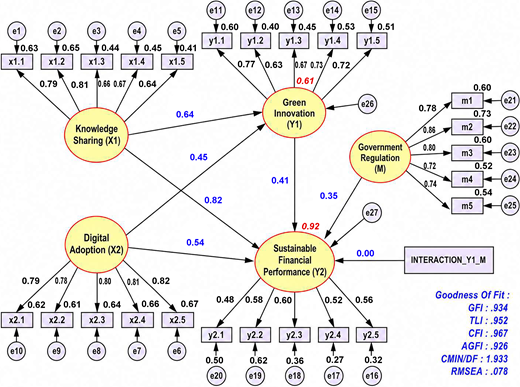
Statistical analysis is used to examine the proposed model and its assumptions. We assessed the goodness-of-fit; the results showed a chi-square value of 128.922. This finding has statistical significance at a level of 0.05 (Schoonen, 2015; Thakkar, 2020) It is important to note that the significance of the chi-square is affected by the sample size and that the fit test can be applied to smaller samples. The model fit indices showed satisfactory results: GFI = 0.940, TLI = 0.962, CFI = 0.968, AGFI = 0.926 and RMSEA = 0.151. After going through this evaluation process, the model is accepted and the testing phase continues (Figure 3).

SEM was carried out using AMOS version 24 to test the proposed hypothesis. SEM was chosen for its ability to analyze multiple relationships simultaneously and evaluate measurement and structural models.

A sample size of 200 respondents was considered adequate for SEM analysis using AMOS, especially given the reliability and satisfactory validity of the measurement model (Bogaert et al., 2026; Buchanan et al., 2026; Hair and Alamer, 2022). The measurement model was assessed using Confirmatory Factor Analysis (CFA). The results showed that all indicators were significantly loaded on their respective constructs, with critical ratios exceeding the recommended threshold of 2.0, indicating adequate indicator performance.

4.1.1.1.2. Mediation test using the Sobel Test

The Sobel test is a statistical test used to test the significance of indirect effects, i.e. mediation, whether mediated between independent variables and dependent variables or not. If the results of the Sobel test show that the Sobel statistic is greater than or equal to 1.96 (with a significance level of 5%), then the mediating variable (M) can be said to be able to mediate the relationship between the independent variable (X) and the dependent variable (Y).

4.1.1.2 Sobel test formula.

The above model is a path analysis model with a green innovation variable as a mediator. The z-value of the Sobel Test, cannot be generated directly from the regression results but by calculating it manually with the Sobel test formula. The results of the z-value calculation from the Sobel Test, are as follows:

z = (a × b)/√((b^2 × 〖SEa〗^2) + (a^2 × 〖SEb〗^2))

The testing of the 8th hypothesis, namely the testing of green innovation mediation on the variable of knowledge sharing on sustainable financial performance, is as follows:

a = 0.517

Tes Sobel, = 0.090

b = 0.071

SEb = 0.102

It can be explained that the value of the Sobel Coefficient = 0.69102370, so that Sobel = 0.69102370 < 1.96 means that green innovation does not mediate the variable of knowledge sharing on sustainable financial performance, H8 is rejected (not mediation). Furthermore, for H9 innovations mediate the influence of digital adoption on sustainable financial performance.

a = 0.400

Tes Sobel, = 0.087

b = 0.071

SEb = 0.102

The value of the Sobel Coefficient = 0.68823557 < 1.96, means that green innovation does not mediate the influence of digital adoption on sustainable financial performance.

The results of this study provide important insights into how internal organizational capabilities and external institutional factors affect green innovation and sustainable financial performance in ecotourism. Overall, the findings suggest that the proposed model is only partially supported, with internal capabilities playing a more dominant role than external regulatory mechanisms.

4.2.1 Knowledge sharing as a driver of green innovation and sustainable financial performance.

The results indicate that knowledge sharing has a significant positive effect on green innovation and sustainable financial performance. These findings reflect the practical realities of the ecotourism sector, where collaboration between stakeholders such as local communities, tourism operators and supporting institutions facilitates the exchange of knowledge and best practices. In Bali, for example, local wisdom such as THK encourages the integration of environmental, social and spiritual values, which supports the development of sustainable innovation.

From a theoretical perspective, these findings support the RBV, which considers knowledge as a strategic asset that enhances excellence Competitive (Salam et al., 2024). It is also consistent with KM theory, which emphasizes the importance of tacit and explicit knowledge in driving innovation (Patwary et al., 2025; Zaragoza-Sáez et al., 2023; Zhang et al., 2025). Previous studies have also found that knowledge sharing significantly contributes to environmental innovation and organizational performance in the tourism sector.

4.2.2 The role of digital adoption in improving green innovation and financial performance.

Digital adoption was found to significantly impact green innovation and sustainable financial performance. This finding highlights the growing integration of digital technologies in the tourism sector, such as online booking systems, digital marketing and data-driven decision-making. In practice, ecotourism businesses leverage digital tools to improve operational efficiency, monitor environmental impact and increase customer engagement.

These findings are in line with UTAUT-2, which explains that perceived usability and facilitation conditions encourage use (Al-Romeedy, 2026; Cui, 2025; Ghorbanzadeh and Rahehagh, 2026; Li et al., 2026; Setyaningrum et al., 2023; Zaheer et al., 2024). From the perspective of RBV, digital capabilities serve as strategic resources that strengthen competitiveness (Hutahaean et al., 2025; Wang et al., 2026). Previous studies have also confirmed that digital transformation supports innovation and financial outcomes in tourism SMEs.

4.2.3 The impact of green innovation on sustainable financial performance.

The results show that green innovation does not have a significant effect on sustainable financial performance. This suggests that the benefits of eco-friendly innovation may not be realized immediately, especially for small and medium-sized ecotourism businesses. Implementing green innovations often requires large investments, such as green infrastructure and technology adoption, which can increase operational costs in the short term.

These findings contrast with the much existing literature that reports positive links between green innovation and performance (Alnoor et al., 2026; Cammarano et al., 2026; Arridho et al., 2025; Hutahaean et al., 2025). Explanation by the time lag effect, where the financial return from innovation is realized over a longer period of time. This highlights the need to consider temporal dynamics when evaluating sustainability-oriented investments.

4.2.4 The influence of government policies on sustainable financial performance.

Government policy was found to have no significant effect on sustainable financial performance. This suggests that formal policies may not be effectively translated into operational outcomes at the company level. In practice, ecotourism businesses may rely more on in-house capabilities and informal networks than direct regulatory support. From the perspective of institutional theory (Ardiana et al., 2026; Barbosa and Ferreira, 2024; Liça et al., 2024), regulations are expected to shape organizational behavior. In developing countries, its effectiveness often depends on local enforcement and relevance. These findings highlight the gap between policy formulation and implementation in supporting sustainability practices.

4.2.5 The role of government policy moderators.

Moderation effect policy the government’s view of the relationship between green innovation and sustainable financial performance is not supported. This suggests that the regulatory framework does not significantly strengthen the impact of innovation on financial outcomes not in line with findings (Chen and Liu, 2025; Hussain et al., 2025; Scott, 2024). These findings show a mismatch between policy design and the practical needs of ecotourism businesses. Without adequate support mechanisms, such as incentives, training and infrastructure, regulation alone may not be enough to improve sustainability performance (Ardiana et al., 2026; Liestiandre et al., 2024; Khater et al., 2025).

4.2.6 The mediating role of green innovation.

The mediating role of green innovation is researched to understand whether knowledge sharing and digital adoption affect sustainable financial performance through the innovation process. These findings suggest that green innovation does not significantly mediate this relationship, suggesting that the effects of knowledge sharing and digital adoption on financial performance are not transmitted through green innovation.

These results provide important theoretical implications that in both the RBV and the knowledge-based perspective, innovation is usually considered to be the main mechanism that transforms organizational capabilities into performance outcomes. Current findings suggest that knowledge sharing and digital adoption can result in immediate performance benefits without having to be transformed into green innovation. This suggests that the capability-performance linkage may not always follow a sequential innovation path. So this finding is not in line with previous findings (Ghazwani and Alzahrani, 2024; Qiao and Wang, 2021).

From a contextual perspective, these findings reflect the real conditions in ecotourism SMEs, where resource constraints, financial constraints and operational priorities can hinder the transformation of capabilities into formal innovation practices. Although organizations are engaged in knowledge exchange and digital adoption, these capabilities can be used primarily to improve efficiency and service delivery rather than to develop structured green innovations.

In addition, the implementation of green innovations often requires additional investment, strategic alignment and long-term commitment. As a result, its contribution to financial performance may not be immediately observable, leading to weak or insignificant mediation effects. This shows that there is a time lag between innovation activities and financial results. So this finding is not supported by previous findings (Gretzel, 2025; Harsanto et al., 2024; Kuo et al., 2026; Zaheer et al., 2024).

From a practical point of view, these findings imply that managers should not assume that green innovation will automatically act as an intermediary between internal capabilities and financial performance. Instead, organizations need to actively drive innovation processes by aligning KM, digital strategies and sustainability goals. Without intentional integration, the potential role of green innovation as a value-creating mechanism may not be fully realized.

This study examines the relationship between knowledge sharing, digital adoption, green innovation and sustainable financial performance in the context of ecotourism SMEs. These findings reveal that knowledge sharing and digital adoption have a significant direct effect on sustainable financial performance. Green innovation does not significantly mediate this relationship. This shows that although companies are engaged in knowledge exchange and digital transformation, these capabilities are not effectively translated into structured green innovations that contribute to financial outcomes. These results suggest that the path from organizational capability to financial performance can occur directly rather than through innovation mechanisms, especially in resource-constrained environments such as ecotourism SMEs.

This study contributes to the literature by expanding the RBV and knowledge-based perspectives in the context of sustainability and digital transformation. The insignificant mediating role of green innovation challenges the generally assumed linear relationship between capability, innovation and performance. Future research should explore alternative mechanisms that can better explain how knowledge sharing and digital adoption affect performance, such as operational efficiency, service quality or customer experience. Another thing is that longitudinal studies are recommended to capture the potential time-lag effects of green innovation on financial performance. Furthermore, studies can also incorporate moderation variables, such as organizational readiness, environmental awareness or institutional support, to better understand the conditions under which green innovation becomes effective. The study used a sample of 200; although it meets for SEM analysis, future studies may consider larger samples to improve the generalization and robustness of the findings.

From a practical perspective, the findings show that ecotourism SME managers should not assume that green innovation will automatically emerge from knowledge sharing and digital adoption. Instead, organizations need to intentionally align their KM practices and digital strategies with sustainability-oriented innovation goals. Managers must invest in structured innovation processes, provide training related to green practices and integrate sustainability into business strategies. In addition, policymakers and stakeholders should support SMEs by providing financial incentives, technical assistance and capacity-building programs to facilitate the implementation of green innovations.

This research has several limitations. First, the use of cross-sectional data limits the ability to capture dynamic relationships and long-term effects, especially the delayed impact of green innovation on financial performance. Second, the sample is limited to ecotourism SMEs, which can limit the generalization of findings to other sectors or larger organizations. Third, this study relies on self-reported data, which can give rise to potential biases such as social desire or general method bias.

Future research should address these limitations by using longitudinal designs, expanding the sample across different industries and regions and incorporating objective performance measures to improve the robustness of findings.
Abbas
,
J.
, and
Najam
,
H.
(
2024
), “
Role of environmental decentralization, green human capital, and digital finance in firm green technological innovation for a sustainable society
”,
Environment, Development and Sustainability
, Vol.
27
No.
8
, pp.
19763
-
19777
, doi: .
Abbas
,
J.
(
2026
), “
Resource orchestration and firm competitive performance: the role of knowledge absorptive capacity in converting business analytics into strategic competitive advantage
”,
Technological Forecasting and Social Change
, Vol.
222
, p.
124403
.
Abdulmuhsin
,
A.A.
,
Dbesan
,
A.H.
,
Your Rehman
,
S.
,
Alnoor
,
A.
and
Alkhwaldi
,
A.F.
(
2026
), “
Redefining Knowledge-Generation-Driven blockchain for healthcare use: insights from medical institutions
”,
Health Services Management Research
, Vol.
39
No.
1
, pp.
37
-
54
.
Abdulmuhsin
,
A.A.
,
Owain
,
H.O.
,
Dbesan
,
A.H.
,
Bhat
,
M.A.
,
Your Rehman
,
S.
and
Alkhwaldi
,
A.F.
(
2025
), “
Acceptance of KM-Driven metaverse technology in higher education institutions: are educators ready to Be immersed?
”,
Information Discovery and Delivery
.
Albaladejo
,
I.P
, and
Martínez-García
,
M.P.
(
2015
), “
An RandD-Based endogenous growth model of international tourism
”,
Tourism Economics
, Vol.
21
No.
4
, pp.
701
-
719
, doi: .
Alkhwaldi
,
A.F.
(
2025
), “
Digital transformation in financial industry: antecedents of fintech adoption, financial literacy and quality of life
”,
International Journal of Law and Management
, Vol.
67
No.
6
, pp.
697
-
723
.
Alkhwaldi
,
A.F.
,
Ibrahim
,
A.
,
Abu-AlSondos
,
M.
,
Shehadeh
,
M.
,
Ajouz
. and
A.A.
,
Abdulmuhsin
. (
2024
), “
Investigating user acceptance of AI-Driven fintech services through the lens of the UTAUT model
”, in
International Conference on Technology and Innovation Management
, Springer, pp.
305
-
315
.
Almas
,
B.
,
R.
,
Muhtadi
,
Moh Arifin
. and
K.
,
Musari
. (
2026
), “Empowering coastal communities through integrated Islamic microfinance for sustainable ecotourism in east java”, in
Innovation and Transformation of Islamic Economics
,
IGI Global Scientific Publishing
,
Hershey, PA
, pp.
391
-
416
.
Almeyda
,
A.M.
,
Broadbent
,
E.N.
,
Wyman
,
M.S.
and
Durham
,
W.H.
(
2010
), “
Ecotourism impacts in the Nicoya peninsula, Costa Rica
”,
International Journal of Tourism Research
, Vol.
12
No.
6
, pp.
803
-
819
, doi: .
Alnoor
,
A.M.
,
Abbas
,
S.
,
Alazzawi
,
M.S.
,
Sadaa
,
A.M.
and
Chew
,
X.
(
2026
), “
Navigating the power of the enterprise metaverse and triple helix model for Eco-Innovation: evidence from linear and nonlinear analyses
”,
Asia-Pacific Journal of Business Administration
, pp.
1
-
38
.
Al-Romeedy
,
B.S.
(
2026
), “
AI-Driven knowledge and intelligence: a strategic framework for competitive advantage in tourism and hospitality industry
”,
Business Process Management Journal
, pp.
1
-
32
.
Angessa
,
A.T.
(
2025
), “
Stakeholder dynamics and strategic analysis for ecotourism sustainability: insights from the Wanchi ecotourism association, Ethiopia
”,
Environment, Development and Sustainability
, pp.
1
-
42
.
Ardiana
,
P.A.
,
Sujana
,
I.K.
,
Natalia
,
S.A.P.D.
and
Yanthi
,
K.D.L.
(
2026
), “
Tri Hita Karana: balinese local wisdom and its role in the triumph over corruption
”,
Journal of Accounting and Organizational Change
, Vol.
22
No.
1
, pp.
127
-
148
, doi: .
Arridho
,
A.
,
Sinaga
,
B.O.
,
Hartono
,
H.
and
Syahchari
,
D.H.
(
2025
), “
Digital technology adoption and business growth in Indonesian MSMEs using PLS-SEM
”, in
Proceeding – 2025 4th International Conference on Creative Communication and Innovative Technology: Empowering Transformative MATURE LEADERSHIP: Harnessing Technological Advancement for Global Sustainability, ICCIT 2025. Binus Business School Binus University, Management Department
,
Jakarta, Indonesia
:
Institute of Electrical and Electronics Engineers Inc
.
Bali Provincial Tourism Office
(
2025
), “
Bali tourism statistics data for 2025
”,
Bali Government Tourism Office
,
available at:
Link to Bali tourism statistics data for 2025Link to the cited article (
accessed
21 July 2026).
Baloch
,
Q.B.
,
Shah
,
S.N.
,
Iqbal
,
N.
,
Sheeraz
,
M.
,
Asadullah
,
M.
,
Mahar
,
S.
and
Khan
,
A.U.
(
2023
), “
Impact of tourism development upon environmental sustainability: a suggested framework for sustainable ecotourism
”,
Environmental Science and Pollution Research
, Vol.
30
No.
3
, pp.
5917
-
5930
, doi: .
Barbosa
,
Y.
, and
Ferreira
,
C.
(
2024
), “
Proposal of a human vulnerability index to the insufficiency of basic sanitation: the context of the small Paraibanos municipalities abstract aspects regarding the lack of basic sanitation in small municipalities
”,
Based on the Three Dimensions of Vu
, Vol.
13
, pp.
1
-
30
.
Barney
,
J.
(
1991
), “
Firm resources and sustained competitive advantage
”,
Journal of Management
, Vol.
17
No.
1
, pp.
99
-
120
.
Bigliardi
,
B.
(
2013
), “
The effect of innovation on financial performance: a research study involving SMEs
”,
Innovation
, Vol.
15
No.
2
, pp.
245
-
255
, doi: .
Bogaert
,
J.
,
Loh
,
W.W.
and
Rosseel
,
Y.
(
2026
), “
Consistent factor score regression: a better alternative for uncorrected factor score regression?
”,
Educational and Psychological Measurement
, Vol.
86
No.
4
, p.
131644251399588
.
Boley
,
B.B
, and
Green
,
G.T.
(
2016
), “
Ecotourism and natural resource conservation: the potential for a sustainable symbiotic relationship
”,
Journal of Ecotourism
, Vol.
15
No.
1
, pp.
36
-
50
, doi: .
Brownell
,
K.M.
,
Hechavarria
,
D.M.
,
Robb
,
C.C.
and
Kickul
,
J.
(
2025
), “
Culture and social entrepreneurship: the role of Value – Practice misalignment
”,
Small Business Economics
, Vol.
64
No.
3
, pp.
863
-
887
, doi: .
Buchanan
,
E.M.
,
Elsherif
,
M.M.
,
Geller
,
J.
,
Aberson
,
C.L.
,
Gurkan
,
N.
,
Ambrosini
,
E.
,
Heyman
,
T.
,
Montefinese
,
M.
,
Vanpaemel
,
W.
and
Barzykowski
,
K.
(
2026
), “
Accuracy in parameter estimation and simulation approaches for Sample-Size planning accounting for item effects
”,
Behavior Research Methods
, Vol.
58
No.
2
, p.
48
.
Cai
,
L.A.
,
Wei
,
W.
,
Lu
,
Y.
and
Day
,
J.
(
2015
), “
College students’ decision-making for study abroad – anecdotes from a US hospitality and tourism internship program in China
”,
Journal of Teaching in Travel and Tourism
, Vol.
15
No.
1
, pp.
48
-
73
.
Cammarano
,
A.
,
Aquilone
,
G.
,
Varriale
,
V.
,
Michelino
,
F.
and
Caputo
,
M.
(
2026
), “
The potential of open innovation platforms: driving sustainable development goals through digital collaboration
”,
Innovation
, Vol.
28
No.
1
, pp.
37
-
60
.
Chang
,
H.
,
Hsin
,
Shih
,
S.
,
Yeh
,
Y.A.
,
Yeh
. and
L.Y.
,
Chen
. (
2026
), “
An AIDA model of Taiwanese learners’ participation in online influencers’ language courses: Self-Congruence and influencer attractiveness as moderators
”,
Electronic Commerce Research
, pp.
1
-
46
.
Chaturvedi
,
P.
,
Dahiya
,
S.
and
Agrawal
,
S.
(
2015
), “
Technological innovation: a necessity for sustainable MSME sector in India
”, in
2015 1st International Conference on Futuristic Trends in Computational Analysis and Knowledge Management, ABLAZE 2015
,
S. G., K.
B
., and
J. J.S
, (Eds),
Amity University, Greater Noida Campus
:
Institute of Electrical and Electronics Engineers Inc
. pp.
206
-
211
.
Chen
,
T.
, and
Liu
,
G.
(
2025
), “
Global perspectives on environmental policy innovations: driving green tourism and consumer behavior in circular economy
”,
Journal of Environmental Management
, Vol.
374
, p.
124138
.
Cheng
,
Q.
,
Peng
,
C.
,
Wan
,
H.
,
Dai
,
Y.
and
Zhang
,
S.
(
2025
), “
How to realize digital knowledge innovation through digital technology? A perspective based on knowledge digitization and inter-organizational knowledge sharing
”,
Technology in Society
, Vol.
82
, p.
102905
.
Clulow
,
V.
,
Gerstman
,
J.
and
Barry
,
C.
(
2003
), “
The Resource-Based view and sustainable competitive advantage: the case of a financial services firm
”,
Journal of European Industrial Training
, Vol.
27
No.
5
, pp.
220
-
232
, doi: .
Costa
,
L.A.
,
Dias
,
E.
,
Ribeiro
,
D.
,
Fontão
,
A.
,
Pinto
,
G.
,
Dos Santos
,
R.P.
and
Serebrenik
,
A.
(
2026
), “
Supporting software engineering managers in talent retention: the Brazilian context
”,
Empirical Software Engineering
, Vol.
31
No.
2
, p.
44
.
Cui
,
J.
(
2025
), “
The explore of knowledge management dynamic capabilities, AI-Driven knowledge sharing, Knowledge-Based organizational support, and organizational learning on job performance: evidence from Chinese technological companies
”,
ArXiv Preprint ArXiv, 2501.02468
.
Dayour
,
F.
,
Abubakari
,
A.
,
Adam
,
I.
and
Ndewin
,
S.A.
(
2024
), “
A critical review of the Socio-Cultural, economic and environmental impacts of ecotourism in Ghana
”,
Development Southern Africa
, Vol.
41
No.
4
, pp.
737
-
761
, doi: .
Deepa Raj
,
O.K.
and
Shyam Kishore
,
V.
(
2026
), “
Future of MSMEs in the digital age: challenges and opportunities in developing countries
”, in
International Conference on Business and Technology
, Springer Nature, Cham, Switzerland, pp.
411
-
417
.
Dhakal
,
S.P.
, and
Tjokro
,
S.P.
(
2024
), “
Tourism enterprises in Indonesia and the fourth industrial revolution–are they ready?
”,
Tourism Recreation Research
, Vol.
49
No.
2
, pp.
439
-
444
.
Dhrubo
,
A.M.
,
Lemago
,
S.T.
,
Brohi
,
A.A.
and
Erdem
,
O.H.
(
2024
), “
Re-conceptualizing resources: an ontological Re-evaluation of the Resource-Based view
”,
Philosophy of Management
, Vol.
23
No.
2
, pp.
287
-
313
, doi: .
Diaz
,
E.
,
Carranza
,
R.
,
Martín-Consuegra Navarro
,
D.
and
Zhang
,
J.
(
2026
), “
Digital pathways: enhancing tourism small and Medium-Sized enterprises (SMEs) through smart organizational mindfulness towards technological transformation
”,
Journal of Hospitality and Tourism Insights
, Vol.
9
No.
2
, pp.
685
-
706
.
Ditta-Apichai
,
M.
, and
Gretzel
,
U.
(
2026
), “
Exploring Community-Based tourism enterprises’ social media uses: a netnography approach
”,
Community Development
, pp.
1
-
17
.
Ebaid
,
I.E.S.
(
2023
), “
Nexus between sustainability reporting and corporate financial performance: evidence from an emerging market
”,
International Journal of Law and Management
, Vol.
65
No.
2
, pp.
152
-
171
, doi: .
Falter
,
T.
,
Hennige
,
A.M.
,
Schulz
,
A.
,
Gieswinkel
,
A.
,
Lotz
,
J.
,
Rossmann
,
H.
,
Beutel
,
M.
,
Michal
,
M.
,
Pfeiffer
,
N.
and
Schmidtmann
,
I.
(
2024
), “
Prevalence of overweight and obesity, its complications, and progression in a 10-Year follow-up in the Gutenberg health study (GHS)
”,
Obesity Facts
, Vol.
17
No.
1
, pp.
12
-
23
.
Fatma
,
A
, and
Bhatt
,
V.
(
2026
), “
Conceptualizing smart tourism ecosystem: multi-Level framework integrating smart technologies and stakeholders for value Co-Creation
”,
Journal of Hospitality and Tourism Insights
, pp.
1
-
24
.
Fennell
,
D.
(
2012
), “Ecotourism”, in
The Routledge Handbook of Tourism and the Environment
,
Routledge
,
London
, pp.
323
-
333
.
Ferlie
,
E.
,
Crilly
,
T.
,
Jashapara
,
A.
,
Trenholm
,
S.
,
Peckham
,
A.
and
Currie
,
G.
(
2015
), “
Knowledge mobilization in healthcare organizations: a view from the Resource-Based view of the firm
”,
International Journal of Health Policy and Management
, Vol.
4
No.
3
, pp.
127
-
130
, doi: .
Garrido Pintado
,
P
, and
Recuero Virto
,
N.
(
2024
), “
Residents’ perceived benefits as determinants of sustainable tourism development
”,
Tourism Planning and Development
, Vol.
22
No.
6
, doi: .
Ghazwani
,
S.S.
, and
Alzahrani
,
S.
(
2024
), “
The use of social media platforms for competitive information and knowledge sharing and its effect on SMEs’ profitability and growth through innovation
”,
Sustainability (Switzerland)
, Vol.
16
No.
1
, doi: .
Ghobakhloo
,
M.
,
Fathi
,
M.
,
Okwir
,
S.
,
Al-Emran
,
M.
and
Ivanov
,
D.
(
2026
), “
Adaptive social manufacturing: a Human-Centric, resilient, and sustainable framework for advancing industry 5.0
”,
International Journal of Production Research
, Vol.
64
No.
3
, pp.
1127
-
1160
.
Ghorbanzadeh
,
D.
, and
Rahehagh
,
A.
(
2026
), “
Technology-Enabled knowledge sharing behavior: shaping organizational citizenship in the hospitality industry
”,
Journal of the Knowledge Economy
, Vol.
17
No.
3
.
Gomez-Chambi
,
F.
,
Ramos-Cavero
,
M.J.
,
Rojas-Flores
,
C.
and
Cordova-Buiza
,
F.
(
2026
), “
Ecotourism and sustainable development: impacts on communities near nature reserves
”,
International Journal of Sustainable Development
, Vol.
29
No.
1
, pp.
116
-
133
.
Granados Maguiño
,
M.A.
,
Flores Pérez
,
Y.
,
Ruiz Choque
,
M.
and
Tosso Pineda
,
L.H.
(
2024
), “
Sustainability management policies for ecotourism in Ayacucho, Peru
”,
Venezuelan Journal of Management
, Vol.
29
No.
105
, pp.
49
-
62
, doi: .
Gretzel
,
U.
(
2025
), “
The many questions concerning technology: implications for tourism, hospitality, events and leisure research
”,
Journal of Hospitality and Tourism Management
, Vol.
62
, pp.
232
-
236
.
Hair
,
J.
, and
Alamer
,
A.
(
2022
), “
Partial least squares structural equation modeling (PLS-SEM) in second language and education research: guidelines using an applied example
”,
Research Methods in Applied Linguistics
, Vol.
1
No.
3
, p.
100027
.
Han
,
C.
, and
de Vries
,
T.
(
2026
), “
Can tourism go green? Unpacking the role of FinTech and resource use in emerging Asia’s sustainability transition
”,
Sustainable Development
.
Harsanto
,
B.
,
Pradana
,
M.
,
Firmansyah
,
E.A.
,
Apriliadi
,
A.
and
Ifghaniyafi Farras
,
J.
(
2024
), “
Sustainable halal value chain performance for MSMEs: the roles of digital technology, RandD, financing, and regulation as antecedents
”,
Cogent Business and Management
, Vol.
11
No.
1
, doi: .
Hasanein
,
A.M.
, and
Al-Romeedy
,
B.S.
(
2026
), “
Turning knowledge into innovation: the systemic role of knowledge management capability, intellectual capital, and knowledge utilization
”,
Systems
, Vol.
14
No.
2
, p.
179
.
Hassan
,
M.
, and
Shaukat
,
S.
(
2026
), “
Achieving sustainable business outcomes through Eco-Innovation adoption in manufacturing firms of Pakistan: a Higher-Order PLS-SEM approach
”,
International Journal of Innovation Science
, pp.
1
-
26
.
Hassan
,
M.S.
,
Ibrahim
,
M.S.N.
,
Pengiran Bagul
,
A.H.B.
,
Saikim
,
F.H.
,
Yusrini
,
L.
,
Mohd Zainol
,
R.
and
Mohd Yahya
,
A.S.
(
2026
), “
Local community involvement and its impacts on ecotourism development in borneo: a systematic review
”,
Discover Environment
, Vol.
4
No.
1
, p.
58
.
Hawkins
,
D.E.
,
Elliott
,
S.M.
and
Yu
,
L.
(
2012
), “Tourism knowledge sharing: a virtual consensus building approach”, edited by
E. F.-S.
and
U.
Foundation
.
Bridging Tourism Theory and Practice
,
4
, pp.
33
-
53
, doi: .
Hermawan
,
S.
,
Tawfeeq Yousif Alabdullah
,
T.
,
Sriyono
,
S.
,
Sudarso
,
S.
and
Utomo
,
P.
(
2024
), “
Green perspective on intellectual capital, corporate social responsibility, and competitive advantage: the role of firm performance
”,
Environmental Economics
, Vol.
15
No.
1
, pp.
97
-
107
, doi: .
Holden
,
A.
(
2005
), “
Achieving a sustainable relationship between common Pool resources and tourism: the role of environmental ethics
”,
Journal of Sustainable Tourism
, Vol.
13
No.
4
, pp.
339
-
352
, doi: .
Holdt
,
C.P.
and
Pedersen
,
T.
(
2018
), “
The dual influences of proximity on knowledge sharing
”,
Journal of Knowledge Management
, Vol.
22
No.
8
, pp.
1782
-
1802
, doi: .
Hossain
,
M.M.
,
Sifa
,
R.
,
Rahman
,
M.K.
,
Zainol
,
N.R.
and
Akter
,
S.
(
2023
), “Role of digital social entrepreneurship in ecotourism development”, in
Social Entrepreneurship and Social Innovation in Eco-Tourism
,
Springer Nature
,
Universiti Malaysia Kelantan, Kota Bharu, Kelantan, Malaysia
, pp.
107
-
116
.
Hussain
,
S.
,
Baig
,
T.
,
Beg
,
S.
and
Ali
,
A.
(
2025
), “
Linking government support, and quality management with sustainable energy project success: mediating role of community participation and moderating role of project governance
”,
Innovative Infrastructure Solutions
, Vol.
10
No.
7
, p.
300
.
Hutahaean
,
A.R.
,
Lubis
,
F.S.
,
Saputra
,
D.
and
Shafie
,
D.I.
(
2025
), “,“
Determinants of E-Wallet and IoT adoption for MSME operational efficiency in Indonesia
”, in
Proceeding – 2025 4th International Conference on Creative Communication and Innovative Technology: Empowering Transformative MATURE LEADERSHIP: Harnessing Technological Advancement for Global Sustainability, ICCIT 2025. Bina Nusantara University, Binus Business School Management Department,
Tangerang, Indonesia
:
Institute of Electrical and Electronics Engineers Inc
.
Iqbal
,
S.
,
Ullah
,
S.
,
Rizwan
,
A.
,
Nazeer
,
N.
,
Rasheed
,
M.
and
Siddiqi
,
A.F.I.
(
2026
), “
Building competitive advantage: how organizational culture shapes absorptive capacity through knowledge sharing
”,
Journal of Organizational Effectiveness: People and Performance
, Vol.
13
No.
1
, pp.
170
-
188
.
Irwana Omar
,
S.
,
Ghapar Othman
,
A.
and
Mohamed
,
B.
(
2014
), “
The tourism life cycle: an overview of Langkawi island, Malaysia
”,
International Journal of Culture, Tourism and Hospitality Research
, Vol.
8
No.
3
, pp.
272
-
289
.
Islam
,
M.A.
and
Widen
,
G.
(
2023
), “
Bibliometric analysis of the VINE journal of information and knowledge management systems: 2000–2020
”,
VINE Journal of Information and Knowledge Management Systems
, Vol.
53
No.
3
, pp.
467
-
490
.
Jackson
,
L.A.
,
Singh
,
D.
and
Parsa
,
H.G.
(
2015
), “
Tourism firms’ environmental rankings and financial performance: a multidimensional scaling approach
”,
Journal of Sustainable Tourism
, Vol.
23
No.
10
, pp.
1426
-
1444
, doi: .
Jindal
,
P.
and
Anshika
,
M.
(
2023
), “The role of digital marketing in financial services”, in
Big Data: A Road-Map for Successful Digital Marketing. Chitkara Business School
,
Nova Science Publishers, Inc
,
Chitkara University, Punjab, India
., pp.
155
-
168
.
Kansra
,
P.
,
Oberoi
,
S.
,
Singh
,
N.
and
Choi
,
H.
(
2024
), “
Role of innovation, policy, social media, and environmental munificence for sustainable ecotourism development in Punjab, India
”,
Sustainability (Switzerland)
, Vol.
16
No.
21
, doi: .
Khalid
,
M.S.
(
2024
), “Sustainable tourism’s tomorrow: navigating the future with technological innovations”, in
Achieving Sustainable Transformation in Tourism and Hospitality Sectors
,
IGI Global
. pp.
139
-
155
.
Khater
,
M.
,
Ibrahim
,
O.
,
Sayed
,
M.N.E.
and
Faik
,
M.
(
2025
), “
Legal frameworks for sustainable tourism: balancing environmental conservation and economic development
”,
Current Issues in Tourism
, Vol.
28
No.
22
, pp.
3693
-
3714
, doi: .
Khurana
,
T.
,
Pannu
,
S.
,
Dalal
,
G.
,
Vyas
,
P.
and
Rani
,
P.
(
2025
), “
How do social media influencers’ credibility and brand trust drive purchase intentions for green cosmetics? Insights from SOBC approach
”,
NMIMS Management Review
, Vol.
33
No.
3
, pp.
171
-
185
, doi: .
Kim
,
K.
,
Zhou
,
X.
,
Kim
,
D.
,
Lawall
,
J.
,
Liu
,
K.
,
Bissyande
,
T.F.
,
Klein
,
J.
,
Lee
,
J.
and
Lo
,
D.
(
2025
), “
How are We detecting inconsistent method names? An empirical study from code review perspective
”,
ACM Transactions on Software Engineering and Methodology
, Vol.
34
No.
6
, pp.
1
-
27
.
Kocmanová
,
A.
and
Dočekalová
,
M.P.
(
2015
), “Evaluation of efficient and inefficient czech companies operating in the manufacturing industry using financial and Non-Financial indicators and data envelopment analysis”, ” in
Proceedings of the 26th International Business Information Management Association Conference – Innovation Management and Sustainable Economic Competitive Advantage: From Regional Development to Global Growth, IBIMA 2015
,
S.
K.S.
, (Ed)
University of Technology
,
Brno, Czech Republic: International Business Information Management Association, IBIMA
, pp.
1387
-
1396
.
Kosiol
,
J.
,
Fraser
,
L.
,
Fitzgerald
,
A.
and
Radford
,
K.
(
2023
), “
Resource-Based view: a new strategic perspective for public health service managers
”,
Asia Pacific Journal of Health Management
, Vol.
18
No.
1
, doi: .
Kuo
,
T.C.
,
Ibn Zulkarnain
,
A.A.
,
Rumanti
,
S.-Y.
,
Pan
. and
C.-H.
,
Chang
. (
2026
), “
The role of industry 4.0 in accelerating ecotourism for sustainable development: a comprehensive literature review
”,
Journal of Hospitality and Tourism Technology
, pp.
1
-
30
.
Ladeira
,
W.J.
,
Rasul
,
T.
,
Santini
,
F. D O.
,
Rice
,
J.L.
and
Shaheen
,
M.
(
2025
), “
Understanding heterogeneity in service research: a Meta-Analytic perspective
”,
The Service Industries Journal
, Vol.
46
Nos
7-8
, pp.
721
-
689
.
Lee
,
Y.-S.
,
Lawton
,
L.J.
and
Weaver
,
D.B.
(
2013
), “
Evidence for a South Korean model of ecotourism
”,
Journal of Travel Research
, Vol.
52
No.
4
, pp.
520
-
533
.
Li
,
P.
,
Zhao
,
M.
and
Wu
,
W.
(
2026
), “
Exploring the impacts of digital technology on small and Medium-Sized corporate competitive advantage: evidence from the Chinese A-Share manufacturing industry
”,
Systems
, Vol.
14
No.
3
, p.
256
.
Liça
,
D.
,
Gashi
,
S.
and
Qosja
,
E.
(
2024
), “
Promoting environmental responsibility strategy and innovation in the hospitality industry: a green tourism approach
”,
Corporate. Bus. Strategist. Rev
.
Liestiandre
,
H.K.
,
Yasa
,
N.N.K.
,
Sukawati
,
T.G.R.
and
Sukaatmadja
,
I.P.G.
(
2024
), “
Tourism destination management based on local wisdom tri Hita Karana
”,
Quality – Access to Success
, Vol.
25
No.
203
, pp.
280
-
288
, doi: .
Liu
,
M.
, and
Chamaratana
,
T.
(
2024
), “
Assessing ecotourism development indicators in border areas of the greater Mekong subregion: Insights from stakeholders
”,
Pakistan Journal of Life and Social Sciences
, Vol.
22
No.
2
.
Ma
,
B.
,
Cai
,
Z.
,
Zheng
,
J.
and
Wen
,
Y.
(
2019
), “
Conservation, ecotourism, poverty, and income inequality – A case study of nature reserves in Qinling, China
”,
World Development
, Vol.
115
, pp.
236
-
244
, doi: .
Ma
,
L.
,
Ali
,
A.
,
Shahzad
,
M.
and
Khan
,
A.
(
2025
), “
Factors of green innovation: the role of dynamic capabilities and knowledge sharing through green creativity
”,
Kybernetes
, Vol.
54
No.
1
, pp.
54
-
70
.
Majeed
,
M.
,
Asiedu
,
E.
,
Sulemana
,
I.
,
Abubakari
,
A.
and
Sakara
,
A.
(
2026
), “
The role of green innovation in mediating green supply chain and CSR impacts on hospitality firm performance: evidence from Ghana
”,
Africa Journal of Management
, Vol.
12
No.
1
, pp.
1
-
20
.
Mansour
,
H.
,
Aminudin
,
E.
,
Mansour
,
T.
,
Abidin
,
N.I.A.B.
and
Lou
,
E.
(
2022
), “
Resource-Based view in construction project management research: a Meta-Analysis
”, in
IOP Conference Series: Earth and Environmental Science
, IOP Publishing, Vol.
1067
, No.
1
, p.
12057
.
Martinez-Falco
,
J.
,
Sánchez-García
,
E.
,
Marco-Lajara
,
B.
and
Zaragoza-Sáez
,
P.
(
2024
), “
Green knowledge sharing as the backbone of sustainable performance: evidence from the Spanish wine industry
”,
VINE Journal of Information and Knowledge Management Systems
, Vol.
56
No.
4
, pp.
1208
-
1229
.
Martínez-Falcó
,
J.
,
Sánchez-García
,
E.
,
Marco-Lajara
,
B.
and
Zaragoza-Sáez
,
P.
(
2024
), “
Green knowledge sharing as the backbone of sustainable performance: evidence from the Spanish wine industry
”,
VINE Journal of Information and Knowledge Management Systems
, Vol.
56
No.
4
.
Martínez-Falcó
,
J.
,
Martínez-Falcó
,
J.
,
Marco-Lajara
,
B.
and
Sánchez-García
,
E.
(
2025
), “
Wine tourism as a catalyst for green performance: the mediating role of green knowledge sharing
”,
Journal of Foodservice Business Research
, Vol.
28
No.
6
, pp.
1187
-
1214
.
Maryani
,
E.
and
Indrianty
,
S.
(
2024
), “
The role of government and community in the development of local Wisdom-Based sustainable tourism village
”, in
IOP Conference Series: Earth and Environmental Science
,
University of Education Indonesia, Indonesia
:
Institute of Physics
, Vol.
1366
.
Maziliauske
,
E.
(
2024
), “
Innovation for sustainability through Co-Creation by small and Medium-Sized tourism enterprises (SMEs): socio-Cultural sustainability benefits to rural destinations
”,
Tourism Management Perspectives
, Vol.
50
, p.
101201
.
Mekhum
,
W.
, and
Torasa
,
C.
(
2020
), “
Effect of knowledge sharing and digital management to performance on ecotourism in Ranong province, Thailand
”,
Research in World Economy
, Vol.
11
No.
5
, pp.
481
-
492
, doi: .
Meng
,
F.
, and
Zhang
,
W.
(
2022
), “
Digital finance and regional green innovation: evidence from Chinese cities
”,
Environmental Science and Pollution Research
, Vol.
29
No.
59
, pp.
89498
-
89521
, doi: .
Najicha
,
F.U.
,
Karjoko
,
L.
,
Handayani
,
I.
,
Chandrakirana
,
R.
and
Tenrilawa
,
D.F.
(
2022
), “
The conceptualization of environmental administration law in environmental pollution control”, journal of human rights
”,
Culture and Legal System
, Vol.
2
No.
2
, pp.
87
-
99
, doi: .
Newbert
,
S.L.
(
2007
), “
Empirical research on the Resource-Based view of the firm: an assessment and suggestions for future research
”,
Strategic Management Journal
, Vol.
28
No.
2
, pp.
121
-
146
, doi: .
Nguyen
,
T.H.H.
,
Nguyen
,
G.T.
,
Tučková
,
Z.
and
Hoang
,
S.D.
(
2025
), “
Psychological ownership and knowledge sharing: key psychological drivers of sustainable tourist behavior
”,
Acta Psychologica
, Vol.
253
, doi: .
Nguyen
,
T.H.H.
,
Pilík
,
M.
and
Pham
,
N.T.
(
2024
), “
Firms’ green knowledge sharing and tourists’ green electronic word-of-mouth intention: a two-wave time-lagged study of moderated mediation model
”,
Journal of Sustainable Tourism
, Vol.
33
No.
3
, pp.
416
-
435
, doi: .
Octasylva
,
A.R.P.
,
Yuliati
,
L.N.
,
Hartoyo
,
H.
and
Soehadi
,
A.W.
(
2022
), “
Innovativeness as the key to MSMEs’ performance
”,
Sustainability (Switzerland)
, Vol.
14
No.
11
, doi: .
Ola-Oluwa
,
J.A.
(
2024
), “
Impact of artificial intelligence (AI) in enhancing knowledge sharing and boosting organizational efficiency in Nigerian enterprises
”,
African Journal of Management and Business Research
, Vol.
17
No.
1
, pp.
76
-
95
.
Osei
,
A.
, and
Amoah
,
J.O.
(
2026
), “
Pathways to sustainable competitive advantage: integrating firm‐level sustainability targets, eco‐innovation, and sustainable governance for circular business transformation
”,
Business Strategy and the Environment
, Vol.
35
No.
5
.
Pai
,
C.-H.
,
Zhang
,
Y.
,
Wang
,
Y.-L.
,
Li
,
K.
and
Shang
,
Y.
(
2026
), “
Current challenges and opportunities in cultural heritage preservation through sustainable tourism practices
”,
Current Issues in Tourism
, Vol.
29
No.
5
, pp.
1016
-
1034
.
Partarakis
,
N.
,
Zabulis
,
X.
,
Meghini
,
C.
,
Dubois
,
A.
,
Moreno
,
I.
,
Ringas
,
C.
,
Ziova
,
A.
,
Kaplanidi
,
D.
,
Arnaud
,
D.
,
Crescenzo
,
N.
,
Hee
,
P.
,
Ortega
,
J.J.
,
Garrido
,
J.
,
Benvenuti
,
M.A.
and
Krivokapic
,
J.
(
2025
), “
A review, analysis, and roadmap to support the Short-Term and Long-Term sustainability of the European crafts sector
”,
Heritage
, Vol.
8
No.
2
, doi: .
Pasape
,
L.
,
Anderson
,
W.
and
Lindi
,
G.
(
2015
), “
Assessment of indicators of sustainable ecotourism in Tanzania
”,
Anatolia
, Vol.
26
No.
1
, pp.
73
-
84
.
Patwary
,
A.K.
,
Azam
,
N.R.A.N.
,
Ashraf
,
M.U.
,
Muhamed Yusoff
,
A.
,
Mehmood
,
W.
and
Rabiul
,
M.K.
(
2025
), “
Examining employee performance through knowledge management practices, organizational commitment and capacity building in the Malaysian hotel industry
”,
Global Knowledge, Memory and Communication
, Vol.
74
Nos
3-4
, pp.
733
-
752
.
Pham
,
D.C.
,
Do
,
T.N.A.
,
Doan
,
T.N.
,
Nguyen
,
T.X.H.
and
Pham
,
T.K.Y.
(
2021
), “
The impact of sustainability practices on financial performance: empirical evidence from Sweden
”,
Cogent Business and Management
, Vol.
8
No.
1
, doi: .
Polukhina
,
A.
,
Sheresheva
,
M.
,
Napolskikh
,
D.
and
Lezhnin
,
V.
(
2025
), “
Digital solutions in tourism as a way to boost sustainable development: evidence from a transition economy
”,
Sustainability (Switzerland)
, Vol.
17
No.
3
, doi: .
Pushpakumara
,
T.D.C.
,
Ahsan
,
F.J.
and
Silva
,
D.A.C.S.
(
2026
), “
Artificial intelligence (AI) adoption for ecotourism development: a Multi-Stakeholder analysis in Sri Lanka
”,
Journal of Intelligent Learning Systems and Applications
, Vol.
18
No.
1
, pp.
45
-
76
.
Puspa
,
D.
,
Gandri
,
L.
,
Indriyani
,
L.
and
Rahmatiah Tuwu
,
E.
(
2026
), “
Sustainable ecotourism in small island destinations: a strategic planning perspective
”,
Social, Ecology, Economy for Sustainable Development Goals Journal
, Vol.
3
No.
2
, pp.
101
-
119
.
Putri
,
N.E.
,
Helmi
,
Silfia
,
H.
,
Humaida
. and
A.
,
Frinaldi
. (
2024
), “
Political community entrepreneurship policy as an effort to reduce infrastructural violence: a systematic literature review
”,
Cogent Social Sciences
, Vol.
10
No.
1
, p.
2371676
.
Qiao
,
S.
, and
Wang
,
Q.
(
2021
), “
The effect of relational capital on organizational performance in supply chain: the mediating role of explicit and tacit knowledge sharing
”,
Sustainability
, Vol.
13
No.
19
, p.
10635
.
Ragazou
,
K.
,
Zournatzidou
,
G.
,
Sklavos
,
G.
and
Sariannidis
,
N.
(
2026
), “
Eco-Efficiency and financial sustainability in UK universities: strategic pathways to a Carbon-Neutral higher education sector
”,
International Journal of Sustainability in Higher Education
, Vol.
27
No.
10
, pp.
1
-
31
.
Redaputri
,
A.P.
,
Wibowo
,
A.
,
Santoso
,
C.B.
and
Almahendra
,
R.
(
2026
), “
From identity to innovation: a Multi-Theoretical framework of green organizational identity, ambidextrous green innovation, and Digital-Enabled environmental collaboration
”,
World Development Sustainability
, Vol.
8
, p.
100278
.
Robba
,
M.
,
Aprea
,
C.
,
Iannello
,
P.
and
Sorgente
,
A.
(
2026
), “
Bridging economic and psychological perspectives on financial resilience: an integrative review and research agenda
”,
International Journal of Consumer Studies
, Vol.
50
No.
2
, p.
e70174
.
Rosilawati
,
Y.
and
Ariyati
,
S.K.
(
2021
), “
Environmental communication on ecotourism development: a case study of Subak Sembung, Bali
”, in
E3S Web of Conferences
, Indonesia: EDP Sciences, Vol.
316
, p.
4011
.
Salam
,
R.
,
Samudra
,
A.A.
,
Suradika
,
A.
and
Sumada
,
I.M.
(
2024
), “
Future policy implementation to balance growth and sustainability: managing the impact of mass tourism in Bali
”,
Journal of Infrastructure Policy and Development
, Vol.
8
No.
9
, doi: .
Samal
,
R.
, and
Dash
,
M.
(
2024
), “
Stakeholder engagement in advancing sustainable ecotourism: an exploratory case study of Chilika wetland
”,
Discover Sustainability
, Vol.
5
No.
1
, doi: .
Sarkar
,
R.
, and
Sinha
,
A.
(
2015
), “
The village as a social entrepreneur: Balancing conservation and livelihoods
”,
Tourism Management Perspectives
, Vol.
16
, pp.
100
-
106
, doi: .
Schoonen
,
R.
(
2015
), “Structural equation modeling in L2 research”, in
Advancing Quantitative Methods in Second Language Research
,
Taylor & Francis
,
University of Amsterdam, Netherlands
, pp.
213
-
242
.
Scott
,
D.
(
2024
), “Climate change implications for tourism”, in
Hall
,
C.M.
(Ed),
The Wiley Blackwell Companion to Tourism
,
Wiley Blackwell
, pp.
548
-
562
, doi: .
Sedighi
,
M.
,
Lukosch
,
S.
,
Brazier
,
F.
,
Hamedi
,
M.
and
van Beers
,
C.
(
2018
), “
Multi-level knowledge sharing: the role of perceived benefits in different visibility levels of knowledge exchange
”,
Journal of Knowledge Management
, Vol.
22
No.
6
, pp.
1264
-
1287
, doi: .
Setini
,
M.
,
Yasa
,
N N. K.
,
Gede Supartha
,
I.W.
and
Ketut Giantari
,
I.G.A.
(
2021
), “
The effects of knowledge sharing, social capital and innovation on marketing performance
”,
International Journal of Data and Network Science
, Vol.
5
No.
3
, pp.
257
-
266
, doi: .
Setini
,
M.
,
Yasa
,
N N. K.
,
Wayan Gede Supartha
,
I.
,
Ayu Ketut Giantari
,
I.G.
and
Rajiani
,
I.
(
2020
), “
The passway of women entrepreneurship: starting from social capital with open innovation, through to knowledge sharing and innovative performance
”,
Journal of Open Innovation: Technology, Market, and Complexity
, Vol.
6
No.
2
, p.
25
.
Setyaningrum
,
R.P.
,
Kholid
,
M.N.
and
Susilo
,
P.
(
2023
), “
Sustainable SMEs performance and green competitive advantage: the role of green creativity, business independence and green IT empowerment
”,
Sustainability (Switzerland)
, Vol.
15
No.
15
, doi: .
Shaban
,
O.S.
, and
Barakat
,
A.
(
2023
), “
The impact of sustainability reporting on a company’s financial performance: evidence from the emerging market
”,
Journal of Governance and Regulation
, Vol.
12
No.
4 Special issue
, pp.
306
-
314
, doi: .
Sharma
,
R.
,
Gunasekaran
,
A.
,
Sharma
,
M.
,
Luthra
,
S.
and
Joshi
,
S.
(
2025
), “
Building a sustainable future: the role of green innovation and green premium in transforming Indian SMEs
”,
Environment, Development and Sustainability
, doi: .
Snyman
,
S.
(
2017
), “
The role of private sector ecotourism in local Socio-Economic development in Southern Africa
”,
Journal of Ecotourism
, Vol.
16
No.
3
, pp.
247
-
268
, doi: .
Sriariani
,
N.L.M.
,
Kertih
,
W.I.
and
Widiana
,
W.I.
(
2026
), “
Development of E-LKPD PjBL with the insertion of tri Hita Karana to improve the activeness and learning outcomes of class III elementary school students
”,
Journal of General Education and Humanities
, Vol.
5
No.
1
, pp.
721
-
734
.
Sumiati
,
Y.
,
Helia
,
S.
,
Andria
,
Y.
,
Afriyeni
,
A.
,
Aryadi
,
D.
and
Hasymi
,
E.
(
2024
), “
The impact of green human resource management on the economic and environmental performance of small and medium enterprises (SMEs) in west Sumatra, Indonesia
”,
International Journal of Sustainable Development and Planning
, Vol.
19
No.
8
, pp.
3225
-
3234
, doi: .
Tang
,
D.
,
Chen
,
W.
,
Zhang
,
Q.
and
Zhang
,
J.
(
2023
), “
Impact of digital finance on green technology innovation: the mediating effect of financial constraints
”,
Sustainability (Switzerland)
, Vol.
15
No.
4
, doi: .
Tasa
,
A.R.A.
,
Fridayani
,
H.D.
and
Isnadi
,
Y.
(
2024
), “
Implementation of the smart city concept in the dimensions of smart people, smart mobility, and smart governance for the realization of Jakarta smart city
”, in
SHS Web of Conferences, EDP Sciences
. Vol.
204
, p.
3002
.
Thakkar
,
J.J.
(
2020
), “Applications of structural equation modelling with AMOS 21, IBM SPSS”, in
Studies in Systems, Decision and Control
,
Springer
,
West Bengal, India
, pp.
35
-
89
.
Traskevich
,
A.
, and
Fontanari
,
M.
(
2018
), “
Mental wellness in resilient destinations
”,
International Journal of Spa and Wellness
, Vol.
1
No.
3
, pp.
193
-
217
, doi: .
Tukey
,
J.W.
(
1949
), “
Comparing individual means in the analysis of variance
”,
Biometrics
, Vol.
5
No.
2
, pp.
99
-
114
.
Ul Haq
,
F.
,
Suki
,
N.M.
,
Setini
,
M.
,
Masood
,
A.
and
Khan
,
T.A.
(
2025
), “
Adopting green AI for SME sustainability: mediating role of green investment and moderation by green servant leadership
”,
Sustainable Futures
, Vol.
10
.
Walewangko
,
E.N.
,
Lapian
,
A.L.C.P.
,
Mandagie
,
Y.
and
Sondakh
,
D.S.I.
(
2026
), “
SME digitalization and marine ecotourism as levers for coastal community welfare: the role of local economic empowerment in North Minahasa regency, Indonesia
”,
Tourism and Hospitality
, Vol.
7
No.
1
, p.
26
.
Wang
,
K.
,
Quan
,
H.
,
Chang
,
H.
and
Tian
,
Y.
(
2025
), “
Research on the impact of external knowledge acquisition and internal knowledge sharing on service innovation of tourism enterprises
”,
Journal of Knowledge Management
, Vol.
29
No.
9
, pp.
2821
-
2842
.
Wang
,
S.
,
Tian
,
C.
,
Zhou
,
C.
,
Wu
,
Y.
,
Ametefe
,
D.S.
,
John
,
D.
and
Ametefe
,
M.A.
(
2026
), “
The role of digital twin technology in enhancing energy efficiency in buildings: a systematic literature review
”,
Energy Science and Engineering
, Vol.
14
No.
2
.
Wondirad
,
A.
,
Tolkach
,
D.
and
King
,
B.
(
2020
), “
Stakeholder collaboration as a major factor for sustainable ecotourism development in developing countries
”,
Tourism Management
, Vol.
78
, doi: .
Yan
,
L.
,
Gooi
,
L.-M.
,
Huang
,
W.
and
Wang
,
X.
(
2025
), “
Ecotourism and economic sustainable development of local communities from the lens of technological innovation: the synergistic role of green industry and social capital
”,
International Review of Economics and Finance
, Vol.
104
, p.
104720
.
Yang
,
M.
and
Li
,
Z.
(
2023
), “
The influence of green human resource management on employees’ green innovation behavior: the role of green organizational commitment and knowledge sharing
”,
Heliyon
, Vol.
9
No.
11
, p.
e22161
, doi: .
Yusof
,
N.A.
,
Manan
,
H.A.
,
Karim
,
M.R.A.
and
Kassim
,
N.A.M.
(
2020
), “
Investigating influence of green innovation on sustainability performance: a case on Malaysian hotel industry
”,
Journal of Cleaner Production
, Vol.
258
, p.
120860
, doi: .
Zaheer
,
M.A.
,
Anjum
,
T.
,
Díaz Tautiva
,
J.A.
and
Heidler
,
P.
(
2024
), “
Digital transformation of enterprises to enhance sustainability: how does the reputation of digital applications influence the attributes of E-Commerce
”,
Sustainability
, Vol.
16
No.
17
, p.
7365
, doi: .
Zaragoza-Sáez
,
P.
,
Carmen
,
E.
,
Claver-Cortés
,
B.
,
Marco-Lajara
. and
M.
,
Úbeda-García
. (
2023
), “Corporate social responsibility and strategic knowledge management as mediators between sustainable intangible capital and hotel performance”, in
Knowledge Management, Organizational Learning and Sustainability in Tourism
,
Routledge
,
London
, pp.
14
-
36
.
Zhang
,
S.
, and
Kim
,
K.
(
2026
), “
Psychological drivers of decision making in ski tourists: impact of destination attractiveness, satisfaction, and place attachment
”,
Acta Psychologica
, Vol.
263
, p.
106354
.
Zhang
,
Y.
,
Wang
,
X.
and
Li
,
J.
(
2024
), “
Digital transformation and corporates’ green technology innovation performance–the mediating role of knowledge sharing
”,
Finance Research Letters
, Vol.
62
, p.
105105
, doi: .
Zhang
,
Y.
,
Wang
,
J.
and
Zhang
,
J.
(
2025
), “
Impacts of AI awareness on proactive service behavior and tacit knowledge sharing among hotel employees
”,
International Journal of Contemporary Hospitality Management
, Vol.
37
No.
12
, pp.
3935
-
3951
.
Zhu
,
S.
,
Liu
,
X.
and
Hou
,
Z.
(
2026
), “
Unlocking knowledge sharing motivation and behavior in online communities: a Self-Determination theory perspective
”,
VINE Journal of Information and Knowledge Management Systems
, Vol.
56
No.
2
, pp.
579
-
597
.
Ngurah
,
A.
and
Sagung Laksmi
,
D.
(
2023
), “
Tri Hita Karana as a concept of local wisdom in the development of sustainable tourism in Bali
”, in
International Conference on Changing of Law: Business Law, Local Wisdom and Tourism Industry (ICCLB 2023)
, Atlantis Press, pp.
65
-
72
.
Published by Emerald Publishing Limited. This article is published under the Creative Commons Attribution (CC BY 4.0) licence. Anyone may reproduce, distribute, translate and create derivative works of this article (for both commercial and non-commercial purposes), subject to full attribution to the original publication and authors. The full terms of this licence may be seen at Link to the terms of the CC BY 4.0 licenceLink to the terms of the CC BY 4.0 licence.

Data & Figures

Figure 1.
A diagram links knowledge sharing, digital adoption, green innovation, sustainable financial performance, and government policy.The diagram contains 5 connected constructs. Knowledge Sharing, X 1, and Digital Adoption, X 2, each connect to Green Innovation, Y 1. Knowledge Sharing and Digital Adoption also connect directly to Sustainable Financial Performance, Y 2. Green Innovation further connects to Sustainable Financial Performance. Government Policy, M, connects to the link between Green Innovation and Sustainable Financial Performance, indicating its influence on that relationship.

Research concept framework

Source: Author’s calculation (2025)

Figure 1.
A diagram links knowledge sharing, digital adoption, green innovation, sustainable financial performance, and government policy.The diagram contains 5 connected constructs. Knowledge Sharing, X 1, and Digital Adoption, X 2, each connect to Green Innovation, Y 1. Knowledge Sharing and Digital Adoption also connect directly to Sustainable Financial Performance, Y 2. Green Innovation further connects to Sustainable Financial Performance. Government Policy, M, connects to the link between Green Innovation and Sustainable Financial Performance, indicating its influence on that relationship.

Research concept framework

Source: Author’s calculation (2025)

Close modal
Figure 2.
A path diagram links knowledge sharing, digital adoption, green innovation, government regulation, and sustainable financial performance.The path diagram contains 4 latent constructs and 1 outcome construct with measured indicators and relationship coefficients. Knowledge Sharing, X 1, connects to indicators x 1.1 through x 1.5 with coefficients 0.76, 0.76, 0.72, 0.66, and 0.67. Digital Adoption, X 2, connects to indicators x 2.1 through x 2.5 with coefficients 0.80, 0.77, 0.78, 0.80, and 0.81. Green Innovation, Y 1, connects to indicators y 1.1 through y 1.5 with coefficients 0.81, 0.70, 0.75, 0.80, and 0.76. Government Regulation, M, connects to indicators m 1 through m 5 with coefficients 0.77, 0.68, 0.87, 0.76, and 0.74. Sustainable Financial Performance, Y 2, connects to indicators y 2.1 through y 2.5 with coefficients 0.81, 0.76, 0.74, 0.67, and 0.70. Curved paths connect Knowledge Sharing, Digital Adoption, Green Innovation, Government Regulation, and Sustainable Financial Performance, with coefficients ranging from 0.82 to 0.98, indicating the relationships among the constructs.

Graph of the influence of green innovation on sustainable financial performance

Source: Author’s calculation (2025)

Figure 2.
A path diagram links knowledge sharing, digital adoption, green innovation, government regulation, and sustainable financial performance.The path diagram contains 4 latent constructs and 1 outcome construct with measured indicators and relationship coefficients. Knowledge Sharing, X 1, connects to indicators x 1.1 through x 1.5 with coefficients 0.76, 0.76, 0.72, 0.66, and 0.67. Digital Adoption, X 2, connects to indicators x 2.1 through x 2.5 with coefficients 0.80, 0.77, 0.78, 0.80, and 0.81. Green Innovation, Y 1, connects to indicators y 1.1 through y 1.5 with coefficients 0.81, 0.70, 0.75, 0.80, and 0.76. Government Regulation, M, connects to indicators m 1 through m 5 with coefficients 0.77, 0.68, 0.87, 0.76, and 0.74. Sustainable Financial Performance, Y 2, connects to indicators y 2.1 through y 2.5 with coefficients 0.81, 0.76, 0.74, 0.67, and 0.70. Curved paths connect Knowledge Sharing, Digital Adoption, Green Innovation, Government Regulation, and Sustainable Financial Performance, with coefficients ranging from 0.82 to 0.98, indicating the relationships among the constructs.

Graph of the influence of green innovation on sustainable financial performance

Source: Author’s calculation (2025)

Close modal
Figure 3.
A path diagram links knowledge sharing, digital adoption, green innovation, government regulation, and sustainable financial performance.The path diagram contains 5 constructs with measured indicators, path coefficients, and model fit values. Knowledge Sharing, X 1, connects to indicators x 1.1 through x 1.5 with coefficients 0.79, 0.81, 0.80, 0.82, and 0.84. Digital Adoption, X 2, connects to indicators x 2.1 through x 2.5 with coefficients 0.79, 0.79, 0.80, 0.81, and 0.82. Green Innovation, Y 1, connects to indicators y 1.1 through y 1.5 with coefficients 0.77, 0.83, 0.87, 0.73, and 0.72. Government Regulation, M, connects to indicators m 1 through m 5 with coefficients 0.79, 0.78, 0.80, 0.72, and 0.74. Sustainable Financial Performance, Y 2, connects to indicators y 2.1 through y 2.5 with coefficients 0.80, 0.82, 0.80, 0.83, and 0.84. Knowledge Sharing connects to Green Innovation with a path coefficient of 0.64 and to Sustainable Financial Performance with 0.82. Digital Adoption connects to Green Innovation with 0.45 and to Sustainable Financial Performance with 0.54. Green Innovation connects to Sustainable Financial Performance with 0.41. Government Regulation connects to Sustainable Financial Performance with 0.35. The interaction term, INTERAKSI, Y 1, M, connects to Sustainable Financial Performance with 0.00. Goodness of fit values list G F I 0.904, T L I 0.952, C F I 0.967, A G F I 0.926, C M I N over D F 1.933, and R M S E A 0.078.

Structural model of ecotourism innovation strategy

Source: Author’s calculation (2025)

Figure 3.
A path diagram links knowledge sharing, digital adoption, green innovation, government regulation, and sustainable financial performance.The path diagram contains 5 constructs with measured indicators, path coefficients, and model fit values. Knowledge Sharing, X 1, connects to indicators x 1.1 through x 1.5 with coefficients 0.79, 0.81, 0.80, 0.82, and 0.84. Digital Adoption, X 2, connects to indicators x 2.1 through x 2.5 with coefficients 0.79, 0.79, 0.80, 0.81, and 0.82. Green Innovation, Y 1, connects to indicators y 1.1 through y 1.5 with coefficients 0.77, 0.83, 0.87, 0.73, and 0.72. Government Regulation, M, connects to indicators m 1 through m 5 with coefficients 0.79, 0.78, 0.80, 0.72, and 0.74. Sustainable Financial Performance, Y 2, connects to indicators y 2.1 through y 2.5 with coefficients 0.80, 0.82, 0.80, 0.83, and 0.84. Knowledge Sharing connects to Green Innovation with a path coefficient of 0.64 and to Sustainable Financial Performance with 0.82. Digital Adoption connects to Green Innovation with 0.45 and to Sustainable Financial Performance with 0.54. Green Innovation connects to Sustainable Financial Performance with 0.41. Government Regulation connects to Sustainable Financial Performance with 0.35. The interaction term, INTERAKSI, Y 1, M, connects to Sustainable Financial Performance with 0.00. Goodness of fit values list G F I 0.904, T L I 0.952, C F I 0.967, A G F I 0.926, C M I N over D F 1.933, and R M S E A 0.078.

Structural model of ecotourism innovation strategy

Source: Author’s calculation (2025)

Close modal
Table 1.

Population and sample

ComponentsDescriptionData source
Target populationThe target population mainly consists of organizational actors in Bali’s ecotourism sector, including (i) managers/officials of government or private institutions authorized in ecotourism policy and (ii) operational employees directly involved in tourism services. Travelers who have visited ecotourism destinations are included only to provide additional user-side perception of the digital service experience and sustainability practicesBali Provincial Tourism Office (BPPB) 2023; Ministry of Tourism and Creative Economy
Population frameworkOfficial list of sustainable hotels, tour guide operators, ecotourism travel agents and non-profit organizations registered with BPPB and the Ministry of Tourism. The number of registered units at the end of 2023 is 3500 (800 managers, 1600 employees and 1100 tour guides/tourists)BPPB 2023, Annual Report of the Ministry of Tourism
Table 2.

Convergent reliability and validity constructs

ConstructionAVECRDescription
Knowledge sharing0.6330.88Valid and reliable
Digital adoption0.7010.90Valid and reliable
Green innovation0.6810.85Valid and reliable
Government policy0.7920.91Valid and reliable
Sustainable financial performance0.6710.80Valid and reliable
Source(s): Author’s calculation (2025)
Table 3.

Discriminant validity (Fornell-Larcker criteria)

ConstructKSDAGIGPSFP
Knowledge sharing (KS)0.796
Digital adoption (DA)0.480.837
Green innovation (GI)0.520.530.825
Government policy (GP)0.410.340.380.890
Sustainable financial performance (SFP)0.500.550.880.470.819
Source(s): Author’s calculation (2025)
Table 4.

HTMT Ratio

ConstructKSDAGIGPSFP
Knowledge sharing
Digital adoption0.62
Green innovation0.680.66
Government policy0.550.520.58
Sustainable financial performance0.700.720.780.60
Source(s): Author’s calculation (2025)
Table 5.

Variance inflation factor

ConstructToleranceVIFInterpretation
Knowledge Sharing (X1)0.2354.251Acceptable
Digital Adoption (X2)0.2484.026Acceptable
Green Innovation (Y1)0.3612.771No multicollinearity
Government policy (M)0.2833.532Acceptable
Interaction (Y1 × M)0.7391.353No multicollinearity
Source(s): Author’s calculation (2025)
Table 6.

Hypothesis testing

HypothesisPathwayβC.R.p-valueResults
Direct effects
H1KS → SFP0.41140.180<0.001Supported
H2DA → SFP0.29730.817<0.001Supported
H3KS → GI0.51750.718<0.001Supported
H4DA → GI0.40040.611<0.001Supported
H5GR → SFP0.1790.6920.489Not supported
H6GI → SFP0.0710.6920.489Not supported
Moderation effect
H7GR × GI → SFP0.0000.0001.000Not supported
Source(s): Author’s calculation (2025)
Table A1.

Measurement items, sources, standardized loadings and critical ratios

Variables and indicatorsSourceStd. LoadingC.R. ≥ 1.96
1) Knowledge sharingAdaptation of previous research (Cai et al., 2015; Holdt and Pedersen, 2018; Matošková, 2020; Sedighi et al., 2018)
1. Frequency of information exchange (x1.1)0.7957.928
2. Quality of the material shared (x1.2)0.8068.567
3. Platforms used (x1.3)0.6626.803
4. Community involvement (x1. 4)0.6676.868
5. Best practice documentation (x1.5)0.6406.547
2) Digital adoptionAdaptation of previous research (Nguyen et al., 2024; Zhang et al., 2024; Yang and Li, 2023)
1. Usage rate of digital platforms (X2.1)0.7899.769
2. Number of mobile apps (x2.2)0.7818.949
3. Interaction on social media (X2.3)0.7998.829
4. Use of the online reservation system (x2.4)0.8119.099
5. Visitor feedback on technology (x2.5)0.8209.289
3) Green innovationAdaptation of previous research (Bigliardi, 2013; Chaturvedi et al., 2015; Khalid, 2024; Octasylva et al., 2022)
1. Number of sustainability-based products or services (y1.1)0.7726.574
2. Rate of adoption of new technologies (y1.2)0.6306.137
3. Use of Eco-Friendly Technology (y1.3)0.6716.573
4. Local community participation in green innovation (y1.4)0.7277.151
5. Implementation of green technology (y1.5)0.7157.030
4) Government policyAdaptations of previous studies (Granados Maguiño et al., 2024; Najicha et al., 2022; Wondirad et al., 2020; Yusof et al., 2020 
1. Policies that support ecotourism (m1)0.7777.583
2. Law enforcement effectiveness (m2)0.8569.311
3. Financial support (m3)0.8929.746
4. Stakeholder engagement (m4)0.7217.585
5. Public education programs (m5)0.7377.782
5) Sustainable Financial PerformanceAdaptation of previous research (Ebaid, 2023; Kocmanová and Dočekalová, 2015; Pham et al., 2021; Shaban and Barakat, 2023)
1. Profitability (y2.1)0.6925.158
2. Cost-to-revenue ratio (y2.2)0.6174.793
3. Revenue growth (y2.3)0.6044.724
4. Social impact (y2.4)0.5234.264
5. Reinvestment (y2.5)0.5624.262
Table A2.

Cross loadings

IndicatorKS (X1)DA (X2)GI (Y1)GP (M)SFP (Y2)
X1.10.790.320.280.250.30
X1.20.810.350.300.270.33
X1.30.660.290.260.210.28
X1.40.670.310.270.220.29
X1.50.640.280.250.200.27
X2.10.340.790.360.290.38
X2.20.360.780.370.300.40
X2.30.330.800.350.280.37
X2.40.350.810.360.290.39
X2.50.340.820.370.300.38
Y1.10.400.450.770.320.48
Y1.20.420.470.630.300.46
Y1.30.430.480.670.310.47
Y1.40.410.460.730.290.45
Y1.50.390.440.720.280.43
M10.300.280.330.780.35
M20.310.290.350.860.36
M30.290.270.340.890.34
M40.280.260.320.720.33
M50.270.250.310.740.32
Y2.10.450.520.480.350.69
Y2.20.470.540.500.360.62
Y2.30.440.500.470.330.60
Y2.40.420.480.450.320.52
Y2.50.400.460.430.300.56
Note(s):

The cross-loading results show that all indicators load highest on their respective constructs compared to other constructs, indicating adequate discriminant validity

Table A3.

Indicator-Level Variance inflation factor (VIF)

Unstandardized coefficientsStandardized coefficientsCollinearity statistics
ModelVariablesBStd. ErrorBetatSig.ToleranceVIF
Coefficientsa
1(Constant)−7.925E-150.0000.0001.000
y2.11.0000.0000.257252344947.00.0000.3962.523
y2.21.0000.0000.240277317270.00.0000.5471.828
y2.31.0000.0000.273283845124.80.0000.4442.255
y2.41.0000.0000.281334968512.60.0000.5861.708
y2.51.0000.0000.205240558277.60.0000.5641.773
a. Dependent variable: Sustainable financial performance
Coefficientsa
1(Constant)−1.168E-140.0000.0001.000
x1.11.0000.0000.255337263049.10.0000.4452.248
x1.21.0000.0000.242301314036.70.0000.3962.526
x1.31.0000.0000.227341044237.40.0000.5741.741
x1.41.0000.0000.284457276100.00.0000.6601.515
y2.51.0000.0000.205240558277.60.0000.6321.581
a. Dependent variable: Knowledge sharing
Coefficientsa
1(Constant)2.014E-140.0000.0001.000
x2.11.0000.0000.22536,722,403.100.0000.4012.497
x2.21.0000.0000.24341,467,195.730.0000.4392.278
x2.31.0000.0000.28247,741,603.780.0000.4322.316
x2.41.0000.0000.22836,729,751.670.0000.3912.557
x2.51.0000.0000.20734,488,820.980.0000.4152.407
a. Dependent variable: Digital adoption
Coefficientsa
1(Constant)2.211E-150.000
y1.11.0000.0000.2250.4822.074
y1.21.0000.0000.2520.3642.744
y1.31.0000.0000.2580.3313.025
y1.41.0000.0000.2650.5081.970
y1.51.0000.0000.2160.4672.143
a. Dependent variable: Innovation
Coefficientsa
1(Constant)1.557E-140.0000.0001.000
m11.0000.0000.237153398501.70.0000.3902.565
m21.0000.0000.258158728002.60.0000.3522.843
m31.0000.0000.254137796513.50.0000.2753.639
m41.0000.0000.237167536189.50.0000.4652.149
m51.0000.0000.200134361907.40.0000.4202.378
a. Dependent variable: Government regulation

Supplements

References

Abbas
,
J.
, and
Najam
,
H.
(
2024
), “
Role of environmental decentralization, green human capital, and digital finance in firm green technological innovation for a sustainable society
”,
Environment, Development and Sustainability
, Vol.
27
No.
8
, pp.
19763
-
19777
, doi: .
Abbas
,
J.
(
2026
), “
Resource orchestration and firm competitive performance: the role of knowledge absorptive capacity in converting business analytics into strategic competitive advantage
”,
Technological Forecasting and Social Change
, Vol.
222
, p.
124403
.
Abdulmuhsin
,
A.A.
,
Dbesan
,
A.H.
,
Your Rehman
,
S.
,
Alnoor
,
A.
and
Alkhwaldi
,
A.F.
(
2026
), “
Redefining Knowledge-Generation-Driven blockchain for healthcare use: insights from medical institutions
”,
Health Services Management Research
, Vol.
39
No.
1
, pp.
37
-
54
.
Abdulmuhsin
,
A.A.
,
Owain
,
H.O.
,
Dbesan
,
A.H.
,
Bhat
,
M.A.
,
Your Rehman
,
S.
and
Alkhwaldi
,
A.F.
(
2025
), “
Acceptance of KM-Driven metaverse technology in higher education institutions: are educators ready to Be immersed?
”,
Information Discovery and Delivery
.
Albaladejo
,
I.P
, and
Martínez-García
,
M.P.
(
2015
), “
An RandD-Based endogenous growth model of international tourism
”,
Tourism Economics
, Vol.
21
No.
4
, pp.
701
-
719
, doi: .
Alkhwaldi
,
A.F.
(
2025
), “
Digital transformation in financial industry: antecedents of fintech adoption, financial literacy and quality of life
”,
International Journal of Law and Management
, Vol.
67
No.
6
, pp.
697
-
723
.
Alkhwaldi
,
A.F.
,
Ibrahim
,
A.
,
Abu-AlSondos
,
M.
,
Shehadeh
,
M.
,
Ajouz
. and
A.A.
,
Abdulmuhsin
. (
2024
), “
Investigating user acceptance of AI-Driven fintech services through the lens of the UTAUT model
”, in
International Conference on Technology and Innovation Management
, Springer, pp.
305
-
315
.
Almas
,
B.
,
R.
,
Muhtadi
,
Moh Arifin
. and
K.
,
Musari
. (
2026
), “Empowering coastal communities through integrated Islamic microfinance for sustainable ecotourism in east java”, in
Innovation and Transformation of Islamic Economics
,
IGI Global Scientific Publishing
,
Hershey, PA
, pp.
391
-
416
.
Almeyda
,
A.M.
,
Broadbent
,
E.N.
,
Wyman
,
M.S.
and
Durham
,
W.H.
(
2010
), “
Ecotourism impacts in the Nicoya peninsula, Costa Rica
”,
International Journal of Tourism Research
, Vol.
12
No.
6
, pp.
803
-
819
, doi: .
Alnoor
,
A.M.
,
Abbas
,
S.
,
Alazzawi
,
M.S.
,
Sadaa
,
A.M.
and
Chew
,
X.
(
2026
), “
Navigating the power of the enterprise metaverse and triple helix model for Eco-Innovation: evidence from linear and nonlinear analyses
”,
Asia-Pacific Journal of Business Administration
, pp.
1
-
38
.
Al-Romeedy
,
B.S.
(
2026
), “
AI-Driven knowledge and intelligence: a strategic framework for competitive advantage in tourism and hospitality industry
”,
Business Process Management Journal
, pp.
1
-
32
.
Angessa
,
A.T.
(
2025
), “
Stakeholder dynamics and strategic analysis for ecotourism sustainability: insights from the Wanchi ecotourism association, Ethiopia
”,
Environment, Development and Sustainability
, pp.
1
-
42
.
Ardiana
,
P.A.
,
Sujana
,
I.K.
,
Natalia
,
S.A.P.D.
and
Yanthi
,
K.D.L.
(
2026
), “
Tri Hita Karana: balinese local wisdom and its role in the triumph over corruption
”,
Journal of Accounting and Organizational Change
, Vol.
22
No.
1
, pp.
127
-
148
, doi: .
Arridho
,
A.
,
Sinaga
,
B.O.
,
Hartono
,
H.
and
Syahchari
,
D.H.
(
2025
), “
Digital technology adoption and business growth in Indonesian MSMEs using PLS-SEM
”, in
Proceeding – 2025 4th International Conference on Creative Communication and Innovative Technology: Empowering Transformative MATURE LEADERSHIP: Harnessing Technological Advancement for Global Sustainability, ICCIT 2025. Binus Business School Binus University, Management Department
,
Jakarta, Indonesia
:
Institute of Electrical and Electronics Engineers Inc
.
Bali Provincial Tourism Office
(
2025
), “
Bali tourism statistics data for 2025
”,
Bali Government Tourism Office
,
available at:
Link to Bali tourism statistics data for 2025Link to the cited article (
accessed
21 July 2026).
Baloch
,
Q.B.
,
Shah
,
S.N.
,
Iqbal
,
N.
,
Sheeraz
,
M.
,
Asadullah
,
M.
,
Mahar
,
S.
and
Khan
,
A.U.
(
2023
), “
Impact of tourism development upon environmental sustainability: a suggested framework for sustainable ecotourism
”,
Environmental Science and Pollution Research
, Vol.
30
No.
3
, pp.
5917
-
5930
, doi: .
Barbosa
,
Y.
, and
Ferreira
,
C.
(
2024
), “
Proposal of a human vulnerability index to the insufficiency of basic sanitation: the context of the small Paraibanos municipalities abstract aspects regarding the lack of basic sanitation in small municipalities
”,
Based on the Three Dimensions of Vu
, Vol.
13
, pp.
1
-
30
.
Barney
,
J.
(
1991
), “
Firm resources and sustained competitive advantage
”,
Journal of Management
, Vol.
17
No.
1
, pp.
99
-
120
.
Bigliardi
,
B.
(
2013
), “
The effect of innovation on financial performance: a research study involving SMEs
”,
Innovation
, Vol.
15
No.
2
, pp.
245
-
255
, doi: .
Bogaert
,
J.
,
Loh
,
W.W.
and
Rosseel
,
Y.
(
2026
), “
Consistent factor score regression: a better alternative for uncorrected factor score regression?
”,
Educational and Psychological Measurement
, Vol.
86
No.
4
, p.
131644251399588
.
Boley
,
B.B
, and
Green
,
G.T.
(
2016
), “
Ecotourism and natural resource conservation: the potential for a sustainable symbiotic relationship
”,
Journal of Ecotourism
, Vol.
15
No.
1
, pp.
36
-
50
, doi: .
Brownell
,
K.M.
,
Hechavarria
,
D.M.
,
Robb
,
C.C.
and
Kickul
,
J.
(
2025
), “
Culture and social entrepreneurship: the role of Value – Practice misalignment
”,
Small Business Economics
, Vol.
64
No.
3
, pp.
863
-
887
, doi: .
Buchanan
,
E.M.
,
Elsherif
,
M.M.
,
Geller
,
J.
,
Aberson
,
C.L.
,
Gurkan
,
N.
,
Ambrosini
,
E.
,
Heyman
,
T.
,
Montefinese
,
M.
,
Vanpaemel
,
W.
and
Barzykowski
,
K.
(
2026
), “
Accuracy in parameter estimation and simulation approaches for Sample-Size planning accounting for item effects
”,
Behavior Research Methods
, Vol.
58
No.
2
, p.
48
.
Cai
,
L.A.
,
Wei
,
W.
,
Lu
,
Y.
and
Day
,
J.
(
2015
), “
College students’ decision-making for study abroad – anecdotes from a US hospitality and tourism internship program in China
”,
Journal of Teaching in Travel and Tourism
, Vol.
15
No.
1
, pp.
48
-
73
.
Cammarano
,
A.
,
Aquilone
,
G.
,
Varriale
,
V.
,
Michelino
,
F.
and
Caputo
,
M.
(
2026
), “
The potential of open innovation platforms: driving sustainable development goals through digital collaboration
”,
Innovation
, Vol.
28
No.
1
, pp.
37
-
60
.
Chang
,
H.
,
Hsin
,
Shih
,
S.
,
Yeh
,
Y.A.
,
Yeh
. and
L.Y.
,
Chen
. (
2026
), “
An AIDA model of Taiwanese learners’ participation in online influencers’ language courses: Self-Congruence and influencer attractiveness as moderators
”,
Electronic Commerce Research
, pp.
1
-
46
.
Chaturvedi
,
P.
,
Dahiya
,
S.
and
Agrawal
,
S.
(
2015
), “
Technological innovation: a necessity for sustainable MSME sector in India
”, in
2015 1st International Conference on Futuristic Trends in Computational Analysis and Knowledge Management, ABLAZE 2015
,
S. G., K.
B
., and
J. J.S
, (Eds),
Amity University, Greater Noida Campus
:
Institute of Electrical and Electronics Engineers Inc
. pp.
206
-
211
.
Chen
,
T.
, and
Liu
,
G.
(
2025
), “
Global perspectives on environmental policy innovations: driving green tourism and consumer behavior in circular economy
”,
Journal of Environmental Management
, Vol.
374
, p.
124138
.
Cheng
,
Q.
,
Peng
,
C.
,
Wan
,
H.
,
Dai
,
Y.
and
Zhang
,
S.
(
2025
), “
How to realize digital knowledge innovation through digital technology? A perspective based on knowledge digitization and inter-organizational knowledge sharing
”,
Technology in Society
, Vol.
82
, p.
102905
.
Clulow
,
V.
,
Gerstman
,
J.
and
Barry
,
C.
(
2003
), “
The Resource-Based view and sustainable competitive advantage: the case of a financial services firm
”,
Journal of European Industrial Training
, Vol.
27
No.
5
, pp.
220
-
232
, doi: .
Costa
,
L.A.
,
Dias
,
E.
,
Ribeiro
,
D.
,
Fontão
,
A.
,
Pinto
,
G.
,
Dos Santos
,
R.P.
and
Serebrenik
,
A.
(
2026
), “
Supporting software engineering managers in talent retention: the Brazilian context
”,
Empirical Software Engineering
, Vol.
31
No.
2
, p.
44
.
Cui
,
J.
(
2025
), “
The explore of knowledge management dynamic capabilities, AI-Driven knowledge sharing, Knowledge-Based organizational support, and organizational learning on job performance: evidence from Chinese technological companies
”,
ArXiv Preprint ArXiv, 2501.02468
.
Dayour
,
F.
,
Abubakari
,
A.
,
Adam
,
I.
and
Ndewin
,
S.A.
(
2024
), “
A critical review of the Socio-Cultural, economic and environmental impacts of ecotourism in Ghana
”,
Development Southern Africa
, Vol.
41
No.
4
, pp.
737
-
761
, doi: .
Deepa Raj
,
O.K.
and
Shyam Kishore
,
V.
(
2026
), “
Future of MSMEs in the digital age: challenges and opportunities in developing countries
”, in
International Conference on Business and Technology
, Springer Nature, Cham, Switzerland, pp.
411
-
417
.
Dhakal
,
S.P.
, and
Tjokro
,
S.P.
(
2024
), “
Tourism enterprises in Indonesia and the fourth industrial revolution–are they ready?
”,
Tourism Recreation Research
, Vol.
49
No.
2
, pp.
439
-
444
.
Dhrubo
,
A.M.
,
Lemago
,
S.T.
,
Brohi
,
A.A.
and
Erdem
,
O.H.
(
2024
), “
Re-conceptualizing resources: an ontological Re-evaluation of the Resource-Based view
”,
Philosophy of Management
, Vol.
23
No.
2
, pp.
287
-
313
, doi: .
Diaz
,
E.
,
Carranza
,
R.
,
Martín-Consuegra Navarro
,
D.
and
Zhang
,
J.
(
2026
), “
Digital pathways: enhancing tourism small and Medium-Sized enterprises (SMEs) through smart organizational mindfulness towards technological transformation
”,
Journal of Hospitality and Tourism Insights
, Vol.
9
No.
2
, pp.
685
-
706
.
Ditta-Apichai
,
M.
, and
Gretzel
,
U.
(
2026
), “
Exploring Community-Based tourism enterprises’ social media uses: a netnography approach
”,
Community Development
, pp.
1
-
17
.
Ebaid
,
I.E.S.
(
2023
), “
Nexus between sustainability reporting and corporate financial performance: evidence from an emerging market
”,
International Journal of Law and Management
, Vol.
65
No.
2
, pp.
152
-
171
, doi: .
Falter
,
T.
,
Hennige
,
A.M.
,
Schulz
,
A.
,
Gieswinkel
,
A.
,
Lotz
,
J.
,
Rossmann
,
H.
,
Beutel
,
M.
,
Michal
,
M.
,
Pfeiffer
,
N.
and
Schmidtmann
,
I.
(
2024
), “
Prevalence of overweight and obesity, its complications, and progression in a 10-Year follow-up in the Gutenberg health study (GHS)
”,
Obesity Facts
, Vol.
17
No.
1
, pp.
12
-
23
.
Fatma
,
A
, and
Bhatt
,
V.
(
2026
), “
Conceptualizing smart tourism ecosystem: multi-Level framework integrating smart technologies and stakeholders for value Co-Creation
”,
Journal of Hospitality and Tourism Insights
, pp.
1
-
24
.
Fennell
,
D.
(
2012
), “Ecotourism”, in
The Routledge Handbook of Tourism and the Environment
,
Routledge
,
London
, pp.
323
-
333
.
Ferlie
,
E.
,
Crilly
,
T.
,
Jashapara
,
A.
,
Trenholm
,
S.
,
Peckham
,
A.
and
Currie
,
G.
(
2015
), “
Knowledge mobilization in healthcare organizations: a view from the Resource-Based view of the firm
”,
International Journal of Health Policy and Management
, Vol.
4
No.
3
, pp.
127
-
130
, doi: .
Garrido Pintado
,
P
, and
Recuero Virto
,
N.
(
2024
), “
Residents’ perceived benefits as determinants of sustainable tourism development
”,
Tourism Planning and Development
, Vol.
22
No.
6
, doi: .
Ghazwani
,
S.S.
, and
Alzahrani
,
S.
(
2024
), “
The use of social media platforms for competitive information and knowledge sharing and its effect on SMEs’ profitability and growth through innovation
”,
Sustainability (Switzerland)
, Vol.
16
No.
1
, doi: .
Ghobakhloo
,
M.
,
Fathi
,
M.
,
Okwir
,
S.
,
Al-Emran
,
M.
and
Ivanov
,
D.
(
2026
), “
Adaptive social manufacturing: a Human-Centric, resilient, and sustainable framework for advancing industry 5.0
”,
International Journal of Production Research
, Vol.
64
No.
3
, pp.
1127
-
1160
.
Ghorbanzadeh
,
D.
, and
Rahehagh
,
A.
(
2026
), “
Technology-Enabled knowledge sharing behavior: shaping organizational citizenship in the hospitality industry
”,
Journal of the Knowledge Economy
, Vol.
17
No.
3
.
Gomez-Chambi
,
F.
,
Ramos-Cavero
,
M.J.
,
Rojas-Flores
,
C.
and
Cordova-Buiza
,
F.
(
2026
), “
Ecotourism and sustainable development: impacts on communities near nature reserves
”,
International Journal of Sustainable Development
, Vol.
29
No.
1
, pp.
116
-
133
.
Granados Maguiño
,
M.A.
,
Flores Pérez
,
Y.
,
Ruiz Choque
,
M.
and
Tosso Pineda
,
L.H.
(
2024
), “
Sustainability management policies for ecotourism in Ayacucho, Peru
”,
Venezuelan Journal of Management
, Vol.
29
No.
105
, pp.
49
-
62
, doi: .
Gretzel
,
U.
(
2025
), “
The many questions concerning technology: implications for tourism, hospitality, events and leisure research
”,
Journal of Hospitality and Tourism Management
, Vol.
62
, pp.
232
-
236
.
Hair
,
J.
, and
Alamer
,
A.
(
2022
), “
Partial least squares structural equation modeling (PLS-SEM) in second language and education research: guidelines using an applied example
”,
Research Methods in Applied Linguistics
, Vol.
1
No.
3
, p.
100027
.
Han
,
C.
, and
de Vries
,
T.
(
2026
), “
Can tourism go green? Unpacking the role of FinTech and resource use in emerging Asia’s sustainability transition
”,
Sustainable Development
.
Harsanto
,
B.
,
Pradana
,
M.
,
Firmansyah
,
E.A.
,
Apriliadi
,
A.
and
Ifghaniyafi Farras
,
J.
(
2024
), “
Sustainable halal value chain performance for MSMEs: the roles of digital technology, RandD, financing, and regulation as antecedents
”,
Cogent Business and Management
, Vol.
11
No.
1
, doi: .
Hasanein
,
A.M.
, and
Al-Romeedy
,
B.S.
(
2026
), “
Turning knowledge into innovation: the systemic role of knowledge management capability, intellectual capital, and knowledge utilization
”,
Systems
, Vol.
14
No.
2
, p.
179
.
Hassan
,
M.
, and
Shaukat
,
S.
(
2026
), “
Achieving sustainable business outcomes through Eco-Innovation adoption in manufacturing firms of Pakistan: a Higher-Order PLS-SEM approach
”,
International Journal of Innovation Science
, pp.
1
-
26
.
Hassan
,
M.S.
,
Ibrahim
,
M.S.N.
,
Pengiran Bagul
,
A.H.B.
,
Saikim
,
F.H.
,
Yusrini
,
L.
,
Mohd Zainol
,
R.
and
Mohd Yahya
,
A.S.
(
2026
), “
Local community involvement and its impacts on ecotourism development in borneo: a systematic review
”,
Discover Environment
, Vol.
4
No.
1
, p.
58
.
Hawkins
,
D.E.
,
Elliott
,
S.M.
and
Yu
,
L.
(
2012
), “Tourism knowledge sharing: a virtual consensus building approach”, edited by
E. F.-S.
and
U.
Foundation
.
Bridging Tourism Theory and Practice
,
4
, pp.
33
-
53
, doi: .
Hermawan
,
S.
,
Tawfeeq Yousif Alabdullah
,
T.
,
Sriyono
,
S.
,
Sudarso
,
S.
and
Utomo
,
P.
(
2024
), “
Green perspective on intellectual capital, corporate social responsibility, and competitive advantage: the role of firm performance
”,
Environmental Economics
, Vol.
15
No.
1
, pp.
97
-
107
, doi: .
Holden
,
A.
(
2005
), “
Achieving a sustainable relationship between common Pool resources and tourism: the role of environmental ethics
”,
Journal of Sustainable Tourism
, Vol.
13
No.
4
, pp.
339
-
352
, doi: .
Holdt
,
C.P.
and
Pedersen
,
T.
(
2018
), “
The dual influences of proximity on knowledge sharing
”,
Journal of Knowledge Management
, Vol.
22
No.
8
, pp.
1782
-
1802
, doi: .
Hossain
,
M.M.
,
Sifa
,
R.
,
Rahman
,
M.K.
,
Zainol
,
N.R.
and
Akter
,
S.
(
2023
), “Role of digital social entrepreneurship in ecotourism development”, in
Social Entrepreneurship and Social Innovation in Eco-Tourism
,
Springer Nature
,
Universiti Malaysia Kelantan, Kota Bharu, Kelantan, Malaysia
, pp.
107
-
116
.
Hussain
,
S.
,
Baig
,
T.
,
Beg
,
S.
and
Ali
,
A.
(
2025
), “
Linking government support, and quality management with sustainable energy project success: mediating role of community participation and moderating role of project governance
”,
Innovative Infrastructure Solutions
, Vol.
10
No.
7
, p.
300
.
Hutahaean
,
A.R.
,
Lubis
,
F.S.
,
Saputra
,
D.
and
Shafie
,
D.I.
(
2025
), “,“
Determinants of E-Wallet and IoT adoption for MSME operational efficiency in Indonesia
”, in
Proceeding – 2025 4th International Conference on Creative Communication and Innovative Technology: Empowering Transformative MATURE LEADERSHIP: Harnessing Technological Advancement for Global Sustainability, ICCIT 2025. Bina Nusantara University, Binus Business School Management Department,
Tangerang, Indonesia
:
Institute of Electrical and Electronics Engineers Inc
.
Iqbal
,
S.
,
Ullah
,
S.
,
Rizwan
,
A.
,
Nazeer
,
N.
,
Rasheed
,
M.
and
Siddiqi
,
A.F.I.
(
2026
), “
Building competitive advantage: how organizational culture shapes absorptive capacity through knowledge sharing
”,
Journal of Organizational Effectiveness: People and Performance
, Vol.
13
No.
1
, pp.
170
-
188
.
Irwana Omar
,
S.
,
Ghapar Othman
,
A.
and
Mohamed
,
B.
(
2014
), “
The tourism life cycle: an overview of Langkawi island, Malaysia
”,
International Journal of Culture, Tourism and Hospitality Research
, Vol.
8
No.
3
, pp.
272
-
289
.
Islam
,
M.A.
and
Widen
,
G.
(
2023
), “
Bibliometric analysis of the VINE journal of information and knowledge management systems: 2000–2020
”,
VINE Journal of Information and Knowledge Management Systems
, Vol.
53
No.
3
, pp.
467
-
490
.
Jackson
,
L.A.
,
Singh
,
D.
and
Parsa
,
H.G.
(
2015
), “
Tourism firms’ environmental rankings and financial performance: a multidimensional scaling approach
”,
Journal of Sustainable Tourism
, Vol.
23
No.
10
, pp.
1426
-
1444
, doi: .
Jindal
,
P.
and
Anshika
,
M.
(
2023
), “The role of digital marketing in financial services”, in
Big Data: A Road-Map for Successful Digital Marketing. Chitkara Business School
,
Nova Science Publishers, Inc
,
Chitkara University, Punjab, India
., pp.
155
-
168
.
Kansra
,
P.
,
Oberoi
,
S.
,
Singh
,
N.
and
Choi
,
H.
(
2024
), “
Role of innovation, policy, social media, and environmental munificence for sustainable ecotourism development in Punjab, India
”,
Sustainability (Switzerland)
, Vol.
16
No.
21
, doi: .
Khalid
,
M.S.
(
2024
), “Sustainable tourism’s tomorrow: navigating the future with technological innovations”, in
Achieving Sustainable Transformation in Tourism and Hospitality Sectors
,
IGI Global
. pp.
139
-
155
.
Khater
,
M.
,
Ibrahim
,
O.
,
Sayed
,
M.N.E.
and
Faik
,
M.
(
2025
), “
Legal frameworks for sustainable tourism: balancing environmental conservation and economic development
”,
Current Issues in Tourism
, Vol.
28
No.
22
, pp.
3693
-
3714
, doi: .
Khurana
,
T.
,
Pannu
,
S.
,
Dalal
,
G.
,
Vyas
,
P.
and
Rani
,
P.
(
2025
), “
How do social media influencers’ credibility and brand trust drive purchase intentions for green cosmetics? Insights from SOBC approach
”,
NMIMS Management Review
, Vol.
33
No.
3
, pp.
171
-
185
, doi: .
Kim
,
K.
,
Zhou
,
X.
,
Kim
,
D.
,
Lawall
,
J.
,
Liu
,
K.
,
Bissyande
,
T.F.
,
Klein
,
J.
,
Lee
,
J.
and
Lo
,
D.
(
2025
), “
How are We detecting inconsistent method names? An empirical study from code review perspective
”,
ACM Transactions on Software Engineering and Methodology
, Vol.
34
No.
6
, pp.
1
-
27
.
Kocmanová
,
A.
and
Dočekalová
,
M.P.
(
2015
), “Evaluation of efficient and inefficient czech companies operating in the manufacturing industry using financial and Non-Financial indicators and data envelopment analysis”, ” in
Proceedings of the 26th International Business Information Management Association Conference – Innovation Management and Sustainable Economic Competitive Advantage: From Regional Development to Global Growth, IBIMA 2015
,
S.
K.S.
, (Ed)
University of Technology
,
Brno, Czech Republic: International Business Information Management Association, IBIMA
, pp.
1387
-
1396
.
Kosiol
,
J.
,
Fraser
,
L.
,
Fitzgerald
,
A.
and
Radford
,
K.
(
2023
), “
Resource-Based view: a new strategic perspective for public health service managers
”,
Asia Pacific Journal of Health Management
, Vol.
18
No.
1
, doi: .
Kuo
,
T.C.
,
Ibn Zulkarnain
,
A.A.
,
Rumanti
,
S.-Y.
,
Pan
. and
C.-H.
,
Chang
. (
2026
), “
The role of industry 4.0 in accelerating ecotourism for sustainable development: a comprehensive literature review
”,
Journal of Hospitality and Tourism Technology
, pp.
1
-
30
.
Ladeira
,
W.J.
,
Rasul
,
T.
,
Santini
,
F. D O.
,
Rice
,
J.L.
and
Shaheen
,
M.
(
2025
), “
Understanding heterogeneity in service research: a Meta-Analytic perspective
”,
The Service Industries Journal
, Vol.
46
Nos
7-8
, pp.
721
-
689
.
Lee
,
Y.-S.
,
Lawton
,
L.J.
and
Weaver
,
D.B.
(
2013
), “
Evidence for a South Korean model of ecotourism
”,
Journal of Travel Research
, Vol.
52
No.
4
, pp.
520
-
533
.
Li
,
P.
,
Zhao
,
M.
and
Wu
,
W.
(
2026
), “
Exploring the impacts of digital technology on small and Medium-Sized corporate competitive advantage: evidence from the Chinese A-Share manufacturing industry
”,
Systems
, Vol.
14
No.
3
, p.
256
.
Liça
,
D.
,
Gashi
,
S.
and
Qosja
,
E.
(
2024
), “
Promoting environmental responsibility strategy and innovation in the hospitality industry: a green tourism approach
”,
Corporate. Bus. Strategist. Rev
.
Liestiandre
,
H.K.
,
Yasa
,
N.N.K.
,
Sukawati
,
T.G.R.
and
Sukaatmadja
,
I.P.G.
(
2024
), “
Tourism destination management based on local wisdom tri Hita Karana
”,
Quality – Access to Success
, Vol.
25
No.
203
, pp.
280
-
288
, doi: .
Liu
,
M.
, and
Chamaratana
,
T.
(
2024
), “
Assessing ecotourism development indicators in border areas of the greater Mekong subregion: Insights from stakeholders
”,
Pakistan Journal of Life and Social Sciences
, Vol.
22
No.
2
.
Ma
,
B.
,
Cai
,
Z.
,
Zheng
,
J.
and
Wen
,
Y.
(
2019
), “
Conservation, ecotourism, poverty, and income inequality – A case study of nature reserves in Qinling, China
”,
World Development
, Vol.
115
, pp.
236
-
244
, doi: .
Ma
,
L.
,
Ali
,
A.
,
Shahzad
,
M.
and
Khan
,
A.
(
2025
), “
Factors of green innovation: the role of dynamic capabilities and knowledge sharing through green creativity
”,
Kybernetes
, Vol.
54
No.
1
, pp.
54
-
70
.
Majeed
,
M.
,
Asiedu
,
E.
,
Sulemana
,
I.
,
Abubakari
,
A.
and
Sakara
,
A.
(
2026
), “
The role of green innovation in mediating green supply chain and CSR impacts on hospitality firm performance: evidence from Ghana
”,
Africa Journal of Management
, Vol.
12
No.
1
, pp.
1
-
20
.
Mansour
,
H.
,
Aminudin
,
E.
,
Mansour
,
T.
,
Abidin
,
N.I.A.B.
and
Lou
,
E.
(
2022
), “
Resource-Based view in construction project management research: a Meta-Analysis
”, in
IOP Conference Series: Earth and Environmental Science
, IOP Publishing, Vol.
1067
, No.
1
, p.
12057
.
Martinez-Falco
,
J.
,
Sánchez-García
,
E.
,
Marco-Lajara
,
B.
and
Zaragoza-Sáez
,
P.
(
2024
), “
Green knowledge sharing as the backbone of sustainable performance: evidence from the Spanish wine industry
”,
VINE Journal of Information and Knowledge Management Systems
, Vol.
56
No.
4
, pp.
1208
-
1229
.
Martínez-Falcó
,
J.
,
Sánchez-García
,
E.
,
Marco-Lajara
,
B.
and
Zaragoza-Sáez
,
P.
(
2024
), “
Green knowledge sharing as the backbone of sustainable performance: evidence from the Spanish wine industry
”,
VINE Journal of Information and Knowledge Management Systems
, Vol.
56
No.
4
.
Martínez-Falcó
,
J.
,
Martínez-Falcó
,
J.
,
Marco-Lajara
,
B.
and
Sánchez-García
,
E.
(
2025
), “
Wine tourism as a catalyst for green performance: the mediating role of green knowledge sharing
”,
Journal of Foodservice Business Research
, Vol.
28
No.
6
, pp.
1187
-
1214
.
Maryani
,
E.
and
Indrianty
,
S.
(
2024
), “
The role of government and community in the development of local Wisdom-Based sustainable tourism village
”, in
IOP Conference Series: Earth and Environmental Science
,
University of Education Indonesia, Indonesia
:
Institute of Physics
, Vol.
1366
.
Maziliauske
,
E.
(
2024
), “
Innovation for sustainability through Co-Creation by small and Medium-Sized tourism enterprises (SMEs): socio-Cultural sustainability benefits to rural destinations
”,
Tourism Management Perspectives
, Vol.
50
, p.
101201
.
Mekhum
,
W.
, and
Torasa
,
C.
(
2020
), “
Effect of knowledge sharing and digital management to performance on ecotourism in Ranong province, Thailand
”,
Research in World Economy
, Vol.
11
No.
5
, pp.
481
-
492
, doi: .
Meng
,
F.
, and
Zhang
,
W.
(
2022
), “
Digital finance and regional green innovation: evidence from Chinese cities
”,
Environmental Science and Pollution Research
, Vol.
29
No.
59
, pp.
89498
-
89521
, doi: .
Najicha
,
F.U.
,
Karjoko
,
L.
,
Handayani
,
I.
,
Chandrakirana
,
R.
and
Tenrilawa
,
D.F.
(
2022
), “
The conceptualization of environmental administration law in environmental pollution control”, journal of human rights
”,
Culture and Legal System
, Vol.
2
No.
2
, pp.
87
-
99
, doi: .
Newbert
,
S.L.
(
2007
), “
Empirical research on the Resource-Based view of the firm: an assessment and suggestions for future research
”,
Strategic Management Journal
, Vol.
28
No.
2
, pp.
121
-
146
, doi: .
Nguyen
,
T.H.H.
,
Nguyen
,
G.T.
,
Tučková
,
Z.
and
Hoang
,
S.D.
(
2025
), “
Psychological ownership and knowledge sharing: key psychological drivers of sustainable tourist behavior
”,
Acta Psychologica
, Vol.
253
, doi: .
Nguyen
,
T.H.H.
,
Pilík
,
M.
and
Pham
,
N.T.
(
2024
), “
Firms’ green knowledge sharing and tourists’ green electronic word-of-mouth intention: a two-wave time-lagged study of moderated mediation model
”,
Journal of Sustainable Tourism
, Vol.
33
No.
3
, pp.
416
-
435
, doi: .
Octasylva
,
A.R.P.
,
Yuliati
,
L.N.
,
Hartoyo
,
H.
and
Soehadi
,
A.W.
(
2022
), “
Innovativeness as the key to MSMEs’ performance
”,
Sustainability (Switzerland)
, Vol.
14
No.
11
, doi: .
Ola-Oluwa
,
J.A.
(
2024
), “
Impact of artificial intelligence (AI) in enhancing knowledge sharing and boosting organizational efficiency in Nigerian enterprises
”,
African Journal of Management and Business Research
, Vol.
17
No.
1
, pp.
76
-
95
.
Osei
,
A.
, and
Amoah
,
J.O.
(
2026
), “
Pathways to sustainable competitive advantage: integrating firm‐level sustainability targets, eco‐innovation, and sustainable governance for circular business transformation
”,
Business Strategy and the Environment
, Vol.
35
No.
5
.
Pai
,
C.-H.
,
Zhang
,
Y.
,
Wang
,
Y.-L.
,
Li
,
K.
and
Shang
,
Y.
(
2026
), “
Current challenges and opportunities in cultural heritage preservation through sustainable tourism practices
”,
Current Issues in Tourism
, Vol.
29
No.
5
, pp.
1016
-
1034
.
Partarakis
,
N.
,
Zabulis
,
X.
,
Meghini
,
C.
,
Dubois
,
A.
,
Moreno
,
I.
,
Ringas
,
C.
,
Ziova
,
A.
,
Kaplanidi
,
D.
,
Arnaud
,
D.
,
Crescenzo
,
N.
,
Hee
,
P.
,
Ortega
,
J.J.
,
Garrido
,
J.
,
Benvenuti
,
M.A.
and
Krivokapic
,
J.
(
2025
), “
A review, analysis, and roadmap to support the Short-Term and Long-Term sustainability of the European crafts sector
”,
Heritage
, Vol.
8
No.
2
, doi: .
Pasape
,
L.
,
Anderson
,
W.
and
Lindi
,
G.
(
2015
), “
Assessment of indicators of sustainable ecotourism in Tanzania
”,
Anatolia
, Vol.
26
No.
1
, pp.
73
-
84
.
Patwary
,
A.K.
,
Azam
,
N.R.A.N.
,
Ashraf
,
M.U.
,
Muhamed Yusoff
,
A.
,
Mehmood
,
W.
and
Rabiul
,
M.K.
(
2025
), “
Examining employee performance through knowledge management practices, organizational commitment and capacity building in the Malaysian hotel industry
”,
Global Knowledge, Memory and Communication
, Vol.
74
Nos
3-4
, pp.
733
-
752
.
Pham
,
D.C.
,
Do
,
T.N.A.
,
Doan
,
T.N.
,
Nguyen
,
T.X.H.
and
Pham
,
T.K.Y.
(
2021
), “
The impact of sustainability practices on financial performance: empirical evidence from Sweden
”,
Cogent Business and Management
, Vol.
8
No.
1
, doi: .
Polukhina
,
A.
,
Sheresheva
,
M.
,
Napolskikh
,
D.
and
Lezhnin
,
V.
(
2025
), “
Digital solutions in tourism as a way to boost sustainable development: evidence from a transition economy
”,
Sustainability (Switzerland)
, Vol.
17
No.
3
, doi: .
Pushpakumara
,
T.D.C.
,
Ahsan
,
F.J.
and
Silva
,
D.A.C.S.
(
2026
), “
Artificial intelligence (AI) adoption for ecotourism development: a Multi-Stakeholder analysis in Sri Lanka
”,
Journal of Intelligent Learning Systems and Applications
, Vol.
18
No.
1
, pp.
45
-
76
.
Puspa
,
D.
,
Gandri
,
L.
,
Indriyani
,
L.
and
Rahmatiah Tuwu
,
E.
(
2026
), “
Sustainable ecotourism in small island destinations: a strategic planning perspective
”,
Social, Ecology, Economy for Sustainable Development Goals Journal
, Vol.
3
No.
2
, pp.
101
-
119
.
Putri
,
N.E.
,
Helmi
,
Silfia
,
H.
,
Humaida
. and
A.
,
Frinaldi
. (
2024
), “
Political community entrepreneurship policy as an effort to reduce infrastructural violence: a systematic literature review
”,
Cogent Social Sciences
, Vol.
10
No.
1
, p.
2371676
.
Qiao
,
S.
, and
Wang
,
Q.
(
2021
), “
The effect of relational capital on organizational performance in supply chain: the mediating role of explicit and tacit knowledge sharing
”,
Sustainability
, Vol.
13
No.
19
, p.
10635
.
Ragazou
,
K.
,
Zournatzidou
,
G.
,
Sklavos
,
G.
and
Sariannidis
,
N.
(
2026
), “
Eco-Efficiency and financial sustainability in UK universities: strategic pathways to a Carbon-Neutral higher education sector
”,
International Journal of Sustainability in Higher Education
, Vol.
27
No.
10
, pp.
1
-
31
.
Redaputri
,
A.P.
,
Wibowo
,
A.
,
Santoso
,
C.B.
and
Almahendra
,
R.
(
2026
), “
From identity to innovation: a Multi-Theoretical framework of green organizational identity, ambidextrous green innovation, and Digital-Enabled environmental collaboration
”,
World Development Sustainability
, Vol.
8
, p.
100278
.
Robba
,
M.
,
Aprea
,
C.
,
Iannello
,
P.
and
Sorgente
,
A.
(
2026
), “
Bridging economic and psychological perspectives on financial resilience: an integrative review and research agenda
”,
International Journal of Consumer Studies
, Vol.
50
No.
2
, p.
e70174
.
Rosilawati
,
Y.
and
Ariyati
,
S.K.
(
2021
), “
Environmental communication on ecotourism development: a case study of Subak Sembung, Bali
”, in
E3S Web of Conferences
, Indonesia: EDP Sciences, Vol.
316
, p.
4011
.
Salam
,
R.
,
Samudra
,
A.A.
,
Suradika
,
A.
and
Sumada
,
I.M.
(
2024
), “
Future policy implementation to balance growth and sustainability: managing the impact of mass tourism in Bali
”,
Journal of Infrastructure Policy and Development
, Vol.
8
No.
9
, doi: .
Samal
,
R.
, and
Dash
,
M.
(
2024
), “
Stakeholder engagement in advancing sustainable ecotourism: an exploratory case study of Chilika wetland
”,
Discover Sustainability
, Vol.
5
No.
1
, doi: .
Sarkar
,
R.
, and
Sinha
,
A.
(
2015
), “
The village as a social entrepreneur: Balancing conservation and livelihoods
”,
Tourism Management Perspectives
, Vol.
16
, pp.
100
-
106
, doi: .
Schoonen
,
R.
(
2015
), “Structural equation modeling in L2 research”, in
Advancing Quantitative Methods in Second Language Research
,
Taylor & Francis
,
University of Amsterdam, Netherlands
, pp.
213
-
242
.
Scott
,
D.
(
2024
), “Climate change implications for tourism”, in
Hall
,
C.M.
(Ed),
The Wiley Blackwell Companion to Tourism
,
Wiley Blackwell
, pp.
548
-
562
, doi: .
Sedighi
,
M.
,
Lukosch
,
S.
,
Brazier
,
F.
,
Hamedi
,
M.
and
van Beers
,
C.
(
2018
), “
Multi-level knowledge sharing: the role of perceived benefits in different visibility levels of knowledge exchange
”,
Journal of Knowledge Management
, Vol.
22
No.
6
, pp.
1264
-
1287
, doi: .
Setini
,
M.
,
Yasa
,
N N. K.
,
Gede Supartha
,
I.W.
and
Ketut Giantari
,
I.G.A.
(
2021
), “
The effects of knowledge sharing, social capital and innovation on marketing performance
”,
International Journal of Data and Network Science
, Vol.
5
No.
3
, pp.
257
-
266
, doi: .
Setini
,
M.
,
Yasa
,
N N. K.
,
Wayan Gede Supartha
,
I.
,
Ayu Ketut Giantari
,
I.G.
and
Rajiani
,
I.
(
2020
), “
The passway of women entrepreneurship: starting from social capital with open innovation, through to knowledge sharing and innovative performance
”,
Journal of Open Innovation: Technology, Market, and Complexity
, Vol.
6
No.
2
, p.
25
.
Setyaningrum
,
R.P.
,
Kholid
,
M.N.
and
Susilo
,
P.
(
2023
), “
Sustainable SMEs performance and green competitive advantage: the role of green creativity, business independence and green IT empowerment
”,
Sustainability (Switzerland)
, Vol.
15
No.
15
, doi: .
Shaban
,
O.S.
, and
Barakat
,
A.
(
2023
), “
The impact of sustainability reporting on a company’s financial performance: evidence from the emerging market
”,
Journal of Governance and Regulation
, Vol.
12
No.
4 Special issue
, pp.
306
-
314
, doi: .
Sharma
,
R.
,
Gunasekaran
,
A.
,
Sharma
,
M.
,
Luthra
,
S.
and
Joshi
,
S.
(
2025
), “
Building a sustainable future: the role of green innovation and green premium in transforming Indian SMEs
”,
Environment, Development and Sustainability
, doi: .
Snyman
,
S.
(
2017
), “
The role of private sector ecotourism in local Socio-Economic development in Southern Africa
”,
Journal of Ecotourism
, Vol.
16
No.
3
, pp.
247
-
268
, doi: .
Sriariani
,
N.L.M.
,
Kertih
,
W.I.
and
Widiana
,
W.I.
(
2026
), “
Development of E-LKPD PjBL with the insertion of tri Hita Karana to improve the activeness and learning outcomes of class III elementary school students
”,
Journal of General Education and Humanities
, Vol.
5
No.
1
, pp.
721
-
734
.
Sumiati
,
Y.
,
Helia
,
S.
,
Andria
,
Y.
,
Afriyeni
,
A.
,
Aryadi
,
D.
and
Hasymi
,
E.
(
2024
), “
The impact of green human resource management on the economic and environmental performance of small and medium enterprises (SMEs) in west Sumatra, Indonesia
”,
International Journal of Sustainable Development and Planning
, Vol.
19
No.
8
, pp.
3225
-
3234
, doi: .
Tang
,
D.
,
Chen
,
W.
,
Zhang
,
Q.
and
Zhang
,
J.
(
2023
), “
Impact of digital finance on green technology innovation: the mediating effect of financial constraints
”,
Sustainability (Switzerland)
, Vol.
15
No.
4
, doi: .
Tasa
,
A.R.A.
,
Fridayani
,
H.D.
and
Isnadi
,
Y.
(
2024
), “
Implementation of the smart city concept in the dimensions of smart people, smart mobility, and smart governance for the realization of Jakarta smart city
”, in
SHS Web of Conferences, EDP Sciences
. Vol.
204
, p.
3002
.
Thakkar
,
J.J.
(
2020
), “Applications of structural equation modelling with AMOS 21, IBM SPSS”, in
Studies in Systems, Decision and Control
,
Springer
,
West Bengal, India
, pp.
35
-
89
.
Traskevich
,
A.
, and
Fontanari
,
M.
(
2018
), “
Mental wellness in resilient destinations
”,
International Journal of Spa and Wellness
, Vol.
1
No.
3
, pp.
193
-
217
, doi: .
Tukey
,
J.W.
(
1949
), “
Comparing individual means in the analysis of variance
”,
Biometrics
, Vol.
5
No.
2
, pp.
99
-
114
.
Ul Haq
,
F.
,
Suki
,
N.M.
,
Setini
,
M.
,
Masood
,
A.
and
Khan
,
T.A.
(
2025
), “
Adopting green AI for SME sustainability: mediating role of green investment and moderation by green servant leadership
”,
Sustainable Futures
, Vol.
10
.
Walewangko
,
E.N.
,
Lapian
,
A.L.C.P.
,
Mandagie
,
Y.
and
Sondakh
,
D.S.I.
(
2026
), “
SME digitalization and marine ecotourism as levers for coastal community welfare: the role of local economic empowerment in North Minahasa regency, Indonesia
”,
Tourism and Hospitality
, Vol.
7
No.
1
, p.
26
.
Wang
,
K.
,
Quan
,
H.
,
Chang
,
H.
and
Tian
,
Y.
(
2025
), “
Research on the impact of external knowledge acquisition and internal knowledge sharing on service innovation of tourism enterprises
”,
Journal of Knowledge Management
, Vol.
29
No.
9
, pp.
2821
-
2842
.
Wang
,
S.
,
Tian
,
C.
,
Zhou
,
C.
,
Wu
,
Y.
,
Ametefe
,
D.S.
,
John
,
D.
and
Ametefe
,
M.A.
(
2026
), “
The role of digital twin technology in enhancing energy efficiency in buildings: a systematic literature review
”,
Energy Science and Engineering
, Vol.
14
No.
2
.
Wondirad
,
A.
,
Tolkach
,
D.
and
King
,
B.
(
2020
), “
Stakeholder collaboration as a major factor for sustainable ecotourism development in developing countries
”,
Tourism Management
, Vol.
78
, doi: .
Yan
,
L.
,
Gooi
,
L.-M.
,
Huang
,
W.
and
Wang
,
X.
(
2025
), “
Ecotourism and economic sustainable development of local communities from the lens of technological innovation: the synergistic role of green industry and social capital
”,
International Review of Economics and Finance
, Vol.
104
, p.
104720
.
Yang
,
M.
and
Li
,
Z.
(
2023
), “
The influence of green human resource management on employees’ green innovation behavior: the role of green organizational commitment and knowledge sharing
”,
Heliyon
, Vol.
9
No.
11
, p.
e22161
, doi: .
Yusof
,
N.A.
,
Manan
,
H.A.
,
Karim
,
M.R.A.
and
Kassim
,
N.A.M.
(
2020
), “
Investigating influence of green innovation on sustainability performance: a case on Malaysian hotel industry
”,
Journal of Cleaner Production
, Vol.
258
, p.
120860
, doi: .
Zaheer
,
M.A.
,
Anjum
,
T.
,
Díaz Tautiva
,
J.A.
and
Heidler
,
P.
(
2024
), “
Digital transformation of enterprises to enhance sustainability: how does the reputation of digital applications influence the attributes of E-Commerce
”,
Sustainability
, Vol.
16
No.
17
, p.
7365
, doi: .
Zaragoza-Sáez
,
P.
,
Carmen
,
E.
,
Claver-Cortés
,
B.
,
Marco-Lajara
. and
M.
,
Úbeda-García
. (
2023
), “Corporate social responsibility and strategic knowledge management as mediators between sustainable intangible capital and hotel performance”, in
Knowledge Management, Organizational Learning and Sustainability in Tourism
,
Routledge
,
London
, pp.
14
-
36
.
Zhang
,
S.
, and
Kim
,
K.
(
2026
), “
Psychological drivers of decision making in ski tourists: impact of destination attractiveness, satisfaction, and place attachment
”,
Acta Psychologica
, Vol.
263
, p.
106354
.
Zhang
,
Y.
,
Wang
,
X.
and
Li
,
J.
(
2024
), “
Digital transformation and corporates’ green technology innovation performance–the mediating role of knowledge sharing
”,
Finance Research Letters
, Vol.
62
, p.
105105
, doi: .
Zhang
,
Y.
,
Wang
,
J.
and
Zhang
,
J.
(
2025
), “
Impacts of AI awareness on proactive service behavior and tacit knowledge sharing among hotel employees
”,
International Journal of Contemporary Hospitality Management
, Vol.
37
No.
12
, pp.
3935
-
3951
.
Zhu
,
S.
,
Liu
,
X.
and
Hou
,
Z.
(
2026
), “
Unlocking knowledge sharing motivation and behavior in online communities: a Self-Determination theory perspective
”,
VINE Journal of Information and Knowledge Management Systems
, Vol.
56
No.
2
, pp.
579
-
597
.
Ngurah
,
A.
and
Sagung Laksmi
,
D.
(
2023
), “
Tri Hita Karana as a concept of local wisdom in the development of sustainable tourism in Bali
”, in
International Conference on Changing of Law: Business Law, Local Wisdom and Tourism Industry (ICCLB 2023)
, Atlantis Press, pp.
65
-
72
.

Languages

or Create an Account

Close Modal
Close Modal