


The aim of this study is to examine the role of gastronomy as a form of special interest tourism in cities. This includes analysing the relative importance of gastronomy compared to other activities and identifying the gastronomic preferences of tourists.
The research is based on questionnaire data collected from 537 tourists in Budapest, Hungary, over a period of four weeks in 2022.
The findings reveal that gastronomy-related experiences are becoming even more interesting for tourists than cultural attractions. They show a preference for traditional or typical foods from the city or country that they are visiting but tend to prefer casual dining experiences and street food. Fast food is ranked as highly as fine dining. Satisfaction levels are generally high, but it is difficult to compare the quality of food-related experiences with other cities without further research. Tourists show an above-average willingness to pay more for food made from local ingredients, which they see as a unique experience.
The data provide new insights into the motivations, activities and preferences of urban tourists in relation to gastronomy. The research can help city agencies to promote traditional gastronomy further and to encourage consumption in restaurants that use local ingredients. Some attention needs to be paid to affordability, but the social implications could be very positive for food and drink producers and suppliers, as well as restaurateurs.
Introduction
This study focuses on the role of gastronomy in urban tourism. Many recent studies have highlighted the growing importance of gastronomic experiences for tourism, including in cities, however, it is often difficult to determine how far gastronomy is a primary motivating factor for visiting cities and how important it is within the urban tourist experience. This article starts by locating gastronomy within the field of special interest tourism, arguing that it is sometimes a primary motivation for urban tourists, but usually forms part of a broader experience. It has close connections with cultural tourism in cases where tourists are keen to sample authentic local cuisine, but also to night-time tourism, when tourists visit restaurants and bars. This study examines urban tourists’ preferences and habits, as well as demonstrating how important food-related experiences are compared to other activities. It recognises the growing desire to eat traditional, authentic, locally-produced foods, as well as considering dietary preferences and restrictions.
Literature review
It has been argued that urban tourists have multiple motivations for visiting cities (Chebli et al., 2020; Valverde-Roda et al., 2021). Culture is still a major attraction for city tourists (Smith et al., 2023) and some tourists may travel specifically to see art (Franklin, 2018). Nevertheless, urban tourists tend to be predominantly “omnivorous” (Peterson, 1992), meaning that they engage in several different activities during their visit to a city. Urban tourist segmentation studies have highlighted a few preferences, for example, women are more likely to be motivated by culture, whereas men are more drawn to nightlife (Chebli et al., 2020); older tourists tend to be more attracted to historical monuments and architecture than younger groups (Valverde-Roda et al., 2021).
Gastronomy was not (until relatively recently) considered as a major motivation for urban tourists (Nowacki and Zmyślony, 2013). Instead, it tends to be viewed as an integral component of the overall travel experience as all tourists need to eat and therefore by default, become “food tourists” at some point during their visit (Hjalager and Richards, 2002). However, it is important to differentiate between tourists who consume food as part of their travel experiences and those whose activities, behaviour and choice of destination are influenced by food (Hall et al., 2003). In such cases, gastronomy can be categorised as a special interest tourism product (Su, 2015); however, research in this field is in its relative infancy (Terhorst and Erkuş-Öztürk, 2015). Gastronomy can be said to be part of so-called “living culture” (Liu, 2014) and forms part of the social and cultural legacy of the people, reflecting their lifestyles and traditions (Brulotte and Di Giovine, 2014). The need to research gastronomy and tourism from a social and cultural perspective has been recognised (Medina et al., 2018). The growth of various culinary attractions and experiences has contributed to developing this special interest form of tourism, for example, food festivals, fine dining experiences, farmers’ markets, street food, cookery classes, and so forth (Csapody, 2022). Urban food markets are growing in popularity because they connect tourists with indigenous products and the authenticity of a place and its people. There is a close connection to culture because the uniqueness of each food market is linked to local history and showcases differences in food varieties and preferences of local populations (Madeira et al., 2023). Certain forms of gastronomic experiences and local food have become tools for shaping and promoting destination image (Amore and Roy, 2020), and gastronomy can sometimes directly influence visitors’ satisfaction with, and loyalty to a destination (Esparza Huamanchumo et al., 2023).
There is a growing number of cities that have placed gastronomy at the centre of their strategies to encourage both employment and tourism development (Derek, 2020). This is highlighted well in the United Nations Educational, Scientific and Cultural Organization (UNESCO) Creative City network, which currently (2024) contains more than 50 designated Cities of Gastronomy. Not all of these are aiming to become tourist destinations, but their gastronomic offerings have put them on the world map of cities for their culinary expertise. Research on the topic of UNESCO Cities of Gastronomy includes the creation of food tourism experiences in cultural heritage destinations. However, it is acknowledged that not all tourists are aware of such designations and may not know about a destination’s gastronomic offers despite the designation (Park et al., 2021). Some cities (e.g. Chengdu in China) have used food as a promotional tool (Zhang et al., 2022), but there may be a need to promote the designation better in those destinations that want to use gastronomy in their branding.
Special interest tourism can offer some new opportunities for destinations suffering from overtourism by creating more segmented and sustainable experiences (Séraphin et al., 2019), some of which might be described as “off-the-beaten-track” (Matoga and Pawłowska, 2018). Some attempts can be made to re-market or de-market destinations to certain segments while avoiding others (e.g. cultural tourists instead of party tourists). Branding can help to position and brand cities to attract the right amount and mix of tourist trade (Bouchon and Rauscher (2019), but social media marketing and “word-of-mouse” play a strong role and are hard to control. It is also important to avoid creating further problems for cities already suffering from overtourism through processes of gentrification and “foodification”. The term “foodification” has been used quite frequently in the context of European and especially Italian cities and refers to the transformation of historic centres into food-dominant retail spaces. Connections have been made to gentrification, touristification and the creation of short-lived tourist experiences to the detriment of residents. In such cases, expensive food outlets take the place of more traditional local retail businesses (Loda et al., 2020). It can also be the case that urban tourists are lured to tourist restaurants because of TripAdvisor reviews instead of those that offer local, authentic experiences. In addition to overcrowding, such tendencies negatively affect the development and quality of local food chains (Ganzaroli et al., 2021). Initiatives are therefore focusing more and more on the importance of sustainability, circular economy and regenerative agricultural practices which tourism cities can capitalise on and support (Forleo and Benedetto, 2020). It has been suggested that Destination Management Organization (DMOs) should encourage food providers and producers to work with both locals and tour providers to strengthen the sustainable development of urban destinations. It has been suggested that local food tourism can help to support sustainable agricultural practices, boost the local economy, generate employment and encourage entrepreneurship (Stalmirska and Ali, 2023). Examples can include food festivals or food markets like the Boqueria in Barcelona (Crespi-Vallbona et al., 2019). Food-related tourism can contribute to residents’ participation, sense of community and pride in culture, thus enhancing social as well as economic or environmental sustainability (Anderson et al., 2017). Indeed, the territorial and cultural aspects of food are what differentiate local cuisine from homogenised experiences like eating fast food, and enhance an understanding of the history and heritage of an urban destination (Stalmirska and Ali, 2023). Some authors have started to emphasise the need to take tourists’ perceived sustainability of local food experiences into consideration in destination strategies, as they affect satisfaction and advocacy (Estrada et al., 2023). It is also worth mentioning the C40 Good Food Cities declaration, which commits to organic agriculture, cutting food waste and loss, and creating healthier and more sustainable diets (Tofias, 2024).
Unfortunately, many urban tourists may not be aware of which ingredients are used in the preparation of their food, but more discerning visitors with a special interest in gastronomy may seek out restaurants that use local, seasonal produce and offer an authentic dining experience (Home et al., 2020). Indeed, it has been suggested that “hyperlocal” restaurants that use essential ingredients sourced from their own production now represent a growing trend in the hospitality sector (De Chabert-Rios and Deale, 2018). This can be a way to achieve higher levels of guest satisfaction by evoking positive emotions, to enhance the image of a restaurant, and increase guests’ intention to revisit (Rahman et al., 2018; Bacig and Young, 2019). Even in cities, menus created based on locally produced food can enable visitors to gain a better understanding of the locale and connect them to the surrounding landscape (Home et al., 2020). However, the importance of eating local gastronomic specialities will depend on individual preferences and budget. In some situations, tourists will opt for the “comfortable” option of eating in a recognised fast-food chain or café or will eat all meals from an international hotel buffet. Nevertheless, the following research shows that there is increasing interest in gastronomy-related activities in cities, including the desire to sample traditional food and drink. The study aims to answer the following questions in the context of Budapest, Hungary:
How important is gastronomy in urban tourists’ chosen and preferred activities?
What are urban tourists’ food preferences (e.g. traditional foods compared to international food?)
How satisfied are tourists with their gastronomic experiences?
How much do urban tourists value the use of local ingredients in restaurants?
Research context
The study was undertaken in Budapest, the capital city of Hungary. The research built on previous research that had highlighted the importance of gastronomy for urban tourists (Smith et al., 2023). For many years in the immediate post-socialist era, Budapest was mainly visited for its cultural attractions, including heritage and arts (Puczkó et al., 2007). For more than twenty years, cultural tourism was the main attraction, especially heritage sites and museums, but increasingly festivals, gastronomy and wines. Marketing and branding campaigns towards the late 2000s started to include thermal spas and Hungarian gastronomy. At the same time, budget airline routes were opened up and Budapest began to gain a reputation as a destination that could offer cheap nightlife and alcohol, especially in the famous “ruin pubs” that were located in dilapidated buildings and courtyards (Smith and Puczkó, 2018; 2012). This eventually led to concerns about overtourism because of night noise, resident disturbance, increasing prices, and so forth (Pinke-Sziva et al., 2019). In the pre-COVID era, the Hungarian Tourism Agency and Budapest DMO started to seek ways to re-brand Budapest as a cultural destination and divert tourists away from the central party areas. Such initiatives were somewhat complicated by research findings that indicated that culturally-motivated tourists and party tourists are not always mutually exclusive groups (Pinke-Sziva et al., 2019). In 2018, the Hungarian National Tourism started a campaign called Spice of Europe, which aimed to highlight the heritage, cultural life and quality gastronomy of Budapest (Kovács, 2018). The city began to be recognised for its vibrant culture and atmosphere, especially by young people, and in 2019, it was voted by travellers as Europe’s Best Destination (Berende, 2019).
Previous research involving questionnaire data with urban tourists in Budapest (Smith et al., 2023) showed that enjoying gastronomy (food and drink) had taken over from culture as the most important activity when visiting the city. It seemed to be the case that many tourists enjoyed cultural sightseeing by day and gastronomy, bars and pubs at night. All groups ranked gastronomy highly in the study regardless of gender, age or nationality. In comparison, older tourists (55+) were more likely to be attracted by heritage sites. When asked which potential or future activities would be most attractive in the city, respondents ranked gastronomic tasting tours (including Hungarian wine) and local gastronomic festivals higher than any other activities. This included guided tours about local life and culture or visiting natural areas. These findings were interesting in the context of both urban tourism and cultural tourism, as gastronomy had become a more important attraction than heritage sites or museums. Deeper analysis of the data revealed that party tourists are especially open to gastronomic experiences, including festivals and cookery courses. Here, gastronomy may be more connected to hedonic motivations (consuming for pleasure) than cultural ones (Valverde-Roda et al., 2021). Cultural tourists showed more interest in combining guided tours to local towns with visits to museums and gastronomic tastings. However, the previous research failed to identify whether respondents were consuming traditional Hungarian food and drink or other types of food, such as fast food or international street food.
Research methods
A questionnaire was designed for international tourists in Budapest who accounted for 81% of the guest nights in the city in 2022 (Turizmus.com, 2023). It was part of a broader study which built on previous data collection in Budapest in 2019 (Smith et al., 2023). The aim of the previous study had been to identify the most popular activities undertaken by urban tourists in the city. This research had highlighted the importance of gastronomy for all age groups, however, it was not known whether the preference was for local Hungarian food or for international or fast food. Validated scales were taken from the 2019 study for the activities undertaken by tourists in the city, but several statements were added which focused specifically on gastronomic preferences, e.g. for traditional Hungarian dishes, international food, fast food, street food, casual or fine dining. Respondents were also asked if they had participated in food or wine festivals or attended cooking classes, which are becoming popular elsewhere. The research also took into consideration concerns about sustainability, such as preferences for locally produced food, supporting the local food economy, and willingness to pay for it.
The fieldwork and data collection took place in September 2022 over a period of four weeks and tourists were questioned in central locations of the city close to major attractions. Respondents were asked to fill out the questionnaires on paper or on tablets with the help of the interviewers. Targeted sampling was used to capture all age groups and attention was paid to gender balance. A total of 558 questionnaires were collected, but 3.67% were excluded due to incorrect entries, thus resulting in a total of 537 valid entries. Table 1 summarises the profile of respondents.
Profile of respondents (n = 537)
| (%) | |
|---|---|
| Gender | |
| Male | 46.7 |
| Female | 53.1 |
| Prefer not to specify | 0.2 |
| Age | |
| 18–25 | 22 |
| 26–38 | 26.8 |
| 39–54 | 36.8 |
| 55–73 | 24.4 |
| 74 or above | 1.1 |
| Civil status | |
| Married | 47.1 |
| In a relationship | 22.9 |
| Single | 23.5 |
| Divorced/widowed | 6.5 |
| Education | |
| Primary school or less | 1.1 |
| Secondary school | 26.1 |
| University level or more | 72.8 |
| Nationality | |
| German | 16.2 |
| British | 8.01 |
| American | 6.52 |
| Spanish | 6.52 |
| Italian | 5.96 |
| French | 4.66 |
| Other | 52.13 |
| Travel status | |
| Alone | 17.5 |
| With a partner | 44.7 |
| With a group (3 or more) | 20.9 |
| Organised travel | 11.2 |
| With family (with children) | 5.8 |
| Eating habits | |
| No preferences | 59.8 |
| Meat lover | 15.6 |
| Allergies to certain foods | 11 |
| Vegetarian | 7.6 |
| Vegan | 1.5 |
| Organic and bio | 2.6 |
| Other | 1.9 |
Source(s): Table by authors
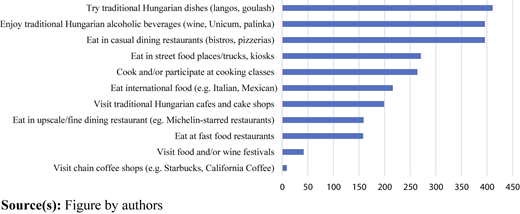
The results in Figure 1 show that Budapest’s unique atmosphere is the most attractive aspect of the city for travellers (as found also in Smith et al., 2023). It has been suggested that the atmosphere of some places is composed of cultural elements such as heritage, music or food, including the identitary traits of food and its connection to sense of place (Paiva, 2023). Atmosphere is followed by consuming traditional Hungarian food (5.76) and drinks (5.31), visiting heritage sites (5.19), and museums and galleries are also highly rated (4.72). These values show that although tourists to Budapest are still attracted by cultural tourism, gastronomy has become the most important activity for many of them. The data also reveals that tourists are more interested in traditional Hungarian food and drink than in more generic dining experiences and international food. Figure 2 goes deeper into these preferences and shows the types of food and beverage that are actually being sampled by tourists in Budapest. The aim of this question was to gain an idea of whether tourists are mainly consuming typical Hungarian dishes, international cuisine, fast food, or are seeking other types of experience like fine dining or street food. Casual dining and street food are popular options. Interestingly, food and wine festivals were not ranked very highly compared to the previous study by Smith et al. (2023) but more of an interest in cookery classes was expressed. It should be noted that there is a Budapest Wine Festival in September (the month when the data was collected), so the time of year did not influence this response negatively. Clearly, the budgets of many tourists would not stretch to fine dining (e.g. Michelin star restaurants), so fast food is ranked equally highly. Until recently, Budapest attracted relatively large numbers of budget airline travellers, but current campaigns are aiming at more premium and luxury travellers (McKinsey and Company, 2024). For many decades, Budapest was relatively famous for its traditional cafés, and they are still an important feature of life in the city (Módis, 2024), but reference has also been made to a “new wave of thinking” about how coffee is “combined with the city’s existing traditions” (Hungarian Tourism Agency, 2024). Although the data shows that tourists are still somewhat interested in traditional Hungarian cafés and cake shops and they are more popular than chain coffee shops like Starbucks, they are ranked lower than eating international food. This suggests that more effort could be made to promote traditional Hungarian café experiences.
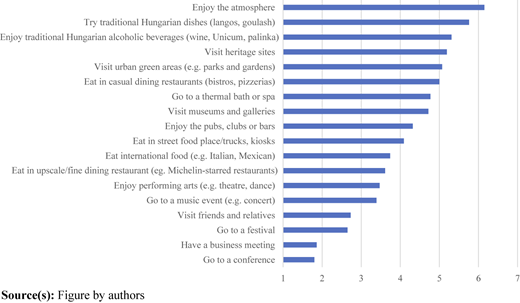
Relative importance of given activities on a trip to Budapest (Likert scale 1–7)
Relative importance of given activities on a trip to Budapest (Likert scale 1–7)
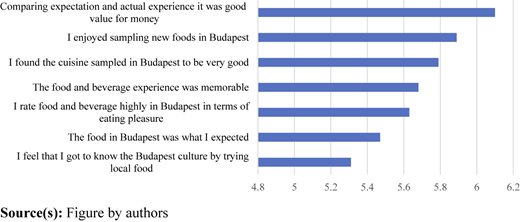
The third figure (Figure 3) examined the expectations and experiences of the sampled tourists. It can be seen that tourists were satisfied with the value for money, but this is typical of visitors to Eastern European cities for whom prices seem relatively low. It seems that tourists enjoyed trying new foods and rated their experiences quite highly, but the gastronomic experiences did not necessarily connect them to local culture very directly. This is no doubt typical of cities, in which the origins of food and the local landscape or terroir are not directly visible to the tourists. Of course, storytelling or promotion could help to fill this gap.
When asked about how Budapest compares to other cities in terms of gastronomic experiences, the scores were as follows:
For food experiences, Budapest is better than most other cities that I have been to (4.45)
I prefer Budapest over other places for food experiences (4.3)
I get more satisfaction out of food experiences in Budapest than any other places (4.08)
While the scores do not seem excessively high, it is not possible to compare these scores with other cities unless the same questionnaire were replicated in other European urban destinations.
Further questions were asked about the tourists’ eating habits relating to sustainability and local food production. Many of the respondents thought that locally produced food tastes better (4.93) and they would prefer to visit a restaurant using locally produced food than one that does not (4.83). A relatively high number stated that the local food economy was important to them (4.66) and they would be willing to pay more for a restaurant that serves locally produced food (4.43).
Discussion
The research indicates that despite the popularity of gastronomy in Budapest and respondents’ evident preference for sampling Hungarian dishes, gastronomic tourism is still in its relative infancy as a form of special interest tourism in the city. Budapest is not one of UNESCO’s Creative Cities of Gastronomy where its cuisine would be a major showcase for the destination (in fact, Budapest is a designated UNESCO City of Design instead). It is not yet one of the 14 C40 Good Food Cities that are focusing on health and sustainability. The city does not usually make Top 10 lists of European food cities (e.g. Time Out), but it was ranked number 11 in the best cities in Europe for wining and dining (Starbuck, 2024). It was also voted 10th among Europe’s best brunch destinations (Daily News Hungary, 2024) and Bernier (2022) listed Budapest as one of the Top 10 Street Food Capitals of Europe. UCityGuides (2025) voted the Budapest New York café “the most beautiful in the world” and it is claimed that Budapest’s café culture is as vibrant as ever (Hungarian Tourism Agency, 2024).
The findings from the data collection suggest that tourists value locally produced food and many would be willing to pay more for it. Such decisions help to support regenerative agricultural practices (Forleo and Benedetto, 2020; Stalmirska and Ali, 2023) and contribute to tourist satisfaction and advocacy (Estrada et al., 2023). Tourists should be directed away from TripAdvisor reviews towards more sustainable restaurants to avoid “foodification” that results in inauthentic and touristified experiences (Loda et al., 2020; Ganzaroli et al., 2021).
It is clear that gastronomy needs to be placed at the centre of Budapest’s strategy to encourage both employment and tourism development (Derek, 2020) and to focus more on the role of gastronomic experiences in the creation of destination image (Amore and Roy, 2020). These experiences arguably need to be more interactive and involve local residents to create stronger links to culture and communities and enhance social sustainability (e.g. local food markets, festivals, cooking courses). To increase the popularity of food and wine festivals, they could be combined with cultural or creative activities. Storytelling through guided tasting tours could also be used to weave narratives about the connections between food, culture and communities. One successful example of this is the company Taste Hungary (2025), which aims to “share stories to put Hungarian history and culture into context, and introduce the delicious foods and drinks that make Hungary’s food culture so unique”.
Conclusion
This article has shown the increasing importance of gastronomy as a potential form of special interest tourism. The range of gastronomy-related activities in cities is growing to include not only restaurants, but also food markets, festivals, cookery classes, food tours and more. Despite multiple motivations for visiting cities, it seems that urban tourists are starting to value gastronomy-related experiences even more than cultural attractions. Previous studies had shown the importance of gastronomy, but they had not always differentiated between preferences for traditional local food compared to international or fast food. This study shows that urban tourists tend to prefer sampling food that is typical of the city or the country that they are visiting, but that they are equally as likely to eat fast food as to pay for fine dining. This is no doubt a budgetary issue, as many of the sampled tourists in this study would have arrived by low-cost airlines. In addition, more than a third of the respondents were travelling in groups or with a family, so they would also not be as likely to opt for time-consuming culinary experiences like fine dining. Many of the experiences seemed to be more hedonic than cultural, and satisfaction levels were relatively high, even if they were not that memorable. It seems that there would be some potential in trying to attract tourists to restaurants that make use of local ingredients, and some tourists would even be willing to pay more for this unique experience. Overall, the data provides new insights into the motivations, activities and preferences of urban tourists in relation to gastronomy. The research can help city agencies to promote traditional gastronomy further and to encourage consumption in restaurants that use local ingredients. Some attention needs to be paid to affordability, but the social implications could be very positive for food and drink producers and suppliers, not to mention restaurateurs.
Limitations
This research did not include the whole range of gastronomic experiences available to urban tourists, for example, food markets were not included, and neither were food tours and tastings. Future research should focus in more depth on the full range of opportunities available to tourists in a city and ideally, such experiences should be compared across different cities (e.g. UNESCO Creative Cities of Gastronomy or Top 10 European Food Cities). More attention could also be paid to issues of sustainability, including the production and supply of food to cities and the promotion of local ingredients and culinary traditions. It would also be interesting to assess whether there were significant differences between genders, age groups and solo travellers compared to couples or groups.

