This study aims to explore the role of organizational learning in effective strategy execution among transport firms in Uganda.
Qualitative data was collected using a semi-structured interview guide from 9 multiple cases that composed 21 key informants. The analysis of transcripts used a thorough thematic analysis approach and QSR NVivo 9 software. Verbatim texts were used to explain the emergent themes.
The findings show that organizational learning in the form of knowledge acquisition, knowledge distribution, knowledge interpretation and organizational memory contributes effectively to strategy execution among transport firms in Uganda.
The study offers initial evidence-based results on the contribution of organizational learning capability toward effective strategy execution from road transport firms that operate in a dynamic environment. This aspect has not been adequately highlighted in previous studies.
1. Introduction
The research question being addressed in study is:
What is the role of organizational learning to effective strategy execution among transport firms in Uganda
Theoretically, how an organization acquires, interprets, distributes and stores knowledge (organizational learning) is likely to affect execution of strategies (Argyris and Schön, 1978). To support this assertion further, the dynamic capabilities theory posits that competitive advantage of firms lies in their managerial and organizational learning (Teece et al., 1997). Also, Teece (2018) shows that top management team can use internal and external data to continuously monitor the firm’s environment, prioritize problems and identify new opportunities. Thus, since transport companies operate in a dynamic environment, managers must continuously study and learn the organizational environment. This is likely to determine the execution of strategies from an informed perspective. Previously, organizational learning as a dynamic capability has been found to predict firm performance (Giniuniene and Jurksiene, 2015; Farzaneh et al., 2020; Ferreira et al., 2021) and competitive advantage (Namada, 2018; Appelbaum and Gallagher, 2000). As such, it is likely that organizational learning can be crucial for strategy execution in transport companies, although its contribution has remained empirically unknown in the context of transport companies.
Several seminal studies (Tawse and Tabesh, 2021; Beer et al., 2005; Okumus, 2003) have made propositions on the relevance of organizational learning in strategy execution. For instance, Okumus (2003) identified organizational learning as a variable that can improve strategy execution by showing how managers, executives and employees can learn and overcome company’s defensive routines. Likewise, Namada (2018) indicated that organizations that learn in knowledge acquisition, information distribution, interpretation and organizational memory succeed with their strategies which bring competitive advantage to the organization. However, there is a paucity of hard empirical evidence on the actual contribution of organizational learning to strategy execution especially in countries with low literacy levels like Uganda (UWEZO report, 2021) with undeveloped transport system (Daily Monitor, 2022). Besides, studies like that of Ssekiziyivu et al. (2023) which tried to address strategy execution in the transport sector concentrated on how such firms successfully execute strategies without showing the contribution of organizational learning to successful strategy execution. In response to the aforementioned gaps in the existing theoretical and empirical literature, this study uses a qualitative research design to collect data from Uganda’s transport firms.
The Uganda’s transport sector is unique in that its current state is entirely in the hands of private players who are struggling to stay afloat after its government fails to operate the transport business(Ndibatya and Booysen, 2020). Also, the Ministry of Works and Transport (MoWT) reported that 45% of road transport firms collapsed while attempting to implement numerous strategies (MoWT, 2022). For instance, Pioneer Easy Bus, which devised plans to alleviate Uganda’s traffic congestion, has made no progress in the decade since its inception in 2012 (Monitor, 2021). Other transportation companies, such as Gaaga Coaches Limited, Elgon Flyer Uganda, Akamba Bus Company, Bahama Blessings and Kampala Coaches, planned to expand their operations along different routes, but instead, they simply went out of business (The Independent, 2022). Therefore, to ensure that the established plans are carried out correctly, actors in the transport sector need to appreciate organizational learning as a crucial capability in dynamic environments.
This study makes three major contributions. First, the study provides evidence on how transport firms can acquire, interpret, distribute and store knowledge to execute their set goals successfully. Other struggling firms can replicate such results to improve their operations. Secondly, the study provides transport companies with theoretical guidance and a practical path to establish dynamic environment and continuous learning to survive in a complicated, ever-changing operating environment. Finally, the study answers a call from scholars like Tawse and Tabesh (2021) and Ssekiziyivu et al. (2023), who have called for a better understanding of the many factors contributing to an effective strategy execution.
The paper’s subsequent structure is as follows: Section 2 encompasses a literature review, Section 3 outlines the methodology and Section 4 details the study’s findings, discussed further in Section 5. The concluding section offers the study’s conclusions and implications.
2. Literature review
2.1 Strategy execution
Iheanachor (2022) defined strategy execution as “putting plans and strategies into action.” Execution represents a disciplined process or a logical set of connected activities that enables an organization to take a strategy and make it work. Without a careful, planned approach to execution, strategic goals cannot be attained (Hrebiniak, 2013). Arnoud (2008) further emphasizes that the adept execution of robust strategies provides organizations with a substantial competitive advantage. In the current turbulent business landscape, the capability to swiftly and effectively develop and execute new strategies can be the decisive factor between organizational success and failure. Hence, well-formulated strategies yield superior performance for organizations only when executed successfully.
2.2 Organizational learning
Organizational learning (OL) is the process through which organizations acquire, interpret, distribute and store knowledge to enhance performance and adapt to changes (Douglas and Haley, 2024). It emphasizes the role of knowledge-based capabilities in shaping decision-making and organizational behavior (Argyris and Schön, 1978; Huber, 1991). OL is essential in competitive markets, as it contributes to building and sustaining a competitive advantage (Teece et al., 1997). In dynamic environments, such as those in the transport industry, OL helps firms address challenges, seize opportunities and improve operational effectiveness (Fleig et al., 2021).
Studies have identified four key constructs of OL: knowledge acquisition, knowledge interpretation, knowledge distribution and organizational memory (Crossan et al., 2021; Schulz, 2021; Huber, 2020). Knowledge acquisition involves gathering information from both internal and external sources, often through strong external relationships (Crossan et al., 2021). Once acquired, knowledge must be disseminated across the organization, a process known as knowledge distribution (Zahra and George, 2002), allowing different departments to address emerging challenges.
The interpretation of acquired knowledge plays a central role in OL, as it shapes decision-making and strategy formulation. Huber (2020) notes that organizational culture influences how knowledge is filtered and applied. Additionally, organizational memory ensures that firms retain knowledge for future use. It includes both formal systems, such as databases, and informal practices, like social networks and internal communications (Schulz, 2021). Robust organizational memory enables firms to recall previous solutions to similar problems, making them more agile and better prepared to tackle new challenges.
2.3 Organizational learning and strategy execution
Studies examining OL and strategy execution in the context of logistics and transport management are scanty. However, recent research suggests that organizations must move beyond evaluating success and failure to recognize valuable learning opportunities in both outcomes. Effective strategy execution requires aligning resources and actions and adapting strategies based on past experiences (Osiyevskyy et al., 2024). According to Douglas and Haley (2024), organizations that integrate learning into their processes enhance their adaptive capacity, enabling them to respond effectively to challenges and disruptions. This adaptability is crucial for real-time adjustments during strategy implementation. Moreover, systematic learning and knowledge-sharing approaches facilitate the smooth flow of information, supporting informed decision-making throughout the execution phase (Douglas and Haley, 2024). Edmondson (2022) argues that the relationship between OL and strategy execution is reciprocal. Effective execution creates opportunities for learning, while a culture of learning enhances strategy implementation. By incorporating feedback loops, collaboration and adaptability into the execution process, organizations are better equipped to navigate challenges and changing environments, leading to improved strategic outcomes.
2.4 Dynamic capabilities theory
Dynamic capabilities theory emphasizes a firm’s ability to adapt to rapidly changing environments by reconfiguring its internal and external resources to sustain competitive advantage (Teece et al., 1997). In the context of the transport sector, this adaptability is crucial as firms must continuously respond to regulatory changes, fluctuating customer demands and technological advancements. Eisenhardt and Martin (2000) conceptualize dynamic capabilities as specific strategic processes that enable firms to innovate and adjust to market changes, making them vital for transport firms operating in fast-evolving environments like Uganda.
This study applies the core components of dynamic capabilities to explore how transport firms in Uganda adapt and execute strategies. Sensing refers to the firm’s ability to detect changes in the external environment, such as government regulations, fuel price fluctuations and evolving customer needs. Seizing involves mobilizing resources to capitalize on identified opportunities, reflected in the adoption of new technologies and forming strategic partnerships. Reconfiguring refers to adjusting internal processes and resources, such as optimizing fleet management practices and restructuring operational routines to meet emerging challenges. By continuously learn from their experiences and the external environment, transport firms in Uganda can refine their strategic processes to stay adaptable and competitive. This enhance their operational efficiency and long-term sustainability (Kazmi and Ahmed, 2022). By integrating sensing, seizing and reconfiguring into their strategy execution, transport firms can maintain a competitive advantage in a dynamic market.
Despite its relevance in this study, the dynamic capabilities theory does not fully capture the process of knowledge acquisition, distribution and retention, which is crucial for effective strategy execution. This is taken into consideration by the Organizational Learning Theory (OLT) (Argyris and Schön, 1978).
2.5 Organizational learning theory
The OLT explains how organizations acquire, process and apply knowledge to improve decision-making and adaptability (Argyris and Schön, 1978). According to this theory, learning is not merely accumulating knowledge but also involves modifying behaviors based on experiences and environmental changes. For learning to occur, the firm must consciously decide to change its actions in response to shifts in circumstances, link actions to outcomes and retain knowledge in organizational memory for future use (Hedberg, 1981). Learning occurs when information is shared, stored and accessed for strategic decision-making (Huber, 1991).
OLT is often divided into two main processes: single-loop and double-loop learning. Single-loop learning involves making adjustments to improve performance without altering underlying policies and goals. In contrast, double-loop learning involves reevaluating and modifying these underlying assumptions and objectives in response to environmental changes (Argyris and Schön, 1978). To be competitive in a changing environment, organizations must learn to change their goals and actions to reach those goals. For instance, when transport firms face disruptions such as fuel price fluctuations, regulatory changes or technological advancements, they must adjust their operational processes (single-loop learning) and reconsider their strategic frameworks (double-loop learning). A firm that continuously adapts its business model, invests in innovative logistics solutions and improves fleet management based on market trends demonstrates the essence of OL. The next section describes the methodology used.
3. Methodology
3.1 Research design
This study used a narrative case study methodology conducted using qualitative data collection technique specifically the appreciative inquiry to examine the role of OL to effective strategy execution among transport firms in Uganda. Case studies offer an in-depth and inductive method for exploring complex phenomena (Yin, 2009). Conducting multiple case studies allows for comparisons across different contexts, enabling the identification of patterns and common occurrences (Yiga et al., 2023). This approach enhances the depth of analysis by examining similarities and differences across case
3.2 Data collection, sample technique and procedure
Qualitative data were collected from nine cases using a semi-structured interview guide based on the Appreciative Inquiry approach (Yiga et al., 2023). A purposive sampling technique was used to select key informants, ensuring participants had relevant knowledge and experience in strategy execution within transport firms. The key informants consisted of senior managers, operations managers and firm owners from three commuter taxi firms and six bus firms. In total, 21 key informants were interviewed. Their strategic roles in decision-making guided participant selection, as higher-ranking respondents tend to provide more reliable insights compared to lower-ranking employees (Phillips, 1981). Additionally, senior managers play a crucial role in both strategy formulation and execution within transport firms (Mintzberg, 1973).
The study adhered to the principle of data saturation, where interviews continued until no new insights emerged (Miles and Huberman, 1994). By the 9th case, the responses became repetitive, indicating that further data collection would likely not yield new themes. This does not imply that participants were chosen based on similar views but rather that the study reached a point of theoretical saturation, where the gathered data sufficiently addressed the research questions.
To enhance data triangulation, at least two senior managers were selected from each transport firm, ensuring diverse perspectives within each case. This approach strengthened the credibility of the findings and provided a well-rounded understanding of strategy execution in Uganda’s transport sector. we also observed what was taking place in the transport firms and compared the views that were given by senior managers during the interview time. Additionally, we observed the activities within the transport firms and compared these observations with the views shared by senior managers during interviews. The study also received ethical review and approval as well as institutional permission for publication.
3.3 Data analysis
The analysis of transcripts used a thorough thematic analysis approach deriving categories or themes from the transcripts, guided by our research question. This method was preferred because it provides a holistic approach to inductive concept development while meeting the high standards for scientific rigor (Gioia et al., 2012). Interview recordings were transcribed, coded and analyzed using NVIVO software. We also ensured that each case was assigned a code number as Miles and Huberman (1994) and Creswell (2013) recommended. Cases generated through the interview guide were transcribed to inform both theory and practice (Qu and Dumay, 2011). The research team reviewed and refined all transcripts to uphold quality standards.
4. Findings
4.1 Respondents characteristics
Results from Table 1 indicate that the nine cases are composed of six bus firms and three commuter taxi firms. A total of 21 top managers were considered for interviews because of their knowledge and experience regarding strategy execution. These included seven general managers, three finance managers, seven operation managers, two human resource managers, one senior driver and two directors. Most of the interviewees were over 30 years old, with most of them having a bachelor’s degree and on average having 10 years of working experience in the transport sector. We also ensured that at least every route from which transport firms operate is represented in the study.
4.2 Role of organizational learning to effective strategy execution among transport firms
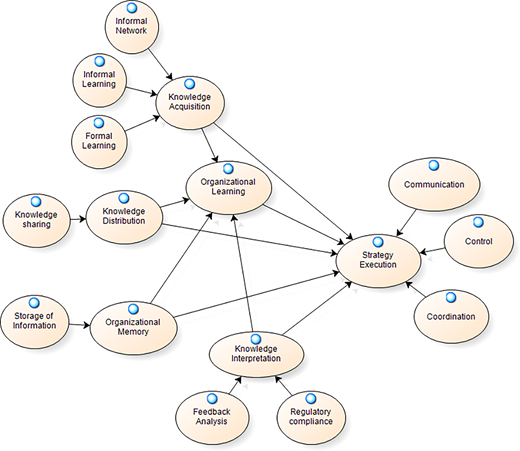
The findings highlight how transport firms in Uganda leverage OL to enhance strategy execution, aligning with both Dynamic Capabilities Theory (Teece et al., 1997) and OLT (Argyris and Schön, 1978). Four key learning mechanisms emerged: knowledge acquisition, knowledge interpretation, knowledge distribution and organizational memory, each playing a role in improving strategic outcomes. The emerging themes and sub themes are indicated in Figure 1.
4.2.1 Knowledge acquisition and strategy execution.
Transport firms acquire knowledge through informal learning, informal networks and formal networks, enabling them to adapt and execute strategies effectively.
Informal Learning: Transport operators actively gather insights to enhance efficiency. For example, a transport owner (Case 4) emphasized learning vehicle conditions firsthand: “I ensure that I have driven all these cars every week […] to detect mechanical issues early, minimizing breakdown costs.” Another operator (Case 6) noted real-time information sharing: “I always get signals from colleagues about traffic, accidents and road conditions, allowing me to react swiftly.” These insights illustrate the sensing capability of Dynamic Capabilities Theory, where firms identify challenges and opportunities through continuous experiential learning.
Informal Networks: Collaboration among competitors fosters business growth. One respondent (Case 2) stated:
Though we compete, we are a family in this park. If I identify a good opportunity, I share it with others […] during school times, my teacher friends notify me to pick students.
This demonstrates knowledge diffusion, enhancing collective problem-solving and strategy execution.
Formal Networks: Participation in industry events exposes firms to valuable business intelligence. A transport operator (Case 4) shared: “Attending a conference by UBOA and MoWT helped me identify MAC East Africa for reliable spare parts, reducing operational costs.” Such interactions align with the seizing capability of Dynamic Capabilities Theory, where firms recognize and act on beneficial opportunities.
4.2.2 Knowledge interpretation and strategy execution.
As seen below, interpreting acquired knowledge helps transport firms refine strategies, aligning with OL processes.
Customer Feedback Analysis: Firms actively use feedback to improve services. One manager (Case 8) stated: “We collect feedback from customer care numbers written on our taxis, analyze it, and use it to enhance our Western route service.”
Regulatory Compliance: Adhering to legal requirements ensures smooth operations. A respondent (Case 9) noted: “We must comply with MoWT by securing a route chart, PSV, and insurance. This avoids penalties and disruptions.”
The above cases illustrate how firms use knowledge interpretation to align with environmental demands, reinforcing the reconfiguring capability of Dynamic Capabilities Theory by adapting to regulations and customer expectations.
4.2.3 Knowledge distribution and strategy execution.
Knowledge sharing fosters efficiency and resilience among transport firms. this is explained under the following sub theme that emerged.
Technical Support Networks: Transport firms maintain emergency contacts for quick mechanical assistance. A respondent (Case 2) stated: “We keep a list of mechanics on each route […] if a bus breaks down, a nearby technician is called immediately, reducing accident risks and delays.” This reflects the OL principle of knowledge distribution, ensuring firms act swiftly on emerging challenges.
4.2.4 Organizational memory and strategy execution.
Transport firms store and utilize past knowledge to improve control measures and strategic decision-making. This is further demonstrated in the following sub themes that emerged.
Stored Information as a Control Measure: Documented financial records help detect fraud. A transport owner (Case 1) noted: “We employ accountants and auditors to analyze records, allowing us to implement control measures against fraud.” Another firm (Case 3) adopted digital solutions: “We installed a ticketing system that automatically records transactions, ensuring revenue accountability.” This demonstrates organizational memory, where firms leverage stored knowledge for strategic control and decision-making.
5. Discussion
The findings indicate that OL play a significant role in ensuring effective strategy execution among transport firms. This learning is in form of knowledge acquisition, knowledge distribution, knowledge interpretation and organizational memory. As transport firms transform into learning organizations, they gain significance by embracing flexibility whenever and wherever necessary (Srivastava and Sushil (2014). The results support the dynamic capabilities theory (Teece et al., 1997), which explains the need for firms to continuously reconfigure their existing resources and capabilities and integrate them into the firm’s existing processes, systems and practices to match changing conditions.
The findings indicate that when transport firms actively engage in seeking new information through informal learning, having informal and informal networks, continuously update themselves and refine their understanding about the transport management issues, they are in position to achieve the set goals. This finding agrees with the works of previous scholars such as Bhimavarapu et al. (2019) who stress that learning enables organizations to determine correlations and linkages between previous successes and failures as early as possible which enable such organizations to adapt quickly to the environment and improve operations. Also, Patalas-Maliszewska (2015) argues that acquiring external knowledge can efficiently provide users the necessary support to achieve strategic results. However, Patalas-Maliszewska (2015) study was carried out in Polish manufacturing firms.
The study revealed that knowledge interpretation in form of customer feedback analysis and regulatory compliance enable transport firms to identify areas for improvement in terms of efficiency, safety, punctuality and overall customer satisfaction to remain competitive in the job market. This finding is in line with other studies showing that open strategizing practices such as feedback analysis contribute to effective strategy execution in a geographically dispersed Dutch national prison agency (Doeleman et al., 2022). Similarly, Namada’s (2018) study also indicates that in a turbulent environment, organizations gather information by experimenting and observing the competitive landscape before taking action. This process enables firms to interpret the needs of customers effectively and satisfy them. likewise, Karlsen et al. (2023) study also found that feedback and the ability to self-evaluate was key in determining the success in organizations.
In relation to knowledge distribution, results indicate that information sharing among employees contributes to effective strategy execution. This result is consistent with findings of Ater et al. (2023) who argued that knowledge sharing improves the implementation of strategies among commercial banks in South Sudan. Regarding the contribution of organizational memory, transport firms in Uganda use the stored information as a control measure to manage losses. When employees have access to performance data, feedback and success stories, they can identify areas for improvement and learn from past experiences. This promotes a learning, innovation and continuous improvement culture, where employees refine their skills, adopt best practices and contribute to the organization’s growth and goal achievement. The results of this study are consistent with dynamic capabilities theory (Teece et al., 1997), which emphasizes the importance of adaptability in strategy execution. Organizational memory provides a foundation for adaptive behavior by helping organizations recognize and respond to changes in their internal and external environments. Using past experiences, organizations can adapt strategies, processes and resource configurations to adapt to new circumstances and address implementation challenges.
6. Conclusion and implications
This study has examined the role of OL in ensuring effective strategy execution among transport firms in Uganda. The findings indicate that firms actively engaging in knowledge acquisition, distribution, interpretation and retention are better positioned to navigate industry challenges and execute strategies successfully. However, the extent and effectiveness of these learning processes vary across firms based on factors such as firm size, resource availability and technological adoption. While larger, more formalized firms tend to have structured learning programs, such as internal training and digital knowledge-sharing platforms, smaller or informal operators often rely on experiential learning and peer networks.
Theoretically, this study contributes to Dynamic Capabilities Theory (Teece et al., 1997) by demonstrating how transport firms develop sensing, seizing and reconfiguring capabilities through learning processes. Firms that continuously acquire and apply knowledge such as adopting global positioning system tracking systems or mobile payment platforms to enhance their ability to sense and seize opportunities, leading to improved service delivery and competitive advantage. Furthermore, firms that reconfigure their operations by integrating digital tools or optimizing resource allocation are more adaptable to changing market conditions, reinforcing the role of learning as a dynamic capability. These findings also align with Argyris and Schön’s (1978) perspective on OLT, as firms that systematically reflect on past experiences and adjust their strategies demonstrate higher adaptability and decision-making effectiveness.
Empirically, the study highlights key patterns in how OL is implemented. For instance, some firms invest in formal training programs to upskill employees, while others adopt an informal approach where learning occurs through on-the-job training and mentorship. The study also reveals that firms that engage in cross-functional collaboration such as interdepartmental meetings to share insights tend to experience better alignment between strategic goals and operational execution.
From practice, the findings emphasize that managers in transport firms should implement structured learning mechanisms to improve strategy execution. Regular training sessions, mentorship programs and peer-learning workshops are essential for developing key competencies. To enhance decision-making, firms should also leverage technology, such as digital knowledge repositories and real-time performance dashboards. For smaller firms with limited resources, cost-effective solutions like WhatsApp groups, peer-learning sessions and mentorship programs offer practical ways to facilitate knowledge-sharing and skill development.
At the policy level, regulatory bodies such as the MoWT and kampala capital city authority should foster a knowledge-sharing culture by establishing industry-wide learning forums. These platforms would enable transport firms to exchange best practices, discuss regulatory challenges and develop sector-wide innovations. Encouraging partnerships between large and small firms could also facilitate knowledge transfer, enabling resource-constrained firms to benefit from industry expertise.
7. Limitations and areas for further research
The study’s cross-sectional design restricted the ability to track changes over time, suggesting that future research should adopt a longitudinal approach. Additionally, the study focused solely on road transport firms, excluding key players like boda operators, bicycle transporters and private transport providers, limiting the generalizability of the findings. The small sample size further constrains broader applicability, and reliance on perceptions from firm representatives may introduce subjective biases. Future studies should incorporate larger, more diverse samples and integrate objective performance metrics to enhance validity. Despite these limitations, the study offers valuable insights into Dynamic Capabilities theory and OLT, emphasizing the role of OL in strategy execution.
The authors would like to express their sincere gratitude to the anonymous reviewers for their constructive feedback, which significantly improved the quality of this paper. They also thank the African Academy of Management for their valuable guidance and insightful comments that helped shape the development of this work.
Funding: Authors did not receive any funding.
Conflict of interest: Authors declare no conflict of conflict.