Integrated reporting (IR) provides a joint overview of an organisation’s financial and sustainability performance and strategies. While the prior literature often critiques IR’s potential to entrench injustice, a systematic approach has not been followed. Therefore, this paper provides a systematic literature review, uncovering IR injustices, informing the development of an IR injustice assessment framework to identify injustices and a research agenda.
Combining Flyvbjerg’s phronetic social science and the phases of the IR idea journey to focus on injustice, this paper reviews published IR articles to inform a critique of IR. As a result, we identify specific injustice(s), the actors responsible for them, as well as the victims, as a basis for recommendations for praxis through the development of an IR injustice assessment framework and a research agenda.
We find that different approaches are needed in each phase of the IR idea journey. In the (re)generation phase, a pluralistic approach to IR is needed from the very beginning of the decision-making process. In the elaboration phase, the motivations and the features of IR are assessed. In the championing phase, IR champions support radical innovation, whereas IR opponents are obstructing its spread. In the production phase, the extent to which IR and integrated thinking are linked to the business model is assessed. Finally, we find that IR’s impact is often limited by the symbolic implementation of its tenets.
The findings suggest a need for companies to rethink the ways in which IR is implemented and used to analyse the ways in which IR is supported and disseminated within and outside the organisation, to focus on internal processes and to reflect on the expected impact of IR on the company’s stakeholders.
This study represents the first systematic approach to identifying IR-related injustices, involving how IR adoption might create injustices and marginalise certain stakeholder groups, and offering recommendations for praxis. Furthermore, the paper details the role of IR in either mitigating or amplifying these injustices and develops a research agenda.
1. Introduction
Integrated reporting (IR) is promoted as a way of addressing several of the shortcomings of traditional financial reporting by being more forward-looking (Farooq et al., 2024), explaining the company’s strategy and business plan for value-creation, and integrating information on social and environmental matters with traditional financial information (De Villiers and Dimes, 2023; Umair, 2023). However, Rowbottom (2023, p. 885) argues that the recent incorporation of the International Integrated Reporting Council (IIRC, 2020), which promoted IR, into the IFRS Foundation, has led to the idea that sustainability reporting should prioritise only “those socio-ecological issues deemed to materially affect future enterprise value” (IFRS, 2022). This would also suggest a shift from a short- to a long-term orientation (Tweedie and Martinov-Bennie, 2015; Rodrigue, 2015). Indeed, IR continues to be criticised for its investor focus, “re-drawing or simply reenforcing power dynamics and inequality” (Rodrigue et al., 2024, p. 4). In a word, IR is perpetuating injustices.
Stacchezzini et al. (2016) argue that IR is unable to contribute effectively to sustainability management and can instead be used as a communication strategy to enhance legitimacy or conform to norms, potentially acting as a corporate veil to shield internal practices (Deegan, 2007; Larrinaga-González, 2010). This symbolic use improves corporate image without real sustainability management and hides injustice (Tregidga et al., 2014). Flower (2015) critiques IR’s potential to entrench injustice and the powerful. According to Dillard and Vinnari (2017), a critical approach is required to identify potential injustices that could arise from accounting. However, despite several general critiques (e.g. De Villiers and Sharma, 2020; Rodrigue et al., 2024), no single study provides an overview of the role of IR in aiding, entrenching or ameliorating injustice in society.
Therefore, this study answers the following research question (RQ): How does IR create and entrench (or ameliorate) injustice(s)? This question is answered by reviewing the IR literature, focusing on injustice, power relationships and identifying recommendations for praxis.
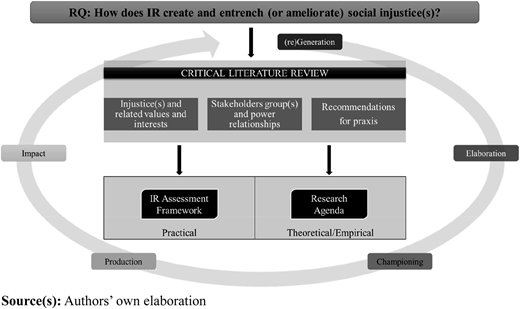
We analysed the literature using a synthesis of Flyvbjerg’s (2001) conception of phronetic social science and the IR idea journey (Perry-Smith and Mannucci, 2017; Rinaldi et al., 2018) [1]. The literature review allows us to develop and contribute the following:
In terms of praxis, an IR injustice assessment framework that could help facilitate tensions between different points of view that emerge in the different phases of the IR idea journey, and
In terms of theory, a research agenda to address areas where a better understanding would be helpful.
The process described in this paragraph and the organisation of the paper’s findings are depicted in Figure 1.
Flyvbjerg’s phronetic social science was particularly useful in surfacing injustice (Dillard and Vinnari, 2017). According to Flyvbjerg’s (2001) phronetic social science, an injustice is a violation of values and interests that undermines the social good, ethical considerations and power balance within a community/society. Considering the importance of context, practical wisdom (phronesis) and value-rationality in addressing social issues, an injustice is an action or situation where the interests of the less powerful are ignored by those in power, leading to harm or unfair treatment (Flyvbjerg, 2001). The IR idea journey theoretical framework (Perry-Smith and Mannucci, 2017) was helpful because of its ability to stratify the IR literature (Rinaldi et al., 2018), which allowed for a more refined identification of the injustices that emerge during each phase of the idea journey. During the analysis of the literature, it became clear that there were areas of potential injustice that had not been explored adequately to inform a complete understanding. This formed the basis for, and informed, the development of the research agenda we identify.
This study contributes to the IR research literature by identifying how IR addresses (or exacerbates) injustices and explores the implications for IR practice and research. First, by analysing the evolution of research, it uncovers insights into the adaptability and resilience of capitalist hegemony in IR (e.g. Brown and Dillard, 2014). Second, it deepens understanding of addressing injustices resulting from IR adoption by providing recommendations for praxis (e.g. Dillard and Vinnari, 2017; Rodrigue et al., 2024). Third, by inquiring power relationships, it examines how IR is sidelining specific stakeholder groups in discussions about the values pursued in reporting a company’s performance through IR (e.g. Adams, 2017).
The results of the critical literature review contribute to both theory and practice. By identifying injustices (which are also summarised in a table), this study contributes to the literature, detailing the role of IR design (at the policy level) and adoption (at the organisational level), in either mitigating or amplifying injustice in each phase of the IR journey.
From a theoretical perspective, the findings firstly identify and provide a complete overview of, IR-related injustice, while identifying the different mechanisms of power and the categories of stakeholders that stand to lose or gain in each phase of the IR journey; and secondly inform the development of a research agenda, identifying areas that could be better understood through further research. In addition, the integration of the phronetic social science approach with the IR idea journey provides a valuable theoretical framework, which could be adopted in future qualitative studies to better understand, at the organisational level, the kind of injustices produced/ameliorated by IR throughout its adoption and, at the policy level, potential adjustments to the current framework.
From a practical perspective, the findings inform the development of the IR Injustice Assessment Framework, which identifies specific injustice(s) produced by the different groups of stakeholders, the actors responsible for the injustice(s) as well as those that suffer from them, as a basis for recommendations for praxis. Specifically, companies and other stakeholders can use this framework to assess the company’s IR journey, first to locate a company’s position along the IR journey (when adopting, implementing and refining IR), and, second, to identify, highlight and manage injustices that may arise along each phase of the journey.
The remainder of this paper is organised as follows. Section 2 discusses the evolution of the IR concept, while section 3 explains the method employed, with a particular focus on Flyvbjerg’s (2001) conceptualisation of phronetic social science. Section 4 analyses the IR research. Section 5 develops/discusses the IR Injustice Assessment Framework and the research agenda, and Section 6 concludes.
2. IR: evolution of the concept
After the formation of the IIRC, IR was recognised for its potential to harmonise internal and external stakeholders (Farneti et al., 2019) and to drive change through integrated thinking (Al-Htaybat and Von Alberti-Alhtaybat, 2018; Dimes and De Villiers, 2020; Maroun et al., 2023), and to enhance sustainable value creation (IIRC, 2017; Eccles, 2014). The IIRC has defined IR as “a concise communication about how an organisation’s strategy, governance, performance, and prospects, in the context of its external environment, lead to the creation of value in the short, medium and long term” (IIRC, 2013, p. 7). Together with integrated thinking, IR can be adopted by companies to address environmental, social and governance (ESG) issues to improve the quality of their sustainability disclosure and, ultimately, to generate benefits for society (Eccles et al., 2015), as it is related to the concept of value creation (Pigatto et al., 2023). IR provides a step forward towards a new global reporting framework aimed at simplifying organisational reporting, while improving its effectiveness in a constantly changing world (Higgins et al., 2014). Although IR incorporates novel ideas related to corporate disclosure, its purpose and concept are still contested (Flower, 2015; Brown and Dillard, 2014; Higgins et al., 2014; van Bommel, 2014). Rinaldi and colleagues have analysed the socio-historical construction of the concept as an “idea journey”, from its conception to its dissemination (Perry-Smith and Mannucci, 2017; Rinaldi et al., 2018). Previous studies (e.g. Rowbottom and Locke, 2013) identified the influential actors – i.e. business, social and regulatory organisations – that are shaping IR development. However, different actors have intervened in different phases of the journey and through different power relationships (Rinaldi et al., 2018). One of the major challenges for IR today is the need to become widespread and relevant for a variety of stakeholders and to have an impact for stakeholders and the society at large within a wide range of reporting frameworks (De Villiers and Dimes, 2023).
Recent years have seen the consolidation of various disclosure standards bodies towards a global baseline for sustainability-related disclosures. Specifically, in 2020, the IIRC merged with the Sustainability Accounting Standards Board (SASB) to create the Value Reporting Foundation (VRF) (VRF, 2021). In 2021, the VRF and the Climate Disclosure Standards Board (CDSB) were consolidated into the IFRS Foundation, which is aimed at developing high-quality, understandable, enforceable and globally accepted accounting and sustainability disclosure standards (De Villiers et al., 2024). Furthermore, the future of IR is expected to evolve significantly in the coming years, considering the recent developments of the European Sustainability Reporting Standards (ESRS) and the Corporate Sustainability Reporting Directive (CSRD). In particular, EU legislative developments are advancing the joint provision of financial and sustainability information (Barrantes et al., 2022). Regarding reporting formats, the implementation of the CSRD modifies corporate reporting in the EU by requiring companies to integrate sustainability information into the management report of their annual report (Baumüller et al., 2021). These developments have faced criticism (e.g. Eccles, 2021). Given that the IFRS Foundation’s founding documents state their raison d’etre as investor protection, these recent developments raise questions about the place of IR’s holistic approach in corporate reporting (De Villiers and Dimes, 2023). Indeed, stakeholders have different interpretations of sustainability, with investors focused on the sustainability of the enterprise and environmentalists more concerned about the sustainability of society and the environment (Eccles, 2021).
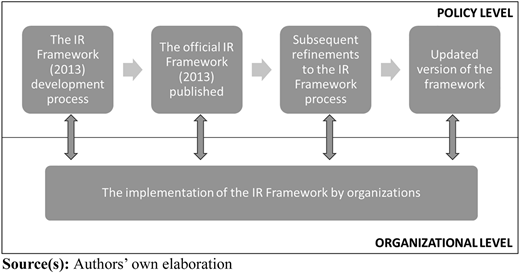
Along with this study, we consider and critique the literature focusing on I) the development of the IR framework, II) the implications of its adoption by firms and III) the subsequent refinements that might have emerged. Thus, considering the potential interconnections between them, we consider two different levels of analysis, namely the policy and the organisational levels (Figure 2).
By reflecting on how an organisation implementing the current IR framework creates and entrenches(or ameliorates) injustice(s), this study provides a better understanding of whether and how evidence provided by IR research can be used to facilitate the achievement of these objectives by producing relevant research, eventually identifying an assessment framework to mitigate the risk of producing injustices by means of IR adoption. This study adopts the phronetic social science approach in the context of IR to identify 1) how power relations changed along the IR journey, 2) by discussing emerging injustices and marginalised actors of IR framework, for example, 3) by identifying the (un)accomplished phases of IR and 4) offering a systematic representation of recommendations for praxis to produce a more inclusive and impactful corporate report through IR.
3. Method
3.1 Data selection
We included generalist and top-tier specialist journals (e.g. Guthrie et al., 2012; Raffournier and Schatt, 2010) to ensure contributions from all fields of accounting research in highly ranked journals. We start from 2013, the year the IIRC’s “International <IR> Framework” was published (IIRC, 2013), to the end of 2023. We searched the title, keyword, and abstract fields using Boolean operators. Articles were first searched on the Web of Science with the following keywords: “Integrated reporting”, “IR” and “Integrated report”. Thereafter, an additional manual selection of articles was performed and searched on the websites of the selected journals, following Massaro et al. (2016). We included only articles within the conceptual boundaries and excluded duplicate articles and articles that do not explicitly refer to the IIRC. Of the 917 articles identified in the initial database search, plus 5 from the manual search, 747 articles were excluded because they were out of scope, not dealing with injustices. We reviewed the full text of the remaining 175 articles, excluding a further 15 articles because they did not refer to the IIRC. This led to a final sample of 160 articles analysed following a two-step approach.
3.2 Data analysis
In the first step, we adopted the general tenets of Flyvbjerg’s phronetic social science approach to examining the IR literature (e.g. Dillard and Vinnari, 2017), which is defined as “ethics in relation to social and political praxis, that is, the relationship you have to society [italics] when you act” (2001, p. 55), representing the “social science that matters”. Following Flyvbjerg (2001), phronetic social science refers to the social science that analyses “what is good for human beings as the modality for action and refers to practical value rationality as the appropriate means for relating values to praxis (i.e. values-guided action)” (Dillard and Vinnari, 2017, p. 90). To be relevant, social science should be both praxis-related and value-sensitive (Lukka and Suomala, 2014), with the aim of identifying inputs contributing to the ongoing social dialogue and social praxis by considering the influence of power and the injustices in the dialogic process (Flyvbjerg, 2001) and by providing society with knowledge that can be used to foster dialogue on relevant social challenges and solutions (Lukka and Suomala, 2014).
Thus, a thematic analysis according to the four questions of Flyvbjerg’s (2001) phronetic approach, following Dillard and Vinnari’s adaptation (2017), was performed for each article. We conducted the analysis manually. The following areas were investigated to critically analyse the IR literature:
First, “Specific injustice (problem or risk) identified”, addresses the specific economic, social and environmental injustice(s) by answering the question “Where are we going?”. Since some injustices related among others to IR theory and practice, the current form of the reporting framework, assurance, integration and narrative features will be explored to assess their impact on society at large;
Second, “Values and interests associated with injustice”, analyses the values and interests associated with the injustice(s) the authors were attempting to clarify and deliberate by answering the questions “Is this [direction] desirable?”, “Who governs?”, and “What rationalities are at work when those who govern govern?”. Values and interests associated with an injustice could be related to more traditional trade-offs (investors’ vs society’s interests) but also to some less discussed interests (environmental interests linked to biodiversity loss) in the IR literature;
Third, “Focal constituency group; the group responsible for injustice (power relationships)”, discusses the focal constituency group and the group(s) or institution(s) that are considered primarily responsible for the injustice(s) by answering the questions “Who wins?”, “Who loses?”, “By which mechanism of power?”, and “What kind of power relations are those asking these questions themselves a part of?” This category is supposed to frame which groups are more (less) powerful in designing the form and the content of IR, and in so doing producing (mitigating the effect of) some injustice;
Fourth, “Recommendations for praxis”, presents the authors’ recommendations for praxis by answering the questions “What should be done?” and “What possibilities are available to change existing power relationships?”. New theoretical and practical approaches to the evolution of integrated reporting and thinking are expected to be addressed by this category.
In the second step, articles were classified according to the phases of the “IR Journey” (Perry-Smith and Mannucci, 2017; Rinaldi et al., 2018) to facilitate discussion and identify specific injustice(s), power relations and recommendations for praxis of each phase. The theoretical framework sets out five main sequential phases for the development and implementation of an idea (Perry-Smith and Mannucci, 2017; Rinaldi et al., 2018; Rinaldi et al., 2018):
Generation is the first sequential phase of the IR journey, in which the development of the IR idea is discussed;
Elaboration is the second sequential phase of the IR journey, in which the processes for assessing and developing IR idea are discussed;
Championing is the third sequential phase of the IR journey, in which the potential of the IR idea to change current practices is exploited;
The production phase of the idea journey is related to studies that investigate the process through which the IR idea is transformed into something tangible;
The impact phase analyses the acceptance and recognition of the IR idea in the field.
Although alternative approaches exist in the literature (Dumay et al., 2017a, b; Guthrie et al., 2012), this framework has been selected since it helps in discussing valuable insights related to the subjects that IR accounting researchers have investigated and in identifying possible future research areas (Rinaldi et al., 2018). In particular, the identification of the journey of a specific domain has often been promoted in business discourse to outline adaptation, learning and advancements (Rinaldi et al., 2018). The categorisation has followed the classification proposed in Rinaldi et al. (2018), where available. When the categorisation by Rinaldi et al. (2018) was not available, consistent with their approach, articles were first analysed to understand the issues and problems stated and then grouped into the phase that most closely aligned with them. Based on the analysed sample, the first two phases are more policy-focused, whereas the latter three lean towards an organisational orientation.
Associating the articles to a specific category was done using the authors’ judgement, and, when multiple themes were addressed, the article was assigned to the category judged to be the primary focus of the author(s). The internal, external and construct validity was tested to check the robustness of the research findings (Franklin et al., 2010). First, internal validity was ensured through an initial analysis of a small subset of articles to test the framework before conducting an analysis of the whole sample (Massaro et al., 2016). To ensure the reliability of the literature review, classification for the first ten selected articles was provided independently by each author to validate the classification system and minimise biases (Massaro et al., 2016; Yin, 2009). Along with this process, all decisions made were agreed on by the authors. Moreover, the start and end points of the study were clearly identified as 2013 and 2023, respectively. Second, external validity was ensured through the detailed and accurate reading of titles, abstracts and full papers to select only those articles that could be considered appropriate (McBurney and White, 2009). Third, construct validity was ensured using multiple data sources of evidence (McBurney and White, 2009).
4. Analysis of injustices identified in IR research
The results of the critical literature review conducted are presented in Table 1. The table states the specific injustices identified, the values and interests associated with injustice, and the group(s) responsible for the injustice, which links the identified injustices to the set of values that are supported (neglected) and the power relationships of the different stakeholder groups that specify those who win and lose. i.e. win, or are primarily affected by the injustice(s), i.e. lose. Following Flyvbjerg’s classification on the questions Who gains? Who loses?, the stakeholder groups were identified through a manual coding activity of the papers included in the sample. Different actors, indeed, have intervened in different phases of the journey and through different power relationships (Rinaldi et al., 2018). Hence, the list of relevant stakeholders was drawn, also reporting the journey phase in which prior studies discussed the stakeholder group and related power relationships. Finally, in the coding phase, for each analysed paper, each stakeholder group was associated with a win vs lose category based on the analysis of the power relationships reported in the results and conclusions drawn from the analysed literature. Finally, recommendations for praxis are provided to turn relevant research into actionable practices by replying to the questions: What should be done? and What possibilities are available to change existing power relationships?
5. Discussion
Power plays a key role, as stated by Flyvbjerg (2001, p. 88), “no conception of phronesis can be adequate today unless it confronts the analysis of power”. However, according to the tenets of phronetic social science, power has to be combined with values (Clegg et al., 1996). Value-rationality, in fact, is the validating methodology for conflicting interpretations of reality (Flyvbjerg, 2001). Following Foucault, the analysis of power per se is not fundamentally relevant since “the central question is how power is exercised, and not merely who has power, and why they have it; the focus is on process in addition to structure” (Foucault, 1982, p. 217). By adopting this Foucauldian view, Flyvbjerg developed a set of questions, namely “Where are we going?”, “Is this [direction] desirable?”, “Who governs?”, “What rationalities are at work when those who govern govern?”, “Who wins?”, “Who loses?”, “By which mechanism of power?”, “What kind of power relations are those asking these questions themselves a part of?”, “What should be done?” and “What possibilities are available to change existing power relationships?”, that informed our investigation of the phases of the IR idea journey, which uncover the stages of the development of IR as an innovative practice (Perry-Smith and Mannucci, 2017; Rinaldi et al., 2018). In this section, the results of the critical literature review are discussed against prior studies for each phase of the IR idea journey.
5.1 Development of the IR injustice assessment framework
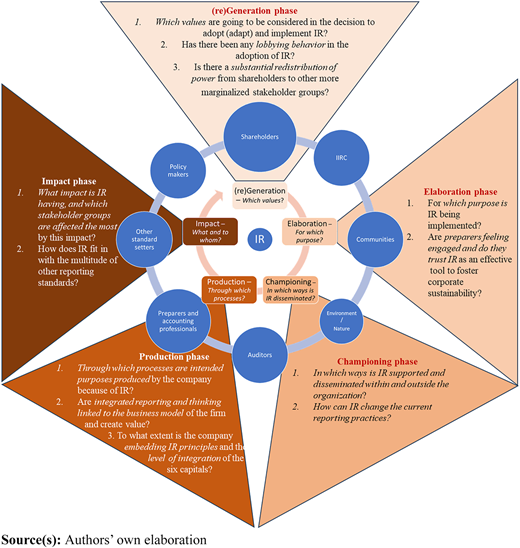
We develop an IR injustice assessment framework that can be used by companies and stakeholders. Practitioners are meant to reply to a set of questions related to the appropriate phase of the IR idea journey to identify, highlight and manage injustices that arise along the journey of adoption (or redesign) of IR (Figure 3).
We discuss the IR injustice assessment framework below for each phase of the IR idea journey.
5.1.1 (Re)Generation phase
Questions: Which values are going to be considered in the decision to adopt (adapt) and implement IR? Has there been any lobbying behaviour in the adoption of IR? Is there a substantial redistribution of power from shareholders to other more marginalised stakeholder groups?
In the (re)generation phase, the company is deciding to undertake the IR journey or to rethink the way in which IR is used, if it has already been adopted. The first crucial question managers should ask themselves is which values will guide their decision to adopt or adapt and implement IR within the company.
Firstly, to address the fragile structure of the IR network, it is particularly important to “embrace and meet the urgent challenges posed by our unsustainable world” (Thomson, 2015, p. 21). Thus, IR should be adopted to support the development of a sustainable corporation operating in a sustainable world, as suggested by previous literature (Thomson, 2015).
Secondly, adopting a pluralistic approach in designing and using the systems and processes for implementing IR is essential, especially to respond “to the calls for more democratic forms of governance in the context of accounting”, in contrast to the current hegemonic accounting regime (Vinnari and Dillard, 2016, p. 25).
Thirdly, top management, such as CEOs, CFOs, and/or sustainability managers, should assess whether lobbying has influenced the adoption of IR as a sustainability tool or if the decision reflects a genuine move towards greater corporate accountability (Reuter and Messner, 2015; Rivera, 2024). To prevent instrumental rationality from shifting the process from democratic pluralism to a more capitalistic ideology in IR’s development (Weber, 1978), professionals and large organisations play a crucial role in the success or failure of IR institutionalisation (Humphrey et al., 2017).
Finally, identifying the motivating factors behind IR adoption is critical (Carmo et al., 2023; Sun et al., 2022; Thomas and Scandurra, 2023). While the main motivation for adopting IR is the perceived advantage over traditional reporting, especially in providing information to capital providers, companies show varying levels of preparedness for the transition. This variation can lead to increased perceptions of costs and complexity. To mitigate this, an evolutionary process towards IR can offer incremental improvements in IR disclosure practices. In this context, managers should also consider whether there is a significant redistribution of power from shareholders to more marginalised stakeholder groups and identify which groups benefit the most from adopting IR, as the literature shows that stakeholders, such as SMEs and users, are often disregarded (Reuter and Messner, 2015; Rivera, 2024).
5.1.2 Elaboration phase
Questions: For which purpose is IR being implemented? Are preparers feeling engaged and do they trust IR as an effective tool to foster corporate sustainability?
During the elaboration phase, where processes for assessing and developing IR ideas are discussed in the company (Rinaldi et al., 2018), the most important question is for which purpose IR is being implemented.
Firstly, the motivations for IR, the sustainable business practices to be introduced (Atkins and Maroun, 2018; Maroun and Atkins, 2019; Brown and Dillard, 2014), and IR features and characteristics should be assessed (De Villiers, Rinaldi and Unerman, 2014; Chaidali and Jones, 2017; Dumay et al., 2019). Therefore, significant efforts are required of policymakers, who should develop a more suitable form of reporting to support sustainability and related challenges (e.g. climate change).
Secondly, since sustainability advocates are calling for more responsible corporate actions (Freeman, 2010) and corporate accountability for their impact on both the environment and society (Roberts, 1991; Antonites and De Villiers, 2003), IR is supposed to facilitate the dialogue between seemingly incompatible values (Milne and Gray, 2013), more specifically capitalism and biodiversity (Atkins et al., 2015a, b; Atkins and Maroun, 2018; Maroun and Atkins, 2019).
Thirdly, in order to overcome the risk of adopting IR as a “discursive object”, De Villiers et al. (2014) suggest it is particularly relevant to monitor the elaboration phase of the IR journey to have a better understanding of the concept, its related development and its adoption in practice.
Finally, a further question to be resolved is whether preparers are feeling engaged and trust IR as an effective tool to foster corporate sustainability. Indeed, IR needs to be recognised as a tool able to promote social and environmental stability and sustainability, beyond its mere financial emphasis.
5.1.3 Championing phase
Questions: In which ways is IR supported and disseminated within and outside the organisation? How can IR change the current reporting practices?
In the championing phase, when the potential of the IR idea to change current practices is exploited (Rinaldi et al., 2018), some peculiar power relationships occur. On the one hand, IR champions support radical innovation within the corporate reporting field, whereas IR opponents are obstructing the spread of IR to maintain the status quo (Dumay et al., 2016). Hence, managers should focus their attention on the ways in which IR is supported and disseminated within and outside the organisation. Indeed, the lack of awareness of the relevance of IR has been identified as a key factor in preventing its adoption (Gerwanski et al., 2022; Maroun and Prinsloo, 2020; Maroun, 2017, 2018, 2019, 2022).
Firstly, increasing the managers’ awareness of the potential of IR assurance could be relevant to improve the quality of information disclosed to stakeholders, thereby enhancing the trust in the reporting tool, and mitigating the risk of greenwashing (Maroun, 2019).
Secondly, IR is expected either to be set aside by mainstream accounting professionals (Humphrey et al., 2017) or to embrace traditional accounting values to branch into an institutionalised accounting practice (Flower, 2015). In both cases, the main aim of IR, namely, to “provide impetus to greater innovation in corporate reporting globally to unlock the benefits of <IR>, including the increased efficiency of the reporting process itself” (IIRC, 2013, p. 2), has not been fulfilled. In this regard, the lack of uniform standard (de Villiers and Sharma, 2020) and little research on the materiality identification and implementation (Steenkamp, 2018) should address a change in the focus of IR moving away from results toward better outcomes in financial terms, as results from previous research suggest (de Villiers and Sharma, 2020) and a more consistent relationship between the materiality analysis and the material issues included in IR (Steenkamp, 2018).
Thirdly, previous studies stressed the importance and difficulty in identifying the various trends of adoption (Ackers and Adebayo, 2022; Al Amosh and Mansor, 2021; Aras and Mutlu Yildirim, 2022; Dameri and Ferrando, 2021; Karwowski and Raulinajtys-Grzybek, 2021; Mirsadri et al., 2021). In particular, managers are encourage to recognise the potential of IR, such as IR intended as a strategy to minimise information asymmetry, to distinguish the company from its competitors and to foster positive organisational change.
Additionally, given the limited change exerted by IR on corporate reporting traditions (Dumay et al., 2016; Humphrey et al., 2017; Bernardi and Stark, 2018; Caglio et al., 2020; Raimo et al., 2020), IR researcher should be more engaged with practice.
5.1.4 Production phase
Questions: Through which processes are intended purposes produced by the company because of the adoption and use of IR? To what extent are integrated reporting and thinking linked to the business model of the firm and create value as part of it? To what extent is the company embedding IR principles and the level of integration of the six capitals?
In the production phase, IR becomes something tangible (Rinaldi et al., 2018). One of the most important questions managers should ask in this phase is through which processes are intended purposes produced by the company because of the adoption and use of IR. A question strongly related to the previous one is to what extent integrated reporting and thinking are linked to the business model of the firm and create value as part of it. In this phase, auditors can support companies in effectively implementing the IR framework (Briem and Wald, 2018). Likewise, the adoption of robust corporate governance mechanisms is likely to enhance the credibility of information disclosed and assured in a company’s IR (Wang et al., 2020). Preparers are the professional group responsible for making this happen (Kwok and Sharp, 2005) since they are directly involved in the preparation of the Integrated Report. Hence, they are exercising most of the power in translating the “principles-based guidance” (IIRC, 2013, p. 2) into a narrative of corporate disclosure for a multitude of stakeholders (Busco et al., 2018), a business model (Sukhari and Villiers, 2019; Feng et al., 2017), and corporate governance (Zhong et al., 2017). However, rather than embracing the integrated thinking approach and developing a customised IR (Gibassier et al., 2018), they might fall prey to incumbent standard setters and shareholders. Indeed, due to integrated thinking concept misspecification (Feng et al., 2017), preparers are in the position to adjust IIRC principles to the hegemonic accounting ones and, in doing so, to favour shareholders’ perspectives while marginalising non-financial stakeholder groups. In this regard, a proper stakeholder engagement and combination of KPIs and business model and strategy has been addressed as one way to address the difficulties in implementing the materiality assessment (Beske et al., 2019; Lai et al., 2017; Del Baldo, 2017; Farneti et al., 2019; Setia et al., 2015; Busco et al., 2018). Furthermore, accounting education and training for integrated thinking could be useful to bring about CSR innovation in practice (Dumay et al., 2016). What IR is still missing is the leap from a ceremonial to a substantive sustainability reporting practice (Haji and Anifowose, 2016), mainly given by different levels of adherence of companies to IIRC (Haji and Anifowose, 2016; Kiliç and Kuzey, 2018; Macias and Farfan-lievano 2017; Mokabane and du Toit, 2022). From an organisational perspective, setting cross-organisational teams, engaging the top management team and focusing on relational and social capitals can be helpful in providing an organisationally coherent view of integrated thinking (Feng et al., 2017). To mitigate the risk of producing different levels of integration and small changes in corporate thinking (Higgins et al., 2019; Busco et al., 2019; Adams et al., 2016; Adams, 2017; Stacchezzini et al., 2019; Feng et al., 2017; Doni and Corvino, 2019; Hassan et al., 2019; McNally et al., 2017; Guthrie et al., 2017; Tirado-Valencia et al., 2019; Stent and Dowler, 2015), it is important to engage different organisational departments, since “one size does not fit all”, which will result in an enhancement of the integration as general trend in corporate reporting.
Moreover, in order to address the critics to IR with regard to the unclear link between business model and value creation for stakeholders, companies can adopt a wider view of the concept of the business model provided by the IIRC. The disclosure of how a company’s business model adapts to changes as well as its distinctive features could improve the informative capability of IR (Tweedie 2018). This would also foster the creation of organisational legitimacy (Wang et al., 2020; Du Toit, 2017; Du Toit et al., 2017), thereby reducing IR’s uncertain impact. However, mandating companies to disclose information on their business model is an initial step towards ‘the right thing to do’ (Sukhari and Villiers, 2019, p. 723). Organisations should move from an “outside-in”, or compliance-focused, towards a more “inside-out”, or sustainability-led, reporting approach to substantially contribute to increased accountability and a sustainable impact (Stubbs and Higgins, 2014).
Although IR adopters are supposed to take an integrated thinking approach when preparing an Integrated Report (Stacchezzini et al., 2019), paradoxically, IR does not necessarily outperform other reporting frameworks in disclosing the level of integration between strategy and sustainability performance achieved by the company (Adams et al., 2016), making its impact uncertain (Wang et al., 2020; Du Toit, 2017; Du Toit et al., 2017; Abhayawansa et al., 2019). Therefore, managers should assess the extent to which the company is embedding IR principles and the level of integration of the six capitals. Since IR can be used as a discursive practice through which concepts such as ‘sustainability’ can get a shared meaning (Busco et al., 2018), in order to move toward a more effective reporting framework, IR preparers are called to truly interpret the integration thinking approach (McNally and Maroun, 2018).
Additionally, tensions have been identified in the implementation of the principles of the circular economy (Barnabè and Nazir, 2021, 2022; Esposito et al., 2023). More specifically, the governance composition plays a crucial role in influencing the level of integration of circular economy disclosure in IR.
Finally, previous studies remarked on the unclear contribution of IR to the SDGs (Nicolò et al., 2023; Hamad et al., 2023). Indeed, the SDGs is often adopted as a symbolic tool to enhance corporate reputation and secure a social license to operate (Nicolò et al., 2023). However, integrating SDGs into the internal management processes of companies may prompt substantive changes in the IR process.
5.1.5 Impact phase
Questions: What impact is IR having, and which stakeholder groups are affected the most by this impact? How does IR fit in with the multitude of other reporting standards?
As previously noted, the impact phase investigates the acceptance of the IR idea in the reporting field in general and in the company under analysis in particular (Rinaldi et al., 2018). Therefore, companies adopting IR should ask themselves what impact IR is having, and which stakeholder groups are affected the most by this impact. IR’s impact is still limited due to the symbolic implementation of its tenets (Liu et al., 2019; Pfarrer et al., 2008). More specifically, scholars argue that stakeholder engagement and pluralism will be put at risk if IR is grounded on the preparers’ view only (Vesty et al., 2018). The lack of, or poor, engagement of both internal and external stakeholders at different phases of the IR journey results in a sterile outcome. To mitigate the risk that the power in this phase is primarily held by the dominant shareholders, in whose interests preparers are shaping the corporate IR while marginalised groups requiring a transformational change through IR are underrepresented (Stubbs and Higgins, 2014; de Villiers et al., 2014), managers and researchers are called to further critically analyse the impact of IR in changing the traditional accounting field (Rinaldi et al., 2018).
This is particularly true also in relation to IR quality and transparency (Beretta et al., 2019; Stone and Lodhia, 2019; Gibassier et al., 2018; Liu et al., 2019; Atkins and Maroun, 2015; Wachira et al., 2020; Sinnewe et al., 2021; Velte, 2023; Muttakin et al., 2020; Minutiello and Tettamanzi, 2022; Raimo et al., 2021; Ribeiro et al., 2024; Sinnewe et al., 2021; Songini et al., 2022; Velte, 2022, 2023, ; Vitolla et al., 2019; Wachira et al., 2020, ; Wong et al., 2023; Wu and Zhou, 2022), where two main approaches, namely the impression management versus the incremental information, could be arbitrarily selected by managers with regards to the linguistic choices of the disclosure.
Furthermore, previous studies have also identified the need to “establish how IR fits in with the multitude of other standard setting bodies, both at national and international levels” (Robertson and Samy, 2015, p. 215). In doing so, to mitigate the risk of limited expected positive outcomes associated with IR, companies could share their experiences in several ways: e.g. by engaging in research projects, participating in panel discussions, or publishing articles and stories about (un)successful stories about the impact of IR.
Finally, previous studies identified a strong emphasis on the link with financial performance, thus adopting a mainstream approach (Omran et al., 2021; Gerwanski, 2020; Haladu and Bin-Nashwan, 2023; Salvi et al., 2020, 2022; Albitar et al., 2020; Landau et al., 2020; Wahl et al., 2020; Ribeiro et al., 2022). Conceiving firm value as a broader concept, that also includes company’s commitment and performance in sustainable practices and ESG considerations could help in analysing the impact on its overall value, rather other than only on financial indicators.
5.2 Development of a research agenda
From a theoretical perspective, the analysis of the IR literature allowed us to develop a research agenda that outlines the various phases of the IR journey and the directions the field has taken. We provide suggested avenues for future research for each injustice below.
5.2.1 re(Generation) phase
What are the key characteristics of a sustainable corporation in a sustainable world, and how can IR networks be stabilised?
How can an (ANT)agonistic process for IR be developed?
What strategies can be employed to include SMEs and other stakeholders in the IR process?
5.2.2 Elaboration phase
What form of reporting is more suitable to support sustainability and how can it be monitored?
How can unsustainable business practices be discouraged?
How can extinction accounting be operationalised in IR?
How can the concept of stewardship be applied in IR research?
5.2.3 Championing phase
How can managers’ awareness of IR be increased and how can IR research be more engaged with practice?
How can the focus be shifted from reporting to outcomes in financial terms?
What should be disclosed about materiality issues and the materiality determination process in IR?
5.2.4 Production phase
How can voluntary assurance, robust corporate governance mechanisms, and IT systems be incorporated into IR?
How can organisations build legitimacy, manage users’ perceptions (including through stakeholder engagement), and implement these in their business models? How can different corporate departments be engaged in IR, recognising that “one size does not fit all,” and how can integration be promoted as a general trend in corporate reporting? Moreover, how can IR as a discursive practice enhance narratives and visual representations while avoiding a mere compliance approach?
How can the shift from an “outside-in” to an “inside-out” approach be facilitated, and how can IR be used as a forward-looking toolbox? How can the SDGs be integrated into internal management processes and reflected in the Integrated Report?
What research is needed to understand and critically challenge how IR should be adopted within organisations, considering all sustainability-related business activities? And what evidence supports the benefits of integrating circular economy principles into IR?
5.2.5 Impact phase
How can company-tailored IRs exploit their full potential, while considering the integration of ESG commitments with the concept of firm value?
How can discursive, forward-looking and human capital focused information be enhanced to improve readability and disclosure comprehension?
How can a compromise view and strong top-level commitment ensure the IT-IR integration?
How can policy and practice be informed on the widespread adoption of IR? What intra-organisational factors should be investigated?
6. Conclusion
By combining Flyvbjerg’s (2001) phronetic social science with the IR idea journey theoretical framework (Perry-Smith and Mannucci, 2017; Rinaldi et al., 2018) to map the different phases of IR development, this paper systematically examines prior IR research to identify how it stimulates (or inhibits) dialogue among a broad (or limited) range of stakeholders, addresses (or exacerbates) injustices and explores the practical implications of IR research based on the 2013–2023 IR literature. We analysed 160 articles published in high-profile accounting and management journals. As a result, from a practical perspective, this study developed the IR injustice assessment framework that companies willing to undertake (or redesign) their IR journey could use to mitigate the risk of perpetuating injustices as either a part or a consequence of this process. Furthermore, from a theoretical/empirical perspective, this study develops a research agenda grounded in the critical assessment of prior research.
This study contributes to the literature in several ways. First, it contributes to the critical literature on accounting innovations (Humphrey et al., 2017) by discussing the injustices and the marginalised actors of one reporting framework, IR, which has been claimed to support pluralism (IIRC, 2013), intended as a paradigm aimed at overcoming “differences through dialogue and debate that lead to mutual understanding” (Vinnari and Dillard, 2016, p. 26). Second, it conceptually combined the phronetic social science and the IR idea journey to develop a framework of the IR journey which could enable IR stakeholders to assess potential injustices that may arise at different stages of the IR adoption journey and suggest strategies to mitigate this risk. Third, it provides some phronetic contributions to the field of corporate reporting (Dillard and Vinnari, 2017; Busco et al., 2019) by offering a discussion of the areas where IR is contributing to mitigating injustices or amplifying them, also providing some recommendations for praxis on how to produce a more inclusive and impactful form of corporate reporting. Finally, this study contributes to the literature by providing a comprehensive review of the role of IR in either mitigating or amplifying the identified injustices in each phase of the IR journey.
In addition, there are also some practical implications of this study. The IR injustice assessment framework that is developed in this study can be used by all the stakeholder groups identified in the framework as an assessment tool to critically reflect whether any injustice is produced or whether any group, by adopting or using IR, gains power at the expense of others. Furthermore, at the institutional level, governments and standard setters could benefit from the findings of this study, given that the potential to radically change the status quo in corporate reporting by moving sustainability reporting standards forward towards a more representative stage, where marginalised actors are “sitting on the board” of corporate sustainability management. At the organisational level, practitioners can benefit from the results of this review by adopting a more pluralistic approach throughout all the phases of the IR journey with the adoption of the IR injustice assessment framework. In addition, we suggest areas for improvement in the integration of IR contents, perspectives and communication media. Furthermore, at the individual level, marginalised stakeholders could gain a “voice” through the adoption of the recommendations from this study. As a result, integrated thinking should imply that no one is “left behind” in the IR sustainability journey.
In conclusion, the power dynamics, group values, conflicts and dialogue among actors of IR, which have been discussed in this study, contribute to developing further the analysis of the tension between the conceptualisation of IR in theory and practice (Dumay 2016; Dumay et al., 2016; Humphrey et al., 2017; Bernardi and Stark, 2018; Caglio et al., 2020; Umair, 2023). This study suggests avenues for future research at each phase of the IR adoption journey, which is relevant from a phronetic perspective. More specifically, the analysis of those areas where IR is helping to reduce injustices or amplifying injustices could be further explored by future studies in order to investigate the related effects. Hence, it is desirable that future research will adopt differing critical theoretical lenses to identify additional injustices and the power relations that govern these in order to “continue […] to investigate accounting as it relates to economic, social and environmental (in) justice” (Dillard and Vinnari, 2017, p. 103).
Funding: This study has been financially supported by Progetto PRIN 2022 “Non-financial disclosure and audit quality: Future perspectives in Europe and Italy (n-FAQ)” (codice progetto 2022YALETF - CUP F53D23003200006 - Finanziamento dell'Unione Europea - NextGenerationEU - missione 4, componente 2, investimento 1.1) and by the Department of Excellence of the Department of Economics and Management Science, University of Pavia.
Notes
The phases of the IR idea journey in Figure 1 are represented by a darker shade of grey when the focus of related literature is predominantly at the policy level, transitioning to a lighter shade of grey when the focus shifts to the organisational level.
i.e. GRI.
People and/or institutions with the role of preparing the IR.
International Integrated Reporting Framework and Integrated Thinking Principles standards setters.
People and/or institutions who invested money in the company in exchange for a “share” of the ownership.
The natural capital, resources and/or processes provided by nature, as part of “ecosystem services”.
Those that might be influenced by corporate activities at large.
Higgins et al. (2019), Busco et al. (2019), Adams et al. (2016), Adams (2017), Stacchezzini et al. (2019), Feng et al. (2017), Doni and Corvino (2019), Hassan et al. (2019), McNally et al. (2017), Guthrie et al. (2017), Tirado-Valencia et al. (2019), Stent and Dowler (2015), Silvestri et al. (2017), Adhikariparajuli et al. (2020, 2021), Maroun et al. (2023), Vitolla et al. (2020), Mohammed et al. (2021).
People and/or institutions with the role of examining and verifying IR.
People and/or institutions with the role of developing future policies in the area.
People and/or institutions who invested money in the company to sustain a “just” world.
Barth et al. (2017), Beretta et al. (2019), Chouaibi et al. (2022), Donkor et al. (2022), Stone and Lodhia (2019), Gibassier et al. (2018), Liu et al. (2019), Atkins and Maroun (2015), Wachira et al. (2020), Sinnewe et al. (2021), Velte (2023), Leukhardt et al. (2022), Muttakin et al. (2020), Minutiello and Tettamanzi (2022), Raimo et al. (2021), Ribeiro et al. (2024), Sinnewe et al. (2021), Songini et al. (2022), Velte (2022, 2023), Vitolla et al. (2019), Wachira et al. (2020), Wong et al. (2023), Wu and Zhou (2022).